Unknown's avatar

About Jeff Kallman

Member, Internet Baseball Writers Association of America and the Society for American Baseball Research.

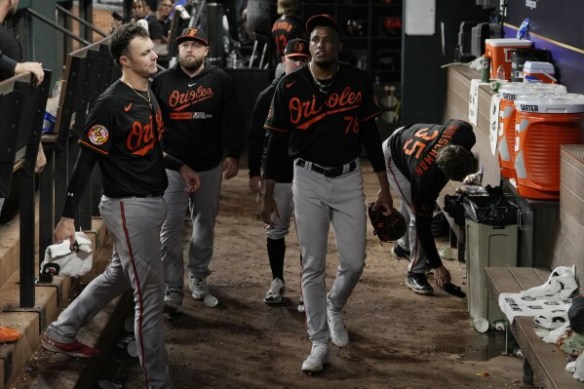
ALDS Game Three: Baltimore Agonistes

Baltimore Orioles

After their surprising and pleasing AL East conquest, the inexperienced, pitching-compromised Orioles found the AL West-winning Rangers too hot to handle.

Maybe it had to be this way, an inexperienced team of Orioles upstarts getting flattened by a better-experienced collection of Rangers in three straight. It might have been the team’s first postseason appearance in seven years, but they brought a collection of men with plenty of postseason time among themselves before becoming Rangers.

Maybe the Orioles were in over their own mostly young, 101 game-winning heads. Maybe the Rangers were too well primed by their Hall of Fame-bound manager who’d skippered three Series winners in five years on the Giants’ bridge.

But as joyous as it was to see the Rangers make too-easy work of the Orioles in this American League division series, it still hurt to see these Orioles swept away like flotsam and jetsam. It was the first time they’d been swept in any series since the May emergence of Adley Rutschman as both their regular catcher and their team leader. The first, and the worst, at once.

No matter how heavily tanking played a role in getting the Orioles to the point of winning the American League East, it hurt. No matter how stupid their administration looked censoring their lead television broadcaster—over a team-generated graphic meant to show a positive portion of their progress—it hurt.

No matter how further stupid that administration looked in doing practically nothing at the trade deadline despite having an upstart group of American League East conquerors on their hands—it hurt.

And, no matter how temporarily stuck Orioles manager Brandon Hyde might have looked  having to start a heavy-hearted pitcher in his fourth major league season but on his first postseason assignment in Game Three—it hurt.

“This is a really good group of guys,” said pitcher Kyle Gibson, a pending free agent, “and I think that adds to the sting of it too, because we knew we had something special. You want to try to capitalize on that whenever you can.”

“There’s no other way to put it,” said outfielder Austin Hays. “They kicked our ass. It sucks. Just couldn’t really get anything going, couldn’t get any momentum on our side to get things going. It hurts. It really hurts.”

The real-world motto of the real-world Texas Rangers: “One riot, one Ranger.” The motto of the American League West winners now could be: “Two postseason sweeps, thirty Rangers.”

The Rangers picked up where they left off Tuesday night against a flock of Orioles lacking veteran presence and, especially, veteran pitching, beating the Orioles, 7-1, in a game that was essentially over after two innings. Manager Bruce Bochy, in the conversation for Manager of the Year as it is, looked even smarter in this AL division series than he looked winning with the Giants in 2010, 2012, and 2014—and he looked like the Yankee version of Casey Stengel then.

Even more so because, until Tuesday night, the AL West-champion Rangers had to to their heaviest labours on the road. “We had our work cut out going on the road against Tampa and Baltimore,” Bochy said after wrapping the division series Tuesday night. “Just shows the toughness with this ballclub and the deal with having to fly to Tampa.”

Now they were home and happy in Globe Life Field, and Rangers shortstop Corey Seager didn’t give Orioles starter Dean Kremer a chance to continue collecting himself after second baseman Marcus Semien fouled out to open the bottom of the first. Seager smashed a 1-1 service 445 feet over the right field fence.

An inning later, it was one-out single (Josh Jung), two-out double (Semien), and an intentional walk to Seager. Kremer and the Orioles weren’t going to give him another chance to mash with first base open if they could help it. They took their chances with Mitch Garver, whose Game Two grand slam broke them almost in half—and Garver thanked them with a two-run double.

Up stepped Adolis García, the Rangers’ right fielder. Kremer had García down 1-2. The next fastball, a little up over the middle of the zone, disappeared over the left center field fence. Just like that, the Orioles were in a 6-1 hole out of which they wouldn’t get to within sight of the earth’s surface if the Rangers could help it.

They could. Their redoubtable starter Nathan Evoaldi, who’s been there and done that in postseasons previous, pinned them for seven innings and seven strikeouts, the only blemish against him an almost excuse-me RBI single by Orioles rookie star Gunnar Henderson in the top of the fifth. As if to drive yet another exclamation point home, Rangers first baseman Nathaniel Lowe greeted Gibson, the third of five Oriole pitchers on the night, with a leadoff homer in the bottom of the sixth.

“You’re not trying to do anything different,” said Seager, whose nine walks are a record for a three-game postseason span, according to MLB analyst Sarah Langs. “You’re just more focused. That’s not the right word, but it’s just more intense. Everything matters. It’s just a different game. It really is. There’s no way around it. So you have to have a different edge, different approach.”

Kremer’s heavy heart was thanks to the atrocity Hamas inflicted upon Israel, to which his parents are native and for which they both served in the Israeli Defense Forces before emigrating to California where their son was born. But he told Hyde when asked—this was discussed often on the game broadcast—that no matter what was in the back of his mind or the front of his heart, he could go for Game Three.

He still has extended family living in Israel. (He’s also said he do as Hall of Famer Sandy Koufax and decline to pitch if an assignment happens to fall on Yom Kippur, the Jewish Day of Atonement.) Anyone who thinks Kremer still didn’t take a heavy heart to the mound with him Tuesday night may be deluding himself or herself.

Perhaps if Hyde had more choices he might have told Kremer to forget the mound for now and focus upon his family. But the Orioles standing pat at the trade deadline, other than adding Cardinals comer-turned-injury-compromised righthander Jack Flaherty, who’d pitched his way out of their rotation to become a bullpen option, came back to haunt them horribly this series.

They were forced to hold veteran ace/post-Tommy John surgery patient John Means out of the division series because of late September elbow soreness—and had no reinforcements. They lost relief ace Felíx Bautista to a torn ulnar colateral ligament that took him to Tommy John surgery on Monday—and rode their bullpen a little too hard compensating for their lack of rotation depth down the stretch and in the division series after the AL East championship bye week off.

So their survival depended upon a young man with a temporarily compromised heart. Kremer went out courageously enough and found the Rangers a little too hot to handle after all. However the Rangers might have empathised with him, that didn’t mean they were going to let him off the hook.

That survival also depended upon an offense that dissipated near season’s end. Even when they awoke well enough in Game Two, turning what began as a 9-2 blowout in the making into an 11-8 squeaker of a loss. “Offensively, we weren’t at our best the last two, three weeks of the season,” Hyde said. “That carried into the postseason where we had guys scuffling. [The Rangers] rolled in with a ton of momentum. I don’t think we rolled in with a ton of momentum offensively.”

The Rangers had to dispatch the Rays in two straight wild card series games before taking the Orioles to school. Eovaldi pitched both series winners.

“I’ve never had a curtain call or anything like that,” said the veteran righthander whose six-inning relief in that eighteen-inning World Series Game Three marathon in 2018 really put him on the baseball map, and who took such a call after his Tuesday night’s work ended. “But our fans were bringing it all night long. When I walked out at 6:30 tonight, they were chanting, the ‘Let’s go Rangers.’ I knew it was going to be a really good night for us.”

He couldn’t have known just how good. For Eovaldi and his Rangers, it’s on to take on whomever wins the Twins-Astros division series in the American League Championship Series.

For these Orioles, it’s on to reflect upon how far they got in the first place despite almost nobody imagining them here when the season began. They have a core that can win again next year. All their administration has to do is refuse to hesitate on opening the trade lines and the checkbooks a little deeper. Knowing this Oriole administration, alas, good luck with that.

NLDS Game Two: Awakening the sleeping Braves

Travis d'Arnaud, Zack Wheeler

Travis d’Arnaud was only too happy to remind people what can happen when a lineup gets a third crack at his old Mets teammate Zack Wheeler . . .

If you expect to keep the Atlanta threshing machine from threshing, you can’t let any of them see Zack Wheeler the third time around. Not even if he’s taking a one-hitter into the seventh. Not even if you’re about to have your next two National League division series games in your own yard. Not even if the lone run out of him to that point scored on a tough fielding mistake.

You just might end up awakening the sleeping Braves.

Which is just what happened Monday night in Atlanta, the Braves overthrowing a 4-1 Phillies lead to win, 5-4. Slamming an exclamation point home with one of the most daring game-ending double plays anyone could hope to see, at any time.

Wheeler lost his no-hit bid and the Phillies’ bid for a second straight shutout in the bottom of the sixth, on Braves shortstop Ozzie Albies’s two-out single, sending Ronald Acuña, Jr. (two-out walk) home after Phillies shortstop Trea Turner misplayed a one-hop throw in from right. Phillies manager Rob Thomson elected to send Wheeler back out for the seventh.

Brain fart. Wheeler lifetime came into Game Two with opposition OPSes that accelerated each time through an opposing lineup: .594 the first time, with 39 home runs; .638 the second time, with 37 home runs; but, .759 with 47 home runs the third time. He was already in his third round with the Braves lineup when he walked Acuña in the sixth.

So with the Phillies leading by three, Wheeler opened with Matt Olson singling up the pipe, Marcel Ozuna striking out swinging, but Travis d’Arnaud—Wheeler’s former Mets teammate in the bargain—hitting the first pitch into the left field seats. As Truist Park went nuts over the first extra-base hit by the Braves all set long, then Thomson lifted Wheeler for Jose Alvarado.

“I wanted him to go back out, and he said he was fine,” Thomson said of Wheeler postgame. “He still looked good, so I was all in.” Three batters in, Wheeler was all out and the Braves were back on the march.

They continued marching with one out in the bottom of the eighth. Alvarado yielded to Jeff Hoffman, who hit Acuña on the left arm with his first pitch before Albies pushed him to second with a ground out. But then Acuña stole third with Austin Riley at the plate, and Riley rewarded Acuña’s larceny with his own drive into those left field seats.

The Phillies hung four on the board in the first five innings against a clearly struggling Braves starter Max Fried and Braves reliever Kirby Yates. Alec Bohm singled Turner (one-out double to the back of center field) home in the first. With Bryce Harper (one-out single) in the third, J.T. Realmuto hit one the other way into the right center-field bullpen.

With one out in the fifth, and Yates on the mound, Nick Castellanos (single) stole second and took third when d’Arnaud’s throw went far enough offline while Bryson Stott waited at the plate. Then Stott lofted a fly to center sending Castellanos home on the sacrifice fly.

d’Arnaud at least got his shot at redemption two innings later. The Phillies might have had a fatter lead for the Braves to overcome but for stranding the bases loaded in the first, stranding Johan Rojas on second (after a one-out walk and an advance on a wild pitch) in the second, and stranding first and second in the fourth and the sixth.

The defending National League champions had one more grand opportunity in the ninth when Harper pried a leadoff walk out of Braves relief ace A.J. Minter, prompting Braves manager Brian Snitker to reach for closer Raisel Iglesias. After Realmuto flied out to center, Castellanos sent one to the rear end of right center. Center fielder Michael Harris II ran it down like a cop chasing a mugger.

“I knew off the bat it was going to be close to the fence,” he said postgame. “I knew once I went back I wasn’t stopping. I was going to do anything I could to get a glove on it. If my body had to go down because of that, I would have done that.” His body didn’t go down despite its rude meeting with the fence, but he caught the drive and winged a throw in that snuck past Albies and meant disaster. For about three seconds.

Riley backed the play alertly, with Harper having rounded second hell bent on getting as close to the plate with the tying run as he could. But Riley fired a strike across the infield to first, making Harper pay for being just a little over-aggressive.

“Usually, you don’t pass the base,” said Thomson postgame. “You stay in front of it, make sure it’s not caught. But he thought the ball was clearly over his head, didn’t think he was going to catch it. And Harris made a heck of a play. Unbelievable.” Heck of a play? The Elias Sports Bureau says it’s the first time a postseason game ever ended on a double play involving any outfielder.

You hate to say a series tied at one game each has become treacherous. But Philadelphia’s Citizens Bank Park is a haven for hitting, and re-awakening the Braves’ threshing machine, after they spent the series’ first fourteen innings scoreless, is not a sound idea. Especially when they hit a record 307 homers on the regular season—including 24 against the Phillies exactly half of which were put in the Bank.

Thomson said the split in Atlanta was disappointing but, what the hey, now the Phillies have the home field advantage. The Braves didn’t put their best 2023 road show on in the Bank. (That honour belonged to Cincinnati’s hitting haven of Great American Ballpark.) But they’re not exactly pushovers in Philadelphia, either.

ALDS Game Two: From blowout to squeaker

Mitch Garver

Mitch Garver’s third-inning grand slam proved the difference maker as the Orioles turned an  early blowout into a squeaker of a win for the Rangers Sunday.

Until this weekend, the last time the Orioles were swept in a series was in May, by the Blue Jays. During the regular season, the Orioles were a .642 team on the road. Now, they’re on the threshold of an American League division series sweep, but they’re counting on that traveling mojo to overthrow a Rangers team that won’t be overthrown without a fight.

Not after the Orioles turned a 9-2 blowout in the making into an 11-8 squeaker in Game Two Sunday. Not after the Orioles couldn’t do better than Aaron Hicks’s three-run homer with one out in the bottom of the ninth. Not after the Rangers battered them for nine runs in the first three innings, including and especially Mitch Garver’s grand slam in the third.

Not after the Oriole bullpen was so deeply deployed following a Game One loss that saw theirs ranks pressed into duty after four and two thirds. Today’s travel day from Baltimore to Arlington may not necessarily give them relief. Not facing a Rangers team that hasn’t played at home in a fortnight but hit 53 home runs more at home than on the road during the season.

“We just came up a little bit short today, but that built a lot of momentum going into the next game,” said Orioles leftfielder Austin Hays after Game Two. “Nobody laid down. We didn’t give away any at-bats. We continued to fight. We were able to get into their bullpen and work on those guys a little bit. I feel good moving forward, but we know we’ve got our work cut out for us.”

That’s a polite way to put it. They played .500 ball against the Rangers in six regular season games, but they blew their home field advantage to open this division series. A team that hasn’t seen home in a fortnight can be presumed hungry to put an end to this set as soon as possible, by any means necessary.

The Rangers proved that when they started Garver, a backup catcher who played in only half the regular season games, and sent him out for his first postseason appearance this time around. In a game the Orioles opened with a 2-0 lead after one full inning, but the Rangers slapped rookie Orioles starting pitcher Grayson Rodriguez silly with a five-run second, Garver checked in at the plate with one out followed by three straight walks.

Orioles reliever Bryan Baker left the pillows loaded for his relief, Jacob Webb. On 3-1 Webb elevated a fastball, and Garver elevated it six rows into the left field seats.

Rangers manager Bruce Bochy—who came out of retirement to shepherd the Rangers after all those years and those three World Series rings managing the Giants—said pregame that it was “just time to get [Garver] out there.” Garver may have given the boss the most expensive thank-you present of the postseason thus far.

“He’s got big power,” Bochy said postgame, “and that’s big at that point in the game. Really was the difference in the game.”

So were the eleven walks handed out by eight Orioles pitchers, including a postseason record five to Rangers shortstop Corey Seager. So were the mere three hits in thirteen Oriole plate appearances with runners in scoring position, which explains a lot about how the Orioles actually out-hit the Rangers (fourteen hits to eleven; .973 to .891 game OPS) but fell three short in the end.

Also in too-vivid contrast were the fruits of each team’s trade deadline moves. Or, in the Orioles’ case, lack thereof. The Rangers moved to bring future Hall of Famer Max Scherzer into the fold but also added starter Jordan Montgomery and reliever Chris Stratton in a deal with the Cardinals.

The Orioles moved to bring another Cardinal pitcher, Jack Flaherty, aboard at the deadline. But Flaherty, once a glittering Cardinal comer, hasn’t been the same pitcher since a 2021 oblique injury and a 2022 shoulder injury. He pitched his way out of the Oriole rotation and now looks to be the long man out of the bullpen.

He got a shot at showing what he could do in that role when it looked as though it would be just mop-up work Sunday. The good news: He surrendered only one run (on Garver’s double play grounder in the fifth) in two innings’ work. The bad news: He contributed to the Oriole walking parade with three of his own, including two in the fifth.

Some say the Orioles standing practically pat at the trade deadline instead of going for any kind of impact deal may yet come back to bite them right out of the postseason, especially after their own pitching depletion (losing top starter John Means and closer Félix Bautista especially) late in the season. Others fear the Orioles were more concerned with their usual penny pinching plus censoring a lead broadcaster over a positive graphic the team itself fashioned for a broadcast.

Montgomery handled the Orioles well following the two-run first, at least until he surrendered a pair in the fourth on an RBI single (Jorge Mateo) and a sacrifice fly (Ryan Mountcastle.) But when Orioles rookie star Gunnar Henderson greeted him with a full-count leadoff home run and Hicks followed with a base hit, Montgomery’s day ended and the ordinarily wobbly Ranger bullpen took over.

That bullpen kept the Orioles quiet until the bottom of the ninth, when Brock Burke handed Henderson a one-out walk and Hays singled him to second. Bochy reached then for José Leclerc, and Hicks—the erstwhile Yankee who never really found his best footing in the Bronx—reached for a one-strike service and drove it into the right field seats.

It was a little vindication for Hicks the day after he blew a hit-and-run sign in the Game One ninth, leaving Henderson a dead duck on the pond when he was thrown out at second, before Leclerc finished the 3-2 Rangers win. After his up-and-down Yankee life, Hicks looked like an Oriole blessing after he signed in May following his Yankee release. After Sunday, he looked like an Oriole hope once again.

An Oriole hope is just what Baltimore needs now. But Ranger hopes won’t exactly play to an empty house come Tuesday. At the end of the former, survival. At the end of the latter, a chance to play for the pennant.

NLDS Games One: The Atlanta Chop Slop, the Los Angeles funeral parlour

Truist Park

Trash talk? Have at it. Trash the field over a call going against you? What was this, Braves fan?

Neither the Dodgers nor the Phillies expected simple National League division series this time around. Not with both teams coming in with what some call patchwork pitching. But one came out looking better in their Game One while the other came out looking like the remnant of a nuclear attack.

The Phillies and their pitching managed to keep the Atlanta threshing machine from threshing Saturday afternoon, winning 3-0. Starting with a first-inning nuking of future Hall of Famer Clayton Kershaw, the Diamondbacks laid waste to the Dodgers Saturday night, 11-2. On the arms of big enough bats and a starting pitcher who was usually close enough to Dodger batting practise.

Letting starter Ranger Suárez go no more than three and two thirds, knowing they’d have a day off between Games One and Two, the Phillies went to a bullpen game, essentially. And that bullpen finished what Suárez started, shutting the Braves out over the remaining five and a third. The Braves who hit a record 307 home runs on the regular season looked as though they had paper towel tubes for bats.

None more glaring than the founding father of the 40/70 club. Ronald Acuña, Jr. went 0-for-3 with a walk, and his evening’s futility included an embarrassing called strikeout in the fifth, when—with first and third and one out—the second Phillies reliever of the evening, Seranthony Domínguez, planted a fastball right on the low inside corner.

Small wonder that Braves manager Brian Snitker could and did say, postgame, “I think it was more their pitching than our hitting.” Indeed.

Braves starter Spencer Strider pitched boldly enough, striking eight out and scattering five hits in seven innings’ work. But the Phillies still pried two runs out of him, both with Bryce Harper the big factor. First, Strider threw wild enough trying to pick Harper off first in the top of the fourth, enabling Bryson Stott to single him home with the first run. Then, Strider threw Harper enough of a meatball to disappear into the Chop House seats behind right field with one out in the top of the sixth.

“Strider, man, he’s one of the best in the game. You know he’s going to come at you and throw his best at you,” Harper said postgame. “So just trying to get a pitch over and was able to get the slider up and do some damage.”

Except for Acuña’s surprising silence, and the eighth-inning catcher’s interference call with J.T. Realmuto at the plate and the Phillies with the bases loaded, enabling the third Phillie run home, the Braves at least looked stronger in Game One defeat than the Dodgers did. Even Strider, who became the first postseason pitcher ever to lose twice against a team against whom he’s well undefeated in the regular season.

The Diamondbacks didn’t let Clayton Kershaw—all 35 years old of him, with possible lingering shoulder issues plus eight days of rest leaving him with little enough to offer—get out of the first alive. Their 35-year-old journeyman starter Merrill Kelly, who didn’t turn up in the Show until age 30 in the first place, manhandled them for six and a third after the Snakes bit Kershaw deep in the first.

For the regular season’s final two months, with a 2.23 ERA over eight starts, Kershaw seemed to tell age and his shoulder alike where to stuff it. Then Kershaw took the ball Saturday night. What’s the saying about too much rest being as hazardous to a pitcher as too little rest can be?

Ketel Marte opened with a double to the back of left center field, and Corbin Carroll began showing why he’s in the Rookie of the Year conversation with a prompte RBI single. Tommy Pham—the same Tommy Pham who called out the lack of work ethic among second-tier Mets teammates with whom he played before the trade deadline—rapped a short single to left for first and second.

Then Christian Walker, a veteran first baseman who hadn’t been anything much special before 2022, hit one so far to the back of the left field bleachers some wondered how the ball didn’t leave the ballpark structure. Just like that, Dodger Stadium resembled a funeral parlour. And, just like that, Kershaw resembled the corpse for whom the audience came to mourn.

A ground out by Lourdes Gurriel, Jr. and a walk to Alek Thomas later, Evan Longoria sent Thomas all the way home with a double to deep center field, hammering the final nails into Kershaw’s coffin.

“Embarrassing,” the lefthander said postgame. “You just feel like you let everybody down. The guys, a whole organization, that looked to you to pitch well in Game One. It’s just embarrassing, really. So I just feel like I let everybody down. It’s a tough way to start the postseason. Obviously, we still have a chance at this thing, but that wasn’t the way it should’ve started for me.”

Kershaw’s postseason history is a direct contrast to the regular-season career that guarantees him a place in Cooperstown. Until Saturday night, enough of that sad history came by way of leaving him in too long or by circumstances above and beyond his control.

Entering Game One with a 5.49 ERA against the Dodgers lifetime but a 7.03 ERA against them when pitching in Dodger Stadium, Kelly pitched six and a third shutout innings before turning it over to a bullpen that kept the Dodgers to one hit. The bad news: the hit was a two-run triple by Will Smith off Miguel Castro. The good news: The Snakes could afford such generosity by then, since it cut an 11-0 lead by a measly two runs.

Kelly’s keys included forgetting how the Dodgers treated him like a piñata in regular season play. “I’m watching our guys beat up on one of the best pitchers that we’ve ever seen in our lives and watching them do it in the first game I’ve ever pitched in the playoffs,” he said postgame. “I felt if I gave those games any attention I was going out there behind the eight-ball before I even stepped on the mound.”

This time, Kelly went out there with a six-run cushion, then saw it padded to nine by a three-run second including Carroll leading off against Dodger reliever Emmet Sheehan with a drive into the right field bleachers. Kelly was now comfortable enough that he could have pitched from a high-backed leather office chair and incurred no damage.

The only thing that should have and apparently did embarrass the Braves was the Truist Park crowd throwing drinks onto the field after catcher Sean Murphy’s mitt grazed Realmuto’s bat by a thin hair. You could hear it on replays that didn’t exactly show it too clearly, but Murphy’s lack of challenging the call affirmed it.

Trea Turner—who started a spectacular double play with Acuña (leadoff walk) on third to end the bottom of the eighth, diving left for Ozzie Albies’s ground smash and backhanding to second baseman Stott—scored on the interference. The rain of drinks into the outfield annoyed both the Braves and their manager.

“There’s no excuse for that,” Snitker snapped postgame. “It’s scary because those water bottles, when they come, they’re like grenades. It could really seriously injure one of our players.”

That’s what the miscreants don’t stop to think about. Against a team whose fan base is usually considered one of the worst in the game. (Remember the Philadelphia wedding: the clergyman pronounces the happy couple husband and wife before telling the gathering, “You may now boo the bride.”) Be better, Braves fans.

Only the silence in Dodger Stadium following the Diamondbacks’ early and often abuse of Kershaw and Sheehan kept the big National League division series headlines elsewhere from reading, “Chop Slop.”

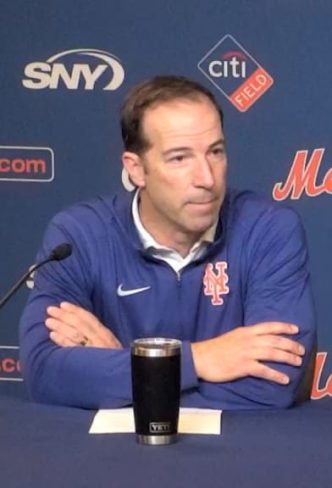
Billy Eppler and the invisible injured list

Billy Eppler

Billy Eppler leaves the Mets to hunt a new GM, while MLB investigates his use/misuse/abuse of the so-called phantom injured list.

Something is further amiss in the milieu of the Mets than just the sunken season that compelled manager Buck Showalter’s scapegoating. It may not be limited to the Mets alone, but with general manager Billy Eppler resigning—possibly before he, too, might have been shown the door—it’s the Mets drawing the headlines on it.

First, it came forth that Eppler all but strong-armed Showalter into continuing to write Daniel Vogelbach’s name into the lineup, against just about every piece of evidence saying Vogelbach didn’t truly belong there. Then, it came forth that Eppler was under baseball government investigation over what’s known as the phantom injured list.

Even with the medical advances of this century, it’s bad enough that (you guessed it) baseball medicine could still be tried by jury for malpractise. The phantom injured list—basically, placing underperforming players on it to keep them out of the lineup, while still paying them and granting their major league service time, though possibly denying them certain incentive-based chances—could be called another kind of malpractise.

That would be the kind that calls honest competition into further question that such things as tanking have it already. The kind that compels some baseball people—former Phillies manager Joe Girardi, notoriously enough—to admit they’re not always forthcoming about real injuries the better to keep valuable intelligence out of opposition sights. Never mind that teams can usually tell when the other guys have a likely wounded warrior.

The Mets had 28 real IL placements in 2023. This didn’t even make the Mets the Show’s worst such infirmary roll: the Giants, who dumped manager Gabe Kapler for being unable to maneuver a dubious roster built by president of baseball operations Farhan Zaidi, had 46 IL members. Right ahead of the Reds’ 45 and the Angels’ 42.

By contrast, the healthiest reported 2023 teams were the postseason-reaching Astros (14), the postseason-missing Guardians (17), the postseason-missing Mariners (18), and the postseason-reaching Diamondbacks (also 18).

Teams are supposed to provide medical documentation and approval when they place players on the injured list. The New York Post broke the news that, when MLB investigators informed the Mets that Eppler was being probed over the phantom IL, Eppler elected to resign rather than “potentially become a distraction” as new PBO David Stearns settles into his new job.

“Stashing healthy players on the IL can aid a team competitively,” the Post said, in an article under the joint bylines of Mike Puma, Joel Sherman, Jon Heyman, and Mark W. Sanchez. “Designating healthy players as injured can enable clubs to keep those players under team control rather than risk losing them to other organizations.”

A day before that story broke, Puma reported that Showalter and Eppler clashed over Vogelbach. Showalter likes to use the DH slot as breathers for his position players but also didn’t like Vogelbach’s skill set limits. None of which seemed to matter to Eppler, who continued insisting that the lefthand-swinging Vogelbach remain the DH against righthanded pitching.

It’s one thing to allow a less than perfect physical specimen a place in the lineup at all, but it’s something else to let him stay there if he can’t deliver. Physically, Vogelbach can be described politely as making Babe Ruth resemble Mike Schmidt. His most apparent skill set, his on-base ability, shown well after the Mets acquired him from the Pirates before 2022’s trade deadline, disappeared drastically enough amidst the 2023 Mets’ dissipation.

But Vogelbach lacked power and didn’t hit consistently enough with or without power to convince Showalter he belonged in the Mets’ lineup, no matter how gifted he is at working out walks. His bulk also made him less than mobile enough that playing him at first base or elsewhere could have been considered giving aid and comfort to the opposing lineup.

Fair disclosure: At 6’4″, I once packed 325 pounds. I’ve since lost in the neighbourhood of fifty pounds, striking to return my weight to 225. I empathise with Vogelbach in that regard. But I haven’t played baseball since age 15, when I discovered the hard way I wasn’t any kind of good at it anymore.* And I’m not the guy a GM forced a manager to put in the lineup.

At points in the season’s first half, where the Mets’ more formidable plate presences struggled, Vogelbach’s presence in the lineup looked even more suspicious. There were thoughts public and private that the Mets might move Vogelbach at the 2023 trade deadline, but Puma says when the move didn’t happen Showalter began “questioning openly” why Vogelbach was still a Met.

“Not only was Vogelbach still on the team,” Puma wrote, “but (a) source indicated the manager was told by Eppler to keep him in the starting lineup.” For what purpose? For Eppler to save face over dealing for Vogelbach in the first place?

Marry that to MLB investigating Eppler’s use, misuse, or abuse of the phantom IL, and maybe, just maybe, you have a prospective case of Eppler resigning before Stearns—who’d first said he looked forward to working with him—might be forced to throw him out on his none-too-ample derriere.

Just what the Mets didn’t need now. They hired Eppler in the first place after interim GM Zack Scott was charged with DUI. Scott replaced Jared Porter, after Porter was exposed as having sent sexually explicit text messages to a female reporter. The Mets have to be hoping Eppler’s eventual successor comes at minimum and remains scandal free.

That may prove child’s play compared to the issue that finally compelled Eppler to show himself the door out. It will not do, either, for anyone to confine their curiosity about phantom IL use and abuse to trying to determine who blew the whistle on Eppler. Maybe it’s time to look at all teams and the phantom IL, not the Mets alone.

Maybe it’s long past time that baseball’s entire medical culture was given a full and proper investigation. For the sake of player health, and for the sake of honest competition. And in that order.

—————————————————————————————————-

* At 15, I discovered I couldn’t hit fair unless the foul line ran perpendicular to the back point of home plate. I’ve had long enough legs but you need more than that to run. Even if I could hit one fair, it would have taken me longer than Bartolo Colon to run the bases if I hit one out. Without hitting one out, I could have been the guy who’d get thrown out at first from the bullpen.