
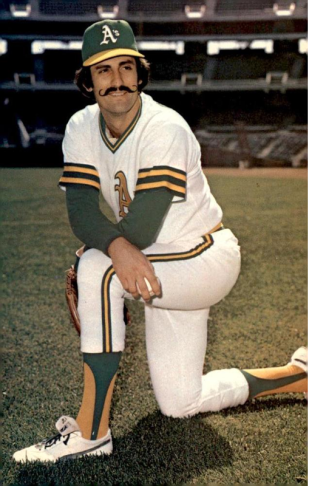
“It was an ignorant, bone-headed, destructive policy which had no foundation in anything except that Kuhn . . . saw that he could drive Finley out of the game by denying him the right to sell his players.”—So said Bill James about Bowie Kuhn’s barring of player sales when blocking that of Hall of Famer Rollie Fingers (shown) and two A’s teammates in 1976, a ban that helped speed, not solve salary inflation in the free agency era.
Every time Rob Manfred refers to “our fans” when insisting baseball’s next collective bargaining agreement shall be salary cap and floor or bust, he’s referring to no known poll or survey taken. Reliable or otherwise.
For the moment, never mind that Manfred and his employers beating the cap-and-floor drum to death lack the depth perception to consider Ken Rosenthal of The Athletic was and remains right when he spoke of “the dirty little secret” in the cap-and-floor rhythm.
Too many teams are risk averse, regardless of their actual or alleged resources. Rosenthal knows it. He also knows that’s why the cap-and-floor system, aside from the obvious, isn’t the panacea Commissioner Pepperwinkle, his bosses, and those fans who do support them believe: “it would not guarantee small-market teams success. Many would need to develop more of a killer instinct.“
Many would also have to admit they’re not exactly playing in truly small markets. The two smallest major league baseball markets have slightly less than a million television households each. One of them roots for the team that just won the World Series. The other roots for the team whose ownership tells them they have no choice but to root for mediocrity.
(Do you realise Tampa-St. Petersburg as a market is right between such ghost towns as Boston and Phoenix? That the Rangers play in a market that’s almost equal to that whistle stop hamlet known as Chicago? That Pittsburgh as a market is equal to San Diego, that one sea horse town whose Padres don’t mind spending enough to make drunken sailors resemble Ebenezer Teetotaler?)
Neither Manfred nor enough of his depth-challenged bosses seem to have thought about undoing a piece of mischief that actually might provide relief enough for the “smaller market” teams to remain financially competitive. Enough to allow them to remain or return to field competitiveness without tanking or other mischief. Enough to provoke them to put up or shut up.
Baseball hasn’t allowed straightforward, team-to-team player sales since 1976. That supermarket was closed down because another short-sighted commissioner saw a chance to force a particularly pestiferous owner out of baseball without thinking of the longer term and the bigger picture.
Charlie Finley quaked as much as his fellow owners about the coming of full free agency in after the December 1975 Messersmith decision. Unlike most of his fellow owners, Finley liked to shoot from the lip and ask questions later. Unlike most of his fellow owners, further, Finley saw things they were too full of themselves to see.
When Andy Messersmith pitched his way into the advent of free agency, Finley had a remedy: “Make them all free agents. Every one of them. Every year.” To his fellow owners, as Rob Neyer put it in The Big Book of Baseball Blunders, “the proposal was just another madcap scheme from a rogue owner who didn’t believe in pushing the envelope when you could rip it to shreds.”
That idea died a death because, as Major League Baseball Players Association director Marvin Miller observed, the owners “just couldn’t envision an environment in which they no longer controlled the players. It wasn’t just about the money . . . what we eventually negotiated, the . . . service time, left them with some control and that was what mattered to them.” Their blindness relieved Miller’s greatest fear, an oversaturated market.
But Finley still had to deal with his Athletics stars who planned to play 1976 out without signing contracts lacking no-trade clauses. That’s what provoked Messersmith to pitch 1975 without signing in the first place. With Finley’s idea to make players free agents every year dead, the cantankerous A’s owner had a remedy for his unsigned, too.
First, he traded Hall of Famer Reggie Jackson plus front-line starting pitcher Ken Holtzman to the Orioles for Don Baylor, Mike Torrez, and Paul Mitchell. Then, he opened his own version of Toys ‘R’ Us. Sale of the century! Christmas in June! Get your very own Vida Blue, Rollie Fingers, and Joe Rudi! went Finley’s sales pitch on his star starting pitcher, his Hall of Fame relief pitcher, and his star center fielder.
Commissioner Bowie Kuhn had about as much taste for Finley as Donald Trump has for taste. After the Red Sox ($1 million apiece for Fingers and Rudi) and the Yankees ($1.5 million for Blue) walked away from the checkout counter with their new playthings, Kuhn stopped them in the parking lot. Not so fast, boys and girls. Sales voided. Detrimental to baseball.
It might have been the most short-sighted decision in baseball economics since the Earl Averill case.*
When Averill asked how much of the $50,000 the Indians paid the San Francisco Seals of the old, tough Pacific Coast League he could expect to receive. When everyone laughed their fool heads off except, of all people, Commissioner Kenesaw Mountain Landis.
This may shock those who remember him as baseball’s village tyrant, but Landis actually thought Averill was anything but out of line. According to Bill James (in The New Bill James Historical Baseball Abstract), Landis suggested baseball draw up a rule granting a player a cut of the proceeds if he was sold outright rather than traded.
Shame it was just a suggestion, not a proclamation. The Indians did sweeten Averill’s pot, with a $5,000 bonus and a higher salary than the standard major league rookie nut. James reviewed the Averill case, the Finley fire sale voiding, and the subsequent ban on straight-up player sales. Then he saw and raised Finley’s denunciation of Kuhn as his honor, the village idiot.**
James didn’t go quite that far in attacking Kuhn’s short-sightedness. But he called the sales ban “an ignorant, bone-headed, destructive policy which had no foundation in anything except that Kuhn hated Charlie Finley, and saw that he could drive Finley out of the game by denying him the right to sell his players.” ***
So what should Kuhn have done? James had the answer: Enact the Landis suggestion:
[P]layers could be sold for whatever they would bring, but thirty percent of the money had to go to the players. Had he done that, the effect would have been to allow the rich teams to acquire more of the best players, as they do now. But this policy would have allowed the rich teams to strengthen themselves without inflating the salary structure, and would have allowed the weaker teams . . . to remain financially competitive by profiting from developing young players. [Emphasis in the original.]
If the Indians in Landis’s time had done that, Earl Averill would have put $15,000 in his pocket before he played one game in a Cleveland uniform. If Kuhn had imposed the Landis idea, $300,000 each would have gone into Joe Rudi’s and Rollie Fingers’s pockets, $450,000 would have gone into Vida Blue’s pocket.
Rudi, Fingers, and Blue would have banked more dollars each than their 1976 salaries paid. Finley would have squealed only long enough to put the remaining $2.25 million in the bank.
Suppose Manfred removes his blinders, looks deep and wide, and decides that his predecessor five times removed screwed the proverbial pooch deeper and wider than, say, the manager who leaves his best relief pitcher untouched while all around him is on the threshold of demolition becaue it isn’t a quote save situation unquote.
In other words, suppose Commissioner Pepperwinkle takes up the Landis policy just as unilaterally as Kuhn banned team-to-team player sales. Get with the MLBPA, too. Tell them the salary cap is off the table for now but a different kind of floor is on it. A sales floor.
If a team has players they might ponder selling, send those players out onto that floor. Sell them for whatever they’ll bring. But each player sold must be given thirty percent of their price. The buyers prowling the aisles will still bank bigger bucks. Let the sellers put their money where their whining is. Let the buyers call the sellers’s bluffs.
Let’s see how fast teams like the Reds don’t spurn such riches as the Elly De La Cruzes would bring even after they take their thirty percent cuts. Let’s see how fast the De La Cruzes don’t complain over putting an extra million or two into their own cookie jars. Let’s see how fast the Phil Castellinis walk back that you-have-no-choice harrumph.
(Let’s also see if we can fathom what the Tigers would have done last August by selling Tarik Skubal for, say, twice his remaining 2026 salary. Let’s see if Skubal would have minded pocketing $5.4 million and the Tigers, $13.4 million. The Tigers could find plenty of sound places to invest that money, assuming their owners really want to invest in the team. Skubal could still look forward to his big payday—which has turned out to be nine years and $450 million from the Mets.)
This could turn the Hot Stove (and the annual trade deadline, which would now become an annual trade-and-sale deadline) into a pizza oven. With extra cheese, pepperoni, and mushrooms. Far more pleasurable than the liver and onions with lima beans sides Manfred and his masters wish to serve now.
* The chart of Mr. Kuhn’s concern may be plotted with some precision, since he had offered no let or hindrance to a just previous deal involving the sale of Minnesota pitcher Bert Blyleven to the Texas Rangers for three hundred thousand dollars.
—Roger Angell, in “Cast a Cold Eye,” The New Yorker, 22 November 1976; republished in Five Seasons: A Baseball Companion. (New York: Simon & Schuster, 1977; Lincoln, Nebraska: Bison Books, 2004.)
** Finley sued Kuhn for $10 million over the voided Vida Blue, Rollie Fingers, and Joe Rudi sales. He lost in court almost a fortnight later.
Finley’s true goal, of course, was to pocket the cash [from the Blue/Fingers/Rudi sales] and, in the face of an untenable financial landscape, dump the depleted A’s. “He knew the price of the team would be the same with or without those players . . . ” said Paul Finley, looking back. “So why not unload them, pick up the $3.5 million, and sell the team for the same amount of money?”
—Jason Turbow, in “Housecleaning,” from Dynastic, Bombastic, Fantastic: Reggie, Rollie, Catfish, and Charlie Finley’s Swingin’ A’s. (New York: Houghton Mifflin Harcourt, 2017.)
*** Finley tried to rebuild the A’s starting in 1977—the team found, among others, Hall of Fame left fielder Rickey Henderson plus pitcher Mike Norris. But he sold the A’s in due course, in 1980, to fund his divorce settlement, after his wife refused an interest in the team as part of the settlement.

