The long, slow Mets deflation

Juan Soto

Juan Soto—Not his fault.

A choke? Not exactly. More like the Mets stuck a pin in their $340 million blimp, somehow,  and it deflated slowly enough, agonisingly enough. The team that started the season as the best and most expensive in Show finished . . .

No, they didn’t go from the top of the mountain all the way to the rocks at the bottom. They did finish second in the National League East. On the surface, that doesn’t look anywhere near resembling terrible. Know how many teams would jump from the top of the Flatiron Building if it meant finishing second for a change?

Why, over yonder in the American League Central, the Tigers could have been called going down harder. On 12 June they had an eight-game division lead over the next in line. At one point, the Guardians were 15.5 games out of first place in the group.

Then the Tigers deflated painfully themselves to settle for a wild card while the Guards dug, clawed, gnawed, and shoved their way back to take a division that once looked like the Tigers’ exclusive possession. But since the Tigers get to meet the Guards in a wild card set, the magnifying glass is over the Mets.

And how.

How on earth did a team finish play on 12 June and sit 21 games over .500, with a Show-best 45-24 record, and five games ahead of the eventual NL East champion Phillies, but go from there to play .408 ball the rest of the way?

How did that come to include a 10-15 September that featured an eight-game losing streak and a season-ending weekend in which they looked as though they’d signed surrender papers instead of commitments to fight for their very baseball lives?

Juan Soto regrouped after early inconsistency to get within two thefts of posting a 40-40 season and finish the year leading the National League in on-base percentage. Francisco Lindor posted a second 30-30 season in three years. Pete Alonso Alonsoed (38 home runs and leading the league in doubles with 41). But . . .

“A few players thought [manager Carlos] Mendoza’s communication was not as sharp as it could be,” said The Athletic‘s Tim Britton and Will Sammon.

Others suggested that he showed some unnecessary panic early in the season when he kept shuffling roles for different players. That will be part of the conversation this winter.

“I really think he’s done everything in his power,” another club source said. “In this market, you want that type of leader: somebody who is steady and going to be honest.”

That doesn’t mean Mendoza’s coaching staff is safe. The Mets’ defense was a season-long issue. While the offense put up good overall numbers, it operated far too often in boom-and-bust cycles. The pitching staff never put it together in the second half, with many of its purportedly reliable arms underperforming.

Let’s not wait ’till next year. They’ll have all winter to solve the coaching staff, the booming-and-busting, the pitching inconsistencies, and the defense that would guarantee a war over five minutes after it begins—with the Mets on the wrong side. How should we begin to outline the manner in which this year’s blimp deflated?

* When Kodai Senga, one of the best pitchers in the game for the season’s first month and a half, exited his 12 June start with a hamstring injury incurred covering first base, was brought back just before the All-Star break instead of getting that one extra minor league rehab start, and looked nothing like that early-season ace from there, ending up in Triple-A to get himself straightened out?

* When the Rays swept them in early June, which didn’t look that ominous—the Mets were 4.5 in front of the National League East and owned that 45-25 record going in—until you saw the bullpen’s meltdown over the set, and began to get the awful feeling that it wouldn’t be the last time the pen would prove the cobras’ own mongooses? (C’mon, Mr. Webster, make it official and let us use mongeese as the plural!)

* When they rumbled into Pittburgh, where the sunken Pirates were two months past forcing manager Derek Shelton to walk the plank, and got themselves swept by the Pirates in three straight, outscored 30-4 in the set, letting the Pirates drop at least nine runs per game against them during—without Pirates ace/should-be National League Cy Young Award winner Paul Skenes facing them even for a third of an inning?

* When they lost two out of three to the Reds coming out of the All-Star Break, with the 2-1 lead they gifted back-in-the-rotation Sean Manaea squandered by one reliever whose Show debut was just a month earlier but wouldn’t turn up in a Met uniform again? When the Mets won the third game but those first two losses all but handed the Reds the wild-card tiebreaker?

* When relief ace Edwin Díaz’s otherwise stellar season (the finish: 1.63 ERA; 228 FIP; 0.88 WHIP) was rudely interrupted when the Brewers’ Isaac Collins blasted a game-ending home run 10 August, sending the Mets back to New York with their second of a pair of seven-game losing streaks?

* When the Mets turned to Nolan McLean in Philadelphia for his fifth career start, the young man responded with a one-run/5.2 inning performance that would have been enough for the Mets to win . . . if only they could have found a way to score even once? Leading to a Philadelphia sweep and any lingering hope of the Mets reclaiming the NL East they once owned in the trash compactor?

* When the Mets finally gave Jacob deGrom substantial run support in Citi Field—forgetting that deGrom now pitches for the other guys, the Rangers in this case, who’d drop another loss on them the following day for a season-longest eight-game losing streak?

* When the dead-last Nationals beat them 3-2 in the final Mets home game of the year, abetted by a pair of acrobatic fielding plays (robbing Brett Baty of extra bases; swiping a home run from Francisco Alvarez that would have tied the game) by Nats center fielder Jacob Wilson?

* When the Marlins channeled their 2006/2007 ancestors and told the Mets, “Not so fast, boys,” with the Mets needing to scale the Fish on Saturday, the Reds already losing to the Brewers, to nail the third wild card?

* When the non-Díaz bullpen surrendered four in the fourth, forcing manager Mendoza to bring Díaz in early to bind up the wounds?

* When the Mets ended up stranding ten runners, Pete Alonso hit a bases-loaded cruise missle stopped cold by Miami left fielder Javier Sanoja, and the Mets finished 2025 0-70 for the year whenever the other guys led after eight innings? (The number of Mets ninth-inning comebacks this year: zero. The number in 2024, when they got to the League Championship Series: eight.)

“There’s no other way to sugarcoat it,” said Alonso, who didn’t wait too long to let it be known he intended to opt out of his two-year deal and test his market, while leaving a door open wide enough for a reasonable-length deal with the Mets. “Super-talented team and we didn’t even get to October.”

In a sane major league game in which the leagues were aligned and divided reasonably, in which no such thing as regular-season interleague play existed, in which no team earned the right to postseason play unless its fannies were parked in first place at season’s end, the Mets wouldn’t be half the topic they are now.

In a sane baseball world, we wouldn’t have just gone through another wild race of thrills, chills, and spills, on behalf of seeing who’s fighting to the last breath (or rolling over dead trying) to finish . . . in second place.

“Sane” and “Mets” rarely fit comfortably in the same sentence. But this was one of those Met seasons about which you could say it’s liable to get them thrown out of the nut hut.

Seattle’s Sixty Special

Cal Raleigh

The baseball that’s just left Angel Civilli’s right hand is destined to land in the right field seats for Cal Raleigh’s unprecedented (for a catcher) 60th bomb of the year . . .

He still has the worst nickname in baseball, so far as I’m concerned. But if that’s the only terrible thing about Mariners catcher Cal Raleigh, I can live with it.

Sort of. A guy who goes where no catcher has gone before deserves better than the Big Dumper. Sorry.

With one swing in the bottom of the eighth Wednesday, in an interleague game against the National League West’s Colorado bottom-crawlers, Raleigh did more than just stamp the Mariners’s first American League West crown since 2001.

You thought it was freaky enough that Raleigh hit a 50th regular-season bomb? (Against the Padres, 25 August.) You thought it was surreal that a catcher met and passed Hall of Famer Mickey Mantle as the most home run-prolific switch hitter ever in a single season? Now he’s the only catcher ever to hit 60 or more homers in a season.

So far as the American League is concerned, when Raleigh swung on Angel Civilli’s first two-out service and sent it on a Roger Maris-like high liner into the right field seats, he also yanked away whatever exclusivity the Yankees might have claimed on 60+ home run season bombardiers.

Relax, American League teams not based in the south Bronx. You are now free to unearth your own prospective 60-homer season hitters without the slightest chance of any Yankee or Yankee fan presenting you with a cease-and-desist order attached to ownership papers. Isn’t it just delicious to feel as though someone a transcontinental distance away poached a Yankee claim?

The Mariners didn’t even exist in Maris’s and Babe Ruth’s times. When Aaron Judge passed Maris as the AL’s all-time single-season bombardier, in 2022, the Mariners were a) 36 years old as a major league franchise, and b) second-place AL West finishers behind the eventual World Series-winning Astros. Add first expansion franchise player in Show history to hit 60 or more bombs in a season.

How far past Judge could Raleigh go? Number 60 was the second homer of the evening Wednesday; Raleigh started the Mariners en route their 9-2 romp with a one-out first inning blast on Rockies starter Tanner Gordon’s dollar. That was the first of three solo bombs the Mariners detonated in the inning; Julio Rodríguez followed Raleigh with a shot, then Jorge Polanco launched one an out later.

The Mariners have one more to play against the Rocks today. They get to finish the regular season against the ogres of the National League West this weekend. The idea of this set proving a potential prelude to the World Series may not be terribly unrealistic, even if the Dodgers are extremely old hands at postseason play. (This will be their thirteenth straight postseason trip, on their twelfth NL West title in thirteen years.)

And the guy who’s had a huge hand in getting the Mariners there, whether helping his pitchers hold down a respectable 3.97 ERA when they throw to him or making longtimers forget other catchers for a few moments (Yogi whom? Johnny what? Ivan where? Mike how?), doesn’t think he’s doing anything all that remarkable.

“I mean, I just try to be the best I can be,” Raleigh tells reporters one moment. “Catchers usually are pretty tired at this point in the year, but you could say the same thing for everybody,” he says the next.

Horseshit, say his peers and elders who know that playing 120 major league baseball games behind the plate, as Raleigh’s done this season so far, isn’t exactly the healthiest or the least taxing job on the field.

“It’s pretty incredible what he’s done,” Rangers manager Bruce Bochy, himself a former major league catcher, tells The Athletic. “He’s a workhorse. It’s kind of an old-school thing. You look at Johnny Bench and Carlton Fisk and those guys. I’m sure he’s been beat up at times, too. Foul tips and things that go with catching every day. And to be able to do what he’s doing, it’s really incredible.”

“It’s the mystery bruise game,” says Guardians manager Stephen Vogt, also a former catcher. “You wake up and you can’t remember where it came from. Your legs are jello. Your body just aches. It hurts.”

“Once you catch every day and you get about 30-40 under your belt, your body becomes kind of numb,” says Tigers catcher Jake Rogers. “You get really tired, but you don’t really feel like it. You feel like you can go forever. You get in the routine of things and you’re like, ‘OK, this is not that bad.’ And then at the end of the year, you’re like, ‘Holy shit, I’m the most tired I’ve ever been in my entire life’.”

Bochy never hit more than eight homers in any of his nine major league seasons. Vogt hit a sentimentally memorable home run in his final major league plate appearance, during a return engagement with the Athletics, but his season high was eighteen. Rogers hit 21 in 2023 but ten the following year and only three this year in a season disrupted by a left oblique injury.

“Every inning you catch is making you a worse hitter,” says Guardians backstop Austin Hedges, whose career high was also eighteen in 2017.

You don’t have your legs. You’re thinking a lot. You’re mentally exhausted. There are so many things that are taking away how hard hitting is, or at least challenging that. And for him to go out and play literally every single day and his off-days are DH days—he doesn’t get a day to just stop thinking about game-calling—it’s really, really special. For me, he’s MVP.

For him, but possibly not for everyone who votes on the award. Raleigh has to overcome Judge, who leads the American League in on-base percentage, slugging percentage, OPS, total bases, runs created, and win probability added. If this self-effacing young man allows himself to think of winning the AL’s MVP this year, he’d have to pray that MVP voters take his über-demanding field position into heavy account.

My Real Batting Average metric—total bases + walks + intentional walks + sacrifice flies + hit by pitches / total plate appearances—doesn’t help Raleigh against Judge in and of itself, either:

2025 PA TB BB IBB SF HBP RBA
Cal Raleigh 687 347 95 16 3 9 .684
Aaron Judge 662 359 121 34 7 7 .798

But Raleigh accomplished what some people thought even the most powerful catchers could never fathom.

There were those who claimed Negro Leagues legend Josh Gibson either might have done it or did done it, the verifiable records being shamefully incomplete but the eyewitness accounts making plausible. The best hitters among the pre-integration/pre-World War II Show catchers—Mickey Cochrane, Gabby Hartnett, Ernie Lombardi—didn’t get near it. Neither did the best of the postwar/post-integration/night-ball era backstops, Berra, Bench, Carter, Fisk, Rodríguez, Piazza.

Raleigh’s making aspiring catchers dream the impossible dream.

Ask another Raleigh elder, Kansas City’s redoubtable Salvador Perez, whose own season homer high is 48 in 2021. “I think he’s the MVP of the American League. I have a lot of respect for Aaron Judge and I know he’s a good hitter, too,” Perez says. “but to be a catcher and prepare the game plan, help the pitcher, catch well, throw well and hit fifty-plus homers? Ha!”

That’ll be sixty plus, most likely, before the final regular-season weekend is finished.

“I’m really at peace with this”

Clayton Kershaw

Kershaw gets to retire as few of the greats truly do—on his own terms.

Often as not, you learn more about those whose careers you admire by the way they face the end than by the ways they did what earned your admiration. In Clayton Kershaw’s case, it might not be learning but re-learning.

When Kershaw froze the Giants’ Rafael Devers like ice cream with a strike-three fastball that could have been accused of clogging up the passing lane to open the top of the fifth Friday night, his mates in the infield surrounded and hugged him, then he handed the ball to Dodgers manager Dave Roberts. Roberts’s final season as a player was Kershaw’s first.

Now, Roberts put an arm around Kershaw and congratulated him on the career that’s written his likely first-ballot Hall of Fame ticket. Kershaw had only one reply: “I’m sorry I pitched so poorly tonight.”

Then, the 37-year-old lefthander looked toward his wife and four and a half children (Mrs. Kershaw is expecting their fifth) in the stands and motioned to the Dodger Stadium crowd before walking down from the mound and toward the dugout. He gave the crowd the curtain call they all but demanded, knowing they’d seen him pitch at home for the final time, then disappeared.

“I’m kind of mentally exhausted today, honestly,” he said after the Dodgers finished the game with a 6-3 win, “but it’s the best feeling in the world now. We got a win, we clinched a playoff berth, I got to stand on that mound one last time. I just can’t be more grateful.” Note the order in which he listed all of it. We first, I second.

That attitude enabled Kershaw not just to rule the earth from the mound in his prime but to pick up, dust off, start all over again after more mound heartbreak than the all-time greats should be allowed. When he triumphed, it was splendor on the mound; when he didn’t, it was down at the end of Lonely Street to Heartbreak Hotel. Never once did Kershaw take the triumphs for granted or the heartbreaks for finalities.

Clayton Kershaw

Kershaw beginning to deliver the strike three freezer to the Giants’ Rafael Devers, his final regular season batter and strikeout in Dodger Stadium.

No worse hour befell him, perhaps, than the night the Nationals yanked the Dodgers out of the 2019 postseason. The division series night Roberts sent Kershaw in relief of Walker Buehler and Kershaw yanked the Dodgers out of a seventh-inning Game Five jam by striking Adam Eaton out on three pitches. The night Roberts should have met Kershaw en route the dugout, given him the proverbial pat on the posterior, then taken the ball and brought Kenta Maeda in for the eighth to do what the manager later admitted thinking should have been done originally: face Anthony Rendon and Juan Soto.

Oops. Kershaw went out for the eighth. He threw Rendon a 1-0 fastball that looked as though it might catch the corner. Looks were so deceiving that Rendon sent it over the left field fence. The next pitch Kershaw threw, to Soto, was a slider that hung just enough for Soto to hang it into the right field bleachers. Then Roberts brought Maeda in. And Maeda struck the next three Nats out in order.

Those blows tied the game at three each, but Kershaw wasn’t anywhere near the mound when Howie Kendrick wrecked Joe Kelly and the Dodgers with the grand slam that punched the Nats’ tickets to the National League Championship Series. (And, to their eventual World Series conquest.) Some small packs of Dodger fans relieved themselves by running their cars over Kershaw jerseys in the postgame parking lot anyway.

Kershaw couldn’t bring himself to say what had to be said, that his manager inexplicably set him up to fail. Instead, he took the responsibility for himself.

“That’s the hardest part every year,” Kershaw said postgame. “When you don’t win the last game of the season and you’re to blame, it’s not fun . . . Everything people say is true right now about the postseason. I understand that. Nothing I can do about it right now. It’s a terrible feeling, it really is.”

He’d go forth to claim two World Series rings, in 2020 and 2024, even though his fractured toe kept him from pitching in last October other than cheerleading. His career 154 ERA+ leads all still-active pitchers. His 2.85 lifetime fielding-independent pitching rate is second among the active only to the often ill-fated Jacob deGrom. His resumé includes three Cy Young Awards, a Most Valuable Player award, and a no-hitter. Baseball-Reference considers Kershaw the number 20 starting pitcher who ever hit the mound; he was the best starting pitcher of his own time before his body finally started telling him, “That’s what you think.”

The fastball isn’t Little Johnny Jet anymore. The curve ball Vin Scully himself labeled Public Enemy Number One might be headed for Leavenworth. The slider that really turned Kershaw from good to great to extraterrestrial has lost just enough of its slide. But he is still Clayton Kershaw, and he will still have a role in the Dodgers postseason. Even if it’s coming out of the bullpen. He’ll be valued, even if he’ll let other arms hog the headlines for better or worse.

He didn’t pitch as poorly as he thought he did Friday night. Sure, he surrended a pair of earned runs and walked four while scattering four hits otherwise, but he struck six out in his 4.1 innings’ work. Even if that freezer to Devers looked borderline enough that you could wonder whether plate umpire Lance Barksdale might have let the moment and the legacy inform his judgment.

Kershaw Family

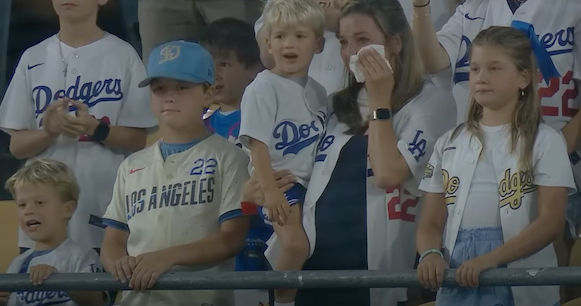
L to R—Cooper, Charley, Chance, Ellen, and Cali Kershaw contribute to the ovation for their future Hall of Famer as he’s about to begin his final regular-season Dodger Stadium start.

The night before, Kershaw made his pending retirement official, after an annual flirtation with the idea. True to form, he was humble and appreciative, right down to letting his wife share the moment by way of reading a letter she wrote him for the occasion:

From my perch, I have been uncomfortably pregnant, nursed newborns, rocked them to sleep to the roar of the seventh-inning stretch to get their last nap in. Fed them baby food, pouches, teething with crackers, changing blowout diapers, been frazzled with toddlers, tantrums and meltdowns, chased them through the concourses. A Mary Poppins bag filled with tricks and games to keep them occupied, and ironically teaching them the ins and outs of baseball. Explaining all the numbers on the scoreboard and the concession line, the ballpark food.

(I’ve) cried over some really hard losses and some really incredible milestones. (I’ve) watched our kids fall in love with the game, with the players and watching you pitch. Singing “Take Me Out to the Ballgame,” chasing beach balls, ducking from fly balls, spilling food and popcorn all over the fans below them. (I’ve) done it thousands of times, thousands of bathroom runs, all in the stadium. The workers and ushers are (our) best friends now.

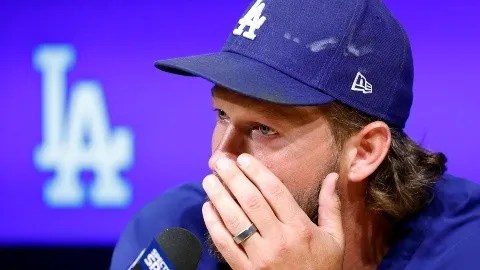
A tear crept down Kershaw’s cheek as he read it.

“I’m really not sad. I’m really not,” he said later in the conference. “I’m really at peace with this. It’s just emotional.”

Few of the greats get to choose their own retirement terms. But they show more of what they’re made of when they do so than they ever showed on the field. Kershaw facing the end, whenever it may prove to be, showed more than any triumph and transcended any tribulation. No wonder grown adults wept for and with him.

The Mets finally support Jacob deGrom

Jacob deGrom

These meatheads couldn’t get me even three runs a start even if I offered to pay for them to bribe the other teams into taking dives. Now they get me six, and I’m supposed to be trying to beat them? Just. So. Mets.—What Jacob deGrom could have been forgiven for thinking before he went to work against his old team on Friday night.

Having been a Met fan since the day they were born, I’ve seen enough cringe to last three lifetimes and two Hall of Fame careers. Enough so that I’ve earned the stripes required to tell today’s Met-fans-come-lately (say, strictly this century) that even the Mets deserve not to be written off entirely for a season over one bad inning . . . in April.

Friday night almost changed my mind.

When Jacob deGrom was the best Mets pitcher this century, winning two Cy Young Awards on merits that (among other things) should have shattered the myth of the pitcher “win,” he did it despite getting an average of 3.3 runs to work with per inning pitched in his starts. He could have taken the Mets to court and sued for non-support, and no judge would have remanded him to the nut farm.

“So are you still asking why we’re ignoring wins?” The Athletic‘s Jayson Stark asked, then answered. “[T]here isn’t a single entry on the state sheet that tells us less about how this man has pitched than the entry that most people used to check first. That’s why.”

“Jacob deGrom’s issue wasn’t that he ‘didn’t know how to win’.” It was that he didn’t know how to not be on the 2018 New York Mets,” wrote Anthony Castrovince, in A Fan’s Guide to Baseball Analytics. That was deGrom’s issue in 2019, as well.

So. After more injury miseries and one change of address, deGrom finally showed up in Citi Field Friday night. The Mets thanked him for his distinguished previous service with a video presentation that had the righthander very appreciative. “It was really cool,” he said after the game. “Like I said before, this is where it all started. And then coming back here, I thought it was going to be a very special day. So thankful to the Mets for playing that. And you know, like I said, these fans were great to me when I was here. And you know, that was a really nice thing they did.”

What a difference three years makes. The Mets got deGrom six runs to work with before the first inning was over. There was just one little problem with that, before you start thinking about old times’ sake. They gave him the runs to work with before he even had to take the mound.

DeGrom pitches for the Rangers now. (More injury miseries kept him from pitching more than nine games for the Rangers between 2023-24.) It’s not that he would have objected to getting six runs for a cushion before he even had to go to his office, but you couldn’t blame the man if he allowed himself even one moment to think: These meatheads couldn’t get me even three runs even if I offered to pay for them to bribe the other teams into taking dives. Now they get me six, and I’m supposed to be trying to beat them? Just. So. Mets.

Of course, deGrom could have laughed like Figaro that he might not have wept. The Rangers hit the plate against young Mets starter Jonah Tong, a pitcher with promise getting perhaps a too-early education in shaking it off and starting over. That’s after his first major league start found him sitting prettily enough with twelve runs to work with after two innings. (Against the Mighty Marlins, 29 August, en route the Mets’ 19-9 Fish fry.)

Now, in his third major league start, Tong started by walking Josh Smith, striking Wyatt Langford out, walking Joc Pederson, and getting Jake (Whata) Burger to fly out to center field, pushing Smith to third. Two out, two on. And then . . . and then . . .

And then along came Jung. Josh Jung, lining a single to right to send Smith home and Pederson to third. Then came Alejandro Osuna to poke a first-pitch single into shallow enough left to sent Pederson home. Then came a walk to Jonah Heim to load the pads for Cody Freeman to shoot a 2-2 fastball into right for a two-run single. Then came a full-count fastball for Michael Helman to line down the left field line for a two-run double. And then came Huascar Brazoban to lure Smith into flying out for the side.

The Mets did manage to pry three runs out of their old buddy in the bottom of the third, when Francisco Alvarez greeted him with a home run to open, then a single and a double turned to Juan Soto and Pete Alonso going back-to-back with sacrifice flies. The Rangers made it 8-3 to stay when Dylan Moore yanked a two-run homer off Mets reliever Gregory Soto in the top of the seventh, before deGrom’s evening ended.

DeGrom sports a neat 2.82 ERA and a staggering 0.92 walks/hits per inning pitched rate this season. Neat enough for a guy who turned 37 while we blinked in his absence. A guy who enjoyed getting another chance to pitch in front of Mets fans once again. “[T]he fans were great to me tonight,” he said of the ovation he got pregame and after his evening looked over. [He pitched seven strong.] They were great to me when I was here. So I always enjoyed taking them out in front of this crowd. So tonight was just as special.”

But getting six runs to work with from the Mets right off before pitching against them, deGrom must have felt unable to decide whether to call for a glass of champagne or the Looney Limousine.

Davey Johnson, RIP: “Forward thinker with old-school soul”

Davey Johnson

Davey Johnson at a 2016 reunion of his 1986 Mets. L to R: Keith Hernandez (1B), Jesse Orosco (RP), Ray Knight (3B), Lee Mazzilli (OF-PH), Johnson. They made the Deltas of Animal House resemble monks.

In 2012, on the threshold of managing the Nationals to their first National League East title after they moved from Montreal, Davey Johnson had mortality very much on his mind, after his one-time Mets player and lifelong friend Gary Carter lost a battle with brain cancer.

Johnson had seen Carter the previous winter and played golf with him at Carter’s charity event for needy children. When The Kid died, Johnson couldn’t bring himself to attend the funeral. “He would want me to be doing what I loved and not crying over him,” Washington Post writer Adam Kilgore remembers Johnson saying. “I don’t want nobody crying over me, either. It’s that simple. It may be callous, but I don’t look at it that way.”

The man who bookended both Mets World Series championships—he flied out to Cleon Jones to finish the 1969 Miracle Mets triumph, and managed the (shall we say) swashbuckling 1986 Mets to a World Series title—died Friday at 82.

Perhaps former Nats general manager Mike Rizzo described him best, in a Saturday text message to Kilgore: “Davey was a tough guy with a caring heart. One of the great baseball minds of all-time. A forward thinker with an old-school soul.”

During his playing days, Johnson took computer courses as a Johns Hopkins University graduate student and used what he learned to develop best possible baseball lineups. Offering one to his irascible manager Earl Weaver, who spurned it, Johnson said, “I don’t know whether to tell Earl, but the sixth-worst lineup was the one we used most of the time [in 1968].”

When he became a manager in the Mets’ system and then for the Mets themselves, Johnson brought such thinking plus his computer into his clubhouse and dugout. It’s entirely likely that he pushed the door open to sabermetrics as an active game tool and not just a postmortem analysis. He looked for the matchups and took the concurrent measure of his players at once.

But he wouldn’t let you call him one of the smartest of the game’s Smart Guys. “I never thought I was smart,” he said in 2017. “But I love to figure out problems. Through my stubbornness and relentlessness, I get to the end.” Bless him, he had to learn the hard way that the end had more than the meaning he had in mind.

“I treated my players like men,” he once said of his Mets, whom he led out of a dark age through a pair of hard pennant races and second-place finishes before they went the 1986 distance. “As long as they won for me on the field, I didn’t give a flying [fornicate] what they did otherwise.”

Not even when they celebrated a too-hard-won 1986 National League Championship Series by trashing their United Airlines charter DC-10 with partying that made the Gas House Gang and Animal House’s Deltas resemble conclaves of monks.

Maybe Johnson really was a forward thinker with an old-school heart. He treated like men a team with too many players behaving off the field as though their second adolescence came or their first hadn’t ended yet. Such straighter arrows as Hall of Fame catcher Carter plus infielders Howard Johnson, Ray Knight, and Tim Teufel, and outfielder Mookie Wilson, were the exceptions.

“He was just a player’s manager,” said Wilson upon Johnson’s passing. “He made it fun to go to the field. He laid down the law when needed, but other times he just let us play.” Then, and right to the end of his tenure on the Nationals’s bridge, Johnson liked to tell his players, “You win games. I lose them.”

Little by little, general manager Frank Cashen got less enchanted with his team and his laissez-faire manager. No two more opposite minds could ever have come through the Oriole system to bring the Mets to the Promised Land. And almost as swiftly as they got there, Cashen began letting his most characteristic players escape.

“Maybe we’ve made too many trades for guys who are used to getting their asses kicked,” said Dwight Gooden, the pitching star first made human by ill-advised work to fix what wasn’t broken in spring training 1986 and then a long war with substance abuse, to Jeff Pearlman for The Bad Guys Won. The guys who used to snap . . . they’re gone.”

Some also thought Cashen’s gradual dismantling of the team that should have ruled the earth or at least the National League for the rest of the decade took a toll on and the edge off Johnson’s once-formidable in-game cleverness. (He was known to be less than enthusiastic about several trades instigated by either Cashen or his then right-hand man Joe McIlvane.)

Once a second base star with the Orioles who also set a record for home runs in a season by a second baseman as a Brave, Johnson faced the proverbial firing squad in early 1990. It wouldn’t be the last time he brought a team to the Promised Land or its threshold only to be shoved to one side.

He took the Reds to the first-ever National League Central title after the post-1994 strike realignment—despite being told early that season it would be his last on that bridge. Capricious owner Marge Schott apparently didn’t like that he’d lived with his wife before she became his wife.

Then the Orioles made a dream come true and hired Johnson to manage them. Season one: 1996 American League wild card. Season two: The 1997 AL East. Neither brought him a World Series title. The wild card led to an American League Championship Series loss. (The outstanding memory: Jeffrey Maier making sure Derek Jeter’s long drive wouldn’t be caught for a homer-robbing out.) The division title led to another ALCS loss (to the Indians).

Johnson and Orioles owner Peter Angelos weren’t exactly soul mates. Angelos steamed all 1997 when Johnson fined Hall of Fame second baseman Roberto Alomar for missing a team function and ordered the fine to be paid to the charity for which Mrs. Johnson worked as a fundraiser. Johnson admitted soon enough that that was a mistake. (Alomar paid the fine to another charity.) Angelos wanted Johnson to say publicly he’d been “reckless.”

The manager declined, politely but firmly. Then, after the Orioles postseason ended, Johnson waited for Angelos to tell him, ok, you won the division again, that’s enough to let bygones be bygones. “Last week, Johnson called the Oriole owner,” wrote the Washington Post‘s Thomas Boswell, on 6 November 1997.

They talked. And yelled at each other some, too. Aired their differences. Johnson hoped it would help. That’s how it works in the clubhouse. You got a problem with me? Spit it out. Then work it out.

Johnson took a chance on Angelos. When challenged, maybe he’d respond like a big leaguer. Sometimes, after the venting is finished, a friendship develops—even a strong one. Sometimes you just agree to disagree and keep on fussing, like Earl Weaver and Jim Palmer. Either way, you respect each other and pull in the same direction.

Instead, all Johnson heard from Baltimore was silence. So, Johnson had his answer. Angelos wanted Johnson to resign as manager. If the Orioles fired him, they’d have to pay Johnson $750,000 next season . . .

. . . Nobody wants to be where they are not wanted. Especially if they are wanted almost everywhere else. “I’ll make it easy for him,” Johnson said. He wrote to Angelos: “I offer my resignation.”

On the same day Johnson was named American League manager of the year by the baseball writers, his resignation was accepted by Angelos.

Taking the high road helped make sure Angelos wouldn’t try to renege on the $750,000 he still owed Johnson for 1998. You think Angelos appreciated that high road? Not a chance. As with departed Orioles broadcast mainstay Jon Miller, Johnson “asked to be treated with the respect—in contractual terms—that his performance merited.”

In response, Angelos orchestrated the exodus of each. After Miller left, Angelos claimed Miller wanted to leave, contrary to appearances and Miller’s amazed protestations. Yesterday, Angelos said of Johnson, “It seems to me he wanted to move on.” By way of comment, let it be noted that Angelos has one of the rare law firms in which there are no partners. It’s just his name on the door.

Davey Johnson

Once a star second baseman in Baltimore, Johnson presses a point as a successful Orioles manager—who ran afoul of owner Peter Angelos, as Angelos made sure only too many did.

Johnson didn’t remain unemployed for long. (Neither, of course, did Jon Miller.) The Dodgers brought him to the bridge for 1999. He had his first losing season as a manager (though he won his 1,000th game in the job), then turned the Dodgers around in 2000 but fell short of the division title. Back to the firing squad. Again.

He then managed American and (one year) Netherlands teams in international competition before being hired into the Nationals front office. When manager Jim Riggleman decided to quit in June 2011, Johnson was named his eventual successor. He took them to a third-place NL East finish, their best since moving to Washington from Montreal, then led them to the NL East title in 2012 but a division series loss to the defending world champion Cardinals.

That didn’t keep his players from respecting him. Johnson must have come a very long way from the years when a laissez-faire approach to managing men eventually blew up in his face. I could be wrong, but I don’t remember any of his Cincinnati, Baltimore, Los Angeles, or Washington teams accused of trashing jumbo jets, for openers.

“If you come out here and you play hard and really work your tail off,” said his Rookie of the Year winner Bryce Harper during that season, “he’s going to like that. He plays it hard and he plays it right. That’s the type of manager you want.”

“Davey was an unbelievable baseball man but an ever better person,” said longtime Nats mainstay Ryan Zimmerman in a text to Kilgore. “I learned so much from him about how to carry myself on and off the field. No chance my career would have been the same without his guidance. He will be deeply missed by so many.”

On and off the field. Make note.

Johnson did win his second Manager of the Year award guiding the 2012 Nats. He’s one of seven to win it in each league; his distinguished company: Tony La Russa, Lou Piniella,  Buck Showalter, Jim Leyland, Bob Melvin, and Joe Maddon. After a second-place 2013—made slightly worse than it looked when he opened the season saying it looked like a World Series-or-bust year to be—Johnson elected to retire.

“In one respect,” Boswell wrote after his Oriole departure, “he’s different than almost every other manager of his generation. He doesn’t come to ownership with hat in hand. He doesn’t act like he’s lucky to be a big league manager and could never get any other job half so grand. He’s an educated, broadly accomplished man. And he carries himself that way. It has cost him.”

Johnson learned compromise as he aged, both in the game and away from it. So did a few of his former players who once butted heads with him or otherwise made him resemble Emperor Nero fiddling while Flushing flushed. (Darryl Strawberry, with whom Johnson had a relationship often described as “testy,” came to believe Johnson was the greatest manager he ever played for.)

Maybe tragedy had something to do with it, too. Johnson’s daughter, Andrea, once a nationally-ranked surfer but a diagnosed schizophrenic, died of septic shock in 2005; his stepson, Jake, died of pneumonia in 2011. (He also has a stepdaughter, Ellie.) Even the most impregnable man can be wounded. Even men who win two World Series as an Orioles second baseman and one managing the wildest and craziest Mets team of the 1980s.

May the forward-looking old-schooler be escorted to a happy reunion with his daughter, stepson, host of teammates, and Kid Carter in the Elysian Fields.