“There’s an end for all athletes”

Joey Votto

Joey Votto, shown batting in a 2019 game. 

Watching a baseball great retire at all is enough. Watching him do it during a season is more of an eye-opener and a mood killer. Hearing him say honestly that he doesn’t have it anymore could very well be baseball’s red badge of courage.

When Joey Votto realized he simply couldn’t will himself to another self-resurrection after a slow start, the way he’d done on more than one occasion during his 17-season major league career, he did the only thing that could be done by a man who said often enough that he’d leave money on the table rather than play poorly.

Realizing his comeback attempt to make it to the Blue Jays wasn’t going to happen, Votto simply retired last week. Just like that. No grand gesture, no grand and often foolish farewell tour. The greatest first baseman in the history of the Reds, bought out by his longtime home after last year, unlikely to turn a minor league contract with the Jays into seeing Jays action unless he was seated in the ballpark, decided enough was more than enough.

The day after Votto made his Instagram announcement, the Reds met the Jays at Rogers Centre and buried the Jays 11-7. Votto was delayed by car trouble and didn’t get to see the game, but he did get to the visitors clubhouse in order to say hello and goodbye to old teammates. Then, as The Athletic‘s Kaitlyn McGrath wrote, he talked to the press.

“I was not waxing and waning,” Votto began, “but I had moments where I was like, ‘Is this the right thing to do? And do I want the organization to tell me that I’m done?’ And I just decided, you’ve played long enough, you can interpret what’s going on. And I was awful. I was awful down there. And the trend was not fast enough, and I didn’t feel at any point in time like I was anywhere near major-league ready. I can say to the very last pitch I was giving my very all. But there’s an end for all athletes. Time is undefeated, as they say.”

Because he never got to suit up for the Jays in regular-season major league play (a longtime dream, since he grew up rooting for the Jays in his native Canada), Votto gets to retire as a single-team player. He also gets to retire as one of the game’s über-mensches, a guy who throve on fan interaction, liked to hang at chess clubs, and spoke out about a battle with protracted anxiety and depression in the wake of his father’s death.

Votto even made time to make it up to a young girl who adored him and the Reds but wept when he was tossed from a game in San Diego in the first inning over arguing balls and strikes. Told that little Abigail Courtney was heartbroken at not being able to see her hero play, Votto sent her a ball signed, “I am sorry I didn’t play the entire game. Joey Votto.” Then, he blew her family to tickets for the next day’s game and made a point of meeting and spending time with the girl, not to mention signing anything she handed him.

Last November, after the Reds declined his option and handed him the buyout, Abigail’s mother, Kristin, Xtweeted her immediate response: “The Reds are a bunch of PUTZES!!!” Mom assured one and all that Abigail (now 9 and playing softball in southern California) used that word only when she’s furious.

You can imagine about three-quarters of Reds Nation reacting comparably. Even if they knew in their hearts of hearts that Father Time caught up to their longtime first base fixture who was an on-base machine to what some critics thought was a fault: they blamed him for refusing to swing at unhittable pitches even with chances for “productive” outs. Please.

Your most precious commodity at the plate for an inning is outs to work with; your second most precious is baserunners. And if you have men on base ahead of you, would you rather see the man at the plate drawing the walk or swinging away for the “productive out” but  landing himself in a rally-altering or killing double play?

Let’s flip that coin and see what the other side says. Oh, yes — Votto swung at only 19 percent of the pitches he saw that didn’t hit the strike zone between 2012-2020; you can presume that, framing that period, Votto’s selectivity rarely wavered otherwise. A guy retiring with a .409 lifetime OBP, who led his league in that stat seven times and the entire Show three, doesn’t get there by swinging at practically anything. Nor does he create runs, which Votto did quite splendidly, retiring thus with a +145 wRC.

That and far more are why Votto will end up with a plaque in Cooperstown in due course. You might care to see how he sits against all post-World War II/post-integration/night-ball era Hall of Fame first basemen according to my Real Batting Average metric. (TB + BB + IBB + SF + HBP / PA.)

First Base PA TB BB IBB SF HBP RBA
Jim Thome 10313 4667 1747 173 74 69 .653
Jeff Bagwell 9431 4213 1401 155 102 128 .636
Willie McCovey 9692 4219 1345 260 70 69 .615
Joey Votto 8746 3706 1365 147 48 81 .611
Harmon Killebrew 9833 4143 1559 160 77 48 .609
Orlando Cepeda 8698 3959 588 154 74 102 .561
Gil Hodges 8104 3422 943 109 50 25 .561
Eddie Murray 12817 5397 1333 222 128 18 .554
Tony Perez 10861 4532 925 150 106 43 .526
HOF AVG .592

But Votto also joins a small roll of players who saw the end before it showed itself to them. Dearly though he wanted one final major league turn, in and for the city where he grew up, Votto didn’t want a free ride or a legacy call-up. If he didn’t earn his way, he didn’t want to be there. Out of respect for the Jays and the fans.

“This isn’t my organization, so how can I show up and make it my day, my moment?” he said. “Here’s an at-bat, here’s a game, here’s a stretch of time. To me, it’s disrespectful to the game. I also think it’s disrespectful to paying fans that want to see a high-end performance, and I would have given them an awful performance. So truly, I can say that I tried my very best and I just came up short. And I’ve had 22 years of not coming up short, so I guess I’m due.”

If that resembles an echo of another city’s baseball past, it should. Votto faced Father Time slightly over 35 years after the arguable greatest player in Phillies history called it a career — in a season’s second month, no less.

“I could ask the Phillies to keep me on to add to my statistics,” said Hall of Famer Mike Schmidt through tears at a press conference, “but my love for the game won’t let me do that.” He did, Thomas Boswell wrote, “what so many great athletes have failed to do; he left us wanting more.”

So did Joey Votto.

This essay was published in slightly different form at Sports Central.

One Sizemore to fit the White Sox

Grady Sizemore

From being part of a Cleveland team that shaved off a fifteen-game White Sox lead in the AL Central . . . to managing the Sox the rest of this season about which “disaster” might be flattery.

Once upon a time, when life was fair enough and the American League Central seemed a likely White Sox possession, Grady Sizemore and his 2005 Indians managed to turn a fifteen-game White Sox division lead in July to a mere game and a half entering the regular season’s final weekend. Even while they lost six of seven to the Sox along the way.

Those Indians forced the White Sox to think about and execute sweeping those Indians over that closing weekend to start those White Sox on the march to the World Series—which they hadn’t won since the Petrified Forest was declared a national monument. Sizemore finished the season leading the Indians with his 6.6 wins above replacement-level player.

That was then; this is now. Now, Sizemore—who took time after his playing career ended to make himself a husband and father, then worked as a $15-per-hour player development for the Diamondbacks at the behest of his friend Josh Barfield, whose move to the White Sox brought him aboard as a coach last winter—takes interim command of the White Sox for the rest of this year. God and His Hall of Fame servant Bob Feller help him.

There’s no way Sizemore could have played that final 2005 weekend against the White Sox and imagined the day coming hence when he’d have the White Sox’s bridge, even on an interim basis the team insists will remain just that while they look toward hunting a permanent skipper over the offseason to come. Neither could his legion of adoring Cleveland fans imagine it.

That 2005 opened a run of four straight seasons during which Sizemore became one of the American League’s top center fielders (37 defensive runs above his league average; .572 Real Batting Average*; 107 home runs; 128 OPS+) and matinee idols. The performance papers made him a superstar; his wiry physique and boyishly handsome face (not to mention what some have called his porn star-like surname) made him a sex symbol.

But the most irrevocable unwritten rule of Cleveland baseball for so long has been that no good deed goes unpunished. Not even the one that made Sizemore an Indian in the first place.

He came to Cleveland in the package the Indians all but embezzled out of the ancient Montreal Expos (it included pitching star to be Cliff Lee and second baseman Brandon Phillips) in exchange for pitcher Bartolo Colon. That’d teach them, and Sizemore, perhaps in that order.

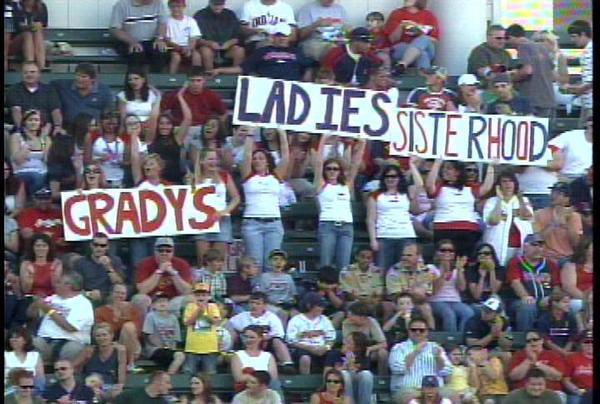
Around Cleveland, they didn’t name candy bars after Sizemore, but countless young women including a formal fan club known as Grady’s Ladies wore marriage proposals aimed his way on T-shirts in the Indians’ home playpen. (“I’m not trying to be the sex symbol of Cleveland,” he once told a writer who purred in print about his politeness and his modesty.) He managed to keep his marble (singular) and play ball; perhaps his worst known vice was driving a well-maintained baby blue 1966 Lincoln Continental.

“Good luck getting him to talk about himself,” said Indians relief pitcher Roberto Hernandez to Sports Illustrated‘s Tom Verducci. “He’s such a quiet guy who’s only interested in playing baseball and doing what he can for the team.” What he did was become one of the game’s respected and feared leadoff men, with power-speed numbers to burn, a kind of Mookie Betts prototype, but he might have done it too hard for his body’s taste.

Grady's Ladies

This is how popular Sizemore was in his early Cleveland years. And that’s without showing the young ladies wearing T-shirts with marriage proposals for him.

That being Cleveland, and those being the Indians, Sizemore couldn’t be allowed to turn a promising first five years into a Hall of Fame career. He was battered, beaten, and bludgeoned by injuries that shortened three seasons following 2008 before leaving him unable to play at all for two to follow. He didn’t have Mike Trout’s statistics but he didn’t need those to become the Trout of the Aughts. He ended up playing in Boston, Philadelphia, and Tampa Bay without a fragment of his Cleveland best left to offer.

“Just coming back from one surgery is hard,” Sizemore told a reporter when he signed with the Red Sox. “When you lump seven in a short period of time, it kind of puts your body through the wringer a little bit. I kind of had to take a step back the last year or two, and kind of just get the body right and try to get healthy and not rush things.”

Sizemore had had a double and a bomb during a fourteen-run single-inning massacre of the Yankees in April 2009. At that season’s end, he’d undergo surgeries on his groin and his elbow. Followed by another abdominal surgery, back surgery, and three knee surgeries. The three-time All-Star and two-time Gold Glove winner was reduced from a Hall of Famer in the making to an orthopedic experiment who’d be lucky to average 72 games a year over his final four major league seasons, sandwiching two full seasons his body forced him to miss.

The good news is, Sizemore is in splendid health today, and nobody’s in a hurry to see him turn the team around from joke to juggernaut. They believe in many things in Chicago, but magic acts aren’t among them. Not even if it might have taken one to end the Sox’s horrific 21-game losing streak Tuesday night or save Pedro Grifol’s job on the bridge. The skinny had it that Grifol would survive only long enough to see that streak end, if it ended.

Grifol survived to watch his charges beat the Athletics, 5-1, but the following day the White Sox couldn’t keep a 2-0 lead past the seventh, then couldn’t overcome a freshly minted one-run deficit in the final two innings. Those attentive to whispers that Grifol didn’t preside over the most communicative or tension-free clubhouse (his total record with the Sox: 89-190 over two seasons) probably noted Sox general manager Chris Getz making a point of mentioning Sizemore’s apparent knack for drawing people closer to him (unlike the guy he’s going to end up spelling when we execute him!) when announcing Sizemore’s original addition to the coaching staff.

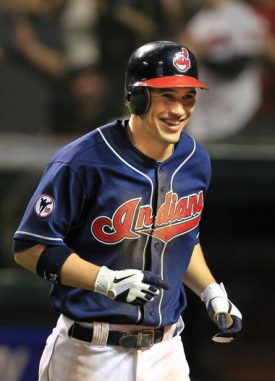
Grady Sizemore

Sizemore, young and an Indian, wearing his love for the game unapolgetically while playing like a future Hall of Famer—before the injuries made him the Mike Trout of the Aughts.

“He’s got a strong understanding of the game, how to play the game,” Getz said of him when announcing his mission for the rest of this lost and buried season. “He’s very authentic and honest with his communication ability. And so we felt that Grady would be the right fit for getting us to the end of September and building this environment that’s more effective for our players. Grady is a very strong, steady voice that we look forward to having as the manager to finish up this season.”

A guy with baseball brains to spare who can endure seven surgeries in five years without looking for the nearest escape hatch to the nearest booby hatch is a guy who can handle getting these White Sox through a remaining season in which they’d kinda sorta like not to end up breaking the 1962 Mets’ modern record (40-120) for season-long futility.

The interim manager might even have a chance to so what some have thought impossible thus far this year. Those Original Mets sucked . . . with style. And laughs. Sizemore might not make these White Sox more stylish in self-immolation, but he might actually get them to laugh—even to prevent them from thoughts of sticking their heads into the nearest ovens.

The White Sox would have to win thirteen more games to elude liberating those 1962 Mets from the top of the bottomcrawling heap. If Sizemore can get that much out of them from this day forward, he might make other teams cast an eye upon him as a manager without an interim tag attached. He might even make the South Side believe in magic, after all.

Beer showers and heck raisers

Andrew Benintendi

Andrew Benintendi hitting the two-run homer that started the White Sox on the way to ending their franchise-worst, AL record-tying losing streak Tuesday night.

In a way, it almost figured that the end would happen on the road. Something about this year’s White Sox just didn’t cry out that they should end the single most miserable spell in their history this side of the Black Sox scandal before their home people.

Maybe it was the distinct lack of humour. Nobody likes to lose, nobody likes when losing becomes as routine as breakfast coffee, but there have been chronically losing teams who managed to laugh–even like Figaro that they might not weep . . . or kill.

The 1988 Orioles survived their record season-opening 21-game losing streak with gallows humour. This year’s White Sox didn’t dare adopt gallows anything, perhaps out of fear that their own odious owner might take them up on it, build a gallows, and send a different team member to it each postgame.

My God, when these White Sox finally found better angels upon whom to call and beat the Athletics 5-1 Tuesday night, the funniest thing about it was that nobody could find a beer to drink in the postgame clubhouse celebration—because the entire supply had been poured over each other once they came off the field.

“A beer shower, what are you talking about,” cracked White Sox relief pitcher John Brebbia, who got three straight air outs in the bottom of the ninth to finish what Andrew Benintendi’s two-out, two-run homer started in the top of the fourth. “I’ve never heard of such a thing. That’s absurd.”

As if he’d suddenly been made aware he’d almost crossed the no-humour line, Brebbia plotted his own course correction. “We’ve got a day game tomorrow,” he said, “so guys are super focused on getting some sleep. Making sure they’re eating right and supplementing properly.”

Sure. Bust the franchise’s longest losing streak ever, keep them tied with the 1988 Orioles as the American League losing streak record holders, and do nothing more than check and maintain their diets, pop the right vitamins, and don’t be late for their dates with Mr. Sandman.

No White Sox player, coach, clubhouse worker, or front office denizen expected that kind of losing streak, of course. Not even with owner Jerry Reinsdorf executing his longtime leadership tandem of Ken Williams and Rick Hahn. Not even when Reinsdorf looked no further than his own hapless assistant GM Chris Getz to succeed the pair—fast. Not even with White Sox fans, what’s left of them, take pages from the book of A’s fans and hoist “Sell the Team” banners at Guaranteed Rate Field.

Not even the most shameless tankers of the past decade went into seasons expecting double-digit losing streaks at all, never mind record tyers or record threateners. But these White Sox might yet overthrow the 1962 Mets and their 40-120 season for record-setting futility. 38-124, anyone? No one’s saying that’s impossible yet.

Those Mets actually had no losing streak longer than seventeen games. They were also shut out a mere six times while they actually managed to shut the other guy out four. These White Sox have managed somehow to shut the other guys out one more time than that, but they’ve also been shut out thirteen times and possibly counting. Perhaps more amazing than those Original Mets, these White Sox were shut out only once during the now-ended losing streak. (A 10-0 blowout by the Mariners.)

The ’88 Orioles ended their notorious losing streak with a win against the White Sox that also involved eight Orioles and only three White Sox striking out at the plate. Last night, four White Sox batters struck out and five A’s did as well. The first strikeout wasn’t nailed until the bottom of the third, when White Sox starter Jonathan Cannon ended the side by blowing A’s catcher Sean Langoliers away on a climbing fastball.

To the extent that you could call it a pitching duel, the White Sox and the A’s seemed more bent on settling who could get more ground outs than fly outs. The White Sox pitchers landed eleven ground outs and sixteen air outs; the A’s pitchers, ten ground outs and nineteen fly outs. As if both teams believed idle gloves were the devil’s playthings.

The White Sox also left three men on base to the A’s leaving seven. Maybe the sleekest defensive play of the game ended the Oakland second, when White Sox shortstop Nicky Lopez handled A’s left fielder Lawrence Butler’s hopper on the smooth run and executed a smoother-than-24-year-old-scotch step-and-throw double play.

Then, in the top of the fourth, White Sox center fielder Luis Robert, Jr. slashed a clean line single to left with one out. First baseman Andrew Vaughn flied out to right to follow, but then Benintendi turned on A’s starter Ross Stripling’s 1-1 fastball right down the chute and sent it far enough over the right field fence.

This time, the White Sox would not blow the lead. Not even after A’s second baseman Zack Geldof hit a two-out solo homer in the bottom of the inning. Would anyone guarantee a White Sox win with a mere 2-1 score? The White Sox themselves wouldn’t have.

First, Sox third baseman Miguel Vargas wrung Stripling for a leadoff walk in the top of the sixth. Brooks Baldwin, a youthful midseason addition who had yet to be part of a major league victory, promptly singled him to second. One out later, Vaughn singled Vargas home and Baldwin to third with a base hit, chasing Stripling. Reliever Michel Otanez wild-pitched Baldwin home with Vaughn stealing third as Otanez worked on Sox designated hitter Lenyn Sosa—who flied out for the side but left the score 4-1, White Sox.

Maybe that still wouldn’t be enough. As the redoubtable Jessica Brand Xtweeted, the White Sox pre-Tuesday had one game since the Fourth of July in which they had a three-plus-run lead in the eighth or later, a 5-2 lead against the Royals on 29 July. Oops. The Royals dropped three homers including a grand slam to make it an 8-5 Royals win and White Sox consecutive loss number fifteen.

Come Tuesday, the White Sox turned out to have one more card to play in the top of the ninth. Benintendi doubled to right with one out, took third on a wild pitch with Sosa at the plate, then Sosa sent Benintendi home with the RBI single, before Brebbia made short air-out work of the A’s in the bottom to close a deal that once seemed about as likely as finding coherence coming from Donald Trump’s or Joe Biden’s mouths.

So what did Benintendi—once upon a time the acrobat who charged and dove to steal a certain three-run triple from Houston’s Alex Bregman, sending the 2018 American League Championship Series into a two-all tie rather than leaving it 3-1 Astros—think after he and his White Sox finally closed the book on their team-record, league-record-tying losing streak?

“We won a game, nothing more than that,” he said postgame. “I think everybody has played enough baseball. You understand that we play 162 of them. It sucks that we’ve lost 21 in a row, but a win’s a win. We’re all excited obviously, but this is no different than any other win.”

Maybe it was exhaustion. Maybe it was unexpected relief that the White Sox didn’t become the new AL losing streak record holders. When Benintendi hauled down Gelof’s towering fly to shallow left to end the game and the streak, he didn’t even want to keep the ball as a souvenir.

Chicago White Soxfans

Two traveling White Sox fans urge the team on indicating they were one out from the Promised Land Tuesday night.

Sox manager Pedro Grifol, who’s just about guaranteed to be left to find new employment, possibly when the season finally ends, possibly sooner, was almost as benign as that when the streak ended. “It was cool to watch for nine innings, these guys pull for each other,” he said. “The [Coliseum] dugout is small, but nobody really cared about how small it was today. It was just a group of guys, together, trying to see if we could get this thing behind us.”

That may have been one of the least testy postmortems of the year for these Sox. Grifol is no Casey Stengel. Not as a baseball tactician or strategist, and certainly not as a riffer with a twist who could keep the heat off his hapless charges at the lowest of their low.

“Come an’ see my amazin’ Mets,” Stengel often hectored Polo Grounds fans waiting to see the latest of the 1962 Mets. “I been in this game a hundred years but I see new ways to lose I didn’t know were invented yet.”

Grifol could never cut the mustard at Stengel’s hotel bar roost. His White Sox already sank under the weight of underwhelming individual performances and a small swarm of injury bugs. They incurred embarrassment when a few of the men they sent elsewhere around the trade deadline shone at first for their new teams. They’ve needed a Stengel badly this time around. They’ve barely got a Marx Brother—Zeppo.

A 21-game losing streak that followed a May-June fourteen-gamer was above and beyond Grifol’s and his White Sox’s comprehension no matter what. So much so that they rarely if ever found any reason to laugh while they threatened but didn’t pass the ’88 Orioles. But it’s tough enough being a White Sox fan these days, isn’t it? Do the fans have to provide all the humour?

Apparently. Before Gelof checked in at the plate in the bottom of the ninth, a pair of White Sox fans who’d gone west hoping to see the streak end stood behind the visiting dugout. They made motions indicating to White Sox players, just one out from the Promised Land of a win, any win.

One wore a brown paper bag over his head.

“Will anyone be writing any books about these White Sox?” asked a Tuesday editorial by the Chicago Tribune. Then, they answered.

If only the legendary Tribune columnist Mike Royko were still with us, we’d love to see what he would produce, given his rants back in the day about the hapless Cubs of the 1970s. But those Cubs teams were the 1927 Yankees compared with the 2024 Sox. Even Royko might be at a loss for words on the 2024 White Sox.

How rich is that? Name one other baseball team who could, in theory, have left Mike Royko lost for words, with or without a paper bag over his head. That would have been bigger headlines and more viral memes than any moment in which the White Sox finally played way over their own heads to end their horrific streak. Bigger, even, than the Rangers’ Corey Seager ruining Astro pitcher Framber Valdez’s no-hitter with a two-run homer in the ninth Tuesday.

“They played a good, clean game tonight, and we didn’t generate any offense,” said A’s manager Mark Kotsay postgame. “For that club over there, I’m sure they’re excited about ending their losing streak.” Excitement, apparently, remains in the eye and ear of the beholder.

Ladies and gentlemen, your Chicago Blight Sox

2024 Chicago White Sox

The Blight Sox, on the threshold of possessing the American League’s longest losing streak, depending upon what they can or can’t do with the Athletics, of all people, Tuesday night.

The number twenty-one has meanings profound (a winning hand at blackjack; the legal age of consent in most places), historical (a fabled New York restaurant and Prohibition-era speakeasy), and disgraceful alike. (The 1956-58 television game show that ignited the infamous quiz show scandal.) It was also the uniform number of 29 White Sox players over the team’s history.

As of Monday night number 21 became something more sinister. In Chicago, that is. The White Sox lost their 21st consecutive game. Somewhere in this favoured land, the sun is shining bright, the band is playing somewhere, but the White Sox are under a massive cloud with the threat of funeral marches sounding too clear.

The Athletics, of all people, dropped it upon the Blight Sox. The team so reduced by their ten-thumbed, brain-challenged owner that it was thought the A’s would bury themselves a live in what’s still their farewell season in Oakland beat the White Sox 5-1 in the A’s rambling wreck of a ballpark.

Once upon a time, the White Sox tied the game at one. The A’s said, don’t even think about it, scoring four more. And there was no joy back in Windville when the mighty Senzel (Nick, that is) struck out to end consecutive loss number 21.

This is the longest such streak of sorrow since the Orioles opened 1988 0-21; the 21 losses are an American League record now shared. The streak followed the 27-67 record the White Sox amassed from Opening Day through 5 July. They have only to lose three straight more to pass the 1961 Phillies and six straight more to pass the 1889 Louisville Colonels of the antique American Association. And, unlike those 1988 Orioles, these White Sox may have lost their sense of humour along the way.

Says White Sox manager Pedro Grifol, whose seat may resemble a stovetop burner, “Everybody knows what it is. It’s 21 in a row. It sucks. It’s not fun. It’s painful. It hurts. You name it. However you want to describe it.”

Said 1988 Orioles manager Frank Robinson, installed after Cal Ripken, Sr. skippered them to the first six straight losses, “Nobody like to be the joke of the league, but we accept it”—after showing a visiting reporter a button he kept in a desk drawer saying, “It’s been lovely, but I have to scream now.”

Says White Sox left fielder Corey Julks, who managed a highlight-reel catch to save a run, “Don’t dwell on the losses. Try to learn from them and get better each day.”

Said Hall of Fame shortstop Cal Ripken, to a reporter new on the Oriole beat when that 1988 streak hit the big Two-Oh, “Join the hostages.”

Said Grifol, “It’s not for lack of effort. Nobody wants to come out here and lose. We’ve just got to put a good game together and put this behind us.”

Said Robinson, “Nobody’s really gone off the deep end. All except one game, there’s been a real effort.”

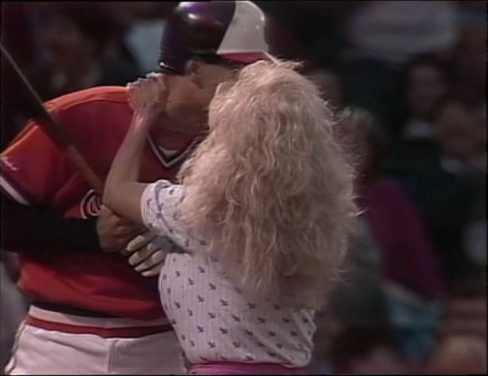
Cal Ripken, Jr.; Morganna. the Kissing Bandit

When the ’88 Orioles needed a little extra mojo after losing two straight following the end of their epic losing streak, Morganna the Kissing Bandit planted one on Hall of Famer Cal Ripken, Jr.—and they battered the Rangers for her trouble.

Said former White Sox manager Ozzie Guillen to Athletic reporter Jon Greenberg, after Greenberg suggested White Sox owner Jerry Reinsdorf and general manage Chris Getz were waiting for Grifol to manage one more win before executing him, “That means Pedro is 100 games under .500 since he got the job. Hoo, hoo boy.”

Said Robinson, told of a radio personality who promised to stay on the air until those Orioles finally won a game, “We’re gonna kill the poor guy.”

Come 29 April 1988, Baltimore’s old and long-gone Memorial Stadium was sold out, the crowd broke out the ancient championship-aspiring chant “O-R-I-O-L-E-S” . . . and the Orioles won at last, 9-0. Their opponent then? A different collection of White Sox. Out of whose starting pitcher Black Jack McDowell they pried five runs (four earned), out of whose bullpen they banged four more, in a game featuring two Hall of Famers on each side, with the Oriole Hall of Famers—Ripken and Eddie Murray—each hitting home runs and the whole team pounding eleven hits to the White Sox’s four.

After two straight Oriole losses to follow, Morganna the Kissing Bandit showed up to plant a wet one upon Ripken . . . and they battered the Rangers, 9-4. Ripken hit one out that day, too. It wasn’t enough to salvage an Oriole season in which they played below .500 ball in each month. (Morganna wasn’t about to become a single team’s attitude adjustment mascot, either.) But it might have kept the sting of 0-21 cauterised awhile.

Now, the White Sox don’t have someone else to confront them trying to end a losing streak. This time, the White Sox have to try again. They’re not finding laughs, they’re hearing that their own Hall of Fame legend Frank Thomas  is scolding them: “I don’t want to hear no more: ‘We’re trying.’ No more: ‘They’re working hard every day.’ No, it’s time to snap. It’s time to kick over the spread.”

The 1961 Phillies were managed by Gene Mauch, a man to whom kicking the postgame food spread over came as naturally as song to an oriole. Grifol doesn’t yet impress as a man ready to turn a table full of food and drink into a Jackson Pollock floor painting. Yet. But if the White Sox don’t escape Oakland with at least one win, don’t bet against the homecoming spread in Guaranteed Rate Park being served under armed guards.

Don’t look for Morganna to bring a little mojo. She’s been retired a quarter century and has no known intention of making a comeback. But upon whom would anyone suggest she plant one, if she did? Maybe upon Grifol, when he brings out the lineup card. If nothing else, it might loosen the manager up to the point where he can say, “It’s been lovely, but I have to scream now.”

A stupid anniversary

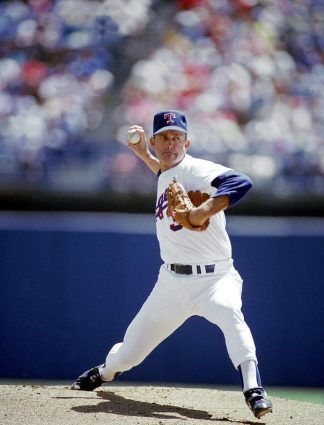
Nolan Ryan

This is the way to remember Nolan Ryan—as a great pitcher, not the guy who got buried alive in a nasty brawl with the White Sox.

At the rate it turns up on social media discussions, and not merely on its anniversary, Hall of Fame pitcher Nolan Ryan is going to be remembered purely for the day he drilled Robin Ventura into charging the mound. As if nothing else he accomplished in a quarter-century plus pitching career mattered half as much as putting a temporarily brain-damaged third baseman in his “place.”

As if Ventura got the worst in a Ryan headlock that triggered a bench-clearing brawl between Ryan’s Rangers and Ventura’s White Sox in which Ryan got far worse than he inflicted upon Ventura. As if Ryan, in what proved his final season, was some sort of saint and Ventura some sort of bandit. As if there hadn’t been tension between the two teams for going on four full years.

It’s time to put the whole damn business to bed where it belongs. There were far more important things to think about to open this August. Things like Blake Snell’s no-hitter, Jack Flaherty’s Dodger debut, the sad end to yet another season from yet another injury to Hall of Famer-in-waiting Mike Trout. Things like the White Sox losing a twentieth straight game. Things like José Abreu hitting two bombs his first game back from his grandmother’s death and Freddie Freeman’s Guillain-Barre syndrome-afflicted little son home from the hospital.

But no. Who needs those when you can bring up the Ryan-Ventura brawl, a textbook exercise in celebrating false masculinity and baseball brain damage, on its anniversary, which is rendered meaningless anyway for how often it gets brought up all year long on one or another social media outlet?

Ryan was of the school of thought that taught the outer half of home plate was the pitcher’s exclusive property. You won’t find that anywhere in baseball’s written rules, of course. Generations of pitchers have been taught that; generations of hitters have been taught likewise. Well, now.

The Ryan-Ventura brawl was impregnated by a 1990 White Sox rookie named Craig Grebeck. He’d go on to make a useful career as a defense-first utility infielder. But in spring training 1990 he shocked a lot of people—probably including Ryan, probably including his own team—when he homered against the Rangers on a first pitch. He pumped his fists rounding the bases.

Come the regular season, Ryan faced Grebeck and surrendered one of (read carefully) the nineteen major league home runs Grebeck would ever hit in a twelve-season career. Again, Grebeck pumped his fists rounding the bases. Back on the bench, Ryan asked pitching coach Tom House about him.

Told that it was Grebeck, a not so tall player who looked then like a boy entering middle school, Ryan is said to have told then-Rangers pitching coach Tom House, according to Ryan biographer Rob Goldman, “Well, I’m gonna put some age on the little squirt. He’s swinging like he isn’t afraid of me.” The next time Grebeck faced him, Ryan hit him in the back with a pitch. “Grebeck was 0-for the rest of the year off him,” House remembered.

Fat lot of good that did The Express: Grebeck actually finished his career with a .273/.429/.545 slash line and a .974 OPS against the Hall of Famer. It wasn’t exactly a powerful one (three singles, two walks, three strikeouts, but four runs batted in, somehow), but Ryan didn’t exactly age Grebeck with the first of only two drills he’d hand Grebeck lifetime, either.

What it did, though, was begin some very tense times between Ryan’s Rangers and Grebeck’s White Sox. The White Sox’s batting coach, Walter Hriniak, was teaching his charges to cover that outer half of the plate. House insisted that was a root but Ventura himself said otherwise. “At the time in baseball the (strike) zone was low and away, and that was where pitchers were getting you out,”he said. “We weren’t the only team doing it. It was the kind of pitch that was getting called, so you just had to be able to go out and get it.”

What followed:

17 August 1990: Ryan hit Grebeck with one out in the third, Grebeck’s first plate appearance of the game. Two innings later, White Sox starter Greg Hibbard hit Rangers third baseman Steve Buechele with two outs. (The game went to extras and the Rangers won, 1-0, when Ruben Sierra walked it off with a line drive RBI single in the thirteenth.)

6 September 1991: Ryan hit Ventura in the back on 1-2, also in Arlington, three innings and a ground out after Ventura doubled Hall of Famer Tim Raines home with nobody out in the top of the first and scored on Lance Johnson’s subsequent two-out single. It started a rough day for Ryan, who surrendered two more runs (both on third-inning sacrifice flies) en route an 11-6 White Sox win.

2 August 1993: This was two days before Ryan and Ventura’s rumble in the jungle: Rangers pitcher Roger Pavlik hit White Sox catcher Ron Karkovice with one out in the third. (Ventura posted a first-inning RBI single to open the scoring; Rangers left fielder Juan Gonzalez answered with a two-run homer in the bottom of the first. Subsequently, White Sox relievers Bobby Thigpen and Jason Bere each hit Rangers third baseman Dean Palmer, while Rangers shortstop Mario Díaz also took one from Thigpen.

Ventura and assorted White Sox teammates of the time insisted Ryan was throwing at hitters and often hitting them on a routine bases. Two days later, Ryan and Ventura went at it. Among the pleasured by Ventura charging Ryan was Sox pitcher Black Jack McDowell: “Ryan had been throwing at batters forever, and no one ever had the guts to do anything about it. Someone had to do it. He pulled that stuff wherever he goes.”
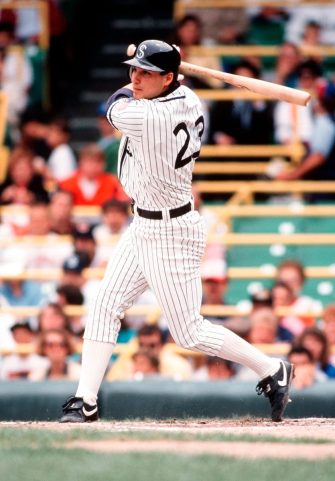
Robin Ventura

And this is the way to remember Robin Ventura—a great third baseman, not the guy who charged the mound indignantly when Ryan hit him with a 1993 pitch after a few seasons of White Sox-Ranger knockdown-and-plunk tensions.

“We had a lot of going back and forth that season,” says Ventura. “Guys were getting hit regularly, and it was just one of those things where something was going to eventually happen.” It probably involved other Rangers and White Sox pitchers, too.

Ryan was as notorious for his career-long wildness (he led his league six times and the entire Show three times in wild pitches, and averaged twelve per 162 games lifetime) as for his seven no-hitters, his 5,714 lifetime strikeouts, and his 2,795 walks. (They’re also number one on the Show hit parade.) He may have gotten away with throwing at hitters, but he was actually pretty stingy when it came to actually hitting them.

He retired averaging seven hit batsmen per 162 games. Seven. If he’d actually hit seven men a year for his entire career, it would give him 31 more drilled than he actually compiled (158). He actually had eleven seasons in which he hit five batters or fewer; hitting Ventura on that fine 4 August 1993 was the only hit batsman Ryan had in thirteen 1993 starts before he finally called it a career.

That doesn’t exactly sound like one of the most merciless drillers the game’s ever seen. Ryan only ever led his league in hit batsmen once (1982, when he was an Astro), and that’s one more than Hall of Famer Bob Gibson—too often the unjustified first name in, ahem, manly intimidation—ever did. Believe it, or not. Ryan is number sixteen at this writing on the all-time plunk parade. Gibson, you might care to note, is tied for 89th on the parade with (wait for it) 102. And he averaged (wait for it again!) . . . six per season.

“If you look at the replays, the ball wasn’t really that far inside,” House told Goldman.

It was just barely off the plate and it went off Ventura’s back. Robin was starting toward first base when he abruptly turns and charges the mound instead. And the closer he got to Nolan, the bigger he looked. If you watch it in stop action, you can see Ryan’s eyes were like a deer’s in a headlight. So everybody was surprised by what Nolan did next: Bam! Bam! Bam! Three punches right on Ventura’s noggin!

Actually it was about six. Now for the part everyone still gaping in awe over Ryan’s manly deliverance of a lesson to Ventura forgets: Both teams swarmed out of their dugouts, but the White Sox got to Ryan so swiftly that they drove him to the bottom of a pileup from which the White Sox’s Bo Jackson had to extricate Ryan before some serious damage was done to the veteran righthander.

“All I remember,” Ryan eventually told Goldman, “is that I couldn’t breathe. I thought I was going to black out and die, when all of a sudden I see two big arms tossing bodies off of me. It was Bo Jackson. He had come to my rescue, and I’m awful glad he did, because I was about to pass out. I called him that night and thanked him.” (The two were friendly rivals since then-Royal Jackson hit Ryan for a 1989 spring homer and his teammates hailed Ryan the next day—from the spot where Jackson’s bomb landed, as Ryan went through an exercise routine on the field.)

Ryan otherwise actually got the worst of it when all was said and done. Jackson extracted a man “visibly winded,” Goldman wrote. Ryan wasn’t the only one thankful for Jackson. “When Nolan didn’t come out of the pile, I got concerned,” said his wife, Ruth. “With his bad back, sore ribs, and other ailments, he could easily have suffered a career-ending injury.”

Somehow, Ryan remained in the game. Ventura was ejected for charging the mound. Of all people, his pinch runner was . . . Craig Grabeck. Ryan picked Grabeck off first before he threw a single pitch to the next batter, Steve Sax, who grounded out to end the inning.

The Rangers went on to win, 5-2. Ryan insists to this day that if Ventura had stopped shy of the mound rather than finish the pursuit and grab his jersey, “I wouldn’t have attacked him.” But he also felt embarrassed by the brawl. So much so that, Goldman recorded, when the Ryan family returned home from a postgame family dinner, Ryan declined when one of his sons—who’d videotaped the scrum—asked Dad if he wanted to see it again.

Ryan’s no, Goldman noted, was “firm.”

Said the Dallas Morning News headline the day after: Fight Gives Game a Big Black Eye.

Now, if rehashing that brawl isn’t to Nolan Ryan’s taste, it ought to be lacking likewise for the idiots who insist on reliving and re-viewing it on social media—and not just on its anniversary. I could be wrong, but it seems that social media outlets can’t last two weeks, and possibly less, without at least one jackass posting the video of the scrum.

Pitching to the inside part of the strike zone is part of the art, even if there’s no written rule saying the outer half of the plate is the pitcher’s exclusive property. You can delve as deep as you want and discover there were plenty of pitchers who lived so firmly on the inside that they, too, earned unfair reputations as headhunters.

Not everyone is as shameless as shameless as fellow Hall of Famer Early Wynn insisting he’d knock his grandmother down if she “dug in” against him. Well, guess what. Grandma’s Little Headhunter hit only 64 batters in a 23-season career and averaged only three per 162 games lifetime. He even had eleven seasons where he hit three batters or less.

Once upon a time, Bob Gibson signed an autograph for a fan who told him, in the earshot of baseball writer Joe Posnanski, “Oh, do I remember the way you pitched. I remember all those batters you hit. They were scared of you. The pitchers today, they couldn’t hold a candle to you.”

Gibson did want the edge every time he took the mound. He did look as ferocious as his reputation on the mound, though that may have been as much a byproduct of his nearsightedness as anything else he brought to the mound, including an innate and justifiable sense that a black pitcher in his time and place needed the edge just that much more. He did pitch inside as often as he thought he had to to keep batters off balance.

But when that fan departed with his autograph, Gibson turned to Posnanski and probably sounded wounded when he asked, “Is that all I did? Hit batters? Is that really all they remember?” (If it is, they didn’t see him pitch his way to the Hall of Fame.)

A few years ago, in another online forum, I was addressed directly by a fan who objected to my recording that, among other things, Gibson didn’t hit as many home run hitters after their bombs as people think they remember: He wasn’t just ‘brushing back’ batters—especially those who had hit a donga off him the time before. He was damn well trying to hit them. 

Well, I was crazy enough to look it up. Here’s what I wrote then:

Thirty-six times in 528 major league games Bob Gibson surrendered at least one home run and hit at least one batter in the same game. He only ever hit one such bombardier the next time the man batted in the game; he hit three such bombardiers not the next time up but in later plate appearances in games in which they homered first; and he surrendered home runs after hitting batters with pitches in fourteen lifetime games.

For the record, the one batter Gibson hit in the next plate appearance following the homer was Hall of Famer Duke Snider. The three bombers he’d hit later in those games but not in their most immediate following plate appearances: Hall of Famer Willie Stargell plus longtime outfielders Willie Crawford and Ron Fairly.

Is that all I did? Hit batters? Is that really all they remember?

Is that all I did? Sock Robin Ventura six times in a headlock before I got buried alive in the bottom of a pileup in my last year in the bigs and I needed Bo Jackson to save my sorry behind?

Ryan is a Hall of Fame pitcher. Ventura had an excellent career that shakes him out as the number 22 third baseman ever to play the game. They both deserve far better than to be remembered first for a hit-by-pitch and brawl that lowered both men’s dignity a few levels. The fans who “celebrate” the brawl every week or two, never mind on its anniversary? They deserve to be condemned.