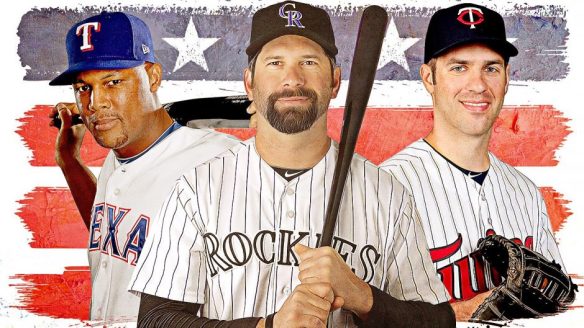
A trio grand for Cooperstown

Adrián Beltré, Todd Helton, Joe Mauer.

L to R: Newly-elected Hall of Famers Beltré, Helton, Mauer—They’ll join Contemporary Baseball Era Committee choice and longtime manager Jim Leyland on the Cooperstown stage come July.

The third baseman whose surname begins with “belt” and was way more than just a great belter. The first baseman who wasn’t just a Coors Canaveral product at the plate. The catcher forced to first base by concussion but who forged his case as the game’s number seven catcher all-time, defying his haters who still call him a thief.

Ladies and gentlemen, meet your newest Hall of Famers—Adrián Beltré, Todd Helton, and Joe Mauer. Beltré and Mauer deserved to be the first-ballot Hall of Famers they are now. Helton should have been, too, if only the voters his first time around on the Baseball Writers Association of America ballot had taken the dive that went deeper and deeper the longer Helton stayed on the ballot.

Beltré is probably in the most unique position of the trio. The number four third baseman of all (I’d rank him a touch higher for his combination of power hitting and off-the-charts defense) has something none of his peers can claim. Quick: name the only third baseman, ever, with 1) 3,000+ hits and 2) five or more Gold Gloves.

Hall of Famer Wade Boggs has two Gloves. Hall of Famer George Brett has one. Hall of Famer Paul Molitor (who probably got in more as a designated hitter than a third baseman) has none. Beltré, of course, has five. Now you can argue that a lot of Gold Glove award voting has been suspect over the years. You can’t argue with only two of the quartet being in the top twelve for run prevention at third base: Beltre (+168 total zone runs; 2nd) and Boggs (+95; 12th).

There’s only one other third baseman in the top twelve for run prevention who had anything like Beltré’s power in hand with it: Hall of Famer Mike Schmidt. Hall of Famer Eddie Mathews (512 home runs) was worth 40 defensive runs saved but that doesn’t get him quite to the levels of Beltré and Schmidt among the biggest bopping third basemen.

Here’s Beltré, among post-World War II/post-integration/night-ball era Hall of Fame third basemen, according to my Real Batting Average metric (RBA): total bases + walks + intentional walks + sacrifice flies + hit by pitches, divided by total plate appearances:

HOF 3B PA TB BB IBB SF HBP RBA
Mike Schmidt 10062 4404 1507 201 108 79 .626
Chipper Jones 10614 4755 1512 177 97 18 .618
Eddie Mathews 10100 4349 1444 142 58 26 .596
Scott Rolen 8518 3628 899 57 93 127 .564
George Brett 11625 5044 1096 229 120 33 .561
Ron Santo 9397 3779 1108 94 94 38 .544
Wade Boggs 10740 4064 1412 180 96 23 .538
Adrián Beltré 12130 5309 848 112 103 97 .533
Paul Molitor 12167 4854 1094 100 109 47 .510
Brooks Robinson 11782 4270 860 120 114 53 .458
HOF AVG .555

You see he was hurt most at the plate by taking a lot less unintentional walks than everyone else on the list. But he’s the number two most run-preventive third baseman ever behind Brooks Robinson. His combination of power and defense should nudge him up to the number three all-around third baseman who ever played. WARriors, take note: Beltré’s 93.5 is bested among Hall third basemen by two, in ascending order: Mathews (96.0) and Schmidt (106.8).

Among his group of Hall of Famers, Beltré was also the most fun Fun Guy of the game. Even if his career was an ascending trajectory to genuine greatness (people still wonder how the Dodgers could have let him take a hike into free agency), there was always a sense about him that he really did play more for the fun of it than the riches of it.

I’ve asked elsewhere: how often do you get to send one of the real Fun Guys to Cooperstown? Too many playing or managing greats were about as fun as open-heart surgery. Too many of the game’s Fun Guys weren’t all that much fun when they were actually on the field or at the plate. (Dick Stuart, for example, was one of the funnest of his time’s Fun Guys—but he earned his nickname Dr. Strangeglove at first base. He only got to play major league baseball because he could hit baseballs across city limits.)

Ernie Banks, Yogi Berra, Bert Blyleven, Roy Campanella, Dizzy Dean, Whitey Ford, Lefty Gomez, Rickey Henderson, Minnie Miñoso, David Ortíz, Satchel Paige, Babe Ruth, and Warren Spahn were bona-fide Hall of Famers and Fun Guys in the bargain as players. (And several of them had to do it through unconscionable bigotry.) Casey Stengel was both as a manager. Beltré will grace their company.

I did notice someone aboard social media ask aloud if someone could arrange for his old Texas teammate Elvis Andrus to come rub his head at his induction. Not a half bad idea. Barring that, maybe the Hall could arrange for Beltré head-touching bobbleheads to pass out come induction day? Barring that, maybe the Hall staff would let him drag the on-deck circle mat lonce more?

Helton may have finished what Hall of Famer Larry Walker started and fractured the idea that a career spent half or more with Coors Field as your home ballpark will kill or at least cast abundant doubt on your Hall credentials. Helton lacked what Walker had, enough time in another uniform to show that he was Hall of Fame good without the Coors factor. But Helton has this distinction: the first Rockie-for-life to go to Cooperstown.

Now, look deeper, once again, please. The Toddfather posted an .855 OPS on the road to his 1.048 at home. An .855 OPS across the board might mean a spot in the Hall of Fame for a lot of players. Helton’s road OPS is higher than the across-the-board OPSes of (in ascending order) live ball-era Hall of Famers Eddie Murray, Gil Hodges (who played most of his career in a bandbox home park), Orlando Cepeda, Ben Taylor (Negro Leagues), Sunny Jim Bottomley, Harmon Killebrew; and, one point below Fred McGriff. His across-the-board .953 is better than all but nine Hall of Fame first basemen.

Let me apply my RBA to Helton among post-World War II/post-integration/night-ball era Hall of Fame first basemen:

First Base PA TB BB IBB SF HBP RBA
Jim Thome 10313 4667 1747 173 74 69 .653
Jeff Bagwell 9431 4213 1401 155 102 128 .636
Todd Helton 9453 4292 1335 185 93 57 .631
Willie McCovey 9692 4219 1345 260 70 69 .615
Harmon Killebrew 9833 4143 1559 160 77 48 .609
Fred McGriff 10174 4458 1305 171 71 39 .594
Gil Hodges 8104 3422 943 109 82 25 .565
Orlando Cepeda 8698 3959 588 154 74 102 .561
Eddie Murray 12817 5397 1333 222 128 18 .554
Tony Pérez 10861 4532 925 150 106 43 .526
HOF AVG .594

Helton has the number three RBA among those Hall of Fame first basemen, he’s 37 points above the average RBA for those Hall first basemen, and it wasn’t all or purely a product of Coors Field. He also had a 144 OPS+ over his ten-year peak of 1997-2007. OPS+, of course, adjusts for ballpark factors. That peak OPS+ alone should disabuse you once and for all about whether the Toddfather was pure Coors.

By the way, for those of you obsessed with swinging strikeouts at the plate and the metastasis thereof, be reminded that Helton lifetime walked more than he struck out, especially as the leverage situation rose. He averaged eleven more walks (96) than strikeouts (85) per 162 games, and he walked 160 times more than he struck out. Would you like to know how many of the other aforelisted Hall of Fame first basemen walked more than they fanned? Z-e-r-o.

Mauer joins a unique Cooperstown group—one of the three field positions (catcher) that have resulted in only three first-ballot Hall of Famers. (It’s still impossible to believe that Yogi Berra wasn’t a first-ballot Hall of Famer.) Thus does Mauer join Johnny Bench and Ivan Rodríguez in the Cooperstown Trinity of the Tools of Ignorance. (The other two positions with only three first-time Hall of Famers: first base and second base.)

He also has a .569 RBA that puts him third among post-World War II/post-integration/night-ball Hall catchers. (Only Mike Piazza and Roy Campanella—who played in the same bandbox as Hodges when he made the Show in 1948—are ahead of him.) He wasn’t all bat as a backstop despite his gaudy batting averages, either; the pitchers who threw to Mauer posted an ERA almost a full run below his league average, he was worth +65 total zone runs behind the dish, and he threw out a respectable 33 percent of runners who tried to steal on him lifetime. (He led the American League twice: 53 percent in 2007; 43 percent in 2013.)

WARriors should remind themselves, too, that in the ten seasons Mauer played as the Twins’ regular catcher, he out-WARred the three other catchers active during all ten of those seasons by a wide margin: his 44.6 bested Victor Martinez (28.1), Yadier Molina (27.6), and Jorge Posada (20.0).

Well, now. A year ago, after Scott Rolen’s election to the Hall of Fame provoked the usual chatter about who’d be elected this year, Twins fans tried to smother social media with assaults and batteries of Mauer for “stealing” the money in that yummy contract extension he signed before his first concussion compelled the Twins to get him the hell out from behind the plate.

He suffered his second well into the extension, chasing a foul ball from first base. Those brain-dead fans either forgot, never knew, or didn’t care that injuries incurred in the line of duty don’t equal goldbricking or defrauding. I swore then that I wouldn’t say another word about their idiocies, but I can’t resist today.

Who has the last laugh now?

Bud Harrelson, RIP: Don’t back down

Bud Harrelson

Perhaps unfairly, Bud Harrelson is remembered less for solid shortstop play than for getting plowed into an NLCS brawl by Pete Rose.

God rest her soul, my paternal grandmother (herself a victim of Alzheimer’s) called her favourite Met “my little cream puff.” The reference was to Bud Harrelson’s not-so-tall or large dimensions, surely. Hall of Famer Yogi Berra, a longtime Mets coach and their manager for three and two-third seasons, merely called him Shorty.

The only Met in uniform for both their World Series triumphs (as their starting shortstop in 1969, as their third base coach in 1986) was anything but a cream puff on the field. “Buddy was 150 pounds soaking wet,” his Hall of Fame teammate and best friend Tom Seaver remembered three decades later, “but he wouldn’t back down from anyone.”

Not even from Pete Rose, who plowed him moments after Harrelson threw on to first to finish a 3-6-3 double play in Game Three of the 1973 National League Championship Series. Not even from umpire Augie Donatelli in the World Series to follow, Donatelli calling him out at home despite Oakland catcher Ray Fosse seeming to miss the tag and provoking a wild Met argument around the plate.

And not even from Alzheimer’s disease, with which Harrelson was diagnosed in 2016 and against which he fought a bold fight until his death at 79 Thursday morning. Some of the obituaries that followed lasted several paragraphs before mentioning the Rose play and the infamous bench-and-bullpen-clearing brawl that erupted. Some of them lasted only several syllables. It almost figured.

Rose entered Game Three of the set between the Mets and the Reds steaming over Harrelson’s post-mortem following Mets righthander Jon Matlack’s Game Two two-hit shutout. It wasn’t braggadoccio by any means. The .236-lifetime-hitting Harrelson’s grit was matched by his wit. He observed Matlack had “made the Reds look like me out there” at the plate, adding only that he thought, “It looked like they were swinging from their heels.”

That doesn’t seem normally to be an observation that would steam a team, not even a Big Red Machine. Indeed, as New York Post columnist Mike Vaccaro observes, most of the Reds weren’t interested when Rose tried to use Harrelson’s benign remarks as the equivalent of what we call today bulletin-board fodder.

The most “printable” of Rose’s post-mortem replies, in Vaccaro’s word, was, “What’s Harrelson, a [fornicating] batting coach?” Hall of Famer Joe Morgan even warned Harrelson during pre-Game Three practises that one more such remark would get him punched out, and Rose was going to get him at second if given the opportunity. Some of the Big Red Machine weren’t exactly renowned for a sense of humour about themselves.

So, come the Game Three top of the fifth, Morgan tapped one toward Mets first baseman John Milner, who threw to Harrelson to get Rose (a one-out single up the middle) by ten plus feet for one before Harrelson winged it back to Milner to get Morgan for the two. The next thing anyone knew, Rose had plowed and thrown an elbow at Harrelson and the pair were up and swinging.

“When he hit me after I had already thrown the ball I got mad,” Harrelson once remembered. “And we had a little match. He just kinda lifted me up and laid me down to sleep and it was all over.” It wasn’t all over that quickly, alas. To say all hell broke loose in Shea Stadium after Mets third baseman Wayne Garrett hustled over to try protecting Harrelson would be to call a prison riot a debate.

The less-than-willing Reds had little choice but to back their impetuous star. After order was restored at last, Rose took his position in left field and that portion of the Shea crowd let him have a shower of debris that included a glass bottle near his head. It got so out of hand that the Reds’ Hall of Fame manager Sparky Anderson pulled his team off the field. (“Pete Rose has done too much for baseball to die in left field,” the ever locquacious Anderson said postgame.)

A forfeit to the Reds was threatened. Under National League president Chub Feeney’s urging, Berra led Seaver plus Hall of Famer Willie Mays and outfielders Rusty Staub and Cleon Jones to plead for peace in the stands. Order was restored and the Mets finished what they started, a 9-2 Game Three win and a five-game triumph over the Reds for the pennant.

Rose didn’t hold a grudge for very long. Handed the Good Guy Award by the New York contingency of the Baseball Writers Association of America the following January—the long since disgraced and banished Rose was one of the game’s great notebook fillers during his playing days—Rose accepted it . . . from Harrelson himself.

“I want the world to know,” Harrelson cracked as he presented Rose the award, “that I hit him with my best punch. I hit him right in the fist with my eye.” In due course, Rose returned the favour, signing a photograph of the fight, “Thank you, Buddy, for making me famous.”

In some ways, Harrelson was responsible for the Mets making it to that postseason in the first place. He missed significant regular season time with an injury and the Mets slumped almost coincidentally. But when he returned to action the Mets—with or without a little firing up from relief pitcher Tug McGraw’s “You gotta believe!” holler, aimed sarcastically at first (at a pep talk by general manager M. Donald Grant)—ground their way from the basement to the National League East title that September.

“You had Seaver, who was the greatest pitcher I ever saw,” Rose told Vaccaro in 2008,  “and you had great hitters like Cleon Jones and Tommie Agee, and later Rusty [Staub] and Milner. But the heart and soul of that team—ask anyone who played against them—was Bud Harrelson.”

Harrelson’s weak bat was offset by his sure-handed play at shortstop; he averaged turning  57 double plays a season in his twelve prime seasons from 1967-1978, even missing significant time to injuries. He also retired being worth +34 defensive runs above his league average, retroactively leading the National League’s shortstops with a +17 1971.

He roomed with Seaver for the entire time they were Mets together, having first met in AAA-level ball in the Met system. “We were perfect roommates,” Harrelson remembered in his memoir, Turning Two. “Tom did all the reading and I did all the talking.”

After finishing his playing career with two seasons in Philadelphia (where Rose was a teammate) and one in Arlington, Harrelson returned to the Mets and soon became their third base coach. That was Harrelson giving Ray Knight a pat and running down the third base line with him as Knight scored, after Mookie Wilson’s grounder skipped through hapless Bill Buckner’s feet, to finish the Game Six comeback win that sent the Mets toward their 1986 World Series conquest.

Later, when Davey Johnson was finally cashiered as the Mets’ manager 42 games into the 1990 season, Harrelson took the bridge and helmed the Mets to a 71-49 record the rest of the way, good for a second-place NL East finish. The following season, enough of the 1980s Mets’ contending core players were gone and suspicions arose that Harrelson was just the dugout figurehead while bench coach Doc Edwards called the shots.

The Mets went 74-80 under Harrelson, toward a fifth-place NL East finish, before he executed before the season’s final week. There were those who thought Harrelson’s problem was trying to manage like a pal more than a leader. Harrelson himself said, candidly enough, “If the public wanted a manager with vast experience, I wasn’t it . . . If they wanted somebody who would grow with the organization, I think that was me.”

1969 Mets

Harrelson (far left) traveled with a few 1969 Mets teammates plus After the Miracle co-author Erik Sherman (center rear) for a final visit in California with Hall of Fame teammate Tom Seaver (front right). Joining them: pitcher Jerry Koosman (second from left), outfielder/After the Miracle author Art Shamsky (second from right, rear), and outfielder Ron Swoboda (far right rear). Seaver was stricken with Lewy Body dementia; Harrelson, with Alzheimer’s. (Photo posted to Xtwitter by Erik Sherman.)

In due course, Harrelson helped bring minor league baseball to Long Island as the co-owner, senior vice president, and first base coach of the Long Island Ducks. He even managed the Atlantic Leaguers to a first place tie in their maiden season. Then, come 2016, after a few incidents first attributed to aging’s mere memory lapses, Harrelson and his former wife, Kim Battaglia, got the fateful diagnosis.

Battaglia remained his close friend and primary caretaker. Harrelson was part of the contingent of 1969 Mets—organised by outfielder Art Shamsky, also including pitcher Jerry Koosman and outfielder Ron Swoboda—who trekked to California for a final visit with Lewy Body dementia-stricken Seaver at his vineyard a year later. The journey was recorded by Shamsky with Erik Sherman (who accompanied the group) in After the Miracle. (Seaver, alas, died in 2020.)

The former Mrs. Harrelson urged Shamsky to have voluminous photographs taken to help Harrelson remember the trip. Harrelson himself admitted to Sherman that he’d begun writing numerous notes to himself to help him fight the Alzheimer’s memory robbery. He also described co-owning and promoting the Ducks as “the best thing I’ve ever done in baseball,” indicating his displeasure that the now-former Wilpon ownership was not always kind to himself and too many other former Met stars.

Harrelson and his former wife even joined and became active with the Alzheimer’s Foundation after making his diagnosis public in 2018. “I want people to know you can live with this and that a lot of people have it,” he said. “It could be worse.”

When traveling with Koosman, Shamsky, Sherman, and Swoboda for that final Seaver visit, Harrelson had nothing but praise for his former wife (“She’s the best ex-wife I ever had”) who urged him on. “She’ll call me and go, ‘You know you have to go to the doctor. Our son T.J. can bring you’,” said the twice-divorced father of five. “Married, we just didn’t gel after awhile. But I still love her and give her hugs. Kim doesn’t have to do what she does, but I appreciate it.”

Perhaps not quite as deeply as she and his children appreciated Harrelson’s grace under fire as he fought the insidious disease that finally claimed him. The scrapper who didn’t let Pete Rose intimidate him became the elder who didn’t let a medical murderer intimidate him.

Now Harrelson can be serene and happy in the Elysian Fields with his old roomie pal Seaver, his old skippers Berra and Gil Hodges, and too many other 1969 and 1973 Mets who preceded him there. Maybe Grandma Gertie will elbow her way out there to shake his hand, and maybe Harrelson can give her a wink and a “Your little cream puff, huh?”

Why Wander Franco must go

Wander Franco

Rays shortstop Wander Franco amidst reporters as he arrived at a Dominican court Friday. (AP/WTSP Tampa Bay photo.)

Last August, when a social media post first hinted that Wander Franco dined upon forbidden fruit, he was held out of the Rays’ lineup. But he was quoted as saying, “They don’t know what they’re talking about. That’s why I prefer to be on my side and not get involved with anybody.”

Franco had the part about “they” not knowing what they were talking about kind of right.

He wasn’t just “running around” with an underage girl in his native Dominican Republic. Authorities there say he was sexually involved with her and, apparently, paying her mother about $1,700 a month for seven months in return for, as the old rhythm and blues song pleads, mama keeping her big mouth shut.

You thought Trevor Bauer turned out to be a nightmare for women and for baseball? Sexual violence with a fellow adult who wasn’t awake to continue giving her consent (which was never discredited in court even if his victim lost her restraining order bid) is demeaning and dangerous. What should we call kidnapping (for two days), seducing and schtupping a fourteen-year-old girl even once, never mind over four months?

Especially if the girl in question, fourteen years old when Franco began his relationship with her, may have been forced into this kind of rodeo before, sadly and sickeningly. She said so when interviewed by a psychologist during Dominican authorities’ investigation of the Rays shortstop.

“Since I was little,” the girl told a psychologist, according to court documents made available to The Athletic, “my mother has seen me as a way for her to benefit both from the partners she has had and from my partners. And it is something that I dislike very much.”

The shortstop who was worth sixteen defensive runs saved above the American League average in 2023 won’t be able to throw his way out of this one as readily as he can throw enemy batters out after slick and swift fielding of their batted balls. This isn’t, say, a high school sophomore having a romp with an eighth grader, as shattering as that sounds. This is a legal adult in his early 20s accused of putting it to at least one girl of eighth-grade age and possible others as well.

Like Franco, the mother is charged formally with commercial sexual exploitation. Like Franco, she could go to prison for 20-30 years if convicted in court. If her daughter told the truth to the investigating psychologist, mama may not have had to be paid to keep her big mouth shut in her daughter’s case.

For now, the Rays and baseball’s government have a more immediate problem to solve, namely what to do with a 22-year-old shortstop who’s at once a face of the Rays and a guy who was on baseball’s restricted list over this case from last August through the end of the World Series.

MLB has been investigating since. The sport’s protocols governing domestic violence, sexual assault, and child abuse allow teams and the commissioner to discipline a player for violating it regardless of a court verdict. Bauer escaped legal punishment but not baseball discipline. Franco’s case is far more grave than even Bauer’s.

It isn’t helped by a Tampa Bay Times column, written by John Romano, describing him as a ballplayer beyond his years on the field and at the plate but a comparative child off the field and without a bat in his hands.

If his baseball skills had advanced beyond his chronological age, then Franco’s social skills were more like an adolescent.

It was nothing dramatic; nothing immediately noticeable. But common courtesies seemed to elude him . . . It wasn’t that Franco was mean or rude, he just didn’t seem to consider the needs of those around him.

There was also a propensity to make impulsive choices. Franco was a father at 17. He bought a Lamborghini, a Mercedes and a Rolls Royce SUV before he was 21. He traveled with high-end bling, which the world discovered when his car was broken into at a Jacksonville hotel during a minor league rehab assignment and $659,000 worth of jewelry was stolen.

He got into an altercation with centerfielder Jose Siri near the end of spring training in 2023, and then another with Randy Arozarena during the regular season. The longer he was in Tampa Bay, the more isolated he seemed to become in the Rays clubhouse . . .

The first public sign that there might have been issues was earlier in the summer when Rays manager Kevin Cash took the unusual step of sending Franco home for two games. It wasn’t a suspension per se, more like sending an unruly child to timeout. Cash talked that day about Franco needing to control his emotions better.

Eventually it was decided to invite one of his best friends from the Dominican, Tony Pena, to join Franco in Tampa Bay. A few years older, it was hoped that Pena would be a steadying influence. And for a short time, Franco’s off-field mood and on-field performance did seem to improve. He hit eight homers in a 32-game stretch in July and August.

Then came the social media post heard ’round the sport. Then the probe. Then Franco’s arrest during 2023’s final week when he failed to appear on a court summons. Then the details thus far in the current case. And, his release under such conditions as a guaranteed two million pesos payment (roughly $35,000 U.S. dollars), and showing up every month before the Dominican Public Ministry. (He is allowed to leave the country so long as he meets those conditions.)

Can the Rays or baseball government itself send Franco—who signed the fattest contract in Rays history after the 2021 season, eleven years and $182 million—back to the Phantom Zone before he goes to trial?

Hark back to 2019. Pirates relief pitcher Felipe Vázquez, in his second All-Star season, was bagged for having sex with a Florida girl whose age he claimed not to know was thirteen years old when he first intercoursed with her. Baseball’s government wasted no time putting him on the restricted list—they did it practically the moment he was arrested.

The Pirates wasted no time, either. They disappeared Vázquez just as fast. They scrubbed his image from scoreboard videos and banners outside PNC Park, not to mention removing his name from inside-the-park monitors showing National League relief pitching leaders. “By game time, looking around,” wrote The Athletic‘s Rob Biertempfel, “it was as if Vázquez had never played for the Pirates.”*

It was the least both baseball government and the Pirates could have done out of respect to Vázquez’s victim. Returning Franco to the Phantom Zone now is the least both baseball government and the Rays can do out of respect for his victim, too.

They may wish to consider a remark from Franco himself to the girl in question, during a WhatsApp conversation cited in the court documents and disclosed by the Dominican news agency Diario Libre: “My girl, if my team realises this it could cause problems for me, it is a rule in all teams not to talk to minors, and, nevertheless, I took the risk and I loved it.”

If that quote is accurate, the Rays and baseball government have even less time to move. For the girl’s sake, and for baseball’s. And in that order.

—————————————————————

* In due course, Vázquez was convicted and sentenced to two-to-four years in state prison with a 23-month credit for time served before trial and sentencing. He lost an appeal in Pennsylvania Superior Court in 2021 and was deported back to his native Venezuela last March.