Keep your veto pen wet, Gov. Lombardo

Once the Athletics’ uniform insignia, this now represents what John Fisher has made of the A’s. And, what Nevada’s cactus-juice-for-brains lawmakers approved for taxpayer financing to move to Las Vegas. It’s your move, Gov. Lombardo.

Let’s put it this way, as Deadspin‘s invaluable Sam Fels has, in more words than I’m about to sketch: Nevada, you’re being had. You have better odds playing for the Megamillions slot jackpot ($14 million) won two months ago by a man in a Reno casino than you have that the Oakland Athletics will make it worth soaking your taxpayers for $350 million plus to build it when they may not come the way the A’s think.

Fels wrote before the state Assembly gave its blessing toward enabling A’s owner John Fisher and his enabler, baseball commissioner Rob Manfred, to count on that minimum $350 million tax soak to build a ballpark on the Las Vegas Strip that isn’t liable to draw anywhere near what Fisher and Manfred think it will. The Assembly approved it a day after the state Senate signed off on it eyes wide shut.

Newly-minted Nevada governor Joseph Lombardo is expected to sign it all. Before he does, you wish he’d read Fels’s warning. Not only are the A’s moving from a large market they threw under the proverbial bus, when they couldn’t shove their once-planned Howard Terminal project of mass real estate investment with a ballpark thrown in for good measure down Oakland’s throat, but they’re planning to build the smallest ballpark in the Show.

Fels warns properly that the A’s may be counting on most of Las Vegas, if not most of Nevada, having just as much cactus juice for brains as their state legislature and, apparently, their governor. The forthcoming ballpark, as planned now, and as Fisher and Manfred want you to believe, means 27,000 tickets sold per game, which is ninety percent capacity for 81 home games. Not so fast, Fels hollers: Nobody sells that much per game all home season long.

You know who doesn’t sell 90 percent of their seats on average? The Dodgers (86 percent). You know who else didn’t? The Best Fans In Baseball, Cardinals (87 percent). Neither did the Yankees (also 87 percent). Are we really supposed to believe that the A’s, run by the duopoly of knuckleheadedness that is John Fisher and David Kaval, are going to produce a team that’s going to draw 90 percent capacity through July in the desert?

Fisher, Kaval, and Manfred say of course you’re supposed to believe it. They’re a trio of Mad Hatters. Except that the Mad Hatter was unapologetically honest about inviting you to come have some tea because he had no tea. The disingenuity from which Fisher, Kaval, and Manfred spring is enough to make smarmy politicians the essence of candor.

Maybe the lawmakers should have asked a major league ballplayer who just so happens to be native to Las Vegas. He grew up the son of a Yankee fan and with friends who became Braves fans (thanks to superstation TBS); Dodger or Padre fans (since each team is a mere four and a half hour reach from Vegas by car); or, Cub or White Sox fans, thanks to lots of Chicago people moving to Vegas over three decades prior to his 1992 birth.

“Are they really going to sell out for a Yankees game on a Friday night?” asks Bryce Harper, now a Phillie for life and hoping to keep things that way. “Is it going to happen? I don’t know. I have no idea. I don’t think anybody knows . . . Do you think people are going to drop the Cubs or the White Sox to be A’s fans? There’s no way. No chance. But that five- or six-year-old, in the next ten years, they could grow up A’s fans. In ten years, you could have a lot of fans.”

Depending, of course, on one small detail nobody’s convinced the A’s can tend so long as Fisher ownes the club and Kaval is his trained parrot. “You can’t have (out-of-state) fans having to push this team,” Harper goes on. “You can’t have that. You need a fan base. They’re going to have to build a fan base, big time . . .”

They’re going to have to build behind a player. Who is that player going to be? Because it has to start next year . . . If they go to Vegas next year, you have to be able to go, ‘We’re going to get this player. We’re going to spend $300 million on him. And this is what it’s going to be.’ And he’s your guy. You have to build around that player. But it has to be a dude. It can’t be a middle-of-the-road guy. It has to be a dude. And it should be two.

Some people seem to think that if the NHL’s Golden Knights could thrive in Las Vegas—not to mention win a Stanley Cup Tuesday night, the second-fastest Cup win for an expansion team in NHL history—there’s hope for the A’s. Uhhhhh, not so fast, folks.

The Knights were born as an NHL franchise in 2017. In what’s surely one of the most grotesque cases of timing in this century’s sports history, great misfortune led to unforeseen reward. The Mandalay Bay atrocity of that year brought the best out in the newborn Knights, whose organisation from the front office to the men on the ice dove headfirst into helping a shattered city rehorse, financially and spiritually.

That cemented the Knights in turn as a “Vegas Born” city favourite. So did smart administration and solid play enable reaching the Stanley Cup final in their newborn season. The A’s won’t be Vegas born, they’ll be Vegas imported. (A joke since I moved to Las Vegas in 2007: if you’ve lived here seven years, you’re considered a native.) And it’ll be like importing pestilence, not princeliness.

When the Dodgers and the Giants went west for 1958, Los Angeles and San Francisco at least had the pleasure of welcoming teams whose owners believed in true competition and were recent World Series winners. (The Giants in 1954; the Dodgers, 1955.) When the A’s move a little ways east, unless Lombardo gets whacked with a wake-up stick, Las Vegas may have the dubious pleasure of welcoming what was once just the team’s uniform breast insignia: a white elephant.

(Harper: “I don’t think they should use the A’s name. I really don’t. I don’t think it’s fair to anybody in Oakland for that to happen. I really don’t. I think they should rebrand it. That’s my own personal opinion. Maybe people in Vegas might think differently. They might love the Las Vegas A’s name. You already have the [WNBA’s] Aces and they’re really good. You’re not going to take a New York Yankees fan and change them into an A’s fan overnight.”)

RingCentral Coliseum reverse boycott night.

Part of the scene from Tuesday night’s “reverse boycott” at RingCentral Coliseum. “Vegas Beware,” indeed!

On the same night the Knights secured the Stanley Cup by flattening the battered Florida Panthers, 9-3, in the finals’ Game Five, frustrated A’s fans in Oakland turned out large enough for a “reverse boycott.” Perfect timing: The A’s won (beware the shock factor) their seventh straight game. (“Break up the A’s!” became an immediate punch line.) The day after, of course, they reverted to their 19-51 form losing to the Rays.

“It was never going to stop the [relocation] process,” writes The Athletic‘s Tim Kawakami of the “reverse boycott,” never mind fans hoisting their now-customary banners demanding Fisher either sell the team or pay for his own relocation fully. “But the sights, sounds and emotional flavor of that 27,000-plus crowd were all indelible and important.”

MLB owners will not be persuaded by it, of course. They see the free win in Las Vegas, and they’re going to take it. But sometimes civic defiance just needs to happen. Sometimes the moral moment lingers even in the wake of a larger loss. Maybe especially then.

. . .This is a bad deal for Las Vegas, not only because of potential shortfalls that Fisher isn’t required to cover but also because I’ve not seen any deal language about who’s paying for overruns—which isn’t the only thing about this deal that seems to be unsettled. Do you trust Fisher in a $1.5 billion deal with tons of gray area? I wouldn’t.

. . . Oh, man, the final few months of this season are going to be brutal at the Coliseum, and possibly through next season, which is when the lease expires. I expect Fisher and Kaval to come up with a plan to play their home games somewhere in Nevada next season. But the most likely options are the minor-league stadiums in Las Vegas and Reno, and I can see the players union not being in love with those scenarios.

So there will be a lot of bumpiness in the coming weeks, months and years, to be sure. But soon, it’s likely to be all Nevada’s headache, not Oakland’s anymore. And Fisher will still be Manfred’s headache, too. That’s not going away. Manfred got one problem solved Wednesday, but he gave up a lot for it—that is, if you consider legacy, honor and moral standing important.

Legacy? Manfred’s legacy is liable to be trying to fix what wasn’t broken; ignoring what was and might remain broken; surrendering to the attention-deficit fan rather than enhancing the fan who knows baseball is a thinking person’s game requiring patience and the long view; and, now, enabling a billionaire who trainwrecked a colourfully-historic team and a fan base that loves them to move it out of town and jam too much of the cost down another town’s throat.

“This thing has the potential to be an absolute disaster,” Fels writes, “that will rob a passionate baseball city that’s been [screwed] over repeatedly of its team to give a team to a market that likely won’t want it after too long. But hey, Rob Manfred’s happy as long as Fisher didn’t have to pay for a stadium himself.”

Look. We in Las Vegas would love major league baseball. We’ve made the minor-league Aviators either the Pacific Coast League’s top draw or near enough to it since their lovely little ballpark was built and opened. And we know the only way the Show would work would be in a ballpark with any kind of retractable roof. The summer game would be played dry roasted otherwise. (The average Vegas temperature between the final third of June and the end of August: about 101 degrees. The known highs: As high as 120.)

But I think we in Las Vegas, and in Carson City, should have told Manfred, Fisher, and Kaval, “Halt right there,” when they decided they were going to abandon their Oakland loyalists—after abusing them no end—to come our way and stick us with a bigger bill for a bigger deception than they think they can deliver.

Manfred has spoken lovingly about expanding the Show to two more teams. That’s what Las Vegas should have had if he was that bent on planting a major league team here. Gov. Lombardo should awaken himself, be certain his veto pen has a full tank of ink, and tell Manfred, Fisher, and Kaval: If you want us to come, you build it and you pay for it.

Meet the new boss, not the same as the old Boss

Steve Cohen

Steve Cohen, outside Citi Field. The fan-friendly Mets owner preaches patience. Attention-deficit Met fans say, “and we want it right now!”

Listen up, frustrated (and spoiled) Yankee fans who think any early season series lost demands an accounting of “what would George do.” Look across town to the owner of the Mets, whose frustrated fan base seems to wish he was prepared to go full-on Boss because the 2023 Mets, thus far, are (shall we say) underwhelming.

Enough Yankee fans think a season is illegitimate unless the Yankees reach, never mind win the World Series. Enough Met fans think, “this year is next year,” upon one terrible inning—in April. The Yankee fan wishes their owner had even an eighth of his father’s notorious impatience. The Met fan wishes their owner might consider selling to The Boss’s ghost.

Not so fast, urges that owner, Steve Cohen, who is disinclined to push the proverbial plunger simply because the team he thought was well constructed has shown cracks aplenty.

Met fans can’t question Cohen’s own passion. Like me, he is a Met fan since the day they were born. Like me, he knows that frustration comes with the territory at least as much as surreal miracles or surreal self-resurrections. He, like me, knows that blowing a faltering team up at the first drop of a bad inning leaves little enough beyond difficult to contain rubble and fallout.

“When things get really bad,” Cohen told the New York Post‘s Joel Sherman over the weekend, “I’m not going to blow up. I don’t think that’s the proper response. I don’t think it solves anything, other than it gives people a one-day story. But it doesn’t really solve anything.” Where was he when George Steinbrenner turned the 1980s Yankees into Jacobin France as it might have been administered by the Rufus T. Firefly Administration?

“There’s plenty of blame to go around from a performance point of view,” Cohen continued. “So blowing up, I’m not sure it solves anything. It would demonstrate, ‘Oh, he really cares. He’s one of us.’ But the reality is it’s not going to solve our problems. And I think in some ways it can be demotivating.”

Hark back to how many times a Steinbrenner tantrum demotivated and demoralised Yankee teams from their top of the line stars to their glittering turned jittery prospects. (Roger Erickson, 1983 pitcher: “They told me I’m their future. I told them, ‘I don’t want to be in your future. It’s frustrating enough being in your present’.”)

“I’ve got enough experience, whether in my business or even in baseball now,” Cohen said, “to know that when things are going great, you are never as great as you think you are, and when things are going really bad, you are not as bad as you think you are. Things can turn around fairly quickly.”

They can. Until they can’t. Sometimes, they do. Sometimes, they don’t. Sometimes, things turn around quickly from tragedy to triumph. (Think of the 2019 Nationals and, what do you know, the 1973 Mets.) Sometimes, they turn around quickly from triumph to tragedy. (Think of the 1964 Phillies, the 1969 Cubs, enough Red Sox teams for the final 82 years of the 20th Century, and the 2007 Mets, to name a few.)

Cohen has the patience of Job. Enough of his fan base seems to wish Job had hit the ceiling running. But neither he nor they expected Max Scherzer and Justin Verlander, a pair of future Hall of Famers in the sunsets of splendid careers, to show their ages quite this drastically. Neither Cohen nor Met fans expected rotation inconsistency from that pair down to turn into bullpen exhaustion. Neither Cohen nor Met fans expected Pete Alonso to hit the injured list with a wrist injury off being hit by a pitch. Neither Cohen nor Met fans expected inconsistent hitting with men in scoring position.

Certainly manager Buck Showalter and general manager Billy Eppler have made an error or three. The Met fans who lack Cohen’s lifelong immersion in the team think the solutions range from throwing out the first manager to throwing out the first general manager—and then getting really mad. But Yankee fans with memories long enough and hubris short enough can tell you how well that worked for The Boss in the 1980s.

It’s not as though the National League is composed entirely of threshing machines. The league is somewhere between modest and mediocre overall this season. The Mets may not look quite as terrible as their surface record and their daily over-under-sideways-downs. And things could have been much worse.

Remember the gnashing when Steven Matz was thought to have gone back on his word and then signed with the Cardinals? How did that work out for the Cardinal Wayward? Matz had an injury-addled 2022 with a 5.25 ERA, and his non injury-addled 2023 has him at 5.72 and demoted to the bullpen.

Remember the prayers that some way, some how, Jacob deGrom might be made a Met for life? The injury-compromised great now requires his second Tommy John surgery. Of all the might-have-beens in baseball history, deGrom is liable to go down as the saddest of them all, a Hall of Fame talent who owned the mound when he was healthy but whose body told him, almost continuously, “Don’t even think about it, Buster.”

Remember how close the Mets got to making Carlos Correa one of their own? Until Correa flunked a physical exam for the Mets, just as he had for the Giants, then re-upped with the Twins. This season, thus far, Correa has a 97 OPS+, a .304 on-base percentage, a pace to hit far enough less than his career-long 162-game average 28 home runs, and he’s one defensive run below the American League average for shortstops. That should be a sigh of relief that he didn’t become a Met and become the planned third base experiment.

Cohen is not going to erect a guillotine in Citi Field or anywhere else just yet. The Boss kept his Yankee guillotine on red alert every month, so it seemed, at the worst of his depths. Meet the new boss, not the same as the old Boss.

“[T]he only other thing I see that, frankly, I’m a little bit troubled by is I’m seeing mental errors that we didn’t see last year and that we can fix,” Cohen continued. “That’s fixable.”

And I just don’t know why that’s happening. We all see it on the field on a daily basis. And that’s, that’s on the players, you know, and they’re working hard. I guess teams get into a funk, that happens. And then come out of it. These are veterans that have performed before, and they’re working hard. They care. They’re good guys. I believe in them.

And they’re smart enough, they care enough, that they’ll fix it on their own. They’ll fix, at least the mental side. We’re going through a bad period, but they know it, and they are willing to own it. Those are what I would call unforced errors that we can fix and we will because these are good guys who are working hard. As much as the fans care, as much as I care, they care even more.

It could be worse. Much worse. To which one fears today’s attention-deficit Met fan would reply, “Off with your head!” Even Cohen knows the present state can’t continue. That he refuses to just blow up the joint is more than admirable. But he may also know that a move or two may have to be made, soon enough.

Commissioner, anyone?

Adapted from JK’s speech to the Las Vegas chapter of the Society for American Baseball Research delivered 10 June 2023.
Calling baseball commissioner Rob Manfred an inveterate tinkerer is calling Donald Trump and Joe Biden mountebanks. Calling Manfred a visionary denigrates the very definition of vision. But those who pine for the so-called good old days, while letting themselves think Manfred’s lust for rule remaking/remodeling points toward them, must first be made to answer, “Which good old days?”

Certainly not the days when the bases were large stones. Certainly not when pitchers were required to throw no way but underhanded and from a standing position strictly. Certainly not when the one-hop hit to the outfield was ruled an out if the fielder snagged the ball on that hop. Certainly not when none but white men were permitted to play the major league game. 

There are some things from the so-called Good Old Days that ought to be preserved or exhumed, of course. That’s without regard to the particular period of Good Old Days the get-off-my-lawn crowd prefers to revive. There are also things heretofore inconceivable to which today’s governors of our game, Manfred on down, should lend far more thought than they do. But it cannot be Manfred to shepherd it any longer.

Would you like to become baseball’s next commissioner? If your answer is yes, at minimum you’ll need a reasonable station from which to disembark your train. What follows is a fourteen-step platform:

1. The august office itself. Upon assuming office, the new commissioner shall convene a rules committee to explore broadening the means by which commissioners are chosen in the future. There’s no sound reason why the owners alone should choose the game’s public steward and top administrator, since it’s long been proven that under the owners alone the commissioner thinks the good of the game is little more than making money for it, and them.

The commissioner of the future should be elected by the following group of 79 people: Single representatives of the owners and the players, each; and, designated representatives from each of major league baseball’s nineteen umpiring crews.

2.Tick-tock clock. On paper, and in the imagination, the pitch clock seemed sound as a nut. In actuality, it wreaks more havoc than should be allowed. Havoc, and no few injuries ranging from the simple to the serious and back. Not to mention the imposition upon pitchers with unique or at least colourful pitching styles. Those concerned about the coming of the Clockwork Baseball Player should concern themselves about and stand athwart anything that would make that coming reality.

3. Game time. Are we supposed to applaud that, thus far, the pitch clock and its concurrent impositions upon the batter have shaved a whole . . . half an hour on average off the time of play? Are we supposed to applaud that the truest culprit of the elongated major league game—namely, the broadcast commercial blocks after each half inning and during each pitching change—remains unmolested?

The pitch clock’s elimination should be matched by all effort to make a new broadcasting agreement that includes no commercial blocks longer than one minute after half-innings and thirty seconds during pitching changes. (Yes, Virginia, it really does take less time now for a relief pitcher to get from the bullpen to the game mound than for the commercials to play.)

4. Manfred Man. The free cookie on second base to open each extra half inning shall be eliminated. Permanently. The only Manfred man that should ever be in the public mind shall be, once again, the hitmaking band of the 1964-66 British Invasion.

5. We’re on the air, anywhere. Eliminate all blackout rules for television. Allow any major league game to be broadcast in any region regardless of whether the ballpark is in the same broadcast region. Let a million television sets bloom because decades of evidence have proven that, of all the reasons for people to stay away from the ballpark, television like radio before it is the least of those reasons.

(As a relevant aside, I still remember seeing Dodger Stadium fans clutching tiny portable TV sets in the park. With the pictures turned down but the sound turned up. Why? Because they wouldn’t believe what they’d just seen from beginning to end unless they heard it from the late Vin Scully.)

6. Umpires can be impeached, too. The umpires have been laws unto themselves for long enough. It’s past time for them to be held as accountable for their malfeasance as players, managers, and team administrators. There’s no reason on earth for accuracy below 96 percent to be permissible. If you doubt that, ponder that a surgeon with a 96 percent accuracy rating wouldn’t face job security, he’d face malpractise suits.

Umpires with accuracy below 96 percent shall be placed on probation for the rest of the incumbent season or the first half of the following season. Failure to improve will result in suspensions. And, yes, the rule book strike zone shall be enforced strictly. The days of umpires deploying their own strike zones must end. That by itself should help assure accuracy of 96 percent or higher behind the plate.

7. No tank you veddy much. Team ownerships who fail repeatedly to invest properly in their major league product and their minor league support systems shall be put on notice. You have one year to decide: Will you invest properly in your teams, every year, regardless of the free spoils of revenue sharings you receive before each season begin; or, will you sell your team to a local/regional ownership willing to do what needs to be done to put an honestly competitive team on the field.

Tanking is fan abuse, plain and simple. If you can afford to buy a major league baseball team, you can afford to put forth a product that gives honest effort to compete. Rebuilding on the fly has been done for eons, before and after the free agency era.

Concurrently, past commissioner Bowie Kuhn’s ridiculous prohibition on player sales shall be rescinded. Teams shall be allowed to sell their players on an open market for whatever price other teams are willing to pay—and the players to be sold shall receive at least 25-30 percent of the sale price. This will allow the supposedly not-so-rich teams to stay minimally competitive, too.

Call it the Averill-Landis Rule, after the ancient commissioner who thought Hall of Famer Earl Averill wasn’t nuts to demand to know how much of the sale price he might receive when the Cleveland Indians bought him from the Pacific Coast League.

While we’re at it, a tanking team must never be given permission to relocate, which leads to . . .

8. If you want to build it, we will come. Under no circumstances shall any team seeking to build a new ballpark go to the local and/or state government for help. For now we mean you, Oakland Athletics. It takes colossal gall to try strongarming your incumbent locale into building you a new ballpark and, when they call your bluff, try to strongarm Las Vegas into building one for you; or, at least, paying for half if not more of it.

The willful self-destruction of a team fan base should never be sanctioned. Neither should regional taxpayers be made to foot all or most of the bill for a new playpen. The Voice in Field of Dreams assuredly did not say, If you build it, they will pay for it.

9. Interleague, schminterleague. Eliminate it from the regular season. Entirely. Save it for when it truly matters—during the All-Star Game, and during the World Series.

10. Are the All-Stars out tonight? Absent one fan, one vote, one time requirements, eliminate the fan vote. Why? Because the All-Star Game must include rosters containing none but the absolute best players on the season thus far. If this means one or more teams lack All-Star representation, tough. This isn’t T-Ball.

While we’re at it, the next commissioner must rule that the All-Star Game also needs to cease being used as a gold watch, even for future Hall of Famers. They’ll get their tributes appropriately around the circuit without a final All-Star honorarium, not to mention those so qualified getting the big one in Cooperstown in due course.

11. Competition, not compensation. This nonsense must cease. The regular season’s meaning has been compromised long enough. And the saturation of postseason games has compromised more than enhanced the game. There’s no reason on earth why any team not parked in first place at season’s end should be playing for baseball’s championship.

Expansion should be pursued to create divisions with even numbers of teams. Then, two conferences of two divisions each shall be fashioned in each league. The wild cards shall be eliminated entirely.

Then, each league’s division champions will meet in a best-of-three division series. The winners in each league will then meet in a best-of-five League Championship Series. (You want the Good Old Days restored, there’s a splendid restoration.) The World Series shall remain its best-of-seven self with its primacy thus restored. (Postseason saturation will be scaled back considerably under such a system, too.)

Thus will baseball fans no longer be subject to the thrills, spills, and chills of watching teams fighting to the last breath to finish in . . . second or even third place.

12. We want a real ball! Something’s very wrong when the Japanese leagues can develop baseballs pitchers can grip easily and are eminently fair to both sides of the ball but the American major leagues—which own a major baseball manufacturer—can’t. All effort to develop a baseball that doesn’t require that new-fashioned medicated goo for pitchers but is consistent and fair to hitters as well shall be undertaken.

A new, consistent baseball shall be developed and brought into play within one year of the new commissioner taking office. It’s long past time for the thinking person’s sport and those who support and supply it to start thinking. Hard.

13. Pensions. The new commissioner shall convene an immediate panel from among all team ownerships and the Major League Baseball Players Association. This panel, at once, shall agree that it was wrong to eliminate pre-1980 short-career major league players from the realignment of 1980. That realignment granted pensions to all players who accrued 43 days of major league service time, and health benefits to all players accruing one day of major league time.

The calculations shall be done to ensure full and proper pensions, based on their actual major league time, to all 500+ surviving short-career players who played before the 1980 realignment. The 2011 Weiner-Selig stipend—one small payment per 43 days service time, which today equals $718 per 43 days—was laudable, but insufficient.

Those players backed their players union’s actions that led to or upheld free agency, too. They do not deserve to remain frozen out.

14. As your absolute first order of business in office. Before assuming office, the new commissioner’s first official pronouncement shall be to demand . . . a recount.

Strasburg Agonistes

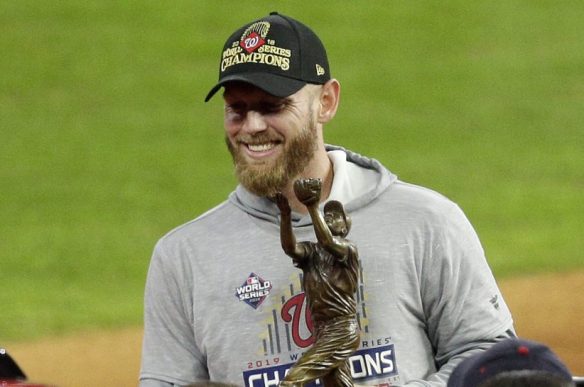
Stephen Strasburg

The proud and happy MVP of the 2019 World Series may face career-over now.

Stephen Strasburg’s father moved to northern Virginia to be closer to his son. Three weeks after Strasburg got a stress-reaction diagnosis, his father died. The son, an only child, cleaned the father’s apartment out last fall and discovered the old man kept a library of newspapers and magazines chroncling his baseball career.

There it was. From Strasburg’s days as San Diego State’s most-hyped major league draft prospect to his early Nationals splash, all the way to his triumph winning the 2019 World Series’ Most Valuable Player award. And all the injury-addled points around and in between following his early-career Tommy John surgery.

“Time has gone so, so fast,” he told Washington Post writer Jesse Dougherty. “A lot of guys that you played with have moved on and they’re in the next chapter of their lives. It’s crazy to think about how short baseball careers can be.” Crazy and, in Strasburg’s case, sobering and saddening.

A month after that Series triumph, Strasburg got his fondest wish. In essence, and I said as much at the time, he clicked his spiked heels three times and pleaded, “There’s no place like home! There’s no place like home!” He got his wish, a seven-year, $245 million contract extension making him a Nat for life. It’s what he didn’t wish for that has Strasburg at a sad crossroads now.

He didn’t wish not to pitch on. But since undergoing thoracic outlet syndrome surgery, Strasburg has pitched only once, last June, before hitting the injured list again, Dougherty observed, with a stress reaction in two ribs. That was well enough after Strasburg underwent carpal tunnel syndrome surgery—and learned the hard way that that was a mere pilot fish for TOS.

If you look at Strasburg now, even at age 34, he still looks as though he could go out and give you seven innings. But he only looks that way. Underneath, his arm and shoulder remain a mess. There’s the very real chance that all the surgery on earth won’t let Strasburg return to the mound again. Ever.

And it’s not for lack of trying. Dougherty has recorded Strasburg’s efforts to rehabilitate, all the way down to limiting his workouts to his lower body only to discover those, too, strain his upper body because of nerve damage. Last fall, Strasburg still hoped to get well enough to pitch again. By now he may be hoping just to accept it if his body finally tells him pitching again isn’t an option.

The Nats have had little beyond trouble since that stupefying World Series triumph. Now they’ve got a bigger pile of it above and beyond their 25-33 record this year and their sitting at the bottom of the National League East heap. Strasburg’s been shut down entirely since late April with severe nerve damage. This may be the prelude to shutting down his pitching career entirely.

The Nats are on the hook for the rest of Strasburg’s contract after they couldn’t insure it.  Dougherty reports that sources close to the Nats say they might not have spent atop Strasburg’s extension to insure the deal if they could have found an insurer willing to work with Strasburg’s injury history. Naturally, the jerk brigades can be expected to say Strasburg went from World Series hero to common thief.

You can’t convince them, try though you might, that even a young man whose pitching career has been marked as much by injuries as by triumphs on the mound doesn’t sign a nine-figure deal expecting to make only eight major league appearances in the time since he signed. Injuries may come with the territory of professional sports, but you can’t name one professional athlete who goes to the park thinking he’d really love to turn his arm and shoulder into a science experiment.

Strasburg’s had enough trouble in his career, whether his injuries or whether misperceptions about him as a man. For the longest time his stoic public demeanor caused people to mistake him for being a jackass. Behind it, he had to learn how to pitch with his mind when his body eroded his fastball somewhat. He took the misperceptions head on in 2019, letting his teammates loosen him up, loosening himself up more with the writers who covered the team.

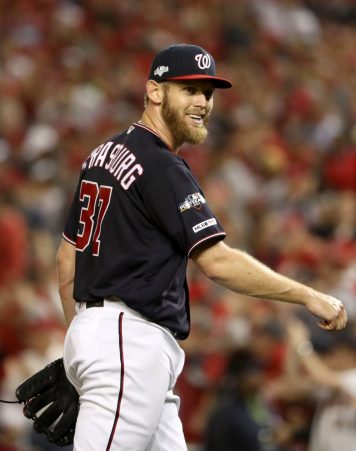
Stephen Strasburg

It took Strasburg a long time to let joy in his work show before the public, but show it he did as he triumphed in the 2019 Series.

TOS happens when blood vessels and/or nerves between your collarbone and your first rib compress, causing shoulder and neck pain and finger numbness. The surgery for it cuts somewhat invasively into the shoulder and the back. The surgeon removes a cervical rib and a pair of small scalene muscles.

Can pitchers return from it successfully? The known results are a mixed bag. When now-retired former Mets pitching star Matt Harvey underwent the procedure in 2016, FanGraphs writer Craig Edwards took a deep dive. For every Bill Singer or Kenny Rogers or Aaron Cook who can pitch a long enough time after the surgery, there’s a Harvey, a Josh Beckett, a Chris Carpenter, a Phil Hughes, a Noah Lowry who can’t.

“Counting on a pitcher who has been through this injury is a terrifying proposition . . . until we have a better track record of pitchers returning from thoracic outlet syndrome, it will keep its reputation as one of the worst arm injuries that a pitcher could suffer,” wrote Beyond the Box Score‘s Nick Lampe a year before Harvey’s surgery. Post-TOS pitchers might or might not lose velocity on their pitches but they’re very likely to lose pitch command.

If they signed delicious contract extensions before turning up with the condition, they’re going to be targeted as thieves by witless fans and careless writers who prefer gorging on the red meat of a fat contract going upside down to digging deep and seeing whether something physical might be the real cause. As if injuries somehow equal moral turpitude or mortal sin.

Don’t let the injuries or the jerks obscure that, when he could pitch, Strasburg was often remarkable, often enough great, and deadly in the postseason: he has a lifetime 1.06 postseason ERA and a 2.07 postseason fielding-independent pitching rate. His bold pitching in Game Six of the ’19 World Series made possible the Nats’ survival to the seventh game they won surrealistically.

When he stood tallest as the 2019 Series MVP, Strasburg spoke soberly in the midst of the Nats’ celebrations, even as he’d finally learned to loosen up enough to let his teammates hug him and make him show his joy. “When you have the ups and downs, I think you can learn just as much from the downs as you can the up,” he began.

I’ve learned that I’m a perfectionist. I’ve learned that I’m a control freak. And in this game it’s very hard to be perfect. It’s very hard to control things. But the one thing that you can control is your approach and how you handle your business off the field. And when you go out there and compete, it’s just about execution. And you put in all the work in the offseason, in between starts, to go out there and try and be the best version of yourself. And that’s something you can control every time.

Until or unless your body says not so fast, Buster. Yet again. This time, his body may be telling Strasburg it’s time to think about the rest of his life, as a husband, a father, a man. There shouldn’t be a juror on earth—in Washington or elsewhere—who’d vote against him if he does.