The Twins deliver a stunning signing: Carlos Correa

Carlos Correa

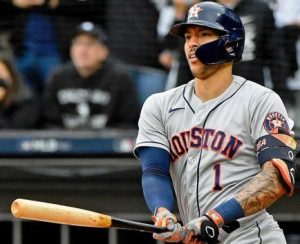
Almost nobody expected the longtime Astros shortstop to sign with the Twins.

It’s hard to look at Carlos Correa signing with the Twins for three years and $105.3 million without knowing the Astros’ remaining Astrogate contingent is reduced officially by one. There are now only three position players and one pitcher remaining from the tainted 2017 World Series winners.

This should be good for the Astros in terms of leaving the Astrogate taint further and further behind them. But I suspect it won’t be. With only four Astrogate-team members left last year, the Astros still heard it loud and long from fans on the road. Some of it was mere booing, catcalling, and “chea-ter!” chants. Some of it was inflatable and actual trash cans hitting fields.

I still suspect it’s not going to stop until the last Astrogater standing no longer wears an Astro uniform. Not until second baseman Jose Altuve (who actually didn’t partake all the way in the Astro Intelligence Agency’s 2017-18 off-field based, illegal camera-abetted, electronic sign-stealing operation), third baseman Alex Bregman, first baseman Yuli Gurriel, and pitcher Lance McCullers, Jr. move to other teams if not into retirement.

As it happens, I have tickets for what will now be Opening Day, period, in Angel Stadium on 7 April. Guess who the Angels host to start their regular season. My son and myself will probably wonder en route the ballpark how many other Angel fans will turn up with inflatable trash cans, bangable trash cans, and more to continue letting the Astros have it.

It took decades before the 1951 New York Giants were verified once and for all as off-field based sign-stealing cheaters en route the comeback that forced the fabled pennant playoff. It took only two years from the 2017 World Series to expose and verify the AIA. And it took only a couple of hours during the pandemically-aborted 2020 spring training for the Astros to show the world they didn’t quite think their cheating was that big a deal.

Correa since the infamous spring training 2020 presser has been maybe the most stubborn defender of the Astros’ 2017 Series title. “When you analyze the games,” he said before the coronavirus closed that spring training and half the season to come, “we won fair and square. We earned that championship.”

Funny, but that’s not exactly what Correa said at the infamous presser. While Astros owner Jim Crane tripped over himself, Bregman tossed word salad, and since-gone outfielder Josh Reddick “couldn’t really say [the AIA operation] did or didn’t” give the Astros an advantage, Correa said, essentially, not so fast:

It’s an advantage. I’m not going to lie to you. If you know what’s coming, you get a slight edge. And that’s why [then-general manager Jeff Luhnow and then-manager A.J. Hinch] got suspended and people got fired because it’s not right. It’s not right to do that. It was an advantage. But . . . it’s not going to happen moving forward.

After the Braves nailed last fall’s World Series at the Astros’ expense, Correa spoke in terms that would have made him a fit on the 20th Century Yankees.

Second place is not good enough for us. I know it’s not good enough for you guys. But it speaks volumes of how good our organization is, how talented our clubhouse is. Five ALCS in a row. Three World Series in five years. I don’t know what else you want to ask from a great ball club . . .People expect greatness when you talk about the Houston Astros. They expect us to make the playoffs every year. They expect us to be in the World Series every year.

But the only one they won is the one that just so happens to be tainted.

And, speaking of the Yankees, take a poke around the vast multitudes that root for or at least follow them and it seemed as though the number one thought in and out of their minds Saturday morning was, How on earth could the Yankees miss out on signing Correa? Did they really take Josh Donaldson’s contract on in that trade with the Twins just to let the Twins snatch Correa with the savings?

Others thought Correa outsmarted himself into taking considerably less with the Twins than he thought he might get on a market that got forced into overdrive thanks to that ridiculous owners’ lockout. But he’ll pull down the fourth-highest single-season salary of 2022, behind pitchers Max Scherzer (Mets) and Gerrit Cole (Yankees) plus outfielder Mike Trout (Angels).

The deal also includes opt-outs after this season and next. Turning 28 in the final third of this coming September, and assuming he has a typically Correa season in Minnesota, he could still opt out and play next winter’s market for something more to his supposed liking. Maybe he didn’t really outsmart himself, after all?

Maybe the Yankees still have a spring surprise yet to play. They unloaded Gio Urshela (shortstop) and Gary Sanchez (catcher) to bring Donaldson (third base), Isiah Kiner-Falefa (shortstop), and Ben Rortvedt (catcher) aboard. Maybe they have Kiner-Falefa in mind to play support after they sign free agent shorstop Trevor Story? Maybe?

Or maybe the Twins have decided, yes, they’re coming into it to try to win it, including enticing the shortstop anchor from the penthouse of the American League West for a season at least. Maybe they can make Correa happy in the Twin Cities, after all.

Maybe he can join his fellow high 2012 draft pick Byron Buxton (Correa and Buxton were numeros uno and two-o in that draft) to yank them from the basement to the penthouse. He did prove last year that he knows how to win without any funny business that anyone knew of, even if the Astros came up two bucks short in the World Series.

‘[T]he makings of a formidable lineup are present in Minnesota, though they’ll need a few things to break right,” writes MLB Trade Rumors’s Steve Adams, who also notes their “patchwork starting [pitching] rotation” remains a cause for some alarm even with trading for Sonny Gray from the apparently tanking Reds.

From the defensive side of things, Correa gives the Twins a pair of Platinum Glove winners, joining Buxton in that regard. With quality defenders like [Max] Kepler, Urshela and young catcher Ryan Jeffers also occupying key spots on the diamond, the Twins should have a strong defensive team overall. The Twins already ranked 12th in the Majors both in Defensive Runs Saved and Outs Above Average in 2021, and Correa should boost both marks.

There’s something else Correa could do now that he’s become a Twin, too. Something not exactly unprecedented. He could become the latest 2017 Astro to drop all pretenses, denials, and whataboutisms, and come a lot cleaner about Astrogate.

That began with utilityman Marwin Gonzalez, who signed with the Twins as a free agent for 2018, then with the Red Sox as a free agent for 2021, got released by the Red Sox last August, and signed to return to the Astros for their run to the World Series.

Gonzalez broke the ice around the time of the infamous 2020 Astro presser. “I’m remorseful for everything that happened in 2017,” he told reporters, “for everything that we did as a group, and for the players that were affected directly by us doing this.”

He, too, didn’t use the C word. Maybe it’d be too much to expect Correa to use it, too, if he decides it’s safe to come all the way clean now. But it would give him a better look either way than the one he often had clinging stubbornly to the idea that the 2017 World Series title wasn’t really tainted.

Freeman gets the sixth year he wanted—from the Dodgers

Freddie Freeman

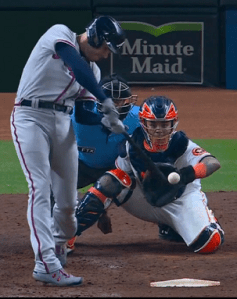
Freddie Freeman, crossing the plate after hitting what proved last fall’s NLDS-winning home run gainst Josh Hader and the Brewers. The Dodgers now give him what the Braves wouldn’t.

Freddie Freeman got what he wanted most . . . from the Dodgers. A sixth year on his next contract. The dollars are nothing to dismiss at $162 million total and $27 million annual value. And Freeman now has the pleasure of playing for the team stationed about an hour away from where he grew up in southern California.

The Dodgers weren’t the only team in play for Freeman if the Braves inexplicably and falsely decided they couldn’t afford to give him the sixth year he wanted. The Padres had eyes for him. So did the Blue Jays. So did the Red Sox. Aside from the benefits the Red Sox would have reaped from Freeman’s hitting and leadership style, there’d have been another mad fun factor.

The Yankees re-upped Anthony Rizzo after all on a fresh deal. Rizzo and Freeman have a long-standing friendship that translates now and then to deliciously hilarious moments on the field together. Especially Rizzo, sent to pitch to Freeman while the Braves were blowing the Cubs out last April, striking Freeman out swinging on five pitches in the bottom of the seventh last April.

The laughter between the pair was priceless. In the thick of the usual Yankee-Red Sox rivalry, it would have been much needed levity if the Yankees might be blowing the Red Sox out and Red Sox manager Alex Cora could have ordered Freeman to the mound to pitch to Rizzo; and, if Freeman could have exacted friendly revenge by striking Rizzo out.

So much for fields of dreams. Right now that sound you hear is Dodger fans crowing, “We had him all the way!” From the moment Freeman hit his first free agency after his Braves won last year’s World Series, you couldn’t swing a bat without it smashing into the hind quarters of a Dodger fan believing to his or her soul that a Dodger uniform would be the next wardrobe addition for the native of Villa Park, California, just a few miles east of Anaheim.

From the same moment, though, you couldn’t swing a bat with it smashing into the hind quarters of a Braves fan praying from his or her soul that the Braves, somehow, some way, would do right by the franchise face who’d done nothing but right by them from the moment he first turned up at first base in Braves’ silks.

Then, during the owners’ lockout, when Braves owner Liberty Media’s 2021 financials were released as mandatory for a publicly-traded corporation, you saw just the Braves’ considerable 2021 revenues and very considerable 2021 profit. And you realised any talk of the Braves being “unable” to afford to make Freeman a Brave for life was a shameless lie.

This Braves ownership couldn’t bring itself to do what a previous Braves ownership did whenever Hall of Fame third baseman/former franchise face Chipper Jones came to within striking distance of free agency, get him extended or signed to a coming new deal before he could hit the market, knowing Jones’s baseball heart remained with them.

This Braves ownership preferred to spend less on an import first baseman, four years younger than Freeman, dealing for him a day before extending him eight years and $168 million worth. Matt Olson won’t earn per season what Freeman will, and he may well shake out as essentially the Braves having swapped a Freeman for a Freeman Redux. May.

But the Braves’ corporate overlords sent the message clear enough and shameful enough: The only ones in baseball expected to be loyal are the players. Just the way they always were. This isn’t purely a free agency era thing, and anyone who says otherwise either needs a refresher in baseball history or is too willfully blind to allow it.

Have a good gander at the roll of Hall of Famers whose careers were entirely or mostly in the reserve era, the era before Andy Messersmith finally finished in 1975 what Curt Flood began in 1970. Those would be players elected before 1980. There are 127 of them. Now: 89 played for two teams at minimum; fourteen played for five teams at minimum. That would leave you with (count them) 24 single-team Hall of Famers from the reserve era.

Let’s look at the Hall of Famers elected after 1980, men whose careers careened into the free agency era or who played all or most of their careers during the era. There are sixteen such single-team Hall of Famers—including Jones. The free agency era has yet to surpass the reserve era for length, so it’s fair to say that both eras sent an equivalent portion of single-team players to Cooperstown.

What Joe and Jane Fan and no few writers (who really ought to know better) still forget is that, during the reserve era, players had absolutely no say in where they played, and owners could and did trade or sell them at will, and not always for reasons that made purely baseball sense.

Fans and writers alike have broadened their view in recent times, appropriately. You could see more than the fans and writers fuming over the owners’ lockout before it was finally resolved and baseball could get back to the serious work of play.

You could see them fume over the prospect that the Braves would do exactly as they did, declaring expendable the guy who stayed the course from the lows to the competitive highs, all the way to their first World Series triumph since the Clinton Administration. If the Braves wouldn’t give Freeman the sixth year he wanted, the Dodgers were only too willing.

That’s going to be some packed Dodger lineup coming your way. With a small pack of All-Stars including five-timer Freeman. With a small pack of MVP winners, including Freeman, apparently resurgent Cody Bellinger, and Mookie Betts. With Trea (The Slider) Turner acquired at last year’s trade deadline now able to play his natural position at shortstop following Corey Seager’s free agency departure to Texas. With aging but still effective future Hall of Famer Clayton Kershaw re-upping for 2022 at least.

If Olson gives the Braves both solid performance on the field and at the plate, and proves to be a solid clubhouse presence, that might take some of the sting of losing Freeman away. Some. Olson knows he might “succeed” Freeman without truly “replacing” him. Returning Ronald Acuna, Jr. knows he, too, might “succeed” Freeman as the Braves’ face without truly replacing him.

But if the Dodgers tangle with the Braves in the postseason to come, the Braves may learn the hard way what their ownership’s concept of “loyalty” can cost in more ways than one. May.

Loyalty, in the eye of the beholder, still

Freddie Freeman

Freddie Freeman, hitting his 2021 World Series Game Six home run, but the face of the Braves no more. (Fox Sports screen capture.)

Let’s talk about “loyalty.” But let’s do it reasonably. It never truly existed in baseball, whether during the reserve era or the free agency era. In the former, teams could trade or sell players at will and players had no choice in the matter, but in the latter a player has the right to play his job market once his contract expires.

Today’s players also have the rights to insert into their contracts lists of teams to which they’d consent to be dealt. Often enough, too, their contracts include clauses allowing them to opt out of their incumbent deals and test their markets a little earlier.

Joe and Jane Fan often still think it’s the players who’ve lost the meaning of the word “loyalty.” They need reminders that players learn or re-learn that loyalty is too often in the eye of the beholder, especially among their employers. The defending world champion Braves just handed them a beauty of a reminder.

Their franchise face since around 2011 (when he finished second to his then-teammate Craig Kimbrel as the National League’s Rookie of the Year), Freddie Freeman remains an unsigned free agent, albeit one whose heart and soul told him there was still no place like home so long as the Braves would do right by him in return for him having done so right so long by them.

The Braves elected instead to trade for another first baseman, Matt Olson, who looks a lot like Freeman on the surface and is four and a half years younger. Then, seeming to add insult to grievous injury, the Braves managed somehow to sign Olson to an eight-year, $168 million contract extension within 24 hours or so after making the deal to make him a Brave in the first place.

Throw in the four prospects the Braves sent the Athletics to make Olson Freeman’s successor, and the Braves paid a phenomenal price for deciding that even Freeman’s attachment to the team by which he’d done nothing but right over his first twelve seasons didn’t necessarily matter when it came to cold, hard business.

All of a sudden, it didn’t matter that Freeman kept the faith as the Braves went from reconstruction to contention to a return to the Promised Land at long enough last. (Until last fall, they hadn’t gotten there since the first year of Bill Clinton’s second term in the White House.)

Signing an eight-year deal to stay the course and stay a Brave, which is just what Freeman did in 2014, he kept that faith during four putrid seasons followed by four of the Braves returning to contention. The climax only began when Freeman parked a Josh Hader service in the left center field seats for what proved the game and 2021 division series win that sent them to the National League Championship Series in the first place.

It finished when Freeman delivered the final two runs of the Braves’ emphatic World Series-winning Game Six triumph in Houston, an RBI double to the back of left center field in the top of the fifth, and a home run bounding off the Phillips 66 porch above Minute Maid Park’s center field in the top of the seventh. And, when he caught the final out of the set as shortstop Dansby Swanson had to throw to first on Astros first baseman Yuli Gurriel’s grounder.

“It’s a situation unlikely to repeat itself,” writes Yahoo! Sports’s Zack Crizer. “Wrack your brain all you want, and you probably won’t come up with a star who bridged a rebuild quite like Freeman. He was an established, nine-figure extension-worthy player when the Braves blew it up. And he was an established, nine-figure free-agent-to-be when their reincarnation reached the pinnacle.”

And he climaxed the Braves’ improbable self-resurrection from midway last year—when their entire outfield needed to be rebuilt on the play—to hoisting one of commissioner Rob Manfred’s pieces of metal when it all ended with a flourish.

Those comparing Olson now to Freeman at the same age might care to examine both over the six seasons and counting of Olson’s career but a little deeper than normal. Like Freeman, Olson can hit and slug. Olson’s a slightly better defender at first base, but if you measure them according to my Real Batting Average metric—total bases + walks + intentional walks + sacrifice flies + hit by pitches, divided by total plate appearances—there’s a decent size gulf between them:

Player, 2016-2021 PA TB BB IBB SF HBP RBA
Freddie Freeman 2868 1370 362 62 15 33 .642
Matt Olson 2369 1046 272 25 14 35 .588

A 54-point gulf between them. In fairness, though, Olson spent his first six seasons with a none-too-great home park in which to hit, and he’s been measurably better on the road so far. Freeman has been practically the same hitter at home or on the road over his career thus far. But give Olson a park like Freeman’s Truist Park in which to hit at home, and he would get a lot, lot closer to Freeman’s performance papers.

So maybe, big maybe, in pure baseball terms the Braves switched a Freeman with a Freeman. If so, why on earth do it in the first place when it involves not just one of the game’s elite first basemen but a still-young man who was only too happy and proud to wear the Braves uniform and would have loved nothing more than to wear it to the end of his playing days?

The Braves are said to have offered Freeman five years to come, and Freeman is said to have wanted the sixth. Adjusted for inflation, Freeman’s now-expired eight-year extension equals the one Olson has now signed. As Crizer observes dryly, the Braves basically signed a slightly younger Freeman.

But Olson’s not Freeman redux just yet. We don’t know what kind of clubhouse cred Olson will prove to develop as a Brave. Freeman had such cred to burn. Assorted now-former Freeman teammates spoke of losing him as just about a death in the family, about losing a guy who wasn’t just a game or season-changing player but a guy who reached to pull everyone else up with him.

What of Freeman’s age? Well, now. He probably has a better chance of keeping his formidable bat for the entire eight seasons to come than his legs and reflexes at first base. The designated hitter becomes permanent in the National League this year. It’s entirely conceivable that the Braves re-signing Freeman for just the six years he sought meant they’d keep a quality first baseman for its first four and still have a quality DH over the final two.

Even general manager Alex Anthopolous sounded as though he’d made the Olson deal at all but gunpoint. In the wake of revelations that the Braves’ owners, Liberty Media, generated such revenues and profit last year that put the lie to the owner-side pleas that investing in baseball isn’t investing profitably, it sounds even more now as though, to the Braves, loyalty was about as valuable as Major Strasser described human life in Casablanca.

Olson to his credit isn’t even thinking about trying to “replace” Freeman. “I’m just going to go out there and do what Matt Olson does,” he told the San Francisco Chronicle. So far, so good, for him, never mind that you can’t remember Freeman ever referring to himself in the third person.

But do you think they’re going to love Freeman’s clubhouse embrace and his penchant for the lefthanded inside-out swing in Boston? (They need anything resembling a quality first baseman who can hit.) In San Diego? (They’re unafraid to spend and they’re shopping incumbent Eric Hosmer, who’s no Freddie Freeman and has barely been an Eric Hosmer since leaving Kansas City.) In Toronto? In Los Angeles?

Freeman meant enough to the Braves, their fan base, and even the opponents who respected and, yes, enjoyed him, but they meant something to him, too.

“We’d lost 97 games six years ago. And we’re looking at four straight division titles [since] and a world championship now,” Freeman said in a television interview right after the World Series ended in triumph. “It’s just a testament to this organisation, the guys they brought in, the front office, they pushed all the right buttons and we played so well for the last three months . . . Being in this organisation means everything to me . . . Everyone knows this is a crazy game, a crazy business, but everyone knows where my heart is, and this is the Atlanta Braves.”

The Olson deal sealing Freeman’s future away from Atlanta reminds one who was there of the manner in which a certain university president, destined to become a baseball commissioner, nailed how Mets fans felt when contentious negotiations (and scurrilous media attacks) turned into the unceremonious purge of a certain Hall of Fame pitcher in 1977:

[A]mong all the men who play baseball there is, very occasionally, a man of such qualities of heart and mind and body that he transcends even the great and glorious game, and . . . such a man is to be cherished, not sold.

Or, left to the waiting arms of another team for whom those very qualities of heart, mind, and body might mean another trip to the postseason that includes another lease upon the Promised Land.

Tiny sweetening for pre-1980, pension-less players

For 525 pre-1980 major leaguers, their cups of coffee are sweetened only slightly by a raise to their still-short-of-full-pensions annual stipend.

Once upon a time, a World War II-era radio commentator named Gabriel Heatter opened the lion’s share of his broadcasts with, “There’s good news tonight!” For 525 remaining pre-1980 short-career major league players denied pensions in the 1980 pension plan re-alignment, there was a small but significant spot of good news to start the week.

The New York Times‘s David Gardner, writing of one such player, Aaron Pointer, mentioned almost in passing that not only will Pointer and the others receive the annual stipend payments the now-solved lockout blocked in February, but the stipend will increase by fifteen percent over five years.

The stipend in question was arranged by the late Major League Baseball Players Association director Michael Weiner and then-commissioner Bud Selig in 2011. The original deal delivered $625 per 43 days’ major league service time for those players, up to $10,000 a year before taxes.

A fifteen-percent increase isn’t close to what those former players deserve, considering how unconscionably they were frozen out of the 1980 pension plan re-alignment, but it’s something. The bad news is that they still can’t pass their stipend to their families upon their deaths.

“That’s a good move, and I’m glad they remembered us,” says Pointer, the last full-season .400+ hitter when he did it in Class-D minors in 1961, to Gardner. “Although it could have happened earlier, and it should have happened earlier. A lot of guys who have passed won’t benefit, but it does help the guys who are still alive. It’s just a shame: It should have happened years ago.”

Several such players to whom I’ve spoken, since my first encounter with former Mets/Senators/Tigers pitcher Bill Denehy in 2019, have said they believe one key reason for their freeze-out was a perception that the bulk of them were only September call-ups, enjoying what journalist Douglas J. Gladstone termed—as the title of his book about these players and the freeze-out called it—A Bitter Cup of Coffee.

Denehy himself made all three of his major league rosters out of spring training, including as a rookie with the 1967 Mets. (His teammates included Hall of Famer Tom Seaver, with whom he shared a Topps rookie card that season.) A misdiganosed shoulder injury compromised his career; numerous, excessive cortisone shots have had the long-term effect of rendering him legally blind since early 2005.

The September question shouldn’t even have been an issue in the first place, particularly since the 1980 pension re-alignment changed pension vesting to 43 days’ major league service time, period, as opposed to the previous four years’ vesting time. It also changed the vesting time for qualifying for MLB’s health benefits plan to one day’s service time.

But I’ve begun examining the game logs at Baseball Reference of all remaining 525 such short-career, pre-1980 players. Running down in alphabetical order just the first 25 names on the list, none of those 25 were mere September call-ups.

Fourteen of the first 25 either came north with their major league clubs in at least one April or joined their teams during at least one April to play several games during that month. Three arrived in at least one May; four more, in at least one June; three more, in at least one July; and, one in at least one August. I suspect that, once I’ve seen the game logs of the remaining 500 names on the list, I’ll discover much the same.

Those players paid their MLBPA dues faithfully and supported any and all actions to begin prying players out of the abusive reserve era and toward their rightful free agency. Many of them had their moments in the sun of the Show even if they weren’t destined to become long-term players for assorted reasons, never mind superstars.

But you’ll be very hard pressed to find more than an extremely few sportswriters with national reach (Bill Madden of the New York Daily News has been a very notable and honourable one of them) who have written more than cursorily or by-the-way, if at all, about these men and their pension freeze-outs.

The Players Association’s first director, Marvin Miller, once told frozen-out players that in 1980 the money to cover them wasn’t yet available fully but he believed future labour agreements would repair that. Miller’s tenure ended in the early 1980s; Denehy, Clyde, and other such players have said Miller’s largest regret was that the union didn’t redress that 1980 mistake completely.

Those to whom I’ve spoken since 2019 have told me they believe that, if Weiner had lived (he died of an inoperable brain tumour in 2013), he would have worked to get further redress for themselves and their otherwise frozen-out short-career brethren.

But we’ll never truly know. And today’s major league players, flush as they are even in minimum-salary terms, seem barely aware if at all that these men, who helped make their justly-earned and not-begrudged riches possible in the first place, settle for a mere stipend instead of a full, just-as-deserved baseball pension.

Baseball’s unlocked. But . . .

“I believe that God/put sun and moon up in the sky./I don’t mind the gray skies/’cause they’re just clouds passing by.” So wrote Duke Ellington, and sang Mahalia Jackson, in his 1943 magnum opus reworked for 1958’s album  Black, Brown, and Beige. The lyric was part of a segment called “Come Sunday.”

Come Sunday, this Sunday, the gray skies yield metaphorically as spring training finally begins. And, early-series cancellations notwithstanding, there will indeed be 2,430 regular season baseball games played in a 162-game schedule this year. It might mean a tighter calendar, of course. But, given that, does it now feel as though spring has arrived properly at last?

Baseball’s owners’ lockout, which ended 26 years of labour “peace” needlessly, ended Thursday. Commissioner Rob Manfred called it a “defensive lockout.” Those who believe that might as well believe Vladmir Putin decided to defend himself against Ukranian “aggression.”

The owners could very well have elected to let baseball continue operating while they negotiated and hammered out a new collective bargaining agreement. The now-concluded 99-day lockout was and will ever be on them entirely. But they had the players right where the players wanted them. Sort of.

The players now have the owners accepting the largest hike in the so-called competitive balance tax—too long used by the owners as a de facto salary cap—since the tax was born after the 1994-95 players’ strike. They also have the owners accepting the largest jump ever in the minimum major league player’s salary, and a pre-arbitration bonus pool for young players emerging as early stars that’s worth $230 million new money just over the time span of the new CBA.

Yet the Major League Baseball Players Association’s vote for accepting the terms was a mere 26-12. The Athletic‘s Evan Drellich writes that it was “telling” for “roughly a third of the executive board [feeling] there was more to accomplish right now, in continued negotiations in 2022, not in the future.”

There’s the warning from Hall of Fame baseball writer Jayson Stark: The new competitive-balance tax threshold may not necessarily mean putting the “competitive balance” all the way into it:

You know those seven teams that came within $8 million of going over the [old] threshold last year? They’re likely to do that same thing this year—other than the Mets, who are already well north of it. But if all those teams spend another $20 million or so apiece, that’s a notch in the win column for players, except for one thing . . . teams that weren’t spending money before still have no incentive to spend now.

“All this does is just increase payroll disparity,” said one longtime club official. “Just because the Phillies go up $10 million doesn’t mean a team like the Marlins goes up $10 million.”

In other words, there’s still room enough for continuing tanking. Maybe that was why that one-third of the union’s executive board felt there was still more to get done now, if not yesterday. Remember Hall of Fame shortstop Derek Jeter took a hike from running the Marlins almost a fortnight ago, saying, essentially, that he didn’t sign up to preside over the Fish only to see their “direction” resemble a killifish and not a barracuda.

What, then, of commissioner Rob Manfred, who is probably the single worst salesman in baseball and barely sold it when he proclaimed at a Thursday press conference that he was “thrilled” the lockout was over and a new deal was done?

At least three questions presented to him inquired about future mended relationships between MLB and those who actually play baseball. Manfred actually doffed his stegasaurus-in-the-china-shop cloak to admit he hasn’t been so successful at promoting “a good relationship with our players. I’ve tried to do that. I have not been successful at that.”

Gee, what gave him the clue? Standing with almost no apology for the precept that the general good of the game is making money for the owners? Allowing the owners to go 43 days worth of silent after their lockout began? Dismissing the World Series championship trophy as “a piece of metal” while not quite holding all the Houston cheaters accountable when Astrogate tainted their 2017 World Series title and outraged as large a percentage of players as it did fans?

Saying it was Mike Trout’s fault Trout wasn’t considered baseball’s face outside the game itself? Abetting the owners trying to cheat the players out of their proper pro-rated 2020 salaries during the pan-damn-ically short season? Tinkering like Rube Goldberg with the game’s play, from the free cookie on second base to open each half inning to the three-batter minimum for relief pitchers?

Manfred did at least observe that the new deal should give the owners and the players more than a little room to move on working out such things as doing away with draft-pick compensation for players reaching free agency; and, on establishing a joint committee aimed at addressing issues involving field competition. But . . .

“The committee can implement rules changes with 45 days notice,” writes another Athletic staffer, Ken Rosenthal, “and with the league holding a majority of members, Manfred can push through any changes he desires. Will he do it, continuing the league’s chest-pounding, zero-sum style? Or will he and league officials show greater understanding that players are the product, and become better listeners?”

They’ve barely understood, if at all, that no fan has ever paid his or her way into a ballpark to see their team’s owner. “Recent history suggests that when the owners give in one area, they take from another, which again leaves the middle class of players vulnerable,” Rosenthal warns. “Don’t hold your breath waiting for the league to suddenly become more benevolent to its most valued employees, though even a mildly less aggressive approach would be helpful.”

But Rosenthal points to at least one team administrator not named Steve Cohen (the deepest-of-deep-pockets owner of the Mets whom enough owners fear for his willingness to invest in his team and its organisation) who has more than a clue. “It’s paramount,” said Twins president Dave St. Peter on a Zoom call to writers covering the team, “that we as an industry do a better job of building trust with our players.”

Coming in the wake of such petty tacks as scrubbing players from MLB’s own Website early in the lockout, St. Peter’s words may sound encouraging on the surface. But it’s wise to remember a remark once made often enough by the maverick journalism legend Sidney Zion: Trust your mother, but cut the cards.

Try not to get too hopped up over the new service-time adjustments, either, which mean rookies finishing with the Rookie of the Year or in second place for the award get a full year’s service time even if he didn’t spent the entire season in the Show. “[A]ny system based on counting days is a system that can be manipulated,” Stark warns. “So why do we suspect we could be back in this same, uncomfortable place in five years, trying to remind the powers that be again that there’s something wrong with a sport that rewards teams for not putting its best players on the field.”

For the moment, we can revel in a few things. The entire baseball family, from the teams to the fans, is watching to see the swift enough movement of the game’s remaining free agents. And we’ll be spared at long enough last the overwhelming, century-plus-old futility of pitchers at the plate wasting outs (those who can hit have always. been. outliers), now that the designated hitter will be universal instead of everywhere but the National League.

At long enough last, we should see a cutback in basepath injuries thanks to coming new bases that will be—relax, ladies and gentlemen—a mere three inches larger than the bases have been in the past, but designed with more give that may mean less leg injuries taking players out for two-thirds of a season or longer.

That twelve-team postseason format? With three wild cards per league? The good news is that the odds of a team with a losing record making the postseason under it aren’t great. Since the first wild-card game in 2013, Stark says, if this format had been in play only once might a sub-.500 team have burglarised its way into the postseason: 2017. (The Angels, the Rays, or the Royals.) And, the extra-card clubs would still average 87 wins.

“So despite this expansion,” Stark continues, “the baseball playoffs will still be the most difficult to make among the four major professional sports.” And still rather profitable for the owners, who stand to pull down $85 million postseason from ESPN with the third wild card. They may also change the trade deadline atmosphere, as Stark observes: “More buyers. Fewer sellers. Less incentive for teams hovering near contention in July to hold those depressing closeout sales.” May.

Myself, I remain in favour of something else: eliminating the wild cards entirely, adding two more major league teams to make sixteen-team leagues, and doing away with regular-season interleague play. But with or without the third of those, 1) divide each sixteen-team league into four four-team conferences; 2) best-of-three conference championships; 3) best-of-five League Championship Series (you know, the way the LCS was from 1969-85); and, 4) leaving the World Series its best-of-seven self.

Goodbye postseason saturation, welcome home genuine championship.

For now, I hope, too, that the remaining 525 pre-1980, short-career players maneuvered out of the 1980 pension realignment won’t be forgotten much longer, either. The lockout also suspended the annual stipend the late MLBPA director Michael Weiner and former commissioner Bud Selig got them—$625 per 43 days’ major league service time, up to $10,000 a year. (It would have been paid normally in February.)

Which would, of course, require what they once called the vision thing. This commissioner and his bosses tend to lack that. Today’s players have it, but they could use a lot more depth. Doing right further for those pre-1980 men whose playing careers were short, but who supported the union in its most critical early years, toward the end of reserve era abuse, and the rightful advent of free agency, would show vision even philosophers only imagine having.