Whitey Ford, RIP: The Chairman takes his leave

“A couple of New York kids who made good,” Sandy Koufax’s biographer said of Koufax (Brooklyn-born) and Whitey Ford (Manhattan-born, Queens-raised), here sharing a handshake before Game One of the 1963 World Series.

When Jane Leavy researched and interviewed for her splendid biography of Hall of Famer Sandy Koufax, she discovered something about then-U.S. poet laureate Robert Pinsky. Pinsky had an animus against Koufax’s fellow Hall of Fame pitcher Whitey Ford.

Ford, who died Thursday at 91, was Leavy’s girlhood hero. Pinsky’s poem “Night Game” addresses Ford and Koufax, who met twice in the 1963 World Series with Koufax beating Ford twice. But over a decade earlier, Pinsky as a boy waited at Fort Monmouth, New Jersey to get Ford’s autograph.

Ford then was an emerging Yankee hero, a second place 1950 American League Rookie of the Year finisher who’d rolled a 2.51 ERA after his June call-up and beat Hall of Famer Robin Roberts to finish the Yankees’ World Series sweep of the Philadelphia Phillies’ “Whiz Kids” pennant winner.

Now, Ford pitched for the Army Signal Corps to fulfill his military obligation of the time. When Pinsky finally got to face Ford and asked for the autograph, Ford replied, “Not now, kid.”

When Pinsky told the story to Leavy while talking about “Night Game,” she called Koufax the morning after. After a couple of moments’ silence on the other end of the line, she noted, Koufax asked her, “Do you think he’d like a ball?” Two weeks later, Pinsky received the ball, autographed by Koufax and accompanied by a small, handwritten note saying, only, “Whitey’s really a good guy.”

“Ford subsequently redeemed himself in Pinsky’s estimation,” Leavy wrote, “with a plaintive, if belated, explanation for his youthful rudeness: ‘Soldiers don’t give autographs.’ (And in mine by asking for a copy of Pinsky’s poem. ‘He wrote nice about Sandy?’ Whitey said. ‘I’d like to see that.’)”

This was the same Whitey Ford who had a classic reaction when Koufax, winner of a spanking new Corvette as the 1963 World Series’s Most Valuable Player, left the awards banquet to discover the car parked on the sidewalk . . .with a $15 parking ticket attached to the windshield. “Sandy has only two flaws,” Ford cracked. “He can’t hit, and he can’t park.”

That from the pitcher who once cost the Yankees a run in a World Series game when he tagged and left third base too soon on what should have been a sacrifice fly by his Hall of Fame battery mate Yogi Berra.

The Los Angeles Times‘s Hall of Fame sportswriter Jim Murray handed Ford his enduring nickname, when he wrote rooting for the 1950s Yankees was like rooting for U.S. Steel with Ford—whose eight World Series Game One starts is a major league record—the chairman of the board.

A compact lefthander at 5’10”, Ford was most renowned for two things. Thing One: the likewise compact delivery that relied as much on his brains as his repertoire, an assortment of off-speed pitches he threw all around the strike zone, since he couldn’t even throw the proverbial lamb chop past a snail. Batters hit .235 off him lifetime.

“If it takes 27 outs to win,” his longtime manager Casey Stengel once said of him, “who’s going to get them out more ways than Mr. Ford?”

“He was like a master chess player who used his brain to take the bat right out of my hands,” recalled one-time Boston Red Sox outfielder Walt Dropo. “You’d start thinking along with him, and then Whitey had you because he never started you off with the same pitch in any one sequence.”

Thing Two: Mr. Ford’s sense of humour. A man who spends the bulk of his career cleaning up after his Yankee bestie Mickey Mantle’s messes almost as often as he befuddles hitters and pitches in the World Series (his 33 consecutive scoreless World Series innings remains a record) needs a sense of humour. And maybe a healthy supply of anti-migraine medication.

Ford wasn’t exactly allergic to the night life in his native New York (he was Queens-born), but he wasn’t exactly allergic to knowing when to shut it down, either. “His fellow rogues, Mickey, Billy [Martin], and Toots [Shor, the legendary New York sports restauranteur], were all gone,” New York Daily News writer Bill Madden wrote in his 2003 book Pride of October: What It Was to Be Young and a Yankee, “but he had survived, still the same wisecracking, self-assured son of the city.”

Wisecracking and practical joking. When Yankee infielders Joe Pepitone and Phil Linz were still barely past rookie status, according to teammate Jim Bouton in Ball Four, Ford and Mantle told the pair they’d finally arrived and were ready to go out on the town with the big boys. In Detroit, Ford and Mantle instructed Pepitone and Linz to dress to kill, hail a cab, and head to the Flame where they were to ask for Mantle’s table.

Pepitone and Linz did as instructed. They dressed to kill. They hailed their cab. And discovered the hard way that the Flame—once a legendary Detroit jazz and rhythm and blues hot spot (among others, assorted future members of Motown’s legendary Funk Brothers house band had played the place)—was now a ramshackle wreck with the glass blown out and maybe two surviving toasted tables remaining.

Ford’s playful side extended to making sure the Yankee bullpen didn’t get bored when members weren’t called upon to warm up and get ready to go into a game. “I think it should be known,” Bouton wrote on 5 April, in the journals he kept to compose Ball Four, “that when Whitey Ford was pitching for the Yankees he set up a table with a checkered tablecloth in the bullpen. On the table there was an empty wine bottle with a candle in it. Also hero sandwiches. Whitey Ford had style.”

Ford was a thinking craftsman on the mound and a practical joking, fun-living fellow off it.

And influence. A month and a half later, Bouton had to record: “Hot flash! Whitey Ford’s Italian restaurant in the bullpen has a real rival in the Baltimore bullpen: wienie roasts.”

When Whitey and Joan Ford married in April 1951 in Long Island City’s St. Patrick Church, Stengel arranged a little surprise for the couple: he loaded the entire Yankee team, including Joe DiMaggio, onto a bus following an exhibition game to hit the church. One Yankee was too nervous to get off the bus, like his fellow rookies, so the newlywed Fords went out to greet him.

That’s how he met Mickey Mantle for the first time. The friendship that must have made Ford wonder often enough whether the devil was punking him started on a bus outside his wedding church. “Years later,” Ford said, “Mickey told me the highlight of that day for him was meeting Joan, not me.”

The ever-quick Ford got a measure of vengeance when his first grandchild was born. When his son-in-law phoned in the dead of night to announce the birth to Grandpa, Ford called Mantle—who went into the Hall of Fame with him in 1974—first thing in the morning. “You’re not going to believe this,” he said. “Last night for the first time in my life I slept with a grandmother.”

In Pride of October Madden wrote that Ford wasn’t always comfortable having been the sole survivor among the little night-owl group of himself, Mantle, and Martin. The only time Ford was ever uncomfortable with Stengel—who judiciously managed him as an every-fifth-day pitcher to save him for the bigger games of Yankee races and the Series—was when Casey neglected to align his 1960 Series rotation to let Ford pitch more than twice, which probably did cost them that Series as much as Bill Mazeroski’s winning home run.

Ford was also uncircumspect about his late-career ball doctorings. Admitting he turned to chicanery in a bid to hang on as long as he could until elbow and arm miseries forced him to call it a career in 1967, Ford swore he never did it during his Cy Young Award-winning 1961 or his likewise 20 game plus-winning 1963.

“Well,” he added puckishly, “maybe a little.”

“For a long time,” Bouton revealed, “Whitey got away with throwing a mud ball that was positively evil.” If the grounds crews wetted the infield or the mound a little too generously, or he and/or his late-career catcher Elston Howard could mix saliva and dirt surreptitiously, Ford would get a tiny mud load on balls. One-time Los Angeles Angels pitcher/flake Bo Belinsky once said, “If a mud ball was left for me on the mound, I had two outs waiting right there.”

“Ford could make a mud ball drop, sail, break in, break out, and sing ‘When Irish Eyes are Smiling’,” Bouton continued.

Eventually the opposition, particularly Bill Rigney, the manager of the Angels, got wise to him and he had to quit using the mudder.

Then he went to his wedding ring. He gouged such sharp edges into it that we used to kid him about having lost the diamond out of it. He’d scuff up the ball with the ring and make it do all the things the mud ball did, except maybe now the song was different. He got by with the ring for a couple of months . . .

After that, Ellie Howard sharpened up one of the buckles on his shin guard and everytime he threw the ball back to Whitey he’d rub it against the buckle. The buckle ball sang two arias from Aida.

Madden convinced Ford to show him around the Astoria, Queens neighbourhood where he grew up as the son of a Con Edison electrical worker. Ford pointed to a yellow-bricked apartment building where he’d lived ten years and adjacent to where his wife-to-be lived as a girl. “I was sixteen and she was twelve,” Ford said. “She had great legs. That’s what attracted me most about her. We moved three or four times when I was growing up there. I guess every time the rent was due.”

Some of Ford’s boyhood acquaintances and friends in that predominantly Irish, Italian, and Polish neighbourhood grew up to go into baseball as he did, including future coaches Tony and Al Cuccinello and future Minnesota Twins pennant-winning manager Sam Mele. One who didn’t go into baseball was a kid named Anthony Benedetto, whose family owned a nearby beauty salon.

“It wasn’t until he after he left the neighbourhood,” Ford said, “that he changed his name to Tony Bennett. Kind of like me, going from Eddie to Whitey, only I think his new name did a lot more for him than mine did for me.”

Baseball-Reference shows ten major league players (including two who eventually became managers) named Whitey. Be assured that if you just say “Whitey” in any gathering, they’ll remember Ford first. But neither they nor even longtime Yankee fans will remember him as quickly as his widow, two of his three children (his son, Thomas, died in 1999), and his grandchildren.

Once during an Old-Timers Day ceremony, Ford and Berra watched the Yankee Stadium video board display a tribute to Yankees past who had passed away that year. Yogi turned to Whitey and said, “Boy, I hope I never see my name up there!”

Ford can now tell Berra in the Elysian Fields, “Yogi, I never wanted to see your name up there, either!” Even at 91, Ford’s family and baseball fans alike weren’t quite ready to see his name up there, either.

The Astros in the ALCS? Relax.

Manager Dusty Baker gets a hug from catcher Martin Maldonado as the Astros celebrate bumping the Athletics off in their ALDS Thursday.

We just got one step closer to the possibility of at least one losing irregular season team turning up in the World Series, anyway. Maybe it’ll still be enough to make commissioner Rob Manfred’s hopes of too-far-expanded postseasons future, which may or many not involve as many as sixteen teams, disappear. Maybe.

The best way to make that disappearance happen would have been a Houston Astros-Milwaukee Brewers World Series, of course. Unfortunately, the Brewers didn’t keep their side of the bargain. The National League West champion Los Angeles Dodgers wouldn’t let them. If anything, the chance of an Astros-Dodgers World Series re-match got a lot bigger after Thursday’s doings.

On Thursday night, the Dodgers destroyed the plucky, exuberant, fun-fun-fun San Diego Padres 12-3, to finish a National League division series sweep in which only one game turned out close thanks to a near-imploding Dodger bullpen. At least they know who they’ll face in the National League Championship Series, thanks to the NL East champion Atlanta Braves wiping the suddenly-upstart Miami Marlins out 7-0 in a dissimilar sweep.

The Padres at least scored in each of the three games. The Marlins scored five in Game One but got shut out in Games Two and Three. By a Braves pitching staff that’s now pitched shutouts in four of their five postseason games. Maybe the chance of an Astros-Dodgers World Series re-match isn’t quite as powerful as you might think?

The Astros wrecked any Oakland Athletics comeback hopes by turning an early 3-0 deficit into an 11-6 Game Four demolition so profound that the A’s ninth-inning pushback resembled unanswerable cries for help from the bottom of the ocean after falling off the Bay Bridge just when they’d finally decided life was too precious to jump.

Admit it: When the A’s jumped Zack Greinke for three in the second it looked for awhile as though they’d force a Game Five. About a blink of awhile when all was said and done.

Matt Olson snuck a base hit through an Astro infield shift, Mark Canha hit one for which Astro shortstop Carlos Correa dove and barely missed for his first lifetime hit off Greinke, Ramon Laureano hit a full-count slider into the left field bleachers, and it looked like the Astros gamble with Greinke—sending him to start with his sore arm possibly not fully recovered—would fail.

Then the A’s starter Frankie Montas’s fortune ran cold in the fourth. How cold? Try Antarctic cold. Michael Brantley hit a two-run homer and Correa hit a three-run bomb, then Montas two more or less excuse-me outs while leaving first and second when manager Bob Melvin lifted him to go to his usually reliable bullpen.

This time, that bullpen didn’t have it. The Astros tore six runs out of that pen before they were finished. Between them, the Astros and the A’s finished setting a new division series record by hitting 24 into the seats all set long. Each team hit twelve. Including Brantley, Correa, and Laureano twice in Game Four. Altuve joined the Thursday bomb squad when he hit one out off Jake Diekman with Martin Maldonado aboard to complete the Astros’ scoring.

But there’s unfinished Friday business to come. The Astros don’t know yet whether they’ll meet the American League East champion Tampa Bay Rays or the AL East runner-up New York Yankees. The Yankees held the Rays off 5-1 on Thursday, somehow, some way, and they’ll open Friday with a distinct advantage named Gerrit Cole. Sort of.

The sort-of is that Cole has never pitched on short rest in his entire major league career. Ever. He’s pitched 106 games on four days’ rest, 67 on five days’ rest, and 31 on six or more days’ rest. It may be the first time in Cole’s sterling career when the phrase “roll of the dice” applies to him.

Can they get a miracle from Cole Friday? He faces Tyler Glasnow, credited with the Game Two win despite surrendering four Yankee runs. Glasnow hasn’t done it since he pitched nine games in relief for the 2018 Pittsburgh Pirates. They were the only nine relief gigs of his career to date. And the Rays will likely turn it over to their bullpen if Glasnow gets into trouble early enough.

Either way, Friday’s Yankees-Rays show will be must-see TV for baseball lovers in general but the Astros in particular. What a way to have to spend one of their only two days off before the ALCS begins—in San Diego’s Petco Park, under the pandemic-inspired semi-bubble/neutral-site plan.

As if the Astros didn’t have enough migraines this year. They lost Justin Verlander to Tommy John surgery and Cole to free agency. Greinke pitched better than his 4.03 irregular season ERA tells you before his arm soreness kicked over. (His 2020 fielding-independent pitching [FIP]: 2.80.) If their set with the A’s went to a fifth game, they’d have gone most likely to Framber Valdez to open and turned it over to their bullpen at the first sign of trouble.

Now they get to open the ALCS with Valdez—who beat the A’s with seven two-run innings in division series Game Two. Setting them up to work Greinke on his regular rest including a Game Seven if need be. Jose Urquidy will look to prove his ALDS Game Three outing—slapped silly for four home runs in four and a third innings—was an aberration, but beware: his irregular season 2.73 ERA was deceptive looking considering his 4.71 FIP.

They also get to show a little more that their 29-31 irregular season record just might have projected to an acquitting winning record, maybe even another AL West title, if the season had been full and normal. Might.

One key reason for that 29-31 record was being hit with an injury bug enough to rival the battered Yankees of the past two years. But, deeper reality check: this year’s Astros aren’t really as good as last year’s. Even if manager Dusty Baker finally overcame his lifelong prejudice and learned how to have as much faith in his youth as in his elder players.

They lost their best player of the future, 2019 Rookie of the Year Yordan Alvarez, to a season-ending injury. Altuve struggled early, found his stroke later in August, then hit the injured list with a knee sprain. They’ve lost key pitchers Chris Devenski, Brad Peacock, and Roberto Osuna to season-ending injuries. This postseason Astro staff could be called, plausibly, Greinke, Urquidy, and the Newer Kids on the Block.

Even with those compromises, this year’s Astro Core Five (Altuve, Correa, Alex Bregman, Yuli Gurriel, and George Springer) had a lower weighted on-base percentage than last year’s edition. It looked better for the Astros that they bombed twelve homers and averaged 8.3 runs a game against the A’s better-than-they-look pitching staff. Of course, the chatter about slightly deadened balls on the irregular season and slightly amplified balls for the postseason is entirely coincidental.

It bodes well for the Astros whether they get the Rays or the Yankees in the ALCS, and they know neither of those teams are pushovers. Scoring 33 runs against a crew of A’s that scored 22, knowing that often as not 22 runs are good enough to win a short set, gives the Astros a little extra comfort to take in.

It even bodes well for them that somehow, some way, they’ve managed to get this far even under the still-hovering clouds of Astrogate. They hit the irregular season running with only nine men left on the roster from the 2017-18 cheaters. They’re closer than you might think or accept to turning what’s left of that roster over and finally putting the Astrogate stain behind them.

Turning what’s left of that roster over? Well, Gurriel has re-upped for another season. But Springer and Reddick face free agency this winter. New general manager James Click has said he’d like to keep Springer on board even with young Kyle Tucker’s emergence, but whether the Astros have the dollars to do it (they’d like to avoid luxury tax penalisation if possible) is another question yet to be answered.

The pandemic did the Astros a huge favour in keeping them from normal ballpark crowds who surely would have let them have it long and loud, over both the scandal of their illegal electronic sign-stealing cheating and their more sad than sickening, mealymouthed non-apologies at that disaster of a February presser.

(Don’t even think about it. Once more with feeling: there’s a Grand Canyon-size difference between a team like the Boston Rogue Sox using what MLB itself provided already in video rooms to steal signs and send them to baserunners to send hitters—you know, Mom and Dad give the kiddies the liquor cabinet keys daring them not to drink unlawfully—and the Astros who a) took an existing outfield camera off mandatory transmission delay, or b) installed a second, illegal real-time camera to send enemy signs to extra clubhouse monitors.)

Now, let’s be absolutely fair about this. Continuing to bop this year’s Astros on the nose over Astrogate when they have only eight men left playing from that tainted 2017 edition is unfair. Unfair but unstoppable, unfortunately, human nature being what it is.

Human nature includes being aghast that genuinely great teams  who would have demolished the league regardless felt compelled to operating the 2017 Astro Intelligence Agency or the 2018 Red Sox Replay Room Reconnaissance Ring.

To too many people, cheaters once, cheaters always. Right? But nobody claimed the San Francisco Giants remained tainted for how their 1951 edition in New York cheated telescopically to pull off that dazzling pennant-race comeback and playoff force. Nobody really thinks the real curse upon the Cleveland Indians has to do with their 1948 telescopic cheating. (It doesn’t really have that much to do with trading Rocky Colavito at the end of spring training 1960, either.)

By all means hold the 2017-18 Astros to account in public opinion if Commissioner Nero didn’t, beyond a fine, a couple of stripped draft picks, and suspending their since-fired general manager, manager, bench coach (the Red Sox squeezed Alex Cora out as manager), and designated hitter. (The Mets squeezed Carlos Beltran out as manager before he even got to manage a spring training game for them.)

But don’t keep hammering this year’s Astros for it, until or unless someone discovers and produces proof of this year’s edition crossing to the dark side. (The Red Sox didn’t need anyone hammering them for their 2018 taint and similarly mealymouthed non-apologies. They plotzed this year all by themselves.)

You don’t have to root for or even like the Astros to give them whatever fair shake they deserve now. They’re a lot easier to like when you just watch them play baseball the way they normally play than they are when you have to listen to them talking to reporters. Which is what people have said about teams like the Yankees, the Dodgers, and even the St. Louis Cardinals for several generations, too, no?

Yet new manager Dusty Baker took their bridge and kept his and their marble (singular) through this season’s pandemic weirdness and Astrogate aftermath to sneak into the postseason at all. That has Baker in the Manager of the Year conversation and the Astros  on the brink of a possible third pennant in four seasons. The last team to go to three World Series in four seasons? Ladies and gentlemen, your 1998-2001 New York Yankees.

Consider this, too: With fans still kept out of the stands so far this postseason, it became too simple to hear every sound, noise, and utterance coming from the dugouts. Nobody heard anything this week that’s comparable to the Astrogaters banging the can slowly in 2017.

About the most suspicious sound coming out of Dodger Stadium during the Astros-A’s ALDS was the PA system DJ playing Booker T. & the MGs’ “Green Onions” at every opportunity. (That song was a huge hit—the year Dodger Stadium was born.) Some might wonder since when do today’s ballpark sound people have that kind of historic music sense. Speaking personally, it was music to my rhythm and blues ears.

The Great Escape

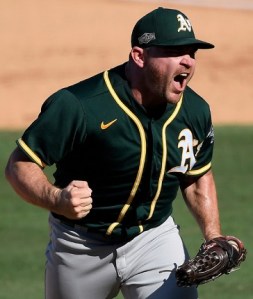
Liam Hendriks, who just might be able
to bust his way out of a double-chain-
locked footlocker if asked to do it.

Postseason baseball is littered enough with mishaps, mistakes, and acts of God (we think, often as not) that turn certain triumph into disaster in less than the proverbial New York minute. The Oakland Athletics got thatclose to seeing for themselves in the bottom of the eighth Wednesday afternoon.

When A’s catcher Sean Murphy’s glove was hit by the bat of Houston Astros right fielder Kyle Tucker with Carlos Correa aboard and nobody out, the catcher’s interference call stood an excellent chance of standing as the arguable worst postseason moment in A’s history.

That’s because it happened immediately after the A’s sacrificed their way back to a two-run lead in the top of the inning, with a pair of sac flies, one inning after Chad Pinder yanked them back from the dead and into a fresh tie with a long distance call.

The interference suddenly turned Oakland closer Liam Hendriks’s day’s work from somewhat routine with a three-up, three-down seventh into an eight-inning wrestling match. That was not what the A’s needed with a tenuous late, re-claimed lead, in a game they had to win to stay alive in the division series the Astros threatened to sweep.

It also could have made A’s manager Bob Melvin go from looking like a genius for bringing Hendriks in so soon in the first place to looking like a nut for . . . bringing him in so soon. But it turns out that Hendriks doesn’t like leaving his manager looking like a straitjacket candidate.

The husky righthander also isn’t averse to a hard wrestling match. Not even against these Astros whose 29-31 irregular season record belied their postseason batting revival thus far.

Not when Hendriks could get Yuli Gurriel to pop out to first, Aleidmys Diaz to ground out to second, and Josh Reddick to strike out so violently on a pitch that barely missed the middle of the plate that Reddick—pinch hitting for Astros catcher Martin Maldonado—fumed and broke the bat over his knee angrily as he left the plate area.

A’s fans might have a difficult time deciding the day’s biggest hero. Was it Pinder nailing Astros reliever Josh James’s first pitch after seventh inning-opening back-to-back singles for that game re-tying three-run homer into the right field corner cutouts? Was it Hendriks making Harry Houdini resemble a clumsy Watergate burglar in that 19th-nervous-breakdown eighth?

In a Game Three that featured seven home runs, a 4-2 Oakland lead turned into a 7-4 Houston lead with a five-run fifth, and five lead changes before Pinder launched—who would have wagered that the day’s heaviest drama would be an eighth inning like that? Even on a day George Springer, who treats Dodger Stadium like his personal batting cage, struck out three times and didn’t hit a lick?

Finish the Astros off in the ninth? Child’s play. Strike out Springer, lure Jose Altuve into popping out to first, and get Michael Brantley to fly out to left? Simpler than shaving in the morning, right? There’s a clearance sale on bathing suits at the North Pole waiting for you.

The Atlanta Braves throwing their third shutout in four postseason tries at the Miami Marlins earlier in the day? Ho-hum. Pending whatever came between the New York Yankees and the Tampa Bay Rays in another ALDS, plus the Los Angeles Dodgers and the San Diego Padres in another NLDS, the A’s and the Astros claimed Thursday’s Alfred Hitchcock Prize for High Drama.

To think that it looked like just another routine long distance exchange before the bottom of the eighth arrived.

Tommy LaStella, who had to leave the game in the eighth after he was hit on the arm by an Andre Scrubb pitch (and when will they change the name of the bone away from “humerus,” since LaStella thought it was as funny as a vampire managing the blood bank) opened the barrage with a first-inning, one-out launch over the center field fence.

Altuve faced Oakland starter Jesus Luzardo in the bottom of the first with one out. He caught hold of a changeup hanging a little off the middle of the zone and hung it to the same real estate but about 25 feet farther out. Brantley coming home on an infield ground out later in the inning merely made for a 2-1 Astro lead. Big deal.

A’s left fielder Mark Canha said “not so fast” leading off the top of the second and sent Astros starter Jose Urquidy’s 1-2 dangling slider dangling over and into LaStella’s and Altuve’s real estate—but landing at a mere 394 feet.

A’s first baseman Matt Olson decided the three half innings preceding him leading off the top of the fourth were a little too quiet. He hit Urquidy’s first pitch into the right field bleachers for a 3-2 A’s lead. Shortstop Marcus Semien decided the A’s punished Urquidy enough for one day, chasing him with one out in the top of the fifth with yet another launch over the center field fence.

Houston reliever Blake Taylor then put first claim on the day’s Houdini award, when he worked his way out of the subterranean chains slapped around him by LaStella’s walk and Pinder’s single by getting Khris Davis to fly out to center and—after walking Olson to load the pillows—getting Canha to fly out to center for the side.

Then it was the Astros’ turn to make up for lost time. They chased Luzardo in the bottom of the fifth when Diaz made him pay for walking Yuli Gurriel to lead off by hitting one into the left field bleachers. Luzardo rid himself of Maldonado when the Houston catcher bunted a line out to third before coming out.

But A’s reliever Yusmeiro Petit hit Springer with a first-pitch fastball, allowed Altuve to beat out an infield hit up the third base side, and served Brantley a pitch good enough to drive Springer home with a base hit. The good news for the A’s: Altuve got thrown out at third trying an extra advance. The bad news: Alex Bregman whacked an RBI double to the back of left center field.

Melvin let Petit put Correa aboard before lifting him for Jake Diekman. Tucker swatted an RBI single to short center before Diekman got Gurriel to ground out to third with the 7-4 Astros lead looking only too ominous for A’s fans’ comfort.

But when it was all over and the A’s lived to play a Game Four, the first thought would be how Melvin might have to shuffle his bullpen after Hendriks worked three innings Thursday, making him most likely unavailable until a Game Five if the set gets that far.

The second thought was who the Astros might send out to start if ailing Zack Greinke’s arm still isn’t ready to take a chance. Not to mention the sudden realisation that the Astros’ bullpen—which shut the A’s out in the first two games—may not be as invincible as Games One and Two made them look.

The third thought? Easy enough. If the A’s hang in there to overthrow the Astros, they’ll have a hard time deciding which Game Three moment was the one that lit the turnaround’s powder keg, Pinder’s seventh-inning solar plexus punch, or Hendriks’s eighth-inning escape.

They may debate that even longer than they would have debated where the interference call rated for postseason calamity.

Cut the crap

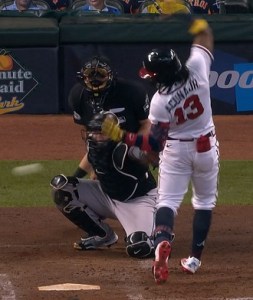
Sandy Alcantara’s pitch ricochets off Ronald Acuna, Jr. in the third.

So far as the Miami Marlins seem concerned, the heir apparent to Freddie Freeman as the Atlanta Braves’s franchise face doesn’t wear a Braves uniform. He wears a target. Especially after he hits home runs, in the postseason and otherwise.

Here we went again Tuesday afternoon. Game One, National League division series. And, yes, it was weird enough that the Braves and the Marlins played in Houston’s Minute Maid Park, with the Braves as the home team.

Then Acuna hit the second pitch from Marlins starter Sandy Alcantara over the right field fence opening the bottom of the first. As is characteristic of the ebullient outfielder, he watched for the briefest moment before flipping his bat to one side on his way up the first base line to run it out.

Acuna had reason enough to celebrate even before the Braves demolished the Marlins with a comeback 9-5 win. He became the youngest man in Show history to hit a leadoff bomb in a postseason game. He and the Braves got to enjoy it until the bottom of the third, with the Marlins holding a 4-3 lead and Acuna at the plate with one out.

Alcantara threw at and hit Acuna on an 0-1 count with a 98 mph fastball. At least Alcantara waited until Acuna greeted him again instead of going completely infantile and drilling Freeman following Acuna in the first. That may be the only thing to his credit.

Acuna might have said after the game that he’s kinda, sorta, kinda getting used to being Fish fodder, but that didn’t mean he was necessarily thrilled to be so high on their hit parade when the third-inning pitch struck. He took a few steps forward, toward the mound, holding onto his bat a bit, and both Braves coaches and umpires surrounded him before he entertained any ideas about relieving Alcantara of his head or any other extremities.

“I looked over to their bench,” Acuna said post-game. “I said it’s been five times. At this point, I think we’ve become accustomed to it.” Not necessarily. If that were true, the Braves wouldn’t have engaged in a chirping contest with the Marlins before Acuna finally dropped his bat and took his base.

They also might not have answered the Marlins’ three-run top of the third with Marcell Ozuna doubling Acuna home following Freeman’s followup fly out and Travis d’Arnaud doubling Ozuna home to bring things back to within a run.

And they wouldn’t have bided their time, chased Alcantara out of the game in the seventh with a pair of inning-opening infield singles, one by Acuna himself, before Freeman forced Acuna at second with Yimi Garcia on the mound, Ozuna singled home Austin Riley to tie the game at four, and d’Arnaud hitting a 2-0 grapefruit far enough over the center field fence.

Nor would Ozzie Albies have followed d’Arnaud’s demolition with a base hit to chase Garcia in favour of James Hoyt, whose first service to Dansby Swanson disappeared over the center field fence, too.

That’s where the score stayed other than Matt Joyce’s excuse-me RBI single in the top of the eighth.

“I think it woke us up,” d’Arnaud said of Alcantara drilling Acuna. “And we took advantage of the momentum.” Said Braves manager Brian Snitker, “You better be good at going in and not hitting [Acuna] after a homer.”

Alcantara wasn’t, obviously. Nor was he especially good at covering his tracks after the game. Any expressions of the-ball-got-away-from-him/the-dog-ate-his-homework got vapourised when he added, referencing Acuna’s brief but interrupted advance to the mound, “If he’s ready to fight, I’m ready to fight, too, no matter what happens.”

Cut the crap.There was only one reason Acuna might have been ready to fight, and that was getting drilled his next time up after hitting one out and—oh, the hor-ror!—showing his pleasure over his feat.

Cut the crap. He’s hitting for a .318/.414/.665 slash line against them since he first faced them in 2018. It couldn’t possibly be that the Fish are fed up with Acuna making tuna salad out of them so far in his career.

Cut the crap. It doesn’t matter that has a .182 lifetime batting average against Alcantara into the proceedings. Maybe Acuna also felt like celebrating finally having something more to show than two walks, two strikeouts, and nothing else off the Miami righthander in ten previous plate appearances. Since when does that give Alcantara a license to drill when the first hit he surrenders to Acuna is a parabolic opening launch?

Jose Urena, whose 2018 drilling of Acuna after a bomb-flip got Urena suspended six games, has decent performance papers against Acuna otherwise, if not quite those of Alcantara’s: five strikeouts, three walks, four hits including that lone bomb, and a .235 batting average against him. But Acuna also has a .409 on-base percentage against Urena in 22 plate appearances. And he’s been hit twice in the bargain.

Cut the crap. I’ve said it before, I’ll say it again. You don’t want Acuna turning his bat into a helicopter rotor when he hits one out against you, stop throwing him cantaloupes to hit in the first place. You want to be a Fun Policeman, wear a police uniform and not a Marlins uniform on the mound.

It ruined Alcantara having a solid outing otherwise, until the Marlins bullpen—whose main men are the proud possessors of a 2.72 irregular season ERA—got dismantled in the seventh. It also put a little smudge on the Marlins’ 2020 reputation as a pleasant surprise who missed winning the National League East by finishing four behind these Braves.

But it also reminded close observers that Acuna has been bitten twice as often by the Fish as he’s been by any other major league team. MLB.com’s Mark Bowman was kind enough to point out that Acuna’s been drilled by Miami pitching once every 41.2 plate appearances—and once every 80 plate appearances by everyone else’s pitching staffs.

Acuna answered on social media after the game too. “They have to hit me because they don’t get me out,” he said in one tweet. “I’d like to take this time to apologize to absolutely NOBODY,” he insisted in an Instagram post. I’d like to take this time to say Acuna owes apologies to absolutely nobody.

Don’t kill the umps just yet

Justin Verlander may have sought divine intervention with Angel Hernandez, but his ex-Astros rotation mate Cole may have other sobering thoughts about the Angel of Doom.

The mere presence of Angel Hernandez among the division series umpiring crews may have been enough to drive most baseball temperatures through the top of the tube. His crew is working the National League division set between the Los Angeles Dodgers and the San Diego Padres.

But New York Yankees pitcher Gerrit Cole may wish Hernandez was working their set with the Tampa Bay Rays, instead. Even if he ever had occasion to dispute one of Hernandez’s calls and the controversial umpire’s long-established reputation for trying to insert himelf too deep into the game for comfort.

This one comes from our Who’d-a-Thunk-It Department: Cole has pitched three times in his career with Hernandez calling balls and strikes. His ERA with the Angel of Doom behind the plate is—wait for it!—1.80.

Just don’t tell that to at least one ex-Yankee for whom Hernandez was as useful as a sore throat, CC Sabathia.

The only way Cole might reject Hernandez behind the plate would be if he were offered the choice between Hernandez and Adrian Johnson. Among the umps behind the plate for three or more games Cole’s pitched, his ERA with Johnson (also three games) is 0.90. But if you mention any of that, bank on it: it’ll be Hernandez who makes the jaws hit the floor.

Now, it’ll be easier to pass the political (lack of) class through polygraph tests than to discover Gerrit Cole demanding Angel Hernandez work his games behind the plate, of course. But wouldn’t you love to know how a group of today’s top-of-the-line pitchers work with certain umpires calling their pitches?

Cole himself has worked with three of the Four Wisenheimers: Hernandez, C.B. Bucknor, and Laz Diaz. Somehow, some way, Cole’s managed to pitch without Country Joe West behind the plate even once. Prepare yourself: With Bucknor behind the plate, Cole’s lifetime ERA is 1.50. (Maybe Hernandez shouldn’t be in a hurry for Cole’s personal invitation.) With Diaz behind the plate, though, Cole’s lifetime ERA is 5.68.

Let’s assume for argument’s sake that Bucknor, Diaz, Hernandez, and West are baseball’s four worst or at least most confrontational self-promoters in the game today. Everybody with me?

Now, let’s look at how this season’s ERA leaders—every starting pitcher with a sub-3.00 ERA in 2020, irregular season or not—have fared in their careers according to the umps calling their balls and strikes. Among those umps who’ve worked behind the plate in a minimum three of their games lifetime, who do they love and hate the most back there?

You may or may not be surprised. (Arizona’s Zac Gallen, who sits between Zach Davis and Kyle Hendricks on the 2020 ERA parade, isn’t included because he’s never worked with any single umpire behind the plate for more than two games so far. He’s also never worked with the Four Wisenheimers. Yet.)

Pitchers & Plate Umps, At Least Three Games (2020 ERA Leaders)
Pitcher Loves Behind the Plate Hates Behind the Plate
Shane Bieber Carlos Torres (3.94) Larry Vanover (4.80)
Trevor Bauer Ted Barrett (0.78) Alan Porter (9.27)
Dallas Keuchel Mark Ripperger (0.95) Paul Nauert (7.91)
Yu Darvish Bill Welke (0.94) Rob Drake (7.53)
Dinelson Lamet Mike Muchlinski (2.65) Tom Woodring (2.81)
Chris Bassitt Alfonso Marquez (0.34) Phil Cuzzi (7.04)
Jacob deGrom Lance Barrett (0.48) Mike Muchlinski (7.98)
Hyun-Jin Ryu Brian Knight (0.43) Alan Porter (5.40)
Kenta Maeda Scott Barry (1.13) D.J. Rayburn (8.56)
Zach Davies Chris Conroy (1.00) Rob Drake (6.75)
Kyle Hendricks Marvin Hudson (0.44) Kerwin Danley (6.38)
Carlos Carrasco Adrian Johnson (0.52) Joe West (8.44)
Zack Wheeler James Hoye (0.87) Pat Hoberg (8.10)

Hands up to everyone who’s surprised three out of the Four Wisenheimers didn’t show up even once on that survey—never mind Alan Porter and Rob Drake showing up twice in the hates-behind-the-plate column.

Now, hands up to everyone who’s shocked that Joe West shows up only once. (Was anyone really surprised to see it’d be in the hates-behind-the-plate column?) Hands up, too, to everyone who’s shocked that Trevor Bauer hates Porter behind the plate more than Carlos Carrasco hates Country Joe.

You may have noticed that Mike Muchlinski is the only umpire to show up once each in the loves and hates columns. Making it tempting for cynics to ask what he has against Jacob deGrom that he doesn’t have against Dinelson Lamet. (Or, to ask when Chris Bassitt plans to blow Alfonso Marquez to a chateau briand dinner with all the trimmings.)

Of course, a pitcher’s ERA with a particular umpire behind the plate isn’t necessarily conclusive. Brian Knight could have given Hyun-Jin Ryu a small volume of strike calls on pitches that weren’t within a mile of the zone’s ZIP code. Porter could have called every pitch from Bauer on the money.

It could go in reverse, too. Knight could give Ryu a ton of balls that hit the zone and Ryu could just shake them off and bear down harder. Porter could call some strikes for Bauer that weren’t even visible on radar and Bauer could just get plain clobbered no matter where the other pitches were called.

Nor does any of the foregoing mean I’m backing off my calls for umpire accountability, for the end of umpires having their own kind of qualified immunity. I’m not backing off my approval of the coming electronic strike zones and even robot umps.

I’m funny that way. I don’t believe umps deserve qualified immunity from their glaring inaccuracies, any more than I believe rogue police deserve qualified immunity from answering for their misdeeds or crimes when they commit them. I don’t believe the “beautiful human factor” (Joe Torre’s words) means a license to blow calls on pitches Ray Charles could see in the zone or Superman couldn’t see out of the zone.

And, I don’t believe there’s a damn thing wrong with getting it right. Especially when championship advance or championship victory is squarely on the line.

But I’m still trying to fathom whether Gerrit Cole’s lifetime 1.80 ERA with the Angel of Doom calling his balls and strikes is more peculiar than Carlos Carrasco among this irregular season’s ERA leaders wishing for anyone except Joe West working behind the plate.

(Even the others among the Four Wisenheimers? Carrasco has three with C.B. Bucknor—7.54 ERA; thirteen strikeouts, three walks. He has three with Joe West, too—aside from the ghastly 8.44 ERA, he’s got a measly six strikeouts and five walks with Country Joe behind the dish. With the Angel of Doom behind the plate? One game, 0.00 ERA for the game with ten strikeouts and a walk. Maybe Carrasco ought to send Cole a text message.)

Or, maybe it’s just another useful affirmation of one of baseball’s oldest laws: Anything can happen—and usually does.