The KBO actually holds umps accountable, too

2020-05-09 KoreanUmps

In this photo from South Korea’s Yonhap News, umpires work on a review with the Korean Baseball Organization’s video review office during a pre-season game last month. The KBO has demoted a full crew after complaints about inconsistent strike zone calling.

It almost seems as though every mistake by American baseball government instructs the Korean Baseball Organisation, “Study this and learn what not to do.” In American baseball, umpire accountability often seems something along the line of promiscuous celibacy. In South Korean baseball, umpire accountability is a necessity.

When enough players between the SK Wyverns and the Hanwha Eagles complained about an inconsistent strike zone following a Thursday game, the KBO didn’t just hoist platitudes about effort, they up and did it. They demoted the entire umpiring crew, re-assigning every member of the crew to the country’s Futures League for re-training.

What a concept. And, as a Yahoo! Sports writer named Mark Townsend observes, “Try to picture this scenario. MLB officials approach Joe West. MLB officials then inform Joe West that his entire crew is headed back to rookie ball for retraining. And you thought the stare West gave Madison Bumgarner was frightening?”

Stare, schmare. From what American baseball fans have seen of American umpires the past couple of decades, many if not most American umps might be tempted to take hostages at the very hint of the American game taking a KBO-like stance on accountability.

Townsend cites a writer with the Korean news service Yonhap News, Jee-ho Yoo, who quoted Eagles outfielder Yong-kyu Lee as asking the KBO to consider that the league’s umpires should take player complaints into consideration more seriously. The league actually listened.

“Even though [the KBO season has] only been three games this season,” Lee says, “a lot of players are really unhappy with the lack of consistency on ball-strike calls. I’d like to ask all the umpires to please be more considerate of the players. We’re all very confused. I know the umpires are doing their best out there, but I just hope they should start seeing things from the players’ perspective, too.”

Allow that Lee spoke in language considerably more polite than the average American major leaguer, and you still see a serious point. The KBO isn’t really in the mood to suffer foolish umpires gladly. They’re funny that way. You might think the American Show would reply, “Say what?” when you call for uniform strike zone call and enforcement, not this too-long-time nonsense regarding umpires’ “individual” zones, and the KBO says “Say this!” when demoting inconsistent umpires.

You would have thought American umpires learned the hard way, after the accountability question provoked their original union to implode over two decades ago.

You don’t remember? I take you back to the summer of 1999, right around the All-Star break, when Major League Umpires Association director Richie Phillips announced that 57 of the Show’s 66 umpires resigned effective the coming 2 September. The arbiters wanted “to continue working as umpires, but they want to feel good about themselves and would rather not continue as umpires if they have to continue under present circumstances,” Phillips proclaimed. “They feel in the past seven months or so, they have been humiliated and denigrated.”

Let’s review the humiliation and denigration, shall we? We can do so courtesy of the late Doug Pappas of the Society for American Baseball Research, whose essay “22 Men Out”  ran the entire business down admirably.

Pappas noted that umpire Tom Hallion got suspended for bumping a player during an argument and the umpires screamed blue murder, momentarily and blissfully ignorant of how much louder they would have been screaming if a player didn’t get suspended for bumping one of them.

Then-commissioner Bud Selig, who wasn’t customarily known for taking positions of wisdom, proposed that the commissioner’s office and not the individual leagues (they still had their own administrative structures at the time) should assume the business of umpire oversight. As Pappas observed, Phillips put the proverbial kibosh on that by proclaiming that would amount to a change of employer good for millions in umpire severance pay.

The Major League Baseball Players Association conducted a survey of players, coaches, and managers to rank umpire performance, which led to Selig’s office asking teams to chart pitches and file reports on each umpire’s strike zone. Pappas reminded his readers that Phillips dismissed the former as lacking “credence” because “ratings are always subjective” and the latter as “just another case of Big Brother watching us.”

Pappas cited a 14 June 1999 installment of the HBO series Real Sports aboard which Phillips “took his arrogance to a new level,” comparing umpires to federal judges who “should [not] always be subject to the voter, just like federal judges are not subject to the voter.” Sandy Alderson, then doing the job Joe Torre does now, could barely stifle a laugh.

“Federal judges can be impeached,” Alderson retorted. “I got worried when I found out that players were more concerned with who was umpiring the next day than they were about who was pitching.” (Who’s to say today’s players aren’t concerned likewise, often as not?)

Phillips didn’t stop with the mass resignation, either. On the same day he announced it, he proclaimed the umps would now be employed by a body called Umpires, Inc. that “would negotiate to provide umpiring services to MLB—and it, not MLB, would supervise and assign the umpires,” Pappas wrote. “In short, Phillips proposed to turn the umpires into a self-governing association, free of MLB control.”

To owners and players alike, this demand was tantamount to a municipal police union demanding an end to civilian control of the police force. Even if the owners had been willing to cede such authority, the screams of the MLBPA would have killed the deal. And the owners weren’t willing. When informed of the umpires’ move, Sandy Alderson . . . termed the resignations “either a threat to be ignored or an offer to be accepted.”

The final outcome, of course, was 22 umpires gone for good, seemingly, after the leagues hired 25 minor league umps (all of whom had major league experience) and several of the MLB arbiters scrambled to rescind their resignations. The American League re-hired the first fourteen rescinders; the National League decided “performance standards” would apply when picking the umps to re-hire. Imagine that.

A group of MLUA dissidents led by John Hirschbeck and Joe Brinkman called for a new union and for de-certifying the MLUA, both of which happened in the 1999-2000 off-season, with the World Umpires Association (now the Major League Baseball Umpires Association) born. Eleven of the 22 men out (including Joe West and Sam Holbrook) were finally re-hired in 2002.

All that because Phillips and his allies in the old union sought to become and remain a law unto themselves. Today there remain enough umpires who still think they alone and not the rule book have the power of the strike zone and other calls. They may even think that fans pay their way into the ballpark (whenever they’ll be allowed to do so again) to see the umpires. All things considered, it might be true in West’s case. Might. But not for the reasons he might think.

Commissioner Rob Manfred, whose reign has been inconsistent when phrased most politely, but who’s rarely been caught beyond mere thought when it comes to umpire accountability, ought to look more acutely at the answer the KBO handed to at least one umpiring crew who thought so: “Not so fast.”

In Korea, they let the kids play, bless them

2020-05-07 NCDinos

Members of the KBO’s NC Dinos during a game.

In America, when professional baseball was still played and when it might be played again (it’s anybody’s guess, educated or otherwise), the game remains a wrestling match of a sort. It’s between letting the kids play and letting the old farts persist with enforcing and applauding too many unwritten rules that seem too many times to enjoin against—oh, that vulgarity—fun.

The old farts lost their credibility long enough ago. They did it with rank hypocrisy. They’re all in favour of baseball being played like a business until the game’s business comes out to play.

Let a home run hitter flip his bat or a pitcher pump his fist or fan his imaginary pistol upon a strikeout, and it’s time to remember “respect for the game.” Let a player negotiate on a properly open market for however many millions that market determines he’s worth, and it’s time to remember they’re already being paid many millions enough to play a goddam game.

Enter the Korean Baseball Organisation, that ten-team league where baseball is underway thanks to South Korea being a little bit more alert than other countries when it came to coronavirus safety measures. And, where (the horror) baseball is played under the distinct encouragement to take and give joy in the playing. Even if the coronavirus compels near-empty stands.

You can conjugate numerous differences between the KBO and the American Show, but Yahoo! Sports’s Leander Schaerlaeckens reduces it to simple terms: “At a big league game, the loudest person in your section is often the ice cream guy.”

OK, that’s a slight exaggeration. But only slight. Two days ago, Chang-min Mo blasted one into the empty left field bleachers and flipped his bat in the same motion. He swung and the bat flipped out of his hands on the follow through. Americans might say ok, he did it in one motion and didn’t put on a show out of the box. Enough American pitchers would still want to rumble over it.

Not Josh Linblom, who spent some time pitching in Korea (and was the KBO’s MVP last year) before signing for three years and mucho million to return to the United States courtesy of the Milwaukee Brewers. “I’ve never had more fun playing baseball than I did there,” Lindblom tells Schaerlaeckens. “Just the joy of it.” Major league baseball and its fans, do take note.

Take note, too, that it doesn’t stop with demonstrative hitters and pitchers, Schaerlaeckens continues.

Korean baseball also leads the way in weird glasses. Fans sing and chant in unison. Cheerleaders hype the crowd. Players scrub each other’s backs in the showers. They have coordinated mascot dances. There are fire-breathing robot dragons, even though they have nothing do with their team or its mascot. Each player doesn’t merely pick his own walk-up song – no no. Special theme songs are composed for them and they’re amazing. The atmosphere, above all else, is generated by the crowd itself, rather than being orchestrated by a PA system as spectators are tamely shepherded through whatever “fan engagement” is expected of them.

Why do you think the Washington Nationals were such engaging World Series winners last October? Because they managed to vanquish the Houston Astros subsequently exposed as barely-if-at-all apologetic 2017-18 high tech cheaters? Well, yes, that was part of it. But there was also the irrepressible sense that the Nats actually had fun playing the game, even in the Serious Postseason, and couldn’t have cared less who knew it or who objected.

They Baby Sharked, dugout danced, and pantomime drove their way to something unseen in MLB in Washington since Calvin Coolidge’s first and only election to the White House in his own right. It was almost as infectious as the coronavirus and a hell of a lot more entertaining. You had to be a terminal grump to say the Nats won a world championship by disrespecting the game—and there were enough such grumps who probably did.

Maybe the cheerleaders in the KBO are a little bit much. But Schaerlaecken’s observations otherwise look like precisely the kind of things that would engage and amuse. And they’re far more creative than stuff like the Brewers’ Racing Sausages who only run their races once a game anyway.

Worried about the time of game, you say? The KBO is taking that bull by the horns. They’ve already instituted a twelve-second pitch clock. They’re kicking around a slightly wider strike zone. (The width of the plate, the traditional old top-to-bottom between the batter’s shoulders and knees, however the batter positions himself at the plate, and umpire accountability to enforce such a uniform strike zone, wouldn’t hurt.)

Maybe the one flaw in the KBO is that it’s as offense-weighted now as the Show was in the 1990s and the past couple of seasons now. Schaerlaecken observes that, in 2019, the KBO’s league-wide batting average was .286 and league-wide ERA was above 5.00. It has work to do to re-balance the game.

But I wouldn’t bet against them. All evidence thus far indicates they’re always trying to improve things for the fan’s and the game’s sake. Real baseball fans love good pitching duels—whether it’s the periodic starters’ clash or a battle of wits between bullpens—as much as batting clinics.

Come to think of it, real baseball fans love entertaining pitchers as well. Those my age remember how much fun Juan Marichal was on the mound, as well as being great, with his maybe twenty different windups and fifteen different leg kicks including the one that became his most indelible image. Or how Dennis Eckersley in his early seasons thought nothing of fanning an imaginary pistol after striking a batter out.

Or Mark (The Bird) Fidrych, who was a package of fun and laughs before he even threw a pitch. And anyone who could infuriate the Bronx Zoo Yankees with his antics—and, in his Rookie of the Year season, the pitching to back it up—should have been given the keys to his city. It was more the pity that Fidrych’s knee injury the following spring led to too many premature comebacks, shoulder demolition because of them, and career killed in its crib.

I’ve said it before but I’ll say it again: I don’t care if a pitcher fans his pistol, a batter flips his lumber, or a slick double play combination goes into a tandem juggling pantomime after delivering a slick double play. I haven’t seen the juggling act among Korean or American major and minor league middle infielders yet, but it wouldn’t shock or enrage me if I see one.

(Just for the record, I’m not exactly a spring chicken myself, but I decided long ago that age didn’t have to mean hardening of the arteries—actual or mental—either. How old am I? I’ll put it this way: On my last birthday, I got serenaded nigh unto death with a certain song aboard the Beatles’ legendary Sgt. Pepper’s Lonely Hearts Club Band . . . and it wasn’t “Being for the Benefit of Mr. Kite.”)

Real baseball fans also don’t like to see lineup spots wasted on the unproductive. The KBO has the designated hitter rule. “[S]kirting the entire farce of forcing the unskilled labor of pitchers hitting upon the public,” Schaerlaeckens writes.

Last year, MLB pitchers hit for a cumulative .128/.159/.163. “Traditionalists” would rather wait for the next Bartolo Colon or Madison Bumgarner than accept that wasting a lineup slot on a pitcher who isn’t being paid to swing the bat or run the bases (and might well injure himself out of his normal season’s work doing so) is plain damn dumb.

Even more dumb than huffing, puffing, and blowing down the house rather than letting the kids play, the way they play in Korea, the way the Koreans who are otherwise among the world’s most mannerly people expect them to play, for fans’ entertainment—even if the fans are limited because of the coronavirus—and their own.

Once upon a time, the late Jim Bouton (in Ball Four) revealed that Seattle Pilots manager Joe (Ol’ Sh@tf@ck—or Ol’ F@cksh@t, depending) Schultz lectured his players about the entertainment dollar. In that day’s game, catcher Jim Pagliaroni scampered to catch a foul pop near the dugout and made a point of running deliberately to the steps, sliding down those steps, and crashing into the bench. When Schultz questioned him, Pagliaroni replied, “I was just going for the entertainment dollar.”

The KBO isn’t about to start staging dugout crashes on foul pops, I think, but there’s plenty to be said about going for the entertainment everything. Even crusty Crash Davis (in Bull Durham) reminded his teammates, “This game’s supposed to be fun.” When American baseball fans have to gaze upon games being played as far away as one American war was once fought, American baseball has a (pardon the expression) serious problem.

Matt Keough, RIP: Aces and aches

2020-05-03 BillyMartinMattKeough

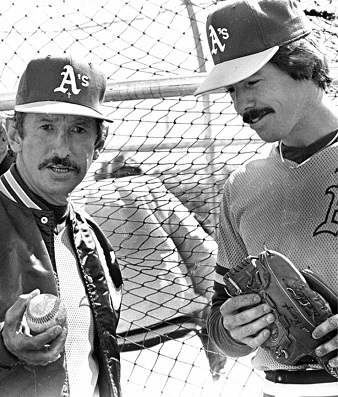
Matt Keough (right) with Billy Martin, who burned his Five Aces out with overwork and turned the A’s from sudden contenders to sudden basket case in a comparative blink.

It’s not every major league pitcher who goes from one-fifth of a heralded, overworked, and ruined young starting rotation to scout, coach, advisor, and occasional reality television figure. Nor is it every pitcher who passes away at 64 just weeks after his grandson dies during birth.

Of the five righthanders who once made up a youthful Oakland Athletics starting rotation Sports Illustrated brandished on a spring 1981 cover as the Five Aces, Matt Keough’s wasn’t one of the simpler baseball lives. He recovered well enough to rejoin the A’s in their front office as a special assistant; had his son, Shane, made it to the majors instead of playing an aborted minor league career, he’d have been the father of baseball’s twelfth third-generation player.

“Daddy,” Kara Keough Bosworth posted on Instagram upon Keough’s death Saturday, “please take care of my son. Teach him the circle changeup and how to find forever friends. You’re on grandpa duty in heaven now. Xoxo, Hammerhead.”

“My favorite place was always on your shoulders,” Shane Keough posted on Instagram upon his father’s death. “It makes me smile knowing [grandson] McCoy will be there with you; right there on your shoulders. It wasn’t always perfect but I wouldn’t change it for the world. You taught me more than you’ll ever know and I hope that I make you proud. Kick back and enjoy the eternal sunshine.”

Matt Keough was the son of former longtime major league outfielder Marty Keough and the American League’s Comeback Player of the Year winner for 1980. With Mike Norris, Rick Langford, Steve McCatty, and Brian Kingman, Keough helped yank the A’s from nothing special (and the league’s second-worst earned run average) in 1979 to the best ERA in the league in 1980 and a 29-win improvement to an 83-79 record.

And within an extremely short time to follow, the Five Aces came to represent something else: witless mishandling of pitching talent.

While the country sat in thrall to Billy Martin and his “Billyball” attack on the American League from the A’s bridge, they were unaware that if the Aces were the mound cobras then Martin was their own mongoose.

In 1980-81 the Aces pitched 152 complete games. In 1982, the A’s were 28-50 by the All-Star break, and almost every one of the Aces—who lived mostly on breaking balls that weren’t always kind to shoulders and elbows in the first place—had physical trouble, as Rob Neyer reminded one and all in 2006’s The Big Book of Baseball Blunders.

Keough himself suffered a shoulder issue after slipping on a wet Baltimore mound in 1981. In 1982 he was a mess, leading the American League in losses and posting a 5.72 ERA, not to mention leading the league in home runs surrendered and in earned runs allowed.

Langford went down with a sore elbow late in the year but he may have been pitching through the issue before that, considering the 4.32 ERA he posted after showing a 2.99 in strike-shortened 1981. (“He’s his own worst enemy,” McCatty once said of the stubborn Langford.)

Norris developed shoulder tendinitis, hit the disabled list, and finished with a 4.76 ERA—and he may have pitched through shoulder trouble the year before. That he also had issues with cocaine addiction may or may not have been secondary. (Norris recovered in due course and became an inner-city baseball advocate teaching youth the game and its pitfalls.)

McCatty left spring training with a sore shoulder and pitched only 129 innings after he returned for the season. Kingman avoided arm and shoulder issues but he was often left to continue in games where he was being murdered.

“Oakland’s starters, all of them,” Neyer wrote, “looked like they were pitching hurt, and as things turned out they probably were. In 1983, Keough pitched only 100 innings; Norris, eighty-nine; Langford, twenty; Kingman pitched five innings. McCatty wasn’t healthy in 1983, but he led the way with 163 innings and a decent ERA. After 1983, none of them ever won more than five games in a season again.”

For the one game you needed to win yesterday, there may have been few better than Martin; for the longer term, sustained success, alas, there may have been few worse. The only thing Martin compromised more profoundly than teams he led to almost instant success was himself.

His biographers often underestimate his carelessness about the pitchers he handled. One, David Falkner, in The Last Yankee: The Turbulent Life of Billy Martin, claimed the charge that Martin overworked his pitchers “probably carried more weight than substance,” going on to claim the Five Aces’ “low pitch count per game [often in the 90-100 range] was better than average and a better barometer of their actual work load.”

Falkner was dead wrong. Neyer discovered that the quintet threw 90-100 pitch games fourteen times in those two seasons but threw 120-140 pitch games 94 times in the span. They also threw 152 complete games among them and averaged 130 pitches per complete game. Keough, McCatty, and Norris each averaged 131 pitches per complete game; Langford averaged 129; Kingman, 126.

“They did not routinely throw in the ’90-100 range’ as Falkner claims,” Neyer wrote. “They routinely threw in the 120-140 range. There are certainly pitchers who can survive, or even thrive, under the yoke of such workloads. Most cannot.”

Among the Aces, Keough may have been the most charitable in retrospect, when Sports Illustrated caught up to the quintet in 1984—by which time Keough had been traded and was missing the season with rotator cuff inflammation and McCatty was the only one of the group still in the Show somehow.

“Ballplayers are never the best judges of what’s wrong with them. We were all such good athletes that we thought we could always go nine,” he said.

Billy never failed to ask us how we felt. He would always say there was no room for heroes. He just wanted you to tell the truth. But we had such egos. We felt if it’s just a soreness maybe we’re better at 75 percent than the others would be at 100. We have to share the blame for what happened to us. I know I’m sick and tired of hearing about Billy Burnout. Billy and [pitching coach Art Fowler] took an obscure ball club and taught it how to win. How could I object to that? We never pitched any more than pitchers did on other competitive teams, anyway. I completed 20 games in ’80, but I only pitched 250 innings. There are too many intangibles involved to place the blame on any one person.

Martin himself blamed the 1981 strike for the Aces’ downfall. He said in one of his books that without him and Fowler there “to see that my pitchers did their work, warmed up properly, did their running, wore a jacket when they were sweating, threw with the proper motion . . . I’m convinced the sore arms that came later were the result of improper training during the strike, not overwork.”

The thought that he could have engineered the A’s 1980-81 turnaround (including one postseason series win in 1981) without killing his starting pitchers’ futures was never programmed into Martin’s hard drive. (Especially when he failed to trust the viable enough bullpen behind them.) Like Leo Durocher before him, Martin wasn’t shy about dismissing the ailing or the injured as quitters.

The likely combination of the A’s 1982 collapse and assorted non-game issues—including the day he trashed his office when the team refused him a loan for a tax issue—got Martin [and Fowler] fired after that season.

“If Martin’s theory was correct,” Neyer rejoined in a Big Book aside, “wouldn’t there have been a rash of injuries to pitchers all around the majors” as a result of the strike? “I don’t recall that there was.” As Neyer observed earlier in the aside, Martin had one thing in common with semi-legendary Brooklyn Dodgers manager Charlie Dressen: he “never made a mistake he couldn’t blame on somebody else.”

Keough made an All-Star team before the Martin era in Oakland; he pitched in four other organisations and for a spell in Japan before working as a well-liked and respected roving pitching coach, scout, and special assistant for the A’s, the Angels, and the Rays, before returning to the A’s.

His try at a pitching comeback with the 1992 Angels ended when he took a hard line drive foul off his head—while sitting in the dugout waiting for his turn to pitch in an exhibition game. His attorney swore Keough wasn’t quite the same man again after that.

Keough’s marriage to former Playboy playmate Jeane Tomasino ended, though the couple’s divorce wasn’t finalised until last year. (The couple had another son, Colton.) He fought and finally overcame a battle with the bottle that included time behind bars for the second of two drunk driving incidents.

It said something for Keough, too, that his still-estranged wife—with whom he and his children appeared occasionally on The Real Housewives of Orange County—testified for him over his second DUI in 2009 and pleaded with the judge to give him probation.

Keough was respected as a pitcher and beyond for his mind. “Matt probably had the most well-thought out game plan of any of us,” Norris was quoted as saying Sunday. “He was a student of the game and had great knowledge.”

He was credited with helping the A’s to draft such 2000s talent as Huston Street, Joe Blanton, and Nick Swisher. “[O]ur talks–even a week ago–unforgettable,” J.G. Taylor Spink Award-winning writer Peter Gammons tweeted.

“He had an amazing mind for the game and incredible work ethic,” Kansas City Royals senior scouting director Gene Watson told San Francisco Chronicle writer Susan Slusser. “When you watched a game with him, it was impossible not to learn something new from him every time.”

But he knew what really counted in the long run. “I have three best days—when each of my children was born,” Keough once said. May the Lord give him nothing but best days eternally, on grandpa duty with little McCoy Casey Bosworth, the baby grandson who preceded him early in April, and now greeted Grandpa with two tiny but profound open arms.

Immortal handshake to be immortalised

2020-05-01 GeorgeShubaJackieRobinsonHandshake02

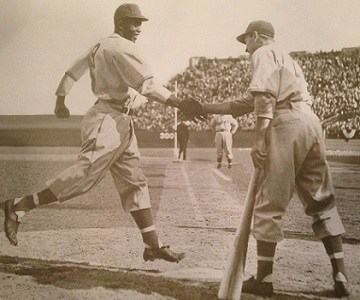
Jackie Robinson accepts George Shuba’s handshake as he finishes a three-run homer in his Montreal Royals debut in 1946. This photograph became known as “A Handshake for the Century,” and a statue in Shuba’s hometown will immortalise the handshake further next year. (Photograph courtesy of Michael Shuba.)

The late George Shuba is said to have kept only one memento from his professional baseball career. That was  the famous photograph of Shuba shaking Jackie Robinson’s hand—after two white teammates aboard ahead of him went to the sideline waiting to see what Shuba would do—as Robinson crossed the plate after hitting his first minor league home run, a three-run “screamer over the left field wall,” as Shuba would remember it.

Robinson and Shuba were Montreal Royals teammates in 1946, after Brooklyn Dodgers mastermind Branch Rickey sent Robinson there to break him into non-Negro Leagues professional baseball. Raised in a climate of racial tolerance in Youngstown, Ohio, Shuba didn’t realise for a long time the impact of what he’d done in that moment when Robinson hit the plate.

“I didn’t care if Jackie Robinson was blue, green, or yellow,” Shuba said in his memoir, My Memories as a Brooklyn Dodger. “He was my teammate and that was all I cared about because his home run just gave us the lead in our season-opening game.”

That Opening Day between the Royals and the Jersey City Giants in Roosevelt Stadium was Robinson’s Royals debut, a day on which he went 4-for-5 with two stolen bases and three runs scored—two after unnerving the opposing pitcher to balk while he was the runner at third base. But the homer handshake from Shuba reverberated long after the game settled into the International League record books.

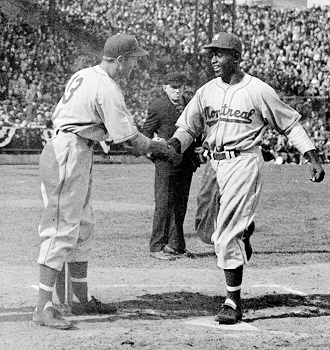
There are two takes on the image. One is the famous shot from the third base line, Robinson’s Royals uniform number 9 visible on his back as his right hand meets Shuba’s and his left foot is a split second from hitting the plate. The other comes from a first base line view, at the split second Robinson’s foot hit the plate, his right hand still holding Shuba’s in the handshake, and Shuba’s number 13 is visible from behind the right side of his back.

In both Robinson has a big grin on his face and Shuba grins likewise. Neither man knew in the moment that the handshake would prove to transcend the home run. Shuba, the on-deck batter, was mildly astonished that the two teammates scoring ahead of Robinson didn’t stop to wait and shake his hand. So the modest Ohioan of solid Slovakian stock stepped forth from the on-deck circle and did it.

2020-05-01 GeorgeShubaJackieRobinsonHandshake01

As Robinson actually hit the plate to score on that three-run homer, an Associated Press  photographer caught the handshake with Shuba from the first base side.

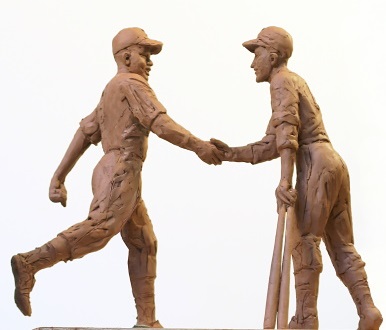
Next year, Robinson and Shuba’s home plate handshake will become even more immortal than a pair of photographs. It’ll be depicted in a life-size statue of the two men in Shuba’s native Youngstown. Shuba’s only son, Michael, says the statue’s work is proceeding as planned and mostly on schedule despite the coronavirus disruption of most of the nation’s life today.

“Everything seems to be going as planned,” the younger Shuba told me by telephone last week. He said Robinson’s half of the statue is life-size finished already, as is his father’s life-sized head, with the rest of his father yet to be complete. “We believe our goal that they have can still be met.”

Shuba and the committee in charge of producing, erecting, and dedicating the statue intend for that dedication to happen on April 18, 2021—the 75th anniversary of the game and the home run handshake. Asked whether Robinson’s widow, Rachel, would attend the dedication, Shuba said he only hopes so. “You know, I think she’s 97 now,” he said, “and I just don’t know if she’d be there, but maybe Sharon (the Robinsons’ daughter) will be there.”

The project began with Eric Planey, a New York financial executive who’s native to Youngstown. “He took it upon himself to get the project going,” Shuba said. “Out of the blue one day I get a call from him saying he was working on this and he wanted my blessing. That’s basically how I found out it was going on. I instantly knew that I had to honour Dad and Jackie to the best of my ability when I heard this was going to happen.”

Marc Mellon, the sculptor whose likeness of the late former president George H.W. Bush reposes in the Smithsonian Institute’s National Portrait Gallery, has designed and is building the Robinson-Shuba statue. He recently sat for a newspaper photograph showing the base of Robinson’s full body in front of a small wall of photographs . . . and the base of George Shuba’s head on a pedestal in front of another small wall of photographs.

One former major leaguer is involved directly in the project—Herb Washington, the Olympic-class sprinter who became the most talked-about among Oakland Athletics owner Charlie Finley’s 1970s experiments with designated baserunners, eventually a successful McDonald’s franchiser in Youngstown. Washington didn’t return queries for comment at this writing.

2020-05-01 GeorgeShubaJackieRobinson

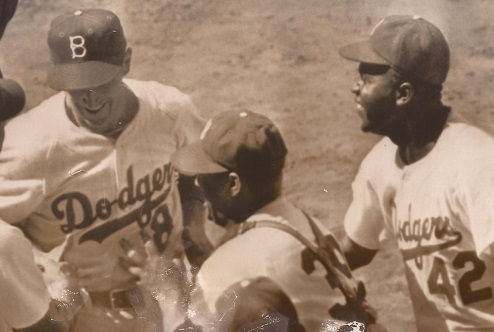
George Shuba’s reception at the plate after a home run includes Jackie Robinson (42) and fellow Hall of Famer, catcher Roy Campanella (39).

As a baseball player, George Shuba was known for a smooth, natural-looking swing delivering hard line drives that inspired Alabama sportswriter Bill Bingham to nickname him Shotgun. He was also known for being the first man in National League history to hit a pinch home run in a World Series. (Game One, 1953; Hall of Famer Yogi Berra was the first ever to do it, in the 1947 Series.) The bad news is that a combination of Rickey’s caprices and the outfielder’s knees conspired to keep his major league career a short one.

Raised a devout Roman Catholic, whose older brother became a priest and eventually a monsignor, the Shotgun learned tolerance at an early age. “George grew up as an altar boy, and he was taught as a young boy to treat all people equal,” his son said. “In high school they would play alongside black fellows all the time, so it was no big deal to him. It just seemed the right thing to do.”

Robinson and Shuba maintained a friendly relationship during their Brooklyn playing days. Like many ballplayers, though, they drifted apart in the years following their baseball careers. Shuba’s career ended after the 1955 season; Robinson retired before the 1957 season. “I think, just like the rest of the fellows, they got tied up in their lives,” Michael Shuba said. “They talked to each other a few times, but I don’t think very many of them would see each other during that period.”

Robinson became a personnel executive with Chock Full o’Nuts, the coffee company whose lunch restaurants were famous for black staffers, before trying his hand at other businesses aimed at furthering interracial economy and activity. The elder Shuba tried his hand in the sporting goods business, found it wanting, then joined the U.S. Postal Service, eventually becoming an inspector for over a quarter century.

He died at 89 in 2014, but he loved to teach school children about racial tolerance and Jackie Robinson’s significance whenever invited. He was the last living Dodger to have played in Game Seven of the 1955 World Series, the only one the Dodgers won in their Brooklyn years. His pinch hitting appearance for second baseman Don Zimmer in the top of the sixth inadvertently saved the Series for the Bums.

2020-05-01 GeorgeShubaJackieRobinsonHandshake03

A clay model of the in-progress Robinson-Shuba handshake statue, as designed by sculptor Marc Mellon. (From the Robinson-Shuba Commemorative Statue Project.)

After the Shotgun grounded out for the side, manager Walter Alston moved starting left fielder Junior Gilliam to second base and sent lefthanded thrower Sandy Amoros out to play left. Amoros’s running catch of Berra’s long opposite-field drive, and subsequent peg in to Hall of Fame shortstop Pee Wee Reese, enabled Reese to double up Gil McDougald at first and Brooklyn starting pitcher Johnny Podres to finish his 2-0 shutout.

For a long time, the Shotgun preferred to keep his baseball past quiet while raising two daughters and a son—his wife, Katherine, died two years after her husband—but in time he came to embrace that past, including happily re-enacting the Robinson handshake with children of all races who met him. (Other stories have said he preferred signing autographs for children almost exclusively for a very long time.)

“I took George to the Brooklyn Cyclones [minor league team], and I took him all over the country,” Michael said, “teaching young kids about this moment and what it represented. We went to the Cyclones and they had a re-enactment, one black kid and one white kid, meeting at home plate. George was there to help them and meet them when they met at home plate. To this day I have a baseball I had those two kids sign.”

The son considers his father to have been his best friend in life. “The last ten years of his life, I took him all over and made him enjoy himself,” said Michael, who encouraged his father to connect with Ohio writer Greg Gulas for the memoir after realising his father’s memories of his baseball life remained lucid and well intact.

“Today, I don’t think he would even believe the statue is happening,” the son said. “I’m glad it’s going on, but I wish he would have been here to see it.”