It wasn’t as simple as Kaline made it look

2020-04-08 AlKaline

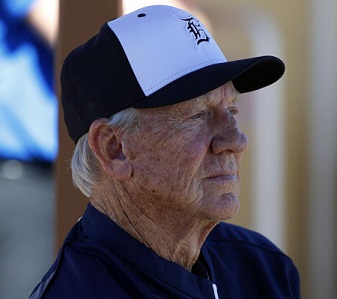
Hall of Famer Al Kaline, observing a spring training 2014 Tigers workout. “I have to work as hard if not harder than anybody in the league,” he once said of playing the game he made look simple.

The late Al Kaline was twenty years old when he won his only American League batting championship, in 1955. In wins-above-replacement-level-player terms, it’s the third best season by any twenty-year-old, with only Alex Rodriguez (9.4 WAR, 1996) and Mike Trout (10.5, 2012) passing Kaline’s 8.3.

In earthier terms, that season planted such extreme expectations upon him that Mr. Tiger eventually said it was the worst thing that could have happened to the man who finally became a Detroit icon for his play and his accommodating personality. Neither of which came simply to him, no matter what you think of the flood of tributes pouring forth upon and since his death at 85 Monday.

“Detroit’s Al Kaline looks like a man who plays with consummate ease as well as rare skill,” said Sports Illustrated in a 1964 profile, “but he is finding it hard to follow baseball’s toughest act: himself.” Kaline was the cover story in that issue, and the headline attached to a photograph of Kaline following through on a swing said, simply, “Enigma of the Tigers.”

By then the Hall of Famer struggled with injuries that kept him from posting many more than 140 games a season. Even in one of his eighteen All-Star seasons, this one during the period when fans were still bereft of the vote following the Cincinnati ballot box-stuffing scandal of 1957, this was a time when some sportswriters and enough Tiger fans called for the team to trade the right fielder who’d retire as a franchise demigod.

“This put the pressure on me,” Kaline told SI writer Jack Olsen of the beginning that culminated in that batting title. “Everybody said this guy’s another Ty Cobb, another Joe DiMaggio. How much pressure can you take? What they didn’t know is I’m not that good a hitter. They kept saying I do everything with ease.

“But it isn’t that way,” Kaline continued. “I have to work as hard if not harder than anybody in the league . . . I don’t have the kind of strength that [Mickey] Mantle or [Willie] Mays have, where they can be fooled on a pitch and still get a good piece of the ball. I’ve got to have my timing down perfect or I’m finished . . . I’ll tell you something else: I’m not in the same class with players like Mays or Musial or Henry Aaron, either. Their records over the last five seasons are much better than mine.”

There have always been those players who make baseball look so simple that Joe and Jane Fan become deluded enough to think they can play it even half as well as Kaline did. Kaline himself was the first to admit that making baseball look simple required work, and lots of it. Marry that to the expectations a talent showing itself early inspires, and you might find a player despairing of ever being what he thinks people want him to be.

“In the first few years after he won the batting championship,” Olsen wrote, “Kaline went into frequent depressions over his inability to give the fans what he knew they expected. He would come into the clubhouse after a game and slump in front of his locker, speaking to no one.”

That actually earned Kaline a reputation for difficulty for awhile. But Kaline himself—who once earned Hall of Famer Ted Williams’s respect and a tip to use hand weights to strengthen his wrists for hitting—told Olsen he wasn’t exactly being a sulk during those first few post-title seasons.

“I was just quiet, and when a newspaperman came up to me and said, ‘Nice game,’ or something like that, I’d just say, ‘Thank you’,” he said. “I would never prolong the conversation, and the guys who didn’t know me would say, ‘Look at this stuck-up kid.’ But it was just my way. I don’t talk much. I don’t like to make people mad at me, and if you talk too much you’re gonna put your foot in your mouth sooner or later.”

When Kaline had a terrific 1956 followup to his batting title season and pressed for a salary raise that might bring him at least next to then-Tiger Harvey Kuenn’s income neighbourhood, then-Tigers president Spike Briggs put his foot into his own mouth.

Briggs told a Detroit advertising club meeting, “Kaline thinks he’s as good as Mickey Mantle, and wants as much money as Mantle.” Except that Kaline thought and said nothing of either sort. It took the intercession of player development director John McHale to get Briggs to back off and hand Kaline $30,000 for 1957.

Under misinterpretation Tiger fans began booing Kaline and the sharp right fielder was, understandably, none too thrilled. He merely clammed up for a good while. Especially when the Tiger front office tried to impress upon him the idea that a little flash out on the field might go a long way. Asking Al Kaline to become a showman would have been something like asking Casey Stengel to become an undertaker.

“They told me to be more colorful, that I could bring more people into the ballpark if I was more colorful,” Kaline told Olsen. “But how could I do that? I could jump up and down on the field and make an ass out of myself arguing with umpires, but I’m not made up that way. I could make easy catches look hard, but I’m not made that way, either.”

He merely made himself a ten-time Gold Glove winner, and it wasn’t by reputation alone. Only two right fielders—Hall of Famer Roberto Clemente and sometimes-forgotten Jesse Barfield—finished with more fielding runs above average. He made near-impossible catches look simple, if not painless. He made throwing runners out look routine. He made hitting tough pitches look as natural as eggs on a breakfast plate.

His early 1964 slump didn’t worry his then-manager, one-time Brooklyn icon Charlie Dressen, one lick. “He’s not hitting now, but what does that mean? Nothing,” Dressen said then. “When a man is an established hitter like Kaline, you know what he’s gonna do. The pitchers are getting him out now, but later on in the season somebody’s gonna suffer.”

Kaline’s injury issues only began with an osteomyelitis-plagued left foot that led to small bone removal surgery which compelled him to develop a way to run on the side of the foot. “On top of that,” Olsen wrote, “he has suffered more than the average number of injuries, among them depressed fractures of both cheekbones, two beanings and a broken collarbone. Baseball has not been a frolic through sylvan glades for Al Kaline.”

The Tigers’ 1964 general manager knew it. “Al Kaline has had more reason to jake it than almost any ballplayer I know, but I have never seen him give less than everything he had,” Jim Campbell told Olsen. “That’s the way he learned to play baseball, and that’s the only way he knows how.” Campbell also said oh, sure, he’d think about trading Kaline—for Hall of Famers Mays, Juan Marichal, and Orlando Cepeda of the Giants in the same deal, that is.

Olsen’s piece was titled inside the magazine, “The Torments of Excellence.” “Talking to Kaline,” he observed then, “is like making funeral arrangements.” The longer he played, the farther behind he left the old expectations and front-office animosities, the easier it became for him to be himself, around fans and players in his and opposing uniforms.

The only funeral arrangements Mr. Tiger ever made were in the 1968 World Series. His seventh-inning, bases-loaded shuttlecock of a single turned a 3-2 deficit into a 4-3 Tiger lead, jerking them to a win, and they never looked back. Especially after Kaline flattened a service from Hall of Famer Steve Carlton into a two-run homer on a 3-for-4 day during a 13-1 Game Six rout, before Mickey Lolich out-pitched Bob Gibson to win Game Seven.

He’d also smash an eleventh-inning bomb off Hall of Famer Rollie Fingers in the 1972 American League Championship Series to break a one-all tie in a game the Athletics won in the bottom of the inning; then, in Game Four, his tenth-inning single set him up to score the tying run in what became a 4-3 Tigers win. It wasn’t enough to stop the A’s from winning Game Five.

Two years later, in his native Baltimore, Kaline swatted a leadoff double the other way, into the right field corner, against Dave McNally in the fourth inning for his 3,000th hit. His next time up, he smacked a game-tying RBI single off McNally.  (The Tigers eventually lost the game.) Then he made good on a promise he’d made to retire after he got the hit. If he didn’t get it in 1974, he’d get it in 1975.

“I’ll retire now,” he said simply after the game.

Meaning after the season. Kaline took a year to get the game out of his system, then re-joined the Tigers as a broadcaster, which he’d remain for a quarter century to follow before moving into the front office as an advisor. In the interim, the ancient and short-lived battles dissipated completely. Kaline made fans feel warm and Tigers who followed him feel well enough endowed.

When the Tigers played their final game in Tiger Stadium (“Character, charm, and history,” Kaline once said was the Old Girl’s strength), on 27 September 1999, Kaline gave a rookie Tiger named Robert Fick the pre-game word: Fick would hit one out that night. In the bottom of the eighth, facing Kansas City reliever Jeff Montgomery with the bases loaded and one out, Fick ripped one off the right field roof.

A year earlier, while traveling around the country and spending some time outside Detroit with a friend, I got to take in a game at Tiger Stadium, copping a field-level seat down the left field line next to the foul pole, on a night the Tigers and the Reds wore throwback tribute Negro Leagues uniforms. I looked across to the right field roof on the facade of which were four retired uniform numbers: 2 (Hall of Famer Charlie Gehringer), 5 (Hall of Famer Hank Greenberg), 6 (Kaline), and 16 (Hall of Famer Hal Newhouser).

Kaline’s 6 stood out especially because I’d seen him play often enough growing up, as a Met fan who’d watch the occasional Yankee game just to see the other teams and their big men, remembering how easy Kaline made baseball look—whether running a ball down and throwing a runner out from right field, whether stroking a hit or three with men on base (he has a lifetime .322 batting average in high-leverage situations and .311 with men in scoring position)—but not knowing how much work he did to make it that way.

I thought of that night in Tiger Stadium again when learning of Kaline’s death. Somehow, having the chance to see just one live game in the Old Girl, it felt like Kaline’s house, we were his guests, that Tiger fans were comforted knowing that he was there (still in the broadcast booth at the time), and that he might make even a traveling fan in his first and only Detroit visit feel at home.

“This fellow is amazing,” Stengel said of Kaline during the 1950s. “You ask yourself four questions. Can he throw? And the answer is yes. Can he field the ball? And you answer yes. Is he active on the bases? Yes, you’d have to say yes. And then, can he drive in the runs? The real test. And again you say yes. So he is an amazing fellow.”

Tell Kaline to his face that he was amazing and he’d have denied it under oath. And he’d have gone on trial for perjury.

Great misfortune meaning unforeseen baseball reward?

2020-04-07 ChaseFieldIn a 1930 collection of brief essays, The Book of Journeyman, Albert Jay Nock—once upon a time a semi-professional baseball player himself—included a piece called “Decline and Fall.” He began by disclosing a New England college trustee revealing golf becoming more popular than baseball on campus since baseball’s “over-commercialisation” now impressed students as lacking golf’s class.

Accepting all that, Nock saw “one merit” in that shift of view, writing that golf “is no game to watch—one must play it oneself to get anything out of it.” Funny, but that’s what a lot of people who don’t like to watch baseball say about baseball, even as the fact that so many people have loved watching baseball’s “great spectacle made its commercialisation possible.”

There is some commercialisation of football and tennis, but it will never go any distance as it has in baseball; and golf, I think, will always remain a player’s game. How odd it would be, though, if a generation should grow up which knew not baseball! America would no longer seem like America.

Nock couldn’t have foreseen the future popularity of football, or future baseball administrators becoming as inept as they’ve been in preserving and enhancing the game’s popular value. But neither could he know a day would come when a viral pandemic, whose advent and arrival was bungled worse than any commissioner bungled baseball’s standing, would bring baseball to a halt indeed.

The meme cliche is now weeks old in which you can remember just how profoundly Joni Mitchell’s ancient lyric fits baseball this minute: “Don’t it always seem to go/that you don’t know what you’ve got till it’s gone.” The winter of malcontent over Astrogate melted uneasily enough into spring before the coronavirus’s surge forced American sports to suspend themselves. Baseball’s absence has made more than a few of the restless more so.

Now comes word of a plan of sorts to bring the major league game back  “as early as May,” as ESPN’s Jeff Passan phrases his report, with the apparent blessing of “high-ranking federal public health officials” he says believe baseball can return safely—in Arizona alone, and with nobody in the stands to root-root-root for the home team or otherwise.

The plan, sources said, would dictate that all 30 teams play games at stadiums with no fans in the Phoenix area, including the Arizona Diamondbacks’s Chase Field, 10 spring training facilities and perhaps other nearby fields. Players, coaching staffs and other essential personnel would be sequestered at local hotels, where they would live in relative isolation and travel only to and from the stadium, sources said. Federal officials at the Centers for Disease Control and Prevention as well as the National Institutes of Health have been supportive of a plan that would adhere to strict isolation, promote social distancing and allow MLB to become the first professional sport to return.

There was indeed talk of playing to empty houses by design before baseball and other sports suspended over the coronarivus. Baseball has a precedent, of course, thanks to the 2015 riots that battered Baltimore, a surreal game between the Orioles and the White Sox for which Camden Yards was closed to the public and both teams (the Orioles won, 8-2) felt as though they were playing in the Twilight Zone.

But this isn’t the immediate aftermath of a city-breaking riot provoked by the combustibility of police malfeasance and looters using the very real outrage over Freddie Gray’s death in police custody as beards for their destruction. This is baseball and the world at large trying to overcome one of recorded history’s worst pandemics while trying to find its way back to a semblance of normalcy.

It’s bad enough that governments and leaders seize upon the virus as a beard for their impulses toward bringing their subjects further under control than they’ve craved without such pandemics. It might be just as bad if industries feeling the impact of the shutdowns reach for desperate ploys upon their returns, whenever those returns may be.

Aside from the logistics Passan discusses in fine detail, neither baseball’s government nor the Major League Baseball Players Association has agreed to any plan under which the game might return for even a portion of 2020. This was baseball government’s formal statement:

MLB has been actively considering numerous contingency plans that would allow play to commence once the public health situation has improved to the point that it is safe to do so. While we have discussed the idea of staging games at one location as one potential option, we have not settled on that option or developed a detailed plan. While we continue to interact regularly with governmental and public health officials, we have not sought or received approval of any plan from federal, state and local officials, or the Players Association.

The health and safety of our employees, players, fans and the public at large are paramount, and we are not ready at this time to endorse any particular format for staging games in light of the rapidly changing public health situation caused by the coronavirus.

It’s not just a “format for staging games” they have to consider. They’ll have to consider suspending baseball’s already ridiculous broadcast blackout rules. If you think there are fans restless without baseball at all now, just imagine how ornery they’ll become if they can’t watch any single-state-located games.

They’ll also have to consider ways to make a pennant race and a postseason feasible off a circumstantially shortened season. And there have been times past when seasons disrupted turned into the game outsmarting itself. (The 1981 strike, the split season, and the first divisional-series postseason, anyone? Where the two best teams in each National League division didn’t even make the postseason cut?)

There’s talk that includes the possibility of playing seven-innings-a-game doubleheaders, the better to get as close to a full season as possible. Never mind that a key reason why the doubleheader faded away was owners exhausted of losing gates (doubleheaders traditionally charged a single admission to both games) and players not named Ernie (It’s a beautiful day, let’s play two!) Banks exhausted of being exhausted from playing them.

Try this one on if you like. Suspend the wild cards. Especially if it becomes possible to play baseball in its usual venues, not just in Arizona, draw a schedule that enables each league’s teams to play each other in season series twice. Schedule limited interleague play, as contingent upon local or regional reach as feasible. (This could prove problematic for the Braves, but it’s time for baseball’s brain trusts to use, well, their brains.) Assuming baseball can return in June, all this could make a 100-game schedule workable.

Now, just this once, seize the moment. Streamline the postseason at long enough last. Give the division winner with the best season’s record a round-one bye and let the other two winners play a best-of-three division series. Let those winners meet the bye teams in a best-of-five League Championship Series. And let the World Series remain the prime and the only  best-of-seven.

You guessed it: I’m sort of (ho ho ho) sneaking in a proposal I’ve long advocated on behalf of de-saturating postseason baseball and making pennant races mean something once again. Aren’t you finally tired of all the stretch drive thrills watching teams fight to the last breath to finish . . . in second place?

(It’ll also address an alarm raised by Clayton Kershaw and others. Who really wants the World Series played near Christmas in “neutral” territory? Jingle ball all the way? Who wants to kill the fun of the combatants playing before their home crowds when scheduled?)

Whether baseball can return in May or even June, this would be the ideal condition in which to try it out. If you think the broadcast ratings might take a jump when the season gets underway at all, think of what’ll happen to them when they’re not drowning in postseason excess. Would it be so terrible if that, too, inspires baseball to restore proper championship competition for non-pandemic seasons to come?

This might also be a time for baseball’s government to re-consider the already execrable plan to contract the minor leagues. If you think the Show’s going to make the nation feel loved again upon its return, just imagine what the minors will do for the hamlets, towns, villages, and smaller cities where they play. Remind yourself while you’re at it that that execrable plan is another reason to believe baseball’s better off without Jeff Luhnow, the Astrogate-deposed general manager whose brainchild the minor league contraction was in the first place.

This much we can guess: Baseball’s return is going to be the biggest morale boost this nation has seen since the game was able to return after the respite imposed by the horror of 9/11. Even those to whom baseball is no great shake will feel comfort that somehow, somewhere, there’s a ball game being played.

You might think it either silly or salacious to lean upon even a fictitious Mafia don for comfort, if not wisdom. But in The Godfather (the novel, not the film) Don Vito Corleone mused how true it was that great misfortune often led to unforeseen reward. Baseball has a couple of great chances now to prove how right that is.

Al Kaline, RIP: Mr. Tiger was a pussycat

2020-04-06 AlKalineFredHutchinson

Hall of Famer Al Kaline (left) with Fred Hutchinson, his first major league manager. Hutch introduced the lad to Hall of Famer Ted Williams, who introduced him to wrist strengthening that enhanced his formidable enough hitting–but Kaline’s glove and arm were equal.

Hall of Fame outfielder Al Kaline, whose career ended before Andy Messersmith shattered the reserve era once and for all, once turned down a salary raise because he believed he didn’t earn it. He still became the first Tiger to sign a six-figure single-season contract in due course.

A year ago, a teammate of Kaline’s on the 1973 Tigers told me during a telephone interview about how Kaline—who died today at 85—became a team leader without big talk or big noise.

“Al Kaline was extremely soft spoken,” said Bill Denehy, the former Mets pitcher whose third of three major league seasons was in Detroit. “Any time we had a team meeting, any time we had anything that, you know, caused the team to get together to give their opinion . . . Al would sit at his locker and vote just like he was—Bill Denehy. He wasn’t someone who would complain, he wasn’t someone who really wanted to put his opinion out there, he was the ultimate team player.”

Kaline signed with the Tigers right out of high school for a $35,000 bonus. Under the once-infamous Bonus Baby rule of that era, such players had to be kept on major league rosters for two seasons before they could be farmed out for real seasoning. Of all the players impacted by that bonus rule, Kaline was one of only three to become Hall of Famers. (The others: Sandy Koufax and Harmon Killebrew, though Killebrew was the only one of the three to see minor league time after his bonus period expired.)

The son of a Baltimore broom maker and a scrubwoman, Kaline used his bonus to pay off his parents’ mortgage and for his mother to undergo eye surgery. “They’d always helped me,” he once told a reporter. “They knew I wanted to be a major-leaguer, and they did everything they could to give me time for baseball. I never had to take a paper route or work in a drugstore or anything. I just played ball.”

Kaline was in a Tiger uniform the week after his high school graduation. By the time he became eligible to be sent to the minors, in 1955, it was the last thing on the Tigers’ mind: he was about to become the American League’s batting champion. He developed a near-picture swing, partially on Hall of Famer Ted Williams’s advice, Williams having suggested he try squeezing rubber balls and moderate small weight lifting to build his wrists.

What Denehy considered the ultimate team player on the Tigers proved it on the final day of his major league career, against the Orioles. Coming in having hit in thirteen of his previous eighteen games, including the one that gave him 3,000 lifetime, Kaline also hadn’t hit one out since that September 18. His next home run would be the 400th of his career.

It never came.

Kaline batted twice against the Orioles’ Mike Cuellar, striking out and flying out, while also playing through a badly ailing shoulder. When his next turn to hit arrived in the fifth, Kaline put baseball ahead of a notch on his resume. He told manager Ralph Houk to take him out, which Houk did, sending Ben Oglivie up to pinch-hit against Baltimore reliever Wayne Garland.

The tiny Tiger Stadium crowd booed lustily. “I was sitting there in the clubhouse,” Kaline remembered, “and I could hear them booing. I really felt sorry for Ben. It wasn’t his fault.” Houk, for his part, empathised with Kaline. “With a hitter as great as he is,” he told reporters, “you don’t send him back out there when he says he’s had enough. I think I owed Al that much.”

When Kaline became the (still) youngest batting champion (at 20), he tied for second with Hall of Famer Mickey Mantle in the American League’s Most Valuable Player voting. That wasn’t the only thing he had in common with the Yankee legend. Kaline dealt with osteomyelitis, too, but in his left foot, requiring removal of some bone and forcing him to learn to run on the side of the foot, something that plagued him along with numerous other injuries in his career.

Writing The Cooperstown Casebook, Jay Jaffe ranked Kaline the number seven right fielder who ever played the game, including that his 155 defensive runs saved lifetime are second only to fellow Hall of Famer Roberto Clemente among right fielders. Yet when Kaline became a first-ballot Hall of Famer in 1980, fans and the Detroit press hammered the Tigers yet again over Kaline’s early exit in that final game.

Kaline also faced questions over it even then. “That was one of my most embarrassing moments,” he said long afterward. “But you have to understand that I didn’t realize at the time the fans came out to see me in my last time at-bat.”

He had nothing for which to apologise. A man who puts baseball ahead of his own potential milestone and knows when it’s time to sit down is entitled to dispensation.

“When you talk about all-around ballplayers, I’d say Kaline is the best I ever played against. And he’s a super nice guy, too,” said the Orioles’ Hall of Fame third baseman Brooks Robinson, during Kaline’s final season, Robinson just so happening to be a super nice guy himself. (“Around here,” Brooks Robinson Day MC Gordon Beard said, “people don’t name candy bars after Brooks Robinson—they name their children after him.”)

“There aren’t too many guys who are good ballplayers and nice guys, too,” Robinson continued. “Your attitude determines how good you’re going to be — in life as well as in baseball. He’s got a great attitude.”

So much so that Kaline began getting applause in opposing ballparks around 1969-70, something that didn’t go unnoticed by him. “This makes a guy feel good,” he told The Sporting News in 1970. “Most of it is for being around so long. I’ve stood the test of time. And I haven’t done anything to embarrass the game or myself.”

Kaline’s humility was as legendary in Detroit as his playing consistency. He missed five weeks in 1968 with a fractured forearm, then saw limited time when he returned. He even questioned whether he belonged in the World Series when Mickey Stanley and Jim Northrup, who’d gotten most of Kaline’s plate appearances in the interim, had run the distance.

That’s when then-manager Mayo Smith devised his gambit of moving Stanley from center field to shortstop, displacing good glove/spaghetti bat Ray Oyler, and shifting Northrup to center field, enabling Kaline to take his usual post. Kaline’s two-run single in Game Five yanked the Tigers from the brink of elimination and he finished the Series with a 1.055 OPS.

That was the man who said after the Tigers clinched the pennant in the first place, “I don’t deserve to play in the World Series.”

Kaline became a respected commentator on Tigers’ game telecasts, working with play-by-play man George Kell and then, after Kell retired from the booth, Ernie Harwell. He did that for two decades to follow before he was moved to the Tigers’ front office in an advisory role. More than that, making friends among just about everyone who met Mr. Tiger seemed to come second nature to him.

He had numerous admirers even among his opponents. “I like to watch him hit,” said Hall of Fame pitcher Jim Palmer once. “I like to watch him hit even against us. He’s got good rhythm, a picture swing. Other hitters could learn a lot just by watching him. The thing about Kaline is that he’ll not only hit your mistakes, he’ll hit your good pitches, too.”

Yet the Tigers honoured him with one of only six statues around Comerica Park by having him seen with a glove, rather than a bat in his hand. It depicts Kaline making a leaping, one-handed catch, very much like the catch he made scaling above the old Yankee Stadium right field, field-level scoreboard, to take a homer from Mantle in 1956.

Kaline was as elegant an assassin shooting down runners from right field as he was at the plate. “He was the only fielder,” tweeted actor/baseball fan Jeff Daniels, “who could make the ball come to him.” Not long ago, though, Kaline lamented contemporary outfielders doing less work on their throwing than he and his contemporaries did.

“The outfielders really need to be practicing making long throws because sometimes you can go several games before you have to make a long or hard throw,” he told a writer.

They don’t do it at all. Today the outfielders play long catch before the game, and they work on the outfield walls when they go to another ballpark but they don’t regularly practice throwing home like we did when I played. They just don’t do it. Throwing in game conditions is a lot different then just playing long catch in the outfield. In a game you have to move your feet a lot faster and you don’t have time to set up and throw . . . I don’t know why they don’t practice throwing home at least once every series just to get used to game situations as you possibly can.

Two years before that robbery against Mantle, Kaline threw White Sox baserunners out in three straight innings. The bad news was the White Sox still slapping the Tigers silly in that game, a 9-0 win with sixteen White Sox hits. Typically, Kaline refused to call for fireworks on his own behalf. “That was a pretty fair day,” he said of his three kills in three innings. “I liked it.”

Kaline had only one more enduring marriage than with the Tigers—with his wife, Louise, his high school girl whom he married after the 1954 season and whom he loved for her beauty, her brains, and for her ability to talk baseball. One of their two sons played in the Tigers organisation briefly.

When baseball changed the name of its annual sportsmanship/community involvement award to the Roberto Clemente Award, Kaline was the first to win the award under that name. Fittingly. Both men had 3,000 hits or more and howitzers for throwing arms. But Kaline has just one up on Clemente: his was the first uniform number (6) retired by his franchise.

Such a kind and generous man who meant so much to so many,” tweeted longtime Tigers pitcher Justin Verlander. “I hope you knew how much I enjoyed our conversations about baseball, life, or just giving each other a hard time. I am honored to have been able to call you my friend for all these years.”

Always felt that to be a slam-dunk HOFer you had to have an ego and be selfish, always knowing how many W’s or HRs you were away from Cooperstown,” tweeted Claire Smith, a Hall of Fame baseball writer herself. Then I met #AlKaline Billy Williams, Sandy Koufax, Phil Niekro — gentlemen & gentle men. “R.I.P. Mr. Tiger.”

In numerology, 6 means, basically, family, home, harmony, nurturing, and idealism. It sounds like a thumbnail sketch of Kaline himself. If we have to say farewell on the day this gentleman and gentle man went to the Elysian Fields, the date is only too appropriate, too. The sixth.

Stolen bases justify electronic cheating?

Henderson Rickey_Ron Vesely-053010-R-Henders-01_HoFUseOnly

I bet you didn’t think the Man of Steal gave the Astro Intelligence Agency legs. (Hall of Fame photo.)

Would you like to know one reason why the courts are often held in contempt? Federal judge Jed Rakoff has just given you one. He thinks Rickey Henderson gave the Astro Intelligence Agency and the Red Sox Replay Room Reconnaissance Ring legs.

Rakoff has proclaimed himself a longtime baseball fan. He has also dismissed a lawsuit by fantasy baseball players against the Astros, the Red Sox, and baseball government over Astrogate/Soxgate espionage, who argued that the Astros and Red Sox shenanigans tainted the games based on which they played theirs.

Arguing as Rakoff does that the evidence on the fantasy players’ behalf is insufficient to proceed is one thing. They probably had less to go on than does Mike Bolsinger, the Blue Jays reliever who was farmed out never to return after he was destroyed by the Astro Intelligence Agency in August 2017 unaware going in that the deck against him was stacked.

But the judge’s opening statement deserves to become at least as infamous as Neville Chamberlain proclaiming peace in his time: “A sport that celebrates ‘stealing,’ even if only of a base, does not provide the perfect encouragement to scrupulous play.” Right then and there you should feel less bothered that the suit was dismissed than about what Rakoff’s choplogic says about his judgment over graver matters than baseball espionage.

“Nor can it be denied that an overweening desire to win may sometimes lead our heroes to employ forbidden substances on their (spit) balls, their (corked) bats, or even their (steroid-consuming) bodies,” he continues. “But as Frank Sinatra famously said to Grace Kelly (in the 1956 movie musical High Society), ‘There are rules about such things’.”

The Chairman of the Board spoke to the future Princess of Monaco about love and war and what’s fair in both, not whether the Man of Steal was really a shameless criminal for stealing as many bases as Robin Yount drove in runs. (1,406.)

Rakoff’s essential view, as translated by Yahoo! Sports writer Chris Cwik, is this: “Bettors should know teams will do anything to win. He cites spitballs, corked bats and steroids to make his argument. By Rakoff’s logic, the sign-stealing scandal is the risk bettors take when they place money on a sport known for cheating scandals.”

In other words, there’s a presumption of guilt.

Uh, no. We may presume baserunners will try stealing signs or pitchers might try getting away with a little ball alteration, but that’s not the same as assuming (as the Astros claim they did) that teams are opening and operating their own off-field-based, extralegal intelligence agencies.

Suppose Rakoff were alive and on the bench in 1919. Would he have ruled that angry fans and double-crossed bettors should have known going in that game fixing was a troublesome enough norm before Eddie Cicotte and Shoeless Joe Jackson confessed to the grand jury?

Or, suppose the plaintiffs could have known in advance (there’s no sign-stealing in the courts, we think) that Rakoff would mention actual or alleged performance-enhancing substances. They could have introduced Dodgers pitcher Alex Wood’s observation that he’d rather face a juicer than a hitter getting signs through espionage, because at least the juicer (assuming he isn’t getting electronically stolen signs) still has to guess and try to hit it.

It might not have helped their case, but it might have kept Rakoff from opening his dismissal with the logic-chopping claim that, essentially, Rickey Henderson justifies Astrogate.

At last, an Astrogate apology

signstealingscandal.com

A video capture made infamous by Jonboy after the first Astrogate revelations: Evan Gattis at the plate in 2017, about to face a pitch from Danny Farquhar just before Farquhar called his catcher to the mound to switch signs . . .

Maybe Evan Gattis felt a little too much heat last week, when he snarked about being the last to land a nasty drinking cup with Mike Fiers’s face and the caption “Snitches Get Stitches.” And, when he hastened to walk it back after his boast got him a small firestorm (including “Cheaters Get Heaters”) of snark-back.

Maybe, too, the former Astros backup catcher was reminded that was him at the plate in a 2017 game against the White Sox, on preserved and notorious video, getting electronically stolen signs banged his way until White Sox pitcher Danny Farquhar smelled the proverbial rat, called his catcher out to the mound, and changed signs posthaste.

Whatever compelled him, the now-retired Gattis isn’t feeling too snarky about Astrogate anymore. He unloaded to The Athletic‘s podcast 755 is Real this week. He unloaded a no-holds-barred apology for the Astro Intelligence Agency’s illegal, off-field-based electronic sign-stealing of 2017-18, even while acknowledging that by now no apology on earth will untaint or restore the Astros’ image.

And he’s also more than willing to give Fiers—the original Astrogate whistleblower, the only one among four 2017 Astros who was willing to put his name on the record to The Athletic‘s Ken Rosenthal and Evan Drellich last November—his props, rather than saluting even a just-kidding threat against the now-Athletics pitcher.

“I don’t think I can win the hearts over of anyone right now at all, or maybe ever,” Gattis told 755 is Real. “I don’t know how to feel yet. I don’t think anybody—we didn’t look at our moral compass and say, ‘Yeah, this is right.’ It was almost like paranoia warfare or something. But what we did was wrong. Like, don’t get it twisted. It was wrong for the nature of competition, not even just baseball. Yeah, that was wrong. I will say that.”

Retired since the end of the 2018 season, Gattis didn’t stop there. “If our punishment is being hated by everybody forever, then (so be it),” he said, after saying he hated to see general manager Jeff Luhnow and manager A.J. Hinch fired almost the moment their suspensions for 2020 were handed down by commissioner Rob Manfred.

“And I don’t know what should have been done, but something had to be [fornicating] done,” the former catcher continued. “And I do agree with that, big time. I do think it’s good for baseball if we clean it up. But I really don’t know to this day, and I’ve thought about it a [spit] ton, know what I mean? And I still don’t know how to feel.

“I’ll get ripped by somebody—‘That’s not an apology’—and if I do apologize, that’s still not going to be good enough. No [spit], it’s not going to be good enough. I understand that it’s not [fornicating] good enough to say, sorry. I get it.”

Luhnow and Hinch may have been suspended from baseball through the end of the 2020 season, whenever the season might be played if it’s played thanks to the coronavirus pandemic, but they’d be free to seek other baseball employment afterward. Even if 2020 ends up canceled entirely. There are those who say nobody should even think about hiring them even as concession hawkers.

Luhnow fostered the victory-uber-alles culture within the Astros organisation that too often operated according to Major Strasser’s law (expressed in a memorable line in Casablanca), “You’ll find that human life is cheap.” A culture that allowed Luhnow to dismiss internal alarm when he dealt for a relief pitcher still under suspension for domestic violence and call for an internally-developed sign-stealing algorithm that paved the way to the AIA.

Hinch didn’t exactly look the other way when he caught onto the AIA, but he did nothing to stop it other than smashing one or two of the monitors in the clubhouse from which the opposing signs picked up by an illegal camera were transmitted for translation to pass on to Astro hitters. He fiddled while the plot apparently led by his then-bench coach Alex Cora and his then-designated hitter Carlos Beltran—both of whom eventually lost managing jobs over their Astrogate culpability—burned opponents with little to no idea they walked into a stacked Astro deck.

“For some players that we faced, that I’d never faced before or something like that, even selfishly we didn’t get to find out how good those people are—and they didn’t either,” said Gattis to 755 is Real. “I think that was the one cool thing about playing in the big leagues, was just to find out how good you are, which I think is valuable. Everybody wants to be the best player in the [fornicating] world, man, and we cheated that, for sure. We obviously cheated baseball and cheated fans. Fans felt duped. I feel bad for fans.”

Gattis may have handed ammunition, inadvertently, to former major league pitcher Mike Bolsinger’s legal team, in Bolsinger’s lawsuit arguing that—when he was trying to hang in as a remade relief pitcher with the 2017 Blue Jays—the Astros’ illegal sign-stealing operation destroyed him in what proved his final major league appearance.

In that game, the Astros got more stolen signs banged on the can to their hitters than in any other game for which banging-the-can-slowly could be determined. They also got more when Bolsinger was on the mound than when they faced any other Blue Jays reliever that day. Bolsinger was torn apart for five runs when he entered with two out in the bottom of the fourth, escaping only when he managed to get Alex Bregman to fly out.

The Blue Jays sent Bolsinger to Triple A right after the game. He might have been a former starter reduced by injuries to a journeyman trying to remake himself as a reliever, and I’ve said this before elsewhere, but it’s worth a reminder: Even a marginal relief pitcher has the right to know that his major league career got torpedoed straight, no chaser.

The Astros have had the original Los Angeles judge in the Bolsinger lawsuit removed for “prejudice,” never mind that the judge was chosen at random. They followed that by filing to have the suit either thrown out or moved to Texas in the name of “fairness.” They also face a lawsuit back east from a group of fantasy baseball players arguing that the AIA tainted the games through which they played their fantasy ball.

Aside from handing both lawsuits’ plaintiffs valuable close air support, Gattis isn’t so willing to be snarky about Fiers anymore, either, if his comments to 755 is Real are any indication.

“With Fiers, he had something to say, dude,” the former catcher continued. “It probably started out with him saying exactly what he said—some of these guys coming into the league, they don’t [fornicating] know yet that this [spit] goes on. And I respect that. And he had something to say. So he had to [fornicating] say it. And then we had to get punished. Because if not, then what? It’ll get even more out of control.”

Gattis acknowledged that previous reports citing an anonymous 2017 Astro had it right that Brian McCann, the longtime Brave who joined the Astros for 2017-2018, who retired after a final tour with the Braves last season, objected to the AIA “and made his feelings known at least a couple of times,” as Athletic writer David O’Brien phrases it.

“I could tell it was eating him up,” Gattis told the podcast. “He didn’t like it one bit . . . He’s played so long, and he just understands what it takes to get to the big leagues, and he’s got a lot of respect for ballplayers. You could just tell.”

But you can also just tell that a man making his objections known at least a couple of times isn’t quite the same thing as a man in McCann’s position—a veteran with respect in the clubhouse, whose voice would be heeded assuming he puts more weight into it than a couple of objections made known—pushing a little further within his particular boundaries to turn mere objections into a needed confrontation.

And Gattis isn’t exactly ready to lay the Astrogate onus as heavily as others upon Beltran, whose standing as so respected a veteran, with a Hall of Fame-worthy playing resume, is said often enough to have felt just a little omnipotent among his younger teammates.

“[N]obody made us do [spit] — you know what I’m saying?” Gattis said. “Like, people saying, ‘This guy made us do this’ . . . That’s not it. But you have to understand, the situation was powerful. Like, you work your whole life to try to hit a ball, and you mean, you can tell me what’s coming? What? Like, it’s a powerful thing. And there’s millions of dollars on the line and shit? And what’s bad is, that’s how people got hurt. That’s not right; that’s not playing the game right.”

The Astros weren’t exactly overcome with remorse when Manfred’s Astrogate report was released in January. They weren’t exactly allergic to (depending on your viewpoint) non-apologetic apologies or apologetic non-apologies when spring training opened. Owner Jim Crane persists in his delusion that the Manfred report “exonerated” him and his ignorance that, when you lead, you assume responsibility for what’s done by your subordinates.

Now it’s only to lament that Gattis couldn’t have said upon his retirement what he finally said to 755 is Real. It might have made a far larger difference. Still, the fact that Gattis was willing to go on the public record as he now has to 755 is Real is staggering enough. Whether he saw the light, felt the heat, or came up somewhere in between.