Going tough as coming for Jackie Robinson

2020-04-15 JackieRobinsonSalMaglieGilHodges

Jackie Robinson with Sal Maglie (35) and Gil Hodges (14) after a 1956 win for Maglie—once a hated Giant but, in ’56, the veteran who helped make the last Brooklyn pennant possible . . . before Robinson’s retirement intention was rudely interrupted by a trade to the Giants.

When baseball observed the centenary of Jackie Robinson’s birth last year, I wrote my own tribute in which I included a somewhat passing mention of his retirement after the 1956 season. Robinson had things tough enough when he was granted the opportunity to re-break baseball’s disgraceful colour line. He wouldn’t exactly have them simple for the rest of his life, either.

The Hall of Famer changed baseball’s face, for however long baseball accepted it kicking and screaming. This year’s Jackie Robinson Day falls while baseball remains under suspension thanks to the coronavirus. I can’t help remembering that coming and going were tougher for him than they should have been.

Robinson and his Dodgers went through and won a final pennant race together in 1956. They lost the World Series in seven to the Yankees a year after they won it in seven for their only world championship as the Brooklyn Dodgers. At age 37, the knees Robinson punished for ten major league seasons finally told him not to even think about playing baseball for one more season.

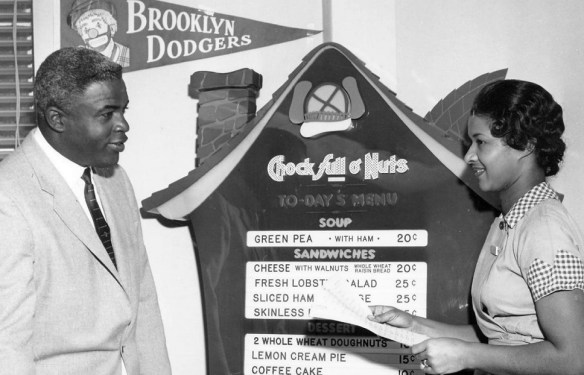
He had a job lined up, with Chock Full o’Nuts, the coffee makers whose chain of lunch counters featured mostly black staff, where he’d be vice president in charge of company personnel. He’d also agreed to tell the story of his retirement to Look magazine for $50,000. He made only the mistake of not making his retirement intentions formal with baseball’s administration or public just yet.

And that hesitation, which many players experienced before and after Robinson, delivered an unexpected posterior bite in December 1956. The Dodgers—now long run not by Robinson’s original patron Branch Rickey but by Walter O’Malley and Buzzie Bavasi—decided to trade him to . . . the crosstown Giants, of all teams.

The same Giants against whom Robinson’s Dodgers had a blood feud that continued after both teams moved to California after 1957. The same Giants whose pitcher Sal Maglie was considered such a Dodger nemesis (If that sonofabitch Maglie throws at my head one more time, I break my bat across his [fornicating] dago head—Dodger right fielder Carl Furillo) that Brooklyn fainted when, after a halting spell in Cleveland, the Dodgers bought the 39-year-old Maglie about a quarter way into the 1956 season.

Perhaps more surprising, getting Maglie helped make the final Brooklyn pennant possible. Maglie had a 2.87 ERA with the ’56 Dodgers, led the National League in ERA+, and finished second to his rotation mate Don Newcombe for baseball’s first Cy Young Award. The bad news was that Maglie was also the very hard luck loser on the flip side of Game Five of the ’56 World Series—Don Larsen’s perfect game.

With the Dodgers now trading Robinson to the Giants for lefthanded pitcher Dick Littlefield and about $30,000 cash, you might imagine competition between Dodger and Giant fans over who’d faint first and hardest. You might also imagine sports cartoonists of the day having a field day with it. According to Roger Kahn in The Boys of Summer, one magazine was preparing along that line: Sport commissioned a cover illustration of Maglie the Dodger pitching to Robinson the Giant. But you might imagine even further Robinson fighting a battle in his own mind.
2020-04-15 JackieRobinsonChockFullONuts

Jackie Robinson with an unidentified staffer in his Chock Full o’Nuts office. His association with the company provoked Casey Stengel to a wisecrack when the two had a public argument: “Jackie Robinson was a great player, but now everybody knows he’s Chock Full o’Nuts.”

The Giants were ready to sign him to a generous enough 1957 deal, and Chock Full o’Nuts’s president William Black—perhaps mindful of the extra publicity thrust likely to arise—was ready to hold Robinson’s job for him if he did decide to play one more season. Still marveling at the imagery of Dodger Maglie against Giant Robinson, Sport editor Ed Fitzgerald asked Kahn, a Sport writer at the time, to find out first if Robinson would indeed suit up for the Giants.

Robinson “was vague,” Kahn would remember of that telephone call. He acknowledged the Giants offering $40,000 for him to play in 1957, followed by $20,000 a year as a scout for the two seasons to follow. But when asked if he’d play, he could only say, “Whatever I do, I’ll give it all I’ve got.” “What Robinson was trying to say (and has never known how to say),” Kahn remembered, “was ‘No comment’.”

A month later, Look called a press conference announcing the publication of Robinson’s article, “Why I’m Quitting Baseball.” Robinson said he’d had help with the piece but, no, the trade to the Giants didn’t make him quit, he’d already started work on the Look article when he got the call about the trade. Two days after the Look press conference, though, Bavasi shot his own mouth off to the press. “Robinson will play,” Bavasi said. “I know the guy and he likes money. Now that Look‘s paid him, he’ll play so he can collect from the Giants, too.”

“If Mr. Black had come to me and said it might be a good idea for me to play,” Robinson told New York Daily News columnist Dick Young, not always a Robinson fan, “I certainly would have considered it.” Bavasi changed all that: “[T]here isn’t a chance—not if Mr. Black got down on his knees and begged me to stay.” One small irony was that, at Chock Full o’Nuts, Robinson’s duties would include doing his best to keep personnel turnover minimal.

“Reading [Bavasi’s] sentences,” Kahn eventually wrote, “Robinson knew: the retirement [from baseball] wold have to be permanent. Already [New York Herald-Tribune columnist] Red Smith was attacking him for ‘peddling a news story, the rights to his retirement.’ If he did play again, critics would denounce him as a phony. His baseball years, begun with heroic pioneering, could end amid cries of fraud.”

The knees that drove him to think about retiring in the first place helped bail Robinson out of an untenable situation at last. (The commissioner’s office voided the deal, returning Littlefield and their thirty large to the Giants.) They also reinforced his retirement decision and removed any lingering doubts on Opening Day 1957, when he awoke unable to get out of bed thanks to his right knee swelling to a size comparable to a pumpkin.

Writing upon Robinson’s death at 53 in 1972, Smith himself described him as “the unconquerable doing the impossible.” Indeed. You couldn’t beat him with a trumped-up Army court-martial. Baseball’s racists couldn’t grind him down. When he suited up, as ally-turned-adversary Leo Durocher once observed, “He didn’t just come to play. He come to beat you. He come to stuff the goddam bat right up your ass.”

Robinson also turned baserunning into guerrilla warfare. Baseball knew its base thieves in the past; Robinson turned even the threat of grand theft into must-see viewing. Smith swore that television introduced split-screen viewing so you could see the pitcher vs. the batter on one side and, on the other side, Robinson on base making that pitcher “wish he didn’t have to throw.”

Jackie Robinson established the black man’s right to play second base. He fought for the black man’s right to a place in the white community, and he never lost sight of that goal. After he left baseball, almost everything he did was directed toward that goal.

Hadn’t coming to and staying in the Show been tough enough without his retirement getting caught in cynical machinations not of his own making? Sal Maglie the Dodger wouldn’t get to pitch to Jackie Robinson the Giant, after all.

Glenn Beckert, RIP: “The closeness is real”

2020-04-13 GlennBeckertRonSanto

Glenn Beckert (right) and Hall of Fame third baseman Ron Santo display their 1968 Gold Gloves. Rawlings presented the award, but Beckert preferred the Wilsons that Hall of Fame pitcher Ferguson Jenkins broke in for him every spring.

When the 1969 Cubs sputtered down the stretch as the Miracle Mets heated up for keeps, Glenn Beckert wasn’t quite as exhausted as several teammates. That’s what missing a month on the disabled list—with a badly jammed thumb after a collision tagging Reds pitcher Tony Cloninger to start a double play—can do for a fellow who was as reliable at second base as the season was long.

Beckert died at 79 Sunday morning. Decades after the 1969 collapse and before his death, he wasn’t unaware of the toll manager Leo Durocher’s whiplash style took on several Cub regulars and especially their bullpen. But he thought those Cubs—enjoying celebrity to levels previously unknown to them, in and out of Wrigley Field—were drained more in the brain than the body.

“Tired? I don’t know, we came up short,” Beckert told Peter Golenbock for the oral history Wrigleyville: A Magical History Tour of the Chicago Cubs. “More than anything, I think we were emotionally drained. None of us were accustomed to the crowds and the intensity. An awful lot of what happened was mental. The whole thing was a sobering experience, but we were young.”

Not that Beckert ignored the physical side. Durocher’s unwillingness to use his decent enough bench or to trust his bullpen deeper than Phil (The Vulture) Regan flattened the Cubs—a team with four Hall of Famers (Ernie Banks, Ron Santo, Billy Williams, and Ferguson Jenkins)—into burnout that September.

“Leo had stuck with his horses, and maybe that hurt us the last month of that season,” Beckert told Golenbock. “Who knows? That’s second-guessing now. But there was no platooning with Leo. I knew I was somewhat tired, and I had an injury before that. [Shortstop Don Kessinger] was getting a little weary, not only physically, but mentally. Ron and Randy [Hundley, stubborn everyday catcher] were hurting.

“We were playing banged up, and maybe that was the time when we could have used a couple of days’ rest,” Beckert continued. “We had a good bench. Papa [Paul Popovich] was the best utility infielder in baseball, the greatest hands, and he could have come in for a week. But that’s looking back. It’s history.”

Mets manager Gil Hodges went the other way completely. “As well as any manager in the game,” Wayne Coffey wrote in last year’s They Said It Couldn’t Be Done, “Hodges understood the importance of making every player feel involved, keeping every player fresh, giving everyone on his club a slice of ownership in what the collective team was doing.”

Durocher “brought us closer to a pennant than anyone else had in a generation,” said Santo in due course, even though he’d been the Cub above all who could be counted on to give Durocher the benefit of the doubt. “But he also brought disruption and chaos.”

“For Durocher’s part,” wrote David Claerbaut in Durocher’s Cubs: The Greatest Team That Didn’t Win, “his feuds, his attempts at intimidating young players, particularly pitchers, and the general tension he generated must have worn on the players.”

And the wear was more severe because of his unwillingness to rest his players and to use his entire roster more wisely. Despite the occasional protestations to the contrary, the team was tired. One need only look at the statistical crumbling, evident in the records of individual players, to draw that conclusion. Only [pitcher] Bill Hands and Billy Williams averted a season-closing freefall . . .

. . . Durocher compounded the fatigue factor by daring his players to admit they were tired . . . in August, when asked by a writer whether he planned to rest some of his regulars, Leo exploded. Cursing at the writer, Durocher called an impromptu team meeting to embarrass him. “Are any of you tired?” he hollered. “Anybody want to sit down for awhile? This man wants to know. Go ahead—anybody who’s tired just speak up.” Not wanting a quitter label and knowing the answer Leo wanted, the players were mum.

Beckert and Kessinger are remembered as a formidable double play combination; Beckert turned 71 double plays in 1969 (he’d turned 107 the year before, arguably his best individual season) but he also committed 24 errors and had a fielding percentage nine points below the league average while being worth five defensive runs above the league average at second base.

He earned his only Gold Glove in 1968, and for his career he did have range factors slightly above the league average. Also in 1969, Beckert found himself on the first of four straight National League All-Star teams.

Yet Durocher’s rejection of the fatigue factor hurt Beckert and Kessinger down that crucial 1969 stretch. Which might be seen through strange eyes, considering Durocher once smiled admiringly when told Beckert was native to a portion of Pittsburgh “where they hit first and ask questions later.” No matter.

“The fact is that when it counted most,” William Barry Furlong wrote in Look during the offseason (in “How Durocher Blew the Pennant”), “both Don Kessinger at short and Glenn Beckert at second were letting ground balls by them that they’d have gobbled up earlier. And what Santo says about it now is, ‘Next season I’m sure Leo will rest the regulars from time to time’.”

As a hitter Beckert was a tough strikeout (he walked seventeen more times lifetime and, after 1966, never struck out more than he walked in any season), which may explain the number one reason why he was made a number two hitter. That was a time when middle infielders were often thought to “belong” at or near the top of the batting order, almost regardless of their actual batting skills.

Like former Yankee second baseman Bobby Richardson, another tough strikeout whose career wound down as Beckert’s began, Beckert’s on-base percentages (1969: .325; lifetime: .318) weren’t really the kind you needed from your top two lineup slots. (Kessinger’s—1969: .332; lifetime: .314) But once he did reach base Beckert was as intelligent as it got; he’d score 90+ runs in a season three times in his eleven-year career and led the National League with 98 in the Year of the Pitcher 1968.

In his rookie season 1965, alas, Beckert had the honour of looking at a Sandy Koufax curve ball for strike three and flying out to right field twice during the Hall of Famer’s perfect game that September 9. According to Koufax biographer Jane Leavy, Beckert’s roommate Santo called back to him after the strikeout. “Hey, Rooms,” Santo asked, “what kind of fastball does he have.”

“So-so,” Beckert answered—right before Williams looked at a similar curve ball for strike three to end the Cub first.

In 1971 Beckert heated up at the plate enough to threaten for the National League batting title—until he ruptured a thumb tendon trying to make a play on a bouncing infield grounder. A few more injuries to follow turned into a trade to the Padres after the 1973 season. Beckert played two more seasons and retired when he realised an arthritic ankle had sapped what remained of his play, though he ended up collecting back pay from the Padres for their releasing him while he was on the disabled list.

It’s not that Beckert was all that sorry to go. “The Padres had the world’s ugliest uniforms, puke yellow and brown,” he’d say later, “and it was a bad experience, going from . . . Scottsdale in spring training to Yuma, Arizona . . . It was like where they filmed Lawrence of Arabia. The sand and the wind. It was like Stalag 17.

He was originally a Red Sox draft who was left exposed to the minor league draft from which the Cubs plucked him. When National League Rookie of the Year (1962) second baseman Ken Hubbs was killed in the crash of his Cessna plane in spring 1964, the Cubs finally settled on Beckert as Hubbs’s successor, bringing him up in ’65.

“A hardscrabble player who sometimes seemed eager to join in collisions at second base,” Bill James wrote in The New Historical Baseball Abstract, “Beckert was the Billy Herman of the 1960s, a pretty good second baseman, and the best hit-and-run man in baseball.”

Beckert made a successful second career as a grain futures trader. His Cub teammates remember a fellow with a fine, dry wit and a friendliness that was priceless. Twenty-seven years after they first met behind a minor league batting cage, Beckert stood as best man at Jenkins’s second wedding.

“Just knowing Glenn was a player who wanted to play every day and knowing he was behind me defensively, that always gave me a good feeling when I pitched,” the righthander told the Chicago Sun-Times.

Jenkins also gladly broke Beckert’s new gloves in for him every spring, something the Sun-Times said wasn’t one of Beckert’s more pronounced abilities. “He’d just hand me his Wilson A2000s, and I’d take care of it,’’ Jenkins said. ‘‘I’d pound a fungo bat into the pocket, put hot water into it, put a ball into it and wrap it nicely overnight. I broke in at least a few gloves for Beck.”

Hitting in front of Williams did Beckert more than a few favours, though whenever Williams fell into a rare slump Beckert would needle him by telling him to start hitting again so the second baseman might reunite with some badly-needed fastballs.

“I was happy to have him up there in the lineup and happy just to have him as a teammate,” Williams told the Sun-Times. “He was a great teammate and a fun guy to be around. He was quick-witted. He and Santo and myself, we used to go out and really enjoy life.”

As often as Beckert dealt with injuries during his playing career, they were nothing compared to the fall he took down fifteen concrete steps in 2001. He was hospitalised long and rehabilitated hard. Then he was diagnosed with lung cancer in 2006. It cut down on the frequency with which Beckert usually attended Cubs conventions and games at Wrigley Field.

“I’m thinking about the good times,’’ said Williams, himself now caring for his wife who battles late-stage dementia. ‘‘That’s what you do when something like this happens, when a person you spent a lot of good times with passes away. We had a really good group of guys on the Cubs back then. Unfortunately, there aren’t a whole lot of us left.”

The departed among the 1969 Cubs now include Beckert, Santo, reserve catcher Gene Oliver, right fielder Jim Hickman, starting pitchers Hands (who had a career year as a ’69 Cub) and Dick Selma, relief pitchers Hank Aguirre and Ted Abernathy, and especially the irrepressible Banks.

Those Cubs experienced two more pennant races with the same results, before Durocher was finally fired in favour of the sometimes-indifferent Whitey Lockman. Most of the team bonded personally as well as professionally, showing up in annual droves after Hundley first established fantasy camps that enabled frequent reunions.

“What you see with us in [the fantasy camp] is just the way it was in the clubhouse when we really played,” Beckert told Claerbaut. “Some guys are outgoing, some more inward. But the closeness is real, maybe because we played together so long.”

He’d had the habit of calling and meeting his old teammates and friends frequently before his accident and illness. Missing those calls will be nothing compared to how much they will miss Beckert himself. But that will be nothing compared to how much his daughters, grandchildren, and longtime companion Marybruce Standley will miss him.

From cycle breaker to brain truster

Chicago White Sox v Tampa Bay Rays

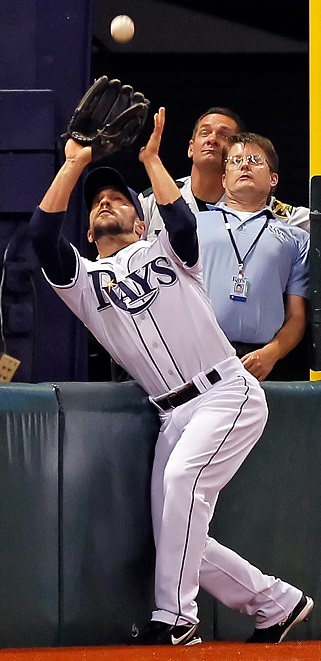
“A manager’s dream and a trainer’s nightmare,” was once the word about outfield acrobat Sam Fuld—who managed not to scramble his brains enough to rob him of the economics and statistical education that’s since made him the Phillies’ information coordinator.

The Phillies’ incumbent coordinator for major league player information used to be a swift outfielder with a penchant for defense that included a remarkable inability to yield to immovable objects. Sam Fuld also has a bachelor’s degree in economics from Stanford, where he insisted on studying before becoming a major league baseball player, and is striking for a master’s in statistics.

And eleven years ago Saturday, as ESPN’s Tim Kurkjian couldn’t resist remembering, Fuld needed a measly single in the top of the ninth to do what Hall of Famers Willie Mays, Henry Aaron, and Babe Ruth, plus Barry Bonds, never did even once in their careers. A single against the Red Sox, whom the Rays were blowing out in Fenway Park as it was, and Fuld would have hit for the cycle.

He didn’t make it.

Not because he didn’t nail a hit—he shot a line drive into Fenway’s right field corner. But neither did he stop at first the way some players might have done if that’s what they needed for the cycle. Fuld knew his hit was deep enough for a double and that’s what he ended up with, running to second just about standing up. And Fuld never once thought he’d made a big mistake.

It would have been a defining moment in the career of a player who wasn’t physically imposing at 5’9″, who was probably mis-seen and mishandled very early in his career, whom injuries compromised to a certain degree, and who never quite found a full-time slot regardless of his contact skills at the plate and his fearless defense.

But it wasn’t baseball. Even with a host of family and friends in the seats (Fuld is native to New Hampshire and grew up a Red Sox fan) who probably would have been the loudest in the park if he’d completed the cycle, it wasn’t proper baseball so far as Fuld was concerned.

“I never thought about stopping at first,” Fuld told Kurkjian in a post-game interview, the game having been showed on ESPN’s Monday Night Baseball. “That’s not the right way to play the game. If you can advance to the next base, you advance. That’s the only way to play baseball.”

So he settled for a night of two RBI doubles, a leadoff triple, a two-run homer into the right field corner seats, and a bath of postgame applause from his Rays teammates. “Everyone in this room respects him even more for that,” said the Rays’ then-general manager Andrew Friedman after that game. “That’s why he’s Sam Fuld.”

Fuld became a Ray in the first place because the Cubs, who drafted him out of Stanford in 2004, found it difficult to find a place for an outfielder described as “a crash test dummy with a death wish” for his daring defense while also swinging a bat that delivered high on-base percentages in the high minors.

In 2008, 2009, and 2010, the Cubs continued having that difficulty. When he was sent to Iowa (AAA) yet again before spring training expired, Fuld was defended from two disparate sources.

“[D]on’t you think you could find a place for a fast guy who gets on base and plays great defense?” asked Rob Neyer, who promptly delivered the answer he didn’t like. “The Cubs did find a place for him. No, not Wrigley Field. Not Heaven, either. Iowa. Again. Where Fuld posted a .383 on-base percentage . . . I’m telling you, there are worse fourth outfielders on half the teams in the majors right now.”

Larry Thornberry, writing then for the political magazine The American Spectator, saw and raised, after Fuld was traded to the Rays for 2011 (in a deal sending pitcher Matt Garza to Chicago and pitcher Chris Archer to Tampa Bay) and made the team out of spring training for the first time—at age 29.

“[P]erhaps decision makers where Fuld has played before Tampa Bay didn’t move him along or pencil him into lineup cards because they were prejudiced against players of Fuld’s stature,” Thornberry wrote. “But those who don’t believe guys of Fuld’s size can be solid major league players should be sentenced to sit in the corner under the dunce hat and read Joe Morgan’s statistics over and over.”

Fuld got his shot as a Rays regular in the first place because Manny Ramirez, being only Manny after all, elected to retire rather than sit out a hundred-game suspension for actual or alleged performance-enhancing substances. “[T]here are no stats to identify the player who captured the hearts of his local fans most quickly,” Thornberry wrote. “If there were, Tampa Bay Rays outfielder Sam ‘The Man’ Fuld might have his first major league record.”

The bad news is that Fuld went from being one of the American League’s on-base percentage leaders ending April to a drop-off at the plate almost inexplicably. Perhaps his acrobatic defense (wags suggested renaming ESPN’s Baseball Tonight to The Sam Fuld Show after so many highlight-reel outfield plays showed up so many times) took the initial toll on his early plate breakout.

Perhaps more, a wrist ligament injury he suffered that September and re-aggravated the following March eroded his once formidable batting skills. The Rays let him walk as a free agent and he signed with the Athletics for 2014; the A’s farmed him out and left him prone to a waiver claim which the Twins placed in late April.

He played thirteen games before suffering a concussion crashing into an outfield wall; he ended up playing only 53 games as a Twin and still managed to lead the team with a .370 OBP, and flying-trapeze outfield plays, before they traded him back to the A’s at the end of July 2014.

2020-04-12 SamFuldSeanRodriguez

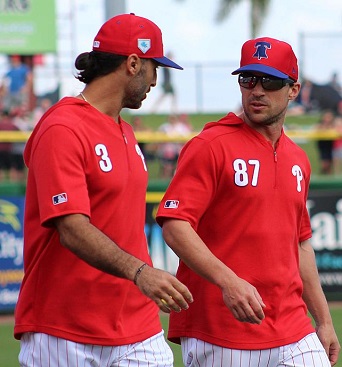
Fuld (right) with Phillies infielder Sean Rodriguez, spring training 2019, before Rodriguez yielded number his uniform number to incoming Bryce Harper.

In Oakland Fuld’s high point was probably the 2014 American League wild card game in which he reached base three times while the A’s fell to the eventual pennant-winning Royals. He moved around the outfield as a part-timer the next two seasons (he led the American League in double plays turned from left field in 2015), never really recovered his batting skills, until the prospect that he’d done so during spring training 2016 ended when he injured his left rotator cuff.

Surgery, season lost, career over. He made his retirement official in November 2017. The Phillies hired him almost before he could finish his announcement that day.

Once it was said about 1960s center field gazelle and 1970s reserve clause challenger Curt Flood that 75 percent of the planet was covered by water and the rest by Flood. When David Price was a Rays pitcher and a Fuld teammate, he plagiarised that observation to say the world was covered 75 percent water and 25 percent Fuld.

What Fuld covers now is baseball knowledge and analytical skill, enough that he was considered seriously for assorted managers’ openings. Last fall, in fact, he was said to be on the candidate lists with the Pirates (who hired Derek Shelton), the Cubs (who canned Fuld’s manager in Tampa Bay, Joe Maddon, in favour of David Ross), the Giants (who replaced retiring Bruce Bochy with ex-Phillies manager Gabe Kapler), and the Mets. (Fired Mickey Callaway, hired Carlos Beltran, unloaded Beltran in the Astrogate wake, hired Luis Rojas.)

A near lifelong Type I diabetic (he was diagnosed at age ten), Fuld is well accustomed to working under pressures. Those who think the analytic nerds come from places having nothing to do with baseball may not have realised that Fuld, who insisted on getting his bachelor’s degree before giving pro baseball a try, merely took what he knew as a player and married it to an already analytical brain.

Even if he scrambled that brain more than a few times making those human cannonball plays.

“A lot of the battle is getting the information to the players when it really matters and that’s when you’re on the field,” Fuld told Philadelphia Inquirer writer Matt Breen in spring training 2018. “You can have all the meetings you want at 1 p.m., but at 7 p.m., when the game really matters, it’s important that they get the right amount of information and the most important information.”

Kapler managed the Phillies in 2018-2019 until he was executed after last season. He was unable to marry his own analytical inclinations to critical, in-game, game-on-the-line moments. Perhaps he forgot that Fuld, his information coordinator, who once immersed himself in Moneyball (the book, not the film) while studying at Stanford, could and did marry both, as a hair-raising outfielder whose very trademark eroded his once-formidable plate smarts and skills but not his intelligence or his feel for the game.

A feel that Fuld displayed for all time on 11 April 2011, in a ballpark where Kapler himself once enjoyed many a high as a championship, real-or-alleged cursebusting Red Sox outfielder. Where Fuld was tempted of the cycle and gunned it past first on to second on an obvious double, ordering that particular Satan to get himself behind.

No wonder there may yet be teams looking for him to take their bridges even if he’s content where he is right now. An analyst who played the game right when he could have stopped short for a moment’s personal glory. It’s as valuable to the game now as sports newscast programmers once held Fuld’s threats to outfield walls everywhere.

Grapefruit vs. Cactus, regular season?

CoronavirusRedImagine there’s no National League or American League, for one season, at least. Imagine, instead, there’s a Cactus League and a Grapefruit League, for just one season. If you take the word of USA Today‘s Bob Nightengale, it could happen this year when baseball’s able to return. If it’s able to return this year.
For just one season I’d be all in. Thanks to a combination of a pestiferous viral pandemic and assorted and sundry responses running the line from ignorant to delayed to scrambling and back, it’ll be a short baseball season if the game can come back. A short season is better than no season.

Nightengale says the Cactus/Grapefruit realignment is just one idea being tossed around the horn for when the stay-at-home/social-distancing orders are lifted. But it’s not a terrible idea at all. That’s the alignment we get watching the spring exhibitions, so it isn’t exactly as though we’d be thrown into the Twilight Zone now.

“The plan would have all 30 teams returning to their spring training sites in Florida and Arizona, playing regular-season games only in those two states and without fans in an effort to reduce travel and minimize risks in the midst of the COVID-19 pandemic,” Nightengale writes. “The divisions would be realigned based on the geography of their spring training homes.”

Under this plan, Nightengale continues, both the Grapefruit and Cactus Leagues would be arranged in three divisions each: North, South, and East for the Florida-based Grapefruit League and Northeast, West, and Northwest for the Arizona-based Cactus League.

And how would the teams be arrayed within those divisions? Nightengale has your answer, too:

Grapefruit League: North—New York Yankees, Philadelphia Phillies, Toronto Blue Jays, Detroit Tigers, Pittsburgh Pirates. South—Boston Red Sox, Minnesota Twins, Atlanta Braves, Tampa Bay Rays, Baltimore Orioles. East—Washington Nationals, Houston Astros, New York Mets, St. Louis Cardinals, Miami Marlins.

Cactus League: Northeast—Chicago Cubs, San Francisco Giants, Arizona Diamondbacks, Colorado Rockies, Oakland Athletics. West—Los Angeles Dodgers, Chicago White Sox, Cincinnati Reds, Cleveland Indians, Los Angeles Angels. Northwest—Milwaukee Brewers, San Diego Padres, Seattle Mariners, Texas Rangers, Kansas City Royals.

OK, the bad news is that the Cactus League would have fewer logistical and distance problems, since the Arizona spring camps are separated by no more than an hour’s drive apiece. The spread in Florida is a lot wider, which Nightengale notes might compel a few tricky maneuvers in the event any team personnel might need to be isolated.

A few traditional rivalries would get temporary short shrift to a certain extent, too. It’ll take a little getting used-to picturing the Yankees and the Red Sox in different divisions, not to mention the Dodgers and the Giants or the Cubs and the Cardinals likewise, with the Cubs and the Cardinals in different leagues in the bargain.

On the other hand, several in-state rivalries remain intact, such as they are. The Reds and the Indians for the honour of Ohio. The Phillies and the Pirates, for Pennsylvania power, never mind how lopsided it now is in the Phillies’ favour. The Dodgers and the Angels for bragging rights to Interstate 5 traffic jams.

How delicious would it be, also, to see even a temporary seasonal rivalry between last year’s World Series combatants—each of whom behaved rudely enough in the other’s house, one of whom won it all in the other’s house, with the winner also out-smarting the other’s flair for espionage even before the other’s exposure as electronic, off-field-based cheaters?

You say it’s theoretically possible that the World Series comes down to the Cardinals vs. the Cubs? Since the Grapefruit/Cactus alignment would keep them apart on what comes of the regular season, how surrealistically bristling would it be to see those two traditional division rivals otherwise in a hammer-and-tongs, few-holds-barred feud for a lease to the Promised Land?

Even if they can’t play the games in St. Louis or Chicago, oh boy will Cardinal and Cub fans go nutsh@t over that.

If there’s one thing baseball’s great for, it’s stirring the imagination. Now we could have one of the greatest imagination stirrers in recorded baseball history. And all it took was a nasty little virus out of a Chinese province that resembles a ball spiked with (depending on the developed image) rubber darts or red broccoli florets to do it.

Except that there are still a few problems. The players themselves would be far less than thrilled to be isolated into playing games strictly in one or the other region. Especially those who happen to be expectant fathers with their anticipated offspring due during the season and their wives expecting them to be there for the deliveries.

No matter how much money they’re paid to play, you can’t blame them for not wishing to be isolated even further from the families away from whom they spend enough time during a normal regular season.

Not to mention that, no matter how often some fans in the stands are bothersome nitwits (reality check: a few such fans are too many, and they’re there, they always have been there), enough players admit it’s just not the same playing in empty ballparks—which could still happen, depending on the extent to which the social distancing orders get lifted.

This much we know: Forget the dollars at stake, they want to play. Bears gotta bear, bees gotta bee, and baseball players gotta baseball. They’ll consider any and just about all alternatives if it means playing ball with the least amount of family encumbrance.

“When you’re trying to get really creative, why say no now?’’ says Hall of Fame manager Tony La Russa—who now works as a senior advisor for Angels baseball operations, and whom Nightengale says was told of the possible Grapefruit/Cactus plan.

“So you have a unique season. I’ve got no problem with that,” La Russa continued. “I’m not sure we’ll be able play in our own cities across the country, so if you split it up like that, it’s a possibility.”

How would they play, then? Nightengale says each league would play twelve games each within their new temporary divisions, six apiece against other teams in the league, at least one doubleheader a night when all the teams are on the schedule because of the fifteen-team leagues.

And, everyone plays with a designated hitter.

Oh, you can hear it now. The “traditionalists” snarling and foaming over further polluting the game. Making those poor National League teams now in temporary league with those sissy American League teams take it like a manperson.

Never mind that last year the National League’s pitchers batted a whopping .133 overall or that all Show pitchers batted a lethal .100 overall. You want to keep wasting a lineup spot on that? Instead of your team putting what amounts to an extra cleanup hitter or an extra leadoff-type hitter in the spot? Instead of having a fifty percent or better shot at putting more runs on the board?

I was in the anti-DH camp for a long enough time. For life, actually. And for the same reason—“tradition.” I don’t dismiss tradition lightly, but there are traditions worth keeping and traditions worth dumping. Baseball’s dumped a few traditions best left to the scrap heap, too. Remember how long it was “traditional” to bar non-white players from “organised” baseball? Or to play strictly day ball?

Sure, it’s a blast (pun intended) when a pitcher hits one into the seats—once in the proverbial blue moon, but it’s just a little self-defeating to sustain some cockeyed idea of “tradition” when you might be adding a little more real run creation/production. “It’s fun to see Max Scherzer slap a single to right field and run it out like he thinks he’s Ty Cobb,” the incomparable Thomas Boswell wrote last year.

But I’ll sacrifice that pleasure to get rid of the thousands of rallies I’ve seen killed when an inning ends with one pitcher working around a competent No. 8 hitter so he can then strike out the other pitcher. When you get in a jam in the AL, you must pitch your way out of it, not ‘pitch around’ your way out of it.

As a result, some weaker pitchers survive in the NL. But survival-of-the-unfittest isn’t good for the evolution of a league. Over time, high-quality hitters migrate to the AL, where they can have longer, richer careers by finishing as a DH. That is the main reason the AL has dominated interleague play in this century.

By the way, the blow that arguably did the most to put the last World Series into the Nationals’ bank? After the same Max Scherzer pitched on less than fumes and somehow managed to keep things no worse than a 2-0 Nats deficit through five innings?

That would be Howie Kendrick, turning on a Will Harris cutter arriving off the middle of the plate, sending it off the Minute Maid Park right field foul pole with a bonk! “It doesn’t add up,” said Astros shortstop Carlos Correa when it was over. “The way [Harris] throws his cutter, it’s one of the nastiest cutters in the game. Down and away, on the black, and [Kendrick] hits it off the foul pole.”

Kendrick was the Nats’ DH on the evening. Do you still want to argue against it sticking around after the coronaball season when baseball goes back to normal next year?

Phillies say phooey to ’93 Series Game Six

2020-04-10 MitchWilliams

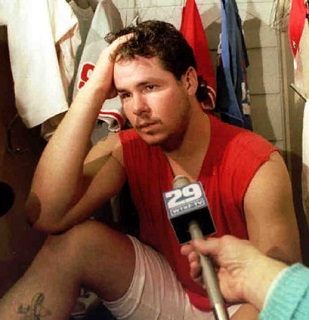
Mitch Williams didn’t run and hide after surrendering the 1993 World Series-losing home run. The Phillies threw him under the proverbial bus anyway.

One of the devices by which baseball’s keeping itself alive during the coronavirus shutdown is assorted networks, YouTube, and Twitter linking to classic games. Allowing that “classic” is in the eye of the beholder a little more often than in the eye of history, you were probably right if you thought at least a few such games might anger more than amuse.

The Phillies aren’t amused that Major League Baseball itself tweeted Game Six of the 1993 World Series. Nobody likes to remember their World Series ending with the humiliation of the other guys’ home run sending those guys to the Promised Land, of course. But there’s a little more to that story than just the Blue Jays’s Joe Carter ruining closer Mitch (Wild Thing) Williams and the Phillies that night.

“Oh, not to be Mitch Williams, now that winter’s here,” Thomas Boswell wrote in a Washington Post column republished in Cracking the Show. “For the rest of us, it’s still autumn. But winter came early for Wild Thing . . . does baseball have eighteen goats to match Williams? . . . When the bullpen phone rang with the Phils leading, 6-5, when Williams saw the top of the gaudiest lineup in baseball awaiting him to begin the ninth, did he want to plead nolo contendere?”

Actually, Williams didn’t want to plead any such thing.

The Wild Thing had to deal with death threats over his blown save in Game Four (the Jays won the game 15-14) reaching him as he arrived home from Veterans Stadium. First he admitted he was terrified enough to spend a sleepless night holding his shotgun. Then he he rejected thoughts of handing the closing role to someone else: “No one’s going to scare me that much,” he answered when asked. “No one will make me hide.”

Nobody did, in fact. Not even after he walked Hall of Famer Rickey Henderson to open the bottom of the ninth with the Phillies up a run and three outs from forcing a seventh game. Not even when pitching coach Johnny Podres visited him on the mound and urged him to use a slide step delivery, instead of his normal, right knee bent to his shoulder leg kick, in a bid to keep the Man of Steal from grand theft second base.

Not even after getting Devon White out on a fly to left, a base hit from Hall of Famer Paul Molitor sending Henderson to third, and Carter checking in at the plate—with yet another Hall of Famer, Roberto Alomar, on deck. Not even when Williams stayed with his pitching coach’s suggestion despite its alteration of his delivery and threw Carter a 2-1 fastball when he had Carter, a low-ball hitter, thinking breaking ball.

“The only reason I hit it fair,” Carter eventually said, “was because I was looking for a breaking ball the whole time. I wasn’t way out in front of the ball. I guarantee you, if I was looking fastball, I would’ve swung and missed or hit a foul ball.” He swung instead into Toronto lore, his three-run homer nailing the Blue Jays’ second straight Series win and hammering Williams into Philadelphia infamy.

Not even facing the press gamely and answering every last question sent to him, however stupid or careless, saved the Wild Thing. “Ain’t nobody on the face of this earth who feels worse than I do about what happened,” he said straight, no chaser. “But there are no excuses. I just didn’t get the job done. I threw a fastball down and in. It was a bad pitch. I’ll have to deal with it.”

In due course, Williams gave the real breakdown. “I knew I made a mistake,” he’d say in due course. “That fastball was down and in, right in Carter’s nitro zone. I wanted to throw it up and away, which I could’ve done if I’d gone with my full leg kick. But the slide step altered my delivery and I ended up rushing the pitch.”

2020-04-10 JoeCarterMitchWilliams

Williams walks off the field after Carter (29) begins his romp around the bases. The pair have since become friends and often autograph this photo together.

Williams’s teammates had his back—at first. “We wouldn’t have been here if it wasn’t for Mitch,” said first baseman John Kruk. “He’s not afraid to take the ball and I like a guy like that on my team,” said center fielder Lenny Dykstra, who might have had the 1993 World Series MVP to put on his mantel (or, all future things considered, put up for sale on eBay) if it hadn’t been for Carter.

Phillies historian William C. Kashatus wrote Macho Row about the ’93 Philthy Phillies, particularly a contingency within the team who lived by their own Code (the upper-case C is Kashatus’s) of solidarity inside and insularity from the outside. Clockwise the cover showed Kruk, Dave Hollins, Darren Daulton, Williams, and Dykstra. It took the figurative equivalent of five minutes after the Phillies finally left Toronto after the Series loss for someone to throw Williams under the proverbial bus.

Actually two someones. Both Dykstra and pitching star Curt Schilling—whose gutsy Game Five shutout got the Phillies as far as to Game Six in the first place—talked to the press showing “concern that Mitch Williams not return to the Phillies” after the Carter bomb, Kashatus wrote. “I love the guy,” said Dykstra. “He’s a great competitor and I’m sure he wants to pitch here again, but for his sake I hope he doesn’t have to . . . he’ll probably never be able to pitch in Philly again.”

That was mild compared to Schilling, who’d made a few World Series waves by sitting on the bench with a towel over his head whenever Williams came into a game and now suggested trading the Wild Thing would be a positive.

“What if we win and go to the postseason again next year?” Schilling asked, then answered. “We’d still be going in with the mentality of ‘Can he do it?’ Mitch was tired at the end of the season. It was a question of whether he was able to. Mitch gave his all every time out there, but, in the big leagues, it’s not a matter of giving everything and wanting the ball. It’s a matter of success.”

Nobody, of course, thought even once to question Podres’s judgment in urging Williams to the slide step delivery even with Henderson on the bases ready to commit high crime at the first known opening. Once a Brooklyn hero for beating the Yankees twice to win the only World Series the Dodgers ever won as the Brooklyn Dodgers, Podres served three more seasons as the Phillies’ pitching coach.

If Podres couldn’t make a second mound visit, the rule being a second visit by either coach or manager meaning the incumbent pitcher having to leave, why couldn’t he send Williams a sign to take the slide step off? Even with Henderson on second?

What’s the worst that could happen from there with the slide step taken off—Carter not missing, not fouling, but maybe hitting a soft fly ball on which even Henderson might not score, maybe even whacking into a game-ending double play that forces Game Seven?

Dykstra and Schilling may have insisted as Kashatus wrote, that Williams not take it personally, but then Williams did indeed get traded, to the Astros early that December. He fumed particularly over Schilling’s remarks at first, the two trading insults for a spell until Williams’s career hit the pit in Houston, Anaheim, and Arlington to follow before he retired.

Come 2008, Dykstra gave a radio interview in which he called Williams a barrel-finding joke. It prompted Williams to talk to the same station the following morning and call Dykstra “the most common sense-void person I’ve ever met in my life. He’s a savant with a bat in his hand. You could have a better conversation with a tree.”

Williams even predicted Dykstra’s long-infamous Players Club venture, giving financial advice to professional athletes, would collapse. Which is exactly what happened, along with enough other financial improprieties including bankruptcy fraud to send Dykstra to the calaboose in disgrace.

Not that it taped Dykstra’s mouth shut when it came to Williams. At a 2015 comedy roast, Dykstra told Williams, “Prison was a [fornicating] fantasy camp compared to playing behind you.” Williams wasn’t exactly caught unprepared, retorting that the only real reason Dykstra still burned over the Carter home run was because it cost Dykstra that ’93 Series MVP.

Schilling ended up going from Philadelphia to become a postseason legend in Arizona and Boston, a qualified Hall of Famer who throve when the games were the biggest, until a combination of his 38 Studios’s collapse and his tendency toward political opinions delivered with threatening tones sank his public image.

The harshest part of that isn’t just that Schilling hasn’t been elected to Cooperstown but that he also caused his parallel reputation for philanthropy to become ignored or at least bypassed. He was fired as an ESPN baseball analyst at a time when he needed the income badly enough after the 38 Studios debacle for which he never shirked responsibility.

Compared to all that, Williams’s life became something of a rose garden for a long enough time. His first marriage collapsed but he’d remarried in 1993. He became a Philadelphia baseball broadcaster who attracted MLB Network into hiring him as an analyst.

Then came an incident while he was coaching one of his son’s youth baseball team’s games. A dispute with an umpire, an accusation that he’d ordered a pitcher to throw at a batter, and another claiming he called an opposing player a feline euphemism for a certain part of the female anatomy. MLB Network fired him when he refused to sign a deal barring him from those games.

Williams sued MLB Network over the firing and Deadspin‘s parent Gawker Media for defamation, and eventually won a $1.5 million settlement in 2017. The Wild Thing couldn’t resist a tweet: “To all of the people that have wondered where I have been for 3 years.today that answer was provided by a court of law#justice.”

He never bought the Phillies saying they traded him to the Astros because they “thought the fans would crucify me the next year. But they underestimated me. They didn’t understand that the fans appreciated that I didn’t run and hide after the World Series or during the off-season. The fans knew I was a guy who fit into their city. They knew that every day I walked out there I gave everything I had.”

That standing ovation with which the Veterans Stadium crowd hit Williams when he returned as an Astro proved it.

A decade before Williams won that settlement, the Mitchell Report and other documents named Dykstra, fellow Macho Rowers Pete Incaviglia, Hollins, and reserve catcher Todd Pratt as using or being connected to actual or alleged performance-enhancing substances. “If someone was using steroids on that team,” Kruk insisted, “they were awfully quiet about it. And we talked about everything on that club.”

Speculation abounded, too, about regular catcher Daulton, who eventually admitted during his battle with brain cancer, “Anything I did in the past is my fault. Not my ex-wives’ fault, nor any of my kids’ faults, not baseball, not the media—me, my fault—I did the damage.”

There are indeed reasons why the Phillies today might not be amused to be reminded of Game Six of that ’93 Series. Reasons having almost nothing to do with the standup pitcher who shook off a sleepless, death-threatened night, listened to his pitching coach once too often, and didn’t look for the nearest hideout after one pitch meant disaster.

The guy who’s since forged a pleasant friendship with the man who destroyed his 2-1  fastball and the hope of a Game Seven. The guy to whom Phillies fans gave that standing O his first time back to Philadelphia because he was maybe the only stand-up man in the crowd.

Who’d have thought, when all was said and done, that the Wild Thing was the ’93 Phillie who had the least amount of splainin’ to do?