Yu’re kidding, right?

2019-11-16 YuDarvish

Yu Darvish looking staggered after surrendering the 2017 World Series homer that knocked him out of Game Seven after an inning and two thirds.

Practically from the moment Mike Fiers triggered Astrogate, there came a swell of blended rage and remorse from Dodger fans still smarting over Yu Darvish getting battered twice in the World Series, especially Game Seven. A lot of which fans now wanted to apologise. To Darvish.

All of a sudden a high-tech cheating scandal made a hero out of a pitcher whom we thought was caught tipping his pitches and battered accordingly, while any Dodger who was supposed to spot those things didn’t spot them. And who still felt the compulsion to apologise on the record just a couple of days later.

Just two years ago Darvish was Public Enemy Number One. Now, all of a sudden, he was embraced as another possible victim of the Astro Intelligence Agency. As God and His servant Branch Rickey are my witnesses, I swear sports fans take a back seat to few for absurdism.

You could have been Los Angeles’s most notorious wanted criminal, and you wouldn’t have inspired half the dragnet Dodger fans wanted to run to capture, draw, and quarter Darvish. And whatever was left of him. Now the guy who was compelled wrongly to a public apology in the first place gets a lavish bubble bath of apologies from the same fans.

“Why am I trending [sic]?” Darvish tweeted on Day One of Astrogate. “Do people finally realize I’m cool?” Priceless.

He’s too polite to reject them directly, but he’s too self-aware to accept them sight unseen. “I’m not looking for that,” he said in a post on his YouTube channel. “I don’t want them to change their minds.” Be careful what Yu wish for.

A simple “I stunk, that’s all” from Darvish on Twitter wasn’t enough. Nor, perhaps, is his further YouTube demurral. “If you ask me if I got hit in Game Seven because they stole signs, I don’t think so,” he said, in a translation by the Los Angeles Times columnist Dylan Hernandez. “The Astros have great players who don’t have to do that. So I think that whether or not they stole signs, the results wouldn’t have changed.”

Notice Darvish’s phrasing. I said more or less the same thing myself in a previous Astrogate entry. About the Astros having great players who don’t have to resort to crime, high tech or otherwise. Which is almost as much of what makes Astrogate such an outrage as the fact that they so flagrantly broke the actual rules about off-field electronic surveillance in the first place.

These Astros needed high tech spying to win about as much as Richard Nixon’s re-election campaign CREEPs needed whatever they were looking for—while so ineptly bugging Democratic National Committee headquarters in the Watergate complex—for their man to win by a landslide in 1972.

And the Astros are accused only of operating the AIA in Minute Maid Park. So far. Nobody’s yet suggested they sent the agency on surveillance missions in road ballparks in the first place, never mind gotten away with it if they had.

Unless there’s evidence yet to be exhumed, it’s not very likely that the Astros bugged Dodger Stadium to get the drop on Darvish. Unless they had a mole among the stadium personnel, any Astro personnel trying to set up electronic surveillance in the road ballpark would have been caught, thrown out of the stadium, and maybe have to answer to la policia in the bargain.

Wouldn’t they?

Even Darvish himself let the suggestion enter his mind for a moment. “What’s been reported up to this point is that they used cameras at their home field,” he said, “so I don’t know if there was anything like that. But what they were doing was so high-level that I can’t honestly say there’s no chance they were also doing it on the road.”

Dodger fans wanting to make it up to Darvish should stop right at the point of apologising for wanting to hang him after the 2017 World Series. Especially since he wasn’t the only reason the Astros won Game Seven, and getting sent to bed without his supper after an inning and two thirds still left the Dodgers plenty of time to overthrow the 5-0 hole the Dodgers were in when he departed.

Memory time, boys and girls. Darvish’s Game Seven evening began with a leadoff double by George Springer and Springer coming home on a throwing error in the infield, allowing Alex Bregman aboard to reach second on the play. Then Bregman stole third with Jose Altuve at the plate, and Altuve pushed Bregman home on an unassisted ground out to first. Two runs, unearned, in the top of the first.

Top of the second? Brian McCann opened with a full-count walk. Marwin Gonzalez doubled him to third. Josh Reddick grounded out to second. And Astros starting pitcher Lance McCullers, Jr. pushed McCann home and Gonzalez to third on another ground out to second, before Springer hit a full-count pitch into the left field bleachers.

Where were the Dodger brain trusters who didn’t catch him tipping pitches and fix it before the Astros could do any more damage than the Dodgers gifted them in the top of the first?

Where were the Dodger hitters who looked McCullers’s gift horse in the mouth, putting two or more on against him the first few innings including ducks on the pond in the bottom of the first, but swinging like Little Leaguers trying to hit six-run homers on every pitch and leaving the runners grounds for court martials, charges desertion?

The only reward Dodger fans got for Brandon Morrow (ending the second), Clayton Kershaw (four scoreless in relief), Kenley Jansen (a scoreless seventh), and Alex Wood (scoreless eighth and ninth) stopping the bleeding was a one-out RBI single from Andre Ethier in the sixth. The Dodgers had two or better on and men on second or better in five of the first six innings, and Ethier was the only man to cash in.

Now the Dodgers deny pitch tipping was the issue. Their roster included now-retired Chase Utley, said to be expert at catching pitch tipping. “[He] watched the Darvish outings,” says team president Andrew Friedman, “and said you couldn’t sell out on something that Darvish was doing.”

Darvish’s ERA in the first two 2017 postseason rounds was 1.62. His Series ERA: 21.60. The 2017 Dodgers won three more regular season games than the Astros despite the Astros out-hitting them—the Dodgers’ team ERA on that season was 3.38; the Astros’, 4.12. And you don’t need me to tell you the flip side of, “Good pitching beats good hitting.”

Was Darvish more right saying “I stunk?” Or did the Astros find some way to take the AIA on the road with them, after all? Were they that nervous about the Dodgers’ potential to out-pitch them?

I’ve written until I was blue in the fingers about baseball’s goats and fans inane enough to try making their lives to follow nightmares. The last time was in the immediate wake of Bill Buckner’s death on Memorial Day. I inadvertently omitted Darvish from the roll of those who really needed no forgiveness because there wasn’t a damn thing to forgive in the first place.

When Thomas Boswell eulogised Donnie Moore, after Moore’s shocking suicide in 1989, he wrote with no small indignation, “Many of us wish that, just once, we could be in your shoes and have a chance to fail so grandly. Although, if we really had to live the experience and its aftermath, which sometimes lasts a lifetime, maybe we would not.”

So Darvish had five runs torn out of him before he could get a third out in the Game Seven second? That didn’t make him a criminal. It made him a pitcher who tried and failed. The most successful people on earth try and fail, usually before their successes and more often than you think after them.

And they don’t all go to work with 50,000+ plus waiting to watch them in the office and millions more eavesdropping in front of television or radio, either.

Angel fans refused to forgive Moore for throwing a great pitch that Dave Henderson managed somehow to send over the left field fence to tie a game when the Angels were a strike away from the 1986 World Series. Haunted as it was, Moore was finally driven to shoot his wife and then himself. Only his wife survived.

He was only preceded by Fred Merkle, Freddie Lindstrom, Ernie Lombardi, Johnny Pesky, Ralph Branca, Gene Mauch, Willie Davis, Curt Flood, Luis Aparicio, Mike Torrez, Tom Niedenfeuer, and Don Denkinger. He was only followed by Buckner (in the ’86 World Series), Mitch Williams, Alex Gonzalez, Grady Little, and—so far as Astro fans are concerned (wrongly, I might add)—A.J. Hinch.

Come to think of it, if the Astros ended up losing the 2017 Series Ken Giles might have had the goat horns plopped on his head. His crimes included surrendering a fisted cue shot to Corey Seager on an inside fastball, walking Justin Turner on five pitches four of which were borderline corner calls, and throwing Cody Bellinger a fastball off the middle that was driven to deep left center to break a one-all Game Four tie in the top of the ninth.

Hinch brought in Joe Musgrove, who struck Yasiel Puig out and put Logan Forsythe aboard to load the pads for a double play, then surrendered a sacrifice fly before throwing Joc Pederson a slightly up, slightly in fastball on 0-1 and watching it sail into the right field seats.

But Giles took the abuse. Despite owning up after the game: “I didn’t do my job. Plain and simple. I let my team down.” Despite George Springer springing to his and Musgrove’s defense concurrently: “This game’s hard. They’re not out there trying to fail. I hope [Hinch] keeps giving ’em the ball. I have the utmost confidence in them, and I’m glad they’re on my team.”

Giles didn’t see another inning’s work in that Series. And it may have gotten to him a little more in the long run. He struggled in early 2018 and fumed when being lifted after a bad outing against the Athletics. He was demoted to the minors, then traded—in classic adding insult-to-injury style—to the Blue Jays . . . for then domestic violence-suspended Robert Osuna.

The Astros took a public relations beating over acquiring Osuna. And during this year’s World Series, assistant GM Brandon Taubman was fired after the Astros embarrassed themselves trying to defend his indefensible hollering with women reporters in post-ALCS triumph earshot that he was so fornicating glad they got Osuna.

Already still under questioning by baseball government over that incident, Taubman is now liable to face Astrogate questioning—as in, what did he know about the AIA and to what extent did he know it—while he’s at it.

Giles, meanwhile, regrouped entirely in Toronto. Though he finished 2018 on the down side, in 2019 he had a breathtaking comeback—a 2.27 fielding-independent pitching rate and a 1.87 ERA. Except that since he was in Toronto, nobody other than Blue Jays fans cared—if you didn’t count the trade deadline interest he drew before elbow inflammation put him on the injured list before the All-Star break.

Darvish went on to sign a mega-deal with the Cubs. He struggled out of the 2018 chute before going down for the season thanks to a triceps strain and concurrent elbow stress reactions. It’s not impossible that he put pressure on himself trying to live up to his new contract. Wasn’t the first, won’t be the last.

This year, Darvish struggled to regain his form—indignant Cub fans referred to him too often as “Flu Garbage”—before going mostly lights out in August and September: he was still prone to the long ball (well, so was American League Cy Young Award winner Justin Verlander), but his ERA for those two months was 2.99.

And he really doesn’t want to think that the AIA did him in in Game Seven two years ago. “I feel that if I absolve myself and say it was the Astros’ fault . . . I can’t develop as a person,” he said in his YouTube posting.

“In life, I think huge failures are extremely important. I’ve had a few up to this point,” he continued. “The World Series was one of them. I think it will remain a point of reference for me. I’ve already learned a lot from it. So regarding that, I can’t view myself charitably. I think I have to continue to accept the results.”

That makes him an even better man than he already showed himself to be. But we’re going to learn soon enough whether Astrogate involves robbing their road hosts. And if it does, who were their Bonnie and Clyde?

“The contest cannot in its essence exist”

ABartlettGiamattiNL

A. Bartlett Giamatti, as president of the National League, 1987-88.

Boys will be boys, but now and again we’re reminded that that doesn’t always excuse them when they mistake crime for high spirits. Come to think of it, baseball got one whale of a reminder in 1987, when the president of the National League found himself unamused about cheating with an appeal placed in front of him.

Phillies pitcher Kevin Gross was caught with sandpaper in his glove, surely not for on-the-spot glove repair, then ejected from the game and suspended ten days. Gross appealed the suspension, but A. Bartlett Giamatti found nothing appealing about it.

And Giamatti handed down a ruling he swore he worked as hard on formulating as he did any scholarly exegesis while he was the president of Yale University. Within that ruling—he upheld Gross’s suspension—the future (and tragically short-lived) commissioner laid down the law.

What Giamatti wrote about one pitcher with a piece of sandpaper can apply to part or even all of a team flouting the rules against deploying high technology, rather than on-the-field gamesmanship, to steal opposition signs.

There were those who thought as the New York Times‘s sports columnist George Vecsey once observed, that Giamatti as president of the National League was “the nutty professor on sabbatical.” What did they think about Gross and his representatives causing his appeal hearing to last five hours and include “exhibits of considerable breadth, two entailing nearly one thousand notations,” as Giamatti recorded at the beginning of his ruling?

Gross and the Players Association claimed the ten-day suspension was “excessive.” Giamatti observed that Rick Honeycutt and Hall of Famer Gaylord Perry had been awarded ten-day drydockings for foreign things in the glove but that Gross and his representatives, conveniently or otherwise, didn’t include those in their mass of exhibits.

In due course, Giamatti told The New Yorker‘s Roger Angell why he approached his Gross appeal ruling with the kind of effort by which he laboured his writings and thinkings at Yale, where his academic specialty was Dante. “It was challenging,” Giamatti told Angell, “to try to be clear about cheating and what it meant, and to be fair at the same time.”

Challenge met with success. You can read the entire ruling in A Great and Glorious Game: Baseball Writings of A. Bartlett Giamatti. Here, though, is the critical point therein. Acts of cheating, Giamatti wrote in denying Gross’s appeal, are . . .

not the result of impulse, borne of frustration or anger or zeal as violence is, but are rather acts of a cool, deliberate, premeditated kind. Unlike acts of impulse or violence, intended at the moment to vent frustration or abuse another, acts of cheating are intended to alter the very conditions of play to favour one person. They are secretive, covert acts that strike at and seek to undermine the basic foundation of any contest declaring the winner—that all participants play under identical rules and conditions. Acts of cheating destroy that necessary foundation and thus strike at the essence of a contest. They destroy faith in the games’ integrity and fairness; if participants and spectators alike cannot assume integrity and fairness and proceed from there, the contest cannot in its essence exist . . . Cheating is contrary to the whole purpose of playing to determine a winner fairly and cannot be simply contained; if the game is to flourish and engage public confidence, cheating must be clearly condemned with an eye to expunging it.

Substitute “one team” for “one person.” Now you get why the Astros caught running a high-tech sign-stealing operation in 2017, against the rules prohibiting such operations, sent baseball, its fans, and its observers into the proverbial tizzy, after a former Astro in position enough to know (pitcher Mike Fiers) blew the whistle on and the covers off the Astro Intelligence Agency.

Reality check: The Astros—or whomever among them created their AIA—aren’t the only such electronic thieves, merely the latest to be caught red Octobered. If you ask whether Astrogate taints their run of three American League West titles and two pennants, you might also ask why a team that great, with as forward-thinking an organisation as theirs, needs technocheating in the first place.

These Astros are sharper than chefs’ knives at the plate and in the field. They exploit the slightest opposition mistakes with minds over matter. Tip your pitches? They sautee you. Slip out of position? They broil you. Hang a breaking ball? They slice, dice, and puree  you. They needed to take up high-tech heisting about as badly as Superman needed a gym membership.

Further reality check: When Giamatti rejected Gross’s appeal, he wasn’t foolish enough to ignore that cheating was (and is) baseball’s oldest sub-profession. Neither was Giamatti naive enough to believe denying one pitcher caught, frisked, arraigned, indicted, and convicted would put cheating in its grave.

Placed in the appropriate position, he could and did demonstrate that at least one baseball official could and did pronounce officially, when the case presented itself, that fair was supposed to be fair. Given the chance to take a stand and make it stick, for however long, Giamatti took the stand with firm eloquence. Saying, essentially, “If not now, then when?”

Unfortunately, even baseball’s most lyrical thinker this side of Sparky Anderson couldn’t make it stick. Neither could a Hall of Famer writing a syndicated newspaper column in 1926 who understood, and enunciated in plain English, the distinction between on-field sign-decoding and off-field high- or even low-tech espionage:

There is another form of sign stealing which is reprehensible and should be so regarded. That is where mechanical devices worked from outside sources, such as the use of field glasses, mirrors and so on, are used . . . Signal-tipping on the fields is not against the rules, while the use of outside devices is against all the laws of baseball and the playing rules. It is obviously unfair.

That was Ty Cobb. Whose reputation as the dirtiest most rules-be-damned player of his era came mostly from one writer whose Cobb-ographies have been debunked completely. If beyond-the-playing-field technological theft was bad enough for Cobb, it should be bad enough for us.

What Cobb called “obviously unfair” is obviously cheating. The Dante scholar who grew up to become president of the National League and baseball’s commissioner should have the last word on cheating, so far as anyone who genuinely loves the game should be concerned. Should but probably won’t. Unlucky us.

Smile! You’re on Candid Camera

PoloGroundsClubhouse

The Polo Grounds clubhouse behind center field. Leo Durocher’s coach Herman Franks sat in one of the windows with a spy glass buzzing stolen signs to the Giants bullpen down the 1951 stretch and possibly in the fabled pennant playoff.

Once upon a time there was a major league catcher whose eventual biography was called The Catcher Was a Spy. But Moe Berg took up his life with the old Office of Strategic Services after his baseball career expired.

Other than possible on-field gamesmanship, Berg wasn’t exactly known for applying advanced surveillance techniques to baseball when he played. The well-educated catcher about whom it was said he mastered a dozen languages but couldn’t hit in any of them waited until World War II to practise intelligence.

After that life ended for him, Berg lived as best he could as a nomadic shadow man who preferred the company of those who’d ask him anything except about himself. And his is the only known baseball card on display at the headquarters of the CIA.

There may be some now who think a few more ought to join Berg’s card there. A few Astros, a couple of Red Sox and Yankees, a Phillie or three, a couple of Braves and Tigers, a Giant or three yonder, and maybe a few more elsewhere.

That, of course, would depend on whether baseball’s government is serious about investigating espionage in the ranks, now that former Astros/current Athletics pitcher Mike Fiers has, shall we say, pulled some of the deep cover away from an apparent high-tech sign-stealing operation by the Astros Intelligence Agency.

An ESPN writer, Buster Olney, advises one and all not to hold their breaths. Partially because the Astros say they’re investigating their own cheating, which some might compare to a police department investigating its own corruption:

It probably took longer for the Astros to generate the statement about the forthcoming investigation than the actual investigation should require — that is to say, two phone calls, to ask two questions.

Astros owner Jim Crane can call Jeff Luhnow, Houston’s general manager and head of baseball operations, and ask: What happened?

And if Luhnow doesn’t know, he can call his video operator and ask: What happened? That’s all it should take.

As Groucho Marx once said, it’s so simple that a child of five could do it—now, somebody send for a child of five. All things considered, that might not be a half bad idea. But this isn’t five-year-old children playing Tinker, Tailor, Soldier, Spy. These are (it is alleged) grown men playing all’s fair in baseball and war.

Fiers told The Athletic‘s Ken Rosenthal and Evan Dillich that the 2017 Astros had a camera in center field tied to a large television set stationed adjacent to the steps from the clubhouse to the dugout. Assorted Astros (Fiers didn’t name names) would see the catcher’s signs on the set, decipher them, and relay them to Astro hitters in two shakes of a tail feather.

Runners on base or coaches on the lines catching, deciphering, and relaying stolen signs merely with their eyes and hands are guilty only of gamesmanship. Aided by technology off the field, it’s grand theft. And before anyone gets the brilliant idea that the Astros invented it, let it be said that they’ve taken it to its technologically logical 2010s extreme but they weren’t exactly the first to even think about it.

“Every team with a scoreboard in center field has a spy inside at one time or another,” wrote Hall of Famer Rogers Hornsby in his memoir—called My War with Baseball. Longtime catcher/coach/manager Birdie Tebbetts once told a Boston newspaper the 1940 Tigers didn’t have a spy in center field but a pitcher in the seats with binoculars—helping those Tigers lead the league in runs and win the pennant by a game.*

Two decades later, the Braves were caught playing The Riddle of the Stands, when two presumed fans in the Wrigley Field bleachers turned out to be pitchers Bob Buhl and Joey Jay, posing as bleacher creatures but relaying signs stolen by binoculars to the Braves dugout.

But the 1951 Giants had a spy in the center field clubhouse of the Polo Grounds. When Leo Durocher discovered a former Cub now a Giant (Hank Schenz) owned a Wollensak spy glass—which he used to steal signs from Wrigley Field’s center field scoreboard—Durocher couldn’t resist, deploying coach Herman Franks to the clubhouse, spyglass in hand.

From there, Franks would catch the opposition catcher’s signs through the spyglass darkly and relay them to the Giants bullpen, from whence quick flashes of tiny but visible light would tell Giant hitters who wanted the purloined signals what was coming up to the plate. Yes, children, the Giants stole the pennant! The Giants stole the pennant!

The 1951 Dodgers suspected Durocher was up to something down that stretch—the Giants came back from thirteen games out to force the pennant playoff—but when they thought about catching his surveillance cold with their own pair of binoculars an umpire confiscated the field glasses post haste. Can’t have the cheated playing tit-for-tat against the cheaters, you know.

In due course, and after the Giants moved to San Francisco, an infielder on the 1951 pennant cheaters (er, winners), Bill Rigney, now managing the team, fashioned a simpler system in 1959 to keep the Braves at bay while two games ahead with ten left in the season: the spy would simply close and open certain scoreboard slats to relay pilfered signs.

Rigney also found a player objecting to that bright idea, relief pitcher Al Worthington. A man of deep Christian beliefs, Worthington persuaded Rigney to knock it off unless he wanted Worthington to walk off the team. Rigney knocked it off. The Braves ended up in a pennant playoff with the eventual winning Dodgers.

“I told Bill that I had been talking to church groups, telling people you don’t have to lie or cheat in this world if you trust Jesus Christ,” Worthington told a magazine writer. “How could I go on saying those things if I was winning games because my team was cheating?”

But when Worthington was traded to the White Sox, after their 1959 American League pennant, he was slightly surprised to discover general manager Hank Greenberg’s crew had a binocular sign-stealing system in full swing. And that he couldn’t discourage Greenberg quite the way he discouraged Rigney.

“Baseball is a game where you try to get away with everything you can,” Greenberg told the stolid relief pitcher. “You cut corners when you run the bases. If you trap a ball in the outfield, you swear you caught it. Everybody tries to cheat a little.” Worthington took a hike. Trying to trade him, the White Sox discovered Worthington now had a reputation as a nutbag.

Let’s see. Greenberg couldn’t quite enunciate the distinction between corner cutting on the bases, ball trapping in the outfield, and spying, buzzing, and binocularity. And Worthington needed psychiatric attention? (In due course, Worthington returned to the Show, first with the Reds, and then with the pennant-winning 1965 Twins.)

Sometimes teams have been caught red Octobered. In 2010 a Phillies bullpen coach, Mick Billmeyer, was caught on camera sitting on the bullpen bench with binoculars up to his eyes. Billmeyer claimed he was only monitoring Phillies catcher Carlos Ruiz’s positioning, but the Rockies television broadcast caught Billmeyer training his binoculars on Rockies catcher Miguel Olivo.

Charlie Manuel, then the Phillies’ manager, gave a beauty of an explanation afterward. “We were not trying to steal signs,” he told a reporter. “Would we try to steal somebody’s signs? Yeah, if we can. But we don’t do that. We’re not going to let a guy stand up there in the bullpen with binoculars looking in. We’re smarter than that.” Don’t ask.

Billmeyer may only have acted upon the impulse of franchise history. The 1899 Phillies got caught red handed with high tech for the time sign stealing, in which a buzzer under the third base coaching line would give a tiny shock to third base coach Pearce Chiles standing atop it—while it was hidden under wet grass.

Reds catcher Tommy Corcoran suspected the coach’s leg twitches and dug his spikes until he hit the board under which the shocker was tucked. Thus was spiked the Phillies’ prehistoric electrotheft, which began with third-string catcher Morgan Murphy hiding behind a center field ad using binoculars to get the opposing signs and relay them by buzzer to Chiles. As if that was liable to be the end of it.

The same year Billmeyer got bagged, Cardinals catcher Yadier Molina caught on to someone in Petco Park’s center field camera well, in a Padres’ sport shirt, brandishing binoculars and clutching a walkie talkie while he was at it. If you think he was chatting between innings with his kids in the grandstands, I have a cane .45 to sell you cheap.

In this decade, maybe the second most suspected of baseball intelligence operations was the Blue Jays, mostly around their once-infamous Man in White—believed to be sitting behind center field in Rogers Centre relaying signs. There were those who believed he was in business up to and including the 2015 American League Championship Series.

And while last year the Indians (eliminated in the division series) warned the Red Sox (who won the pennant and the World Series) to beware Astro infiltration, the previous year a Red Sox trainer was caught deploying an Apple Watch to steal Yankee signs. Which may have been the pot dressing the kettle black: the Red Sox complained the Empire Emeritus used cameras of their YES broadcast network to spy on the Olde Towne Team in-game.

That provided the only known instance in which current commissioner Rob Manfred has punished anyone for espionage, fining the Red Sox and harrumphing that “all thirty clubs have been notified that future violations of this type will be subject to more serious sanctions, including the possible loss of draft picks.”

Lest you think baseball’s high-tech black bag jobbers get away with murder entirely, be advised. The 1899 Phillies finished third behind the National League pennant-winning Brooklyn Superbas (the Dodgers to be). The 1940 Tigers lost the World Series in seven to the Reds. The 1951 Giants were flattened by the Yankees in five in that Series. The 1960 Braves finished second and seven back of the pennant and World Series winning Pirates; the 1960 White Sox finished ten back of the pennant-winning Yankees.

The 2010 Phillies won the National League East but lost the National League Championship Series to the Giants; the 2010 Padres finished second to the Giants in the NL West. The Blue Jays still haven’t been seen anywhere near the World Series since the Clinton Administration. The 2017 Red Sox got pushed to one side by the Astros in the division series.

And, if you assume the Astros didn’t quite put the AIA out of business this year, it did them no favours in this year’s World Series. They had the postseason home field advantage, but the Nats won the Series on the road entirely. If the Astros were stealing signs electronically this time around, it qualifies as maybe the single most inept case of spy-ops since the Watergate burglary.

Reds pitcher Trevor Bauer is known as a drone builder and lover. Before the 2019 All-Star Game in Cleveland—and before the Indians traded him to the Reds—Bauer deployed one of his mechanical flying pets to tour the empty park taking footage, demonstrating potential television broadcast advancement. On another occasion, a Bauer drone followed Indians outfielder Tyler Naquin running out a game-winning inside-the-park home run.

How large a jump would it prove to be from Bauer’s hobbying to a team developing enough drone expertise to hover them over the park on behalf of a new kind of in-game intelligence operation? Would baseball’s next great technological development then be not robot umpires but teams developing strategic defense initiatives? (Will we spend the seventh-inning stretch singing, “Take me out to the spy games?”)

If Mike Fiers has hit the buzzer properly, and if baseball dicks perform the genuine investigation the Astros may not prefer to do, Manfred isn’t long before having the chance to do something more than harrumph that he’s going to . . . be very, very angry at anyone caught playing “Smile! You’re on Candid Camera!” again.

————————————————-

* CORRECTION—It wasn’t binoculars the 1940 Tigers used—it was the telescopic lens of pitcher Tommy Bridges’s hunting rifle. Hall of Famer Hank Greenberg—playing first for those Tigers, of course—owned up and described the idea in his eventual memoir, Hank Greenberg: The Story of My Life.

Spy vs. spy?

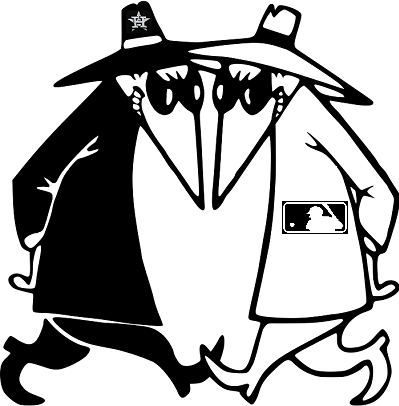
SpyVsSpyDuring the World Series, the eventual world champion road rats—er, the Nationals—reminded themselves that the Astros, whom they finally vanquished, have a Show-wide reputation for sign stealing and for catching on quick if and when opposing pitchers tip their hands. And, the Nats did something about it.
Sign stealing on the field by the men on the field is old fashioned gamesmanship. The Nats, according to The Athletic, simply met gamesmanship with gamesmanship: “They instructed their catchers to utilize a more complicated system communicating the signs to the pitchers, behaving in every situation as if there was a runner on second base.”

A sound proposition, that. Nats relief pitcher Sean Doolittle told the magazine Nats coaches handed out cards with five different sign sets, with Nats pitchers “rotat[ing] through those if there was a hitter on base for more than one at-bat.”

They also paid such close attention to pitch tipping that Game Six winner Stephen Strasburg was caught and corrected tipping early in the game, and Game Seven starter Max Scherzer “altered the way he manipulated his glove when there were runners on base, as there were in all five of his innings.”

The Nats elected not to meet gamesmanship with gamesmanship by going high tech about it, though. The Astros may well have. And baseball’s government is investigating the prospect. Seriously.

The Red Sox were caught redhanded and disciplined accordingly when they were caught using cell phone cameras to try a little sign stealing in 2017. When the Red Sox accused their accusers, the Yankees, of starting it, the Yankees were disciplined concurrently. And while such espionage is spread wider around the game than fans like to think even now, the Astros are believed almost as widely to be two things when it comes to high-tech heists: 1) Expert at it. 2) Shameless about it.

Baseball’s rules ban technological theft formally, but as The Athletic‘s Ken Rosenthal and Evan Dillich now write, “[T]he commissioner’s office hears complaints about many different organizations—everything from mysterious people in white shirts sending signals from center field to elaborate systems involving television cameras and tablets.”

And there are former Astros either singing now or preparing their arias. One is former Astros pitcher Mike Fiers, who pitched baseball’s 300th no-hitter for the Athletics in May. Another is purged assistant general manager Brandon Taubman. This may or may not prove to be baseball’s version of the Watergate tapes, pending the emergence of baseball’s Alexander Butterfield, but it may prove that cheating is still baseball’s oldest sub-profession.

Rosenthal and Dillich concentrate on 2017 because that’s the only Astro espionage they can confirm—for now. Fiers has told Rosenthal and Dillich that, that regular 2017 season, the Astros stationed a real-time camera behind center field to steal signs. We’ve come a very long way from Wollensak spy glasses and buzzers to the bullpen from the center field clubhouse, the technique Leo Durocher applied for his 1951 Giants’ legendary pennant race comeback.

The two writers say that, early that season, a struggling hitter who’d been helped by sign stealing before he became an Astro, and a uniformed Astro coach, “started the process” for the James Bonding ritual. “They were said to strongly believe that some opposing teams were already up to no good,” write Rosenthal and Dillich.

The system is believed to involve the aforesaid camera trained on opposing catchers’ signs and a television screen planted just before the steps from the clubhouse to the dugout, which players and team workers would watch to decipher the opposing signs. Then, write Rosenthal and Dillich, the decoded signs would be sent to the dugout with loud noises, usually a bang on a trash can.

White Sox pitcher Danny Farquhar, now a minor league pitching coach, apparently caught on during two September 2017 appearances in Minute Maid Park. “There was a banging from the dugout, almost like a bat hitting the bat rack every time a changeup signal got put down,” he’s quoted as saying. “After the third one, I stepped off. I was throwing some really good changeups and they were getting fouled off. After the third bang, I stepped off.”

“That’s not playing the game the right way,” they quote Fiers, who didn’t pitch in the 2017 postseason and was non-tendered by the Astros after their 2017 World Series win. “They were advanced and willing to go above and beyond to win.”

Some of the Twitterpated accuse Fiers of “bitterness.” Others tried suggesting his 2015 no-hitter as an Astro was suspect. Shades of the old Soviet Union when it came to dissidents and defectors from Mother Russia and her satellites, too. Except that the Astros aren’t likely to try having Fiers or his wife assassinated. We think.

A man might be less than thrilled about being left out of the postseason fun and sent on his merry way to follow, but bitterness isn’t the only reason whistleblowers choose to reveal their purgers had their own Navajo Codetalkers in place. Especially those willing to attach their names to their public whistling. Rosenthal and Dillich cited four Astro-connected people thus far, but Fiers was the only one willing to be named as a source so far.

Rosenthal and Dillich think the real cause of any bitterness between Fiers and the Astros, which Fiers acknowledged to them, comes from his having told his teams to be—he pitched for the Tigers in 2018 and the A’s this year—all about the Astro Intelligence Agency:

I just want the game to be cleaned up a little bit because there are guys who are losing their jobs because they’re going in there not knowing. Young guys getting hit around in the first couple of innings starting a game, and then they get sent down. It’s (bovine excrement) on that end. It’s ruining jobs for younger guys. The guys who know are more prepared. But most people don’t. That’s why I told my team. We had a lot of young guys with Detroit trying to make a name and establish themselves. I wanted to help them out and say, “Hey, this stuff really does go on. Just be prepared.”

Taubman was purged after his disgrace supporting domestic violence-attached reliever Roberto Osuna, after the American League Championship Series triumph, in earshot of women reporters one of whom wore a domestic violence awareness bracelet. And, after the Astros’ public relations mess when they first tried to smear the Sports Illustrated reporter who revealed Taubman was just so fornicating glad they got Osuna.

Baseball government may want to question Taubman about more than just the Astros’ initial doubling down on smearing Stephanie Apstein. (For which Astros owner Jim Crane apologised—a week later, in a personal note.) They should want to question him about what and how much he knew about the AIA. They should also want to dig deeper enough to discover just how alone the Astros aren’t when it comes to electrotheft.

The Astros are frisked often enough but have yet to be arraigned, never mind indicted. Either the evidence is too scant to send a baseball grand jury, or the Astros have become as good at burying the evidence as their accusers say they are at electrotheft in the first place.

Taubman himself has bumped up against baseball’s spy wars before. In May 2018 he confronted a Yankee Stadium worker when he suspected the Empire Emeritus was up to no good. The bad news is that Taubman was accompanied by Kyle McLaughlin—an Astro worker both the Indians and the Red Sox suspected was up to no good with his photography during the early 2018 postseason rounds.

And Astroworld’s memory won’t soon forget Chris Correa, who hacked into the Astros’ computer data base while he ran scouting for the Cardinals a few years ago. Correa got nailed, tried, convicted, jailed, and banned from baseball over that one.

There’s another factor in play that must not be overlooked: It’s one thing to catch then-Dodger pitcher Yu Darvish tipping pitches in Game Seven of the 2017 World Series and to slap him silly accordingly before he gets out of the second inning alive. But even the Astros’ staunchest accusers don’t believe every Astro player accepts stolen signs.

When Durocher implemented his 1951 telescopic espionage, he was amazed that at least two players—Hall of Famers Monte Irvin and Willie Mays—refused outright to accept stolen signs. And Irvin plus “Shot Heard Round the World” pennant-winning hero Bobby Thomson denied that either the Wollensak spyglass and buzzer were used in the fateful third playoff game or that Thomson accepted a stolen sign.

Even Ralph Branca, whose post-career friendship with Thomson may have been soiled by the confirmed revelation, could never be entirely sure the fateful three-run homer wasn’t hit fair and square. “He still had to hit the ball, ” Branca reflected ruefully.

But the Dodgers suspected enough down the stretch that they took a pair of binoculars into the dugout in a bid to catch the Giants in the act—which was confiscated by an umpire. As Thomas Boswell snorted upon the final affirmation of the Giant plot, “Why, it would be unfair for the victims to use binoculars to expose the telescopic cheaters!”

Just as was the case with Durocher’s ’51 Giants, the Astros aren’t suspected of sending their AIA on missions on the road. If they were trying anything cute at Minute Maid Park during last month’s World Series, it failed miserably: the Nats beat them there by a combined 30-11 score over those four games.

And it isn’t likely that they could have gotten away with their camera-to-TV electrotheft during the postseason in general or the World Series in particular for one very sound reason: You have to be able to hear the trash can banging through the stadium racket.

The last I looked, the Astros didn’t send a pack of Labrador retrievers onto the field. Or was that the reason why, as some Yankees suspected, if any Astros wanted stolen signs during this year’s ALCS, all they had to do was just whistle?

If the Astros are actually guilty of electrotheft, they may be the least embarrassed about it but they’re probably not even close to alone. The Red Sox and the Yankees proved that in 2017. For openers, possibly.

Just as when those in the political (lack of) class caught with their fingers in the cookie jars cry “whatabout” because “the other guys” did it before, the proper response is, “Whatabout stopping it, already?” Murder’s been done since Cain but it doesn’t mean we stop prosecuting freshly minted murderers.

The Astros may be as admired for their winning on the field as they seem to be loathed for their front office culture. They’re right when they say—as Rosenthal and Dillich mulcted from an unidentified Astro source—that they shouldn’t “become the poster child for sign stealing,” but that doesn’t mean it’s kosher for them to do it in the first place.

The Black Sox weren’t the only players trying to throw games for profit in 1919; Cincinnati fans weren’t (by a long shot) the only fans who ever thought of stuffing All-Star ballot boxes; and, the Astros probably aren’t the only team playing Spy vs. Spy. Thinking they’re the only ones in baseball continuing to prove that boys will be boys is thinking inside a very tiny box.

A principled Peter

2019-11-12 PeteAlonso

Pete Alonso hit one for the record book on 28 September, but the NL Rookie of the Year struck a bigger blow for respect on the 9/11 anniversary.

It’s not that Pete Alonso didn’t have the kind of season that deserved the honour. But sometimes baseball award voters are human enough to pick a winner based on something equal to and maybe a little better than his performance—even performance that would blast in neon, as Alonso’s did this year.

Voting Alonso the National League’s Rookie of the Year, they may have thought both.

Alonso’s season performance by itself would have been enough to nail him the award, even if you can make the case that Braves pitcher Mike Soroka—who got the one first place vote Alonso didn’t get—had at least an equivalent season on the mound.

Breaking the rookie season home run record (with a major league-leading 53), creating 126 runs and using only three outs a run to do it, and producing 220 (100 scored, 120 driven in) runs on the season, gets you attention in a big enough hurry. So do three out of a possible six National League Rookie of the Month awards, which Alonso won in April, June, and September.

So does helping put the game back into the game with your enthusiasm, on a team that needed it in the worst way possible this side of the world champion Nationals. The Mets lacked for sharks, baby and otherwise, but thanks to Alonso they became abundant in jersey stripping on game-ending, game-winning hits during their surprising post-All Star break run.

So does a shameless and welcome display of emotion such as Alonso—who’d made the Mets out of spring training on a non-roster invitation—showed when he nailed Soroka’s rotation mate Mike Foltynewicz on the next to last regular season night in New York for the record, then couldn’t hide the tears when he returned to first base.

But so does finding the way to elude baseball government’s edict against special haberdashery commemorating the 9/11 atrocity, as Alonso did for that very anniversary. The Mets and a few other teams wanted to wear such hats; baseball government said no, stick with the official commemorative patches on the sides of the uniform hats.

Alonso said not so fast.

Telling no one but his fellow Mets what he was up to, Alonso gathered up the shoe sizes of his teammates, manager, and coaches, then arranged for special commemorative cleats to be made for the game by Adidas, New Balance, and other top athletic shoemakers. It isn’t every major league rookie who delivers the kind of audacity that ennobles his team and his game.

2019-09-13 Mets911Shoes

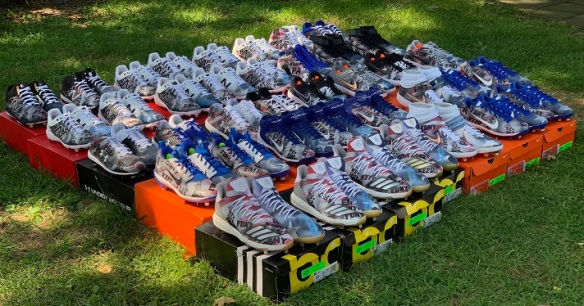
The shoes that put the Mets’ best feet forward on 9/11.

The cleats featured American flag striping, the initials of first responder agencies, a small image of New York firefighters raising an American flag at Ground Zero, and a silhouette of the Twin Towers. Making the major league rookie salary of $550,000 for the season, not to mention winning $1 million as this year’s Home Run Derby champion at the All Star break, Alonso paid for every pair of the special cleats himself.

“For me, this season has been an absolute fantasy. I just want to give back. I want to help,” said Alonso, a Florida first grader when the atrocity happened. “I don’t just want to be known as a good baseball player, I want to be known as a good person, too. And I just want to really recognize what this day is about. I don’t want it to be a holiday. I want it to be a day of remembrance of everything that happened. It was an awful day.”

He hatched his podiatric plot well in advance of the 9/11 anniversary, and it’s not exactly impossible that the Mets being so unified as a team on the matter might have kept baseball’s customarily capricious official leadership from sanctioning the team.

It probably didn’t hurt, either, that a little favour fell upon the Mets from the Elysian Field gods that night. Their surprising bolt out of the post All-Star gate could only get them to within three games of the National League’s second wild card, proving that even the subordinate gods work must work within a budget, but they could at least spend a little extra on the 9/11 anniversary itself.

Thus did the Mets, wearing Alonso’s subversive commemorative cleats, shut the Diamondbacks out on . . . nine runs and eleven hits, including six home runs, two (Todd Frazier, Brandon Nimmo) back-to-back in the Mets’ five-run first, and with Frazier and Jeff McNeil each hitting a pair of them before the carnage was finished.

The following night, the Mets again nailed eleven hits off the momentarily hapless Diamondbacks, but this time they were good for eleven runs, the big blow the first of Juan Lagares’s pair of blasts, in the bottom of the third. The center fielder checked in with the bases loaded, nobody out, and the Mets up 1-0 on an unearned run, then hit a full count service from Alex Young into the left field seats.

And any threats of fines or disciplinary measures against Alonso or the Mets over the commemorative shoes went unfulfilled.

Yordan Alvarez, the Astros’ phenom bombardier, was named the American League’s Rookie of the Year unanimously, beating out Orioles pitcher John Means, Rays second baseman Brandon Lowe, White Sox outfielder Eloy Jimenez, and Blue Jays second baseman Cavan Biggio—the son of Astros Hall of Famer Craig Biggio.

By arriving in a June callup after decimating the two highest minor league levels, Alvarez has the second-shortest Rookie of the Year season behind Hall of Famer Willie McCovey. And, as Alonso did in the National League, Alvarez won a trio of American League Rookie of the Month prizes. (June, July, August.)

He premiered by teeing off against another Oriole pitcher, Dylan Bundy. He went on to tie the rookie record for the most home runs in 100 games or fewer, hit righthanders and lefthanders with equal deadly force, and followed an almost invisible American League Championship Series by hitting .412 with one bomb in the Astros’ seven-game World Series loss.

The third Rookie of the Year in Astro history—Hall of Famer Jeff Bagwell won the award in 1991; Carlos Correa (2015) became the first Astro to win it after they were moved into the American League—Alvarez is Alonso’s near-opposite, the strong, silent type. He shares Alonso’s essential humility, but you’re not likely to see him shred the jersey away of any Astro nailing a game-ending hit. Yet.

“He’s a quiet man by nature,” says his manager A.J. Hinch, “and his demeanor is very low key. But he’s always in tune with other players and other people and the information.”

Alonso is the Mets’ sixth Rookie of the Year, following Hall of Famer Tom Seaver (1967), Jon Matlack (1972), Darryl Strawberry (1983), Dwight Gooden (1984), and Jacob deGrom (2014), and only the second Mets position player (after Strawberry) to win the prize. His race for the prize might have been a lot closer, maybe even lost by a hair, if the Padres’ phenom Fernando Tatis, Jr. hadn’t been held to 84 games thanks to the injured list.

Interesting synergy. This year’s Rookies of the Year belong to a pair of teams born from the same expansion draft, for 1962. Neither of whom could possibly have imagined the day to come when one would be the team to be named later when a third expansion team, the Brewers, would be traded to the National League.

But Alonso played all but one game in 2019. And it took the Mets’ often-criticised general manager Brodie Van Wagenen, a former players’ agent, to convince the club to take Alonso north with them when spring training ended, rather than do as too many other clubs have done with promising youth and bury him one more year in the minors for the sake of extended team control.

Unlike in days of Mets future past, there’s a realistic chance that they might be able to lock Alonso down on a longer-term commitment when his first free agency comes within not-so-distant sight. They’ll be freed of major commitments to too-oft-injured Yoenis Cespedes (in danger of missing all of 2020 as well off multiple-ankle and knee surgery) and aging Robinson Cano well enough when that day arrives.

Assuming Van Vagenen makes no more trades that involve importing still-onerous contracts, such as the deal that landed Cano in the first place, the Mets would be able to keep Alonso in the blue and orange for a long enough time to come. Assuming Alonso continues the kind of performance he showed exponentially in 2019, it would be manna for a franchise that often forces its fans to dine on quail.

And in this case we’re not talking strictly about Alonso’s performances at the plate or at first base, where he shook away the periodic hiccup to establish himself as more than capable afield. Whether Alonso proves the equal of Mets legend Keith Hernandez, who revolutionised the position by making it one of infield leadership as well as fielding virtuosity, remains to be seen, but he showed the potential for either or both.

He showed more than the right stuff in uniform. First, he sent a tenth of his Home Run Derby prize money to a pair of 9/11-inspired charities, the Wounded Warriors project (which aids post-9/11 military wounded) and the Stephen Siller Tunnel to Towers Foundation, named for the firefighter who lost his life on 9/11 trying to save lives in the World Trade Center.

Then, he plotted and executed his end-run around official baseball’s official strictures against any 9/11 commemorative gear above and beyond the hat patches. The gesture couldn’t possibly restore the lives lost in the atrocity but they could and did at least indicate to the city battered by it almost two decades earlier that someone playing baseball in a New York uniform understood that baseball’s transcendence sometimes has to wait its turn behind spiritual transcendence.

It wasn’t given to Alonso to electrify the Citi Field audience this 9/11 the way Hall of Famer Mike Piazza did in the Mets’ first game back in the late Shea Stadium after the original atrocity. When Piazza swung on 0-1 against Braves pitcher Steve Karsay with pinch runner Desi Relaford aboard in the bottom of the eighth and hit it far enough over the center field fence to ricochet off a television camera posted on a scaffold. And, prove the game winner for the Mets.

With his family and his fiancee in the house, Alonso had to settle for sending Foltynewicz’s 2-1 service over the center field fence in the bottom of the third on 28 September, pushing him past Aaron Judge as the single-season rookie home run champion and bringing the Citi Field crowd to its feet not just because of the blast itself but because he couldn’t keep his emotions from overflowing in its immediate wake.

With the memory of his 9/11 commemorative subterfuge likely still fresh, the crowd refused to turn off the love as Cano flied out to deep center for the side and the Mets re-took the field. And Alonso stationed at first base finally couldn’t contain himself, lowering his head and crying shamelessly, the magnitude of his accomplishment overwhelming him in disbelief.

It was the perfect night for nice guys to defy Leo Durocher. While Alonso swung his way into the record book, on the opposite coast the Astros’ Hall of Famer-to-be Justin Verlander threw his way into it.

Verlander struck out the Angels’ right fielder Kole Calhoun in the bottom of the fourth for career strikeout number 3,000, and struck Calhoun out again in the bottom of the sixth for season strikeout number 300. Lifting a page from the late Ernie Broglio, Calhoun can say at least that he played with a couple of Hall of Famers and helped put at least one pitcher there.

Unlike Alonso, alas, Verlander’s entry into history came with a p.s. The fourth-inning strikeout went for a wild pitch, enabling Calhoun to first base, where Calhoun stayed only long enough for the next Angel batter, shortstop Andrelton Simmons, to hit one into the left field bullpens. It didn’t stop the Astros from winning the game, but sometimes you just can’t slip further into the books without one misstep.

Verlander’s a very well seasoned veteran and Alonso is a freshly-initiated kid with, hopefully, a long enough career ahead of him. Maybe, if the Mets don’t relapse and see the core of Alonso, deGrom (still young at 31), McNeil, Nimmo, Michael Conforto, J.D. Davis, Seth Lugo, and Amed Rosario as a young enough core to build around and not fool around with, including a postseason or three.

Maybe even a postseason taking the Mets to face the Astros in a World Series. Maybe. If astronauts first walked the moon when the Mets won their first Series at the tender age of eight, and the Nationals could win this year’s World Series entirely on the road, it reminds you of one of baseball’s truly unimpeachable laws: Anything can happen—and usually does. So who’s to say?

Alonso’s uniform number—20—is deemed by Bible scholars to indicate the perfect waiting period, and by numerologists to indicate infinite potential in relationships and diplomacy. Of course. He fell into the perfect waiting period to make his Show debut this season—no waiting, right out of spring training—and, proving that good things indeed come to those who wait, to break Judge’s rookie home run record on the next-to-last day.

His potential on and off the field appears infinite enough. For now you get the parallel pleasure of seeing that not only does the right player swing for the record book, and play to earn a major award, but every so often he proves to be the right man for both.