Slop go the Cardinals

2019-10-11 AnibalSanchez

Anibal Sanchez, appreciating the man who busted his Game One no-hit bid and the plate ump who called the game, as he leaves in the bottom of the eighth . . .

It looks as though the Cardinals have something else to worry about beside the Nationals’ three aces. There was a joker in the Nats’ deck Friday night.

And what he did in Game One of the National League Championship Series would have been a laugh and a half if he hadn’t had to face a pinch hitter who slapped a clean single off him in the bottom of the eight.

For seven and two-thirds innings Anibal Sanchez threatened to become baseball’s third postseason no-hit pitcher. He threw nothing like the hard stuff usually delivered by Max Scherzer, Stephen Strasburg, and Patrick Corbin. Slop tossing doesn’t begin to cover it.

If you could swear you saw marshmallows going up to the plate until Jose Martinez delivered his hit, your eyes weren’t playing tricks. Sanchez’s fastest pitch barely crosses 90 miles an hour. His split finger fastball is more split than fast. His changeup is called a butterfly, but real butterflies come in like a squadron of fighter jets by comparison. His cutter wouldn’t cut a sheet of paper.

But they move. He moves them all around the strike zone. He and the Nats watched one after another Cardinal batter check in at the plate determined to hit that slop into the Mississippi River and wondering why their biggest swings were barely good for summer day camp softball hitting among ten year olds.

“I just tried to keep focused on every pitch that I’m going to throw,” Sanchez told reporters after the Nats finished what he started, a 2-0 Game One shutout in Busch Stadium. “I don’t want to miss any kind of pitch in the middle in the zone against those guys.”

He succeeded in ways even he probably didn’t fathom. He threw 103 pitches and—count ’em!—only two of them hit dead center of the strike zone while only two more hit immediately around it.

One of the two hitting dead center damn near meant disaster in the bottom of the eighth, when Tommy Edman, playing right field in Game One for the Cardinals, sent a cannon shot toward the right side. Nats first baseman Ryan Zimmerman picked the perfect moment to channel his inner Superman, diving like the Man of Steel on takeoff to snap his mitt around it before it landed for a base hit to short right.

Sanchez thought right then and there that he’d have a shot at finishing the no-hitter. A fly out later Martinez thought otherwise, pinch hitting for Cardinals reliever Ryan Helsley, sending a full-count splitter into center for a clean base hit. The only Cardinal hit of the night.

“He was just hitting his spots and keeping us off balance all night,” said Edman, “and we just didn’t execute our plan very well.”

Time was when Sanchez threw harder, particularly what Gomes called “the power slider.” On Friday night he made a statement on behalf of junkballers the world over. You don’t need power to survive on the major league mound no matter what you throw. Especially when the other guys are about as good with off speed pitching as a hay fever sufferer is with pollen.

“When you kinda lose the power slider,” Gomes said of Sanchez, “there’s power in there (his heart) and power up there (his mind).” Pointing to his chest and his head. “He went out there, controlled the zone, controlled everything they were doing,” Gomes continued. “It’s almost like you get kind of a chuckle off them. When a guy like that can manipulate his speeds it’s pretty amazing.”

Manipulate his speeds? Sanchez’s swiftest pitch wouldn’t have equaled speed four on a Mixmaster. He folded ingredients, blended them gently, maybe mashed a few potatoes, but he wasn’t anywhere near enough power to roll out the attachments.

Almost the moment Martinez pulled up at first in the eighth, Nats manager Dave Martinez went to the mound to lift Sanchez for Sean Doolittle. The Busch crowd bathed Sanchez in a standing ovation that seemed six parts appreciation and half a dozen parts thank-God-he’s-finally-out-of-there.

Sanchez waved his glove in gestures of appreciation to the Cardinal who’d busted the no-no and to plate umpire Phil Cuzzi, who called the pitches. Hopefully, he had a similar gesture or word for Cardinals’ starter Miles Mikolas, whose own six splendid innings went for nothing partly because Sanchez was bound to hog the headlines.

“I had a rough regular season,” said Mikolas, the owner of a 4.16 regular season ERA. “I’m doing my best to make up for it in the postseason.”

Mikolas and six Cardinals relievers did their best to keep the Nats off their own game plan at the plate. Sure, they scored their first run thanks to a leadoff double by second baseman Howie Kendrick and a two-out double by catcher Yan Gomes in the second, and their second run thanks to a one-out triple by right fielder Adam Eaton and Kendrick’s two-out single in the seventh.

But they went 2-for-12 with men on second or beyond, stranded first and second in the sixth and the ninth, and the bases loaded in the fifth and the seventh. They could have gone for the Cardinals’ throats and settled for a couple of raps on the mouth. Lucky for them Sanchez’s lone walk and two accidental hit batsmen came to naught for the Cardinals, too.

The walk, to Wong with one out in the fourth, got dangerous after Goldschmidt flied out, when Wong stole second and took third on Gomes’s throwing error, but Sanchez got Ozuna to foul out to third baseman Anthony Rendon.

Pinch hitter Randy Arozarena—he who sent Cardinal manager Mike Shildt’s foul postgame rant viral for a spell after they won their division series—got plunked with one out in the sixth and stole second himself, then got pushed to third while Fowler grounded out to second, but Wong lined out softly to center to end that one.

And Yadier Molina with two out in the seventh got kissed between his shoulder blades with one of Sanchez’s butterflies but Matt Carpenter grounded out to first unassisted for his trouble.

Doolittle was on call for the end because Daniel Hudson was on quick paternity leave with his wife giving birth to their daughter. Not one Nat begrudged Hudson. “I think the mood of the guys in the bullpen,” Doolittle said afterward, “[was] we really wanted to find a way to pick him up and allow him to enjoy a really special moment with his wife and his family.”

“Apparently,” their skipper said, “the baby didn’t want to come out until later on this morning.”

Doolittle did his part, getting the asked-for four-out save almost effortlessly, luring Dexter Fowler into an eighth inning-ending grounder to third before throwing Kolten Wong out on a leadoff bunt attempt, luring Paul Goldschmidt into grounding out to Zimmerman at first unassisted, then striking Marcell Ozuna out swinging to end the game.

Thus did the Cardinals lose an NLCS opening game without having to deal with the Nats’ vaunted Big Three starting pitchers. Amend that. Sanchez just gave them a Big Enough Four. Almost surprisingly, considering he had a 3.48 road ERA this year and the Redbirds took two of three from the Nats in a regular season Busch set.

They also didn’t have to deal with the Nats’ fully-A lineup. Center fielder Victor Robles was still missing in action nursing a hamstring strain and catcher Kurt Suzuki was still under concussion protocol after taking one off his wrist into his face from Dodger pitcher Walker Buehler in Game Five of their division series.

And they couldn’t push Sanchez out of the game early enough to force the Nats into a Wander Suero option out of the bullpen, Suero occupying Hudson’s spot for the time being, knowing full well that Hudson, Doolittle, and maybe Fernando Rodney are the only three Nats bulls these days who don’t sink Washington’s antacid market.

But this was essentially the same Cardinals lineup that bastinadoed the Braves for ten first-inning runs two days earlier. The problem: they’re vulnerable to off speed stuff thrown by pitchers who know how to keep the stuff away from the middle of the plate. The only pitch Sanchez threw dead center busted up his no-hitter.

Even Max the Knife, Stras, and Prince Patrick should be making notes: don’t live on your fastballs with these Cardinals. And this is not the time to take the middle ground while you’re at it. Sanchez didn’t believe in the middle ground Friday night, and neither, really, did Doolittle, which is why Gomes had one more hit than the entire Cardinal lineup.

“Why any pitcher who can throw decent off speed stuff ever gives this team a fastball within the general vicinity of the strike zone is a mystery,” agrees St. Louis Post-Dispatch writer Ben Frederickson. “The Cardinals’ inability to adapt on the fly resulted in their eleventh and most costly shutout of the season.”

Maybe the least surprised man in the house was Zimmerman, the Nats’ elder in the house. “Ever since Anibal came back from being injured, he’s been one of our most consistent, if not our most consistent, pitcher, which is hard to do with the other guys we have,” said the first baseman, referring to the hamstring issue he incurred in May.

“He doesn’t get overlooked but it’s such a different kind of pitching,” Zimmerman continued. “But tonight was obviously vintage Anibal. I’ve seen him do that for almost fifteen years but tonight was special.”

It may be just as special if not more so when Scherzer goes mano-a-mano with Adam Wainwright in Game Two Saturday. Even if Wainwright isn’t the pitcher he used to be thanks to too many injuries. Far as Wainwright’s concerned, getting to face Scherzer is an early Christmas present.

“We have similar games,” the Cardinals’ righthander said. “We’re both attacking with high-velocity fastballs at the top of the zone and nasty sliders and changeups.” Then, he paused thoughtfully. “I would have loved to have reinvented myself into Max Scherzer, that would have been amazing. It just didn’t work that way.”

It never does. There’s only one Max the Knife. And the Nats need him to slice, dice, and carve as deftly on Saturday as he did to the Dodgers in the division series.
A nation of Natitude?

2019-10-11 WashingtonNationals

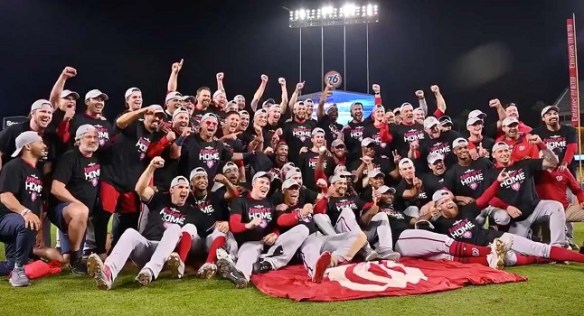
The Nationals don’t want the party to have stopped at Dodger Stadium.

It stood to reason that if the Nationals could and did flatten their way past the Dodgers in the division series, you had to like their National League Championship Series chances. Especially when one Astro gave them a terrific endorsement going in.

“They’re legit,” said Alex Bregman, the Astros’ third baseman, when he and their Game Five conqueror Gerrit Cole were asked if they were relieved that the Dodgers wouldn’t remain in the postseason picture.

“They’re legit. The Nationals got three legit starters, similar to what the ‘Stros have,” Bregman continued. “We were in the same spring training complex so we face them all the time. Tell you what, it was no shock that they won that series. We know what they’ve got. They’re good.”

When the man who’s liable to add an American League Most Valuable Player award to his trophy case if Mike Trout doesn’t endorses you, take it right to the safe deposit box. Smile a few moments before you slide it in and lock the box back up. Then get back to business.

Not that the Nats need any reminder.

Remember: this is the team that was 19-31 on 23 May, after the Mets humiliated them in a four-game sweep in which they were out-scored 23-13 and the demands for manager Dave Martinez’s head on a plate hit critical mass.

The team that went 80-38 from there, including a season-ending eight-game winning streak against what remained of the Phillies and the Indians and 36-18 in August and September. Not that there weren’t hiccups and missteps along the way, but 36-18 down the stretch is championship-caliber baseball any way you conjugate it.

They held their own against other contenders collectively; their total record against their fellow contenders was 43-43; the best records against them came out of their own division. The Mets went 12-7 against the Nats; the Braves went 11-8.

But the Mets—whose own manager faced season-long calls for his own execution and finally did go to the guillotine a few days after the season ended—didn’t have enough to stay in the races. And the Braves got thatclose to pushing the Cardinals home early from their division series before the Cardinals upended and then demolished them.

The bad news is that Shildt—who had an image as being so mild-mannered normally that he made Clark Kent resemble Donald Trump—was about as gracious in triumph as a flock of vultures swooping upon carrion.

Even allowing that it wasn’t intended for prime time, and wouldn’t have gotten there if a Cardinals spare part hadn’t been foolish enough to capture it on video and post it on Instagram, Shildt’s rant left him an image as an unsportsmanlike winner dancing on the graves of a team his Cardinals left looking like the victims of a terrorist attack in the first inning of their final division series game.

The Dancing Nats—whose dugout high stepping, boogieing, and Gene Kellying after big moments has become a rather endearing trademark not restricted to the kids we should let play but enjoyed even by the grizzled veterans who’ve rediscovered their fountains of youth—would love nothing more than to go Soul Train on Shildt’s and the Cardinals’ graves.

And they may not be alone. Shildt just might have given enough of the nation a case of Natitude.

Shildt has since apologised—for the rant having been made public at all, not for the drift of it; for the expletives undeleted but not the sentiment. “I apologize if my language offended anyone,” the Atlanta Journal-Constitution quotes Shildt as saying.

It is not something I like to represent. It’s not to be excused. I will say that I’m flawed. I have my moments. I grew up in a clubhouse and one of the crosses I bear is my language. I’ve done a nice job over the many years of curbing that. Trying to represent always myself and this organization in a positive light with class and dignity. It’s regretful that that was able to get out.

He still thinks the Braves started some excrement and the Cardinals finished it. (The Cardinals weren’t thrilled about Braves center field star Ronald Acuna, Jr.’s, shall we say, exuberance, which is rich coming from a team that has a couple of exuberants itself.) And he still thinks his Cardinals are going to fornicate up any and all comers and that nobody fornicates with them.

He may be in for a big surprise when the Cardinals and the Nats sink into their NLCS.

Among the four last teams standing now the Cardinals had the weakest regular season record. They were closer to being shoved out of their division series than the Nats really were. Their starting rotation has one bona-fide freshly-established ace (Jack Flaherty), a former ace (Adam Wainwright) who can still pitch up in the apparent sunset of a splendid if injury-disrupted career, and a third starter (Dakota Hudson, no known relation to River Phoenix) who’s just that, a quiet and often efficient third starter.

The Nats have three legitimate aces. When you have Patrick Corbin as your third starter behind Max Scherzer and Stephen Strasburg, you’re the next best thing to Houston’s Justin Verlander, Gerrit Cole, and Zack Greinke. And you might even be equal, almost.

Corbin and Greinke have something in common this postseason. They’d be aces on almost any other staff, and they both got destroyed in division series appearances. Corbin got his redemption shot already; working the division series out of the pen, he atoned for his Game Three disaster with critical, spotless relief in Game Five. Greinke won’t get his shot until he starts Game One of the American League Championship Series.

The Nats can also hit. And how. They took a team .265/.342/.454 slash line into the postseason to the Cardinals’ .245/.322/.415. The Cardinals overall hit just a sliver better than the Nats in the division series rounds, and there’s no arguing with that Game Five early-and-too-often attack, but they’re not as powerful an offense as the Nats overall. If the Cardinals seem like comparative mosquitoes, the Nats seem like a can of Raid.

Put each team in the field, though, and the Cardinals may have a big advantage. They went from being the National League’s worst defense for errors in 2018 to the league’s best in 2019. It was like America going from Pearl Harbour one minute to winning World War II the next. And the Cardinals’ pitchers are mostly ground ballers while the Nats aren’t exactly a pure ground ball-hitting team.

But the Nats have a flair for the dramatic, and we’re not talking eighth-inning game-tying singles or walk-off sacrifice flies. When Dave Roberts pushed his luck with Clayton Kershaw in Game Five, Anthony Rendon and Juan Soto answered almost immediately how nice it wasn’t to fool with either Mother Nature or Kershaw’s sad postseason fortune.

And when Roberts pushed his luck with Joe Kelly and the bases loaded without an out even further, Howie Kendrick—talk about awakening a sleeping giant!—pushed it right over the center field fence and right through the Dodgers’ heads. (Speaking of which, Roberts may not be handed his head after all; the Los Angeles Times says people “with knowledge of the situation” say Roberts will be back in 2020.)

“You got to give credit to the Nationals,” Roberts said post mortem, while accepting the complete blame for the Dodgers’ destruction, “the way they played and came in here and won a series.”

But the Cardinals won’t face a Braves-like kid corps augmented with one smart but vulnerable veteran on the mound. And Martinez and his Nats still have to worry about their entire bullpen not named Daniel Hudson and Sean Doolittle. The Cardinals pray Martinez forgets. Everyone else prays otherwise.

It’s not that the Cardinals’ bullpen is invulnerable. They took a possibly fatal hit losing Jordan Hicks to Tommy John surgery in late June. And their pen men seem to like playing with matches a little too much themselves.

But if you thought Curt Schilling was cruelly emphatic wearing a towel over his head over Mitch (Wild Thing) Williams’s relief, watch Scherzer, Strasburg, Corbin, Sanchez, and Nats Nation whole if anyone but Hudson and Doolittle get the call. They’ll be forgiven for donning hazmat head masks. This NLCS could well come down to which bullpen fights fires with the least full gasoline tanks.

The Nats may have discovered a secret weapon, however: rookie Tanner Rainey. He got the job of getting rid of a pair of righthanded Dodger hitters in Game Five. He got a harmless popup to shortstop and an even more harmless fly out to right. Side retired. Leaving Rainey with a division series jacket of five hitters faced and nothing worse than one base hit. Plus fastball, wipeout slider in the making. One less arsonist for Nats Nation to fear. Maybe.

“To win these type of games against this type of teams, the Los Angeles Dodgers, your stars have to be stars,” said Nats general manager Mike Rizzo in the middle of a celebratory champagne flood. “Our stars were stars tonight, and I think that’s what carried us through.”

These Cardinals aren’t those Dodgers. These Cardinals didn’t just post the single best winning season in franchise history only to be destroyed in the end by a swarm of Nats whose franchise-best season, including their Montreal years, was 2012’s 98-winner. And these Nats don’t have a manager who made them look like sore winners after their arguable finest hour.

Forget life, John Lennon, wherever you are. Baseball is what happens when you’re busy making other plans. Neither the Braves nor the Dodgers planned to be imploded out of this postseason. The Rays just didn’t have enough to finish pushing the Astros through the wall up against which they pushed them; the thumping Twins went limp against the Yankees far sooner.

The Yankees vs. the Astros will combine a duel of the titans with a rivalry for who gets baseball’s version of the Nobel Prize for Medicine. The Nats vs. the Cardinals didn’t exactly get through their seasons unscathed, but their overseers aren’t likely to discover that many missing players in the nearest emergency rooms, either.

This nation’s taken enough on the chin (not to mention the gut and the heart) from Washington ever since the Nats first arrived for 2005. From Washington, not the Nats. The lowest moments in Nats history don’t approach to within even two national borders of the lowest in Washington’s.

And there’d be few things more fun, for a nation that too often seems to have forgotten how to have it, than the prospect of the Nats making it “Washington—First in war, first in peace, and first in the National League” by washing Shildt’s mouth out with soap. If not an appropriately named box of Tide.

The little engine that couldn’t, quite

2019-10-10 GerritCole

“We had to get hit in the face twice and then we answered the bell.”—Gerrit Cole.

The Rays got to within one game of being the American League’s Little Engine That Could at the expense of the well-honed Astros. The Astros sent the Rays home for the year as the Little Engine That Couldn’t,  Quite Thursday night.

But the Astros know it didn’t come as easily as their four-run first, their two-bomb eighth, and Gerrit Cole’s eight-inning, ten-strikeout performance will look on paper. If you don’t believe that, just ask Cole himself as one reporter did after the 6-1 Astros win.

“It was a really hard fought series. A lot of credit to the Rays. They had an incredible season,” Cole said, after he was all but shoved out from the middle of the celebrating Astros to give Minute Maid Park fans a curtain call. “It was a dogfight for five games. We had to get hit in the face twice and then we answered the bell.”

Hit in the face twice? The Rays destroyed Zack Greinke on the way to a Game Three blowout and manhandled a short-rested Justin Verlander in Game Four to get to the Thursday night fight in the first place.

Despite saying he was only going to treat Game Five like the next game and nothing more, Cole knew better than anyone that the Astros needed not just to answer the bell but to ring their own. Early and often if need be.

They answered with four straight base hits—single, single, single, two-run double—and a 3-0 lead before Rays starter Tyler Glasnow could calibrate his guns properly in the first inning. Assuming he calibrated at all. In fact, the Astros may have known everything that was coming—several former players now working as game analysts swore Glasnow was tipping his pitches Thursday night if not for longer.

“No doubt in my mind,” said Preston Wilson, son of Mets icon Mookie Wilson and a former outfielder himself.

“Glasnow never changed in between starts! Tips every pitch!” tweeted Kevin Fransden, a former utility infielder who now works as a Phillies radio analyst.

To which Trevor Plouffe, another utility infielder the Phillies released in spring training, tweeted back, “I had his pitches this Spring Training. Every one of em and it only took an inning.”

The Astros had Glasnow’s pitches right out of the first inning chute. And it probably wouldn’t have mattered if Glasnow was or wasn’t tipping. If he was, he should be reminded of the elementary tip minimum. The Astros just love generosity. They gorge on it unapologetically. Just ask Yu Darvish, who learned the hard way in Game Seven of the 2017 World Series.

George Springer, who’d had a horror of a division series for the most part until Game Five, started the Thursday night machine gunning. Michael Brantley and Jose Altuve shot theirs to follow. Then Alex Bregman unloaded his bazooka into the right center field gap.

Then, after super-rook Yordan Alvarez grounded one that Rays shortstop Willy Adames had to charge to grab and throw, Yuli Gurriel, the Astros’ sleepy-eyed first baseman who only looks as though he’s having a snooze, cued one through a drawn-in infield to make it 4-0, Astros, before Glasnow struck Carlos Correa and Josh Reddick out swinging to keep it there.

No Cardinals-like opening riot for the Astros. And, thank God and His servant Stengel, no expletives-undeleted postgame rant from Astros manager A.J. Hinch. Hinch has so much class he’d sooner call a fellow manager who’s just been vanquished to offer consolation, encouragement, and maybe a good stiff drink, than stand on the vanquished’s grave giving a [fornicating] that’s-[fornicating]-how-we-[fornicating]-roll speech.

But, alas, no Nationals-like late explosions for the Rays. Not even a couple of firecrackers. They hit plenty of balls hard enough and sharp enough and just about everything the Rays hit found Astro defenders ready, willing, and only too able—by any means necessary—to turn them into outs.

Making Rays second baseman Eric Sogard—who hadn’t played in almost a month thanks to issues with his right foot, other than a pinch hit RBI single in Game One—the excuse-me hitter of the night, yanking Cole’s first pitch of the top of the second into the right field seats.

“You’ve got Gerrit, who is probably the highest-strikeout pitcher in baseball,” said Rays manager Kevin Cash. “We value Eric Sogard as a very high-contact-oriented hitter.” The problem was, they got Gerrit. And, the Astros’ leather. And, only two hits all night long. Tenacious the Rays are, but they couldn’t solve Cole or the defense Thursday night if they had Albert Einstein as their bench coach.

Sometimes the Astros’ leathermen had to do it the hard way. Such as Gurriel having to scoop Bregman’s throw off a slow Adames chopper opening the third like he was helping himself to a heap of ice cream. Such as Altuve having to throw fast and hard to just nip the swift Rays center fielder Kevin Kiermaier in the top of the fifth.

Such as Springer having to leap and reach just enough to spear Austin Meadows’ high leadoff liner in the top of the sixth and Correa having to backhand one in the hole at shortstop and throwing long to nail Tommy Pham right after that.

And, such as Bregman, Altuve, and Gurriel collaborating like grounded acrobats to make sure Avisail Garcia’s bounder to third dialed Area Code 5-4-3 to strand Travis d’Arnaud (leadoff walk) in the top of the seventh.

But as tenacious as Cole proved on the mound and as sharp as the Astros’ defenders were, they still needed to drop something big enough for aboslute insurance against these just as tenacious, just as hell-bent Rays who didn’t know the meaning of the word quit until Astros closer Roberto Osuna struck Choi out swinging to end it.

They got what they needed in the bottom of the eighth. When Michael Brantley looked at ball one low under the corner before hitting the next pitch into the right field seats. And, when Altuve worked the count to 3-1 before hitting one over the right center field fence. Making the Astros’ little big man the all-time postseason bombardier among second basemen with eleven such explosives.

No wonder Altuve’s pretty little daughter went running up the third base line postgame to jump into Daddy’s arms the way Daddy so often runs and jumps to turn high hoppers and bullet liners into outs. She even upstaged Cole being the rare starting pitcher who reaches his closer for a bear hug before the catcher does to start the celebration.

At long enough last the Rays’ bullpenning—which no-hit the Astros from right after Gurriel’s RBI single in the first until Reddick dumped a single into center in the bottom of the seventh, with five arms out of the pen getting that done no matter what the Astros threw their way—ran out of petrol. And luck.

In plain language, and with apologies to Cash, the Rays got Coled. And boy did the Astros need that to happen, after the Rays abused Greinke and Verlander in Tampa Bay. Cole may not have been quite the no-question virtuoso he’d been with his fifteen-strikeout Game Two concerto, but what he gave the Astros in Game Five was suite enough.

“Cole was really, really tough tonight,’’ said Adames, who took a series 1.815 OPS with five hits in ten at-bats including two home runs into Game Five and also impressed with his own deft shortstop work. “I don’t know if anyone can get better than that.”

Earning the Astros an ALCS date with the Yankees. Two teams who spent too much of the season wondering when, not if their next player would find his way to the nearest medical clinic. St. Elsewhere vs. E.R. M*A*S*H vs. Gray’s Anatomy. The sportswriters will have to share press box space with the New England Journal of Medicine.

But oh what fun it would have been to see the Rays figure out a way to get to the next round. The Little Engine That Could against the Super Chief. Thomas the Tank Engine vs. the S-1. It’s not that the Astros won’t be a trainload of fun, but they’re well entrenched among the American League’s well established 4-8-4s now. And they’re not about to bust their own piston rods just yet.


Clayton Kershaw’s darkest hour

2019-10-10 ClaytonKershaw

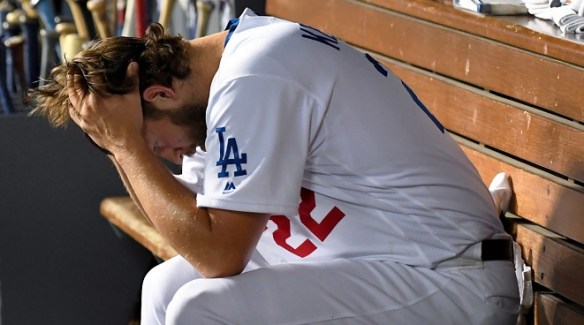
Clayton Kershaw.

Stories emerged that, after the Nationals sent the Dodgers home for the winter Wednesday night, Dodger fans between rage and sorrow ran over Clayton Kershaw jerseys outside Dodger Stadium. Maybe someone should ask them if they could have done it better in front of 55,000 in the park and a few million in front of television sets.

You and me know the answer damn well. Joe and Jane Fan wouldn’t have had one thirty-second of the guts to go out there and taken the risk Kershaw took when manager Dave Roberts pushed both men’s luck and sent Kershaw out to start the top of the eighth.

By all right of logic Roberts should have given Kershaw a pat on the fanny, a big hearty thank you for striking Adam Eaton out to get the Dodgers out of a seventh-inning jam, and the rest of the night off, and then sent Kenta Maeda out for the eighth to do what Roberts in his original mind thought he should do, have Maeda dealing with Anthony Rendon and Juan Soto.

Kershaw’s professional enough to go out and try to do his job when called upon. If you think he went back out for the top of the eighth knowing he’d serve back-to-back pitches to be hit for back-to-back home runs, just mosey on back to the Flat Earth Society.

“We win as a team, we lose as a team,” mourned reliever Kenley Jansen, who’d made two division series appearances and struck out two in an inning and two-thirds’ work without so much as an accidental bump but whom, for whatever reason, Roberts didn’t want to trust while the Dodgers still had a 3-1 Game Five lead.

Tell it to Kershaw, as his teammates generally did after the Nats buried the Dodgers, 7-3, thanks to Howie Kendrick. He may or may not believe you. Even though he probably knows his overall body of work has a space for his plaque in the Hall of Fame in due course, Kershaw has a hard time forgiving himself for the too-well-chronicled hellhound on his postseason trail.

“That’s the hardest part every year,” lamented the lefthander whose beard doesn’t quite negate a still-boyish face that just had the friendly grin wiped off by the neighbourhood bully. “When you don’t win the last game of the season and you’re to blame, it’s not fun . . . Everything people say is true right now about the postseason. I understand that. Nothing I can do about it right now. It’s a terrible feeling, it really is.”

Kershaw is too polite and too self-critical to allow himself the thought that maybe, just maybe, his immediate supervisor set him up to fail.

When he relieved Game Five starter Walker Buehler in the seventh, after Buehler’s magnificent performance was punctured by a frightening drill of Kurt Suzuki leading to first and second and one out, Kershaw looked like the man of the moment striking Eaton out on three pitches to retire the side unscathed. And the Dodgers were a mere six outs from going to the National League Championship Series.

But in the eighth Kershaw threw Rendon a 1-0 fastball that looked like it would nick the floor of the strike zone and Rendon managed to send it over the left field fence. The next pitch Kershaw threw was a slider that hung to Soto, and Soto hung it into the right field bleachers. Then Roberts reached for Maeda. And Maeda struck out the side.

You can blame Kershaw for allowing the game to be tied up at three if you must. But he wasn’t anywhere near the mound when Kendrick turned on a down-and-in fastball with the bases loaded and nobody out in the top of the tenth and sent it up and over the center field fence.

Kershaw wasn’t but Joe Kelly was. Kelly, who’d suffered through a shoulder-troubled season about which “modest” may be an understatement. Kelly, who’d gone through the Nats in order in the ninth and provoked Roberts to push their luck again.

Kelly, whom Roberts trusted over Jansen and trade deadline pickup Adam Kolarek’s 0.77 ERA since becoming a Dodger and spotless division series work to date. Kelly, who surrendered maybe the single most humiliating hit against the Dodgers since Bobby Thomson’s was-it-or-wasn’t-it-tainted pennant winning Shot Heard ‘Round the World.

Not even the destruction wreaked by Red Sox spare part Steve Pearce in Game Five of last year’s World Series hit that far below the Dodger belt.

The worst part isn’t just that Kershaw’s getting the blame yet again for his manager setting him up for failure. It’s that he doesn’t quite understand and may never really know why he can be pitching’s version of Masterpiece Theater during the regular season but pitching’s version of My Mother, the Car in the postseason.

Don’t dismiss it as the pressure getting to him once and for all time. A man who lets pressure get to him is a man who wouldn’t pick himself up and try again over and over and over again. Say whatever else you want about Kershaw but you won’t get a conviction if you charge him with lacking fortitude.

Kershaw has had his moments of postseason triumph, few though they’ve been. The failures have outweighed them so profoundly they’re all but forgotten. And he’s not the pitcher he used to be anymore. The bullet fastball and shark-bite slider are gone. He spent this season remaking himself into a pitcher who survives by thought and guile. His 3.03 regular-season ERA is the highest he’s posted since his 2009 breakout, but a lot of pitchers would drink hemlock if they thought it would get their ERAs down to that number.

It’s bad enough that the sports goat business is still doing boffo business with Joe and Jane Fan. It’s worse when you see a man go out under the most ferocious pressure in games, with no thought in his mind other than doing his job with as little thought of failure as possible, no matter how often he’s been beaten under that pressure in the past, and get beaten on the spot.

Joe and Jane Fan can never admit to themselves that the other guys can be just a little bit better. It can only be their guys stinking up the joint as usual. If Rendon and Soto had missed by even less than a hair, they’d be calling for Kershaw’s statue outside Dodger Stadium.

They can’t admit Rendon and Soto were just better in those two fateful moments. No other explanation is acceptable. So they run over Kershaw’s jerseys in the Dodger Stadium parking lot with the minds of four year olds who’ve just been told no milk and cookies today.

Because he’s a Hall of Famer in waiting otherwise who’s been turned into a postseason pinata for too long. Well, I get that. But I also get that you could fill a room with the Hall of Famers who were bested with championships on the line. I won’t even begin to think now of the Hall of Famers who never got a chance to play for a championship at all.

Or the genuinely great teams who got shoved to one side in the World Series or before the postseason ended. The 1952-53 Boys of Summer, anyone? The 1954 Indians? The 1969 Orioles? The 2001 Mariners? Almost every Brave in creation between 1991 and 2005?

And guess what happened the morning after?

The sun still rose. The flora still bloomed. The fauna still played. The government continued its mischief. The nation still went to work, went to school, went about its everyday business. The world didn’t come spinning to a dead halt. Not even in southern California, not even for Dodger fans who’ve seen their team win a seventh straight National League West and come up short two stops short of the Promised Land.

And nobody figured out a way to overthrow the single most unimpeachable law of games, the law that says somebody’s going to be better than somebody in that sliver of space separating triumph from disaster.

“Spring training’s going to come,” Kershaw finally said. “I’m going to have to be ready to pitch and do the job the best we can.” He probably has lots of baseball miles to go, yet, before he sleeps. It won’t be his job to reconstruct the Dodger bullpen or augment a starting rotation that’s showing its age.

He doesn’t deserve to be harried to the rack of his regrets because his immediate supervisor pushed both their luck Wednesday night or because two Nats hitters were better than his best in the worst possible moment. Or, because the Dodgers had no answer other than a stranded hit batsman in the eighth, a stranded one-out baserunner on a single in the ninth, and the side gone in order in the tenth.

But Joe and Jane Dodger Fan don’t want to hear that now. They may not want to hear it until spring training, if that soon. It was so much more fun to just run over Kershaw jerseys. The only shock is that they didn’t burn Kershaw in effigy. Oops. Better not give them any more bright ideas.

Slam, dunk, don’t stop the dance

2019-10-09 HowieKendrick

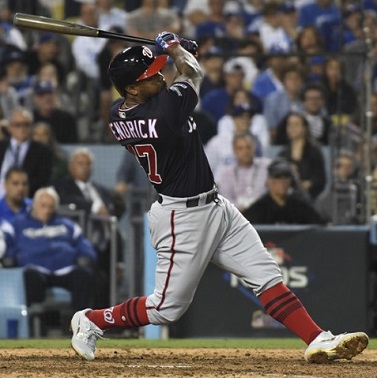
Howie Kendrick swinging for a lifetime’s worth of filet mignon on the Washington house.

Dave Roberts learned the hard way Wednesday night that it takes the same number of moves to get destroyed as it takes to start unfathomable destruction. One.

And a one-time Dodger and Angel alike named Howie Kendrick got reminded all over again just how quickly you can go from a prospective bust—including three fielding errors all division series long—to a game-busting hero with one swing that looked so effortless it looked concurrently as if you could have done under sedation.

Fifteen years ago, with his Red Sox three outs from being swept out of an American League Championship Series, Roberts stole second on Hall of Famer Mariano Rivera to start the unlikeliest comeback of maybe all time. The 2004 Red Sox didn’t lose another game on their way to breaking their actual or alleged curse.

But this is 2019. Roberts is now a reasonably respected major league manager with a fourth straight first place finish and fourth straight postseason trip on his resume. And the way this trip ended Wednesday night sends lesser men past the nearest tavern and right to the distillery to drown themselves in the vats.

And Kendrick, 0-for-4 as he checked in at the plate with the bases loaded and nobody out in the top of the tenth, delivered one swing that’ll save him a small fortune in Beltway filet mignon dinners for the rest of his life.

It nailed the Dancing Nats’ trip to the National League Championship Series with a 7-3 division series Game Five triumph. Their motto now might be the name of a vintage song by rock legend Bryan Ferry: “Don’t Stop the Dance.” And they danced the 106 game-winning Dodgers home for maybe the most bitter winter of their existence since maybe their Brooklyn generations.

For the rest of his life Roberts is liable to face demands to know why he didn’t quit while he was ahead, 3-1 to be exact, accept Clayton Kershaw’s inning-and-threat-ending strikeout of Adam Eaton in the top of the seventh, pat Kershaw on his Hall of Fame-in-waiting fanny with a hearty “Thank you Kersh!” and go to his real bullpen post haste.

But Kershaw didn’t get his pat on the fanny. He got to open the eighth. He got battered back to back on back-to-back pitches by Anthony Rendon and Juan Soto. The first flew just over the left field fence, the second flew into the first couple of rows of the right field bleachers. Vaporising young stud starter Walker Buehler’s magnificent evening’s work and bringing the Nats back from the living dead.

Then Roberts reached for Kenta Maeda. And Maeda promptly struck out the side. Forget the second guessing. This was time for the third, fourth, fifth, and sixth guesses.

Roberts got what he’d asked for out of Kershaw to end the seventh. Why on earth push his own and Kershaw’s luck, knowing only too well that Kershaw’s Hall of Fame resume already has the long-enough sidebar of postseason humiliation as an attachment?

Because, he acknowledged after the defeat, he liked Kershaw against Rendon and Soto just a little bit more.

“[T]he success that Clayton’s had against Soto with the two-run lead, I’ll take Clayton any day in that situation,” Roberts said after the game. “I just think it’s one of those where it was easy for me to get Clayton, with the low pitches to get Rendon and to go out there and get Soto. And to have Kenta behind him. That was my thought, and not have Kenta go through Soto.”

Ancient history teaches that a Cardinals manager named Johnny Keane refused to even think about hooking Hall of Famer Bob Gibson in a threatening World Series Game Seven because he had a commitment to Gibson’s heart. Roberts has the same commitment to Kershaw’s. Keane and Gibson got a World Series win. Roberts and Kershaw got humiliated.

The problem is that Kershaw, one of the nicest men and beloved teammates in the game, goes into a postseason with a hellhound on his trail. And he knows it, sadly enough. After reinventing himself this season as a pitcher who can and does survive on guile to go with the smarts he’s had since his peak seasons, Kershaw couldn’t outsmart Rendon and Soto when he needed to most of all. More acutely, Kershaw can no longer deny what people have said of his postseason work for too long.

“Everything people say is true right now about the postseason,” he said after Game Five, soberly but sadly. “I’ve had to do it so much. I don’t know. It might linger for a while. I might not get over it. I don’t know.”

Roberts went with Kershaw’s heart. He should have gone with his own head. He let sentiment and heart overrule baseball. Oh, he got Maeda not going through Soto all right. He just had to watch Soto drive a second stake into the Dodgers’ heart to get it. Then, he sent Joe Kelly out to work a spotless ninth but pushed his luck yet again.

With further viable bullpen options to spare, a luxury Nationals manager Dave Martinez didn’t have, Roberts sent Kelly almost inexplicably out to work the tenth. Where Kelly walked Eaton on six pitches, surrendered a double to Rendon that was ruled ground-rule when it stuck in the fence, and handed Soto the intentional walk.

And, after Kendrick fouled off a nasty enough breaking ball, where Kelly served him a fastball toward the low inside corner. Not low enough. Kendrick drove it right over the center field fence. You thought the Nats were baseball’s greatest dancers before? Kendrick sent them into dugout moves even Soul Train never busted.

It isn’t just Kershaw for whom Roberts has to answer. Where was Kenley Jansen? Where was young lefty Adam Kolarek? Dodger fans will ask those two questions for the rest of the century. When not asking why Roberts still trusted Kelly despite his shoulder issues and season’s disasters. “Trust Kelly more than your closer Kenley Jansen,” said manager turned MLB Network analyst Kevin Kennedy. “I don’t have an answer for that. Does  Dave?”

The answer may or may not determine Roberts’s future in Los Angeles.

But what a moment it must have been for Martinez, when Kendrick exploded and Nats center fielder Michael A. Taylor hustled in and took a dive to snag Justin Turner’s game and series ending sinking liner. Game Five was the Nats’ entire season in microcosm: early and often faltering; later and often flying. The guillotine built for Martinez in May has been put into storage.

The only bad news for the Nats on the night might have been Stephen Strasburg. He was left almost an afterthought after the Nats’ late game destruction. He merely shook off Max Muncy’s two-run homer in the first and Enrique Hernandez’s leadoff solo bomb in the second to keep the Nats in the game almost as deftly as Buehler seemed to own them.

He’s gone from the world’s most feted draft pick to a pitcher who’s fought injuries to become good, often excellent, and periodically great. He’s comfortable with himself. He’s unflappable to the point that some people mistake him for emotionless. And he knows what he’s doing on the mound even when he’s punctured early.

“The first couple innings, I didn’t hit my spot, and they made me pay for it,” said the 31-year-old righthander who still looks like he’s at freshman orientation despite the beard that’s all grown up from having been born a mere goatee. “As a starter, you just kind of learn how you’ve got to trust your stuff, trust that it’s going to come to you. And it did.”

Tanner Rainey dispatched the Dodgers in order in the seventh. And Patrick Corbin—who’d been so badly humiliated in Game Three—got his chance for redemption in the eighth. Other than plunking Turner Corbin got it, zipping through the inning, including back-to-back strikeouts on Cody Bellinger and pinch-hitter David Freese.

Then it was Daniel Hudson shaking off a one-out single in the ninth. Then it was Kendrick obliterating Kelly and the Dodgers in the tenth. Then it was Sean Doolittle, who had his moments of doubt and disaster on the season before finishing up at reasonable strength, getting three including Taylor’s game-ending swan dive.

There wasn’t a Hunter Strickland or Wander Suero to be found. For all anyone knows, they were under strict orders not to move even their pinkies in the bullpen—under penalty of death, if need be.

“Today’s the biggest game of the year,” Martinez likes to say, to his players and to anyone else who cares to listen, “and we want to go 1-0 today.” He got what he asked for and more. It got the Nats to the second National League Championship Series in franchise history. (Their first? In 1981—as the Montreal Expos.)

For a very long time the article of faith, though not always accurate, was “Washington—First in war, first in peace, and last in the American League.” These Dancing Nats have a better than even shot at making it, “Washington—First in war, first in peace, and first in the National League.”

It’d beat the living hell out of everything else attached to Washington these and most days.