How a Verlander Cy would make history

Houston Astros v Toronto Blue Jays

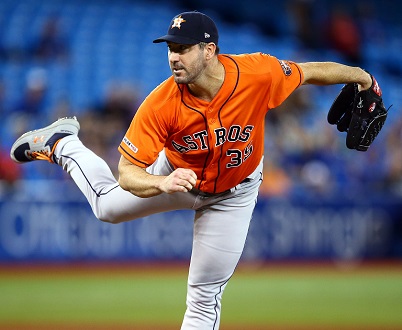
Justin Verlander during his no-hitter against the Blue Jays; if he wins this year’s AL Cy Young Award, he’ll make league history in another way . . .

Even I didn’t catch on and I was watching the game. But Justin Verlander’s no-hitter last Sunday could put him into the history books for reasons other than the no-hitter himself.

That’s because, according to Jayson Stark, five pitchers have thrown no-hitters in the same seasons in which they won Cy Young Awards and Verlander, in theory anyway, could become the sixth. But he’d still make history if he wins this year’s American League Cy—because no American League pitcher has yet won the Cy the same year they went no-no.

The previous five: Jake Arrieta (Cubs), Clayton Kershaw (Dodgers), Hall of Famer Roy Halladay (Phillies), Mike Scott (Astros), and Hall of Famer Sandy Koufax (Dodgers). National Leaguers all. And Koufax did it twice: in 1963, when he pitched the second of his four career no-hitters; and, in 1965, when his fourth proved that practise really makes perfect.

That’s not Verlander’s only shot at the history book this year. (If he does win, it would be his second Cy Young Award.) Suppose he and his rotation mate Gerrit Cole finish one and two in the American League Cy Young Award voting. (It could happen, folks.) According to Stark, it’d be the first time rotation mates ever finished 1-2 in the AL Cy Young vote.

And only one pair of starting rotation mates ever finished 1-2 in a Cy Young Award vote before. No, it wasn’t Koufax and Hall of Famer Don Drysdale. Good guess, though. Koufax won three Cys when it was still a major league award, not one in each league, and he won all three unanimously. Drysdale won it in 1962 even though it’s arguable that Cincinnati’s Bob Purkey probably should have won the award; Dean Chance (Angels) won the 1964 Cy but Koufax was posting a Cy-worth season when it ended after the baserunning injury that exposed his elbow arthritis at last.

It took until 2001 for rotation mates to finish 1-2 in a Cy Young Award vote: Hall of Famer Randy Johnson won the National League award, and should-be Hall of Famer Curt Schilling finished second. The Big Unit, of course, can’t complain since he won five Cy Young Awards including four straight; Schilling’s major Cy Young Award problem is having Cy-worth seasons when someone else was a) just a shade better or b) having a career year.

IF NO KOUFAX—Suppose Sandy Koufax wasn’t in the Show when he copped those three major league-awarded Cy Young Awards? Who would have won them in 1963, 1965, and 1966?

If you go by wins above a replacement-level player, and if Cy Young voters went by it in 1963 (yes, we’re theorising, since nobody thought about WAR back then), the winner would have been . . . Dick Ellsworth, the 23-year-old Cubs lefthander who just so happened to have his career year.

Ellsworth was credited with 22 wins, but he posted career-best full-season 2.11 earned run average (second in the National League to Koufax) and 2.68 fielding-independent pitching. Hall of Famer Juan Marichal won 25 games and had a sub-3.00 ERA for the first time in his career (2.42) and a solid 2.62 FIP.

So how did Ellsworth end up with more WAR than Marichal? Easy: Ellsworth pitched in maybe the National League’s most notorious hitters’ park for a notoriously lousy team still mired in its looney-tooney College of Coaches rotating managers experiment, and he really had to work for those 22 wins. (His ’63 ERA+ was a Show-leading 167.) Marichal’s team was better even though his Giants finished third in the league behind the pennant (and World Series) winning Dodgers and the second-place Cardinals.

Considering that Marichal was credited with 25 wins for a bona-fide pennant contender, it’s entirely possible that if Koufax hadn’t been in the league Marichal would have won the 1963 Cy Young Award. But Koufax was in the league and his ability to miss bats and avoid walks while leading a team to a pennant was just too overwhelming.

Koufax actually didn’t lead major league pitchers in WAR for 1965—Marichal did. So why did Koufax win his second Cy Young Award. Too easy: 26 wins and a fourth no-hitter in as many seasons, which was a perfect game in the bargain. Not to mention pitching the pennant clincher on two days’ rest at the end of a hammer-and-tongs pennant race between the Dodgers and the Giants. And breaking Hall of Famer Bob Feller’s single-season major league strikeout record (with 382) didn’t hurt, either.

But if you went by 1965 WAR Marichal had an MLB-leading 10.3 to Koufax’s fourth-in-Show 8.1. There were two guys in between Marichal and Koufax among the 1965 major league WAR-leading pitchers, both of whom were having their career years: Sam McDowell (Indians) and Jim Maloney (Reds), both of whom finished with 8.2 WAR. And McDowell was arguably better than Maloney that year: McDowell led the American League with a 2.18 ERA and a 2.08 FIP; Maloney’s were a few points higher than Sudden Sam’s.

In 1966, the Dodgers and the Giants went at it for a final time among those 1960s pennant races and this time Koufax led the Show with his 10.3 WAR. He also led with a) his fifth-straight league-leading ERA (1.73, which also led the Show for the third time), his sixth-straight Show-leading FIP (2.07), his fourth Show strikeout title (317), and a Show-leading 27 wins.

Marichal finished right behind Koufax with 9.1 WAR, and Hall of Famer Jim Bunning (Phillies) finished with 9.0. As a matter of fact, only one American League pitcher finished in the top ten Show WAR among the hurlers in ’66: Gary Peters (White Sox), with 5.3.

It’s really to mourn that Juan Marichal, the arguable best righthanded pitcher of the 1960s, never won a Cy Young Award, either the MLB version or the league version, but it wasn’t his fault that a) Sandy Koufax was his contemporary through 1966, and b) someone else not named Koufax had either a career year (Dean Chance, 1964; Mike McCormick, 1967), an extraterrestrial year (Hall of Famer Bob Gibson, 1968), or came into his own completely and to stay (Hall of Famer Tom Seaver, 1969) during several of Marichal’s best seasons.

WHITHER WHITEY?—You may have noticed Hall of Famer Whitey Ford missing from the above discourse. In 1963, the Yankee bellwether got credit for 24 wins while helping lead his Yankees to (what a surprise) the pennant. So why didn’t Ford get much of a Cy Young Award nod that year?

For one thing, Ford wasn’t quite as good as Koufax and Marichal at missing bats; he lived on the ground ball as well as generally avoiding walks. For another thing, Ford got slightly better run support per start than Koufax, Marichal, and Ellsworth did in 1963.

On the other hand, his 24 wins were the second and final time Ford was a 20+ game-winner. And both those seasons came following the Casey Stengel era. The legend about Stengel and Ford is generally true; the Ol’ Perfesser really did tend to save Ford for the Yankees’ best opponents if he could help it.

According to Jay Jaffe’s The Cooperstown Casebook, a researcher named Jason Brannon discovered that Ford made forty percent more starts against the Yankees’ top two rivals than its bottom two in the Stengel era. When Ralph Houk succeeded Stengel starting in 1961, Ford made seven more starts (39) than in the only season Stengel allowed him to make more than thirty. And what do you know: Whitey won the Cy Young Award that year.

Except that he won 25 games but shows only 3.7 WAR. Even if you think Edwin Starr was right (War! What is it good for? Absolutely nothing!), you should know the reason: the 1961 Yankees simply bludgeoned the competition with all those home runs, and they could make any pitcher look like a Hall of Famer, never mind a Whitey Ford who is a bona-fide Hall of Famer.

(The ’61 Yankees are also slightly overrated as a team because of all those home runs and the Mantle-Maris home run chase. If you take the word of Rob Neyer’s Big Book of Baseball Lineups, and it’s a good word to take, five Yankee teams were actually far enough better; from first to fifth—the 1998, 1927, 1939, 1923, and 1937 editions. Me, I’d have thrown in the 1954 edition, if only because there’s something a little sad about a team winning 103 games and not winning the pennant . . . because the Indians chose ’54 to have their career year.)

POOR RICHARD’S ALMANAC—Dick Ellsworth, alas, had a 1966 he’d have just as soon forgotten. At age 26 had a respectable 3.46 FIP but his ERA barely missed reaching 4.00 . . . and he was hung with a major league-leading 22 losses. And the 1966 Cubs finished in tenth place.

The lefthander probably should have suspected it was going to be that kind of year when Topps released his baseball card in the spring. Bad enough: the player shown on the face was righthanded. Worse: The the photograph on the front was actually Ken Hubbs, the Cubs’ second baseman (and 1962 NL Rookie of the Year)—who’d been killed in a February 1964 small plane crash.

The good news is that the 1966 Ellsworth/Hubbs card may not be all that valuable among collectible baseball cards. ComC, the Redmond, Washington-based card and comic trading Website, lists a mint condition Ellsworth/Hubbs at no higher than $55.74. The most valuable Ellsworth card? The 1964 card he shares with Sandy Koufax and Bob Friend (Pirates) showing the National League’s 1963 ERA leaders, at $142.48.

Losing Ken Hubbs was devastating to the Cubs and to baseball, of course, especially given the irony that he took up flying to conquer his fear of it. But Dick Ellsworth didn’t deserve to be embarrassed the way he was on his 1966 baseball card, either.
The more things change . . .

2019-09-05 JimmieFoxxFrankieFrisch

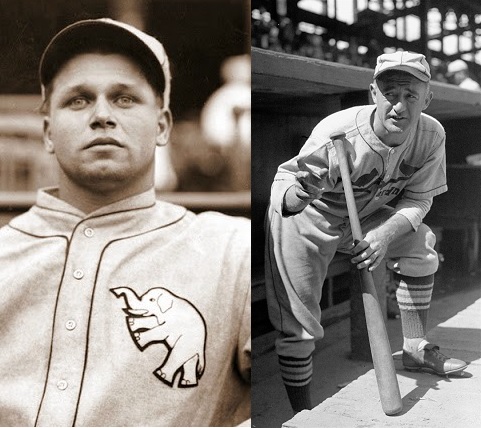
Generational debates on player “toughness” and baseball conditions didn’t end with Jimmie Foxx (left), Frankie Frisch, and a group of fellow Hall of Famers in 1954. They won’t end ever, really.

“Today they don’t have the great number of tough players and hitters. That is because life is different. As a kid I used to shovel manure with a pitchfork. Today everything is done by machines.”

If I gave you that quote without attribution, you’d think it came from one of today’s old-school fans or analysts who think, erroneously, that baseball today lacks “toughness.” But it doesn’t come from one of today’s grumps. It comes from Hall of Famer Jimmie Foxx. And he said it to Sports Illustrated in 1954.

A present-day SI writer, Jon Tayler, exhumes it for a kind of state-of-the-game address. And it might be fun to look at what the other Hall of Famers still alive in 1954 said about the state of the game then. The title of that piece: “Are Today’s Baseball Players Sissies Compared to The Old Timers?” You may or may not be surprised at who said what.

“Baseball is a more aggressive game today,” said outfielder Paul (Big Poison) Waner, answering clearly in the negative. “The players can’t let up a bit. In my day we could. Today the pitcher has to throw hard to every man in the line-up. That’s the reason for so many substitutions. There are many more home-run hitters playing today. And there are cracker-jack fielders.”

Waner should only have been able to see the kind of hard throwing that was yet to come. In 1954, Sandy Koufax and Bob Gibson were playing basketball on college scholarships (Koufax at the University of Cincinnati, Gibson at Creighton University), Sudden Sam McDowell was in middle or junior high school, minor league legend Steve Dalkowski was still in high school, and Tom Seaver and Nolan Ryan were still in grade school.

Rogers Hornsby (second baseman), who wasn’t exactly baseball’s Mr. Congeniality (when he was canned as the St. Louis Browns’s manager in 1952, Browns players led by pitcher Ned Garver presented owner Bill Veeck with an engraved trophy), answered the headline in the affirmative. Feel like a little wager that without knowing it was Hornsby this could have been said by Goose Gossage?

“[I]t’s the fault of the managers, not the players,” Hornsby said. “They change men too often. A pitcher will be removed for one bad pitch. A left-handed batter will be removed for a right-hander, for the percentage. Would they ever have taken out Cobb, Speaker, Wagner or Frisch?”

You wonder if Hornsby wasn’t taking a jab at Casey Stengel, a product of the John McGraw school when all was said and done, but who made a dark and successful art out of changing men, playing percentages, manipulating relief pitching—and kicking the American League’s ass for most of a decade plus while he was at it—during the era Hornsby lamented.

Al Simmons (outfielder) demurred from Hornsby’s assessment. “It was soft for us,” said Bucketfoot Al. “We had no Sunday games. Besides double-headers, today’s players have to play day, night and Sunday baseball.” The doubleheader today is the exception, not the rule, but players in 2019 also have to play night, Sunday, and day baseball. Often while traveling from one coast to the other or north to south.

I bet you think the following remark could be said by any reporter, columnist, or analyst today: “Many of the players today are fully as good as most of the old-timers. But comparisons are difficult to make. One of Ty Cobb’s great assets was base-stealing; in the 1915 season he stole 96 bases . . . With the rabbit ball today, why risk an out? It’s better to wait for the long hit.”

And I bet you’re wrong. That was actually Carl Hubbell, he who wore the silks of the New York Giants while striking out Babe Ruth, Lou Gehrig, Jimmie Foxx, Bucketfoot Al, and Joe Cronin in succession in the 1934 All-Star Game. And Hubbell had a point if you consider it to be that there were (and still are) those who considered 1950s baseball, which some of today’s old schoolers still think was the game’s Golden Age, to be too little more than a big power game. (In 1954, Little Looie Aparicio was just about to start the real return of the stolen base.)

To the question in the 1954 headline Cy Young (there’s a pitching award named in his honour, I think, wink wink) said, “Yes. They can’t take it. I’ve seen some of them threaten the pitcher when a ball brushed them back. Most rugged old-timers took this as a part of the game. It’s the rule today to use several pitchers in one game. Iron Man McGinnity pitched 55 games for the Giants in 1903. He won three double-headers in one month.”

I don’t suppose it crossed Young’s mind that in the dead ball era pitchers such as himself weren’t oriented or taught all that much to try throwing the proverbial lamb chops past the proverbial wolves, or that dead-ball pitching’s number one orientation was inducing contact, the more the better, and that the lack of power pitchers in the dead ball era normally meant that getting hit by a pitch wasn’t liable to leave a welt or a splitting headache.

Would it be fair to have asked Young if he would have flinched pitching against, say, Bob Feller, and had to face retaliation from Feller if Young had knocked down or drilled one of Feller’s Indians? Would it have been fair to question Walter Johnson’s “toughness” because the legend has it that whenever the gentlemanly Big Train did hit a batter he’d be almost apologetic about it and genuinely hopeful that he didn’t injure the poor guy?

“Players today like Ted Williams, Stan Musial, Duke Snider, Eddie Mathews, Mickey Mantle, Bob Feller, Phil Rizzuto and [sic] Pee Wee Reese are as rugged as any of the old-timers,” said third baseman Pie Traynor. “The trouble is that they are handicapped by having to play day and night baseball. This shortens their careers.”

Brushing aside that Rizzuto proved to have the shortest career of the players Traynor named, and that with the exception of Mantle and Mathews all those players had playing careers interrupted by World War II service, Traynor was probably right about their toughness but not quite right about the day/night conundrum. Night ball shortened a lot of Hall of Famers’ and others’ statistics more than their careers; injuries tended to shorten their careers more.

Williams (nineteen seasons) and Musial (22 seasons) would finish very long careers the majority of which seasons were played in the night ball era. So would Feller (eighteen), Mathews (seventeen), Mantle (eighteen), Snider (eighteen), and Reese (sixteen).

In due course you would see such protracted, predominantly night ball careers, from such Hall of Famers as Mantle (eighteen years) Henry Aaron (23 years), Ernie Banks (nineteen), Johnny Bench (seventeen), George Brett (21), Lou Brock (nineteen), Chipper Jones (nineteen), Willie Mays (22), Willie McCovey (22), Joe Morgan (22), Mike Schmidt (eighteen), and Jim Thome (22) among others among the position players.

Among the mostly- or exclusively night ball-era Hall of Fame pitchers? Hello, Warren Spahn (21; “He’ll never get into the Hall of Fame, he won’t stop pitching,” Stan Musial once cracked about him), Robin Roberts (nineteen), Whitey Ford (sixteen), Bob Gibson (seventeen), Juan Marichal (sixteen), Tom Seaver (twenty), Steve Carlton (24), Ferguson Jenkins (nineteen), Dennis Eckersley (24), Greg Maddux (23), Tom Glavine (22), Randy Johnson (22), Mike Mussina (eighteen), and Mariano Rivera (nineteen), among others.

But baseball’s rolls also include too many players whose careers were compromised or shortened by injuries, especially by being foolish enough to try playing through them regardless. That kind of “toughness” gets you some immediate admiration but costs your team a useful-or-better asset and you a career.

They still talk about Mickey Mantle’s what-ifs (forgetting that what was was impossibly great regardless) despite almost his entire career being an orthopedic experiment. And, to this day, baseball fans of long standing lament the what-ifs regarding a lot of players whom injuries compromised or finished: Pistol Pete Reiser, Carl Erskine, Karl Spooner, Herb Score, Wally Bunker, Tony Conigliaro, Mark (The Bird) Fidrych (who came back too soon from one injury too many), Butch Hobson, and Kirby Puckett (who made it to the Hall of Fame anyway), among others. They’re liable to do it regarding David Wright, Joe Mauer, and Buster Posey, too.

Funny that Hornsby should have mentioned his fellow second baseman Frankie Frisch. Frisch had something to say about whether players in 1954 were sissies comparied to players in his day or earlier. Which might surprise those today who remember how Frisch (and his running mate/successor Bill Terry) were so convinced nobody was as good as the good old days’ players that they corrupted the Hall of Fame by ramming as many of their Cardinals’ and Giants’ cronies into the Hall of Fame as they could get away with.

“It’s tough to say who are the tougher,” said the Fordham Flash. “Night games and the rabbit ball have changed everything. The managers seldom play for one run. And the players swing from the end of the bat. But baseball is a nicer game today. They meet you at the train and drive you to the park. TV has them hamming”

If only Frisch hadn’t concluded by adding, “But we got more fun out of the game.” Fun is obviously in the eye of the beholder. But Frisch and company in 1954 should remind us that a Hall of Fame manager named Sparky Anderson would prove right when, continuing his mastery of the double (or more) negative, he’d say in due course, “We try every way we can think to kill this game, but for some reason nothing nobody does never hurts it.”

And the more things in baseball change, the more most of them stay the same.

Discouraged even when the Mets win?

2019-09-04 AmedRosarioJoePanik

Amed Rosario and Joe Panik (2) celebrate the Mets’ Wednesday win over the Nats. So why does it still feel discouraging?

Four months ago, Dave Martinez couldn’t live five minutes without yet another pundit or sports talking head measuring him for the electric chair. Four minutes after the Mets blew one to the Nats in the bottom of the ninth that they led by six in the top, on Tuesday night, Martinez can live like a skipper who has about a 99 percent chance of seeing the postseason even by way of the National League’s first wild card.

Even if he and his Nats lose the afternoon after.

And a few moments before the Nationals started their off-the-charts Tuesday overthrow, Martinez had only one message for his players: “If you let this game go like this, it’s not going to be good,” as he put it in his post-game press conference. Kurt Suzuki in the bottom of the ninth finished making damn sure the game didn’t go like that. He also made sure that what was left of the Nationals Park crowd went from chaos to bedlam while he was at it.

After Suzuki’s three-run homer landed halfway up the left field seats Tuesday night, the Mets looked like they wouldn’t live another five minutes without someone, anyone, preparing to stage an intervention on behalf of the Crisis Addiction Anonymous organisation for which this year’s Mets ought to be the founding fathers.

“It kind of just seemed like a bad dream,” said Mets outfielder Brandon Nimmo, who accounted for two of the Mets’ ten Tuesday runs with a fourth-inning sacrifice fly and a ninth-inning homer.  “I don’t know. That’s hard to do even in a Little League game I feel like, come back from [six] runs down in the bottom of the ninth against guys throwing 99 mph. I don’t really have words for it.”

Mets fans thought it was bad enough watching the Mets blow a seven-run lead in what looked like a blowout in the making against the Braves in Atlanta while almost letting the Braves win it at the eleventh hour? That was just a hard day’s night of a 10-8 win. Tuesday night’s 11-10 loss after the Mets had the damn game locked in the vault was they should have known better. And didn’t.

“We had a six-run lead,” lamented Mets manager Mickey Callaway, whose own neck looked as though it were being measured for a guillotine in May. “Major league pitchers got to be able to hold that.”

How could Martinez and his Dancing Nats, the guys who’ve been baseball’s best since 23 May and think nothing of turning the dugout and the clubhouse into Soul Train after epic home runs or hard-earned wins, know that their still-testy, still-implosive bullpen was going to be taken off the Tuesday night hook by a Mets bullpen that would have fought the Chicago Fire with incendiaries instead of water and other retardants?

A Wednesday matinee between the two, their final meeting of the regular season, promised to be an anticlimax if the Nats won. Or, if the Mets’ self-immolating bullpen incinerated themselves and the Mets yet again. Well, some promises are made to be broken, after all. Some.

Come Wednesday, Luis Avilan struck out Juan Soto swinging after Jeurys Familia surrendered an RBI single (to ex-Met Asdrubal Cabrera) and a two-run double (to Anthony Rendon); Seth Lugo—who wasn’t allowed to work a second inning Tuesday night, with results that will still live in Mets infamy—got his usual two-inning gig and shook off a pair of hits with no runs; and, Justin Wilson pitched a spotless bottom of the ninth.

And the Mets held on to win 8-4. Which cynics, meaning practically any Met fan on the planet, might suggest means it just isn’t safe anymore to trust these Mets with any lead more than four runs. They even had another six-run lead in the middle of the sixth—and let the Nats get a little frisky in the bottom of the inning.

They tied the Nats at a run in the top of the third when spaghetti-bat outfielder Juan Lagares, of all people, led off and hit Nats starter Anibal Sanchez’s hanging cutter over the center field fence. They doubled their pleasure in the top of the fourth when aging second baseman Robinson Cano, returning fresh from the injured list, blasted a first-pitch splitter the other way, into the Mets’ bullpen in left center, with right fielder Michael Conforto (leadoff double) aboard.

And they kicked the train into overdrive when Pete Alonso sent his National League-leading 45th bomb inside the left field foul pole with one out in the top of the fifth.

But with Mets starter Zack Wheeler labouring through five innings and 101 pitches despite surrendering nothing more than Nats shortstop Trea Turner’s two-out RBI single in the bottom of the second, Callaway decided he had no choice but to open the bullpen, and Familia came forth to open the Washington sixth.

Once the Mets’ effective closer, Familia hasn’t been the same since the Mets’ defense blew three World Series saves for him in 2015, or since Conor Gillaspie homered off him to help the Mets lose the 2016 wild card game, not to mention a domestic violence suspension and a blood clot putting paid to his 2017 before the Mets traded him away during 2018.

This season Familia’s been somewhere between lost and implosive, though he had a recent stretch of serviceability before he turned a two-all tie into an eventual 5-2 loss to the Phillies with a little help from a walk to Rhys Hoskins and, in due course, a three-run double by Scott Kingery on Sunday.

Now he took the mound in Nationals Park, walked Gerardo Parra and pinch hitter Andrew Stevenson back-to-back, and struck Turner out swinging. But he threw Cabrera—still bent on making the Mets pay for failing to re-sign him last winter—a creamy pitch that got turned into an RBI single. And he threw Rendon more fodder for the Nats third baseman to solidify a Most Valuable Player case in a walk year, Rendon driving one to the back of right center for a two-run double.

After Avilan dispatched Soto for the side, it took until the top of the eighth for the Mets to thicken the cushion, when Jeff McNeil squirted an RBI single through the right side for the seventh Mets run. The Mets made a push against returning Nats reliever Sean Doolittle in the top of the ninth but Doolittle managed to strand first and third with no scoring damage.

Then Wilson got a ground out, a line out, and shook off a walk to Suzuki—after spinning him around and into the dirt on the first pitch, perhaps just a little reminder against getting too comfy following Tuesday night’s discomfort—to end the game by getting Victor Robles to force Suzuki at second.

You’re encouraged to see a team recover that swiftly from a disaster like Tuesday night. Whether or not it means said team has one more run of derring-do in them before the regular season’s over. But maybe the Mets picked up a piece of Tuesday night news out of Pennsylvania that helped remind them it could always be worse.

Because as bad as it was for the Mets Tuesday night, it was absolutely worse for their Syracuse Mets AAA affiliate. The Mets blew a six-run lead in the ninth? The S-Mets blew a seven-run lead in the eighth, with the International League’s North Division title at stake in a tiebreaking game. But the S-Mets bullpen let the Scranton-Wilkes Barre RailRiders overthrow them, 14-13.

The Mets have been playing for a mere second National League wild card that looks more and more distant the deeper the stretch drive runs. Playing with dynamite, or matches at least, isn’t the way to reach it.

By and large the big boys have reminded the Mets how invincible they aren’t when they look like champions in the making but do it mostly at the expense of the bottom crawlers. Taking two of three from the first NL wild card-leading Nats, just like sweeping the American League second wild card-tied Indians last month, may yet prove aberrational.

Hi! We’re the Mets! And we’re crisis junkies. So who’s going to be the first Met to stand up, make the confession, and begin the recovery process?

The Mets have now won twelve of their last sixteen series, and have won the season series against the Nats, 12-7, but they don’t make you feel too encouraged anymore when they win. And the Nats don’t make you feel discouraged even when they lose two of three. (Even when you think they might think about joining CAA themselves.) Not until they open against the Braves Friday night, anyway.

The Mets hang themselves on the Nats’ gallows

2019-09-03 KurtSuzuki

Trea Turner (7) gives Kurt Suzuki the Gatorade shower. The Nats bullpen should pay for his filet mignon dinners for a year after he helped the Mets bullpen stop the Nats’ intended self-hanging Tuesday night.

These Mets can hang with the big boys. We just forgot to remind ourselves it means hanging themselves. Adolf Eichmann himself didn’t hang from a gallows as big as the one the Mets’ bullpen built in Nationals Park Tuesday.

It takes a rare enough talent to blow a game your team has in the bank. But it takes genius to blow one your team secured in Fort Knox. Just when you thought the Mets’ pen began swearing off arson, and even meaning it, they remind you why you shouldn’t trust them with even a tea light.

Actually, let’s get the facts right. The Nats’ bullpen built the gallows for themselves in the top of the ninth. And they were in not necessarily dire shape but not necessarily pronounced revived fully, especially with overworked closer Sean Doolittle on the injured list.

Then the Mets’ bullpen yanked the Nats’ hapless bulls away from the rope and said, “Thanks large for saving us the trouble! Let us help you to the largest ninth-inning comeback in your franchise history. Least we can do for you building such a nice gallows for us!”

And when Kurt Suzuki, the Nats’ catcher, hit the game-ending three-run homer after Paul Sewald, Luis Avilan, and Edwin Diaz couldn’t get more than one out all inning long, it yanked the noose so tight the Mets looked decapitated as well as hanged.

(The last team to yield five runs or more in the top of the ninth and score more runs than that in the bottom of the ninth? The Red Sox, in June 1961. Against a different Washington franchise. What a difference over half a century makes.)

It didn’t matter that the Mets thumped Nats ace Max Scherzer for four runs in the fourth, beginning with ex-Nat Wilson Ramos extending his hitting streak to 26 games with an RBI double. Any more than it mattered that the Nats pried runs out of Jacob deGrom in the first, the sixth, and the eighth.

But it suddenly mattered even less that Pete Alonso made the score 10-4 in the top of the ninth when he finished a four-run inning with a two-run homer. And, less than that that two Nats relievers—Roenis Elias and Daniel Hudson—got strafed for the four runs before Juan Guerra finally ended that destruction by getting Michael Conforto to fly out for the side.

Because what really matters is three Mets relievers in the bottom of the ninth—Paul Sewald, Luis Avilan, and Edwin Diaz—making a chump out of their manager Mickey Callaway, who’s looked like a chump a little too often this year.

Callaway thought Seth Lugo working a perfect eighth before the five-run Met ninth meant it was perfectly safe for a change not to extend him for a second inning to protect a six-run lead. It was like telling a Brinks guard it was perfectly safe to let Bonnie and Clyde into the bank vault to double check their safe deposit box.

With Victor Robles leading off beating out an infield hit, Sewald got Howie Kendrick to fly out for the first and only Nats out of the inning. Because Trea Turner hit a 1-2 meatball to the back of right field for a double. And after Asdrubal Cabrera singled up the pipe for first and third, Anthony Rendon, the Nats’ should-be MVP front runner, singled home Turner.

Callaway then reached for Luis Avilan to pitch to Juan Soto, whose RBI double in the first opened the game’s scoring in the first place and whose two-run homer in the eighth pulled the Nats back to within a single run just before the Mets started their ninth-inning runaway-that-wasn’t. Soto singled to right to load the pads for Ryan Zimmerman pinch hitting for Matt Adams.

Out went Avilan and in came Edwin Diaz, who only looked in his last couple of outings as though he’d ransomed his once-deadly slider out of its kidnappers’ clutches. In his previous seven outings, he’d surrendered only two earned runs in five and two-thirds total innings. Maybe not close to the Diaz who was lights out in 2018 but not exactly the one who’d dissipated most of this season, either.

The problem was, only the first two of those gigs could be called high-leverage gigs. Diaz hadn’t seen anything like that in over two weeks until Tuesday night. And it showed when Zimmerman hit the second pitch of the plate appearance to deep right to send home Cabrera. But Diaz gamely wrestled Suzuki for seven pitches, a 3-1 count after opening with a swinging strike, then a pair of fouls.

The eighth pitch caught so much of the plate Suzuki could have been tried by jury for neglect if he didn’t send it over the left field fence.

Just like that, the Nats’ worries after losing to the Mets on Labour Day—especially filling their number-five starting rotaton spot after the Mets abused Joe Ross for two and a third, on a day Noah Syndergaard might as well have been the Invisible Man so far as the Nats were concerned—were over. For another day, at least.

With one swing Suzuki silenced the traveling 7 Line Army—a gang of Mets fans whose doings include making numerous road trips including to Washington this week, and who often sounded louder than Nats fans on Monday. In one half inning the poor 7 Liners got silenced almost as fast and hard as they’d been hot and loud in the top.

And Suzuki also punctuated a cold reality about these Mets. That magnificent post-All Star run not only ended ignominiously when they finally got to take on the bigger boys, it now looks like a cruel tease of a dream.

Their apparent crisis addiction remains their number one enemy. You thought the Mets were suddenly beginning to be exposed when they blew a set in Atlanta that they could have won, and won the third game of that set despite opening what looked like a blowout and managing to survive the Braves cutting the margin to a pair?

Who says a team that can blow a seven-run lead they’d built by the fourth inning against the Braves can’t blow a six-run lead they’d built in the top of the ninth against the Nats? Who were only too happy to dance over the Mets’ Tuesday night corpses? The backside of that, of course, is who says a team of Dancing Nats can’t pick themselves up from a six-run deficit at the eleventh hour?

And don’t discount the revenge factor when you think about that. It now seems like centuries ago, but the Mets overthrew the Nats in the bottom of the ninth to open a two-of-three Mets series win in New York last month. They did it almost the reverse of what the Nats did Tuesday night, with a three-run homer to tie and an RBI single to win. But it still left the Nats feeling deflated.

The Mets have been deflating themselves lately. After sweeping the Indians in New York they dropped back-to-back sweeps to the Braves and the Cubs, also in New York, before taking three of four from the Phillies before coming to Washington. That’s now a 3-8 record since 23 August.

Tuesday night may or may not demoralise the Mets completely. But it turned their hopes for even a second wild card into unreality. It probably, really was a sweet dream that they could have played and thought like contenders even for that card for as long as they did.

The Nats reminded the Mets in the worst way possible what happens when a contender real or alleged decide the other guys have no business hanging themselves while the Mets happen to be in the house.

But the Nats better be careful themselves. They have better teams to face yet. And those teams won’t be so inclined to stop them if the Nats insist on building and hanging on their own gallows.

Labour Day looks and lamentations

2019-09-02 WashingtonNationals

Brian Dozier (9) has a feature spot in the Nationals’ dugout dancing. But can baseball’s version of Dance Fever dance themselves into the postseason?

Maybe you did figure on things like this coming. Maybe you didn’t. But it might still be fun to consider them anyway. Prowling around early morning on Labour Day, you can discover, among other things recent past and present:

Looks Aren’t Everything Dept.—Phillies catcher J.T. Realmuto looking as though someone spiked his Raisin Bran with castor oil as he arrived at the mound and saw the bullpen gate open. Realmuto calls it poor timing, and we’ll take his word for it, but the Phillies’ bullpen isn’t exactly disaster free.

Mercy, Mercy, Me Dept.—You really want a mercy rule after Dodgers catcher Russell Martin threw the final inning of a blowout shutout? According to the irreplaceable Jayson Stark, no position player turned that trick since 1917.

Merciless Dept.—Royals shortstop Alex Gordon started a game as the cleanup hitter and finished it pitching two innings. The previous men to start a game hitting cleanup and end up pitching more than one inning in the same game? Ted Williams (1940) and Babe Ruth (1919). Gordon has bragging rights on Martin and a passel of other pitching position players now.

The Basement Tapes Dept.—Six teams came into September with excellent chances of finishing 35 games or more out of first place in their divisions. Two have better chances than that of finishing 40+ games out of first. And one (the Royals) stands to finish 35+ games out of first in the American League Central without being in last place.

But six that far out of first never happened before in the divisional play era. And, according to Stark, it only happened twice before that: in 1906, when the Cubs won 116 games; and, in 1954, when the Indians won 111. (And, when the Yankees won 103—but finished second.)

Houston, We Have No Problem Dept.—The Astros have their third straight American League West title pretty much in the safe deposit box. There’s only one good reason for them to keep grinding aside from their comparatively simple schedule the rest of the way: home field advantage in the American League Championship Series.

The other American League guys who rival the Astros for the greatest ratio of 2019 success to injured list crowding, the Yankees, also rival the Astros for gorging on home cooking: At this writing, the Astros are 51-17 in Minute Maid Park and the Yankees are 49-20 in the House That Ruthless Built.

And only one team since the advent of the wild card has played .700+ lights-out at home without winning a League Championship Series: the 2001 Mariners.

Bronx Bombing Dept.—When it was time to awaken on Labour Day, the Yankees needed one more ninth-inning home run to become baseball’s first. team. ever. to get at least twenty homers on a season in every inning, first through ninth.

Strike The Stage Dept.—With Justin Verlander throwing a fourteen-strikeout no-hitter Sunday, the Astros got closer to setting a precedent: they could finish the season as baseball’s first. team. ever. whose pitching staff will lead the game in strikeouts and whose hitters will finish dead last in striking out.

St. Elsewhere Dept., Continued—Looks like I wasn’t kidding about the Yankees being the American League East’s best and baseball’s version of a M*A*S*H post-op section. Gio Ursehla hitting the injured list with a groin injury Friday made for the 29th Yankee to go to the infirmary this year, breaking the record of 28 by the Dodgers three years ago. Paging Dr. Westphall . . .

Twin City Rockers Dept.—Maybe the Twins can bomb their way to the American League Central title. They’re now baseball’s most prolific single-season smashers with 268 clearing the fences, passing last year’s Yankees. And they’ve also re-gained a five-and-a-half game lead over the Indians as of this morning, with the Indians both a half game behind for the first AL wild card and only a half game ahead for the second card.

It Ain’t Over Until It’s Over Dept.—The Braves went 19-9 in August including an 11-2 finish to the month. The National League East is still theirs to lose right now. But could they lose it? They could, theoretically—to the Nationals. You know. The guys who were among those left for dead before 23 May.

But since 23 May, according to The Athletic, the Nats have a better record (58-27) than the Braves (56-31) and have thus been baseball’s best team since that date. Unfortunately, that 19-31 season opening counts, too. And guess who get to play each other for seven games early this new month?

By the way, the Nats since the All-Star break are 30-16 and the Braves are 30-17. If there’s a time for the NL East leaders to be overthrown, it starts with a four-game set in Sun Trust Park 5 September and could continue with three in Nationals Park starting—wait for it!—Friday the 13th.

The Nats may have the slightly tougher tuneup for the first set, though: the Mets haven’t looked as good in the last two weeks as they did coming out of the All-Star break, but they’re not exactly pushovers just yet, either. And the Nats get to tune up for the Braves against the Mets at home before hitting the road. The Braves get a two-game tune up against the Blue Jays before greeting the Nats.

Too Little, Too Late Dept.—Unless they have a not-too-likely third wind in them, the Mets’ season may be cooked. They were 24-10 after the break and before they swept the Indians last month; they’re 2-7 since, thanks to a sweep by the Braves, in games they could have won, and thanks to a followup sweep by a Cubs club that sometimes hasn’t looked quite as good or at least as consistent as their record.

The Mets had to prove they could hang with the big boys after fashioning that staggering post-break run against mostly the also-rans and the never-woulds. But getting swept by the Braves at a moment when they could have turned the NL East at last into the dogfight everyone predicted out of spring training hurt. So did the followup sweep by the Cubs. They’re four out for the second wild card. Their postseason hope is slimmer than a thread.

Taking two of three from the Phillies in Citizens Bank Park this weekend wasn’t exactly meaningless, but they get three with the Nats in D.C. this week and another set with the Phillies at home this coming weekend. And even if their post-break record is 29-17 (one less win than the Braves), and almost wholly dependent upon how everyone else still in the picture does, this is crunch time for the Mets, whose postseason odds still sit at a seven percent chance at the postseason. This makes or breaks them.

Monsters of the Midwest Dept.—The Cardinals’ self-resurrection makes life even more interesting for the Cubs, who now sit in the second NL wild card spot and only three games behind the Cardinals for the NL Central. And other than two sets to come against the Cardinals, the Cubs have as cream puff a schedule to come as you could ask. The worst the Cardinals seem to face the rest of the stretch is a set with the Nationals starting 16 September.

So at least one and possibly both the sets to come against each other could find both the Cardinals and the Cubs in duel-to-the-death mode. But don’t rule out the spoiler factors to come, either. Pride still counts for plenty among the also-rans who’d like nothing better than to be the ones who make life miserable, or at least more challenging than it ought to be, for the big boys.

Brief Candles Dept.Who says Astros strongman Yordan Alvarez can’t walk home for the year with the American League’s Rookie of the Year award? Only 62 games, you say? It isn’t exactly unprecedented. I can name you a Hall of Famer who won a Rookie of the Year award despite playing in only (count them) 52 games the year he copped the prize: Willie McCovey, 1959.

Aside from which, Alvarez is liable to play in just about all the Astros’ remaining regular season games, giving him possibly 85 games. Ryan Howard copped an ROY playing 88. So if the Rookie of the Year should be the guy who does some of the most unheard-of things you ever heard of among rooks, Alvarez ought to have the award in the bank the same way it looks as though the Mets’ Pete Alonso does in the National League.

It’s just a shame in that regard that the Astros have a great chance of reaching the World Series and the Mets need the rest of the league to drop dead to get there, just about. Because the idea of Alonso and Alvarez tangling in a Series with their rookie credentials and plate firepower would be . . . forget must-see TV. It’d be damn-well-better-see TV.

He’s the Greatest Dancer Dept.—Remember the Sister Sledge disco hit of that name? If they gave that award out in baseball, this year’s Nats—those Dancing Fools, those  Tighten-Uppers, those Dance Fevered, who turn dugout celebrations into Arthur Murray clinics and Nationals Park into the Land of a Thousand Dances—would win the prize without even a sliver of competition.

But if they get to the postseason, would the Nats think of doing the Stroll for their on-field victory celebrations? Why the hell not?