Be a little afraid, Nats Nation

2019-08-09 StephenStrasburg

Getting what they needed from Stephen Strasburg Friday night wasn’t enough for the Nationals in the end.

The Friday night loss by itself had a deep enough sting. Nationals manager Dave Martinez, without meaning to, delivered a deeper one to Nats fans post mortem. A sting that carried the venom of Nats collapses past.

Apparently, Martinez was asked the near-inevitable question—why did he stick with Sean Doolittle, after the third of three consecutive bottom of the ninth-opening Mets was a three-run homer re-tying the game at six each, courtesy of Mets third baseman Todd Frazier?

“He’s our closer; that’s what he does,” the manager said. “It was unfortunate, but come tomorrow, I’ll see how he feels, and he’ll be right back out there.”

Be a little afraid, Nats Nation.

Be a little afraid when the Nats—whose bullpen most of the year rivaled the Mets’ for arson charges—reshuffled the pen, added three new pieces at the trade deadline, then had none of them on standby at the first sign of trouble Friday night.

They got what they needed from Stephen Strasburg: seven strong enough innings, including three perfect to open, with Strasburg becoming the franchise’s career strikeout leader while he was at it. And it went for nothing in the end.

Be a little afraid with Doolittle once again at the mercy of the Mets, during a season in which Doolittle entered Friday night’s game having surrendered as many earned runs to the Mets (nine) as he’d surrendered to all his other opponents.

Be a little afraid when one of the Nats’ new bullpen toys, Roenis Elias, turned up with a hamstring tweak just over a week after they’d added him. And, after fellow new toy Daniel Hudson kept the Mets from mischief in the eighth, the third new bullpen toy, Hunter Strickland, wasn’t even a topic.

Be a little afraid when the only Nat bull on standby in the ninth was ancient lefthander Fernando Rodney, who’d actually been pitching well since 25 July, when he blew a save into a loss to the Rockies, going from there to work five games without surrendering a single run, earned or otherwise.

As a matter of fact, since becoming a Nat in early June, after the Athletics released him with a ghastly 9.42 ERA and 5.58 fielding-independent pitching rate, Rodney’s been as close to lights out as at any previous time in his long career: as a Nat, he has a 2.87 ERA and a 3.15 FIP.

But Doolittle is the official closer. And even though the Mets have rather bullied him all year long, Martinez wasn’t going to take his job away after re-claiming a three-run lead in the top of the ninth. Especially after the way they did it, catching Mets reliever Luis Avilan and catcher (and ex-Nat) Wilson Ramos half asleep on a wild pitch when they might have had a shot at bagging Trea Turner shooting home from third.

At that point the Mets looked as though they were going to waste a mostly brilliant start from their new toy Marcus Stroman in his Citi Field debut plus that staggering three-run-deficit closure in the fourth, off Strasburg, after Strasburg manhandled them perfectly through the first three.

So, after Hudson bridged from Strasburg effectively enough, shaking off a one-out double, Doolittle went to work in the bottom of the ninth. And J.D. Davis sent a 1-1 pitch to the back of left field for an opening double, right before their old buddy Ramos shot an 0-1 service like an arrow up the pipe for a single with Davis gunning it to third.

Up came Frazier, the Mets’ elder third baseman. Doolittle started him up and in with a four-seamer. Then, Frazier swung and missed on a four-seamer tailing away from the zone. Then, Doolittle missed high. Then, Doolittle threw something right down the pipe. And Frazier sent it sailing just fair past the left field foul pole and into the second deck.

Coming back from one three-run deficit is enough of a challenge. The Mets just did it twice in the same game, and the second threatened to send the game to extra innings. And Rodney, who’d been loosening up since the bottom of the eighth, still stood in the bullpen, waiting. For the call that never came.

The newest Met, Joe Panik, stepped up. He’d been signed earlier Friday, a few days after the Giants finally parted ways with their veteran second baseman, and after space-choking veteran second baseman Robinson Cano—who’d begun to hit of late but was still a slowed-down liability at second—went down for the count and maybe the season with a torn hamstring.

Wasn’t it true, Don Vito Corleone mused in The Godfather, the novel, that great misfortune sometimes led to unforeseen reward?

Panik isn’t much of a hitter anymore (his 2014-2015 seasons seem like flukes now) but he can still play second base with aplomb and smarts when he’s healthy. And the Mets now have enough hitting otherwise to be able to afford a guy who fits the mold of the old classic good field/barely hit middle infielder.

Now, Panik singled up the middle only to be thrown out on a followup bunt by Juan Lagares off left of the plate. Anthony Rendon, the Nats’ virtuoso third baseman and free agent-to-be, hustled in from third, speared the dead fish and, with Doolittle bending over in front of him, fired a perfect strike to Turner over from shortstop.

Then Jeff McNeil flied out to short right field. Yep. Going to go to extra innings, it looks like. Amed Rosario poked a base hit into left to set up first and second, and up came Michael Conforto, the Mets’ right fielder, a lefthanded swinger with formidable enough power but a sometimes maddening inconsistency at the plate.

Conforto was 1-for-4 on the night and had made the second out of the fourth before Pete Alonso and Davis cleared the fences back-to-back to tie things at three. Now, Doolittle fell behind 2-0 immediately. Conforto fouled off a pair immediately after that.

Time to start deciding who’s going to handle the extras out of both bullpens. The Mets hadn’t yet gone to either Seth Lugo, arguably their best relief pitcher of late; or, closer Edwin Diaz, whose talent couldn’t keep him from becoming an inconsistent mess much of the season, often through usage not entirely of his own making.

And for the Nats Rodney was warm and prepared, just in case. Except that, if the Nats got out of the ninth still alive and didn’t get to pry something out of either Lugo or Diaz in the top of the tenth, Alonso—the Rookie of the Year candidate, whose fourth-inning two-run blast sailed right over the heads of the Mets’ broadcast team stationed just behind the left field fence—would be the first Met to hit in the bottom.

Just in case never came. Doolittle tried coming inside, and Conforto drilled it on a high line just past Nats right fielder Adam Eaton and off the fence to send Lagares home. It took Doolittle only 26 pitches, getting only two swinging misses, to blow up a certain 6-3 win. When the Mets got aggressive Doolittle had no viable answer.

“I don’t have a lot of answers right now,” said Doolittle, the lefthander who has one of the most accommodating personalities in the game today, and who’s unapologetic about riding the “let the kids play”/”make baseball fun again” train. “I’m kind of searching, going over the inning in my head.”

The Mets were so jazzed by that second comeback and win that Stroman popped into the dugout from the clubhouse in nothing but his boxers and Conforto didn’t make it far past first before he was stripped of his jersey and given the Gatorade bucket ice shower topless.

“I absolutely love the way the guys played,” said Martinez to the Washington Post after the game. He had reason enough to love it. “We did everything right until the ninth inning. Just got to keep pounding. Like I told them before, ‘Hey, we come back tomorrow, we got 1-0, and move on’. ”

But he’s not dealing with pushovers in New York anymore. And the Mets’ post All-Star performance now has them nipping close to the second National League wild card. The Nats are a game and a half ahead of the pack for the first card; the Mets are only a game and a half back of them. This weekend is as close to D-Day as both teams can get so far.

If the Nats want to live through this weekend—especially with Noah Syndergaard looming Saturday against Patrick Corbin, Jacob deGrom against Anibal Sanchez Sunday, and these Mets in no mood to roll over and play dead the way they were once supposed to do—Martinez had better come up with a better bullpen plan.

Martinez needs Corbin and Sanchez to pin the Mets’ ears back if that can be done against these suddenly rampaging, suddenly rapacious, suddenly relentless Mets. If they could say thanks large, bud, to Strasburg for three perfect innings with a couple of game-tying, back-to-back bombs off him in the fourth, maybe no Nats starter is entirely safe.

Maybe not even Max Scherzer if he was healthy. And he isn’t. Scherzer cancelled a planned Friday bullpen session as a precaution while he continues trying to recover from back trouble that culminated in a rhomboid strain. A Strasburg conquest Friday night would have gone long to inflate the Nats’ New York morale.

Now even Corbin goes to work Saturday with the proverbial hand tied behind his back. And Corbin’s history against the Mets isn’t that encouraging, either: they’ve beaten him five times while he’s beaten them twice with five no-decisions and a 4.58 ERA against them in twelve lifetime starts.

Corbin and Sanchez might find ways to throttle the Mets, but there’s almost no way Martinez can keep running Doolittle out to face a team that treats him like a burglar caught dead to right trying to lift the jewels and the cash out of the safe.

The Mets have treated Strickland over his career like almost as much of a pinata as they have Doolittle this year. Strickland’s been battered for a .343 lifetime average against him by the Mets. Elias’s hamstring tweak came at a deadlier time than the Nats could have imagined. Rodney’s jacket against the Mets is only slightly more encouraging—they’ve only hit .259 against him for his career. Except that he hasn’t faced them since 2017. And those Mets aren’t these Mets. Not even close.

Both teams’ revivals removed their formerly embattled managers’ necks from the guillotine braces. But Friday night Martinez looked like the guy who was one tick from the blade dropping and Mets manager Mickey Callaway was made to look like the smart guy, if not necessarily a heretofore-undetected genius.

The Nats’ bullpen has been an improved product since May, but they’re not completely resurrected just yet, and they still have their vulnerabilities. The Mets bullpen, formerly virtuosi at incinerating games the Mets either led or looked like they’d have a clean shot at winning, has suddenly quit playing with matches most of the time. Most.

They said coming into the set that the Mets and us were about to find out what they’re  really made of, after they reheated to nuclear level after the All-Star break, mostly against the bottom crawlers. But it’s not unfair to say that the Nats and us may be about to find out what they’re really made of, too.

Life comes in threes for these Mets

2019-08-09 MichaelConforto

Michael Conforto, seconds from being stripped topless and bathed in Gatorade bucket ice, after his RBI finally beat the Nats Friday night in the ninth.

The question before the Citi Field house, and practically all of baseball Friday night, was whether the resurrected Mets—who’d done it mostly on the backs of the bottom crawlers—could hang with the big boys. Even if Friday night’s big boys out of Washington were picking themselves up by their own bootstraps after an almost-as-nightmarish first half.

The answer came in two parts.

Part one: a comeback from three down against Stephen Strasburg, the Nats’ best starting pitcher with Max Scherzer still in drydock over his bothersome back, in the bottom of the fourth. Part two: Another comeback from three runs down, and a game-winning RBI, off a Nats reliever the Mets turned into their personal pinata all season long.

Sean Doolittle against the rest of baseball in 2019: nine runs surrendered. Sean Doolittle against these Mets before he went to work in the bottom of the ninth: nine runs. The Mets as a team hit .385 against Doolittle in 2019 before Friday night, good for a ghastly 10.13 ERA for Doolittle against them.

The kid corps took care of business in the third. The old men took care of most of it in the ninth, including four straight inning-opening hits including a game re-tying three-run homer. Until Michael Conforto, all of a five-year young veteran, drove home old man Juan Lagares for a 7-6 win that was both the first for the Mets in a game they trailed after eight this and surrealistic even by the standards of this year’s surrealistic Mets.

Conforto barely rounded first when his celebrating teammates stripped him topless in celebration of the absolute first game-ending hit of his career. Then hit him with the Gatorade bucket ice shower. That’s how crazy this one went, right down to the proverbial wire. It didn’t exactly begin with things looking even reasonable for the Mets.

And it almost ended after an unreasonable lapse in the top of the ninth sent them three down for the second time. Apparently, the Mets didn’t get the memo saying they were supposed to tuck their tails between their legs and take it like a manperson from the almost-equally re-upstart Nats. Whoever intercepted the memo should be named the game’s most valuable player.

For the first three innings Strasburg was perfect and Mets starter Marcus Stroman, in his first gig in Citi Field, was out of character. Strasburg threw stuff that found his fielders invariably and picked up a punchout per inning. Stroman, the homecoming import from Toronto, forgot he was the John Coltrane of the ground ball and blew away seven on strikeouts, including five straight from the first to the second.

Alas, in the top of the third it began to look like the resurrected Mets couldn’t really hang with the Washington resurrected. The Nats hung up a three-spot in the top thanks in part to Anthony Rendon’s RBI triple flying just past a pair of oncoming Mets outfielders, one of whose knees (Jeff McNeil) had an unexpected and unwanted rendezvous with another’s (Conforto) face. And, thanks in larger part to Juan Soto sailing one parabolically over the right field fence.

Maybe the Nats would escape having to deal with the Mets without Scherzer, after all. Maybe an inning saying “take this, peasants!” would stick a barb into the newly upstart Mets.

But in the bottom of the third Nats first baseman Matt Adams, who’s not exactly the second coming of Mets broadcaster Keith Hernandez at first base, as it is, inexplicably let leadoff walker McNeil escape unscathed, failing to throw him out at second despite all the time on earth to do it off Amed Rosario’s ground out. And after Conforto popped out to Rendon next to third base, up stepped Rookie of the Year candidate Pete Alonso.

In four seconds flat, Strasburg’s sinking changeup traveled from the end of Alonso’s bat over the heads of Hernandez and the rest of the Mets’ broadcast team (Gary Cohen and ex-pitcher Ron Darling), stationed behind the fence for a change, and into the left field seats. Making Alonso the first Mets rook to clear the fences in four straight games since Larry Elliott in 1963.

And five pitches later, J.D. Davis caught hold of a Strasburg four-seamer coming just inside the zone and drove it the other way into the upper deck behind right. Tie game. Just like that. “Who you callin’ peasants, peasants?!?”

Stroman seemed so impervious to the Nats trying to make his life difficult the second time around the order that, after he walked Trea Turner and surrendered an almost prompt single to Adam Eaton for first and second and two out in the fifth, he slipped a full-count cutter right beneath Rendon for swinging strike three, the side, and his eighth punchout of the night.

Then the Nats got a little more frisky in the sixth. A leadoff double down the right field line by Soto. A single by Adams that eluded Alonso diving into the hole for first and third. And a sharp grounder to third by Kurt Suzuki that looked like the Mets would concede the lead run to turn the double play.

Mets third baseman Todd Frazier was having none of that. He threw home as if premeditated. Catcher Wilson Ramos blocked the hopper perfectly, held the ball, and Soto was in the rundown. The lone mistake was the Mets making the extra throw to nail Soto, allowing Adams to third and Suzuki to second. With one out. But Brian Dozier hit a laser to shortstop. And Rosario made as though he’d been studying Hall of Famer Ozzie Smith. He leaped and speared the laser with a hearty overhead glove snap as if he’d been praying for this one all night long. Then Stroman struck out Strasburg himself for the side.

Bullet dodged? Try howitzer. This was the Met defense that could have been tried by jury for treason not a fortnight ago? And maybe nobody in Citi Field was happier or making more racket than Stroman’s mother, resplendent in a blue Mets alternate jersey, jumping and whooping it up from her seat.

The Nats dodged a howitzer of their own in the bottom of the sixth. With first and third they caught a phenomenal break when plate umpire Mark Carlson called ball four on Davis, on a pitch that missed the inside of the zone and on which Davis checked his swing. But first base umpire Tripp Gibson rang Davis up, erroneously, as an overhead replay showed vividly.

Conforto running on the pitch stole second to set up first and third. But if the Mets went on to lose this game, that blown strike would likely have haunted them the rest of the weekend. Maybe the rest of the season, too, depending.

But the Nats pulled Strasburg’s kishkes away from the long knives when Ramos grounded to third, Rendon threw a little wide to first, and Adams bellyflopped like an appendicitic whale behind the base, somehow keeping his toe on the pad and the ball in his mitt, long enough for the side. It would have been the play of the game if the Nats somehow pried a win out of the Mets after saving that would-have-been tiebreaking run.

And in the top of the seventh it looked as though they’d do just that, when Rendon—after a leadoff walk to Turner pushed Stroman out, bringing in lefty Justin Wilson to strike out Adam Eaton—hit Wilson’s first service into the left field seats. “Go figure,” Hernandez purred on the broadcast. “Wilson has poor numbers against Eaton and strikes him out. He has good numbers against Rendon and Rendon hits one out.”

That’s Andujar’s Law, folks: In baseball, there’s just one word—you never know.

But did the Mets know they were done for yet?

They may have had a suspicion when Strasburg, sent back for the bottom of the seventh, took care of Frazier, newly minted Met second baseman Joe Panik (signed after the veteran Giant was designated for assignment, following their acquisition of Scooter Gennett from the Reds), and pinch hitter Luis Gillorme.

Then they thought, not quite yet, after Robert Gsellman worked a reasonably effortless three-and-three top of the eighth. And one of the Nats’ new bullpen toys, former Blue Jay and Dodger Daniel Hudson, opened the bottom by fooling McNeil completely with a changeup hitting the low inner corner. But Rosario gunned a slightly hanging breaking ball to the back corner of the left field grass for a one-out double.

Conforto pushed him to third with a jam-shot ground out up the first base line. After Hudson fed Alonso a diet of high fastballs that Alonso kept fouling off like they were castor oil, alas, Hudson threw him something good enough only to be whacked on the ground to short for the side.

Gsellman went back to open the ninth. The shaggy righthander wrestled Turner to a full count, something into which Turner is very good at wrestling himself when he begins down in the count, then watched Turner foul off a trio before lining a base hit to right. And then Eaton, who’d had nothing to show for four previous plate gigs against Gsellman, pushed a tiny bunt off to the left of the plate from which nobody could throw him out. Even with a shotgun for an arm.

First and second, nobody out, and Rendon at the plate with a .500+ lifetime batting average against Gsellman. But Rendon almost promptly flied out to right, allowing Turner to take third on the play. Prompting Mets manager Mickey Callaway—once beleaguered, now riding the unlikely post All-Star break Mets success—to reach for lefty Luis Avilan to work to the lefthanded Soto, who was one triple short of the cycle.

Not tonight. Avilan struck Soto out on a lazy looking changeup. Up stepped the lumbering Adams, 2-for-4 on the night to that point. Eaton stole second on 1-0, but Avilan pushed Adams to 1-2 before a changeup missed for 2-2.

But then Avilan threw Adams a changeup that hit the dirt and bounced off the veteran Ramos, himself an ex-Nat. Ramos and Avilan each looked as though they’d fallen asleep on their feet as Ramos barely moved back toward the plate and Avilan inexplicably failed to get there in time to cover, as Turner hustled home with the sixth Nats run.

Then Avilan struck out Adams for the side. Leaving the Mets with Doolittle as their last, best hope to save their own kishkes. To lose this one stood a good chance of cutting their momentum and morale completely in half. And Doolittle and his Nats knew it.

But the Mets knew they had the lefthander by the short and curlies almost before he went to work in the bottom of the ninth. The whole season’s record against him was evidence enough.

Sure enough, Davis opened rudely enough by whacking a double to left. And Ramos promptly sent him to third with a line single up the pipe. And Frazier tied the game with a mammoth rip down the left field line and just fair past the foul pole. The way Citi Field went berserk you’d have thought they were watching the resurrection of the 1969 Mets from half a century ago.

Panik, the newest Met, promptly singled to center, only to be forced at second when Lagares’s bunt floated in the air, leaving Panik stuck to determine whether it would hit the ground before running, allowing Rendon hustling in from third to throw as Doolittle in front of him bent over to give him room, getting Panik by several steps. And McNeil flied out to right almost at once.

Two out, extra innings against these relentless Nats looming. Right?

Wrong.

Rosario shot a tracer to left center for a hit setting up first and second. Then Conforto caught hold of a 2-2 inside fastball and sent it on a high line to right, far enough to elude the onrushing Eaton and bound off the fence with Lagares atoning for the busted bunt by scampering home with the winning run.

These Mets can hang with the bigger boys when they need to. They’ve got arguable the toughest schedule remaining among National League contenders and re-contenders. Until Friday night, a Met journey of a thousand miles was more liable to begin with two flats and a busted transmission than a smooth-running vehicle.

They repaired the flats and un-busted the transmission in reasonably record time. Pulling themselves to within a game and a half of the Nats in the National League’s wild card standings at long enough last.

Don’t ask if anything could possibly be wilder than this one’s finish. Both teams know you probably ain’t seen nothing yet. And you might see everything before this set’s finished.

A cry from Chris Davis’s wilderness

2019-08-09 ChrisDavisBrandonHyde

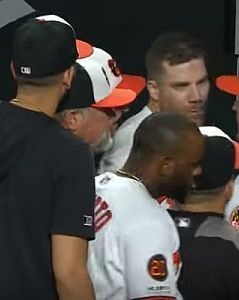
Chris Davis (top right, hatless) had a meltdown with skipper Brandon Hyde (bearded, behind Davis’s shoulder) Wednesday.

Even a single taste of greatness produces a natural high equaled only by any subsequent, equivalent taste of failure producing a natural low that can sting far deeper than the high could elevate. Prolonged greatness shoved aside by prolonged failure lacerates deeper.

And as often as not the ache to reclaim former greatness becomes a burden, if not an addiction, whose lack of consummation harries men and women of all manner of character to the rack of their regrets in a manner as cruel as it can be enduring.

Today’s unexpected champion becomes thrown back tomorrow to the pool of the ordinary, just as readily as today’s unexpected failure or journeyman may be thrown unexpectedly into the pool of the giants. And it’s still rare enough that a man who’s tumbled from particular heights to particular nightmarish depths allows himself the stripping of his professional guard enough to cry out from his unique wilderness.

Chris Davis, the Orioles’ first baseman/designated hitter, became such a man late this week. Davis has fallen from being one of the American League’s marquee sluggers to a man about whom the term “journeyman” can’t begin to describe without injury the depth to which he has fallen so publicly.

He is the Orioles’ highest paid player, based on his former glories and with three years left on his mammoth deal. You would have to presume him inhuman if he didn’t believe to his soul that he wasn’t earning what he’s paid. Yet until this week Davis was also elevated in the minds of fans who appreciate the war within such a man and the courage required to refuse its consumption of his soul.

Earlier this season he ended an unconscionable hitless game streak with the eyes of a nation upon him for the grace he’d exhibited under such futility’s lash, whacking a two-run single that brought loud cheering even in the enemy ballpark in which he drilled the hit. And it was merely the first of three hits he’d collect, and the first two of four runs he’d drive in on the evening.

But Davis since that night has had yet another season in hell parallel to that of his team’s, apparently lost for resolving himself as a player. He’s long past being an everyday player; his season’s salary is a quarter of the Orioles’ season’s payroll; his pride is compromised even deeper than his play.

At long enough last his personal dam yielded to a flood Wednesday night, after he couldn’t perform a somewhat routine scoop of a low infield throw in the fifth inning, in the middle of the Orioles being blown out by the Yankees, 14-2.

When the teams changed sides, there was Davis in a furious verbal showdown with his manager Brandon Hyde, who may have ignited the flood with a remark to Davis and answered his battered first baseman in kind for one and all to see. It was caught on camera and only too widely discussed and disseminated.

Orioles fans knew Hyde in his first season of major league managing had all he could think about trying to foster accountability and navigate the roiled waters of a mediocre team. But if he intended to call Davis out over the error alone, or the full year’s shortfall, Hyde may have underestimated just how painfully self aware Davis must be of his own deflation.

And the day after, Davis was extensively apologetic for having let his season long frustration, interrupted only rarely, and perhaps an extension of two previous years’ unexpected and barely explainable futility, explode as on Wednesday.

I think it’s pretty obvious the offensive struggles I’ve had for quite some time. I feel like night in and night out, I’ve done a real good job of still being there on defense and trying to pick guys up, and at that spot in the game, at that point in the series, that was kind of where it all . . . like I said, I hit a breaking point.

. . . [W]hen you have that much frustration, when you’re constantly having to deal with failure, you’re gonna have episodes where you just have to let it out. Unfortunately, it was in the dugout. I wish it hadn’t been. I wish it had been underneath [in the clubhouse tunnel], but it happened, and I can’t go back and change that.

His temporary fortune was the Orioles having an off-day Thursday, enabling Davis to take succor from his wife and young children, the most immediate and mandatory place for a husband and father to regain comfort after a too-long-protracted bad year on the job.

That’s really the only way that I know kind of how to escape, is just to be a dad, and be a husband. I enjoyed the time with them, but I look forward to coming back in there and getting back to work with these guys.

And when he returned to his place of business Friday, rejoining the Orioles to open a weekend series against the American League West-owning Astros, against whom he won’t play Friday night, Davis approached the boss post haste.

We sat down today and talked, I don’t know, over an hour. That’s just kind of when it all went down, I guess. We both knew that we had an off day. I think it was probably best that we did, just to kind of give us a little bit of time. I didn’t think about it a whole lot. I tried not to. I think he was kind of in the same boat. When we’re not here and we’re not in uniform, we’re not working, we’re just regular human beings. I think he took a little time away from everything just to relax.

Hyde’s own short public remarks immediately after the Wednesday night dam burst offered no indication that he would hold it against Davis, which makes Davis fortunate enough when you allow that in non-public professions such explosions after such protracted internal anguish gain as much unemployment as empathy for the frustrated.

Davis specifies that Wednesday culminated “the last couple of weeks” worth of shortfall and its accompanying discomfort, but you could not blame him if it proved to culminate the last couple of seasons worth. You may consider him fortunate to have tasted greatness at all and remind yourself of those who’ve tasted far more brief such greatness without the prior and subsequent ordinariness or failure breaking them in half.

Stronger men than Davis get crushed beneath the wheel of failure that rolls upon them unexpectedly after they know even a fast flicker of greatness. Weaker men than him triumph on the job yet claim that their only and transient success in a mortal life that does not live by profession alone.

The Baltimore Sun‘s venerable baseball columnist Peter Schmuck suggests Davis’s frustration may prompt him to think of negotiating a buyout of the rest of his contract. It may not be an option to which either Davis or the Orioles are immune.

Pitchers and fans: Stop worrying and tolerate the bomb

2019-08-09 JustinVerlander

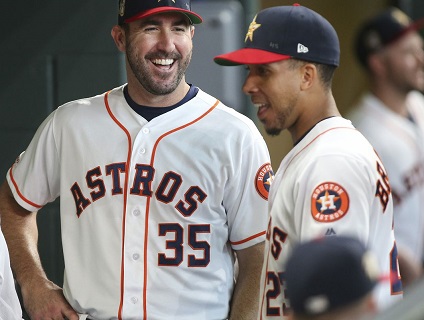
Justin Verlander shares a laugh with Michael Brantley—and you could laugh, too, if you’re surrendering lots of bombs but you’re still mostly unhittable otherwise.

There’s a reason Jayson Stark was named to the Hall of Fame as this year’s J.G. Taylor Spink  Award winner. He never fails to entertain and teach at once. From the deep to the mundane, Stark finds the details that keep baseball an endless river of stimulation and delight between games and, yes, between seasons.

And sometimes it seems that only Stark—who now hangs his shingle at The Athletic, after a long and distinguished career in Philadelphia sports pages and in due course at ESPN—has the patience and the cheerful audacity to plumb into waters deep enough to be occupied only by a somehow surviving prehistoric fish.

If statistics are the life blood of baseball, then Stark is one of the game’s most valuable blood banks. When he excavates, thinking fans get behind him because they know he’s going to exhume something. Something like, say, further evidence that you shouldn’t always start anticipating the demise of a pitcher because he surrenders lots of home runs.

Not even if he’s a Hall of Famer in the making named Justin Verlander.

Stark can’t resist leading off his weekly column of uselessly useful information by noticing Verlander this season is the least hittable pitcher and the most prone to the long ball. “And if you’re thinking that’s a pretty weird combination, to give up the fewest hits but allow the most homers,” he adds, “hey, good call!”

Verlander is only the third such pitcher since 1900 to do that. And he’s in very distinguished company. Hall of Famer Walter Johnson did it in 1913, when he surrendered a measly 6.03 hits per nine average . . . and a league-leading nine home runs. (That, of course, was the final phase of the dead ball era.)

Ten years later, Yankee pitcher Bob Shawkey led the American League with an 8.06 hits-per-nine average (if that was the lowest average in the league that year, you can rest assured that high-offense eras didn’t begin in the Era of Actual or Alleged Performance-Enhancing Substances) . . . and with 17 homers surrendered.

Verlander also leads the American League this year with his 2.68 earned run average. Want to know how many league ERA champions also led in surrendering home runs the same year? Stark has the answer: two. Johnson and John Candelaria. The Big Train did it in the aforesaid 1913 season (1.14 ERA); the Candy Man led the 1977 NL with his 2.34 ERA . . . and with 29 homers surrendered.

Who would you consider the closest of today’s pitchers to Verlander’s level? His old teammate Max Scherzer, perhaps? Well, now. Scherzer through this writing has surrendered 246 home runs lifetime, averages surrendering 24 per 162 games, and his career high is the 31 he surrendered in 2016. And that didn’t stop Scherzer from winning the second of his three Cy Young Awards.

Preacher Roe, the legendary Brooklyn Dodgers lefthander who admitted upon retirement that the spitter was his money pitch, after all, once addressed his own weak hitting thus: “I do it the other way. I’ve thrown some of the longest balls in major league history.” He wasn’t far off.

Roe averaged 23 homers per 162 games lifetime and once led the National League surrendering 34 in 1950. (Even allowing the Dodgers playing in the Ebbets Field bandbox that’s a little staggering.) The NL’s ERA champion in 1950, Sal Maglie of the New York Giants, surrendered fourteen home runs the same season. Today’s baseball fan starts getting paranoid when his pitching heroes surrender a mere ten.

Hall of Famer Sandy Koufax has that five-year ERA championship streak from 1962-66 and a six-year fielding-independent pitching (ERA minus defense, essentially) streak (1961-66). His ERA over those five seasons: 1.99; his FIP over the six: 2.18. Want to know his average home runs surrendered per year over that combined span? How does 20 grab you?

Robin Roberts owned the National League from 1950-56. He finished his career surrendering one more home run (505) than fellow Hall of Famer Eddie Murray hit lifetime (504) and averaged surrendering 27 home runs per 162 games lifetime, while also having four straight years leading his league in home runs surrendered. The average per year during that streak: forty.

In year one of that streak, Roberts posted his final sub-3.00 ERA as a Phillie. The somewhat insane overwork was only beginning to catch up to him. When he helped pitch the 1950 Whiz Kids team to an unlikely NL pennant, he surrendered 29 bombs, and from 1950-53 he never surrendered less than twenty. Today’s fan would call for his head on a fence post for it.

2019-08-09 RobinRoberts

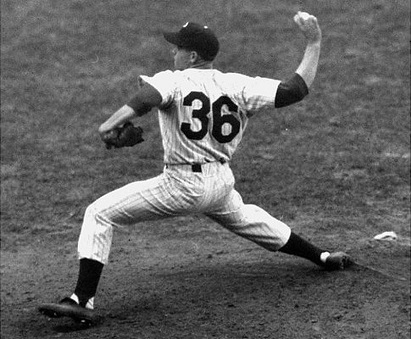
Surrendering one more lifetime homer than Eddie Murray hit didn’t keep Robin Roberts out of the Hall of Fame . . .

Another Hall of Famer, Warren Spahn, won the second Cy Young Award, at a time when it was a major league award and not an award presented in each league. The beaky, prankish lefthander also surrendered 23 home runs that season, two above his lifetime per-162 games average. The following year, Spahn finished second in the Cy Young Award voting  (the Yankees’ Bob Turley won the award)—and surrendered a career-high 29 bombs.

Just try to imagine Spahn pitching in today’s game surrendering 29 home runs in a season. Even Braves fans whose loyalty is matched by very few when it comes to their heroes might demand a public execution . . . after demanding his dispatch at the trade deadline.

Let’s look at all the Hall of Fame starting pitchers who pitched all or most of their careers in the live ball era, plus their home run proclivities, right here and now. I’ve listed them in the order of their induction, allowing that some years saw more than one such pitcher inducted:

Pitcher Career HR HR/162 Season High
Lefty Grove 162 10 20
Carl Hubbell 227 16 27
Dizzy Dean 95 12 21
Ted Lyons 222 14 21
Dazzy Vance 132 11 15
Bob Feller 224 14 22
Red Faber 111 7 11
Burleigh Grimes 148 9 17
Red Ruffing 254 15 24
Waite Hoyt 154 10 16
Jesse Haines 165 12 21
Lefty Gomez 138 14 23
Sandy Koufax 204 20 27
Early Wynn 338 18 32
Warren Spahn 434 21 29
Whitey Ford 228 17 26
Bob Lemon 180 15 28
Robin Roberts 505 27 46
Bob Gibson 257 17 34
Juan Marichal 320 23 34
Don Drysdale 280 19 30
Catfish Hunter 374 26 39
Jim Palmer 303 19 26
Ferguson Jenkins 484 26 40
Gaylord Perry 399 18 34
Hal Newhouser 136 11 23
Tom Seaver 380 20 27
Steve Carlton 414 19 30
Jim Bunning 372 23 38
Phil Niekro 482 21 41
Don Sutton 472 21 38
Nolan Ryan 321 14 20
Bert Blyleven 430 21 50
Tom Glavine 356 18 24
Greg Maddux 353 16 35
Randy Johnson 411 23 32
Pedro Martinez 239 18 26
John Smoltz 288 16 23
Jack Morris 389 25 40
Roy Halladay 236 20 26
Mike Mussina 376 24 31
2019-08-09 WarrenSpahnLewBurdette

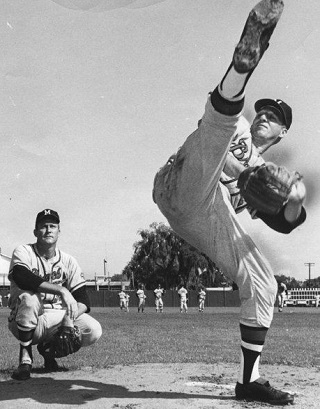
Warren Spahn, who threw a screwball and was one while he was at it, in a spring training throwing session; his rotation mate and running mate (in the practical joke department) Lew Burdette watches in a crouch.

You see five live-ball Hall of Famers surrendering 40 or more in a single season at least once (including Bert Blyleven getting circled for 50 one season); you also see fifteen such Hall of Famers surrendering 30 or more in single seasons at least once.

Make the appropriate allowances for such things as a comparatively turbocharged ball in the early 1930s, a juiced ball in the mid-1980s, and—sometimes forgotten when remembering the actual or alleged PED era—the advent of maple bats and a pack of new ballparks with retro designs and hitter friendliness in the late 1980s and 1990s.

You should still understand: Even a Hall of Famer, a no-questions-asked great among greats, even the arguable greatest peak-value pitcher of all time (Koufax), or the arguable greatest career value pitcher of all time (a possible tossup between Grove, Spahn, Seaver, and Johnson), could be and were hit for some of the longest balls in baseball history.

Think about some of the men these pitchers faced: Babe Ruth, Rogers Hornsby, Lou Gehrig, Jimmie Foxx, Ted Williams, Joe DiMaggio, Willie Mays, Mickey Mantle, Hank Aaron, Duke Snider, Ernie Banks, Frank Robinson, Dick Allen, Mike Schmidt, Ken Griffey, Jr., Jim Thome, Frank Thomas. Now, quick: What’s the flip side of the axiom that good pitching beats good hitting? And when you say that’s what Hall of Famers do, it works both ways.

So stop worrying. Learn to tolerate that your favourite pitchers, even the absolute best in the business, have learned to tolerate and shake off the bomb. And instruct any Astro fans reaching for the rye bottle whenever Justin Verlander surrenders another ball into earth orbit—lighten up. I

“We are now in crunch time”

2019-08-07 PeteAlonso

Pete Alonso a second from starting the Mets’ barrage against the Marlins Wednesday. He says it’s crunch time. Do the Mets continue to crunch, or will they be crunched?

Somebody post guards at the Citi Field clubhouse entrance. Have them ask for I.D. Check it against all known club records. Because whoever these guys are, are we really sure these are the Mets?

Are these the Mets who looked so caught between bewitched, bothered, and bewildered that their hapless, in-over-his-head manager was getting more votes of confidence in three months than a beleaguered (and often two jumps short of overthrow or assassination) head of foreign state gets in a year?

Are these the Mets whose starting pitchers finished their assignments having to try their level best not to sneak into the clubhouse to call the arson squad after the bullpen gates opened and forward came yet another arsonist?

Are these the Mets whose rookie general manager challenged the rest of the league, “Come and get us,” then looked shell shocked (and lost his temper when he threw a chair at manager Mickey Callaway in a closed-door meeting) after the rest of the league, mostly, did just that?

Are these the Mets who could hit anytime but when it really mattered the most, who had defenders either out of position or losing their grip even if left in proper position, until they couldn’t stop enemy grounders or run down enemy flies with walls, bridges, and butterfly nets?

Except for two deals on or close to the new single mid-season trade deadline, and maybe a couple of DFAs along the way, these are those Mets.

Before the All-Star break, they were ten games under .500 and nobody could still decide whether Callaway still needed to be sent to a new line of employment known as unemployment alone or whether the rookie GM needed to join him there, as part one of a complete top-to-bottom de-lousing.

Since the All-Star break: the Mets are 19-6. They’re 13-1 since taking a second of three from the Padres on 23 July. They’ve not only yanked themselves back, improbably, into the National League wild card hunt, they’ve yanked themselves back into the National League East conversation.

And it’s right on the threshold of a six-game test that will determine once and for all whether these Mets have merely shaken away first-half growing pains and proven smart to stand 99 percent pat at the trade deadline, or whether they’ve revived themselves into a big, fat, air-out-of-the-tires letdown.

It’s not that beating up on such clubs as the Pirates, the White Sox, and the Marlins is doing it entirely the easy way; each of thoseis capable of making things just a little challenging for any contender assuming they’re pushovers on the way to glory.

But while the Mets just finished a sweep of the Fish in New York with a 7-2 Wednesday scaling that featured four home runs—including a pair of two-run jobs from Michael Conforto and Rookie of the Year candidate Pete Alonso hitting his third bomb in three consecutive games following a somewhat surprising launch drought—trouble comes to town Friday.

Trouble named the Nationals. Trouble more specifically named Stephen Strasburg, against whom the newest Met, Marcus Stroman, gets to square off in his first Citi Field start. Trouble named the Nats having rehorsed almost the same as the Mets after they, too, spent too much of the first half looking lost and bullpen-burned.

So far this season the Mets have the upper hand on the Nats at 8-5 in the season series. But that was then: the Mets slapped around a Nats group who looked almost as addled as they did, especially during a late May sweep in Washington. This is now: Nobody’s been as good as the Mets since the All-Star break, but the Nats being 13-11 since the break doesn’t exactly qualify them as pushovers, either

On the other hand, the Nats are 8-7 to the Mets’ 13-1 on the threshold of the weekend set. They’re hoping Strasburg pitches like the guy who’s 8-1 with a 2.18 ERA lifetime in Citi Field and a 2.48 ERA overall against the Mets in his career Friday night.

The Mets, for their part, hope their tuning up against the mostly bottom-crawlers since the break has them primed to pry a few runs out of Strasburg before getting into a bullpen that’s improved enough in the past month and a half but might still have its vulnerabilities enough to count.

On deadline day the Nats gave the bullpen a repair job, not a complete overhaul. They imported three serviceable relief arms—Roenis Elias, Daniel Hudson, and Hunter Strickland—but they lost a game they needed to win badly enough the same night, 5-4 to the Braves in ten innings.

Including that loss they’re exactly 3-3 on the threshold of Friday night, including back-to-back wins against the likewise unexpectedly resurgent Giants. But with the Mets showing baseball’s best record since the All-Star break, the Nats likewise face a slightly bigger test. They went 3-4 against the NL East-leading Braves in July. Not a good sign.

Especially with the Braves looking quite a bit less since the break than they looked before it. The runaway NL East train has gone from express to local: like the Nats, the Braves gave their bullpen a bit of a remake at the trade deadline, importing Shane Greene and Mark Melancon. Like the Nats, the Braves since the All-Star break are 13-11 and 3-3 in their last six games, including a split with the AL Central-leading Twins.

On second thought, it may not be as difficult as Met fans might fear for the Mets to get past the Nats and the Braves for the next six games. But if they don’t beat Strasburg Friday night, it won’t necessarily be simple business for the Mets even if Max Scherzer’s errant back means they won’t have to think about him again until early September.

Another piece of good news for the Mets going in: they have what Alonso calls “a ton more home games in August and September.” ‘Tis true. They’ve played 63 games on the road so far this year and only 51 at home. They have twelve more home games this month and seventeen in September.

But look at most of their coming opponents after the coming six with the Nats and the Braves: After three with another bottom-feeding rebuilder (the Royals), the Mets get the Indians, the Braves again (this time at home), the Cubs (home), the Phillies (road, though the Phillies may still be teetering away by that time), the Nats again (road), the Phillies again (home), the Diamondbacks (home), the threshing-machine Dodgers (home), and—after road sets with the Rockies and the Reds—they finish at home against the Marlins and, to end the regular season, the Braves.

The Braves need to do better than their 14-10 July to keep the pace theirs. Turning their 3-3 August beginning into something resembling their staggering 20-7 June would be huge. With Dansby Swanson not expected back from the injured list until later this month, and veteran godsend Nick Markakis not expected back until some time near mid September, that might be easier said than done.

No wonder Alonso could and did tweet, “We are in crunch time . . .Hard work has really been paying off this second half. The rest of the season is going to be a really fun, wild, memorable ride.” He may have made the understatement of the year for the Mets, as understated as his home runs have been conversation pieces.

Half a century ago to the season, another band of Mets rode a second-half surge to a once-in-a-lifetime miracle. Alonso tweets like a young man who believes in miracles. The Mets since the break have played like a team that believes likewise.

It’s better than burying them alive as just about all of us were ready to do when May and June ended, of course, but “crunch time” now means the Mets will either crunch or be crunched.