The Mets leave the Twins a mess for now

2019-07-17 PeteAlonso

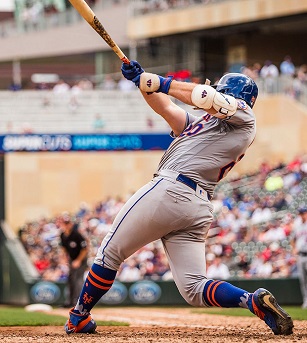
Pete Alonso hits . . . not just a two-run homer but a conversation piece Wednesday in the eighth.

Until the All-Star break the Twins, of all people, looked like the shock of the season with reasonable ownership of the American League Central. And the Mets looked like the National League’s clown show without the benefit of drawing laughs other than those mixing disgust and dejection.

Twins fans have taken the ride savouring every day so far. Mets fans have laughed like Figaro—that they might not weep.

Except when Pete Alonso catches hold of one, with or without men on, in the eighth inning or otherwise. Then, Mets fans weep for sheer joy. Unless their jaws hit the floor as on Wednesday afternoon, when Alonso didn’t just hit a two-run homer, he hit something liable to be picked up on satellite-orbiting radar.

This was one day after the Mets kind of snuck a 3-2 win past the Twins. A former Minnesotan of my acquaintance habitually believes anything good from the Twins is an illusion and anything bad a matter of established fact, phrasing it as politely as longtime Twins fans are reputed for being. Then came Wednesday’s top of the eighth and it was too much for even the most cynical Twins fan.

Who did the Twins think they were all of a sudden—the Mets?

It began with a walk. It climaxed with a monstrous home run. In between came the sort of thing for which the Mets are only too well disregarded and the Twins aren’t exactly among baseball’s most notorious practitioners.

Twins reliever Matt Magill opened by walking Robinson Cano, the designated hitter on the day, who’s come to that point in his career where he’ll take his base any way he can get there, unfortunately for the Mets. Then, Magill struck out Todd Frazier and Michael Conforto swinging in succession. Followed by Amed Rosario shooting a base hit up the pipe for first and second. And then it happened.

Mets second baseman Adeiny Hechevarria sent a fly toward the left field track. Eddie Rosario, sunglasses wrapped snugly around his eyes, drifted back with a perfect bead on the ball until, so it looked, even the sunglasses couldn’t keep his eyes focused as the sun hit the lenses with a nova-like blast. The ball descended to his glove, then rebounded right out of it.

Cano and Rosario hit the jets and scored handily. Then Jeff McNeil doubled off the right field wall to send Hechevarria home. Dominic Smith—who’d smashed a pinch-hit three-run homer to give the Mets a 5-3 lead in the first place an inning earlier—sent McNeil home with a single.

Up stepped Alonso. He looked at two sliders sailing up to the plate under the strike zone floor. He looked at another slider hitting the inside wall of the zone, barely. Then he saw a slider hanging up in roughly the same spot, maybe an inch further on the inside of the plate. And he sent it halfway up the third deck past the left field fence, bouncing off an empty seat and past a female fan who’d bent over futilely trying to grab the ball.

It was only Alonso’s first bomb since he won the Home Run Derby in Cleveland over a week earlier. But the 474-foot flog couldn’t have been any deadlier if he’d hit it with a sledgehammer and not a bat.

Magill got Mets catcher Wilson Ramos to ground out to end the carnage—temporarily. The Twins kindly sent reserve shortstop Ehire Adrianza out to take one for the team in the top of the ninth. The poor guy ended up taking three for the team thanks to a two-run triple (Amed Rosario) and an RBI double (Hechavarria).

Alonso himself looked as though he took pity on the Twins when he ended that inning with a hard ground out to third. Then Mets reliever Chris Mazza shook off a run-scoring ground out in the bottom of the eighth to work two solid relief innings and finish the 14-4 flogging.

These Twins opened the day with a cozy five-and-a-half-game lead over the Indians in the AL Central. But the Indians spent Monday and Tuesday dropping sixteen runs on the toothless Tigers for 8-6 and 8-0 final scores. And the Tribe didn’t seem likely to just roll over and play dead for the Detroit pussycats Wednesday night.

All of a sudden, the Twins thumping and bumping their way into being one of baseball’s 2019 feel-great stories looked very vulnerable after the Mets got through with them in a two-game set.

It didn’t start that way for the Mets. Already in certain disarray because of assorted issues and controversies on the field, in the clubhouse, and in the front office, they were forced to change plans when Zack Wheeler—scheduled to start Tuesday, in a certain trade-deadline-period showcase—hit the injured list with shoulder fatigue instead.

Forcing the Mets to turn to a bullpen game by using Steven Matz, a starter recently moved to the bullpen to fix himself, as an opener. Maybe it was an omen, because a lot of the kind of peculiar fortune that went against the Mets so far on the season went their way for a change.

Like in the top of the first, when McNeil and Conforto moved to third and second on a passed ball, Cano sent McNeil home with a sacrifice fly, and an error by Jonathan Schoop at second allowed Conforto home. Like when Rosario got to score while Conforto beat out a grounder to shortstop in the top of the fifth. And when six Mets relievers kept the Twins scoreless—despite loading the bases on closer Edwin Diaz—after the fourth.

A little more of that and a lot less of the kind of thing that turned them into a hybrid between nursery school and a slapstick academy and the Mets might not have made the wrong kind of truth out of rookie general manager Brodie Van Wagenen’s preseason challenge, “Come get us.”

Don’t look now, but the Mets are 5-1 including now a four-game winning streak since the All-Star break. And they’ve just taken a pair from the reputed threshing machine of the AL Central, including Wednesday’s human rights violations. It may or may not mean a turn of their sad seasonal tide, but this was one time the Mets didn’t need to ponder calling their therapists after a game.

Nor does being sliced, diced, pureed, and nuked Wednesday afternoon mean the Twins face a turn of their otherwise joyous seasonal tide in the wrong direction, either, just yet. But you might forgive them if they pondered calling Dial-A-Shrink for a few minutes.

Joe Grzenda, RIP: Holding a riot ball

2019-07-17 GeorgeWBushJoeGrzenda

Joe Grzenda (right) with President George W. Bush, handing Bush the baseball Grzenda saved since the final, ill-fated Washington Senators game in 1971.

It took almost 34 years for a certain baseball to be pitched to home plate in RFK Stadium, Washington. And when it finally was thrown to the plate, it didn’t sail out of the hand of the pitcher who’d kept the ball all those years, despite having been invited to throw it.

The ball would have been thrown on 30 September 1971, by Washington Senators lefthanded pitcher Joe Grzenda, with two out in the top of the ninth and the Senators about to bank a season and Washington life-ending 7-5 win, assuming Grzenda could erase Yankee second baseman Horace Clarke.

Despite the invitation to throw it up to the plate when Washington re-entered the majors by way of the Montreal Expos moving to become the Nationals, Grzenda handed the honour instead to President George W. Bush, clad in a Nats jacket, who threw an admirable breaking ball to Nats catcher Brian Schneider.

Grzenda, who died 12 July at 82, two days after his 60th wedding anniversary, never got the chance to throw the ball on that surreal September 1971 afternoon. He ended up keeping the ball in a drawer in his Pennsylvania home, in an envelope marked, “Last baseball ever thrown as a Washington Senator, baseball club. Sept. 30, 1971. Murcer grounded out to me.”

That would be Bobby Murcer, Yankee outfielder, who grounded out to Grzenda for the second out of a save attempt that never got consummated thanks to a fan riot that kept Grzenda from pitching to Clarke. All those years later, Schneider—a self-confessed memorabilia collector—returned the ball to Grzenda after the Bush pitch.

Nicknamed Shaky Joe because of a few nervous habits he had on the mound, Grzenda became a Senator in 1970 after a trade from the Minnesota Twins, who’d been the original Senators until moving for 1961, which prompted the expansion birth of the second Senators in the first place.

Shaky Joe finished 1971 with a magnificent 1.92 earned run average, a 2.00 fielding-independent pitching rate, and a 1.01 walks/hits per inning pitched rate. He was a sharp middle-to-late relief pitcher finishing 46 games in 1971 and credited with five saves every one of which was two innings or more. In his next-to-last major league season, he averaged two innings per gig and was, arguably, the Senators’ most reliable relief pitcher.

Several hours before he erased Felipe Alou and Murcer on back-to-back ground outs, Grzenda sat in the RFK Stadium stands well before game time and reflected. “I don’t want to leave this place,” he said. “This year has been the best I’ve had. It’s been like a beginning for me.”

Major league baseball was leaving the capital again because Senators owner Bob Short decided he couldn’t make it work in D.C. any longer—after he’d done just about everything within his power to guarantee it wouldn’t work.

Short wouldn’t sell the team to local interests or at least to buyers willing to camp in Washington, either—unless they were willing to pony up a minimum of $12 million, that is. The Washington Post‘s almost mythological sportswriter, Shirley Povich, compared that to the guy who buys a $9000 car, abuses it, spends $3,000 to repair it, then claims he has a car worth $12,000. Is that so Washington, or what?

“His fellow club owners let go unrecognised Short’s continual mistakes that got him into the mess that, he says, threatened to bankrupt him,” Povich wrote 23 September 1971.

They paid scant heed to the fact that Short foolishly overborrowed to buy the team and then pleaded poverty, and to the stubborn refusal of this novice club owner to hire a general manager, and his record of wrecking the club with absurd deals . . . [T]he impoverished Senators were the only team in the league billed for the owner’s private jet, with co-pilots. The owners had ears only for his complaint that he couldn’t operate profitably in Washington.

Publicly and to his fellow American League owners, Short promised he hadn’t bought the Senators on shaky financial standing in order to move them. According to Tom Deveaux’s The Washington Senators, 1901-1971, Short indulged the nation’s other national pastime: litigation, threatening just that against his fellow owners unless they let him leave.

After authorising then president Joe Cronin to find a solution, the American League owners were stunned at Short’s admission he’d been talking to Texas and other areas. Short was also in hot water with the Armory Board, which owned RFK Stadium and to which the Senators owed six figures worth of back rent. That’s rather Washington, too.

When the Armory Board threatened to turn off the stadium lights, Short relished the feud. At first the board seemed to cave a bit, offering Short free rent for the first million admissions per season and the revenues from stadium billboard advertising. What the board wouldn’t do, however, was forgive the $178,000 back rent. Along came Washington’s city council to sue the Senators and the Armory Board, for failing to pay and collect rent.

That swung into action commissioner Bowie Kuhn, whose boyhood included working as a scoreboard operator at old Griffith Stadium. Kuhn ordered Short “to keep his yap shut,” Deveaux wrote, while hitting the road soliciting potential buyers for the Senators. It proved to be only slightly less futile a road trip than many taken by the Senators themselves.

The American League owners took a 21 September 1971 vote on whether to allow the Senators to move. They now feared the National League might move to town if the Senators moved out, giving the nearby Orioles heavier competition than the usually hapless Nats. Short needed 75 percent of the votes to get his wish.

At first, three clubs abstained while the Orioles and the White Sox voted no. World Airways magnate Ed Daly told Kuhn and Athletics owner Charlie Finley—one of the abstentions—he was willing to buy the Senators. The problem was Finley telling Daly the eleventh hour was upon them, and Daly telling Finley he couldn’t decide that fast. That’s so Washington, too.

Thus did Finley and Angels owner Gene Autry (originally a “no” vote, and acting through a representative since he was undergoing eye surgery) change to “yes” votes. Thus would the Senators begin 1972 as the Texas Rangers. And thus would the Senators meet the Yankees at RFK Stadium on 30 September 1971,  an almost 20,000 strong crowd filling the joint, hoisting placards and banners zapping Short up one side and down the other—particularly those displaying his initials.

Grzenda wasn’t the only Senator who wasn’t anxious to leave Washington. The idea didn’t exactly thrill Frank Howard, their power hitting behemoth and star, either. Which didn’t stop the 6’8″ giant known as Capital Punishment for his glandular home runs from giving those heartsick fans one final thrill, when he checked in at the plate to lead off the bottom of the sixth.

With the Senators down 5-1 and Howard being 0-for-1 with a walk thus far, he caught hold of a Mike Kekich fastball and drove it to the rear end of the left field bullpen, and the crowd went nuclear in its momentary joy. Nudged out of the dugout for a curtain call, Howard tipped his helmet to the crowd for the first time in his baseball life, blew them a couple of kisses, then wept, as much for sorrow as joy.

The blast started a four-run inning to tie the game at five, a tie broken in the bottom of the eight thanks to an RBI single (Tom McCraw) and a sacrifice fly. (Elliott Maddox.) Then Grzenda went out to try saving it for Paul Lindblad, whose two spotless relief innings put him in line to get credit for a win.

After Grzenda erased Alou and Murcer in the top of the ninth, fans began jumping on and off the field down the foul lines. It looked menacing enough for Senators manager Ted Williams (yes, children, that Ted Williams) to order his bullpen pitchers to beat it post haste. Except that the Splinter forgot to urge them to take the safe path to the clubhouse, under the RFK Stadium stands.

As Grzenda got ready to pitch to Clarke, the relievers left the bullpen and headed down the field toward the dugout. Oops. “That’s when all hell broke loose,” Deveaux wrote. “The fans stormed back onto the field en masse, yanking up clumps of dirt and grass which might be kept as souvenirs of Washington Senators baseball.”

Howard playing first base had three fans climbing his back, which must have been something like three mice climbing a tree. Grzenda saw a rather large man heading his way appearing at first to have ideas about tackling the pitcher, which Grzenda eventually admitted gave him ideas about throwing his glove—which still had the ball in it—at the guy. But all Grzenda got for that was a pat on his shoulder.

Finally, as fans continued pillaging what they could, including bases, plus letters and numbers from the scoreboard, umpire Jim Honochick ruled the forfeit to the Yankees. By the time the fans got through with the place, RFK Stadium looked as though it was  tattered and torched in a terrorist attack.

Grzenda drove home from the park with his wife, Ruth, and their two children, including his then-ten year old son Joe, Jr., who wept all the way home. The Grzendas met in 1956, when the lefthander was a Tigers prospect and the Birmingham Barons’s (AA) best pitcher, and she was sitting in the stands at Birmingham.

He had a look at the comely brunette and handed the bat boy a note to give her. “I had come to the game with a girlfriend of mine who I worked with at the First National Bank, and her dad,” Mrs. Grzenda revealed after her husband was inducted into the Barons’ Hall of Fame five years ago. “The bat boy brought a note over to me that said, ‘How would you like to meet Joe Grzenda?’ My girlfriend kept hitting me on my leg, saying you’ve got to meet him and her dad said that Joe was the star of the team,” she continued. “I didn’t know anything about baseball.”

They first met in Birmingham, he taking her out for hamburgers and shakes after the Barons bat boy handed her his note. They married a year later and stayed that way happily for sixty years and two days. For two thirds of their marriage, they lived and loved with the husband part of capital lore. Maybe it wasn’t quite the way Grzenda would have preferred becoming such lore. But that, too, is so Washington.

Can Bob Gibson knock this opponent down?

MLB: Cincinnati Reds at St. Louis Cardinals

Bob Gibson (with glasses) enjoying a laugh with fellow Hall of Famers (l to r) Red Schoendienst, Whitey Herzog, and Lou Brock, while celebrating an anniversary of the Cardinals’ 1968 pennant winner.

Bob Gibson wanted the edge every time he took the mound. And in his absolute prime he got it, never mind that his reputation as an intimidating headhunter is more than slightly exaggerated, about which more to come. But what Henry Aaron, Dick Allen, Roberto Clemente, Al Kaline, Mickey Mantle, Willie Mays, and Carl Yastrzemski among others couldn’t do, one particularly pernicious opponent now just might.

Gibson sent his fellow living Hall of Famers a letter informing them that he’s battling pancreatic cancer. The St. Louis Post-Dispatch says Gibson visited Baltimore’s Johns Hopkins Hospital and been hospitalised in his native Omaha for two weeks, anticipating a chemotherapy program to begin Monday. Hall of Famer Jack Morris revealed Gibson’s struggle while announcing a Twins game Saturday.

It’ll keep Gibson from attending the annual Hall of Fame induction a week from today. And it has more than just the Cardinals’ considerable fan base praying for the 83-year-old former pitcher with the whip-like delivery, the sprawling follow-through, the glare from the mound before beginning his windup that made him resemble a quiet storm about to release its full fury.

Those who remember Gibson’s follow-through and finish, in which he resembled a leaning tree with his glove resembling a hanging grapefruit at one branch’s end, may wonder how on earth he could field his position. Much as they do when remembering the late Hall of Famer Jim Bunning, whose yanking sidearm delivery yanked him almost all the way to the grass on the first base side of the mound as if he’d been knocked over by an oncoming car.

Yet Gibson won Gold Gloves for his position consecutively from 1965-73. Bunning, God rest his soul, would probably have won the Concrete Glove if they’d given one.

There was an aggressive elegance to Gibson’s attack on the mound captured best by Roger Angell, in The New Yorker, in an essay called “Distance,” republished in Late Innings: A Baseball Companion in 1982:

Everything about him looked mean and loose—arms, elbows, shoulders, even his legs—as, with a quick little shrug, he launched into his delivery. When there was no one on base, he had an old fashioned full crank-up, with the right foot turning in mid-motion to slip into its slot in fromt of the mound and his long arms coming together over his head before his backward lean, which was deep enough to require him to peer over his left shoulder at his catcher while his upraised left leg crooked and kicked. The ensuing sustained forward drive was made up of a medium-sized strike of that leg and a blurrily fast, slinglike motion of the right arm, which came over at about three-quarters height and then snapped down and (with the fastball and the slider) across his left knee. It was not a long drop-down delivery like Tom Seaver’s . . . or a tight, brisk, body-opening motion like Whitey Ford’s . . . He always looked much closer to the plate at the end than any other pitcher; he made pitching seem unfair.

Angell may have been the only baseball writer to whom Gibson’s coming election to the Hall of Fame had its disturbing side: “He seemed too impatient, too large, and too restless a figure to be stilled and put away in this particular fashion; somehow, he would shrug off the speeches and honorifics when they came, just as he had busied himself unhappily on the mound when the crowd stopped the rush of the game to cheer him at Busch Stadium that afternoon in 1968. For me, at least, Bob Gibson was still burning to pitch to the next batter.”

The writer so wrongly referred to as baseball’s Homer, when in fact Homer was ancient Greece’s Roger Angell, referred to Game One of the 1968 World Series, the day Gibson broke Hall of Famer Sandy Koufax’s record for strikeouts in a World Series game. He tied Koufax when he struck out Hall of Famer Al Kaline in the top of the ninth, and his catcher Tim McCarver held onto the ball while pointing toward the center field scoreboard announcing the feat.

“Throw the goddam ball back, will you! C’mon, c’mon, let’s go!” hollered the righthander who once ordered McCarver, who’d become one of his closest friends, back to his position by barking, “Get back there behind the plate where you belong. The only thing you know about pitching is that you can’t hit it!” When Gibson finally acknowledged the roaring crowd and his achievement with an uncomfortable tip of his cap, he struck out Norm Cash and Willie Horton to end the game with a Cardinals win and seventeen punchouts.

2019-07-13 BobGibsonAlKaline

Bob Gibson striking out fellow Hall of Famer Al Kaline to tie the World Series record for single-game strikeouts that he’d break shortly after, in Game One, 1968. In that Year of the Pitcher Gibson’s regular season 1.12 ERA shone even more than Tiger pitcher Denny McLain’s 31 wins.

Watching Gibson pitch myself was like watching an assassin with the mind of Montaigne, the reflexes of a gymnast, and an arm that found the way to marry a bullwhip to a Gatling gun. The intimidating appearance and delivery sometimes masked a pitcher who applied a Warren Spahn-like intellect to his art. “Hitting is timing,” Spahn, the Hall of Fame lefthander/prankster, liked to say. “Pitching is destroying timing.” Gibson’s mind saw and raised by studying his challengers’ minds as well as their timings.

The late Hall of Famer Frank Robinson, whose plate stance Angell described memorably as “that of an impatient subway traveler leaning over the edge of the platform and peering down the tracks for the D train,” impressed Gibson as deceptive with his once-famous plate crowding, because pitchers were fooled into thinking Robinson wanted inside pitches.

Besides, they’d be afraid of hitting him and putting him on base. So they’d work him outside, and he’d hit the shit out of the ball. I always tried him inside and I got him out there—sometimes. He was like Willie Mays—if you got the ball outside to Willie at all, he’d just kill you. The same with [Hall of Famer Roberto] Clemente. I could throw him a fastball knee high on the outside corner seventeen times in a row, but if I ever got it two inches up, he’d hit it out of sight. That’s the mark of a good hitter—the tiniest mistake and he’ll punish you.

Yet this proud man, who played a major role in easing the Cardinals’ way toward complete integration earlier in his career, using his often-unheralded wit to guide white teammates out of behaviours bred into them without their even realising it, who took his own unshakeable pride in being in control on the mound and taking control of a game, could admit that he, too, had his moments when his “brains small up,” as he told Angell:

I got beat by Tommy Davis twice the same way. In one game, I’d struck him out three times on sliders away. But I saw that he’d been inching up and inching up toward that part of the plate, so I decided to fool him and come inside, and he hit a homer and beat me, one-oh. And then, in another game, I did exactly the same thing. I tried to out-think him, and he hit the inside pitch for a homer, and it was one-oh all over again. So I could get dumb, too.

Gibson’s intelligence played large in his off-field and post-baseball life. He built and opened a successful Omaha restaurant, Gibby’s, in which Angell recorded he had a direct hand in the design and construction, and for which he encouraged integrated clientele. (“A neat crowd,” Gibson once described the mixture.) He suffered no fool gladly and rejected the idea of professional sportsmen as role models. (“Why do I have to be an example for your kid?” this father of three once asked another father, gently but firmly. “You be an example for your own kid.”)

He also wittily discouraged patrons from trying to chat him about baseball when he knew they didn’t truly know the game:

You hear them say, “Oh, I was a pretty good ballplayer myself back when I was in school, but then I got this injury . . . ‘ Some cab driver gave me that one day, and I said, ‘Oh, really? That’s funny, because when I was young I really wanted to be a cab driver, only I had this little problem with my eyes, so I never made it.’ He thought I was serious. It went right over his head.

During his pitching career Gibson was uneasy with the press because he couldn’t grok their wanting “to put every athlete in the same category as every other athlete.” After his pitching days, stories began to come forth that Gibson’s sometimes forbidding public image masked a man who developed intense friendships, especially with those, black, white, otherwise, who accepted and respected that he wouldn’t say what he didn’t believe.

It was one reason why Gibson’s brief and mostly forgotten attempt at broadcasting (on ABC’s Monday Night Baseball) became as brief as it was. He’d interview a player who’d just achieved an unusual feat and question and banter with him as a fellow professional sharing professional truths about the game and its influences outside the park alike, and not a talking head.

Gibson also served actively on the board of an Omaha bank, invested in an Omaha radio station, served as a pitching coach for his friend Joe Torre in Torre’s three brief pre-Yankees managing turns, and once took the motor home the Cardinals presented him as a retirement gift to travel across the western United States.

When I was in the Air Force in the 1980s, I did my entire post-basic training/post-technical school hitch at Offutt Air Force Base in Bellevue, next to Omaha. (I worked as a member of the old Strategic Air Command as an intelligence analyst.) I knew Gibson lived in Bellevue (Angell said he was handy enough to build most of the improvements on the home including a magazine-ready patio) and I knew of his restaurant, not to mention that he was usually at the restaurant at least ten hours a day.

The temptation to go there to eat and hopefully meet him even for a few moments was equaled only by my fear that he’d see me as just another witless fan, even if I wouldn’t insult him by trying to be like the cab driver whose wannabe reverie he’d deflated so deftly.

Three months ago, I guess I did the next best thing. Challenged by an online forum participant who still buys into the myth that a home run hit off Gibson one inning was meant that batter getting a shot in or near the head his next time up, I was crazy enough to look at the game logs. Every game in which Gibson pitched. To see whether and when he really did hit anyone in the same games he surrendered home runs, and whether he’d hit a home run hitter in the same game, especially the hitter’s next time up.

Well, now. That review told me:

* Thirty-six times in his 528 major league games including 482 major league starts, Bob Gibson surrendered at least one home run and hit at least one batter in the same game.

* He only ever hit one such bombardier—Hall of Famer Duke Snider—the very next time the man batted in the game.

* He hit three such bombardiers not the next time up but in a later plate appearances in games in which they homered first.

* He surrendered home runs after hitting batters with pitches in fourteen lifetime games.

And, unless I missed something somewhere, Gibson’s most frequent plunk victim was Roy McMillan, a shortstop for the Braves (when he first took a Gibson driller) and the Mets, who was a study defensively but about as much of a hitter as Wilt Chamberlain was a baseball player. Gibson hit McMillan five times lifetime; McMillan could have been forgiven if the mere mention of Gibson’s name inspired lustful thoughts of first degree murder.

The fifth time was 20 August 1965, against the Mets in New York. McMillan took one in the bottom of the third. With two out in the top of the fifth Mets starter Al Jackson hit Gibson with a pitch. (The plunk hurt the Mets more than Gibson as it turned out: the Cardinals scored from there on a single, a double steal, an RBI triple, an RBI single, and another RBI triple.) McMillan must have wanted to offer to have Jackson’s children right then and there.

Right now about the only thing anybody wants to offer Bob Gibson is every prayer they can think of. He’s up against an enemy that won’t respond easily to a brushback, a knockdown, a plunk, or an elegantly violent strikeout.

I wish now that I’d taken the chance to meet him back in my Omaha days. I probably would have liked and respected him. Even more than I’d liked and respected him when he pitched. All I can do now is join those praying for him.

The Angels gave Skaggs a past-heaven home farewell

2019-07-12 MikeTrout

Wearing Tyler Skaggs’s name and number, Mike Trout finishes running out the two-run bomb he launched to start the Angels’ memorial massacre Friday night.

The stricken finally returned home to start the season’s second half. And the way they did it didn’t just defy belief, it drove belief almost as far out of Angel Stadium Friday night as Mike Trout’s two-run homer flew out in the bottom of the first.

The Angels paid one more tribute to the unexpectedly late Tyler Skaggs before the home audience Friday night. On the night before Skaggs would have turned 28. With a combined no-hitter and a sinking of the Mariners all the way to Davy Jones’s Locker.

It only began with a 45-second pre-game moment of silence in Skaggs’ memory, the time in honour of his uniform number. The Angels one and all wore Skaggs’ number 45 for the moment and for the game. Some dare call that tempting the baseball demigods, others dare call it divine inspiration.

After the Angels put the 13-0 no-no squarely into the bank, nobody really knew what to call it. Assuming God was available for comment, even He Himself might have been lost for words, and His words are usually the best words any side of heaven.

“Tyler’s birthday is 7/13. Tomorrow,” said Trout following the game. “They’d tell you to rewrite this script to make it more believable if you turned this in.” Which is pretty astute coming from a guy who claimed to be speechless over what he and his mates just did.

“Absolutely incredible,” tweeted Astros pitcher Justin Verlander. “Meant to be.”

The Mariners joined the Angels, showing shiploads of class, in lining up the baselines from the plate as a Skaggs jersey was placed behind the Angel Stadium pitcher’s mound in a frame.

Skaggs’ widow, Carli, his mother Debbie, his stepfather Dan, and his stepbrother Garrett, made for the mound accompanied by Angels pitcher Andrew Heaney. Then Debbie wound up and threw a ceremonial first pitch, before embracing Heaney and Mike Trout, the Angels’ all-everything center fielder suddenly emergent as the team’s no questions asked leader in the immediate aftermath of Skaggs’ unexpected death.

And those genuinely touching moments were almost nothing compared to what happened during the actual game, played in front of a likeness of Skaggs and a circular memorial displaying number 45 large on the rear end of Trout’s office, the center field fence.

How many times can you say the Angels paid their departed pitcher the most unexpectedly appropriate tribute of all—a game in which two pitchers, Taylor Cole (two innings) and Felix Pena (seven innings) combined to surrender no hits, only one walk, and see not a single Mariner reach on an error?

How often can you say Trout himself—who wept unashamedly last week in Texas, trying to express what his friend Skaggs meant to himself and to their team—accounted admirably for almost exactly half the Angels’ commemorative destruction?

Say it as often as you like even if you’re not an Angel fan. Because seldom if ever has a team rent by in-season tragedy responded like this when finally getting to play for the home audience after their lost teammate’s death on the road, showing him the love with their fans.

2019-07-12 LosAngelesAngels

First, they lined up for 45 seconds of silence in Skaggs’ memory. Then, they performed a combined no-hitter and a blowout. Who says baseball’s lost its capacity for surreality?

And even less often does it begin the way it did in the bottom of the first, after Cole retired the Mariners in order on a strikeout, a fly out, and a ground out—dropping seven on Mariners starter Mike Leake before Matt Festa struck out Justin Upton, who’d singled earlier in the inning, swinging on a 2-2 fastball.

The carnage only began when Angels leadoff man David Fletcher banged a double off the right center field wall. Trout stepped up in the number two slot and, proving it almost doesn’t matter where in the Angel lineup he hits, turned on a Leake sinker with about as much sink as a blimp and blasted it right into the rocks behind the center field fence.

Almost immediately after crossing the plate himself, Trout looked toward the Angel Stadium section where players’ wives or girl friends sit, until he caught Carli Skaggs’ eye. It looks as though he gave her a gentle affirmative nod. That one’s for your husband, Carli. And you ain’t seen nothing yet.

The inning from there went single (Shohei Ohtani), single (Justin Upton), swinging strikeout, RBI single (Andrelton Simmons scoring Ohtani), run-scoring error (Upton scoring as Mariners second baseman Dee Gordon misplayed a forceout), RBI single (Dustin Garneau), swinging strikeout, bases-loading single (Fletcher), and Trout’s two-run double.

And Trout wasn’t even close to finished for the night. The very next inning, a strikeout after Festa walked Simmons home, Festa hit Trout with a 2-0 slider to send home Justin Bour. Three innings and two more Mariners pitchers later, Trout squared off against Matt Wistler with Fletcher on second thanks to a single and a throwing error on the play and rifled a double to the back of left field, scoring Fletcher and making things 10-0.

All the while Pena continued keeping the Mariners from bringing their flippers to bear after Cole worked the first two spotless. About the only dicey moment he really faced, other than walking Mariners designated hitter Omar Narvaez in the fifth, was Mac Williamson smashing a grounder in the top of the sixth for which third baseman Matt Thaiss needed to make a diving stop and hard enough throw to nip Williamson.

Trout helped put another cherry atop the Angels’ sundae evening when he came home as Upton sent Mariners reliever Parker Markel’s 2-0 fastball over the center field fence. The Angel who patrols center field like a cop with acrobats in his family history did his evening’s work so well there wasn’t a baseball jury on earth who’d convict or sentence him for grounding out with the bases loaded to end the bottom of the eighth.

By then the only question left was whether Pena could finish the second combined no-no in Angels history. (The first was between Mark Langston and Mike Witt in 1990.) And, the first Angel no-hitter of any kind since Jered Weaver in 2012. Strangely enough, it was in 2012 that the Mariners themselves were last no-hit, courtesy of the White Sox’s Philip Humber’s perfect game.

The answer was Williamson flying out on the first pitch, Gordon grounding out on the second pitch, and Mallex Smith grounding out on the second pitch. Easy as 1, 2, 2.

“This,” tweeted Blue Jays pitcher Marcus Stroman, “is unbelievable. The baseball gods.”

Nobody’s really going to care for the smaller details of the night such as the Angels going 7-20 with runners at second base or better including Trout’s 3-for-4. Nobody’s going to care (too much) that, between them, Cole and Pena threw 63 strikes out of 103 pitches, with Cole striking out a pair and Pena punching out six.

Leave those details plus the Mariners’ seven pitchers combining to surrender eight earned runs, punching out eleven, but walking seven, to the statisticians. Because other than the surrealistic final score, and the absence of Mariners hits, nobody cared about any numbers above and beyond the 45 on the Angels’ backs Friday night.

Nobody cared about anything other than one baseball team coming home from a heartbroken road trip, seeing the massive makeshift memorial to their fallen teammate outside the home plate entrances to their ballpark, and taking a little extra incentive they hardly needed considering, to suit up and give him a sendoff he couldn’t have imagined but surely hoped wouldn’t come for decades yet to be. Decades he’ll see only from heaven.

With Skaggs’ clubhouse locker fully stocked and the team intending to keep it that way the rest of the season, the Angels had one more tribute to make after the game. They went out to the mound and covered it in Skaggs jerseys. Leaving the big 45 behind the pitching rubber exposed. There was nothing more they could possibly do.

Whether the Angels go from here to the postseason, even though they now sit in rear-view enough distance five and a half games and five teams away from a wild card slot, almost doesn’t matter. On Friday night, saying one more farewell to a pitcher they loved on the mound and even more as a young man, the Angels were bigger than baseball. And baseball didn’t seem to mind one bit.

Gooden’s pitching ruin wasn’t drugs

0000 PantsOnFire05 DwightGooden

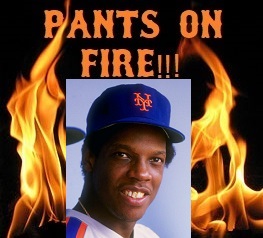
The Mets tried to fix a Dwight Gooden that wasn’t broken. That’s why he was never the same pitcher starting in 1986.

Haunted and periodically haunting Mets legend Dwight Gooden incurred a June arrest for cocaine possession in New Jersey. The New York Daily News, revealing the arrest Friday morning, leads thus: “Fallen fireball pitcher Dwight Gooden, whose drug woes drove him out of a Hall of Fame career, was in trouble with the law again after a recent arrest on cocaine possession, according to court documents.”

Emphasis added, unapologetically. The myth of Gooden’s drug issues driving him out of a might-have-been Hall of Fame career was debunked long before the News‘s lede. Unfortunately, drug issues make for more bristling and enthusiastic water cooler and (today) social media talk than things like, you know, fixing what isn’t broken.

So here we go yet again. Read this very carefully. Drugs didn’t compromise Dwight Gooden’s pitching; the Mets monkeying around with a young pitcher who might have been a little overworked but still owned the game in his first two seasons and knew what he was doing on the mound did.

It’s not that Gooden was immune to dabbling with cocaine, beer, or other such substances even in his first two major league seasons, never mind before the infamous drug test failure that got him starting 1987 in the Smithers Institute. But let’s hark back to spring training 1986, and where Dwight Gooden actually was entering that spring.

  ERA ERA+ FIP K BB K/BB K/9 BAA
Dwight Gooden ‘84-‘85 2.00 176 1.93 544 142 3.83 9.9 .201

He was the National League’s Rookie of the Year in 1984 (he smashed the rookie season strikeout record once held by Herb Score, with 276) and the pitching Triple Crown winner (24 wins, 268 strikeouts, 1.53 ERA) in 1985, the year he also won the National League’s Cy Young Award. His 2.13 fielding-independent pitching (FIP) led the majors (as had his 1.69 in 1984), so it seems a little of his winning was as dependent on his team as on himself. (His Show-leading ERA+: 229, 129 better than the average.)

Any way you see it, Gooden was  major league baseball’s no questions asked best pitcher in his first two seasons. He did it with a four-seam fastball and the most voluptuous curve ball the National League saw since Sandy Koufax. (In those days a curve ball’s usual nickname was Uncle Charlie; Gooden’s became known as Lord Charles.) That’s all he had; it was all he needed. And with that .201 batting average against him, nobody could hit him.

“I never got to play behind Bob Gibson or Sandy Koufax, but this was the equivalent,” then-Mets first baseman Keith Hernandez, now a Mets broadcaster, once said. “Gibson, Koufax, Gooden . . . legends, true greats. Dwight was in that class. He was so good that year that if he didn’t strike out ten batters we would joke around, ‘Hey, what’s wrong?’ You expected greatness every start. It was something to see.”

“Every game,” Gooden would come to remember of 1985, especially, “I could put the ball where I wanted it.”

But in spring 1986 and someone in the Mets’ brain trust decided despite the evidence that it just wasn’t enough. It might have been the late Mel Stottlemyre, the pitching coach, whose reputation was that of a gentleman and a gentle man who preferred to teach quietly and not rant and rave as many pitching coaches did in his own pitching days. Jeff Pearlman (in The Bad Guys Won!) observed Stottlemyre viz Gooden thus: “Throughout (1985) Stottlemyre would watch Gooden perform and think, Boy, this kid is amazing, and all he throws is fastball-curveball! Imagine if he had another pitch. That’s what he set out to do—teach the best pitcher in baseball how to be even better.”

Except that, if that was right, then Stottlemyre missed his mark this time. “All through (spring 1986) Stottlemyre had Gooden toy with a changeup and a two-seam fastball, two pitches he did not throw,” Pearlman wrote. “It was hard to watch. Gooden was a trouper, but the confidence he exuded on his fastball and curve ball never attached itself to the other pitches. He felt awkward and unsure.”

2019-07-12 DwightGoodenGaryCarter

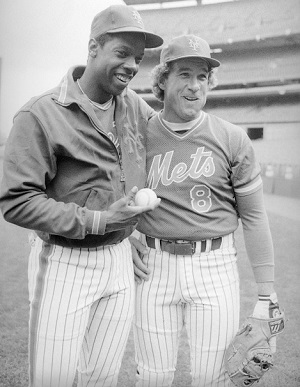
Gooden with Hall of Fame catcher Gary Carter: Carter knew a big mistake was made with The Doctor in spring 1986.

The spring 1986 Mets had four catchers in camp: Hall of Famer Gary Carter, the number one man, plus backups Ed Hearn, Barry Lyons, and future major league manager John Gibbons. And one and all of them thought Stottlemyre and others made a huge mistake.

Hearn: “I remember catching him one day in the bullpen and they were working with him on the two-seam. I’m thinking, What the hell is this? He was a power pitcher with tons of movement, and they’re trying to teach him movement? What the hell for?”

Carter, who came to the Mets for 1985 and caught all but three of Gooden’s 1985 starts: “I always thought they should have left Doc alone. Mel thought teaching him a third pitch would be to his advantage. But he didn’t need it. He needed someone to say, ‘Hey, you’ve been successful. Just keep going at it.’ But they didn’t’. I also think it hurt his shoulder. The pitches didn’t feel natural to Doc, and pitching was so natural to him. It just wasn’t smart.”

The Mets’ general manager at the time, Frank Cashen, urged Gooden to shorten his elegant motion and leg kick to make it harder for opponents to steal on him. (Gooden’s one flaw then was that that naturally elegant windup, kick, and delivery were a little easy to steal on—if you reached base against him at all, that is.)

Cashen’s assistant GM, Joe McIlvane, who’d once pitched in the minors, urged Gooden against striking out the world the way he’d done in 1984 and 1985. Pearlman cites McIlvane telling manager Davey Johnson, “If we can reduce Doc’s pitches, we can save his arm. He doesn’t need 200 strikeouts to succeed.”

As things turned out, exactly 200 strikeouts was what Gooden would deliver in 1986, as well as a 2.84 ERA but a 3.06 FIP, not to mention the opposition on-base percentage jumping 24 points higher in 1986 (.278) than it was in 1985. (.254.)

In one way, it was Gooden’s own fault. But only one. He was known to be pliant and accommodating, so much so that the Mets had to intervene to curtail some of his agreements to appear for this interview or that function before he was plain worn out. And pliant and accommodating when it came to his pitching coach and team overseers meant one thing. “In the pursuit of excellence,” Pearlman concluded, “Gooden made a tremendous mistake. He listened to everyone.”

All that is really what thwarted Dwight Gooden. For his first two major league seasons, he was Hall of Fame great and beyond. For the rest of his career, he was a good pitcher who brushed with greatness every now and then (including his no-hitter as a Yankee), but he was no longer the pitcher about whom no less than Hall of Famer Koufax said, “I’d rather have his future than my past.”

Brooklyn Dodgers manager Charlie Dressen made the same mistake with his own Rookie of the Year relief pitcher Joe Black in spring 1953. Black had posted a great rookie season that included becoming the first black pitcher credited with a win in a World Series game. Black had a hard fastball and a curve ball he threw more as a change of pace, but he knew what he was doing on the mound, too, and he made it work.

In spring 1953 Dressen anticipated the Dwight Gooden unmaking by decided Black needed “more stuff.” He forced Black to try throwing a bigger-breaking curve and possibly a forkball, pitches Black’s hand was physically incapable of gripping properly. But Black tried anyway: “Man says I got to try, I got to.” Uh-oh. Like Gooden in due course, Black’s confidence ended up shot. Unlike Gooden, so was Black’s control.

Gooden managed to forge a sixteen-season career that—despite his coming shoulder issues and his continuing struggle with cocaine and drink—still left him, at this writing, as the 97th best starting pitcher of all time. Black may have been lucky to last six major league seasons after Dressen’s wreckage. After pitching, Black became a Senators scout, then a high school teacher, and then an executive for Greyhound.

And, then, along came Gooden—who’s worked in and out of baseball since, and who continues struggling with the addictions that have pockmarked and potholed his life since—to bump Black to one side as one of New York baseball’s saddest, coaching-ruined might-have-beens.

“Had New York’s [1986] decision makers been present in 1506 when Leonardo da Vinci was painting the Mona Lisa,” Pearlman wrote, “they would have insisted on a mustache and larger ears. Here they had Gooden, called ‘the most dominant young pitcher since Walter Johnson’ by Sports Illustrated, and it wasn’t good enough.”

Figure that if you can: The 1986 Mets were one of the greatest teams in baseball history and they opened the season by ruining theirs and baseball’s best pitcher of 1984-85. It turned out to be the prelude toward the gradual dismantling of a team that was supposed to stay great after returning to competitiveness in 1984 and winning the ’86 Series, but didn’t.

The rubble came from one after another deal that either rid the team of what Gooden himself called “the guys who used to snap” or drained the farm for modest, fading, or indifferent veterans.

And the once-glittering, slender fellow with the big wide smile, the becalmed manner, the pitching rhythm as elegant as Duke Ellington’s jazz, and the strikeout virtuosity that earned him the nickname Dr. K., remains living, breathing evidence of what happens when you call the repairman to fix what wasn’t broken in the first place.