Cahill another low-risk Angel arm

2018-12-20 TrevorCahillSigning Matt Harvey even to what may prove a single-season rental befuddled no few who watch the Angels closely. Signing Trevor Cahill to what may prove a single-season rental seems to do likewise until you look a little closer. Angel fans hope the pitching-needy team knows what they’re doing and won’t have yet another reasonably-laid plan explode in their faces. Especially when they could have had a couple of

Cahill isn’t trying to overcome even half the baggage Harvey had to start overcoming in Cincinnati last year. Signing Cahill for a year and $9 million with about $1.5 million possible in incentives looks at least as reasonable and with just as small a risk. And, as with Harvey, the Angels couldn’t have been unmotivated by the thought that division-rival Oakland had eyes upon Cahill, this time in terms of bringing him back again.

The Athletics bought low on the veteran righthander for 2018 and he proved valuable enough for their slightly surprising run to the wild card game. The only reason he made only twenty starts worth 110 innings was an Achilles tendon strain that knocked him onto the disabled list in mid-June and kept him there until almost mid-July.

He posted the best fielding-independent pitching rate (ERA minus defense factors) of his career with a better than respectable 3.54, and the best strikeout-to-walk rate (2.44) of his career. And he continued the overall bounceback from a 2016 spell of relief pitching by getting ground balls at a rate almost equal to his career 55 percent.

All that while making seventeen quality starts (three earned runs or fewer) out of his twenty. He came away from the season with a 7-4 won-lost record and eight no-decisions out of the quality starts. Three of those turned into A’s losses; if they could have hung up the key lead runs while he was in the game Cahill’s won-lost record might have ended up at 12-4.

In other words, Cahill at last re-emerged as the decent pitcher who launched his Show career with the A’s in 2009 and whose signature tendency seems to have been working with his defenses to get results and keep them in games. If the A’s might have won the three no-decision losses instead, Cahill might have been 15-4 in 2018; add to that two losses in which he pitched well enough to win and he might have been 17-2.

If the Angels have Harvey as a number-three starter, they likely have Cahill as the fourth man. Both pitchers finished 2018 having shown they can get ground balls and miss bats at reasonable rates. Getting grounders and missing bats are things the Angels love unconditionally.

With Garrett Richards and Shohei Ohtani (as a pitcher) down for the 2019 count thanks to Tommy John surgery they may yet lack a legitimate ace, but there have been teams who’ve gone to the wars and endured in the pennant races with four or five solid pitchers despite no ace. It’s difficult but not impossible.

Still, the Angels could have made more impressive-looking moves. Charlie Morton could have been had for comparable money to Harvey; the now-former Astro signed for two years and $30 million with the Tampa Bay Rays. They went in on Nathan Eovaldi but they, too, couldn’t convince him to say goodbye to the world champion Boston Red Sox. Nor could they convince Patrick Corbin to stay southwest; Corbin went to the Washington Nationals for six years and $140 million, or about $12 million a season more than the Angels will pay Harvey just in 2019.

I get the Angels might have been wary about a six-year commitment to Corbin considering their recent history with multiple-year deals going past two or even three. That’s allowing that those deals’ implosions haven’t really been anyone’s fault. I say again:  nobody including Albert Pujols asked his heels and knees to betray him, and nobody including Josh Hamilton asked a) him to incur a substance-abuse relapse that Super Bowl Sunday or b) the Angels’ brass to make such a disgraceful hash out of trying to humiliate Hamilton for it.

The deal for which you can really crucify the Angels in the past decade was Vernon Wells—and it wasn’t even a free agency signing. But it was done purely out of rage; or, purely out of owner Arte Moreno channeling his inner 1980s version of George Steinbrenner, after then-GM Tony Reagins couldn’t convince then-free agent Adrian Beltre to sign up after the 2010 season.

Moreno hit the ceiling hard enough to go through it and almost to the moon. When he came down, he gave Reagins one day to deal for Wells or else. Knowing now-retired manager Mike Scioscia preferred defense-uber-alles catchers, for all the good that did him anyway, Reagins sent big-hitting Mike Napoli to the Toronto Blue Jays, who needed catching help and a big bat, for Wells. Whoops.

Beltre, of course, went on with his just-ended, Hall of Fame-in-waiting career. Napoli went on to contribute mightily to World Series teams in Texas and Cleveland and won a ring while he was at it with the 2013 Boston Red Sox. Wells was a Gary Matthews, Jr.-level bust in Anaheim, so much so that the Angels choked on a lot of money on Wells’s inexplicably backloaded contract to move him to the New York Yankees, where his once-promising career ended in something close enough to a whimper.

The Angels now have a much-improved farm system; last spring it was rated the second-best in the American League West behind the Astros. Want to know how long it took for the Angels to recover the farm? How does eight years strike you?

At the same time Moreno went ballistic over losing out on Beltre and demanded the deal for Wells, the Angels made a sacrificial lamb of their scouting director Eddie Bane. Bane was made to pay for a series of bad drafts and worse free agency signings even though Bane was the lead instigator in the Angels’ landing a kid named Mike Trout.

Bane’s execution followed the Angels gutting most of their international scouting operation, and executing its director Clay Daniels, over bonus skimming shenanigans by underlings who kept Daniels in the dark about their doings. The Angels cashiered the man whose smarts brought them the likes of Francisco Rodriguez (one of the late secret weapons in the Angels’ 2002 world championship run), Ervin Santana, Kendrys Morales, and Erick Aybar in the first place.

It’s forgotten sometimes, too, that the Angels let Corbin escape in the first place. That happened when Reagins (under Moreno’s orders, perhaps?) made the 2010 non-waiver trade deadline deal that practically drained the best of the Angel farm (including then-promising Tyler Skaggs, too) in order to get Dan Haren, who may have led the American League in strikeout-to-walk ratio in his first full Angel season but who gave them 1.7 total wins above replacement-level for his two-and-a-half years with them.

They got Skaggs back in a convoluted three-team deal and Skaggs’s second Angels life has been riddled with injuries, too.

Maybe compared to all that, signing Harvey and Cahill even on a seasonal rental might actually wreak less havoc than the Angels have brought upon themselves in the past decade. Maybe. Might.
Devil or Angel?

2018-12-19 MattHarveyThe way Matt Harvey’s tempestuous tenure with the New York Mets ended last May is still an eye-rubber. When Harvey refused a Mets’ request to go to Las Vegas and work his way back to something resembling his former mound self, prompting the Mets to trade him to the Cincinnati Reds. When the Mets decided he wasn’t worth saving anymore, and nobody on or around the Mets seemed to care.

Harvey was already less than thrilled about being exiled to the Mets’ bullpen, where manager Mickey Callaway thought he would have at least as good a chance to re-horse as Callaway had seen happen for a pitcher he coached in Cleveland, Carlos Carrasco. His final relief appearance as a Met went from promising to disaster. (An inning-ending strikeout to open; a spotless sixth; an RBI single, a sacrifice fly, a walk, and a three-run homer in the seventh, putting the Mets in the hole against the Atlanta Braves, 11-0.)

A week earlier, in San Diego, Harvey managed somehow to make a tony Beverly Hills restaurant opening. Microcosmically that was Harvey’s dilemna as a Met. As former Met Jesse Hahn, his high school teammate, once said, he had no relationship with Harvey “because he’s always big-timed me.” The Dark Knight proved only to self-immolate  himself in the brightest lights he could find and, when his health began to erode the talent that was once just as electric, he may have tried too hard to keep the illusion because he lost his own plot.

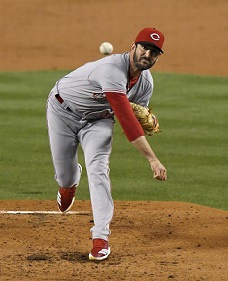
But once he got out of New York and into Cincinnati he seemed a changed young man and pitcher. For the first time in what seemed an excessive sentence, Harvey was healthy. He never missed a single starting assignment as a Red. And as he approached free agency, the only Red headed that way in 2018, he showed enough to convince the Los Angeles Angels that his potential upside, very different from the incendiary young Met, was worth gambling $11 million for a single season.

Are the Angels tempting too many fates? Anaheim is closer to Hollywood and Beverly Hills than San Diego, even if Harvey in Cincinnati seemed a changed young man without the lure of the demimonde. But tempting the fates has always been in the Angels’ DNA, even when they were successful. And far bigger deals than Harvey’s have incinerated them in the recent past, though the flames weren’t always of their own making.

It was nobody’s fault including Albert Pujols’s when serious heel and knee issues began reducing the future Hall of Famer—whom the Angels signed for a decade and the value of a large state economy—to little more than a designated hitter who can still hit for distance (he hit home run numbers 500 and 600 in Angel fatigues) but can barely stand up at first base anymore. Lacking the kind of teammates not named Mike Trout who can get on base ahead of him hasn’t done Pujols’s run production that many favours, either. A lot of people may still wonder how Pujols still managed to drive in 100+ runs in four of his seven Angel seasons.

It was nobody’s fault that Josh Hamilton battled injuries as an Angel before relapsing into a brief spell of substance abuse on one otherwise fine Super Bowl Sunday. But what the Angels did to Hamilton upon that relapse was a disgrace. Hamilton himself reported the relapse to major league baseball, as vivid a cry for help again as you could ask. Angels owner Arte Moreno elected to run him out of town on the proverbial rail, though Moreno might have preferred a hypersonic airplane. And now-retired manager Mike Scioscia demanded he apologise. Then the Angels paid the Rangers to take him back, basically.

The Angels were pitching strapped before they trained their sights on Harvey. They’ve lost Garrett Richards, J.C. Richards, and Rookie of the Year Shohei Ohtani (as a pitcher, not a designated hitter) for 2019 thanks to Tommy John surgery. They couldn’t convince J.A. Happ to sign for two years and $28 million; Happ’s returning to the New York Yankees. They couldn’t convince Patrick Corbin to stay in the southwest at a “strong” offer; Corbin, of course, signed for $140 million with the Washington Nationals.

With the American League West rival Oakland Athletics (who now claim Las Vegas as their AAA affiliate, the Mets having moved theirs to Syracuse) showing interest in the righthander, the Angels convinced Harvey to sign up for a year at comparative bargain money. They’re banking at minimum that Harvey will continue the improvement he showed in Cincinnati, where he began finding a little more velocity on his pitches after it eroded with the Mets (92.6 mph as a Met; 94.4 as a Red) and where he began missing bats again.

As a Red, Harvey pitched 128 innings. His ERA didn’t look anything like his Dark Knight years at 4.50, but he had more quality starts than not—his 24 starts included fifteen quality starts (five or more innings, three or less earned runs) including his final gig of the season. He had seven no-decisions in those quality starts and five of them the Reds went on to lose by a single run. Maybe his biggest was nearly no-hitting the Giants against Madison Bumgarner in August, taking the hitless bit to the sixth and the Reds winning the game 7-1.

His swinging strikeout rate jumped from 8.2 with the Mets earlier in the season to 9.9. He returned to a 7.9 strikeouts-per-nine rate as a Red with a 42.6 percent ground ball rate. And his fielding-independent pitching was enough points lower than his ERA to suggest Harvey, too, could hardly do more to neutralise the Reds’ overall futility. It wasn’t his fault the Reds couldn’t really afford to keep him aboard even at the two years for which he looked and scouts figured he might receive.

After that jewel against the Giants, Harvey couldn’t resist a soft joke about his incumbent status, not having pitched in a full week before that game. “After a successful outing last time, it is big to have another,” he told reporters. “I’m getting there. Health is the biggest thing. It is hard to stay sharp when you’re used to going every sixth day. You feel a little out of whack. The guys are calling me the Saturday starter, like in college.”

As a Met, Harvey’s early promise got flattened first by Tommy John surgery and a return season in which his workload was questioned severely. Earning Comeback Player of the Year honours for 2015, Harvey crowned that season famously by all but demanding the ball to go back out for the ninth of Game Five of the World Series.

Then-Mets manager Terry Collins read his man’s heart deeper than the fuel tank even with a 2-0 shutout in the making. Harvey ran empty with a leadoff walk and, after a stolen base, an RBI double to break the shutout. The Mets’ porous defense allowed the Royals to blow a sure save for now-prodigal reliever Jeurys Familia, when Lucas Duda threw home wild on a sure double play, and the bullpen held fort before a spent Addison Reed got murdered in the twelfth for the Series.

Then it was thoracic outlet syndrome surgery to kill Harvey’s 2016 in its crib. (The syndrome is cause when blood vessels and/or nerves between your collarbone and your first rib compress, causing shoulder and neck pain and finger numbness.) Then, a 2017 interrupted rudely by a shoulder injury. Concurrently, Harvey melted down. The demimonde among whom he felt most at home when not rooting for the New York Rangers of the NHL no longer comforted him. And the aforementioned big-timing attitude left him wanting for empathy when his mound trouble matched his off-field heartbreak.

“Besides life on his fastball and bite on his slider, you know what was missing with Matt Harvey? Compassion,” wrote Joel Sherman of the New York Post when the Mets traded him to the Reds.”There was no empathy from a teammate or member of management for Harvey’s plight. They wanted him to rebound and do well, but that was about the team and their own selfish desire for success.”

The Angels saw a haunted pitcher finding smarter ways to pitch with the numbers trending upward little by little in Cincinnati after he’d collapsed so completely in New York. They’re investing in a realistic enough chance that Harvey approaching 30 years old can continue the upward trend enough to give them one less rotation piece over which to fret. If he does continue upward and stays healthy he becomes a bargain of a middle-rotation piece.

Harvey seemed too often at core as though the big-timing attitude seen in him was really a clumsy way of letting the world know that it wasn’t his teammates who weren’t worthy of him but the other way around. If he learned anything else in Cincinnati other than beginning to remake himself as a major league pitcher, he may have learned that one of the loneliest places on earth is the place to which you fall, good and hard, discovering no empathy, after you’ve burned yourself too deeply seeking artificial life.

For Harvey the Angels are his chance to pitch himself into either an extension with the Angels or a decent payday after the 2019 season ends. So far, all he has to do is remember that, as close as they are to Angel Stadium, the Los Angeles/Hollywood demimonde is only smaller, not less psychically incendiary than it is in New York.

The 1919 Reds, grand theft victims

1919RedsIt’s difficult to feel sorry for a franchise whose history includes fifteen trips to the postseason, ten pennants and five World Series championships, even if they’ve spent the past five seasons in the pits of the National League Central. Difficult, but not impossible.

The centenary approaches of the Cincinnati Reds’ first National League pennant and World Series triumph, and it’s not unfair to say few outside Cincinnati might care. But you should. If you’ll pardon the expression, bet on it: Ninety percent or more of its commemorative commentary will focus on the guys they beat in the 1919 World Series. Understandable, and patently unfair. To the Reds. The thrill of victory never smelled so much or so without warrant like the agony of defeat.

You know about the Black Sox, too much, not enough, or both. You may know the mythology saying the White Sox untainted by the Eight Men Out would have just annihilated the poor little Redsies who just weren’t enough to withstand a feeding attack from the South Side sharks. That’s a lie equal to one president not having had sex with that woman and a thrice-removed successor having the largest inaugural crowd of all time.

The Reds’ golden age was the 1970s of the Big Red Machine. Five division titles, four pennants, back-to-back World Series conquests, over that decade’s first seven years. Franchises would kill for a piece of that. But the Machinists had no single season winning percentage better than the 1919 Reds. The 1919 edition’s .686 winning percentage was better than those White Sox (.629) and any team in their decade except the 1912 Boston Red Sox. (.691.)

Before anyone suspected foul play, the 1919 White Sox were 8-5 favourites to win the Series overall but 2-1 underdogs for the first two games in Redland Field. (The park would be re-named as Crosley Field in 1934.) White Sox manager Kid Gleason trumpeted what he considered the greatest hitting team that yet played a World Series. Reds manager Pat Moran made a prediction that proved too chilling in due course: “If we beat [White Sox pitcher Eddie] Cicotte in the first game, we ought to win the Series.”

Cicotte, of course, hit the Reds’ second baseman Morrie Rath with the second pitch of the bottom of the first, the signal to the gamblers that the fix was on. But Cicotte would have entered that game suspect even without joining the fix. He suffered shoulder and arm miseries at the end a 306.6 inning, 29-win season. (If you’ve seen the dubious film version of Eight Men Out, you remember the scene in which Cicotte’s suspect shoulder and arm received a linament rubdown from his wife.)

The White Sox entered the Series with two great starting pitchers (Cicotte, fellow Black Sox Lefty Williams), a third (Hall of Famer Red Faber) missing in action thanks to injuries, and a rookie (Dickey Kerr, one of the Clean Sox) who looked like a comer both starting and out of the bullpen but whom observers in the moment considered a kind of  wild card. The Reds entered with five solid, healthy starters: Hod Eller, Ray Fisher, Jimmy Ring, Dutch Reuther, and Slim Sallee. Gleason went into the Series on the shorter end of the pitching stick, even without Cicotte and Williams corrupted. Moran had the luxury of being able to rotate his arms—none of which was particularly overworked compared to Cicotte and Williams (297 innings)—reasonably.

Is one way to measure a team their second-half season’s performance? If so, and if  you’ll pardon the expression, you should have put your money on the Reds based on that. They went 47-19 in their second half. The White Sox went 41-26. The Reds finished nine games ahead of the second-place New York Giants; the White Sox finished three and a half ahead of the second-place Cleveland Indians.

Another measure is how they did against fellow contenders in their league. The Reds went 38-22 on the season against three other contenders (the Giants, the Chicago Cubs, the Pittsburgh Pirates); the White Sox went 35-25 against three others (the Indians, the New York Yankees, the Detroit Tigers). In September alone, the Reds faced other contenders ten times and went 8-2; the White Sox, twelve times, going 6-6.

On the regular season the White Sox out-hit the Reds but weren’t that much better at scoring. The White Sox averaged 4.8 runs per game but the Reds averaged 4.1. And the opposition averaged 2.9 runs against the Reds but 3.8 runs against the White Sox. It’s easy to figure out: The Reds out-pitched the White Sox. Entering the Series, the White Sox pitching staff had a 3.04 earned run average and a 2.88 fielding-independent pitching rate. (FIP: your ERA when your defense is removed from the equation.) The Reds staff had a 2.23 ERA and a 2.81 FIP. The Reds were a little bit better at crafting their own pitching luck.

The 1919 White Sox shut the other guys out fourteen times and got shut out seven times. The bad news for the 1919 Reds: they were shut out fourteen times—but the good news is, they shut the other guys out 23 times. The closer you look, the less the White Sox look like predators and the Reds like prey.

It wasn’t just the tainted White Sox who came up short at the Series plate, Shoeless Joe Jackson to one side. Leadoff hitter Nemo Liebold hit .056 with two walks and one hit in the set. Hall of Famer Eddie Collins, another of the Clean Sox, undermined his own reputation as a money player when he hit .226 with a single run batted in. Collins’ Series average was two points above the team’s.

What of Jackson? His cumulative Series hitting line argues against him going into the tank, but his game-by-game performance looks more suspect. In his best single game at the plate all set long, Game Eight, he had two hits, three runs batted in, two runs scored including on a third inning home run, but the White Sox were blown out, 10-5, to lose the Series. The homer was Jackson’s first hit in the game, and he came to the plate with the White Sox already down, 5-0. Uh!-oh.

Even before White Sox first baseman Chick Gandil, shortstop Swede Risberg, and Cicotte  instigated the World Series fix, and found both the gamblers and the teammates to execute it, the White Sox and the Reds had a critical difference. The White Sox were riddled with dissension not all of which was provoked by frustrations real or imagined with their owner. They were wracked by clashes between more- and lesser-educated players and by spells of discomfort with new manager Gleason.

Collins played on the Philadelphia Athletics teams that ruled the earlier parts of the decade that the Red Sox didn’t, which went a long way toward fostering the presumed American League superiority. He once said those A’s “believed in teamwork and cooperation. I always thought you couldn’t win without those virtues until I joined the White Sox.”

The 1919 Reds believed as he did. Susan Dellinger, Ph.D., granddaughter of the Reds’ Hall of Fame center fielder Edd Roush, revealed in Red Legs & Black Sox: Edd Roush and the Untold Story of the 1919 World Series that those Reds liked their own new manager Moran, liked each other, played hard, and thought of team first. They mentored each other when need be, made a powerful point making newer players feel at home, and, on the field, as Dellinger wrote, “No one cared who was on third. If he wore the Reds insignia, just get him home.”

Their morale withstood only one threat, Dellinger exhumed, when Roush finally told Moran of whisperings he’d heard that gamblers tried to get to one or two Reds pitchers. Moran called a team meeting piror to Game Eight. The scheduled starting pitcher, Hod Eller spoke up. He’d run off a gambler who tried to buy him off for the game. Then he pitched the distance in the Series-ending blowout.

“Doesn’t everybody say the dream is nonsense? Didn’t everybody say the Reds couldn’t possibly win?” wrote Damon Runyon after the Reds’ Game One win. (The article is collected in the splendid Guys, Dolls, and Curveballs: Damon Runyon on Baseball.) “Experts, ballplayers, and fans—didn’t they all laugh at Cincinnati’s fall pretensions as they have laughed every year for many years? Cincinnati will tell you that they did.”

Didn’t they tell you Pat Moran’s ball club was made up of castoffs of baseball, and that it was just a sort of baseball joke compared to the million dollar club that represents Chicago?

Cincinnati will tell you they did. Cincinnati never tires of the telling, in fact. But all the time they were telling these things about the Reds, Cincinnati was secretly dreaming a great dream that was realized at Redland Field this afternoon, with 30,000 pop-eyed breathless Cincinnati people looking on.

The castoffs of baseball proved better than the sum of their parts and the million dollar club proved worse in more ways than one.

George F. Will had it right when he once described most of the Eight Men Out as “more dumb than dishonest,” a valedictory that doesn’t apply to the ringleaders Cicotte, Gandil and Risberg. Or, to reserve third baseman Fred McMullin, who stumbled upon their plot in its planning and threatened to expose it unless they cut him in on the profit. (Remember, too, that if the gamblers double-crossed the Black Sox, Gandil may have double-crossed his own co-conspirators; he’s said to have kept the bulk of the money the gamblers paid them.)

Will also said of the commissioner baseball selected in the scandal’s immediate wake, Judge Kenesaw Mountain Landis, that he “delivered rough justice, perhaps more rough than just,” when it came to the game-wide malignancy that enabled the Black Sox. Landis was not faultless, including and especially the de facto perpetuation of baseball’s segregation. (He neither ruled formally nor spoke publicly but it was understood he wouldn’t sanction baseball’s integration so long as he held office.) But if he applied an overweight hand to baseball’s original gambling scandal, it was featherweight compared to the cancer the game needed to eradicate.

Jackson made two terrible mistakes, perhaps out of intimidation from the too-rough/too-tumble Risberg. (“Swede,” he told those investigating the World Series fix, “is a hard guy.”) He accepted an envelope Lefty Williams was ordered to deliver to him, containing $5,000, rather than say thanks but no thanks. And, he delayed his oft-discussed attempt to dispose of it and advise team officials what was up.

Third baseman Buck Weaver wanted no part of the fix or its payoffs. He also wanted nothing to do with being a rat against his friends, some of whom were anything but. That seemed more important than aborting the fix, which Weaver could have done by exposing what he knew. If there was a concerted cover-up of the fix, by White Sox officials at minimum, delaying its revelation and resolution by at least a year, Weaver’s silence left room for a cover-up in the first place.

Jackson’s playing record is considered Hall of Fame worthy. But the guileless outfielder was never elected on the (oft-forgotten) couple of times he did appear on the Baseball Writers Association of America Hall of Fame ballots. It’s not unreasonable to say his Hall worthiness married to his banishment inspired subsequent movements to convince baseball’s government to reinstate him and enable his Hall election, whatever the details behind his Black Sox status.

Don’t think that just because the White Sox were riddled by factionalism, and that even some of the Clean Sox were rough and tumble, it means the Reds were a roster full of saints. But several Reds including Roush, Eller, and outfielder Greasy Neale believed the Series was played mostly straight at least between Games Three and Six—because, they said in various ways, the gamblers double-crossed the fixers and the fixers didn’t get all the money they were promised. It neither mitigated the Black Sox nor eroded the myth of the Reds’ comparative modesty.

Seventy years after that World Series came Pete Rose, banished from baseball for violating Rule 21(d)—the rule against betting on baseball, the rule instigated by the gambling corruptions that climaxed with the 1919 Series fix and its eventual exposure and affirmation. You can say many things about Rose, but guileless isn’t one of them. And the very real prospect of his election to the Hall of Fame despite his banished status prompted the Hall itself, an entity not actually operated or governed by Major League Baseball, to rule against baseball’s ineligible being eligible for Hall election.

A nation whose citizens empathise with victims real or imagined should hark heartily to the real victims of baseball’s two most notorious gambling scandals. The first compromised the integrity of the Reds’ first World Series winners through no fault of their own. The second cost the Reds a franchise icon and manager through all fault of his own.

It would be simple enough for baseball to spend 2019 giving the 1919 Reds their long, long overdue. The evidence says they could have beaten those White Sox in a straight, no chaser Series. Baseball can’t give them a Series do-over but it can give the team the championship legitimacy they deserve. Metaphysically and temporally, the 1919 Reds wuz robbed.