NLCS Game Five: All things small and big

Zack Wheeler

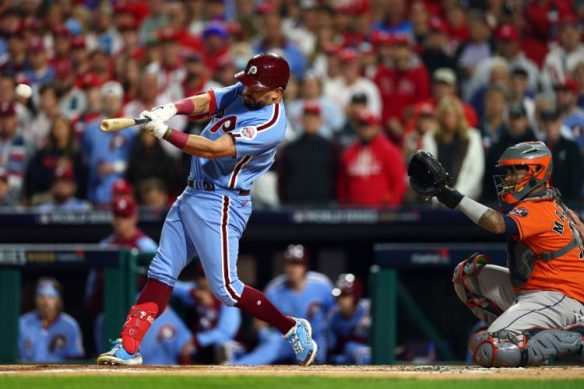
Zack Wheeler pitching almost spotlessly in NLCS Game Five did as much to save the Phillies season as their early running and mid-game bombing did.

Ask, and you shall receive. The Phillies asked Zack Wheeler to pitch like an ace in National League Championship Series Game Five—and he did. They asked their hitters to step up and swing when it mattered—and they did. They asked their bullpen to hold fort—and they did.

Their reward for doing those things was a handy 6-1 win in Chase Field and a trip back to Philadelphia with not one but two chances to punch their World Series tickets. The Phillies, of course, not to mention the throng liable to greet them in Citizens Bank Park come Monday, would prefer it not take that long.

All it took otherwise was for the Phillies to put Games Three and Four behind them, the ones in which their overtaxed bullpen let the Diamondbacks waste a grand start by Ranger Suárez in the former and their overtaxed bull Craig Kimbrel implode them toward a come-from-ahead loss in the latter.

Not to mention Kyle Schwarber starting the Game Five ball rolling in a way you don’t expect of the bombardier who showed up nuclear in the sixth inning, beating one into the ground to take a slow enough roll toward third, a region left open with the Diamondbacks in a slight shift toward second, that he beat out for a leadoff hit.

Not to mention Bryce Harper sending him to third with a one-out single shot right back up the pipe, Bryson Stott lining him home with a single. And, Harper coming home on a double steal while inadvertently colliding with a momentarily-stunned Diamondbacks catcher Gabriel Moreno as the throw from Snakes second baseman Ketel Marte to the plate went off it. It was the first time any Phillie stole home in any postseason.

Not to mention Wheeler and his Diamondbacks counterpart Zac Gallen engaging a pitcher’s duel that was noiseless, generally, until Schwarber opened the top of the sixth by turning Gallen’s 2-0 hanging breaking ball into a satellite flying over the Chase Field pool and several rows into the seats behind it. Giving Schwarber the all-time National League Championship Series home run lead with eleven.

Not to mention Harper, one out later, wrestling back from 1-2 into a full count before driving a fastball slightly over the middle of the zone and a little further into the same general real estate where Schwarber’s leadoff bomb landed.

Not to mention J.T. Realmuto abusing the Diamondbacks’ third reliever of the evening, Luis Frias, for a two-out two-run homer in the top of the eighth, which could have been considered repayment for Diamondbacks center fielder Alek Thomas—the hero of the Snakes’ Game Four win with his unlikely eighth-inning, game-tying two-run homer—hitting Wheeler’s first pitch of the seventh over the right center field fence for the only score of the evening for his team.

Not to mention the Phillies bullpen keeping the Diamondbacks off the board the final two innings despite a couple of dicey moments in the ninth, when Evan Longoria drew a two-out walk off Seranthony Domínguez and took second on defensive indifference before Perdomo landed on first after his bouncer hit Domínguez’s leg and deflected to shortstop.

Manager Rob Thomson reached for Matt Strahm. Strahm landed a swinging strikeout on Diamondbacks rookie Corbin Carroll to finish off. The Phillies reached for ways to express how it felt to shake off such a heartbreaker as the Game Four loss.

“I just want to win. That’s it,” said Harper, whose evening included a grand first inning play when he speared Diamondbacks DH Pavin Smith’s hard grounder lunging right and onto a knee before taking it to the pad himself. “Whatever that takes, whatever that’s going to be, whatever that’s going to look like. That was a big game for us. Coming in here and getting one is huge. That’s a good team over there. We took advantage of everything we could.”

Harper also tended Moreno at once after the double-steal collision, perhaps mindful that Perdomo has been under concussion watch before in his career and was caught in the head on a backswing during the D-Backs’s wild card set. “The way he went down,” Harper said postgame, “I was making sure he was good and stable.”

(Memo to: Social media idiots. It wasn’t a dirty play. Harper came straight down the base line without trying to collide with Moreno. Moreno moving from in front of the plate to reach for the throw crossed into Harper’s path, unintentionally but technically blocking the plate without the ball in his mitt, illegally, leaving Harper nowhere to go at that moment.)

The collision to one side, Realmuto seemed less impressed by his own home run than by the double steal that made Harper the second-oldest (at 31) ever to steal home in a postseason game. (Hall of Famer Jackie Robinson at 37 remains the oldest; he did it in the 1955 World Series.) “After what [the Snakes] did to us the last two games, they had all the momentum in the world,” the Phillies catcher said postgame. “So we had to try to do something early in the game to get it back. That was a great call by [Thomson] putting that on.”

The plot was simple. Stott would take off for second and draw Moreno’s throw while stopping just short of the pad. It looked like Stott getting himself caught in a rundown, but Marte winged his throw home almost immediately after Stott stopped with Harper, instructed to “be aggressive” by Phillies third base coach Dusty Wathan, gunning it home.

“It just shows you,” said Phillies shortstop Trea Turner, “how being aggressive and putting pressure on those guys — not just them but everybody in general, to put pressure on the other side is good and it makes things happen.” Make things happen? The Phillies opened by taking a page out of the Diamondbacks’ grinding book and shoving right back before even thinking about the long ball side of their own game.

For all the Phillies’s basepath daring and bomb launching, though, Wheeler had to have been the player of the game for them when all was said and done. “He gave us exactly what we needed with where our pen was at,” said Thomson. “It’s incredible what he does,” said Harper of Wheeler, who threw 21 first-pitch strikes facing 28 batters. “It’s so much fun to watch. I love playing behind him, and it’s incredible. He’s legit, man.”

Now it’ll be up to Aaron Nola to pick up in Game Six where Wheeler left off in Game Five. As for the rest of the Phillies? Who knows what surprises they might bring? Another double steal including a theft of the plate? Another evening of acrobat defense? Another bomb or three?

You almost hope the set goes the full distance, if only to give the Diamondbacks more chances to show the talent might overcome this edition’s general lack of postseason experience. They’re a young team with a lot of upside and a lot of dynamism in their own right. They showed they, too, can exploit mistakes or misfirings in pushing this NLCS to a two-all tie in the first place.

But if they want to hang around a little longer, they’ll have to find a way to beat the Phillies in the Phillies’ own playpen, where the audience never sleeps and the noise rarely lets up before the final out. The Phillies just won their first NLCS road game. Going home, however, means a lot more to them than just scoring a run.

NLCS Game Two: Was it loud enough?

Merrill Kelly

Arizona pitcher Merrill Kelly leaving NLCS Game Two in the sixth inning and hearing it from the Citizens Bank Park crowd whose sound he underestimated. He ended up bearing the least of the Phillies’ destruction on the night.

Maybe nobody gave Diamondbacks pitcher Merrill Kelly the memo. Maybe he missed the sign completely. Wherever Kelly happened to be, if and when he was warned not to poke the Philadelphia bear and his native habitat, he learned the hard way Tuesday night and the Diamondbacks whole were dragged into class.

Maybe the Braves sent him a message he never saw. You remember the Braves. The guys trolling Bryce Harper after their second division series game, when Harper got doubled up on a very close play following an impossible center field catch to end the game. They learned the hard way, too. They’re also on early winter vacation.

Before this National League Championship Series even began, Kelly was asked whether the heavy metal-loud Citizens Bank Park crowd might have a hand in the field proceedings. He practically shrugged it off, though in absolute fairness he wasn’t exactly trying to be mean or nasty.

“I haven’t obviously heard this place on the field, but I would be very surprised if it trumped that Venezuela game down in Miami [in the World Baseball Classic],” said Kelly, a righthander whose countenance bears a resemblance to comedian Chris Elliott and who’s considered a mild-mannered young man otherwise. “When Trea [Turner] hit that grand slam, I don’t think I’ve ever experienced—at least baseball-wise, I don’t think I’ve ever experienced an atmosphere like that so I hope that this isn’t louder than that.”

That grand slam jolted Team USA into the semifinal round. By the same Trea Turner who’d start Kelly’s Tuesday night with a jolt, hitting a one-out, one-strike pitch into the left center field seats in the bottom of the first. 

Kelly may not have been trying to be snarky, but The Bank let him have it early and often, first when he was introduced pre-game time and then when he took the mound for the bottom of the Game Two first. Loud, clear, and unmistakeable.

The only things Kelly faced louder and more clear than that were Turner’s score-starting blast, the one-ball, two-out laser Kyle Schwarber sent off Kelly’s best pitch, a changeup, into the right field seats in the third, and the 2-1 skyrocket Schwarber sent into the right center field seats leading off the bottom of the sixth.

“He’s really effective because he has a plus-plus changeup,” Schwarber said postgame. “He threw it 2-0 and kinda gave me the window. That’s what it looks like coming out of there. I think that was the first strike [on a] changeup I saw. [The home run pitch] was a little bit more down and away. But, I mean, it came out of the same height. So those are things that you look for.”

“They’re good big-league hitters,” Kelly said of the Phlogging Phillies postgame. “That’s what good big-league hitters do. They don’t miss mistakes.” Neither did The Bank’s crowd, serenading him with “Mer-rill! Mer-rill” chants at any available opportunity. But Kelly actually pitched decently despite the bombs. He only surrendered three hits, but walking three didn’t help despite his six strikeouts.

He’d also prove to have been handled mercifully compared to what the Phillies did to the Diamondbacks bullpen in a 10-0 Game Two blowout.

Once they pushed Kelly out of the game, with two out in the sixth and Turner aboard with a walk, they slapped reliever Joe (Be Fruitful and) Mantiply with a base hit (Bryson Stott), a two-run double (J.T. Realmuto), and another RBI double (Brandon Marsh). Just like that, the Phillies had a four-run sixth with six on the board and counting.

Then, Mantiply walked the Schwarbinator to open the Philadelphia seventh. Diamondbacks manager Torey Lovullo reached for Ryne Nelson. One out later, Harper singled Schwarber to third, Alec Bohm doubled them home with a drive that hit the track, Stott hit a floater that hit the infield grass between Nelson plus Diamondbacks third baseman Evan Longoria and catcher Gabriel Moreno, Realmuto singled Bohm home and Stott to third, and Nick Castellanos sent Stott home with a sacrifice fly.

This time they didn’t need Harper to provide the major dramatics. He’d done enough of that in Game One, hitting a first-inning, first-pitch-to-him, first-NLCS-swing, first-time-ever-on-his-own-birthday nuke one out after Schwarber hit his own first-pitch bomb. That game turned into a 5-3 Phillies win. On Tuesday night, they turned the Diamondbacks into rattlesnake stew.

They made life just as simple for Game Two starter Aaron Nola as for Game One starter Zack Wheeler. Wheeler gave the Phillies six innings of two-run, three-hit, eight-strikeout ball; Nola gave them six innings of three-hit, seven-strikeout, shutout ball. It was as if the Philadelphia Orchestra offered successive evenings of the Brahms Violin Concerto in D Major—featuring Isaac Stern one night and Itzhak Perlman the next.

“It’s a little more hostile and a little more engaging,” said Turner of the Bank crowd after the Phillies banked Game One. “I think [Kelly] can maybe tell you after tonight what it’s like, but I wouldn’t put anything past our fans. Our fans have been unbelievable. They’ve been great. I don’t know what decibels mean, but I guess we did something cool for AC/DC concert level decibels the other night . . . I would just wait and see and we’ll see what he says after [Game Two]”

“They’re up all game on their feet from pitch number one till the end,” said Nola postgame. “I feel like you don’t really see that too much around the league. That just shows you how passionate and into the game they are. They know what’s going on, and that helps us a lot.”

That was not necessarily what Lovullo wanted to hear before or after the Game Two massacre ended. “Everybody’s talking about coming into this environment,” he said, audibly frustrated, “and I don’t care.”

We’ve got to play better baseball. Start with the manager, and then trickle all the way down through the entire team. We’ve got to play Diamondback baseball . . . Diamondback baseball is grinding out at bats . . . driving up pitch counts, catching pop ups . . . win[ning] a baseball game by just being a really smart, stubborn baseball team in all areas.

That assumes the Phillies will just roll over and let them play it. The wild-card Diamondbacks who steamrolled two division winners in the earlier rounds to get here in the first place looked like anything except an unlikely juggernaut after getting manhandled in Philadelphia. They shouldn’t take the Phillies for granted once the set moves to Chase Field, either.

The Phillies might have been a one-game-over-.500 road team on the regular season, but they beat the Diamondbacks in Chase Field three out of four—a couple of weeks after the Snakes beat them two out of three in The Bank. Until this NLCS it was a little over three months since the two teams tangled. It certainly didn’t phaze the Phillies.

“I still think we’re real confident,” said Kelly. “I think there was a lot to be said about us after the All-Star break about how bad of a slump that we went into. I’ve seen in this clubhouse, I’ve seen from these guys that we haven’t gotten rattled all year. And I don’t want us to hang our heads and pout about it this time.”

But let’s say the Diamondbacks iron up and find ways to neutralise the Phillies’ offensive bludgeons and pitching scythes which, admittedly, might require a kidnapping or three. Let’s say they win all three games at Chase. They might become the only team to be at a disadvantage with a 3-2 series lead.

Because guess where the set would return then. And, unless my prowling has missed something this morning, Kelly didn’t have one word to say about that crowd after Game Two came to its merciful end. It must have been more than loud enough for him.

NLDS Game Two: Awakening the sleeping Braves

Travis d'Arnaud, Zack Wheeler

Travis d’Arnaud was only too happy to remind people what can happen when a lineup gets a third crack at his old Mets teammate Zack Wheeler . . .

If you expect to keep the Atlanta threshing machine from threshing, you can’t let any of them see Zack Wheeler the third time around. Not even if he’s taking a one-hitter into the seventh. Not even if you’re about to have your next two National League division series games in your own yard. Not even if the lone run out of him to that point scored on a tough fielding mistake.

You just might end up awakening the sleeping Braves.

Which is just what happened Monday night in Atlanta, the Braves overthrowing a 4-1 Phillies lead to win, 5-4. Slamming an exclamation point home with one of the most daring game-ending double plays anyone could hope to see, at any time.

Wheeler lost his no-hit bid and the Phillies’ bid for a second straight shutout in the bottom of the sixth, on Braves shortstop Ozzie Albies’s two-out single, sending Ronald Acuña, Jr. (two-out walk) home after Phillies shortstop Trea Turner misplayed a one-hop throw in from right. Phillies manager Rob Thomson elected to send Wheeler back out for the seventh.

Brain fart. Wheeler lifetime came into Game Two with opposition OPSes that accelerated each time through an opposing lineup: .594 the first time, with 39 home runs; .638 the second time, with 37 home runs; but, .759 with 47 home runs the third time. He was already in his third round with the Braves lineup when he walked Acuña in the sixth.

So with the Phillies leading by three, Wheeler opened with Matt Olson singling up the pipe, Marcel Ozuna striking out swinging, but Travis d’Arnaud—Wheeler’s former Mets teammate in the bargain—hitting the first pitch into the left field seats. As Truist Park went nuts over the first extra-base hit by the Braves all set long, then Thomson lifted Wheeler for Jose Alvarado.

“I wanted him to go back out, and he said he was fine,” Thomson said of Wheeler postgame. “He still looked good, so I was all in.” Three batters in, Wheeler was all out and the Braves were back on the march.

They continued marching with one out in the bottom of the eighth. Alvarado yielded to Jeff Hoffman, who hit Acuña on the left arm with his first pitch before Albies pushed him to second with a ground out. But then Acuña stole third with Austin Riley at the plate, and Riley rewarded Acuña’s larceny with his own drive into those left field seats.

The Phillies hung four on the board in the first five innings against a clearly struggling Braves starter Max Fried and Braves reliever Kirby Yates. Alec Bohm singled Turner (one-out double to the back of center field) home in the first. With Bryce Harper (one-out single) in the third, J.T. Realmuto hit one the other way into the right center-field bullpen.

With one out in the fifth, and Yates on the mound, Nick Castellanos (single) stole second and took third when d’Arnaud’s throw went far enough offline while Bryson Stott waited at the plate. Then Stott lofted a fly to center sending Castellanos home on the sacrifice fly.

d’Arnaud at least got his shot at redemption two innings later. The Phillies might have had a fatter lead for the Braves to overcome but for stranding the bases loaded in the first, stranding Johan Rojas on second (after a one-out walk and an advance on a wild pitch) in the second, and stranding first and second in the fourth and the sixth.

The defending National League champions had one more grand opportunity in the ninth when Harper pried a leadoff walk out of Braves relief ace A.J. Minter, prompting Braves manager Brian Snitker to reach for closer Raisel Iglesias. After Realmuto flied out to center, Castellanos sent one to the rear end of right center. Center fielder Michael Harris II ran it down like a cop chasing a mugger.

“I knew off the bat it was going to be close to the fence,” he said postgame. “I knew once I went back I wasn’t stopping. I was going to do anything I could to get a glove on it. If my body had to go down because of that, I would have done that.” His body didn’t go down despite its rude meeting with the fence, but he caught the drive and winged a throw in that snuck past Albies and meant disaster. For about three seconds.

Riley backed the play alertly, with Harper having rounded second hell bent on getting as close to the plate with the tying run as he could. But Riley fired a strike across the infield to first, making Harper pay for being just a little over-aggressive.

“Usually, you don’t pass the base,” said Thomson postgame. “You stay in front of it, make sure it’s not caught. But he thought the ball was clearly over his head, didn’t think he was going to catch it. And Harris made a heck of a play. Unbelievable.” Heck of a play? The Elias Sports Bureau says it’s the first time a postseason game ever ended on a double play involving any outfielder.

You hate to say a series tied at one game each has become treacherous. But Philadelphia’s Citizens Bank Park is a haven for hitting, and re-awakening the Braves’ threshing machine, after they spent the series’ first fourteen innings scoreless, is not a sound idea. Especially when they hit a record 307 homers on the regular season—including 24 against the Phillies exactly half of which were put in the Bank.

Thomson said the split in Atlanta was disappointing but, what the hey, now the Phillies have the home field advantage. The Braves didn’t put their best 2023 road show on in the Bank. (That honour belonged to Cincinnati’s hitting haven of Great American Ballpark.) But they’re not exactly pushovers in Philadelphia, either.

“We’re going to play to the end”

Kyle Schwarber

Kyle Schwarber hitting his first-inning bomb off Justin Verlander in Game Five. “We’re going to play all the outs. We’re going to see where it takes us,” he says approaching Game Six. The “where,” of course, is up to Zack Wheeler and the Phillies against Framber Valdez again.

Approaching World Series Game Six, the Phillies could lean on the experience of one member who’d been there, done that, down 3-2 in a Series, then took the final two and the world championship. That was seven years ago, when he was a Cub, his season began (thanks to injury) in the World Series, and the Cubs finally did what seven-eighths of the earth thought wouldn’t happen in its lifetime.

“We’ve overcome a lot of things throughout the course of this year to be in this position,” said Phillies left fielder/bombardier/periodic base thief Kyle Schwarber as the Phillies traveled to Houston Friday. “I think when we get there, you’re going to see a really resilient club and we’re going to play until the very end and we’re going to see where it takes us.”

Funny, but that’s just about what every 2016 Cub said, too, when the then-Indians had them on the ropes with the Series returning to Cleveland for Games Six and Seven.

That was then: the Cubs pushed, shoved, pitched, and pounded their way through two arduous games. This is now: The Phillies, whose World Series drought is barely an eleventh of those Cubs’, will have to do all that plus rip, snarl, tear, slice, dice, and air fry. Just as when he was a 2016 Cub, the Schwarbinator won’t surrender, to these Astros or anyone else.

“It’s going to take everything,” said Schwarber, who did what he could to keep the Phillies from losing Game Five when he opened with a nasty home run off future Hall of Famer Justin Verlander in what proved a to-the-max 3-2 Phillies loss. “It’s going to take everyone. We’re excited. Trust me. Sure, it’s frustrating, but we’re also very excited.”

The Phillies are in a strange position this postseason. They enter Game Six with their first series deficit since they wrestled their way to the final National League wild card in the first place. Beyond that, they have reason not to fear. They’ve come back several times to get here in the first place.

Game One of the wild card set against the Cardinals? Down 2-0 in the top of the ninth. Then: bases-loaded hit batsman, two-run single, run-scoring infielder’s choice, RBI single, and a sacrifice fly, and two Cardinal runs in the bottom of the inning weren’t enough to deny the first win of a Phillie sweep.

Game Four, National League Championship Series? A four-run Padres first didn’t exactly bury them alive. Bottom of the first: Two-run homer (Rhys Hoskins), RBI double (Bryce Harper). Deficit cut to one. Bottom of the fourth: Tying RBI single. Bottom of the fifth, after Juan Soto put the Padres back up with a homer? Two-run homer (Hoskins, again), RBI double (Harper, again), RBI single, two-run Phillie lead. Bottom of the sixth: Solo bomb (Schwarber), three-run lead. Bottom of the seventh: Solo bomb (J.T. Realmuto), four-run lead, ultimately four-run win.

Game Five, NLCS? Call it the Mud and Guts Game if you must. Bottom of the third: Phillies take a 2-0 lead with another Hoskins two-run thump. Top of the fourth: Soto cuts the San Diego deficit in half with another solo smash. Top of the seventh, with the Citizens Bank Park rain turning the field into a swamp and pitching grips and strides into mush and mire? The Padres take a 3-2 lead with an RBI single and two wild pitches enabling a run. Bottom of the eighth? Harper fights and fouls his way to a dramatic opposite-field two-run homer. Two Phillies relievers make it stick for the pennant.

Game One, World Series? Kyle Tucker’s two bombs help the Astros bushwhack Aaron Nola in the first three innings. So the Phillies return the favour by ripping five out of Verlander—RBI single and immediate two-run double in the top of the fourth; two-run double in the top of the fifth. The score stays tied at five until Realmuto breaks it for keeps with a leadoff bomb in the top of the tenth, and David Robertson survives a double, a walk, a wild pitch for second and third, and gets the game and win-ending ground out.

All the Phillies need to do now is continue overcoming that nasty 0-for-20 with runners in scoring position until Jean Segura slapped an RBI single in the eighth in Game Five. They need Zack Wheeler to be his best self on the Game Six mound. They need to continue overthrowing their earlier reputation for defensive mishaps and cut the Astros off with more of the glovework and derring-do they began flashing during the Philadelphia leg of the Series.

They need, in other words, to be better than the best of their selves that pulled them into the Series and into the 2-1 Series lead the Astros wrested away from them on their own soil. Astros Game Six starter Framber Valdez, who manhandled them in Game Two, also in Houston, intends to let them do nothing of the sort.

“I think I’m just going to try to continue doing what I’ve been doing all season,” Valdez said through an interpreter after Game Five. “Just try and attack hitters early, try to breathe, try to stay calm, try to meditate. It’s something that’s really exciting. I think it’s something that really adds a lot to your career, and I’m really excited for this opportunity.”

It’ll add something to the Astros’ resume, too: their first untainted World Series rings. Not to mention handing their manager Dusty Baker—the man who steadied the Astro starship after it was strafed by the in-house phasers of Astrogate, keeping his gradually turning-over team playing through the aftermath, three seasons following its exposure, despite the organisation’s turmoil and grotesqueries—the first World Series triumph of his long and mostly distinguished managerial career.

The Astros know the Phillies won’t be simple pickings despite shutting them out back-to-back in Philadelphia, once with a combined no-hitter. It’s the Phillies’ job not to make things simple for the Astros.

“What a better storybook ending,” asked Castellanos, whose limp bat is almost forgotten when you’ve seen his defense turning into must-see television all of a sudden, “than if we can go there and win this in Game Seven?”

First things first, Schwarber would remind one and all.

“We’ve got a pretty good pitcher going for us in Game Six,” the Schwarbinator says. “We’ve got to be able to bounce back offensively. I don’t think anyone believes more in this group than we do. That’s going to be a big thing for us. We’ve just got to be able to play all the outs. We’re going to see where it takes us.”

First, it needs to take them past the Astros in Game Six. Then the Phillies can worry about who writes their storybook ending—the team of Roger Towne and Phil Dusenberry (who wrote the screenplay for The Natural); or, any given Astro, plus Jack Benny and Fred Allen, climaxing their long-running mock on-air feud while satirising the notorious weeper quiz show Queen for a Day:

Allen: An expert operating the Hoffman Pressing Machine will press your trousers
Benny: Now wait a minute! (Studio audience laughter and noise.) Now wait a minute, Allen!
Allen: Keep your shirt on, King!
Benny: You bet I’ll keep my shirt on!
Allen: All right, folks, tune in again next—
Benny: Come on, Allen, give me my pants!
Allen: Quiet, King!
Benny: Where are my pants?
Allen: Benny, for fifteen years I’ve been waiting to catch you like this.
Benny: Allen, you haven’t seen the end of me!
Allen: It won’t be long now!

The Phillies look a gift Brave in the mouth

Will Smith, Travis d'Arnaud

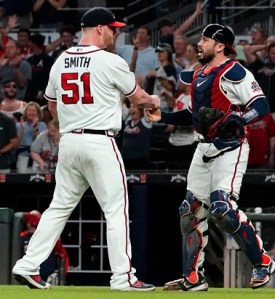
Will Smith and Travis d’Arnaud, after the Phillies somehow declined the gift Smith tried to give in the ninth Tuesday.

Until the top of the ninth Tuesday night the Phillies hadn’t scored a single run in their previous twenty innings. Then the Braves all but gifted the Phillies a run in that ninth. They’d even gifted the Phillies the potential go-ahead run and then the bases loaded with one out.

The problem was the Phillies picking the wrong way to say thank you. All that got them was elimination from the National League’s wild card race with a 2-1 loss. It’s win the NL East or wait till next year for them now.

But the ninth-inning high-wire routines of lefthanded relief pitcher Will Smith—with a rather remarkable ability to get himself into hot water—got a little too high on the wire Tuesday night.

It wasn’t so much that he and the Braves escaped as that the Phillies sent a helicopter overhead to lift him to safety when they should have left him and the Braves wiring mad. The Braves won’t always find the opposition that willing to bail them out.

Thanks in large part to their grand old man Charlie Morton’s seven-inning, ten-strikeout, shutout-ball gem, while managing to pry only two runs out of Phillies starter Zack Wheeler in seven otherwise-strong innings, the Braves may have been lucky to take a 2-0 lead into that ninth.

But with Smith having the opening advantage against lefthanded Bryce Harper, the major leagues’ OPS leader, Smith found himself in a wrestling match that ended with Harper wringing himself aboard with a leadoff walk. Phillies catcher J.T. Realmuto now represented the potential game-tying run at the plate.

Realmuto hit one on a high line to right center that ninth-inning center field insertion Guillermo Heredia had to run down long to catch on a high backhand. That spot of Braves fortune lasted just long enough for Phillies pinch-hitter Matt Vierling to hit a high liner to left, where Braves left fielder Eddie Rosario ran over, extended his glove, and watched the ball carom off its fingertips, setting up second and third for the Phillies.

Now the Phillies had veteran Andrew McCutchen—a long way from his days as a center field gazelle and a 2015 NL Most Valuable Player for a better array of Pirates—coming to the plate. McCutchen isn’t the danger he was once seen to be anymore, but he’s a veteran who still knows what he’s doing at the plate, and the Braves had no intention of letting his righthanded bat lay them to waste.

So the Braves ordered McCutchen walked intentionally, putting the potential second go-ahead run aboard, even while it looked as though Smith fooled nobody at the plate. The problem was that putting McCutchen aboard also put the Phillies’ fate into two bats described best as balky.

Phillies shortstop Didi Gregorius continued playing through a bothersome elbow and a shrunken ability to handle pitching from the same side as which he swings, lefthanded. Third baseman Freddy Galvis, lately pressed into everyday service, simply keeps proving why the Phillies unloaded him in the first place four years ago—he’s not truly an everyday player, and though he switch-hits he’s not exactly a game-breaker at the plate.

The Braves now had only to pray that Smith could survive. The Phillies had only to pray that Gregorius and Galvis had a few more unexpected surprises in their bats. Every Braves fan in Atlanta’s Truist Park had to pray that Smith could put his own fire out with a real retardant, not with gasoline.

He served Gregorius a 1-1 offering, and Gregorius hit a high liner that looked for a few seconds as though it would find a way off the right field wall—but Braves right fielder Adam Duvall ambled back in front of the track to haul it in for the critical second out even as Harper was able to tag and score from third.

Now Smith went to work against Galvis. Two balls in the dirt, ball three high, a grounded foul for strike one, a called strike right down the pipe, and a hard line foul down the left field side out of play. Then, Smith threw Galvis a meatball so fat it could have been hit with a cardboard paper towel tube.

Galvis swung right through it. Strike three and the game.

The Cardinals won their seventeenth straight behind the aging arm of their own grand old man Adam Wainwright and a trio of home runs in a 6-2 win over the Brewers Tuesday night. The Phillies’ postseason hopes shrank to a hair in their none-too-formidable division.

“We have to win out,” said Phillies first baseman Brad Miller postgame. Easier said than done. They have to beat the Braves tonight and tomorrow and hope the Mess (er, Mets) beat the Braves over the coming weekend.

That’s what happens when you open a game the way the Phillies did, with back-to-back singles in the top of the first, but you can’t cash them in after a force out, a swinging strikeout, and an infield ground out—two days after the Phillies were shut out by the NL Central bottom-feeding Pirates, of all people.

That’s what happens when Morton—the last man standing on the mound when the Astros won their now-tainted 2017 World Series title—all but toyed with them the rest of the way, the 37-year-old righthander making the Phillies’ lefthanded lineup stack look silly in going 2-for-15 with a walk before his evening ended.

“The moment doesn’t get too big for him, I know that,” said Braves manager Brian Snitker about Old Man Morton, who kept the Phillies off-balance on a deftly blended diet of curve balls, changeups, and fastballs. “I think he does a really good job of just staying with the next pitch and doesn’t get caught up in the big picture. And it’s just about making the next pitch, which is really, really good. That was, gosh, seven really good innings.”

That’s what happens when Wheeler, the National League’s strikeout leader among pitchers entering Tuesday, could manhandle the more formidable portion of the Braves’ lineup but couldn’t quite contain their lower-leverage bottom of the order in the bottom of the third—a leadoff double (Travis d’Arnaud, hitting seventh), an immediate first-pitch single (Dansby Swanson, hitting eighth) put Braves on the corners with nobody out.

Morton then bunted a high chop off the plate that pushed Swanson to second on the out, but Jorge Soler, the Braves’ leadoff hitter in the lineup, ripped a hard single down the left field line to send both runners home easily enough, before Wheeler retired Freddie Freeman and Ozzie Albies on grounders to second baseman Jean Segura.

That was the game until that too-close ninth. But the game put the Phillies’ core flaws into stark light, too. Even before the Phillies and the Braves squared off, The Athletic‘s Matt Gelb isolated the point: “[T]hey have too many holes right now.”

Didi Gregorius is tough to play against lefties. Andrew McCutchen is tough to play against righties. They love what Brad Miller has done, but he won’t start against lefties. Matt Vierling has provided a surprise boost for the Phillies in September, but he hasn’t gained the full trust of [manager] Joe Girardi.

The Phillies also lack the one thing that’s enabled the Braves to hang in and stand now on the threshold of wrapping an NL East that wasn’t exactly a division of baseball terrorists in the first place. Sure, the Mets spent 103 days leading the division—deceptively, as things turned out—but nobody in the NL East looked that much like a powerhouse.

What the Phillies lack that the Braves proved to have in abundance is depth. Their Harpers, Realmutos, and Wheelers all but willed them to stay in the race in the first place, but it may not have been enough. They just weren’t deep enough to hang in without major effort. A coming off-season overhaul may not shock anyone.

The Braves were deep enough in system and in the thought process of general manager Alex Anthopoulos that they withstood the full-season loss of their best young pitcher (Mike Soroka) and the rest-of-season loss of franchise center fielder Ronald Acuna, Jr. to serious injuries.

But they still have to find ways to neutralise that ninth-inning high-wire act.

Don’t let the 36 saves fool you. Smith’s 3.55 ERA and 4.28 fielding-independent pitching (FIP) should tell you the real story. So should 28 walks against 84 strikeouts in 66 innings’ work so far, not to mention 3.8 walks per nine innings. He seems too much to play with matches.

Snitker has two far-superior pen men to send forth when the game gets late and dicey, Luke Jackson (1.90 ERA) and Tyler Matzek (2.66 ERA). Between them, Jackson and Matzek pack a 3.34 FIP, a lot more comfortable than Smith’s. They should be considered more than in passing as viable ninth-inning options.

If these Braves want to get past postseason round one, they may want to consider how much less Jackson and Matzek like to tempt fate or challenge for baseball Darwin Awards. The last thing the Braves need now is to be the cobra with its own ninth-inning mongoose.