Ready for a none-too-short Serious?

NatsShark-2

Washington hopes the sharks bite. They have a better chance even against the Astros than you might think.

The 1906 White Sox. The 1914 Braves. The 1954 Giants. The 1960 Pirates. The 1969 Mets. The 1987 Twins. The 1988 Dodgers. The 1990 Reds. The 2003 Marlins. The 2006 Cardinals.

The 2019 Nationals?

They’d love nothing more than to join the roll of history’s greatest World Series upsets. And it’ll be about as simple as slicing filet mignon with a paper knife.

Not just because the Astros are their opponents. That much difficulty is a given going in. But difficulty doesn’t quite mean impossibility. And the Nats have already done a couple of impossibles entering the first Washington-team World Series since the year Albert Einstein moved to the United States as a refugee from the Third Reich.

Just picking themselves up from that lousy day in May when they ended their day 19-31, with their manager’s execution orders presumably signed and notarised, may have been impossible enough.

Starting from the following day through today, the Nats have gone 82-40 and scored 700 runs. Only one team in baseball knocked on their door from the same point through today, going 81-41 and scoring 690 runs. Who’s that team? Hint: they have this Series’s home field advantage.

In the postseason? The Baby Sharks faced three elimination games and won. The Astros faced one, and won. Even with the Nats having almost a full week off before going to Houston to start the World Series, they may have a slight momentum advantage.

Especially since they’re probably not even close to feeling the pressure. They’ve already been through the worst of it. Entering this postseason the world said the Nats caved under postseason pressure early. Right? Never even got to the National League Championship Series. Right?

Then the Nats faced an elimination game against the Brewers and won. Then they faced two against the Dodgers—the best-in-the-NL-Dodgers—and won. Then they swept the Cardinals, who had to go down to the wire to win the NL Central by only two fewer than the Nats, in the National League Championship Series. They’re getting pretty damn good at odds defiance.

Division series play began in 1969. The Miracle Mets beat a team that was supposed to smother them in the World Series. Would you like to know how much more often the better regular season team has won the World Series since division play began?

Once.

Thomas Boswell exhumes that starting in 1969 the teams whose regular season showed the better records are 23-24 in the World Series. Fifteen of those Series, he adds, began by looking lopsided with one combatant having a 10+ advantage in regular season wins . . . and those “better” teams are 7-8 in those Series.

The Nats won fourteen fewer games on the regular season than the Astros did. A look at the Astros making their third straight postseason and second World Series in three years might tell you the Nats are David against Goliath. But a look at their 2019 postseasons to date might tell you David has a fair chance of evening Goliath out:

The Nats’ division series slash line: .230/.321/.373. (OPS: .694.) The Astros’: .242/.294/.406. (OPS: .700.) The Nats’ NLCS slash line: .274/.327/.415. (OPS: .741.) The Astros’ ALCS: .179/.281/.318. (OPS: .600.)

The Nats’ division series pitching: 4.20 ERA; 1.27 walks/hits per inning pitched. The Astros’: 3.56/1.23. Then the Nats removed the major culprits from the roster. Presumably with orders that Hunter Strickland and Wander Suero are to be shot on sight if they even think about poking their noses out of their holes.

Now, the Nats’ NLCS pitching: 1.25 ERA; 0.64 WHIP. The Astros’ ALCS? Let’s be fair to them, too, and remove their main culprit, Bryan Abreu. (Two earned in two-thirds of a Game One inning and wasn’t seen again in the set.) And, take Ryan Pressly out of the equation for a moment, since his two earned in two-thirds of a Game One inning belie how well he pitched in Games Four and Six. Now look: 2.51/1.12.

Anthony Rendon (Nats) and Alex Bregman (Astros) are as close to a third base match as you can find, with a slight edge to Bregman for a slightly higher regular-season OBP and an OPS a measly .005 points higher. Advantage: Astros by a sliver.

Ryan Zimmerman is the Nats’ grand old man at first base who doesn’t look as good as Yuli Gurriel on paper, but Gurriel’s bat went mostly to sleep until his first-inning ALCS Game Six three-run homer. Still, the late-blooming Gurriel—who’s a year older than Zimmerman and doesn’t look it—had a better regular season. Slight advantage: Astros.

Howie Kendrick (Nats) has just about the same flair for the jaw-dropping drama as Jose Altuve (Astros), but he’s no Altuve at second base and Altuve is still in his prime while Kendrick has produced magnificently as an elder spare part. Advantage: Astros.

Michael Brantley made one decibel-busting play in left in ALCS Game Six but as a left fielder and at the plate he’s no Juan Soto. Advantage: Nats.

Victor Robles has a very promising future in center field if he can stay healthy, but he’s no George Springer. Springer’s only beginning to shake off his early postseason funk and Robles is still on the comeback trail from a division series hamstring tweak. Advantage: Astros.

Adam Eaton is harmless in right field but the Nats actually would have been better off this year with the $330 million guy he replaced. Even with that, he hits slightly better than Josh Reddick where Reddick is slightly more adept with the leather. Advantage: neither.

Both Trea Turner and Carlos Correa are good defensive shortstops. Correa had two bombs in the ALCS but didn’t hit much of anything else; Turner hit more consistently in the NLCS and is a lot more dangerous on the bases when he gets there. Correa had a slightly better regular season OBP but he tried and stole only one base to Turner stealing 35. (Lifetime stolen base percentages: Turner, .841; Correa, .804.) Advantage: Nats.

To the Astros’ Big Three starters—Gerrit Cole, Justin Verlander, and Zack Greinke, to take the likely World Series-opening order—the Nats have a Big Three Plus the Unexpected One: Max Scherzer, Stephen Strasburg, and Patrick Corbin, plus Anibal Sanchez—you know, the guy who opened the NLCS by damn near no-hitting the Cardinals the day before Max the Knife damn near did.

Cole and Verlander are powerful Cy Young Award candidates and Verlander, of course, is a future Hall of Famer with a formidable postseason jacket since he became an Astro in the first place. But while Cole went from possible Cy Young winner on the season to off the charts early in the postseason, Verlander’s been vulnerable ever since his unlikely short-rest division series start against the Rays.

And Greinke got spanked in his only division series start before graduating back to touchable-but-survivable (three earned in Game One; one earned in a short Game Four outing) in the ALCS.

Scherzer and Strasburg look at least the equal of Cole and slightly better off than Verlander this postseason, and Strasburg carries maybe the most quiet postseason pitching mystique of all time into the World Series. The Nats’ previous postseason implosions obscured that Strasburg lifetime in the postseason has a 1.10 ERA.

Scherzer’s going to be pitching for his legacy, too: Max the Knife has a 3.35 lifetime postseason ERA and a 1.03 WHIP. And you can be sure he’d prefer not to let his old Tigers buddy Justin Time have seconds when he hasn’t had his firsts yet.

Corbin and Greinke, those old Diamondbacks buds, haven’t had their firsts yet, either. Maybe the stars, plus managers A.J. Hinch and Dave Martinez, might find a way to tangle them before it’s over?

The Nats may have the option of bumping Sanchez up to Game Three and sending Corbin out to pitch against an Astros bullpen game. Not as scary for Nats fans as it might have been at first.

Corbin ended (temporarily, we think) the Nats’ starters-as-reliever division series technique when the Dodgers beat six earned runs out of him in a third-game relief outing. But he started NLCS Game Four and struck out twelve Cardinals in five innings despite surrendering four earned runs—which the Nats could well afford since tearing seven out of them in the first inning.

The Nats’ bullpen was mostly a regular season disaster. Then, after a couple of division series disasters, they pruned the pen down to Sean Doolittle, Daniel Hudson, rookie Tanner Rainey (who pitched his way into a setup role), and Grandpa Fernando Rodney. Doolittle and Hudson are veterans who can extend when need be; Rainey’s good for the quick shutdown; and Rodney might be in for matchup play but he can still give you an extra inning here and there.

That’s good for the Nats’ mostly effective and long-running starters, since it’s not enough to even think about matching an Astro bullpen game with one of their own. And while the Astros have a mostly shutdown closer in Roberto Osuna, Osuna’s armour did get blown open in the top of the ninth of ALCS Game Six. He needed every foot of Altuve’s ALCS-winning two-run homer to put it back together again.

And both teams were built in pretty much the same way: a rock-solid homegrown core married to mostly imported pitching.

All of which is to say that this isn’t likely to be a short World Series. Six games minimum, seven games more than probable, barring unforeseen circumstances. (And, nothing personal, Astros and your fans, but you look like you’re in leg casts when you dance for celebration. The Dancing Nats you ain’t.) And baseball is nothing if not the thinking person’s game of unforeseen circumstances.

Great misfortune often leads to unforeseen reward, Don Vito Corleone mused in The Godfather. (The novel, not the film.) In baseball, great fortune often leads to unforeseen disaster. Just ask the 1906 Cubs, the 1914 Athletics, the 1954 Indians, the 1960 Yankees (who actually out-scored the Pirates in that World Series, 55-27), the 1969 Orioles, the 1987 Cardinals, the 1988 and 1990 A’s, the 2003 Yankees, and the 2006 Tigers.

It could work both ways this time around. The Astros’ regular season was great fortune. So is their postseason until now. The Nats’ obeyed Corleone’s Law about unforeseen reward after 23 May and in the postseason to date. Both the Nats and the Astros would like to remind each other of another rule by which Don Corleone lived: Every man has but one destiny.

It’s a shame we can’t really know the Nats’ or the Astros’ destinies just yet. But the Astros are only two years removed from a World Series triumph and still hold the title deed to the American League West, which they’re not likely to surrender for another few seasons yet. The Nats haven’t reached the World Series until now in their franchise history, which isn’t as old as the Astros’ but is as old as Neil Armstrong’s first steps on the moon.

And a Washington team has won but one Series—in the same year as the founding of MGM, the introduction of the tommy gun by bootlegging gangsters, the birth of Miracle Mets manager Gil Hodges (who first managed a second Senators team), and the death of Frank (Tinker-to-Evers-to-) Chance.

As much as I love to watch both these teams play baseball, I’ll say it again: we need something better out of Washington than the nation’s largest organised crime family. And we’ve got it with the Baby Sharks. If I had my way, the Astros can just hurry up and wait one more year. It won’t kill them. Pinkie swear.
Washington—First in war, first in peace, and first in the National League

2019-10-16 WashingtonNationals

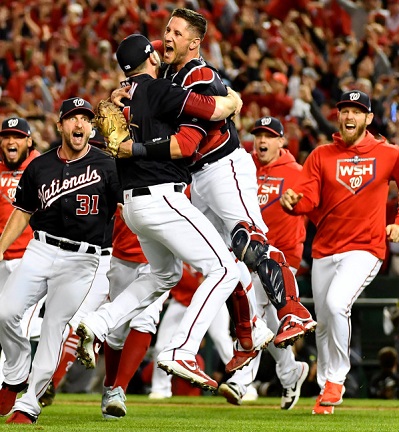
Max (the Knife) Scherzer (31) and Stephen Strasburg (far right) join up as the party starts with finishing reliever Daniel Hudson leaping in the arms of catcher Yan Gomes Tuesday night.

Let’s face it. Three pitching-dominant games are all well and good, for the Nationals and for anyone. But there’s nothing like a little hair-raising to make even a National League Championship Series sweep feel like an honest-to-God battle.

Even die-hard Nationals fans must have suspected it might take some doing, after all, to make it “Washington—First in war, first in peace, and first in the National League.” But make it the Nats did Tuesday night. And make it easy for them the otherwise overmatched Cardinals didn’t.

And somehow the Nats lived long enough to win 7-4 and sweep the Cardinals who never had even a single half-inning lead in the entire NLCS.

This time, there was no Book-damaged manager to hook a boy wonder an out away from a division series shutout and watch his team implode while leaving his best arm in the bullpen. This time, there was no stretch drive collapse. This time, there was no pair of catching errors (interference and throwing) to push the plunger deeper on a fifth-inning implosion. This time even their injuries couldn’t stop them.

This time, the Nats said nuts to all that.

After demolishing the Dodgers in a fifth division series game to get here in the first place, the Nats won the pennant in a sweep that felt more like they used vacuum cleaners instead of brooms. And had Nationals Park going nuts all Game Four long.

“I can truly say this is the best time of my career,” said series MVP Howie Kendrick, who’d been up and down with the Angels, the Dodgers, briefly with the Phillies, and then endured even a career-threatening Achilles tendon rupture as a Nat in 2018 before returning to hoist the best on-base percentage of his major league life as a role player this year.

“(I)t means a lot to be around those guys. I learn so much from them, and I love these guys just as much as they love me, and I know that 100%,” said Kendrick, who went 5-for-15 in the set and hit three doubles with three runs driven in in Game Three. “I think that’s the big reason why we have success, because we truly care about the next guy.”

Enough to land Washington’s first major league pennant since year one of the New Deal. Its first league championship of any kind since the Homestead Grays won the Negro National League pennant in 1948. Making this the second time a single-team city landed pennants in each league with separate teams.

Milwaukee can brag about two National League pennants and a World Series title with the Braves and one Brewers American League pennant. Washington has three Senators pennants and a World Series title in the American League and, now, one Nationals pennant in the National League.

And in the end it didn’t come quite as easily as reading of the four-game sweep on paper will make it look. “We still got work in front of us,” said Max Scherzer after the game, before diving back into the on-field party. The Nats re-learned about hard work Tuesday night without even trying. And they’d already learned about hard work starting in late May as it was.

A team that yanks itself up from a season-opening 19-31 to get to the postseason in the first place doesn’t reach the World Series without beyond-maximum effort in the end. And survival instincts. And baby sharking a la veteran pickup Gerardo Parra, who introduced it in honour of his little daughter who loves Baby Shark.” And Natitude enough.

“We knew where we were at one point, but we knew where we wanted to go,” said third baseman Anthony Rendon, who faces his first free agency after the postseason is finally over. “The season wasn’t over and back then we were upset, but it was still the first half of the season. You don’t win the division or the World Series in the first half of the season.”

Slice and dice Cardinals starter Dakota Hudson with a little help from momentarily caught-frozen Cardinal fielders? Yank another pair off Adam Wainwright coming in to rescue the poor guy but leave the Cardinals in a 7-0 hole after just one full inning? All well and good. The Cardinals escaped three runs shy of knowing exactly how the Braves felt in division series Game Five.

But don’t let Patrick Corbin spend most of his bullets in the first four innings, when he becomes baseball’s first to strike out double digits in four innings of any postseason games, ever. Even despite surrendering a sort-of excuse-me home run to Yadier Molina that rudely interrupted three more Cardinal strikeouts in the top of the fourth.

Because even pushed out of the boat early, these Cardinals weren’t allergic to the smell of blood in the water yet as they came to the top of the fifth.

A walk, a single, and a walk loaded Cardinals on the pond with nobody out. A ground out to second by Tommy Edman nudged a second Cardinal run home; a two-run double by Jose Martinez yanked the Cardinals back to within three. Then Corbin reached for reserves enough to nail Paul Goldschmidt and Marcell Ozuna on back-to-back swinging strikeouts to end that uprising before it got genuinely poisonous.

And that seven-run Nats first started looking safe again even with the Cardinals somehow grinding their way back to within three runs. Until it wasn’t.

Until Daniel Hudson relieving Sean Doolittle with two out in the top of the eighth plunked Molina with a man on and walked Paul DeJong to load the Cardinals on the pond. And with Matt Carpenter pinch hitting, the Cardinals were suddenly one solid swing away from changing the game entirely.

But Hudson ran it to 2-2 before luring a ground out to second out of Carpenter to dodge maybe the biggest howitzer shell of the Nats’ season to date. You can’t say the Cardinals went down like canaries. They made the Nats fight for their right to party.

Among numerous sadnesses for the Cardinals is that their bullpen went on from the first inning disaster to throw seven and two-thirds shutout relief, not without some doing, with seven strikeouts, one walk and four hits against them. This is what’s called heroism in a lost cause in some quarters. And it’ll be forgotten against the Nats’ final stand.

Who knew that after Corbin struck out the side swinging to open Game Four that Rendon’s sacrifice fly with nobody out and two on in the bottom of the first would prove the first splash of a profound flood? The Cardinals couldn’t have known, no matter what they did to the Braves. The racket in Nationals Park probably masked that the crowd knew nothing but merely hoped it wouldn’t stop there.

Juan Soto promptly shot one the other way into the left field corner to send Adam Eaton (double) home. After the Cardinals put eventual NLCS MVP Howie Kendrick aboard on the house, the Cardinals’ normally skintight defense betrayed them yet again.

The Nats’ grand old man, Ryan Zimmerman, slashed one up the third base line that Cardinals third baseman Edman stopped with a racing dive, scrambling up to throw to second. And the throw ricocheted off the glove heel of Kolten Wong, the Cardinals’ Gold Glove-caliber second baseman, unusually and unfortunately.

Leaving the bases loaded for Victor Robles in his second game back from a hamstring tweak. He hit a tall opposite field pop fly to shallow right, not far from the line. Wong from second and Goldschmidt from first ran toward the ball. Right fielder Martinez ran in toward the ball. With the three converging it appeared Martinez snapped his glove a time or two indicating he’d have it.

Martinez held up as if thinking Wong would have the play. Except that Wong made one move suggesting he’d back off. The ball hit the grass off Martinez’s left. It might as well have been a bomb drop. And Soto hit the plate with the third Nats run and the sharks still on the docks. Goldschmidt looked like a robbery victim. Martinez looked skyward as if praying.

But Nats catcher Yan Gomes shot one just past a diving Cardinal shortstop Paul DeJong and Kendrick and Zimmerman scored runs three and four. Cardinal manager Mike Schildt pulled his starter for Wainwright, his veteran approaching the end, who’d been magnificent for him all postseason long so far.

After Corbin dropped the kind of sacrifice bunt that some people still think is sacrilege today, Wainwright ran right into Trea Turner, the Nats shortstop who’d started the merry-go-round with a leadoff single. And Turner continued obeying the Nats’ order of the first inning: jump on the first pitch if it looks meaty enough but swing on the second if you must.

Wainwright hung him a curve ball to open. Turner jumped on it, hitting a high liner to left for which Ozuna inexplicably slowed before playing it on the hop when he was a mere step and a half from a catch. Two more Nats runs. The last two Nats runs of the game as things turned out. The last two they’d need the rest of the night.

This is how pumped the Nats were in the first. Only two Nats—Turner leading off—saw third pitches in their plate appearances that inning. Turner smacked a 2-0 sinker without a lot of sink into right field to open; Robles’ bomb drop in almost the middle of Martinez, Goldschmidt, and Wong was a fifth-pitch loft on 1-2 off a sinker hitting the low inside corner. Eaton’s inning-ending line out was a third-pitch curve ball. His one on/no out double, Rendon’s sacrifice fly, Gomes’s two-run single, and Turner’s eventual two-run single, all came on the first pitch of the turns.

And just like the Cardinals against the Braves, the Nats did it without even one ball flying over the fence. Maybe the baseball that was a little hopped up during the regular season did get just a little deadened down this postseason. Maybe. The Nats bombed their way into the NLCS in the first place and surely didn’t mind settling for pistols, machine guns, bazookas, and mere cannons to win Game Four.

Even if they didn’t suspect the Cardinals would put up four in the fourth and fifth. Even if they didn’t suspect three out of their now four-man flying bullpen—rookie Tanner Rainey and veterans Doolittle and Hudson—would have to perform feats of derring-do without nets over the final couple of innings. Derring-do, hell. Hudson had to plug the leak before the Hindenburg exploded in the top of the eighth. Then he got the three NLCS-ending air outs almost in a blink. Almost.

Once upon a time, just a couple of months ago, calls to the Nats bullpen caused Nats fans to reach for the nitroglycerin pills if not call for the crash carts. Now the only thing missing Tuesday night was Rodney not getting a chance to shoot another invisible arrow up, out, and maybe clear through the Capitol Dome.

Wait until the Nats get to tangle with either the Yankees or the Astros in the Serious. They may have to stop that nasty iceberg from hitting the Titanic. And they just might be able to do it. Only one team in baseball scored more runs over the regular season’s final 123 games than the Nats: the Yankees. And if the Astros can hoist Verlander, Cole, and Greinke, with Greinke not exactly a sure thing lately, the Nats can hoist Scherzer, Stephen Strasburg, and Corbin. Plus Anibal Sanchez and his high enough-flying junkyard.

But World Series against either of those teams won’t be the walk in the park (Nationals or otherwise) they took against the Cardinals, and they did get close enough to being mugged near the end. Neither the Yankees nor the Astros are liable to let even the Nats’ stellar pitching do to them what they did so amazingly to the Cardinals, whom the Nats’ arms struck out 48 times in 123 at-bats.

The Cardinals hit .130 as a team with a team .195 on-base percentage; Goldschmidt, who shook off early season struggles to hit 37 home runs, had one hit in the NLCS while striking out nine times. Their best hitter turned out to be Martinez (.500/.500/.700 NLCS slash line) in a mostly part-time role; he went 3-for-8 as a starter in Games Three and Four.

“There’s not one thing you can point to,” said Goldschmidt, before doing just that in his own case. ”I didn’t play well enough to help us win. One hit in four games, that’s not going to cut it when you’re hitting third. It just came back to bite us.” So does being out-scored 20-6 in a four-game set. Oh, that shark bites.

The Nats’ pitching and depth made the difference. The Cardinals didn’t stand a chance against a pitching staff working to a 1.25 ERA and a 0.64 walks/hits per inning pitched rate in the NLCS, while theirs posted a 4.50 ERA/1.41 WHIP. Against Scherzer (eleven strikeouts in Game Two), Strasburg (twelve in Game Three) and Corbin (twelve in Game Four), the Cardinals looked like the victims of three Bob Gibsons.

These Nats aren’t exactly afraid to go the distance if they have to, either. But another kind of distance may yet be in their way: only one team that ever swept a best-of-seven League Championship Series (it was a best-of-five until 1986) went on to win the World Series, the 1995 Braves.

“You can’t simulate that type of emotion that you go through in an NLCS, nor when the World Series starts,” says Jimmy Rollins, now a TBS analyst but long the Phillies shortstop anchorage who was one key to their 2008 World Series winner after winning the NLCS in five.

“You try to use it as rest. Mentally, you’re on. You’re thinking about execution, you’re thinking about who you may face as you’re watching the games, and game planning,” Rollins continues. “You have to do something mentally. Physically, you’re body’s naturally going to shut down for a day or two, then you have to get on the field, get on a treadmill, start throwing and get it revved back up . . . usually this long of a break is the only thing that stops momentum. Hopefully that’s not the case.”

Are you kidding? These Nats aren’t exactly afraid of any worst-case scenario. They survived the worst of all starting in late May. The pitching coach was executed. The team was going to be broken up or at least partially shaved down by the new single mid-season trade deadline. Manager Dave Martinez was going to the guillotine, the lethal injection chamber, the firing squad, or the electric chair. Whichever came first.

A measly week off to keep their minds calibrated, their bodies in tune, and their hearts well enough massaged shouldn’t be that problematic. Should it? Don’t ask now. The Nats are probably still in party mode today. And considering their franchise drought plus their city not having seen a World Series since the year Franklin D. Roosevelt first threw out a first pitch from the boxes at old Griffith Stadium, you can’t blame them.

On Tuesday night, hoisting the National League championship trophy from a podium set up post-game on the infield, Martinez could afford to channel his inner Ecclesiastian. “Often bumpy roads lead to beautiful places,” he told the Nationals Park throng who refused to leave just yet. “And this is a beautiful place.”

On the threshold of a dream

2019-10-14 StephenStrasburg

Striking out twelve in NLCS Game Three is child’s play. Getting Stephen Strasburg to crack a smile on the mound? That takes talent!

Roll over, George Stallings, and tell Yogi Berra the news. And send Phil Garner the bulletin while you’re at it. The Nationals are one win away from doing what only three teams in baseball history have ever done before. What a difference five months makes.

The 1914 Boston Braves, managed by Stallings—twelve games under .500 on 30 May; final record 24 games over .500 and into the World Series.

The 1973 Mets, managed by Yogi—twelve and a half  games under .500 on 15 August; final record three games over .500, winning the National League Championship Series and thus into the World Series.

The 2005 Astros, managed by Garner—twelve under .500 on 21 May; final record sixteen games over .500, winning the American League Championship Series and thus into the World Series.

Of the three only the Miracle Braves won their World Series; the You Gotta Believe Mets lost in seven games to the Athletics’ “Swingin’ A’s” (who swung in more ways than one), and the ’05 Astros got swept by the White Sox. (Who hadn’t won a World Series since the year before World War I ended.) It’s a shame nobody thought to stick a memorable nickname on those ‘Stros.

The Dancing Nats would like very much to become only the second major league team ever to win a World Series in the same year they were that far under .500 at one point. Even with their opponent standing to be whoever survives the Astros-Yankees skirmish in the ALCS, it’s not yet an unrealistic prospect.

That was the Nats on 24 May 2019: Twelve games under .500, the execution cocktail being mixed for their manager, and trade speculation finally if regretfully including no less than Max Scherzer himself. And you were tempted to pull out of your music library an ancient ballad by what was considered heavy metal music’s brainiest band in 1972, Blue Oyster Cult:

Then came the last days of May, I’ll be breathing dry air/
I’m leaving soon, the others are already there.
Would you be interested in coming along, instead of staying here?
They say the west is nice this time of year . . .

This is the Nats on Tuesday morning: Including the postseason, they’re 81-40 since the last days of May.

Sentimentally you want to believe a cancer-stricken ten-year-old whose lymphoma went into remission, got to spend 24 May with his Nats heroes, and throw a ceremonial first pitch changeup to Scherzer from the rubber to behind the plate got the Nats’ mojo working all over again.

Especially after Parker Staples threw out another such ceremonial first pitch before their Game Three demolition of the Cardinals Monday night. And the boy threw another changeup. Almost as wicked as the one Stephen Strasburg deployed among his other befuddling breaking balls.

But there were realistic reasons for the Nats’ self-resurrection: Trea Turner, Juan Soto, and Anthony Rendon got their health back. Soto turned the dugout into Soul Train after big home runs. Kid Gerardo Parra and old man Fernando Rodney brought some much needed more fun, fun, fun to the dugout and the clubhouse, from baby sharks to shooting pantomime arrows after shutdown innings.

Let the kids play? The Nats said let the kids of all ages play. All of a sudden, the next thing you knew was the Nats taking life and baseball one day, one game at a time, and remembering for all their game prep that Hall of Famer Willie Stargell had a point when he observed, “The umpire doesn’t say, ‘Work ball’.”

Rich or modestly well off individually, these Nats actually remembered how to play. Not just in the field, on the mound, or at the plate. This is Animal House, without the debauchery. These are the Alpha Omega Nats. You wouldn’t be shocked if they go out for laughing gas instead of dinner and drinks after games. Especially knowing that a lot of what’s happened since 24 May comes from playing each game for itself. They quit thinking the fate of the entire season rested on one game.

When even Strasburg—who usually looked so serious on the mound and in the dugout you wondered if he’d been raised in a Skinner Box—flashed big smiles after finishing a twelve-strikeout Game Three performance while his Nats made mincemeat out of Cardinals boy wonder Jack Flaherty and a few Cardinal relievers Monday night, you know things have changed in Natville.

It didn’t faze Strasburg one bit that he didn’t join the Nats’ almost-no-no parade. It almost fazed him more that his teammates wanted to smother him in a group hug after he was done. “They’re just trying to make Stras as uncomfortable as possible,” says outfielder Adam Eaton. “It’s great, and when Stras is uncomfortable, good things happen.”

When Parra tried to hug him, Strasburg replied with a few pats on the back but otherwise tried squirming away. Not a chance. “I’m not much of a hugger,” says Strasburg, who’s often seen as the most uptight Nat. “They kind of just surround me, so I just have to take it.”

He still doesn’t dare let himself enjoy a last laugh he’s earned so richly. But he should.

Remember when the world went ballistic over the Nats shutting Strasburg down in 2012, over a year after his career began with a bang that exploded into Tommy John surgery? You can’t do that when this might be his only chance at a World Series!!! the world cried angrily. You can’t tell us this kid’s future is that meaningless, the Nats shot back indignantly.

Now Strasburg’s 31. He’s gone from child prodigy to injury-compromised, from pitching student to . . . well, if not for Scherzer he’d be man of the house. Somewhere in there he became a dependable number two who comes up big enough when he’s needed enough. And he’s even learning to lighten up. There were times Monday night when you thought he’d actually crack a little smile in the split second before he delivered to the plate.

He’s also become one of the most quiet postseason horses in history; his 1.10 lifetime postseason ERA is second only to Hall of Famer Sandy Koufax among those who’ve started at least five postseason contests. And only one pitcher has ever worked a postseason game of twelve strikeouts or more without a walk: Hall of Famer Tom Seaver did that in Game One of the ’73 Series.

Some think the Nats put an end to the Cardinals’ season in the third inning Monday night. When Victor Robles—returning to the Nats lineup after being missing since Game Two of the division series with a hamstring tweak—shot a Flaherty slider, the one against which hitters on the season hit a measly buck eleven, not too hard but right past diving shortstop Paul DeJong.

When Strasburg executed what used to be a textbook sacrifice to the first base side leaving the Cardinals no possible chance of stopping Robles from taking second.

When Eaton with two outs bounced one right up the middle for the base hit that sent Robles home.

When Rendon smashed a hard foul near third base one pitch, then floated one toward the left field line for which Marcell Ozuna slid  only to have the ball bound off and out of his glove web, enabling Eaton to score and Rendon to have second. “Rendon does a good job of not punching out on what I felt was a pretty good executed pitch,” said Flaherty. “But that’s what he does. That’s why he is what he is.”

For Ozuna, who actually rated very well in left field this season as part of a very stingy Cardinals defense, that mishap was a mute horror. “Anytime you’re sliding feet first like that trying to make a play,” says Cardinals second baseman Kolten Wong, “as soon as you hit the ground, there’s going to be some kind of movement, and I think that’s what jarred the ball out of his glove.”

Then it was a walk to Soto, a wild pitch to Kendrick setting up second and third, and a line drive all the way to the right center field fence. That, Flaherty says, is the one Monday night pitch he really wants to have back.

But Flaherty can’t fix the Cardinals’ bats. The Redbirds are in danger of matching the 1966 Dodgers who could only muster two runs while the Orioles swept them out of that World Series. The Cardinals’ two came because of Nats fielding mishaps. And they’ve never had a lead in any of the NLCS games so far. Pitching coach Mike Maddux’s much-talked-about pair of holes in one on the Army-Navy Club golf course earlier Monday beat anything the Cardinals did at the plate.

Their ineffectiveness against off-speed pitching is killing them. Killing them even more is that enough of them are being thrown by power pitchers who’ve figured out or re-learned that sometimes you can win battles the sneaky way. The Nats’ NLCS walks/hits per inning pitched rate? 0.52. The Cardinals’? 1.42.

That ten-run first-inning disemboweling of the Braves to win a division series they nearly lost now looks like a pleasant dream. And they’re on the threshold of a season in which they won the National League Central at literally the last minute turning into a hard day’s nightmare of a finish.

“It’s definitely better pitching than the Braves,” says outfielder Jose Martinez, who’s accounted for a little over a third of the Cardinals’ NLCS hits with his four. “They [Strasburg, Scherzer, and Game Four starter Patrick Corbin] are three of the best pitchers in the big leagues.”

And now for the weirdest part. For most of the season the Nats’ bullpen could have been tried by jury for arson. They finished with the worst bullpen ERA in baseball. Only one team ever finished a season with baseball’s worst pen and a trip to the World Series at all: the 1918 Red Sox. (Whose starting rotation included a guy named Babe Ruth.) They’d like to be the second there, too.

But four Nats relievers—Rodney, Sean Doolittle, Daniel Hudson, and rookie Tanner Rainey—have turned up in the NLCS. Their ERA over four total innings work? Zero. The worst culprits in the hard-earned division series triumph, Hunter Strickland (18.00 division series ERA) and Wander Suero (27.00 division series ERA), may be being held in a remote cabin somewhere beyond the D.C. metro area with their overseers under orders to shoot them on sight if they even think about escaping to return to the pen.

The next-weirdest part? The Nats have overrun the Cardinals without relying on the long ball. Kendrick’s jaw-dropping, division series-winning grand slam, and Rendon and Soto’s solos earlier in that fifth game, seem like aberrations now.

The ball was juiced; the ball’s deadened, has been the postseason mantra from the conspiracy minded. The Nats couldn’t care less. Out of 28 Nat hits in this NLCS only two have flown into the seats or elsewhere over the fence and only twelve overall have gone for extra bases. The Cardinals’ eleven NLCS hits so far include only two for extra bases and none over the fence. They could have put the shots at the Nats and the Nats would have turned them into base hits.

“We’re a little flustered with trying to figure out how to get there,” says Wong, “but we know how good we are. Once we get going, man, this team, we steamroll.” You heard that allegation, too? The way these Cardinals are going against these Nats, Stan Musial himself couldn’t jump-start them, never mind put them back on the highway.

And it’s a shame. The Cardinals have taken it on the chin for a few years now. Former manager Mike Matheny was so incapable of deviating from his particular version of The Book to manage in the actual moment that he cost the Cardinals big in a couple of postseasons. Then Matheny lost his clubhouse and his job early enough in 2018, when among other things he let one veteran sourpuss be as close to a clubhouse bully as definable and then couldn’t walk back a public comment about “soft” young players.

And a rogue Cardinal scouting director was caught dead to right hacking into the Astros’ computer data base over a sixteen-month period. It made Leo Durocher’s then high-tech sign stealing to effect the 1951 Giants’ pennant race comeback resemble randy kids sneaking peeks at the comely housewife next door. Chris Correa’s been banned from baseball since, and for life, but he gave the entire Cardinal organisation an unfair image as cheaters.

The Nats haven’t been devoid of body blows, either. They overshot their mark against Matheny’s Cardinals in a 2012 division series win-or-be-gone Game Five, when they jumped the Cardinals for six runs in three innings, then started pitching as though trying for strikeouts on each pitch and hitting as though trying to hit six-run homers on each swing. They ended up losing, 9-7.

Later manager Matt Williams lost his clubhouse over his Matheny-like marriage to his own Book, his astonishing inability to communicate to the point where players often didn’t know they’d play until near the last minute before games, and his complete snooze when then-reliever Jonathan Papelbon tried choking then-right fielder Bryce Harper in the dugout after being eliminated in 2015 (get in his face over alleged loafing, sure; choke him, no way, Jose)—and Williams still sent Papelbon out to pitch the ninth instead of putting him through a wall himself.

“When, exactly,” since-retired outfielder Jayson Werth demanded to know of Williams at one point, very early in that season, “do you think you lost this clubhouse?”

And Dusty Baker found himself out of a job after two years, following the Nats’ spectacular fifth-inning implosion in Game Five of their 2017 division series against the Cubs in Wrigley Field. Baker may have learned his lessons about handling pitching but that implosion, through no fault of his own, wrote his pink slip after the series. When the 2018 Nats began with a reputedly uneasy atmosphere, Baker mused aloud, “Jayson Werth. That’s who they miss in that clubhouse.”

Scherzer, Strasburg, Rendon, Soto, and from-the-beginning mainstay Ryan Zimmerman seemed to prefer leadership by example over personality often as not. But something happened this season. A little new blood, a lot of remembering that baseball’s a profession but it’s also a game. And don’t let that 19-31 start get you down. One day at a time, gentlemen. Don’t stop the dance.

The Yankees and the Astros pick up in New York where they left off in Houston today, their ALCS tied at a game each. Wherever their set goes, whoever comes out as the last American League team standing, they’re not going to assume an easy time of things if the Nats do what no Washington baseball team has done since the birth of the New Deal.

Never mind doing what no Washington baseball team has done since Hall of Famer Walter Johnson—the historical antecedent for the Nats’ recent starters-as-relievers tactic—saved Game Seven of a World Series with four innings of scoreless relief. A month before Calvin Coolidge ran for and got his only elected term in the White House.

Of course the Nats have to win one more game first. They have Game Four coming and, if need be, three more shots at it coming. And even they know the Cardinals aren’t really as bad as they’ve made them look. But they really are thatclose to saying, “Washington—First in war, first in peace, and first in the National League.”

If they can get Stephen Strasburg to smile on the mound, these Nats just might be capable of anything.

The Nats on a Staples diet

2019-10-14 ParkerStaples

Ten-year-old Parker Staples preparing a ceremonial first pitch 24 May. He did it again Monday night—a wicked changeup. Almost like the ones ruining the Cardinals so far.

Who’s to say a lymphoma-stricken boy didn’t turn the Natonals’ season around on 24 May? Not the Nats limbering up for National League Championship Series Game Three Monday. And he did his share to help send the Nats to one game away from the World Series.

On 24 May, in remission, Parker Staples got his wish granted to be a National for a day, with a little  intercession from the Make-a-Wish Foundation, which does things like that and more for children suffering grave illnesses.

Parker got his wish beginning with Nats general manager Mike Rizzo signing him to a real live one-day player’s contract. He spent the day with his heroes in the clubhouse and on the field and got himself a nice round of signatures, sunglasses, and other swag from Anthony Rendon, Juan Soto, Yan Gomes, and Matt Adams among other Nats.

Then, looking proud and happy in his Nats home whites with his surname across the back above number 34, Parker walked out to the mound with Max Scherzer, whom he got to chat with before the moment, waiting behind the plate. The boy waggled his glove just a moment before going into a stretch at the rubber.

Then, he threw one to Scherzer that crossed the plate just under the low, lefthand-hitting corner. Scherzer’s pitch framing needed a little work; the boy missed a low strike by millimeters. But the kid threw one hell of a changeup.

And Max the Knife trotted back to the mound, plopped the ball into Parker’s glove, shared a hearty mid-five with the boy, then walked him off the mound toward the dugout in front of which he signed the ball for him.

That night, the 19-31 Nats ground their way back to 9-8 against the Marlins, of all people, when Soto crashed a three-run homer and Adams followed immediately with a solo blast in the bottom of the eighth. The Marlins’ lone answer back was Jorge Alfaro hitting Sean Doolittle’s first pitch of the ninth over the left center field fence, but Doolittle held on to close out the 12-10 Nats win.

Parker’s Game started the Nats’ season turnaround, right into the 74-38 they nailed from there to snatch a National League wild card, dispatch the Rockies in the wild card game, wrest the division series from the Dodgers, and pull back into Nationals Park Monday for Game Three of a National League Championship Series they dominated on the first St. Louis leg.

Hours before the game, the Nats couldn’t resist commemorating Parker’s first pitch. They tweeted, “On May 24, Parker threw out the 1st pitch at #Nats Park. On May 24, we turned our season around. Coincidence? We think not.”

You hoped it wasn’t pushing the Nationals’ luck to remind yourself Monday afternoon that, in a season which bullpen issues including their own were matters of life and death, their starting pitchers kept the other guys hitting .150 in this postseason so far. With a Game Three showdown between Stephen Strasburg and Jack Flaherty looming, boy wonder past (Strasburg) versus boy wonder present (Flaherty).

And with Scherzer himself hoping the joint went nuts Monday night. “I have a feeling it’s going to be even more crazy,” he told an afternoon presser, “given what we’ve done. Really, our first postseason win as an organisation, I think that means a lot to everybody in D.C., so it should be a fun time.”

Max the Knife got what he wished for. Nationals Park went nuts over the 8-1 Game Three win. And over being just one win away from the first World Series appearance by any Washington team since year one of the New Deal.

2019-10-14 ParkerStaples01

Parker Staples holding the 24 May lineup card Nats skipper Dave Martinez signed for him before that game.

With young Parker Staples throwing out the ceremonial first pitch again, another changeup hitting under the corner, too, the lad telegraphed Strasburg’s evening’s work only too acutely. Striking out twelve Cardinal batters on the night, not one of Strasburg’s strikeouts finished with anything resembling a fastball.

The power pitcher who hits 96 or better on the gun nailed those third strikes with changeups and curve balls and exploited almost to the point of mental cruelty the Cardinals’ continuing flaw, their near-complete inability to hit off-speed pitching.

By the time the game ended, the only shock was that neither Strasburg nor two Nats relief pitchers to follow even thought about throwing a screwball. But you’d forgive the Cardinals if they wanted to reach for unlimited highballs.

“It’s not like they’re throwing it right down the middle,” said Cardinals first baseman Paul Goldschmidt, a four-strikeout victim Monday night. “They’re making quality pitches. They’re throwing strikes and then they’re getting us to chase. They’ve done a good job. We’ve got to do a better job if we’re going to win.”

For three and a half innings the Strasburg-Flaherty matchup went mostly as advertised. Then the Nats slapped Flaherty silly in the bottom of the third. And Howie Kendrick went doubles happy on the night,  including driving one to send Anthony Rendon and Juan Soto home in the third, driving another one to send Rendon home in the fifth, and doubling in the seventh to kindly allow Ryan Zimmerman to single him home in the seventh.

An excuse-us Cardinal run scored in the seventh when Soto lost his footing as he fielded Paul DeJong’s should-have-been bases-loading single and threw inexplicably, perhaps in momentary confusion, toward an uncovered portion of real estate. It wasn’t even close to enough to negate the Nattacks.

“Shoot,” deadpanned Rendon after the game, “maybe we’re finally coming around.”

All Game Four starter Patrick Corbin has to do is stick to the script and resist the temptation to feed the Cardinals anything at or above the speed limit. And don’t worry about contact. The Cardinals’ defense was considered nonpareil entering this set, but any time the Cardinals managed to tag any pitch hard Monday night, there was a Nat with a glove committing grand theft base hit.

Rendon took a guaranteed leadoff hit away from Paul DeJong with a well-timed dive left in the third, and Victor Robles—freshly returned to the lineup after the hamstring tweak running up the line in division series Game Two—backpedaled deftly to reach for and snatch Kolten Wong’s leadoff liner to the track in the fourth.

As if to prove further that he was recovered well enough to make it count, Robles made Cardinals reliever John Brebbia pay for ending the fifth with back-to-back strikeouts by hitting a 2-1 fastball too far in the middle of the zone over the right center field fence to lead off the bottom of the sixth.

By the time the Cardinals got anywhere near a more balanced diet including fastballs, there on the mound, of all people, was Fernando Rodney—the grand old man of the Nats’ formerly beleaguered bullpen, who could probably say with a straight face that in his childhood the top ten were the Ten Commandments—to get them out in order in the eighth, including back-to-back strikeouts.

He threw Paul Goldschmidt one changeup near the end of a run of fastballs before catching him looking at a third-strike fastball. He threw Marcell Ozuna—whose premature slide trying for Rendon’s third-inning double let the ball get past him in the first place—two fastballs to open, then nailed him swinging and missing on (stop me if you’ve heard this before) a changeup.

Then as he walked away from the mound, Rodney turned, arched, and delivered his familiar arrow-shoot pantomime. You thought the big boppers, the dugout dancers, knew how to celebrate big moments?

Before you ask, I’ll answer: the Cardinals didn’t hit fastballs too well Monday night, either. Nats rookie reliever Tanner Rainey proved it by throwing sixteen fastballs in eighteen ninth-inning pitches to get rid of Jose Martinez (in the Cardinals starting lineup for a change) and Yadier Molina on swinging strikeouts before letting Tommy Edman settle for flying out to left to end the game.

Just don’t ask Kendrick to explain his torrid postseason to date. “Just having fun and trying to keep it loose,” he said in an on-field interview. “Same stuff I’ve been doing during the season, trying to stay consistent in my routine, trying to get pitches to hit.”

Five months ago the Nats were left for dead. Their manager was left to wonder when, not whether, he’d be taken on the perp walk to the guillotine. Now, they’re the swingingest act in Washington—at the plate, on the mound, in their dugout, and in their clubhouse.  “If you don’t have fun in this game, or in anything that you do,” said Rendon, “then in the end, you shouldn’t be doing it.

The Cardinals need a little of that. And any other mojo they can get working. As of the end of Game Three, they have two runs—both unearned—and eleven hits in this NLCS. Their manager Mike Shildt is only too well aware of it.

“We’ve got to get a lead at some point in this series. Hard to win a game if you can’t get a lead,”said Shildt, the man who promised after his team’s division series triumph to [fornicate] up anyone who got in their [fornicating] way. “We’ve got to figure out a way to create some offense early in the game and be able to hold it there. It’s the first time our pitching hasn’t been able to contain this offense. I’m confident we’ll be able to do that tomorrow.”

Maybe the Nats shouldn’t take chances. Maybe Parker Staples should be there to throw out the first pitch before Game Four, too. Considering the Nats season after he did it in May, and the Nats’ NLCS after he did it Monday night, well, if it ain’t broke, don’t call the repairman.

Millie’s song

2019-10-13 DanielHudson

Millie Hudson’s father and his team have their priorities straight.

Now I’m going to say it. Freshly minted Millie Hudson, daughter of Nationals reliever Daniel, exposed former Marlins executive David Samson as a horse’s ass.

When Daddy arrived at the delivery room for Millie’s premiere on the day of National League Championship Series Game One, Samson behaved more like the Philistines.

“Only excuse would be a problem with the birth or health of baby or mother,” Samson fumed in a Friday tweet. “If all is well, he needs to get to St. Louis. Inexcusable.”

So was Samson’s fuming. And he couldn’t wait to walk it back after Hudson bagged the final outs of the Nats’ Game Two win: “Happy to see Daniel Hudson get the save. I didn’t say he should miss the birth, & didn’t mean to judge his decision. I would have done everything possible to try to get him to St. Louis for game 1 of #NLCS, once health of baby & mom had been established. Respect his decision.”

Not so fast, Samson. You most certainly did mean to judge his decision because that’s what you did originally. “Inexcusable,” I believe was your word for it. If that’s not judging a decision, I’ve got two tickets to presidential impeachment hearings to sell you cheap.

If you want to put it in purely baseball terms, Hudson’s presence for Millie’s premiere didn’t exactly compromise the Nats against the Cardinals. Thanks in large part to Anibal Sanchez’s no-hit bid through seven and two thirds, the Nats won Game One, 2-0. And to a man the Nats had Hudson’s back.

None more emphatically than Hudson’s fellow back-end reliever Sean Doolittle. “If your reaction to someone having a baby is anything other than, ‘Congratulations, I hope everybody’s healthy’,” Doolittle snapped upon learning of Samson’s denunciation, “you’re an asshole.”

Never mind Hudson saying, “We didn’t exactly plan to have a baby in the middle of the playoffs.” Hudson knew long before the Nats even got to the postseason—you know, the one they weren’t supposed to reach in the first place after that 19-31 horror of a season beginning—that the only place he’d be when Millie debuted was by his wife Sara’s side.

“I heard somebody say one time: Baseball’s what I do, it’s not who I am,” the pitcher told the Washington Post‘s Barry Svrluga. “Once I had kids, it really resonated with me.”

The Hudsons actually thought they had it planned down to the nth detail going in. Millie Hudson wasn’t supposed to check in until 14 October. “That led Daniel and Sara Hudson to pull out their calendars and start mapping out days,” Svrluga writes. “If the Nats won the wild-card game and if the division series against the Los Angeles Dodgers was pushed to a decisive fifth game, maybe Daniel could shoot home to Phoenix, Sara could pop out the kid on command, and the Nats’ run could continue unhindered.”

Any father will tell you children have remarkable ways of changing the best laid plans in the tap of a smartphone app. They don’t do it maliciously, they do it because, well, they’re children. That’s what children do. Daniel and Sara Hudson will have time aplenty yet to teach Millie, when she’s teachable enough, that there is such a thing as perfecting the ratio between plan and execution.

But children in the womb don’t always behave according to plan or schedule. Millie is very normal that way. Her father high tailed it to Phoenix when learning she was liable to be induced the day before Game One. Hudson’s pitching repertoire includes a better than serviceable changeup. Taking her time until deciding Friday morning was her time to bow, his new daughter threw quite a changeup herself.

Nats manager Dave Martinez sounded as though he might be tempted to offer Millie a contract. “Apparently,” he cracked after Game One, “the baby didn’t want to come out until later on this morning.” After Game One, Martinez texted Hudson: “Hey, I got a name for your little girl: Anibala Sean Hudson.”

Thoroughly modern Millie will do just fine, thank you.

You’d have thought Samson took it personally when a baby girl not his own threw her changeup. Not that Millie Hudson was aware that the fate of the Nats rested so profoundly upon her exercising a woman’s perennial right to change her mind before she’d even poked her nose out from within her mother’s womb.

Neither was she aware that with one delivery she knocked Samson down and exposed as a baseball man who still seems to hold the ancient plantation mentality through which baseball executives considered their players commodities before humans.

Don’t go there about how much money Hudson earns as a pitcher. “A $90,000 slave is still a slave,” Curt Flood once said, once famously. Such baseball men as Samson today sometimes think the salient difference between players then and now is that Flood was a pauper compared to today’s slaves’ earnings.

“Samson’s [original] tweet did not seem to recognize–outside the scope of medical harm–that there was a need for any balancing test between family obligations and work obligations,” writes Forbes‘s Marc Edelman. “The analysis was entirely one dimensional as is sometimes the case with someone who spends their entire career in an executive position.”

Edelman also reminds you that Samson was still in office as the Marlins’s president when baseball agreed upon a postseason parental leave policy, instigated after Blue Jays pitcher Aaron Loup’s wife gave birth during a 2015 division series. “If Samson was really so opposed to the concept,” Edelman continues, “he could have encouraged the Marlins and other teams not to agree to the provision. Arguably, he should not be tweeting his objections years later.”

Who would have thought that one minute you’d hear people denouncing sports’ deadbeat dads, real or alleged, and the next you might find them denouncing a baseball player who thinks fatherhood is an honour?

Hudson—who signed with the Angels in February, was released in March, signed with the Blue Jays the same month, then was traded to the Nats at the new single mid-season trade deadline—certainly didn’t. “I went from not having a job on March 21 to this huge national conversation on family values going into the playoffs,” he told Svrluga. “Like, hey. Life comes at you fast, man. I don’t know how that happened and how I became the face for whatever conversation was going on.”

He became that face because a former baseball muckety-muck seemed to believe fatherhood is less important than throwing fastballs, sliders, changeups, and cutters at enemy hitters in the ninth inning. But don’t expect Samson to be a job candidate for the Nats’ front office anytime soon.

Asked about Hudson’s slightly unexpected Game One absence thanks to Millie’s dramatics, general manager Mike Rizzo said flatly, “It was a no-brainer.” Ask Nats owner Mark Lerner and he’ll tell you what he told Svrluga in support of his pitcher: ““Who could think anything else?”

“These decisions are easy,” Rizzo also said. “A happy player is a performing player. We’ve got to take care of our people. You have to treat this like a family. And the important thing is, we’ve got a new little member of the Nationals family.”

When was the last time you heard anyone around the Marlins, during or after Samson’s presidency, describe the floundering Fish as anything resembling a family?

Hudson, of course, returned to the Nats in St. Louis on Saturday, where he got to nail the final two outs in a 3-1 Game Two win that began with Max Scherzer taking a no-hit bid of his own into the seventh, where Cardinals first baseman Paul Goldschmidt ruined the no-no with a leadoff hit.

“Having a baby is the biggest blessing in the world,” the reliever said. “To come out here and get a save in a playoff game is second to that, but it’s pretty cool.”

Millie Hudson is a lucky little girl to have a father who believes fortune has to wait in the on-deck circle for family, and with colleagues and bosses who have his back without hesitation or apology. That’s one Natitude you should wish everyone else had.