Davey Johnson, RIP: “Forward thinker with old-school soul”

Davey Johnson

Davey Johnson at a 2016 reunion of his 1986 Mets. L to R: Keith Hernandez (1B), Jesse Orosco (RP), Ray Knight (3B), Lee Mazzilli (OF-PH), Johnson. They made the Deltas of Animal House resemble monks.

In 2012, on the threshold of managing the Nationals to their first National League East title after they moved from Montreal, Davey Johnson had mortality very much on his mind, after his one-time Mets player and lifelong friend Gary Carter lost a battle with brain cancer.

Johnson had seen Carter the previous winter and played golf with him at Carter’s charity event for needy children. When The Kid died, Johnson couldn’t bring himself to attend the funeral. “He would want me to be doing what I loved and not crying over him,” Washington Post writer Adam Kilgore remembers Johnson saying. “I don’t want nobody crying over me, either. It’s that simple. It may be callous, but I don’t look at it that way.”

The man who bookended both Mets World Series championships—he flied out to Cleon Jones to finish the 1969 Miracle Mets triumph, and managed the (shall we say) swashbuckling 1986 Mets to a World Series title—died Friday at 82.

Perhaps former Nats general manager Mike Rizzo described him best, in a Saturday text message to Kilgore: “Davey was a tough guy with a caring heart. One of the great baseball minds of all-time. A forward thinker with an old-school soul.”

During his playing days, Johnson took computer courses as a Johns Hopkins University graduate student and used what he learned to develop best possible baseball lineups. Offering one to his irascible manager Earl Weaver, who spurned it, Johnson said, “I don’t know whether to tell Earl, but the sixth-worst lineup was the one we used most of the time [in 1968].”

When he became a manager in the Mets’ system and then for the Mets themselves, Johnson brought such thinking plus his computer into his clubhouse and dugout. It’s entirely likely that he pushed the door open to sabermetrics as an active game tool and not just a postmortem analysis. He looked for the matchups and took the concurrent measure of his players at once.

But he wouldn’t let you call him one of the smartest of the game’s Smart Guys. “I never thought I was smart,” he said in 2017. “But I love to figure out problems. Through my stubbornness and relentlessness, I get to the end.” Bless him, he had to learn the hard way that the end had more than the meaning he had in mind.

“I treated my players like men,” he once said of his Mets, whom he led out of a dark age through a pair of hard pennant races and second-place finishes before they went the 1986 distance. “As long as they won for me on the field, I didn’t give a flying [fornicate] what they did otherwise.”

Not even when they celebrated a too-hard-won 1986 National League Championship Series by trashing their United Airlines charter DC-10 with partying that made the Gas House Gang and Animal House’s Deltas resemble conclaves of monks.

Maybe Johnson really was a forward thinker with an old-school heart. He treated like men a team with too many players behaving off the field as though their second adolescence came or their first hadn’t ended yet. Such straighter arrows as Hall of Fame catcher Carter plus infielders Howard Johnson, Ray Knight, and Tim Teufel, and outfielder Mookie Wilson, were the exceptions.

“He was just a player’s manager,” said Wilson upon Johnson’s passing. “He made it fun to go to the field. He laid down the law when needed, but other times he just let us play.” Then, and right to the end of his tenure on the Nationals’s bridge, Johnson liked to tell his players, “You win games. I lose them.”

Little by little, general manager Frank Cashen got less enchanted with his team and his laissez-faire manager. No two more opposite minds could ever have come through the Oriole system to bring the Mets to the Promised Land. And almost as swiftly as they got there, Cashen began letting his most characteristic players escape.

“Maybe we’ve made too many trades for guys who are used to getting their asses kicked,” said Dwight Gooden, the pitching star first made human by ill-advised work to fix what wasn’t broken in spring training 1986 and then a long war with substance abuse, to Jeff Pearlman for The Bad Guys Won. The guys who used to snap . . . they’re gone.”

Some also thought Cashen’s gradual dismantling of the team that should have ruled the earth or at least the National League for the rest of the decade took a toll on and the edge off Johnson’s once-formidable in-game cleverness. (He was known to be less than enthusiastic about several trades instigated by either Cashen or his then right-hand man Joe McIlvane.)

Once a second base star with the Orioles who also set a record for home runs in a season by a second baseman as a Brave, Johnson faced the proverbial firing squad in early 1990. It wouldn’t be the last time he brought a team to the Promised Land or its threshold only to be shoved to one side.

He took the Reds to the first-ever National League Central title after the post-1994 strike realignment—despite being told early that season it would be his last on that bridge. Capricious owner Marge Schott apparently didn’t like that he’d lived with his wife before she became his wife.

Then the Orioles made a dream come true and hired Johnson to manage them. Season one: 1996 American League wild card. Season two: The 1997 AL East. Neither brought him a World Series title. The wild card led to an American League Championship Series loss. (The outstanding memory: Jeffrey Maier making sure Derek Jeter’s long drive wouldn’t be caught for a homer-robbing out.) The division title led to another ALCS loss (to the Indians).

Johnson and Orioles owner Peter Angelos weren’t exactly soul mates. Angelos steamed all 1997 when Johnson fined Hall of Fame second baseman Roberto Alomar for missing a team function and ordered the fine to be paid to the charity for which Mrs. Johnson worked as a fundraiser. Johnson admitted soon enough that that was a mistake. (Alomar paid the fine to another charity.) Angelos wanted Johnson to say publicly he’d been “reckless.”

The manager declined, politely but firmly. Then, after the Orioles postseason ended, Johnson waited for Angelos to tell him, ok, you won the division again, that’s enough to let bygones be bygones. “Last week, Johnson called the Oriole owner,” wrote the Washington Post‘s Thomas Boswell, on 6 November 1997.

They talked. And yelled at each other some, too. Aired their differences. Johnson hoped it would help. That’s how it works in the clubhouse. You got a problem with me? Spit it out. Then work it out.

Johnson took a chance on Angelos. When challenged, maybe he’d respond like a big leaguer. Sometimes, after the venting is finished, a friendship develops—even a strong one. Sometimes you just agree to disagree and keep on fussing, like Earl Weaver and Jim Palmer. Either way, you respect each other and pull in the same direction.

Instead, all Johnson heard from Baltimore was silence. So, Johnson had his answer. Angelos wanted Johnson to resign as manager. If the Orioles fired him, they’d have to pay Johnson $750,000 next season . . .

. . . Nobody wants to be where they are not wanted. Especially if they are wanted almost everywhere else. “I’ll make it easy for him,” Johnson said. He wrote to Angelos: “I offer my resignation.”

On the same day Johnson was named American League manager of the year by the baseball writers, his resignation was accepted by Angelos.

Taking the high road helped make sure Angelos wouldn’t try to renege on the $750,000 he still owed Johnson for 1998. You think Angelos appreciated that high road? Not a chance. As with departed Orioles broadcast mainstay Jon Miller, Johnson “asked to be treated with the respect—in contractual terms—that his performance merited.”

In response, Angelos orchestrated the exodus of each. After Miller left, Angelos claimed Miller wanted to leave, contrary to appearances and Miller’s amazed protestations. Yesterday, Angelos said of Johnson, “It seems to me he wanted to move on.” By way of comment, let it be noted that Angelos has one of the rare law firms in which there are no partners. It’s just his name on the door.

Davey Johnson

Once a star second baseman in Baltimore, Johnson presses a point as a successful Orioles manager—who ran afoul of owner Peter Angelos, as Angelos made sure only too many did.

Johnson didn’t remain unemployed for long. (Neither, of course, did Jon Miller.) The Dodgers brought him to the bridge for 1999. He had his first losing season as a manager (though he won his 1,000th game in the job), then turned the Dodgers around in 2000 but fell short of the division title. Back to the firing squad. Again.

He then managed American and (one year) Netherlands teams in international competition before being hired into the Nationals front office. When manager Jim Riggleman decided to quit in June 2011, Johnson was named his eventual successor. He took them to a third-place NL East finish, their best since moving to Washington from Montreal, then led them to the NL East title in 2012 but a division series loss to the defending world champion Cardinals.

That didn’t keep his players from respecting him. Johnson must have come a very long way from the years when a laissez-faire approach to managing men eventually blew up in his face. I could be wrong, but I don’t remember any of his Cincinnati, Baltimore, Los Angeles, or Washington teams accused of trashing jumbo jets, for openers.

“If you come out here and you play hard and really work your tail off,” said his Rookie of the Year winner Bryce Harper during that season, “he’s going to like that. He plays it hard and he plays it right. That’s the type of manager you want.”

“Davey was an unbelievable baseball man but an ever better person,” said longtime Nats mainstay Ryan Zimmerman in a text to Kilgore. “I learned so much from him about how to carry myself on and off the field. No chance my career would have been the same without his guidance. He will be deeply missed by so many.”

On and off the field. Make note.

Johnson did win his second Manager of the Year award guiding the 2012 Nats. He’s one of seven to win it in each league; his distinguished company: Tony La Russa, Lou Piniella,  Buck Showalter, Jim Leyland, Bob Melvin, and Joe Maddon. After a second-place 2013—made slightly worse than it looked when he opened the season saying it looked like a World Series-or-bust year to be—Johnson elected to retire.

“In one respect,” Boswell wrote after his Oriole departure, “he’s different than almost every other manager of his generation. He doesn’t come to ownership with hat in hand. He doesn’t act like he’s lucky to be a big league manager and could never get any other job half so grand. He’s an educated, broadly accomplished man. And he carries himself that way. It has cost him.”

Johnson learned compromise as he aged, both in the game and away from it. So did a few of his former players who once butted heads with him or otherwise made him resemble Emperor Nero fiddling while Flushing flushed. (Darryl Strawberry, with whom Johnson had a relationship often described as “testy,” came to believe Johnson was the greatest manager he ever played for.)

Maybe tragedy had something to do with it, too. Johnson’s daughter, Andrea, once a nationally-ranked surfer but a diagnosed schizophrenic, died of septic shock in 2005; his stepson, Jake, died of pneumonia in 2011. (He also has a stepdaughter, Ellie.) Even the most impregnable man can be wounded. Even men who win two World Series as an Orioles second baseman and one managing the wildest and craziest Mets team of the 1980s.

May the forward-looking old-schooler be escorted to a happy reunion with his daughter, stepson, host of teammates, and Kid Carter in the Elysian Fields.
Goodbye, RFK. (Stadium, that is . . . )

Olaf Hall

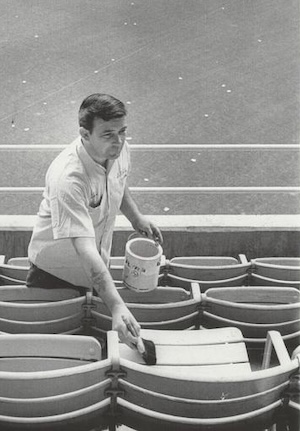
Olaf Hall, RFK Stadium worker, painting white an outfield  seat struck by one of Senators legend Frank Howard’s mammoth home runs. 

Time was when I worked shy of a year at a Washington, D.C. think tank, lived just outside Washington in Capitol Heights (Maryland), and walked the five miles to work every day on behalf of saving what little money I earned. The route from my little hideaway to my job included walking past RFK Stadium.

Perhaps providentially, I had no choice but to walk past the old tub. Not unless I wanted to take the Metrorail, which had a station that was a short walk from my little hideaway. But the baseball maven in me would have had me flogged for even thinking about avoiding RFK.

My days began, after all, with spending time and my breakfast with Shirley Povich, the founding father of the Washington Post‘s sports section. He founded it more or less when the ancient Washington Senators (as in, Washington–First in war, first in peace, and last in the American League) won their only World Series in (count ’em) two tries before they absconded to Minneapolis.

When those days didn’t begin with Povich, they began with Thomas Boswell, now the freshly-inducted Hall of Fame baseball writer, also of the Post. (I refuse to say the official award name until the Baseball Writers Association of America gives it a name far more properly fitting than “Career Excellence Award.” Like maybe the Shirley Povich, Roger Angell, or Wendell Smith Award.)

I’d then tuck the paper into my briefcase and make the aforesaid five-mile walk. Passing RFK Stadium. With only one apology, that I’d never gotten to see a baseball game there and that I’d forgotten to buy myself a Washington Senators hat while I worked in and lived next to D.C. And while I tended to walk with a certain vigour, on behalf of losing physical weight and as much mental and spiritual baggage as I could lose (I was separated from my first wife and en route a divorce), I didn’t mind slowing down to take a slow stroll around the Washington Hall of Stars—if I could talk an early-arriving stadium staffer into letting me in.

Frank Howard

Howard only looked as though he was going send a pitcher’s head and not a baseball into the seats. No gentler giant ever played baseball in RFK Stadium—or anywhere.

Up in the mezzanine were Hall of Stars Panels 6 through 8. Honouring such Old Nats as owner Clark Griffith, Hall of Famers Joe Cronin, Goose Goslin, Bucky Harris, Walter Johnson, Harmon Killebrew, and Early Wynn. Honouring such Negro Leagues legends as Hall of Famers Josh Gibson and Buck Leonard. Honouring such not-quite-Hall of Fame Old Nats as Ossie Bluege, George Case, Joe Judge, Roy Sievers, Cecil Travis, Mickey Vernon, and Eddie (The Walking Man) Yost. Honouring Vernon’s fellow Second manager Gil Hodges. Honouring such Second Nats as Chuck Hinton and Frank Howard.

It was easy to take in such history and all its pleasantries and calamities alike. It was tough to look at the field below and see, aside from the football markings for the Redskins (oops! today we call them the Commanders), the inevitable ghosts of the saddest day in RFK Stadium history: the day heartsick fans broke the joint over the hijacking of the Second Nats to Texas.

“Right where . . . the Senators played their final game in 1971 and the Nationals brought baseball back in 2005—that’s where the crews from Smoot Construction are separating concrete from metal so they can be hauled away separately,” writes the Post‘s Barry Svrluga. “Whatever can be repurposed will be . . . ”

Anyone who has driven or walked by RFK Stadium over the past decade or so knew it would come down, knew it had to come down eventually. Long ago it devolved into an ugly relic that served no one. This was inevitable.

But I have to admit that as I watched the process over that morning last week, I got a little emotional . . . I was at that first game when baseball came back. I saw the stands along the third-base line bounce. I watched Ryan Zimmerman drill his first walk-off home run to beat the New York Yankees on Father’s Day in 2006. I watched Nationals owner Ted Lerner and then-manager Manny Acta dig out home plate from the ground after the final game in 2007.

. . . Do yourself a favor, though. Take some time over the coming weeks and months to drive west on East Capitol Street from Interstate 295 or east on Independence Avenue from downtown. Do a loop around RFK before it vanishes completely. This is athletic history. It’s D.C. history. And piece by piece, it’s finally being torn down.

Ryan Zimmerman

Ryan Zimmerman mobbed and hoisted after his Father’s Day game-winner in RFK, 2006.

Well, I took my slow strolling loops around the joint 35 years ago. When baseball’s return to the nation’s capital was still a fantasy. “Pardon my French: le baseball est revene á Washington,” wrote Radio America founder James C. Roberts, in Hardball on the Hill, in 2001. “In Montreal, that’s how they would say, ‘Baseball is back in Washington.’ They are words I long to hear—in any language.”

Baseball might appear now and then in the old tub until 2005, never more transcendantally than when they cooked up the Cracker Jack Old-Timers Game in 1982 . . . and Hall of Fame shortstop Luke Appling, leading off for the American League’s alumni at age 75, caught hold of a second-pitch meatball from Hall of Famer Warren Spahn, age 61, and sent it behind the specially-shortened left field fence, but traveling a likely 320 feet—a major league home run no matter how you slashed it.

“It was a good pitch, it was right there, and I just swung away,” Old Aches and Pains  deadpanned after the game.

Machinations of dubious ethics to one side, including baseball government taking temporary ownership, Montreal (her city fathers, not her baseball fans) then didn’t seem to want its Expos that much anymore. Washington was only too happy to welcome them. Even the President of the United States donned a team jacket of the newly-rechristened Nationals and threw a ceremonial first pitch. Actual major league pitchers would kill puppies to have the kind of slider Mr. Bush threw—with a ball bearing a unique if sad survival story.

Senators relief pitcher Joe Grzenda had only to rid himself of Yankee second baseman Horace Clarke to secure a Second Nats win on that heartsickening farewell day in 1971. Grzenda never got the chance because all hell that spent much of the game threatening finally broke loose. Fans poured onto the field in a perfect if grotesque impersonation of hot lava soaring over and down a volcano’s side. The umpires forfeited the game to the Yankees. When the mayhem ended, RFK Stadium resembled the net result of a bombing raid.

Perhaps miraculously, Grzenda saved the ball. He presented it to Mr. Bush on Opening Day 2005. It took about 12,000+ days for that ball to travel from the RFK mound to the RFK plate by way of its detour in Grzenda’s custody.

The old structure, built as D.C. Stadium to open in 1962, renamed for an assassinated presidential candidate in 1969, has been the site of assorted joys and jolts. It closed officially in 2019; its final official baseball game was in 2007. “Without RFK, who knows where we would be?” said Chad Cordero, relief pitcher, and the first man to hold the official closer’s job as a Nat, upon that closing. “We might still be in Montreal. We could be somewhere else. This place has treated us well. We have some great memories here.”

And, despite the circumstances that brought me there, so do I. Even if they have to be one part a Hall of Stars display and 99 parts my imaginings.

Most of those stars didn’t play in RFK Stadium, but it was quiet fun to think about Early Wynn, traded away long before, but showing up for the White Sox trying to keep Chuck Hinton from hitting one out. (On the 1962 Second Nats, Hinton tied for the team home run lead with . . . Harry Bright, the man who’d be remembered best, if at all, as the strikeout victim securing Hall of Famer Sandy Koufax’s breaking of the single-game World Series strikeout record a year later.)

It was even more fun remembering the occasional Senators game televised to New York on a Game of the Week offering and watching gentle giant Frank Howard carve his initials into some poor pitcher’s head as he hit one into orbit. Howard, the Senator above all the rest who didn’t quite enjoy the team being hijacked to Texas. Howard, who brought that heartsick RFK crowd to its feet when he hit one into the left field bullpen midway through the game to start the Second Nats comeback that turned into a win that turned into a forfeit.

“What can a guy do to top this?” he asked after it was all over. “A guy like me has maybe five big thrills in his lifetime. Well, this was my biggest tonight. I’ll take it to the grave with me. This was Utopia. I can’t do anything else like it. It’s all downhill the rest of the way.” That from the man who also once said, “The trouble with baseball is that, by the time you learn to play it properly, you can’t play anymore.”

They’re demolishing RFK Stadium slowly, on behalf of environmental concerns, so the Post says. The seats are long gone. The rest has been going one portion at a time. It wasn’t the most handsome of the old (and mostly discredited) cookie-cutter stadiums. But something seems as off about the piecemeal disassembly as the big dent in the rooftop that made the joint resemble a stock pot left on the stove too long.

Note: This essay was published originally by Sports Central.

No más for Stras

Stephen Strasburg

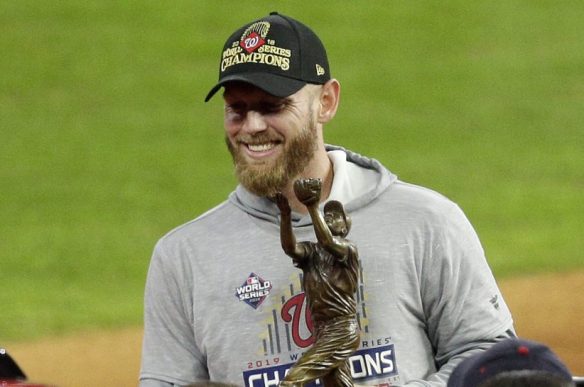
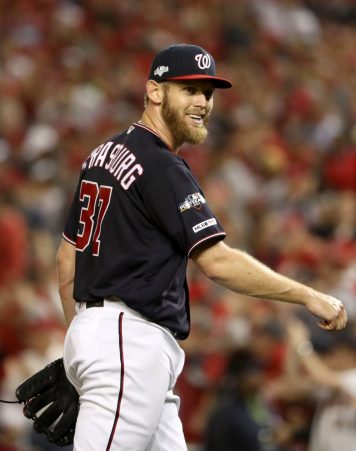
Now-retiring Stephen Strasburg has much to be proud of, and his career has much to teach future pitchers and coaches about mechanical issues.

There was no pleasure for me when I wrote, in June, that since Stephen Strasburg underwent throacic outlet syndrome surgery he’d pitched only once, a year before I wrote. And, that it was more than likely that his career was really over.

Strasburg’s attempts to rehabilitate since that surgery haven’t worked. The 2019 World Series MVP tried everything, all the way to limiting his workouts to his lower body but discovering they strained his upper body thanks to nerve damage. Two months ago he hoped to accept it if his body told him not to even think about the mound again.

He’s accepted it. The word came forth Thursday that Strasburg’s calling it a career, with only a formal September announcement to come.

The news hit the Internet running when we’d barely processed fully that Shohei Ohtani suffered a second ulnar collateral ligament tear in his pitching arm. If Ohtani undergoes a second Tommy John surgery, he has a better chance of returning to the mound at all. Assuming his continuation as the Angels’ designated hitter doesn’t cause even more damage before he might undergo the operation.

Strasburg’s eventual fate may have been far more cut-and-dried, for all the man’s determination to return after assorted injuries. The root was his pitching style, the inverted-W positioning of his arms, with both elbows above his shoulders as he cocked to throw a pitch. The positioning strains elbow and shoulder alike.

In Strasburg’s and others’ cases, it’s numbered career days even if they can’t really pinpoint the likely end. It’s also a comparatively recent phenomenon. The inverted-W positioning, Clearing the Bases author Allen Barra observed in 2011, began coming into play when the full windup began disappearing from the pitching repertoire.

Whenever you ask how the like of Hall of Famers Warren Spahn and Juan Marichal could pitch 250+ innings a season without arm or shoulder trouble, Barra says, the answers are several (including that they just might have been outliers) but the primary just might be the full windup. (In Marichal’s case, he had about sixteen different ones, not to mention about a dozen different leg kicks including his fabled Rockettes-high kick.)

[It] took advantage of the momentum of their whole body to give velocity to the pitch. In recent decades, with pitchers more concerned about holding runners on base, the windup has largely gone the way of the two-dollar hot dog. The Inverted W is the result of a pitcher trying to add speed or finesse on a pitch by forcing the delivery—in other words, his arm working against his body instead of with it.

Strasburg almost never pitched with a full windup. The most he’d show in the way of any kind of windup would be lifting his hands to just below his chin, before turning to throw and cocking into that inverted-W before throwing. WIth his landing leg’s foot planted ahead of, not with the throw.

The no-windup delivery by itself isn’t dangerous. Don Larsen pitched his perfect game in the 1956 World Series using a no-windup delivery, hands set at the letters before throwing. But Larsen also didn’t have the inverted-W. His pitching elbow didn’t come above his shoulder, his arm was “up and ready,” above his head releasing the ball, as his left foot landed.

A no- or little-windup delivery with the inverted-W, alas, is something else entirely. That inverted-W plus 2003 overwork contributed the bulk of the injury trouble that turned Mark Prior’s pitching career from phenomenal to science experiment. (There were a few other injuries, of course.) But I bet you don’t remember a Hall of Famer whose career ended because of it.

Don Drysdale

Don Drysdale—the inverted-W put paid to the Hall of Famer’s career in 1969 with a dissipated rotator cuff.

Don Drysdale had the inverted-W. He pitched longer with it than you might reasonably expect, even through previous shoulder pains. The year after he broke Walter Johnson’s consecutive shutout-innings record, Drysdale’s rotator cuff dissipated and ended his career in a time when surgery on the cuff didn’t exist.

Barra wrote that Joba Chamberlain was the Yankees’ Strasburg, the single hardest throwing righthander the Yankee system had produced in decades. He also observed that, with all the Yankee tinkering upon the much-hyped, talented Chamberlain, they missed the biggest hindrance he’d developed, the inverted-W cock-and-throw style.

The issue with the inverted-W isn’t just the elbow and shoulder straining. It’s a timing issue, too. As analyst Chris O’Leary (the aforementioned “up and ready” was his descriptive phrase) has written, “[T]he position isn’t damaging in and of itself.”

However, by coming to this position, [a pitcher] is ensuring that his pitching arm will not be in the proper position at the moment his shoulders start to turn. As with pitchers with other timing problems like rushing, because his pitching arm is so late, he will dramatically increase the stress on both his elbow and shoulder.”

That’s “late” as in a pitcher’s front, landing foot planting before his arm is back around throwing the pitch, not as he throws it.

Strasburg may have been extremely fortunate to return from Tommy John surgery as a successful pitcher. But his mechanics and the timing issues they can cause, even if he modified them somewhat by the time of the 2019 postseason (he’d long fixed an issue with his pivot foot, training it to be fully parallel to the rubber), may have been destined to take him out at last with a shoulder compromised so severely that he couldn’t even pick his daughters up for fatherly hugs and affection.

That’s more than enough to make a man think that, no matter how much he loves the thrill of competition and the spoils of success, there comes the moment when it’s just not worth pursuing it further. Ask Hall of Famer-in-waiting Joe Mauer, who finally retired because of what concussions did not just to his career but to his ability to be the husband and father he prefers to be.

They’ll still have to talk about how to handle the rest of Strasburg’s uninsured mega-contract, the one he signed after coming away as that 2019 Series MVP and exercising his opt-out clause, only to click his spikes three times saying “there’s no place like home!” and getting the deal. He didn’t want to leave Washington, and God plus His servant Walter Johnson know Washington didn’t want him to leave, either.

He didn’t ask for his body to keep him from pitching and earning the dollars to come, no matter how treacherous his pitching mechanics proved. No professional athlete does. The mind overcomes the body’s basics only so often, and no two bodies are exactly alike. Strasburg’s kept him from posting the Hall of Fame case his talent and performances when healthy suggested. Now it sends him to retirement at 35.

The Nats couldn’t insure Strasburg’s post-2019 deal without paying ferociously high premiums. If Strasburg had retired without injury, he’d have left the remainder on the table. But with TOS putting paid to his career the Nats will pay out the remaining $150 million on the deal, including some deferred payments that will keep paying the righthander through 2029.

If you consider the jumpstart his original arrival gave the Nats for credibility, the deadly postseason resume (1.46 ERA; 2.07 fielding-independent pitching; 0.94 walks/hits per inning pitched; 11.5 strikeouts per nine innings), that 2019 Series MVP pushing the Nats toward the finish line and into the Promised Land, the franchise strikeout leadership, Strasburg has earned every dollar.

Maybe the real miracle was that Strasburg could and did pitch so well as long as he did. A young man that talented, who could and did deliver some big moments in a career that was good, often great, sometimes beyond these dimensions, has to say goodbye not because age caught up to him but because his body said, “Halt right there, brah” and meant it this time.

It took Strasburg long enough to let his pleasure in the game show through his usually stoic countenance, in large part because the early hype might have suffocated him. But he went from baseball’s No. 1 draft pick to a World Series MVP before he was finished. That’s something in which to take pride and joy.

Almost as much pride and joy as we hope Strasburg enjoys raising his family and living whatever second act in life that he chooses to live.

Strasburg Agonistes

Stephen Strasburg

The proud and happy MVP of the 2019 World Series may face career-over now.

Stephen Strasburg’s father moved to northern Virginia to be closer to his son. Three weeks after Strasburg got a stress-reaction diagnosis, his father died. The son, an only child, cleaned the father’s apartment out last fall and discovered the old man kept a library of newspapers and magazines chroncling his baseball career.

There it was. From Strasburg’s days as San Diego State’s most-hyped major league draft prospect to his early Nationals splash, all the way to his triumph winning the 2019 World Series’ Most Valuable Player award. And all the injury-addled points around and in between following his early-career Tommy John surgery.

“Time has gone so, so fast,” he told Washington Post writer Jesse Dougherty. “A lot of guys that you played with have moved on and they’re in the next chapter of their lives. It’s crazy to think about how short baseball careers can be.” Crazy and, in Strasburg’s case, sobering and saddening.

A month after that Series triumph, Strasburg got his fondest wish. In essence, and I said as much at the time, he clicked his spiked heels three times and pleaded, “There’s no place like home! There’s no place like home!” He got his wish, a seven-year, $245 million contract extension making him a Nat for life. It’s what he didn’t wish for that has Strasburg at a sad crossroads now.

He didn’t wish not to pitch on. But since undergoing thoracic outlet syndrome surgery, Strasburg has pitched only once, last June, before hitting the injured list again, Dougherty observed, with a stress reaction in two ribs. That was well enough after Strasburg underwent carpal tunnel syndrome surgery—and learned the hard way that that was a mere pilot fish for TOS.

If you look at Strasburg now, even at age 34, he still looks as though he could go out and give you seven innings. But he only looks that way. Underneath, his arm and shoulder remain a mess. There’s the very real chance that all the surgery on earth won’t let Strasburg return to the mound again. Ever.

And it’s not for lack of trying. Dougherty has recorded Strasburg’s efforts to rehabilitate, all the way down to limiting his workouts to his lower body only to discover those, too, strain his upper body because of nerve damage. Last fall, Strasburg still hoped to get well enough to pitch again. By now he may be hoping just to accept it if his body finally tells him pitching again isn’t an option.

The Nats have had little beyond trouble since that stupefying World Series triumph. Now they’ve got a bigger pile of it above and beyond their 25-33 record this year and their sitting at the bottom of the National League East heap. Strasburg’s been shut down entirely since late April with severe nerve damage. This may be the prelude to shutting down his pitching career entirely.

The Nats are on the hook for the rest of Strasburg’s contract after they couldn’t insure it.  Dougherty reports that sources close to the Nats say they might not have spent atop Strasburg’s extension to insure the deal if they could have found an insurer willing to work with Strasburg’s injury history. Naturally, the jerk brigades can be expected to say Strasburg went from World Series hero to common thief.

You can’t convince them, try though you might, that even a young man whose pitching career has been marked as much by injuries as by triumphs on the mound doesn’t sign a nine-figure deal expecting to make only eight major league appearances in the time since he signed. Injuries may come with the territory of professional sports, but you can’t name one professional athlete who goes to the park thinking he’d really love to turn his arm and shoulder into a science experiment.

Strasburg’s had enough trouble in his career, whether his injuries or whether misperceptions about him as a man. For the longest time his stoic public demeanor caused people to mistake him for being a jackass. Behind it, he had to learn how to pitch with his mind when his body eroded his fastball somewhat. He took the misperceptions head on in 2019, letting his teammates loosen him up, loosening himself up more with the writers who covered the team.

Stephen Strasburg

It took Strasburg a long time to let joy in his work show before the public, but show it he did as he triumphed in the 2019 Series.

TOS happens when blood vessels and/or nerves between your collarbone and your first rib compress, causing shoulder and neck pain and finger numbness. The surgery for it cuts somewhat invasively into the shoulder and the back. The surgeon removes a cervical rib and a pair of small scalene muscles.

Can pitchers return from it successfully? The known results are a mixed bag. When now-retired former Mets pitching star Matt Harvey underwent the procedure in 2016, FanGraphs writer Craig Edwards took a deep dive. For every Bill Singer or Kenny Rogers or Aaron Cook who can pitch a long enough time after the surgery, there’s a Harvey, a Josh Beckett, a Chris Carpenter, a Phil Hughes, a Noah Lowry who can’t.

“Counting on a pitcher who has been through this injury is a terrifying proposition . . . until we have a better track record of pitchers returning from thoracic outlet syndrome, it will keep its reputation as one of the worst arm injuries that a pitcher could suffer,” wrote Beyond the Box Score‘s Nick Lampe a year before Harvey’s surgery. Post-TOS pitchers might or might not lose velocity on their pitches but they’re very likely to lose pitch command.

If they signed delicious contract extensions before turning up with the condition, they’re going to be targeted as thieves by witless fans and careless writers who prefer gorging on the red meat of a fat contract going upside down to digging deep and seeing whether something physical might be the real cause. As if injuries somehow equal moral turpitude or mortal sin.

Don’t let the injuries or the jerks obscure that, when he could pitch, Strasburg was often remarkable, often enough great, and deadly in the postseason: he has a lifetime 1.06 postseason ERA and a 2.07 postseason fielding-independent pitching rate. His bold pitching in Game Six of the ’19 World Series made possible the Nats’ survival to the seventh game they won surrealistically.

When he stood tallest as the 2019 Series MVP, Strasburg spoke soberly in the midst of the Nats’ celebrations, even as he’d finally learned to loosen up enough to let his teammates hug him and make him show his joy. “When you have the ups and downs, I think you can learn just as much from the downs as you can the up,” he began.

I’ve learned that I’m a perfectionist. I’ve learned that I’m a control freak. And in this game it’s very hard to be perfect. It’s very hard to control things. But the one thing that you can control is your approach and how you handle your business off the field. And when you go out there and compete, it’s just about execution. And you put in all the work in the offseason, in between starts, to go out there and try and be the best version of yourself. And that’s something you can control every time.

Until or unless your body says not so fast, Buster. Yet again. This time, his body may be telling Strasburg it’s time to think about the rest of his life, as a husband, a father, a man. There shouldn’t be a juror on earth—in Washington or elsewhere—who’d vote against him if he does.

Beltway bombshells—Soto, Mancini go west

Juan Soto

Juan Soto stole the show in Game One of the 2019 World Series and helped his Nats reach the Promised Land. That was then, this is now, and the still-top-flight Soto is a young man going west to San Diego . . .

The Big One dropped, in both directions on opposite coasts. The Nationals, who’ve gone from surrealistic World Series champion and National League East powerhouse to hell in a little over two and a half years, traded what should have stayed a franchise foundation to the Padres, the National League West contenders who often enough mistake splash for sustenance.

Juan Soto goes West the day after it turned out he’d end his Nats tenure with a bang, throwing Tomas Nido out at the plate to keep the Mets to a mere three-run top of the second, and crunching his former teammate Max Scherzer’s 1-1 fastball for a leadoff home run in the bottom of the fourth en route a 7-3 loss to the Mets. It won’t make it easier for Nats fans to swallow this.

Soto became expendable when he turned down a $440 million extension that looked stupid-fat on paper while packaged to deny him the thing he wanted most. He wanted ten years and got them. He wanted the total dollars and got them. He didn’t get the highest annual average value the way the packaged was packed.

Maybe Soto was foolish taking the all-or-nothing stance. But maybe the Nats were just as foolish, with or without a pending potential ownership change, to decline making even that small enough adjustment. Standing just as all-or-nothing, with Soto not due to hit free agency for the first time until 2025, the Nats decided even the next Ted Williams was expendable.

Stop laughing at the Ted Williams comparisons. Only five hitters through age 23 have higher OPSes than Soto does: Williams, fellow Hall of Famers Ty Cobb and Stan Musial, and Hall of Famers to be Albert Pujols and Mike Trout. The order from the top is Williams, Cobb, Trout, Musial, and Pujols. His June slump leaves his season so far not quite as good as his priors, but rehorsing himself last month restored Soto on the way back where he belongs.

But if he had a fat enough hand in the Nats’ 2019 in-season resurrection from the outhouse to the Promised Land, will it be fat enough to push the Padres to the Promised Land at last? Baseball’s worst kept secret is that Padres general manager A.J. Preller has a genius for trades equal to Soto’s big swings and nothing much to show for them.

Oh, he’s managed to land some of the bigger fish on the trade market in exchange for high-rated prospects who haven’t yet returned to take a big bite out of his hind quarters for the most part—if you don’t count Trea Turner. (Nat turned Dodger.) But there’s always a real first time. Isn’t there?

He’s run the Padres eight seasons, delivered such blockbuster trade acquisitions, at the in-season deadline or the offseason, as Mike Clevinger, Jake Cronenworth, Yu Darvish, Joe Musgrove, Blake Snell, and Fernando Tatis, Jr., the Padres haven’t yet gone to any full-season postseason. (They reached the National League division series during pan-damn-ic short 2020.)

And he may be lucky that his incumbent first baseman Eric Hosmer declining to waive his no-trade clause to move to Washington didn’t kill the Soto deal. Hosmer has declined so precipitously since becoming a Padre as a free agent that, if Preller wants to get the rest of his due salary off the San Diego books, he’ll have to move yet another good prospect to do it if he finds a team willing to take Hosmer on.

Then, again, as USA Today‘s Bob Nightengale notes, Soto locked in through 2025 has another upside: in the unlikely event the Padres still can’t cross the threshold, Preller can still find a way to flip him on behalf of bringing other delicious-looking prospects back for a team and organisational renewal.

If there’s good news for the Nats, it’s getting five prospects in return for Soto and Josh Bell, with all five rated somewhat higher than the haul they took back from the Dodgers in exchange for Max the Knife and Trea Twinkletoes. But if there’s worse news for the Nats, it’s the number one problem with prospects: No matter how highly rated, they’re just prospects who might or might not cut it fully as Show players.

If they do cut it, it’ll take the sting out of losing a bona fide franchise player only if their cutting it turns into another world championship or two. If they don’t, this one’s liable to sting for Nats fans as long and as deep as such historically notorious purgings as Brock for Broglio, Ryan for Fregosi, Seaver for a quartet that sounds more like a law firm—Flynn, Henderson, Norman, and Zachry—than team reinforcements.

This wasn’t even the top deal of the day when it comes to breaking fan hearts. It’s not that Nat fans weren’t wringing hands and drying tears once they first knew Soto became expendable, but Oriole fans in the throes of seeing an unlikely revival enough to put the team right into the wild card hunt from almost out of nowhere hurt even more losing Trey Mancini.

Hours before Soto moved west, Mancini’s ticket to the Astros was punched in a three-way deal sending promising but inconsistent outfielder Jose Siri from the Astros to the Rays, pitcher Chayce McDermott from the Astros to the Orioles, and pitchers Jayden Murray and Seth Johnson from the Rays to the Orioles.

Trey Mancini

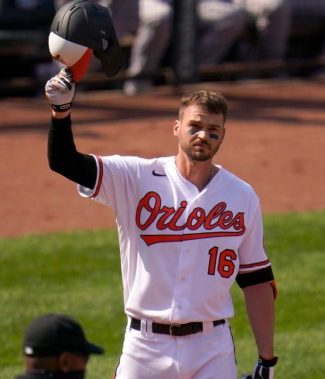
Trey Mancini tipping his cap to Oriole fans after what proved his final home game in Baltimore—he goes somewhat west now, to the Astros.

For Mancini it’s a terribly mixed blessing. One moment he goes from a home ballpark whose left field fence was moved back far enough to cut his power production at home to a ballpark with a short enough porch that he’d have hit over twice the ten bombs he has on the season so far. But he also says goodbye to a mutual love affair between himself and a city starving for the days when the Orioles were consistently great, year-after-year.

His agreeable personality and his courageous fight to beat colon cancer two years ago endeared him even further to Oriole fans than his live bat. As Baseball Prospectus observes, “Mancini . . . was the heart and soul of a franchise long depleted of either.”

The depletion may include Orioles general manager Mike Elias, who offered one of the most cacophonous explanations ever heard after a team struggling to return to greatness unloads a highly popular and franchise-valuable player:

The winning last couple of months that we have, the momentum we have, has made this a much more difficult decision and a much more complicated trade deadline than it would have been or that any of the past ones have been.But ultimately, I have to tether my decisions to the outlook and the probabilities of this year. We have a shot at a wild card right now but it is not a probability that we’re going to win a wild card.

Translation: In one deal and one bowl of word salad whose flavour no dressing on earth could improve, Elias as much as told Oriole fans he’s pushing the proverbial plunger on both this season whole and his team’s gallant, almost-from-nowhere re-entry into the postseason picture, however much distance the Orioles might still have to travel to get there.

Maybe Elias is still building for the nearest future after all. But maybe something could have been done without making the Orioles’ heart and soul the proverbial sacrificial lamb. Could, and should. “He’s the nicest human I’ve ever met,” says Orioles first baseman Ryan Mountcastle, a sentiment that seems to be common in the Oriole clubhouse and Baltimore itself.

Until today, people were even willing to bet on the Orioles having a phenomenal enough shot of reaching in. Now they’re uttering a couple of four letter words, one of which is the vulgar synonym for fornicate and the other a word meaning either a large receptacle for holding gas, an armoured attack vehicle, or taking a dive. Three guesses which meaning Orioles (and Nats) fans think applies.

“Teams liked to claim that captains were no longer necessary because one player shouldn’t be elevated above his teammates,” BP says, “but also, that same force made one player essentially untradable. If someone is designated the heart of a team, you can’t cut him out. Their value might go to waste.”

The region of the nation’s capital has taken enough blows that have knocked the wind out of its belly in the last few years. The Nationals and the Orioles, both of whom enjoy substantial capital followings, have told them, basically, “What’s two more sucker punches among friends?”