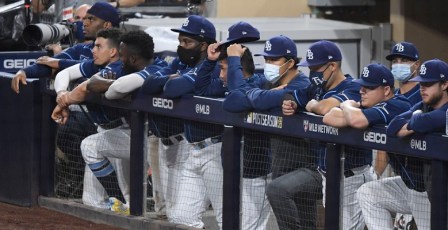
A 2-1 Dodger advantage feels more like 3-1

At any angle, from any view, Walker Buehler overpowered the Rays Friday night.

“They’re more of a manufacturing team than a pure slugging team like Atlanta might be,” said Walker Buehler, the Los Angeles Dodgers’ Game Three starting pitcher, before he actually went out and pitched against the Tampa Bay Rays. “You never know what lineup you get. We’re trying to figure out what they may do against you and work off that.”

Buehler then went out and hung a “Closed for Repairs” sign outside the manufacturers’ plant. The Rays don’t exactly have all the time in the world to put the repair crews to work.

The fixings will probably begin with otherwise stout Rays starter Charlie Morton. The same guy who flattend his old buddies from Houston to help the Rays win the pennant in the first place. The Dodgers slashed five runs on seven hits out of Morton in four and a third innings while Buehler refused to let the Rays catch hold of his full-zone fastballs or force him to work off-speed. Making it feel as though the eventual 6-2 final was a lot worse than a four-run deficit usually is.

Buehler does that when he’s on. He even takes a no-hitter into the fifth when need be. With one slightly off-the-charts outing the righthander suddenly turned the World Series from anyone’s to win to the Rays’s to lose. The Dodgers’ 2-1 Series advantage felt more like 3-1 when it finally ended.

“That might be the best I’ve ever seen his stuff,” said his catcher Austin Barnes after the game.

Buehler didn’t just expose the Rays’ continuing postseason flaw of striking out when they can’t and don’t make contact. The Rays have now done what no postseason team in history has accomplished, striking out 180 times.

They also have 113 hits, making them the only postseason team in history to hit 67 fewer times than they’ve struck out. In the middle of that, they went ten straight games—Game Four of their division series through Game Two of this World Series—with more strikeouts than hits.

Buehler’s thirteen punchouts also left the Rays striking out nine times or more in ten straight postseason games and a twelfth postseason game this time in which they struck out ten times or more. And, with thirteen hitters getting K’ed three times or more in single games.

“It’s like . . . people always say, ‘Why don’t they just hit the ball the other way when they shift?’” said Rays manager Kevin Cash Friday postgame. He laughed like Figaro, that he might not weep. “It’s hard enough just to hit the ball.” Against Buehler, whose three hits surrendered seemed like momentary lapses into generosity, it was impossible enough.

Against Morton, alas, with his fastballs not finding their intended destinations and his breaking balls left a little too readily over the plate, for a change, he might have been fortunate that seven hits were all the Dodgers could get. Begging the question as to why Cash, who normally thinks nothing of such moves when he smells trouble, left him in as long as he did this time around.

Sure Cash thought nothing of hooking Morton in Game Seven of the American League Championship Series at the first sign of trouble in the top of the sixth. And the world went bonkers over that. Since when does a manager that fearless not get his bullpen working and his man the hell out of there when he’s in the hole 3-0 with two out but two on in the third—the first of whom got there as a hit batsman off the foot?

All three of the Dodgers’ hits have come with two strikes,” tweeted ESPN’s Jeff Passan after the third. “And all three have been on pitches Charlie Morton left over the plate. Dodgers lead, 3-0, and they’re doing it against a pitcher whose opponents hit .170/.207/.284 vs. him with two strikes this year.

The Dodgers now have 87 runs this postseason. Fifty of them have come with two outs. “There’s two outs, but you can still build an inning, not giving away at-bats,” says the Mookie Monster, one of four Dodgers to knock in at least a run with two outs Friday night. “That’s the recipe. That’s how you win a World Series.”

I’m always fascinated by Kevin Cash’s pitching decisions,” tweeted The Athletic‘s Jayson Stark after the fourth inning. “Last Saturday, Charlie Morton had 66 pitches and a 2-hit shutout in the 6th – and Cash took him out. Tonight, he was down 5-0 with 78 pitches through the 4th – and got left in. Much quicker hook when Cash has a lead.”

Much harder for Cash to get away with bass-ackwards thinking, too. Not a single Rays bull poked his nose out of his stall before and after Max Muncy lined a two-run single to center. It took until the fifth—after Dodger catcher Austin Barnes dropped his safety-squeeze RBI bunt and Mookie Betts’s full-count, followup RBI single made it 5-0 in the fourth—before the Rays bullpen gate finally swung open.

Did you guess what happened from there right? If not, here it is: Four Rays relievers kept the Dodgers to a single run and three hits in their four and two-thirds innings work. They walked only two and struck out four. In other words, the Rays’ bullpen did what the Rays’ bullpen normally does. They just started four and a third innings too late Friday night.

It doesn’t discredit the Dodgers’ hitters to suggest Cash might have let them break into the house—only beginning with Justin Turner’s one-out, high line home run in the top of the first—and steal all the jewels and cash they could carry. The only thing the Dodgers swiped once Cash finally reached for the armed guards was Barnes catching hold of a John Curtiss slider that didn’t slide as far under the middle as it was supposed to slide and sending it over the center field fence in the top of the sixth.

Get the feeling the Dodgers are turning brand-new Globe Life Field into Dodger Stadium II? They’re not just pitching as though it’s their own vacation home, but they’ve hit one more home run in sixteen postseason games there than the Texas Rangers hit in thirty irregular season games in their brand new house.

Delayed security is not the best idea when you’re up against a Buehler who’s hell bent on making sure nobody got into the Dodgers’ house except Manuel Margot with a one-out double and Willy Adames with a two-out RBI double in the bottom of the fifth.

“Being a big-game pitcher and really succeeding on this stage, there’s only a few guys currently and throughout history,” said Dodgers manager Dave Roberts postgame. “He’s in some really elite company, and I’m just happy he’s wearing a Dodger uniform.”

With Friday night’s flush and the prospect of facing Buehler in Game Seven if the Series goes that far, the Rays would prefer he wear a police, fire, or military uniform right now. Those they can handle. Buehler they couldn’t. When he finished the fifth his lifetime postseason ERA stood at 2.34 and his 2020 postseason ERA alone stood at 1.88. And his streak of nine straight postseason gigs with a minimum six strikeouts and two runs allowed or less became the longest in Show history while he was at it.

“I think the more you do these things the calmer you get,” said Buehler postgame. Not about any records but just about pitching up when you’re striking for the Promised Land. “I don’t want to keep harping on it, but I enjoy doing this. And I feel good in these spots.”

As for World Series games pitched with ten or more punchouts, no walks, and no bombs surrendered, Buehler became only the eighth pitcher to have one. The previous Magnificent Seven: Sandy Koufax (1965), Bob Gibson (1968), Tom Seaver (1973), Randy Johnson (2001), Roger Clemens (2001), Cliff Lee (2009), and Adam Wainwright (2013).

Tampa Bay left fielder Randy Arozarena hit an excuse-us solo homer off Dodger closer Kenley Jansen with two out in the ninth. He’s now hit as many home runs in this postseason (eight) as he did when he was finally past his COVID-19 bout and saddled up for what was left of the irregular season. He also set postseason records with what’s now 52 total bases and 23 postseason hits as a rookie.

Turner had to settle merely for his first postseason bomb since 2017 and for tying Hall of Famer Duke Snider on the Dodgers’ postseason homer list with his eleventh. Barnes also slipped into the record books. Only one man previously had ever homered and squeezed a run home in the same Series game, and that was more than half a century ago.

We take you back to Hector (What a Pair of Hands) Lopez, New York Yankees outfielder, off Cincinnati Reds pitcher Bob Purkey in the deciding 1961 Series Game Five. Barnes is thus the only catcher ever to turn the single Series game bomb-squeeze trick. Roll over Bill Dickey, and tell Yogi Berra the news.

If only Arozarena’s bombings had better timers. Only four of his eight postseason bombs so far have either tied a game or given the Rays a lead. The rook whose 1.340 OPS in the first three rounds widened as many eyes as his home runs has a mere .885 OPS in the Series thus far.

The Rays overall are only hitting a .206/.250/.381 Series slash. They’ve actually struck out at the plate six fewer times than the Dodgers, but they’ve been out-hit by five, out-homered by three, and out-scored by seven. With Morton’s ghastly 10.38 Game Three ERA and Game One starter Tyler Glasnow’s grotesque 12.46, you have to remove them to find the Rays otherwise with a 2.10 Series ERA. Remove Dylan Floro and Dustin May from the Game Two equation, and the Dodgers otherwise have a 2.20 Series ERA thus far.

Timing is everything in this Series. The Rays’ inability to find theirs at the plate against Buehler and Clayton Kershaw, the Dodgers’ finding and finer tuning theirs against Morton and Glasnow, and Cash’s timing off twice on charging his bulls, are three major reasons why the Dodgers holding a 2-1 Series lead feels more like a 3-1 lead going into Saturday night.

This is what the Dodgers saved Julio Urias for. You may have heard a little chirping after he didn’t appear even in a bullpen stir during Game Two, when the Dodgers couldn’t beat the Rays at their own bullpen game. They’d better hope he isn’t too well rested; he hasn’t pitched since he closed out NLCS Game Seven with three shutdown innings last Saturday. And he’s going up against a by-necessity Rays bullpen game with Ryan Yarbrough possibly opening and possibly going three.

That’s the game the Rays usually master. Now it’s the mastery they need desperately enough.

The Blake and Brandon Show

Blake Snell, meet Sandy Koufax.

Realistically, the Tampa Bay Rays didn’t have to come into World Series Game Two wearing hazmat gear Wednesday night. Losing Game One didn’t mean rolling over and playing dead for the Los Angeles Dodgers no matter how formidable the Dodgers looked winning.

Especially on a comparative off night for the Mookie Monster, an on-night and then some for slumping Rays second baseman Brandon Lowe blasting his way out of the funk, an off-night for the Dodgers’ bullpen, and an off-the-charts night for Rays starting pitcher Blake Snell concurrent to a kind of typical night for the Rays’ bullpen.

All of which collaborated on a Series-leveling 6-4 Rays win in Globe Life Field that inspired the pandemically-mandated sparse live human crowd to make enough noise that they sounded like 111,000 instead of the approximate 11,000. Didn’t  that sound refreshing after an irregular season full of cardboard cutouts in the seats and canned noise in the ballparks?

Snell, the tall lefthander who sometimes resembles a tree waving in the heavy wind when he delivers, made World Series history in Game Two. He became only the second pitcher ever to pitch four no-hit innings with eight or more strikeouts in a Series game. He joins a Hall of Fame lefthander named Sandy Koufax, who did it in Game One of the 1963 Series. Rather splendid company to join.

What else did Snell have in common with Koufax? Going four and two-thirds innings before surrendering their first hits and staked concurrently to a 5-0 lead.

Koufax struck Hall of Famer Mickey Mantle out and got Roger Maris to pop out behind the plate. Then, he surrendered three straight singles before striking Hector Lopez out pinch-hitting for Hall of Famer Whitey Ford. This being 1963, the days of wine and roses, and nobody thinking pitchers threw inhuman pitch volumes, Koufax went all the way, struck a then-Series-record fifteen out, and probably threw about 160-180 pitches or so before he was finished.

Snell got Cody Belllinger to ground out to third baseman Joey Wendle behind shortstop in an infield shift and struck A.J. Pollock out swinging on one of his biting sliders. Then, he walked Enrique Hernandez, threw a 2-1 pitch to Chris Taylor that disappeared over the right field fence, walked Mookie Betts, and surrendered a base hit to Corey Seager on a hanging slider.

This being 2020, the days of whine and coronavirus, and especially about thirty times more smarts about pitching and what individual arms and bodies will or won’t allow, Rays manager Kevin Cash remembered his usual script and got Snell out of there in favour of Nick Anderson.  Anderson struck Justin Turner out after starting behind 2-0 for the side.

And more than somewhere in this favoured land, the sun is shining bright, the band is playing somewhere, even in isolation. But the old-school grumps fume not just over the “early” lift of Snell—whose 88 pitches in four and two thirds a) might have been 189 pitches if he’d gone nine in theory; and, b) were less efficient than Clayton Kershaw throwing ten less in an inning and a third more in Game One—but the “early” arrival of Anderson.

Isn’t he the actual or alleged closer? Who the eff brings his closer in in the goddam fifth? An older grump, to whom purists were as anathematic as bunts when it came to trying to, you know, win, has your answer.

Casey Stengel thought absolutely nothing of reaching for fresh pitchers as early as needed if the other guys got ornery enough. He did it with Joe Page to send that skintight 1949 pennant race to the absolute final day; he did it with Bob Turley in Game Seven of the 1958 World Series. “Casey’s reasoning,” his biographer Robert W. Creamer recorded, about that’ 49 game when Allie Reynolds walked his way into third-inning trouble before surrendering an RBI hit, “was that it was a ninth-inning situation. He needed a stopper, right now.”

Just ask Buck Showalter and Mike Matheny. Showalter blew a trip to a 2016 American League division series and Matheny lost a 2014 National League pennant because you were “supposed” to save your closer for the “save” situation. Even if he’s damn well the best pitcher on your staff that year.  Edwin Encarnacion’s Toronto Blue Jays and Travis Ishikawa’s San Francisco Giants would still like to thank Showalter and Matheny for going by The Book.

Koufax got off a lot more easily than Snell. Taylor’s blast made Game Two’s score the same as Koufax’s final score, 5-2. The ’63 Dodgers staked Koufax’s lead in the second inning with a double, two singles, and a three-run homer (John Roseboro), and in the third with an RBI single.

STATS Perform records that Snell was the 62nd pitcher in World Series history to take a no-hitter into the fifth and only the second who didn’t make it out. The first? Ralph Branca,  in 1947 Series Game One. After four no-hit innings of his own, the Brooklyn righthander got pricked by Hall of Famer Joe DiMaggio with a leadoff single. Then it was walk, hit batsman, two-run double (by Johnny Lindell), walk, and day over for Branca as the Yankees went on to win.

The Rays Wednesday night had Snell in the black right out of the chute, especially against this year’s collection of Dodgers who make a normal point of abusing lefthanded pitching to the point of human rights violations. They had a .990 team OPS and one home run every 14.7 at-bats entering Game Two.

Tighten your slack, dial long distance.

Lowe picked an even better moment to break himself out of the horrific postseason batting slump that belied his standing as possibly the Rays’ best irregular season hitter. He batted with one out in the top of the first, got himself into a juicy 3-1 count against the Dodgers’ rookie opener Tony Gonsolin, and hit one over the center field fence.

If Dodgers manager Dave Roberts’s plan was to get two innings out of Gonsolin, the Rays reminded him of the best-laid plans that go to waste in the second. Manuel Margot walked on five pitches, stole second with Joey Wendle at the plate, tagged to third on Wendle’s deep center field fly out, and Roberts went to the pen sooner than probably planned.

Dylan Floro escaped trouble the hard way. Margot running on contact when Willy Adames grounded one to short was a dead pigeon at the plate. Floro really dodged trouble when Adames took off for second as ball three to Kevin Kiermaier went down and well enough away, heaving heavy relief when Seager kept the tag on Adames as he came off the base in his slide and the initial safe call was overturned.

Floro held fort in the third with a lot of help from Seager, who threw Kiermaier out on a grounder and caught Mike Zunino’s pop back in shallow left field. Roberts played the matches then and brought lefty Victor Gonzalez to take care of lefthanded Rays designated hitter Austin Meadows, who popped the first pitch to shallow left where Turner and Seager ambled out to short left but Seager raced past Turner for the catch.

The Rays struck again in the fourth. A one-out walk to Randy Arozarena, whose home run bat seems to have cooled off considerably over the first two Series games, and a force out at second thanks to Dodger second baseman Enrique Hernandez bobbling Ji-Man Choi’s first-pitch grounder. Roberts lifted Gonzalez for rookie Dustin May, and Margot more or less snuck one through the open right side away from the infield shift for a base hit.

But there was nothing sneaky about Wendle banging a two-run double past Betts and off the right center field wall. Then Lowe wrecked May and the Dodgers again in the fifth. With two outs, and Joe Kelly throwing in the Dodger bullpen, Meadows lined a long line single to right center and Lowe launched an 0-2 fastball off the top of the left field fence and gone.

The middle infielder carrying a grotesque 6-for-56/19-strikeout slump into Game Two couldn’t have broken out of that mire better if he’d sent three line drives right down Dodger throats. “Yeah, those felt really good,” he told reporters post-game. “It felt great to kind of get back and contribute to the team. They’ve been doing so well for the past month. It felt really good to get back and actually start doing stuff again.”

“Lowe” in his case rhymes with “wow,” which is what his bombs induced out of teammates and spectators alike. All he had to do to fix himself was touch base with his longtime hitting counselor Hunter Bledsoe and heed Bledsoe’s reminder to take the slack out of his batter’s box posture.

“The reason Brandon has a cool moment like this is because of the fact that he’s unwilling not to,” Bledsoe himself told ESPN’s Jeff Passan. “People can pout. They can blame. He just works, man. And at the end of the day, regardless of what happens, it’s a hard game. And you can trust in that. It might not be on the time schedule we want, but eventually it will pay off.”

Wendle’s sixth-inning sacrifice fly off Kelly provided the sixth Rays run. Dodger catcher Will Smith made it 6-3 when he rocked Anderson for a one-out launch over the left field fence in the bottom of the sixth. Seager spoiled Pete Fairbanks’s otherwise fine relief outing with a leadoff blast in the bottom of the seventh. But Rays lefthander Aaron Loup cleaned up with two outs the second of which caught Bellinger, of all people, looking at strike three just above the dead middle of the plate.

Loup got the first two outs of the ninth without breaking a sweat. He struck late-game entry Edwin Rios out and retired late-game Dodger catcher Austin Barnes on a fly out to left. Then Cash went to Diego Castillo and Taylor looked at two strikes before swinging for strike three and the game. Did you know this was the first time a relief pitcher ever nailed a one-out World Series save coming into the ninth with two outs and nobody on?

Dodger fans spent a lot of the evening wondering why Roberts didn’t open with Julio Urias. That’ll be Urias completely fresh to start Game Four, after Walker Buehler starts against Charlie Morton in Game Three. Roberts has had his blindspots during his postseason managing life but he’s not entirely addlepated.

Before anyone else gets any more ornery about Cash lifting Snell in the fifth, listen to Snell himself. “I’m not gonna be mad at Cash. He’s got to manage. I’ve got to play,” he said post-game. “But I know I have to do things better, to make it harder for him to come out and pull me. I made it easy there with the walk, the homer and then the walk. You know, you can’t blame him for that. He’s trying to win a World Series game.”

If Cash ends up having to try winning a Game Six, that’ll be Snell fresh and ready to go. That’ll also be Roberts and the Dodgers likely, for now, to face a choice between opening with Gonsolin or with May. Think about that, too.

The Rays off script, the Dodgers on top

Clayton Kershaw opened the 2020 World Series with more than a flourish.

Somehow, no matter what the pandemic threw down in baseball’s way, we managed to arrive at the World Series. Somehow, the game’s 99 Cent Store from Tampa Bay bumped, pole vaulted, and sky dove to a Series against the game’s Amazon from Los Angeles.

In Globe Life Field, the brand-new playpen of the Texas Rangers. Where the turf is artificial, the roof makes it resemble the hangar for a Boeing 747, and you can just can all the hoo-ha about the wonders of a neutral-site World Series.

The Dodgers entered with a sort-of home field advantage.They’ve been playing at Globe Life from their National League division series forward. With the pandemic-inspired divisional geography schedule on the irregular season, the Rays never got to play the Rangers even once.

They’ve been been playing there from their division series forward. With the pandemic-inspired divisional geography schedule this irregular season, the Rays never got to play the Rangers even once. And the Dodgers sure took advantage of that inadvertent home-field advantage of a sort Tuesday night.

They waited out a hard labouring Rays starter Tyler Glasnow, aided and abetted by Rays manager Kevin Cash forgetting his well-tested plot, then flipped their merry-go-round to cruising speed from the fourth through the sixth innings, and beat the Rays in Game One, 8-3.

Clayton Kershaw did more than his share starting for the Dodgers. With the continuing questions about his overall postseason life of bad fortune, Kershaw brought the best of his new self to bear, his sliders out-numbering his fastballs, striking out eight through six and getting nineteen misses on 38 swings against him for the highest single-game whiff rate of his entire major league life.

“Kershaw was dealing,” Cash said postgame. “You see why he’s going to the Hall of Fame one day.”

What nobody could see clearly was why Cash pushed his luck with Glasnow labouring to survive, his eight strikeouts negated by six walks—including the leadoff pass to Max Muncy opening the bottom of the fourth to start the Dodgers’ fun—and with only a 2-1 deficit against him when he came out of it.

Will Smith grounded Muncy to second almost right then and there. But Cody Bellinger—the man who rang the Atlanta Braves bell so resoundingly in the seventh National League Championship Series game—hit the first pitch into the Dodger bullpen in right center field. After walking Chris Taylor to follow and wild-pitching Taylor to second, Glasnow was lucky to escape with his and the Rays’ lives on a pair of back-to-back strikeouts.

That’s where Cash moved against his own successfully established grain. The Rays live and prosper on not letting the other guys get third cracks at their pitchers and thus keeping their pitchers from falling into position to fail or get failed. They play that game better than most and rolled the American League’s best irregular season record for their trouble.

Cash withstood the alarms blasted after he lifted Charlie Morton in American League Championship Series Game Seven after five and two-thirds efficient innings when trouble brewed with the Rays up 3-0. The move aligned perfectly to the Rays’ usual M.O. and it paid off with a pennant.

On Tuesday night, though, he left Glasnow in for the fifth despite 107 pitches to that point. With Ryan Yarbrough throwing in the Rays bullpen, Glasnow walked Mookie Betts on four straight balls following an opening strike. Over the past three seasons including a 34-start span, Glasnow had only thrown 100 pitches or more in a game three times, and Tuesday night wasn’t exactly one of his prime outings.

Cash still didn’t make a move after the walk to Betts. Room enough for the Dodgers to boot the merry-go-round. Glasnow walked Corey Seager after Betts stole second without a throw on a low pitch. He struck Justin Turner out, somehow—except that Betts and Seager delivered a near-textbook double steal.

Then Max Muncy bounced one right to Rays first baseman Yandy Diaz. Diaz threw home. This was supposed to be one of those plays the Rays’ usually larger-than-life defense executes with an arm missing and half asleep. Except that Diaz’s throw arrived up the third base line and Betts slid into the plate while Seager took third and Muncy stood safe at first.

“The at-bat with Muncy right there,” Cash said post-game, “just was hoping it felt like [Glasnow] was the best guy to get a strikeout.” Not on a night when only 58 of Glasnow’s 117 total pitches were strikes. Glasnow himself acknowledged trying to rush things a little too much in the beginning, but once he adjusted that he thought his mechanics were off.

“I have to execute pitches better and hold runners better,” he said, admitting the latter is probably his weakest attribute. “Later in the game, I wasn’t really able to throw anything for a strike except the heater. I think the changeup, I probably should have thrown that a little bit more . . . That curve ball, later on, I really didn’t have much feel for it.”

Smith knocked Seager home and Muncy to third with a jam-shot single to center. Finally Cash brought in Yarbrough, a good relief pitcher but a young man whose career to date includes that he’s vulnerable pitching with one out and rare (for him) inherited runners but better when he starts an inning clean.

The lefthander got rid of the lefthanded Bellinger on a pop up to third, but righthanded Chris Taylor lined Muncy home with a clean single to left and pinch-hitter Enrique Hernandez sent Smith home by shooting a base hit between short and third.

Yarbrough escaped with no further damage. Cash sent Josh Fleming out for the sixth. The Mookie Monster sent his first pitch into the right field seats. An infield pop out later, Turner and Muncy doubled back-to-back. Fleming didn’t surrender another run through his next two innings worth of work but that came under the too-familiar heading of taking one for the team.

Not that the Rays left things uninteresting on their end. They chased Kershaw’s relief Dylan Floro with one out in the seventh. Manuel Margot singled right through the middle infielders and Joey Wendle drove on to left center that Bellinger gave a great chase until the ball hit off the heel of his glove, setting the Rays up with second and third.

Then Cash sent Ji-Man Choi to bat for Willy Adames. Dodger manager Dave Roberts brought in lefthander Victor Gonzalez to face the lefthanded Choi. Cash pulled Choi for division series hero Mike Brosseau. And Brosseau lined Margot home with a single to right with Wendle stopping at third. He didn’t stay long. Kevin Kiermaier—whose fifth-inning solo home run was his first hit since being hit by a pitch in ALCS Game Three—lined a single to right to send Wendle home.

It was the final Rays homecoming of the night, but it almost wasn’t. Rays catcher Mike Zunino lined a missile right through the box that Gonzalez snatched just sticking his glove to his right, the ball’s force spinning him right into position to throw and double up Brosseau scrambling back to second. A hair off line or the glove missing by a hair and that missile might have been an RBI single with the Rays still swinging. Might.

The Rays tried to flip their own merry-go-round switch and the Dodgers succeeded in throwing a stick into the motor belt, with Pedro Baez and Joe Kelly finishing up throwing the spotless final two innings.

It was also a night to make history. Kershaw nailed his 201st lifetime postseason strikeout, moving him into second place behind his fellow likely Hall of Famer-to-be Justin Verlander. Betts became the first player in World Series history to homer, steal, and score twice in the same Series game. Cash became the first Little League World Series player to manage in the World Series when he grew up.

“It’s great to get the Series going with a win,” said Kershaw to reporters after the game. “That’s the biggest thing, for us, is to get going. Get that first game—it’s always important to get that first game of a series. Just for me, personally, it’s awesome, you get to pitch well and get a win in a World Series. Like I said, I’m just thankful for another opportunity.”

Bellinger going deep looked like a man who shook off the shoulder dislocation his NLCS bombing brought when it happened during the dugout celebration. He took no chances this time.”I said it before the game,” he told reporters post-game. “If I hit one today, I’m not touching anyone’s arm. I’m going straight foot.”

Since he hit the first Dodger bomb of the Series, Bellinger got to lead the first such dance. Appropriately. And you thought last year’s World Series champion Dancing Nationals knew how to bust moves and cut rugs.

The pennant-winning Rays do several favours

Your American League champion Tampa Bay Rays, with Randy Arozarena (right front) holding his ALCS MVP award.

For those of you who still love to ponder baseball in economic terms alone, have your fun now. The third-lowest 2020 payroll in the Show just finished off the third-highest—after knocking off highest to have the opportunity. Shout it out loud. The Rays win the pennant! The Rays win the pennant!

They who have the gold don’t always rule. For that matter, neither do they who have the platinum.The Tampa Bay Rays—lucky to have a couple of steel pieces amidst a cache of aluminum, tin, and Reynolds Wrap—are one trip shy of the Promised Land as of Saturday night.

After pushing past the New York Yankees’s platinum a little over a week earlier, the Rays  melted the Houston Astros’ gold into a 4-2 win in Game Seven of the American League Championship Series. Playing twelve games in thirteen days, the Rays beat both in final win-or-be-gone games. That only begins to describe their flair for the impossible.

This collection of bargains enough to make you think Woolworth’s was reincarnated as a baseball team became the first in major league history to stand on the threshold of a postseason series sweep, lose the next three straight, then win the first elimination game they’d face in the set.

They became the first to send out a starting pitcher against another starting pitcher with whom he’d collaborated previously to win a seventh World Series game. Charlie Morton got the better of Lance McCullers, Jr. with five and two-thirds innings of two-hit shutout ball on his part and just a little help from the friends he says are an honour to play and compete with.

They became the first to feature a rookie hitting a seventh bomb just in the postseason, when left fielder and series MVP Randy Arozarena sent Lance McCullers, Jr.’s 2-2 fastball over the right center field fence in the bottom of the first—after McCullers hit Manuel Margot with the first pitch of the inning.

They had Mike Zunino—a Seattle trade surrender whose steady defense got undermined by a few passed balls in Game Six but whose power is steady enough when he isn’t injured—provide the rest of their Saturday night scoring with a one-out, full-count launch into the left field seats of McCullers in the second and a one-out sacrifice fly off Jose Urquidy working relief in the sixth.

And, after manager Kevin Cash hooked Morton with a better too soon than too late attitude, the Rays’ bullpen wavered and bent only in the eighth, when Carlos Correa—who’d hit Nick Anderson for the game-winning bomb in Game Five—knocked a bases-loaded two-run single off Pete Fairbanks, who then got Alex Bregman to climax his series-long futility with a furiously swinging strikeout.

If Morton follows through on earlier hints that he might actually retire at 37, he’ll retire as a member in good standing of one elite club. Name the five pitchers who’ve had multiple scoreless starts in postseason winner-takes-it-all games. The answers: Morton plus Madison Bumgarner, Bret Saberhagen, Hall of Famer John Smoltz, and Hall of Famer-to-be Justin Verlander.

Saturday night was Morton’s fourth time out in such a game and his third as a starter. In every one of them, he never threw a pitch while his team was behind. The modest righthander who starts his delivery slow motion before his right arm becomes a whip, whom the Rays could afford because his injury history made him a bargain, really has been late-career better than advertised. If you needed a reminder, he rid himself of thirteen of his twenty batters on three pitches or less.

Arozarena also became the first rookie to hit seven homers in a single postseason. He may have been the only one who wasn’t counting. “I try not to pay attention to the statistics,’’ he said postgame, “but with the Iinternet and everyone bringing it up, you’re kind of aware of it. Honestly, I don’t pay attention to the statistics outside of me and what I can control.”

When Fairbanks shook off Yuli Gurriel’s one-out single to right to strike Josh Reddick out and get Aledmys Diaz to fly out to Margot in right, it would have touched off an all-night party in Tampa Bay if not for the coronavirus social distancing protocols. Those protocols also kept the jubilant Rays from much more than what Zunino said was confetti-tossing and Silly String shooting.

“We’ve done a great job to make it as fun as possible . . . but there’s nothing better than popping bottles and having that seep in and burn your eyes,” the catcher said post-game. That’s one reason why even the World Series winner, whomever it may prove to be, might be the first to reach the Promised Land and holler out, “Wait ’till next year,” hopeful that the pandemic recedes enough to let baseball get back to whatever normal it can achieve.

“Probably more so this year than any other year, the motivation is doing it for each other,” Morton said. “You adhere to protocols; you’re social distancing from families at home. Telling their kids they can’t hug them. This has brought out a level of humanity and empathy that you wouldn’t see in a normal season.”

It also kept baseball’s Public Enemy Number One in the wake of Astrogate from facing the slings, arrows, protest banners, and live catcalls sure to have greeted them on road trips if the pandemic hadn’t substituted cardboard cutouts for live fans.That was the biggest unexpected break the Astros—having enough with being exposed as illegal high-tech cheaters—could have received.

Fans settled for social media slappings plus masking and social distancing while greeting the Astros’ team bus live with slings, arrows, protest banners, trash cans (the mode by which they sent the illegally stolen signs to their hitters in 2017 and part of 2018) and live catcalls whenever the bus pulled into the road ballpark’s parking lot.

The Rays did the Astros and the rest of us another favour by pushing them home for the winter. Assume as you shouldn’t that the Los Angeles Dodgers send the Atlanta Braves home for the winter in Game Seven of the National League Championship Series Sunday. (The Braves aren’t going to go down without a fight, their Game Six futility to one side.) The Rays prevented a World Series dominated by too-much-is-more-than-enough talk about a grudge rematch.

There’s probably no way on earth Astrogate will be forgiven or forgotten for a long time to come. But the spectre haunting America of the Astros going back to the World Series this time around haunts no more. The last thing the Series needs when America needs the Series most is to be half dominated by Astrogate regurgitation and appetites for revenge.

Be certain the Astros will return to the Series in due course. When they do, they’re liable to be just about finished with what has to be done put Astrogate into the past at last—roster and organisation turnover. They have the makings of an impressive young bullpen and a few young positional talents ready to come into their own, too.

The Rays also did us all a bigger favour than even the foregoing. Not only will there be no losing team in the World Series, there’ll be only division winners squaring off. All that early postseason mess, all commissioner Rob Manfred’s apparent wet dreams about permanently expanded postseasons. Put it behind you for now.

Just pray that Manfred doesn’t take the wrong message from it and dance this mess around permanently. Reminder: the Rays had the American League’s best irregular season record. And real division champions—of however truncated an irregular season—will battle to get to the Promised Land. That’s the way it should always be.

The only thing left is for the Rays to come to terms with going from faceless to familiar. That could prove the simplest and most pleasant of their battles.

The waiting is the hardest part

The Rays, looking just the way you expect a team that’s gone from the 3-0 threshold of the World Series to the 3-3 threshold of . . .

What the hell happened Friday? Did the Houston Astros merely iron up? Did the Tampa Bay Rays merely melt down? Was the truth somewhere in the middle? Does it mean the Astros getting the least likely trip to the World Series since 2004?

Forget the Beatles. This is Tom Petty’s turn to sing:

The waiting is the hardest part.
Every day you see one more card.
You take it on faith, you take it to the heart.
The waiting is the hardest part.

Don’t the Astros and the Rays know it. We have to wait to Saturday to find out whose waiting was the hardest part for what redemption. The Rays couldn’t put the Astros away after a 3-0 American League Championship Series-opening lead, after all. What was once their set to win is now anybody’s to lose.

Every day, these Rays see one more card turned any way but their way. On Friday night the Astros didn’t need anyone to hit one out in the ninth to beat the further-dissembling, further-static Rays, 7-4, in Petco Park. You can’t win all your postseason games with eleventh-hour, record-book dramatics. Sometimes you have to win the old-fashioned way, catching your worthy adversary self-weakened and pouncing while the pouncing is good.

All the Astros needed other than a four-run fifth to overthrow an early Rays lead was to not remind the Rays to pay attention to the early warning signs. Such signs as their refusing to lay off Astros starter Framber Valdez’s swan-diving curve balls and make him throw more fastballs. Such signs as resisting the temptation to try hitting six-run homers whenever they did coax fastballs out of the young sprout.

They also needed to make the Rays forget that starting Blake Snell carried a risk, too. Entering Game Six only two Astros in the day’s starting lineup had career batting averages lower than .300 against him while seven had lifetime marks against him over .400.

It didn’t hurt, either, that Brandon Lowe, the Rays’ semi-regular second baseman playing left field Friday, chose the worst possible nanosecond to throw the wrong way when his partners could have cut an Astro run off at the plate and maybe stopped the fifth-inning bleed.

If he had stopped the bleed the Rays might be preparing for the World Series. Might. It’s not that the Rays are unaccustomed to doing things the hard way, it’s that they’re not getting too accustomed to making things more difficult than they should be.

And if you do that to these Astros, you discover the harder way that they aren’t exactly renowned for showing mercy to the walking wounded. They’re more liable to cut your heart out than let you live long enough to receive a transplant. When you have an opening, shove with your shoulders, Casey Stengel preached to his imperial 1950s Yankees. When the Astros have an opening, they shove with an Abrams tank.

You’ve got to love this team,” said manager Dusty Baker after the game. “Well, some people hate this team. But you’ve got to respect them.”

Well, the skipper has a point, alas. There is something perversely respect-worthy about a team that brought the wrath of baseball world down upon their heads all by themselves, slipped into a surrealistically-arrayed postseason experiment despite an irregular season losing record. They managed to seize that gift and turn it into this staggering an ALCS comeback, when it looked to all the world as though their season would end as ignominiously as their year began.

It doesn’t make the Astros lovable outside their own fan base. And that fan base remains divided almost as badly as the country now is politically speaking. But it does make them resemble the grand theft felon who withstands the heat, defies the doubt, and remakes/remodels his life far enough in the plus column. His crime won’t be forgotten no matter when it’s finally forgiven, but he’s making a powerful case for rehabilitation. So far.

Snell had to be better than his 2018 Cy Young Award-winning self to prevail. If he wasn’t, the Rays had to quit trying to channel their inner Murderer’s Row and get back to sending the merry-go-round going ’round on the bases—if they got there at all. Unfortunately, Snell spent so much time trying to find the wipeout strikeout pitch he pitched a dangerous game of chicken for four full innings before his day ended with two on and nobody out in the top of the fifth.

The only clean inning he threw was the third when he sandwiched a full count strikeout to George Springer between two slices of ground out from Martin Maldonado and Jose Altuve. It was barely enough to keep the Rays clinging to the 1-0 lead they snatched in the second, when Willy Adames hit an RBI double into the left center field gap and off the wall eluding Springer. It wasn’t enough to keep manager Kevin Cash from hooking Snell in the fifth and leaving Diego Castillo to get rid of the Astro pests.

No soap. Maldonado dropped a surprise sac bunt in front of the plate pushing Yuli Gurriel (leadoff walk after opening 0-1) to third and Aledmys Diaz (single) to second. Springer defied the left-side shift and squirted a two-run single through the right side of the infield.

Then the Rays’ vaunted defense suffered the unlikeliest brain vapour of the day—and maybe the season. The clowns unexpectedly disappeared the Raysling Brothers’ Circus aerialists and acrobats at the worst possible hour. Altuve hit one down the left field line that caromed right to Lowe. With Springer grinding toward third and being sent home, the Rays were set up perfectly for a play at the plate.

All Lowe had to do was hit his left-side cutoff man and Springer was an obituary. Except that Lowe threw to second. Where nobody was. Then, a walk and a passed ball allowing Altuve third later, Carlos Correa showed he was just as capable of sending a man home the easy was as he was going downtown in the bottom of the ninth, singling Altuve home with the fourth Astro run. The game turned out to be signed and sealed right there.

Think Altuve’s past that frightful attack of apparent yips that helped the Rays push the Astros up to the edge of the roof in the first place? He’s reached base eleven times in seventeen plate appearances since. He’s even delivered errorless play at second base. We can pronounce him recovered well enough. So far.

From there Cash’s usual bullpen virtuosity failed him. He sent barely-tried Shane McClanahan out to work the sixth and Brantley greeted him rudely hitting a 2-0 pitch over the left center field fence. The kid had to wriggle out a one-out single to retire the side with no further damage. Lucky him. Not.

Was Cash now managing just to live to play a Game Seven? After the Rays wasted first and second in the bottom of the sixth when Lowe dialed an inning-ending Area Code 4-6-3, Cash sent McClanahan back out for the seventh, most likely in the hope of just surviving to leave the rest of the Rays’ bullpen A-list fresh for Seven if need be.

The poor kid surrendered Astro runs six and seven on an RBI single by Brantley and a one-out sacrifice fly by Kyle Tucker, after which he walked Gurriel before Cash finally exercised a personal mercy clause and lifted the lad in favour of Jose Alvarado. After Zunino committed one of his three passed balls of the game—meaning the Rays likely sending Michael Perez out to catch Charlie Morton for Game Seven—Alvarado struck Josh Reddick out swinging for the side.

The side and a 7-1 Astros lead. Manuel Margot greeting Aaron Scrubb with a leadoff bomb in the bottom of the seventh turned into further abject Tampa Bay frustration when they grunted to first and third against Scrubb, chasing him in favour of Blake Taylor, but Randy Arozarena—to this point the Rays’ biggest blaster of the postseason—grounded out meekly to first base.

What was the point of Margot hammering a two-out, two-run homer in the bottom of the eighth with two out when Adames would ground out for the side almost too swiftly? And, when pinch hitter Yoshi Tsutsumago singled with one off Astro closer Ryan Pressly just so Michael Brosseau could dial Area Code 6-4-3 to end it?

If you have the answer to those and other similar questions, the Rays need to know. Gravely.

This is more than just three straight elimination games the Astros have survived to force Game Seven. This is more than the Astros threatening to become the only team other than the 2004 Boston Red Sox to win the pennant after getting thatclose to being swept out of an ALCS.

“We’re going to show up tomorrow and do everything we can, like we always do, to find a way to win and pick each other up,” Cash said after the game. “There’s no doubt the momentum has shifted, but I would bet on this team being very capable of bouncing back.”

Didn’t the Rays make the same bet on themselves before Games Four, Five, and Six, too? Remember, in baseball especially anything can happen—and usually does.

To an awful large chunk of baseball world, these Rays are the unassuming, studious, sum-of-parts talented Smart Kids trying to stay one step ahead of the school bullies after refusing to just let the bullies copy their mid-term exams. It doesn’t stop the bullies from copying all the time, as witness the Astros out-Raying the Rays in Game Five. But neither do the Smart Kids outsmart themselves entirely without more than an excuse-me counterattack.

Once upon a time the Astros were the smartest of the Smart Kids—before they were exposed as cheaters in disguise. Morton eventually went over to the new Smart Kids’ side. He gets to face Lance McCullers, Jr.—his old Astro rotation mater, with whom he once collaborated to win a World Series Game Seven. He’s also pondering whether his 37-year-old self may or may not pitch major league ball for the final time Saturday.

Morton out-dueled McCullers in Game Two this week with five shutout innings. “On a selfish level, I didn’t want this to be the last memory I had of the game,” he said while he was at it. “The way it’s had to go with [coronavirus] testing and isolation, not being able to really enjoy special moments together in the clubhouse—this is a very trying time for the game. I got to spend it with a tremendous group of people. It would be an honor, if it is my last year, to have done it with this group.”

The real-world Smart Kids, the Not-So-Smart Kids, and the Plain But Pure Enough Kids together, hope Game Seven won’t be the end of Morton’s and the Rays’ season, if not his career.