Don Denkinger, RIP: Survival

Don Denkinger

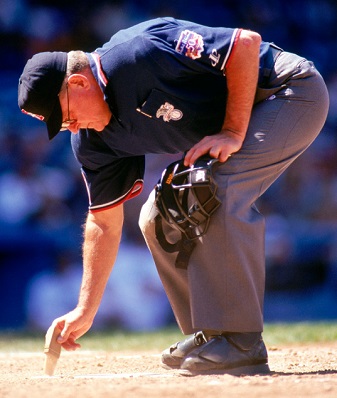
Don Denkinger, dusting home plate clean during a game. He owned his grave 1985 World Series mistake—you know, the one that really didn’t cost the Cardinals a Series championship.

Now-retired umpire Ted Barrett blew a call the first time he worked on a crew with Don Denkinger, in July 1995. Brewers pitcher Scott Karl threw to first looking to bag Mariners outfielder Rich Amaral. Amaral eluded the tag as he scrambled back to first and made it safely, except that Barrett called him out.

Reviewing video after the game, Barrett saw clearly enough he’d blown the call and felt as low as a man could feel. As he walked out of the Kingdome to his car, Denkinger caught up to him and asked what was wrong. Barrett said he felt terrible for having blown the call.

“[H]e looks at me with a grin,” said Barrett to ESPN about Denkinger, who died at 86 Friday, “and says, ‘Try (messing) one up in the World Series.’ I was like, whoa, respect this guy.”

Exactly. Denkinger’s moment of infamy in Game Six of the 1985 World Series made him public enemy number one in St. Louis and elsewhere. (In Kansas City, of course, Denkinger might have been seen as a blessing from the gods.) But once he got past the tumult, the screaming, the humiliation, and the worst of the foulness that followed him, he proved a man who not only learned from his worst mistake but knew how to get behind the proper answer for future such mistakes.

With the Cardinals up 1-0 going to the top of the ninth, calling Royals leadoff pinch hitter Jorge Orta safe on a slow bouncer off first base was a horror known at once to everyone in Kauffmann Stadium and viewing on ABC television. “Nobody wants to have the call that I did in the World Series,” Denkinger told a reporter nine years ago. “But I did. And now it’s part of history.”

Cardinals first baseman Jack Clark fielded the ball cleanly and tossed to covering relief pitcher Todd Worrell, who caught the toss with his foot on the pad well ahead of Orta. The Cardinals and their Hall of Fame manager Whitey Herzog fumed. The call stood, alas. Then a base hit, a bunt, a passed ball, an intentional walk, and a bloop two-run single later, the Royals stood having tied the Series.

Thanks to the normal Series umpire rotating, Denkinger was due to call balls and strikes for Game Seven. The Cardinals seemed more concerned with having been robbed the night before than playing the here and now, and their wheels came off early enough and often enough.

The fury got filthy enough that a regional radio host gave out Denkinger’s home address on the air. More than a few nasty death threats against the ump and his family prompted the FBI itself to investigate. Some way, some how, Denkinger managed to pick himself up, dust himself off, and start all over again to finish a career that shook out as far more distinguished than extinguished.

When Herzog himself started banging the drum none too slowly on behalf of bringing replay review at least to the postseason, Denkinger became an easy ally. Until the day baseball finally decided getting it right was imperative, especially when championship advance or finality was on the line, Denkinger was one of replay’s staunchest supporters.

“I’m not tired of talking about it,” he said in the aforementioned interview. “I mean, it happened. I just know that if the same thing happened now, they’d get it right on replay and it’d be over with.”

This wasn’t a C.B. Bucknor or a Laz Diaz or an Angel Hernandez or a Joe West type who was liable to harrumph “Tough you-know-whatties” whenever someone called him on a horrifically bad call. This was an earnest fellow who’d made the biggest mistake of his career and refused to let it define him or soil him. He blew it. He knew it. He owned it. He went back to finish an almost entirely honourable career.

He probably knew, too, that the Cardinals didn’t exactly have the Royals down to their final out; that they could still have found a way to get three outs before any Royal got anywhere near scoring; or, having failed to do that, come to Game Seven ready to play.

Instead, they saw Denkinger behind the plate and imploded while Royals righthander Bret Saberhagen manhandled them and the Royals manhandled Cardinal pitching for eleven unanswered runs. Anyone on earth, no matter how Game Six ended, would have been justified telling the Cardinals nobody trained artillery upon them and told them to fall flat on their own faces.

Even Denkinger. The closest he came was in the fifth inning, when Joaquin Andujar—normally a starter but now pressed into desperation relief—erupted over a close pitch and Herzog had to hustle out to keep Andujar from being run, while Cardinals third baseman Terry Pendleton and Hall of Fame shortstop Ozzie Smith kept Andujar from trying to tear Denkinger (who’d been a wrestler in high school) into strips.

“If you’d done your damn job last night, we wouldn’t be here!” thundered the White Rat.

“If your team were hitting better than .120 [in the Series],” Denkinger shot back, “we wouldn’t be here, either.” (The Cardinals finished that Series batting .185 as a team.)

Then he ran Herzog over an obscenity and Andujar a pitch or two later over another fury. The Cardinal implosion continued apace, and the upstart Royals finished what they started, an 11-0 Game Seven spanking to win their first of only two World Series championships.

Denkinger had good humour enough to accept Herzog’s own demonstration of good humour a couple of decades after the Hour of Infamy—mutual laughter when, at a dinner honouring the 1985 Cardinals, members of the team were presented spanking new Seiko wristwatches and Denkinger was presented a spanking new watch . . . in Braille.

How well did Denkinger survive otherwise?

When he ran into Dane Iorg the following spring, Iorg having been the Royal who blooped the Game Six-winning runs home, Denkinger joked, “You know, I just had the worst offseason of my life thanks to you.”

He survived well enough to work behind the plate for Hall of Famer Nolan Ryan’s sixth no-hitter, Hall of Famer Jack Morris’s ten-inning 1991 World Series shutout, and Kenny Rogers’s perfect game in 1994—making him one of seven arbiters to work two perfect games. (Denkinger also worked third base for Len Barker’s perfecto in 1981.)

Well enough to retire after the 1998 season because a balky knee was no longer tolerable for standing nine innings a day for six months a year. (The St. Louis Post-Dispatch headlined a story about his retirement thus: “Don Denkinger won’t miss any more calls at first base.” Put that headline writer into the Hall of Shame.)

“I’ll put on there whatever you want,” Denkinger told Sports Illustrated in 2015, when noting some autograph seekers asked him to sign “Oops” next to his name. “It doesn’t make any difference. Life’s too short to do that to yourself, let this dictate your life. I just took the other avenue. Life goes on. Enjoy it.”

“If anything,” his daughter, Denise, told the magazine, “it’s made me even more proud that he’s my dad. He didn’t hide from it. He didn’t say it was someone else’s fault. He took ownership of it.” Said his wife, Gayle, “He made one mistake, but that didn’t define him. Aren’t we all entitled to a second chance?”

The jerk contingencies among sports fans that proclaim human error to be moral degeneracy worthy of the death of ten thousand cuts (and threats) won’t like it, but the answer is yes. Especially if you own your mistake at once and continue by showing you learned everything you needed to learn from it and perform accordingly.

Come to think of it, the jerk contingency among umpires who think fans pay their hard-earned money to come to the ballpark to see them wield power could do to learn a lesson or three from Denkinger. Surely the Lord is reminding him of that, too, over a couple of tall ones in the Elysian Fields. May he get to call a perfect game or three there during his hard-earned eternal peace.

Tim McCarver, RIP: On first guess . . .

Tim McCarver

Tim McCarver, gracing a Sports Illustrated cover in 1967, as his Cardinals struck for a pennant and a World Series championship.

It should have surprised no one that the most frequent phrase uttered in the notices was “first guess.” Most baseball broadcast analysts have in common with fans a trigger, if not a mastery, of the second guess. Tim McCarver, who died at 81 of heart failure Thursday, was the longtime master of the first guess.

Two decades as a major league catcher who saw the whole game in front of him and didn’t restrict himself to handling the pitchers who threw to him did that for him. That McCarver leavened it with disarming wit was merely what Duke Ellington would call a cherries-and-cream topping to your sundae afternoon.

And just as “first guess” was the most often deployed phrase in the obituaries, the most frequently deployed evidence for the defense was Game Seven of the 2001 World Series.

That’s when Yankee manager Joe Torre, with his Hall of Fame closer Mariano Rivera on the mound, and the bases loaded for the Diamondbacks with one out in the bottom of the ninth, ordered his infield in with Luis Gonzalez coming to the plate. At long last—Snakes manager Bob Brenly tended to leave him with nobody aboard to advance or drive home that Series—Gonzo had men on base to work with.

Watching the game on Fox Sports, I heard McCarver remind viewers that Rivera’s money pitch, his fabled cut fastball, ran in on lefthanded hitters and, if they made contact at all, it was broken-bat hits shallow in the outfield. “That’s why you don’t bring the infield in with a guy like Rivera on the mound,” he said.

Bing! After Gonzalez fouled the first pitch away, Rivera threw him a cutter running inside. Gonzo broke his bat sending the ball floating above Hall of Fame shortstop Derek Jeter, into shallow center, for game, set, and Series.

The man who sent grand salami into baseball’s lexicon for the grand slam (he’d done it in one of his earliest broadcast jobs, on the Mets’ team of himself, Steve Zabriskie, and Hall of Fame slugger/from-birth booth mainstay Ralph Kiner) was a catcher who never feared learning, whether it was how to handle mercurial pitchers or how to overcome his upbringing as the son of a Memphis police officer in a time of racial growing pains for the Cardinals and the country.

In October 1964, his account of the pennant races that culminated in the World Series conquest of the last old-guard Yankee team by a new breed of Cardinals, David Halberstam recorded Hall of Fame pitcher Bob Gibson giving McCarver a quick lesson in race relations. Quick, and profound, and perhaps a little shocking even to a white kid whose baseball heroes had actually been Hall of Famers Henry Aaron and Monte Irvin.

Gibson hailed McCarver and asked, “Hey, Timmy, do you know how a white boy shakes hands with a Negro?” When McCarver said no, Gibson enlisted center fielder Curt Flood as his co-star, Gibson playing the white guy. He shook hands with Flood—and, after looking at his hand a moment, promptly wiped his hand on his pants. “You’ve done it before, haven’t you, Tim?” Gibson asked. The shocked McCarver thought a moment and realised Gibson was right.

They became close friends (Any relationship you enter into with Bob is going to be intense, McCarver once said of Gibson), and McCarver had demonstrated his willingness to listen and learn. And, take a gag. His habit of yelling “Gigub” like a frog after losing a ball popping out of his mitt inspired Gibson to mimick it exactly. Those Cardinals used humour next to sobriety to teach their lessons to each other and the league.

But after leading the 1966 National League with thirteen triples, McCarver whacked one in an exhibition game the following, prompting Gibson to buttonhole him after the game, saying, “Hey, you like to hit triples!” According to Halberstam, McCarver took it to mean Gibson telling him he was a good ballplayer and just might be a good man, too. (When he was inducted into Cooperstown as a Frick Award winner in 2012, McCarver lamented and called for arresting the decline in African-American participation in the game.)

The Cardinals out-bid the Yankees and the Giants to sign McCarver with a $75,000 bonus in June 1959. The first things he did, according to Peter Golenbock’s The Spirit of St. Louis, were to buy his parents a new car and to pay off their mortgage, before buying himself some stock in AT&T. By 1963, he’d become the Cardinals’ regular catcher.

He bought into the Cardinals’ ways of teaching the game while flinching at the ways they over-did selling their traditions to incoming young players. “One of the bad things about the Cardinal tradition,” he’d remember in due course,

was the provincialism there in St. Louis that as far as the press was concerned was a lot more unfair than the Eastern press. Everyone says the Eastern press is a lot tougher. I disagree with that. Because provincialism is a lot more difficult to deal with than a press that may be tougher but is more objective, and I’m talking about New York, Philadelphia, Boston. St. Louis is more provincial than any of them. And that provincialism, like the obligations of the family, is much more difficult for the athlete to deal with. Whenever there’s an obligation, there is less desire to do it, because you feel you have to do it.

Nelson Briles, a fine pitcher and a character in his own right, once called McCarver the team’s de facto captain behind the plate.

I have never pitched to a catcher who could call a better game, strategise behind the plate, know what was going on. He was a fiery competitor as well. He was really into the game. He paid attention to game situations, paid attention to the way the hitters were hitting, paid attention to their stance, and if they had changed. And watched what was going on.

And if you shook him off, he was in your face, wanting to know why. “What’s your reason for doing that? I’ll tell you why I called for my sign: Two pitches from now, I want you to do this.” Maybe he was not the best defensive catcher, but he battled for you. He was in the game and would constantly be there to kick you in the pants or to lift your spirits.

Tim McCarver

McCarver accepting his Frick Award to the Hall of Fame, 2012: “I saw Frank Robinson at breakfast and I said, ‘I’ll try to be brief.’ He said, ‘You?‘”

That about the kid who once had the nerve to think about going out to the mound to talk to Gibson, before their relationship solidified, only to get an earful from Gibson before he reached the mound: Get back there behind the plate where you belong! The only thing you know about pitching is that you can’t hit it. Rarely at a loss, McCarver eventually zinged Gibson back: “Bob is the luckiest pitcher in baseball. He is always pitching when the other team doesn’t score any runs.”

(Let the record show that the pitchers who threw to McCarver behind the plate lifetime posted a 3.23 ERA, 43 points below the league average for the span.)

He caught two World Series winners (and stole home during the 1964 Series) and in due course provided analysis on television for 29 straight Series. He was part of the trade to the Phillies that provoked Flood to his reserve clause challenge and thus began the dismantling of the reserve era finished when Andy Messersmith pitched 1975 without a contract and won in arbitration.

He became the personal catcher for notoriously insular Hall of Fame pitcher Steve Carlton, who loved that McCarver would call for as many sliders as Carlton wanted to throw. (“When Steve and I die,” he once said, “we are going to be buried in the same cemetery—sixty feet, six inches apart.”)

He became a broadcaster who learned quickly enough that the game looked far different from above than it did from behind the plate, and he adapted almost as swiftly as a Gibson heater or a Carlton slider hit his mitt. He refused to surrender his objectivity, even when it cost him, as it finally did with the Mets in 1999. Not even when the target of one McCarver barb dumped ice water over him, as Deion Sanders did when he high-tailed it from the postseason-playing Braves to play an NFL game.

McCarver ended his national broadcasting career fortuitously enough; the Cardinals went to the 2013 World Series during his final year in the Fox booth. (They lost to the Red Sox.) A year earlier, he stood at the Hall of Fame podium accepting his Frick Award. “I saw [Hall of Famer] Frank Robinson at breakfast,” he began his acceptance speech, “and I said, ‘I’ll try to be brief.’ He said, ‘You?‘”

It’s to regret only that McCarver—who analysed World Series games for ABC and CBS before joining Fox—was never paired with the late Vin Scully on a World Series broadcast even once.

He returned to St. Louis to become part of a rotating analytical team on local Cardinals broadcasts, until a St. Louis-only broadcast setup for 2021 collided with his doctor’s orders not to travel while he still lived in Florida.

“When do moments in life become memories?” McCarver asked in his Fox farewell, then answered. “I’m not sure, but maybe it starts with a flutter in your heart or a gasp in your throat and ends with just the hint of a tear in your mind’s eye. Maybe it’s the magic of October, because when it comes to baseball, I have never felt more moments to remember than in the World Series.”

That from a man whose professional baseball life began as Hall of Famer Stan Musial’s teammate and whose national baseball life ended with Xander Bogaerts playing in his first World Series, with the Red Sox. A man who caught World Series games in which Hall of Famers Gibson, Carlton, Mickey Mantle, Whitey Ford, Lou Brock, Orlando Cepeda, Carl Yastrzemski, and Al Kaline played.

McCarver had only one part of life with more moments to remember, his 58-year marriage to his high school sweeheart, Anne, their two daughters (one a broadcast news producer, the other an accomplished triathlete), and their grandchildren.

Their sorrow now can be mitigated only by knowing he’s serene in the Elysian Fields with his longtime batterymate Gibson, teammates such as Musial, Briles, and Brock, opponents such as Kaline, Ford, Mantle, and Robinson, maybe even getting to call a game with Scully at last. But only partially.

Rolen rolls into Cooperstown at last

Scott Rolen

A big enough bat at the plate . . .

When Scott Rolen was in his absolute prime, Sports Illustrated said of him, among other things, that he “could have played shortstop with more range than Cal Ripken.” When he was with the Cardinals following his somewhat unfairly contentious departure from Philadelphia, the St. Louis Post-Dispatch asked where Rolen ranked among his era’s third basemen, then answered: the best at the moment.

Rolen’s overdue election to the Hall of Fame Tuesday still inspired carping enough among the philistines who think it was just another case of defining the Hall down. Maybe he wasn’t charismatic. He certainly wasn’t the cheerleading or the self-promoting type. But he was just as SI‘s Tom Verducci described him in 2004, “a no-nonsense star who does it all.”

That’s practically what they said about legendary Tigers second baseman and Hall of Famer Charlie Gehringer, too. He was so no-nonsense he was nicknamed the Mechanical Man. Rolen was many things at the plate and in the field. Merely mechanical wasn’t among them.

“Rolen played with an all-out intensity,” wrote The Cooperstown Casebook author Jay Jaffe, “sacrificing his body in the name of stopping balls from getting through the left side of the infield . . . and he more than held his own with the bat as well, routinely accompanying his 25–30 homers a year with strong on-base percentages.”

This son of Indiana schoolteachers did little more than let his preparation and his play do most of his talking. It’s worth repeating further that he didn’t blow up the nearest inanimate objects when a swing missed, a play faltered, or a game was lost. He played to win, but he lived what most confer lip service upon: let’s get ’em tomorrow. I say it again: if Rolen was a fighter pilot, he’d have earned a reputation as the classic maintain-an-even-strain type. The Right Stuff.

He has the numbers to support it, too, at the plate and in the field, where he knew what he was doing with a bat in his hand and didn’t sacrifice his body at third base or on the bases for naught. Once, he dropped into a slide into second base that wasn’t aggressive or out of line but so forceful that he flipped Royals second baseman Tony Graffanino and knocked shortstop Gerónimo Berroa down. Observed Verducci, “[It was] like a bowling ball picking up a 2-5 combination for the spare.”

“Berroa had this look on his face,” said Cardinals pitcher Matt Morris to Verducci, “like, I didn’t even hear the train whistle!”

First, let’s review Rolen one more time according to my Real Batting Average (RBA) metric: total bases + walks + intentional walks + sacrifice flies + hit by pitches, divided by total plate appearances. This table shows where he stands among all Hall of Fame third basemen who played in the post-World War II/post-integration/night-ball era:

HOF 3B PA TB BB IBB SF HBP RBA
Mike Schmidt 10062 4404 1507 201 108 79 .626
Chipper Jones 10614 4755 1512 177 97 18 .618
Eddie Mathews 10100 4349 1444 142 58 26 .596
Scott Rolen 8518 3628 899 57 93 127 .564
George Brett 11625 5044 1096 229 120 33 .561
Ron Santo 9397 3779 1108 94 94 38 .544
Wade Boggs 10740 4064 1412 180 96 23 .538
Paul Molitor 12167 4854 1094 100 109 47 .510
Brooks Robinson 11782 4270 860 120 114 53 .458
HOF AVG .557

You see it right. RBA has Rolen as the number-four offensive third baseman of the group and seven points ahead of the average RBA for such Hall third basemen. You can do an awful lot worse than to say you weren’t quite as great a batter as Mike Schmidt, Chipper Jones, and Eddie Mathews. But you can’t exactly carp when you shook out slightly better at the plate than George Brett, Ron Santo, Wade Boggs, Paul Molitor, and Brooks Robinson.

Scott Rolen

. . . and an Electrolux at third base.

Now, let’s put Rolen at third base. Only one of those Hall of Famers has more defensive runs above his league average than Rolen does (+140) above his—Robinson (+293). And, only two of them join him among the top 24—Schmidt (+129) and Boggs (+95). The eye test told you that Rolen was willing to throw himself under a train to make a play at third. It also told you what the meds confirmed in due course, that injuries were going to grind him into a harsh decline phase, as happened after his last solid St. Louis season.

“[He’s] the perfect baseball player,” then-Brewers manager Ned Yost said of him not long after he reached the Cardinals in the first place. “It’s his tenacity, his preparation, the way he plays. He tries to do everything fundamentally sound. And he puts the team first—there’s no fanfare with him.”

Maybe the Phillies should have had Yost to lean upon instead of Larry Bowa (manager) and Dallas Green (advisor) during Rolen’s first six-and-a-half major league seasons. Green especially dismissed him in 2001 as “satisfied with being a so-so player. He’s not a great player. In his mind, he probably thinks he’s doing OK, but the fans in Philadelphia know otherwise. I think he can be greater, but his personality won’t let him.”

That was at a point when Rolen struggled at the plate though he was making plenty of plays at third base. Rolen finished that season with a splendid enough .876 OPS and the second of his eight Gold Gloves. His personality won’t let him. Again, the misinterpretation of Rolen’s even strain as indifference.

Call it a classic case of not knowing what you had until he and you were both gone, but Bowa offered a far different assessment upon Rolen’s Cooperstown election. “To be honest with you,” Bowa told MLB-TV, “I thought he should have gotten in a few years ago. I was very happy for him.”

This guy is the ultimate professional, played the game the right way. As a manager, as a coach, you looked at guys like that, very few mental mistakes, always on top of his game. Played the game as hard as you could play for nine innings. There was really nothing Scott couldn’t do on the baseball field. He was a hitting machine, he drove in runs, hit lots of doubles, unbelievable third baseman. He had a tremendous pair of hands, a great arm. If he didn’t play a game, it was because he had an injury or something like that. This guy posted every day. His work ethic, off the charts. This guy was a tremendous baseball player.

That’s the manager who ripped Rolen a few new ones and demanded then-Phillies GM Ed Wade trade him, after Rolen called out the Phillies’ penny-pinching anticipating the arrival of Citizens Bank Park. “Fans deserve a better commitment than this ownership is giving them,” Rolen told then-ESPN writer Jayson Stark. “I’m tired of empty promises. I’m tired of waiting for a new stadium, for the sun to shine.”

In St. Louis, Rolen found a home and three postseason trips including a World Series ring, yet he ran afoul of manager Tony La Russa, who soured on him for—the horror!—injuries he incurred during honest competition on the field. Then-GM John Mozeliak eventually traded him to the Blue Jays, a deal Mozeliak came to regret by his own admission.

When former Cardinals GM Walt Jocketty landed in Cincinnati and discovered Rolen wanted to play closer to home, he didn’t hesitate to wrest him from the Jays onto the Reds. He helped those Reds to a couple of postseasons while he was at it—even after a brain-scrambling concussion and lower back issues.

If you should happen to be traveling through Smithville, Indiana, you may come upon a facility known as Camp Emma Lou. It’s a retreat built by the Enis Furley Foundation, created by Rolen and his wife Niki in 1999, aimed at children and their families struggling with illness, hardship, and other issues and giving them expenses-paid weekend retreats. The foundation and the camp are named for two of Rolen’s dogs.

That’s also the current Indiana University director of baseball player development, who got the call from the Hall and granted a request from his son immediately following a call to his parents with the news. “[I]t’s about thirty degrees here, supposed to snow twelve inches,” he told a reporter, “but there we were, about fifteen minutes after the call, in the driveway having a catch. I’ll remember that forever.”

It’s not every son who gets to have a catch with a freshly-minted Hall of Fame father.

Bruce Sutter, RIP: Like skipping a rock

Hall of Fame relief pitcher Bruce Sutter with the Cardinals en route their 1982 World Series winner.

“It’s unhittable,” said Hall of Fame manager Dick Williams about Hall of Fame relief pitcher Bruce Sutter’s split-finger fastball, “unless he hangs it, and he never does. It’s worse than trying to hit a knuckleball.” Another Hall of Fame manager, Whitey Herzog, has said that Sutter would never have become injured if he’d remained a Cardinal.

Sutter, who died of cancer Thursday at 69, became a Cardinal in the first place, in 1980, because the Cubs with whom he’d arisen to become a groundbreaking relief pitcher in the first place got caught flatfoot, when the combination of salary arbitration and free agency smashed into a grave if unintended error by longtime owner Phil Wrigley.

The elder Wrigley’s mistake, according to Peter Golenbock in Wrigleyville: A Magical History Tour of the Chicago Cubs, was leaving half his estate to his wife, Helen, whose own death meant the Wrigley estate being taxed heavily twice and leaving son William III, who’d inherited the Cubs, strapped for running the team until or unless he could sell it.

In due course, Bill Wrigley’s financial picture would wreak havoc enough on the Cubs. Sutter himself would remember (to Golenbock) the Cubs having a good team or two followed by a disgruntled team full of veterans who came over from established winners and not liking the Cubs’ post-’79 decline.

About 1979, too, the husky righthander remembered, “That was the year . . . we lost a game to the [Phillies], 23-22. You’re going to ask who gave up the last run, aren’t you? It was a Mike Schmidt home run—off me.” Hitting his second bomb of the day, the Hall of Fame third baseman conked one off Sutter and up the left center field bleachers with two out in the top of the ninth. The Cubs—whose own bombardier Dave Kingman hit three out (one onto a Waveland Avenue porch while he was at it)—went down in order in the bottom against former Big Red Machine relief star Rawly Eastwick.

Sutter learned the split-finger fastball from a minor league coach named Fred Martin and rode it to a 2.33 fielding-independent pitching rate, a 3.42 strikeout-to-walk rate, and a 1.05 walks/hits per inning pitched rate as a Cub. He won the National League’s Cy Young Award for 1979 while he was at it. Then he won a $700,000 salary for 1980 in arbitration.

The only relief pitcher never to have started a major league game when inducted into the Hall of Fame in 2006, Sutter found himself one of the 1980 Cubs’ few leading lights, with a 2.64 ERA and a league-leading 28 saves. He also found himself a Cardinal after that season, after the Cubs under Wrigley’s financial distresses couldn’t pull the trigger on a longer-term deal with deferrable money.

Enter Herzog, who’d only coveted Sutter for half the time Sutter pitched for the Cubs. Only too acutely aware of what happens to even great teams without shutdown relief—he’d been purged as the Royals’ manager after front office disputes trying to get them better relief pitching, before All-Star reliever Dan Quisenberry came into his own—the White Rat, doubling as general manager, brought Sutter to St. Louis for Leon Durham and Ken Reitz plus a spare part named Ty Waller.

Sutter delivered in St. Louis—he nailed down Game Seven of the Cardinals’ 1982 World Series triumph— in large part because Herzog and his then-pitching coach Mike Roarke knew even more than the Cubs how to manage a pitcher whose money pitch just so happened to put arms and shoulders in danger if not handled properly. “[N]obody knew [Sutter’s] motion better than Mike Roarke,”  Herzog wrote in You’re Missin’ a Great Game:

I knew Bruce had to come back behind his ear, then straight over the top, with his delivery. He threw that nasty split-finger pitch, which made the ball look like a rock skipping on water—tough to pick up, let alone hit—but it puts a violent torque on the arm. When you think of the guys who live by that pitch . . . how many had a couple of great years, then dropped off the map?

. . . Well . . . Roarke and I were watching Sutter throw in [spring training] and I saw he was coming kind of three-quarters, bringing the ball out to the side and across. I said, “Holy moly, Mike, he’s all out of whack!” We got right on his ass about it, and he straightened it out. No harm, No foul. Bruce saved a lot of games for us; we saved him more damage than anybody knows.

You know what? If he’d stayed with the Cardinals, Bruce would never have gotten hurt.

Sutter left the Cardinals as a free agent after the 1984 season. Owner Gussie Busch decided to share the top decision making with two Anheuser-Busch leaders, Fred Kuhlmann and Lou Sussman, and they weren’t exactly as amenable to Herzog as Busch himself was, according to Golenbock’s The Spirit of St. Louis.

Herzog swore the pair “jerked” Sutter around over a no-trade clause; second baseman Tommy Herr swore Sussman angered Sutter during their talks. “Bruce wanted to stay in St. Louis,” remembered Herr.

I don’t think the money was that big of a deal. It became more of a personality conflict. Lou Sussman was handling the negotiations for the Cardinals. At some point, Lou rubbed Bruce the wrong way, and Bruce just said, “The heck with it. I’m going somewhere else.” Bruce did it just to spite Lou. And that was unfortunate, because we felt Bruce was just such a weapon for us.

Bruce Sutter

Before the beard: a portrait of the artist as a young Cub . . .

Braves owner Ted Turner showed Sutter a pile of money.` (Six years, $10 million, guaranteed contract.) But Turner couldn’t show Sutter a staff that knew how to manage his workload and keep him from letting his delivery and his bullpen warmups (he was warmed up far less judiciously in Atlanta than in St. Louis) wreck his shoulder at last.

He suffered inflammation in the final third of August 1985 plus a pinched nerve, the injury that almost kept him buried in the minors in the beginning, before Martin taught him the splitter. He would never be the same pitcher again. Had he not fallen under the Braves’ then-dubious care, Sutter’s percentage of inherited runs to score would have ended below 30 percent, splendid work for any relief pitcher.

He may have seen his career collapse in Atlanta, but the Pennsylvania native found Georgia life agreeable enough to stay there with his wife, Jayme, and their three sons. He was the only player inducted into the Hall of Fame in 2006 by way of the writers’ vote, an appropriate position considering how he’d helped to change his baseball craft.

His Hall of Fame teammate Ozzie Smith and Hall of Fame Reds catcher Johnny Bench needled him wearing fake, long gray beards as they escorted him to the podium. Sutter made hitters fear the beard from the bullpen long before anyone heard of one-time Giants bullpen stopper Brian Wilson, but he struggled to stay composed addressing and thanking his wife during his acceptance speech.

We were together through the minor leagues, through the major leagues, and now the Hall of Fame. I love you very much, I appreciate everything you have done and continue to do. I wouldn’t be here without you. I know we have some challenges to face in our future, but we’ll do ’em as we always have, together.

Their marriage was a love that endured almost as long as his love for baseball. So did several friendships Sutter made during his career, such as now-Hall of Fame teammate Jim Kaat, who ended his career as a Cardinal while Sutter anchored their bullpen.

“I feel like a brother passed away,” Kaat told a reporter. “I knew Bruce deeper than just about any other teammate. We spent a lot of time together, and as happens when your careers end, you go your separate ways. But we stayed in touch and considered each other great friends.”

The particular challenge didn’t scare Sutter. Whether throwing that rock-skipping splitter past fellow Hall of Famers out of the bullpen (let the record show that except for two homers each, Mike Schmidt and Willie Stargell, to name two, couldn’t hit him with a warehouse door), or making a half-century marriage raising three sons and becoming beloved grandparents to six in an often self-immolating world, there was no challenge to which Sutter seemed  allergic.

“Heaven needed a big time save,” tweeted longtime baseball analyst Dinn Mann. “Marvelous pitcher, even better person,” tweeted USA Today columnist Bob Nightengale. Baseball will miss him on earth only slightly less than his family will.

Genius playing with mental blocks?

Tony La Russa

Hall of Fame manager Tony La Russa has announced his retirement. His pacemaker put paid to his second term on the White Sox bridge. Will that term tarnish his legacy?

With Tony La Russa’s second retirement now a done deal, retrospectives of both the career that put him in the Hall of Fame and the second act that tarnished his reputation only somewhat abound. White Sox owner Jerry Reinsdorf wanted to atone for firing La Russa the first time around, in 1986, but it’s fair to say what began with intrigue devolved to sorrow despite a successful 2021 but enhanced by a 2022 disaster.

I wrote of La Russa’s earliest mishaps in his second act last year. I republish much of that essay here, with a few adjustments befitting the present occasion, and wish him well as he steps away for the second and final time. 

No baseball manager is a perfect specimen, whether he lucks into the job, performs it long enough and well enough, or gets himself elected to the Hall of Fame because of his actual or reputed job performance. Many have been the managers whose reputations for genius are out of proportion to their actual performances.

Even the certified geniuses made their mistakes. Maybe none was more truly egregious than Casey Stengel’s failure to set up his rotation so his Hall of Fame lefthander Whitey Ford could start three 1960 World Series games instead of two. Unless it was Tommy Lasorda deciding it was safe to let Tom Niedenfeuer pitch to Jack Clark, with first base open and the Dodgers one out from forcing a seventh 1985 National League Championship Series game.

Maybe it was Dick Williams, placing public perception ahead of baseball to start gassed ace Jim Lonborg instead of a better-rested arm in Game Seven, 1967 World Series. Unless it was Gene Mauch, the Little General panicking down the 1964 stretch (with the Phillies, using his two best pitchers on too-short rest and blowing a pennant he had in the bank), or in Game Five (with the Angels) when he was an out away from winning the 1986 American League Championship Series.

Regardless of his foibles since what proved his first retirement, Tony La Russa still has an outsize reputation as one of the most deft ever to hold the manager’s job. He’s been called a genius. He’s been called one of the smartest baseball men of the last half-century. They point to his Hall of Fame plaque, the 33 years he managed prior to returning to the White Sox last season, eleven division titles, six pennants, and three World Series rings.

Those plus his longtime reputation for volumnious pre- and post-game thinking and analysis (observed perhaps most deeply in a chapter of George F. Will’s Men at Work: The Craft of Baseball) still allow La Russa absolution from his most egregious errors.

He threw his early 2021 White Sox star Yermin Mercedes under the proverbial bus, and maybe even invited the Twins to retaliate the following day, after Mercedes swung on 3-0 (violating La Russa’s fealty to the Sacred Unwritten Rules) in the eighth inning of a White Sox blowout, and hit a home run . . . off a middle infielder sent to the mound.

La Russa is still considered one of the smartest of the Smart Guys whatever they think of Mercedes’s homer or La Russa’s definition of “sportsmanship.” They don’t always stop to ponder what La Russa thought of the Twins’s “sportsmanship” in giving up the ghost with two innings left to close even a fat deficit and sending a position player to the mound with real pitching still available to them.

Perhaps they haven’t read Keith Law, writing in The Inside Game in 2020: “Sometimes you do all the right things and are stymied by bad luck. Other times you do everything wrong and are subsequently rewarded for it. That’s outcome bias.” There’s a case to be made that La Russa’s reputation, and maybe even his Hall of Fame case, is a little more than half a product of such outcome bias.

It’s hard to argue against a manager with three decades plus on his resume plus those division titles, pennants, and three Series rings. But maybe it’s easy to forget or dismiss how often La Russa either outsmarted or short-sighted himself when the games meant the absolute most.

“Tony, stop thinking,” Thomas Boswell wrote, after La Russa’s Athletics were swept out of a 1990 Series they could have tied in four and gone on to win, instead of being swept by a band of Reds upstarts who didn’t know the meaning of the words “shrink under pressure.”

If the A’s had picked an usher at random to manage them in this Series, they’d have been better. The usher would have brought in [Hall of Fame reliever Dennis] Eckersley to start the eighth inning of Game Two with a 4-3 lead. The usher would have brought in Eckersley to start the eighth inning of Game Four with a 1-0 lead. And this Series would be two-all.

La Russa could write a book on why did he did what he did. But the bottom line is that every manager in the Hall of Fame would have brought in the Eck. Twice Tony didn’t and twice the A’s lost. This time, the goat’s horns stop at the top.

Outcome bias didn’t help La Russa then, a year after he’d won his first Series. But it sure helped him after a 2011 Series he won despite himself. Because smart baseball men don’t do even half of what La Russa did to make life that much tougher for his Cardinals than it should have been.

Smart baseball men don’t take the bats out of the hands of future Hall of Famers with Game One tied at zero. La Russa took it out of Hall of Famer-in-waiting Albert Pujols’s hands by ordering Jon Jay to sacrifice Rafael Furcal, guaranteeing the Rangers wouldn’t let Pujols swing even with a swimming pool noodle, walking him on the house. (The next batter got lured into dialing Area Code 5-4-3.)

Smart baseball men don’t lift better clutch hitters (especially those shaking out as Series MVPs) with late single-run leads for defensive replacements who might have to try a lot harder to do the later clutch hitting with insurance runs to be cashed in—and fail. La Russa did that lifting David Freese (after he scored a single tiebreaking run) for Daniel Descalso (grounded out with two in the eighth) in Game Two.

Smart baseball men don’t balk when their closers surrender two soft hits in the Game Two ninth with a groin-hobbled bopper due up and a double play possibility very distinct. La Russa balked. He lifted Jason Motte for Arthur Rhodes with Josh Hamilton coming up. Rhodes gave the lead away and Lance Lynn gave the game away—on back-to-back sacrifice flies.

Smart baseball men don’t look past three powerfully viable and available bullpen options with their teams down a mere 1-0 and reach for . . . a known mop-up man, with the opposition’s hottest Series bat due up. La Russa learned or re-learned the hard way in Game Four. Mike Napoli thanked him for offering Mitchell Boggs as the sacrificial lamb—Napoli hit the first pitch for a three-run homer. (Final score: Rangers 4, Cardinals 0.)

Smart baseball men don’t snooze for even a moment and forget to flash the red light when their batter (Pujols, in this case) signals their baserunner Allen Craig to try for a steal in the Game Five seventh. Craig got arrested by half a mile, inviting another free pass to the bopper and—following a base hit setting up second and third when the batter advances on the throw to third—another free pass and an inning-ending fly out.

Smart baseball men also don’t let a little (ok, a lot of) crowd noise interfere with getting the pen men up that he wants to get up in the bottom of the Game Five eighth—after ordering one relief pitcher tough on righthanded hitters to put a righthanded hitter aboard on the house, instead of getting the second out—then try sneaking a lefthanded pen man past a righthanded danger who sneaks what proves a game-winning two-run double.

They don’t try to make the Case of the Tangled Telephone out of it, either, after they end up bringing in the wrong man when nobody claimed to hear them ordering the guy they really wanted to get ready. (La Russa wanted Motte but got Lynn. Oops.)

Neither do smart baseball men drain their benches in the eighth of even a do-or-die Game Six. La Russa did. It compelled his Cardinals to perform their still-mythologised ninth and tenth inning feats of down-to-their-final-strike derring-do without a safety net beneath them. Freese took one and all off the hook with his eleventh-inning, full-count, game-winning, Richter scale-busting leadoff bomb.

The Cardinals won that Series despite their skipper. (And, because they pinned the Rangers in Game Seven, after allowing a 2-0 first-inning lead on back-to-back RBI doubles. They made it impossible for La Russa to overthink/mis-think/mal-think again after they tied in the bottom of the first and scored four more from there.) La Russa was thatclose to blowing a Series his Rangers counterpart sometimes seemed to do everything within reach to hand him.

Fairness: La Russa did plenty right and smart winning those division titles. He did plenty right and smart winning the 2006 Series in five. (It didn’t hurt that he knew what he had turning his resident pest/Series MVP David Eckstein loose.) That was two years after nobody could have stopped the Red Sox steamroller from plowing the Cardinals in four, following their self-yank back from the dead to take the last four ALCS games from the Empire Emeritus.

But the 2011 Series got La Russa compared in the long term to . . . Bob Brenly, the Diamondbacks manager who won the 2001 World Series in spite of his own mistakes, too. Batting his worst on-base percentage man leadoff; ordering bunts ahead of and thus neutralising his best power threat; overworking and misusing his tough but sensitive closer, even throwing him out a second straight night after the lad threw 61 relief pitches the night before. (You’re still surprised Scott Brosius faced a gassed Byung-Hyun Kim and tied Game Five with a home run?)

Lucky for Brenly that he had one Hall of Fame pitcher (Randy Johnson) and another should-have-been Hall of Fame pitcher (Curt Schilling, his own worst enemy) to bail him out. Brenly hasn’t managed again since the Diamondbacks fired him during a 2004 skid to the bottom of the National League West.

When La Russa retired three days after that 2011 Series ended, he didn’t announce it until after the Cardinals’ championship parade and after he called a meeting with his players. “Some grown men cried,” he said of the meeting, adding, “I kind of liked that because they made me cry a few times.”

The smartest men in baseball with even half La Russa’s experience don’t invite comparisons to comparative newcomers who trip, tumble, and pratfall their way to World Series rings. Three Series rings kept him a Hall of Fame beneficiary of the outcome bias Law described. New York City mayoral legend Fiorello H. La Guardia liked to say, “When I make a mistake, it’s a beaut.” La Russa could say the same thing, plausibly, about a fair number of his own mistakes.

That outcome bias probably kept La Russa cushioned with the White Sox for the time being, despite his early tactical mistakes. And, despite the perception the Mercedes incident left that he’d rather burn his players in the public eye than handle real or alleged issues the mature way. (Name one manager who ever invited the other guys to retaliate for a real or alleged rookie mistake.)

What made La Russa a Hall of Famer—his long-time, widely-analysed, widely-discussed ability to think ahead, to know each man on his roster and handle them as individuals without losing the team, his ability to sense and out-think his managerial opponent—was almost eroded by what ESPN’s Buster Olney calls his “own surprising decisions—including, on multiple occasions, to order intentional walks to hitters despite the fact that White Sox pitchers were ahead in the count—fuel[ing] the narrative that La Russa was the wrong manager for the team. La Russa strongly defended his choices, sometimes sounding defensive, but even some of his peers found the two-strike intentional walks indefensible.”

Last year’s White Sox scored a division title under La Russa’s hand. This year’s White Sox were done in by a slow start and rash of injuries neither of which were their skipper’s fault, but two-strike free passes were only a portion of the in-game La Russa decisions that fell under fire.

This was far, far from the years during which La Russa’s handle on matchups, on the thinkings of opposing managers, on handling a bullpen reasonably, made him a Hall of Fame skipper even with the aforesaid head-scratchers. The years that made him the third-winningest-ever major league manager and a four-time Manager of the Year winner.

Issues with his pacemaker finally took La Russa out of the game again at August’s end. But La Russa seems to know his day is done at last. (Formerly, he’d hoped to manage through the end of his contract at next season’s end.) His statement announcing his retirement isolates it:

Our team’s record this season is the final reality. It is an unacceptable disappointment. There were some pluses, but too many minuses. In the major leagues, you either do or you don’t. Explanations come across as excuses. Respect and trust demand accountability, and during my managerial career, I understood that the ultimate responsibility for each minus belongs to the manager. I was hired to provide positive, difference-making leadership and support. Our record is proof. I did not do my job.

As daring as it was for La Russa to come out of retirement for a final try, never mind that nobody in baseball but Reinsdorf clamoured for it, it’s admirable that he leaves holding himself to the very accountability he describes. We can think of times and places when it wasn’t so, of course. But maybe La Russa, too, isn’t quite too old to learn.