
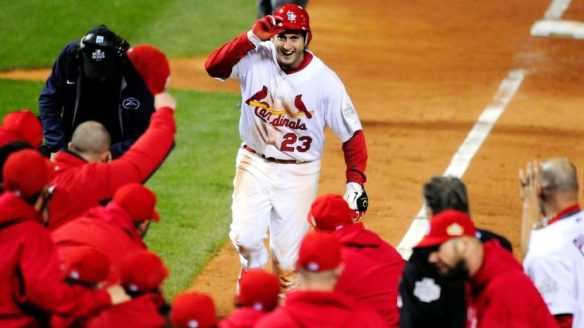
David Freese comes down the third base line after sending the 2011 World Series to a seventh game with a leadoff blast in the Game Six bottom of the eleventh.
If there’s one sub-pastime that animates baseball faithful almost as much as the game itself, it’s arguing. Especially about who belongs in the national Hall of Fame, and who doesn’t. Now you’re about to ponder a twist you probably never thought you’d have to consider.
You may never hear of any Hall of Famer declining the honour because he felt honestly that his career really didn’t justify it. But now there’s David Freese, the biggest of the big from the 2011 World Series, who’s turning down his election to the Cardinals’ team Hall of Fame because he feels his career doesn’t justify it.
The Cardinals aren’t the only team whose greatest moments were often written by others than their national Hall of Fame legends. But I’d be willing to bet they’re the only one who’ve just had one of those authors turn their own team Hall of Fame down. If I’m wrong, I’d be glad to know whom else.
This is a team who’s had enough big moments to stock a warehouse. Including, but not limited to, Hall of Famer Grover Cleveland Alexander (who was or wasn’t hung over) fanning Hall of Famer Tony Lazzeri with the bases loaded in the 1926 World Series, an inning before the Redbirds threw Babe Ruth out stealing to end it—with Hall of Famer Lou Gehrig on deck while Bob Meusel was at the plate.
There was Hall of Famer Enos Slaughter’s mad dash home in the 1946 World Series. There was Hall of Famer Bob Gibson’s perseverance in Game Seven of the 1964 World Series, then busting Hall of Famer Sandy Koufax’s single Series game strikeout record in 1968. There was Jack (The Ripper) Clark’s monstrous three-run homer to snatch a pennant from the Dodgers who were an out away from forcing a seventh 1985 National League Championship Series game.
There was Hall of Famer-in-waiting Albert Pujols’s glandular home run off Brad Lidge that only staved off the Cardinals’ elimination in the 2005 NLCS; and, his three bombs in 2011 World Series Game Three—starting in the sixth inning, finishing in a kind of reverse cycle. (A three-run shot, a two-run shot, and a solo shot.)
And, almost superceding the entire foregoing, Freese in Game Six of that Series. You had to have some kind of mojo working to supercede all that. Freese had it that night. When he hit a game-tying, opposite-field triple with the Cardinals down to their final strike in the ninth; then—in the bottom of the eleventh—sent the Series to a seventh game (which his team also won) by hitting a full-count, leadoff homer straight over the center field fence.
It added the World Series MVP to a trophy case that already included Freese’s being named the 2011 NLCS MVP as well. He’d done bloody well splendid for a kid who’d grown up a Cardinals fan, gave up on the game before college, but took it up again to become the Padre for whom the Cardinals traded aged Jim Edmonds only because they needed a third baseman with a little pop in their minor league system.
Then he earned the starting 2011 third base job, missed time early when hit on the hand by a pitch, and returned to play out the season with a Cardinals team that more or less backed into the postseason when the Braves collapsed as the Cardinals managed to reheat just enough.
“[S]ure, he might trade his career for a Hall of Fame career, but then again he might not,” wrote The Athletic‘s Joe Posnanski in 2020, recounting his own sixty top baseball moments. “There are 270 players in the Baseball Hall of Fame. There is only one player who grew up in St. Louis and got to live the dream again and again for the team he grew up loving. I suspect David Freese is pretty happy with how it turned out.”
Freese’s happiness has been won hard enough. He’s spent a lifetime battling clinical depression, including a lapse into alcoholism as a way to battle it. He kept quiet about that battle until well after he’d left the Cardinals: he didn’t take it to the public until eight months after he married Mairin O’Leary and—after two seasons as an Angel—had become a Pirate.
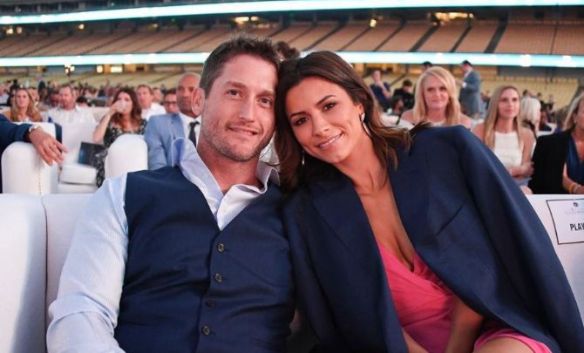
Freese with his wife, Mairin. They met and married after he left St. Louis and began putting his inner burdens—including the outsized weight of the hometown sports hero—in their proper places.
“It’s been fifteen-plus years of, ‘I can’t believe I’m still here’,” Freese told USA Today‘s Bob Nightengale then. “You win the World Series in your hometown, and you become this guy in a city that loves Cardinal baseball, and sometimes it’s the last guy you want to be. So you start building this façade, trying to be something I was not. And the whole time, I was scared to death what was going to happen to me after baseball.
” . . . Who knows where I was headed, but as long as I was here, I had so many friends here, I wasn’t good at just saying no. I wanted to please people, make everyone happy, and that became impossible.”
He came to his hard-earned inner peace only after the Cardinals traded him away. (Then-manager Mike Matheny told him candidly it might be the only way he could begin remaking himself.) He had one or two more moments in the postseason sun, as a Dodger in 2018. He hit a pair of leadoff bombs—in Game Six of that NLCS and in Game Five of a World Series the Dodgers lost in five to a Boston Rogue Sox team of replay room reconnassance rapscallions.
Then, he retired after the 2019 season. Long after he’d begun enjoying life outside baseball, including learning the piano and becoming an avid traveler with his wife and two young sons. “Freese no longer saw his stupefying 2011 postseason as a cross to bear from behind the wall of depression,” I wrote in 2020.
He looked forward to taking his . . . son to a live Cardinals game in due course. Not to mention showing the little boy what Daddy delivered in Game Six. And all that postseason, including a still-record fifty total bases and 21 runs batted in.
. . . The guy who made St. Louis baseball the happiest place on earth in 2011 fought hard enough to get to happiness with how his baseball legacy turned out in the first place.
That’s the guy who took an honest look at his career and, still at peace and happiness with how it turned out, decided he was honoured that Cardinal fans voted him into the team’s Hall of Fame but that they gave the honour to the wrong player.
Lots of not-so-greats have come up bigger than their own selves in baseball’s biggest hours. Such men as Al Gionfriddo, Dusty Rhodes, Don Larsen, Moe Drabowsky, Al Weis, Donn Clendenon, Gene Tenace, Brian Doyle, Bucky [Bleeping] Dent, Dave Henderson, Mickey Hatcher, Sid Bream, Mark Lemke, Tony Womack, Edgar Renteria, Scott Spiezio, David Eckstein, Steve Pearce.
They don’t all get the chance to prove publicly that they were better men than their isolated moments at the top of baseball’s heap. This weekend, Freese struck a big blow for putting a brief spell of baseball greatness into the kind of perspective that comes only from a man who made himself greater than his signature professional achievement.
 Throneberry Fields Forever