Don’t kill the ump, San Diego

Xander Bogaerts, D.J. Rayburn

This is the pitch umpire D.J. Rayburn called strike three (wrongly) instead of ball four. This was not the reason the Padres lost Game Three of their wild card set against the Cubs Friday.

You know something? I’m probably at the front of the line wishing for Robby the Umpbot’s advent at last.  But don’t even think about trying to tell me the Padres getting nudged out of the postseason by the Cubs is plate umpire D.J. Rayburn’s fault.

Yes, Rayburn absolutely blew what should have been ball four to Xander Bogaerts in the top of the ninth of National League wild card Game Three. The pitch was low, with enough clearance between the ball and the strike zone floor to pass a Frisbee through it.

Yes, Bogaerts absolutely should have been on first. No matter how bright it wasn’t that he slammed his bat to the ground, all but forcing Padres manager Mike Schildt out of the dugout in a flash to keep things from getting worse.

Yes, the Padres absolutely should have had the proper chance to keep their late game revival going, after Jackson Merrill led the inning off with a healthy blast into Wrigley Field’s right field bleachers. That looked even more pointed when Cubs reliever Brad Keller hit the next two batters he faced, Ryan O’Hearn and Bryce Johnson, both on 1-2 counts, forcing Cubs manager Craig Counsell to lift Keller for Andrew Kittredge.

It was still first and second and one out. The Padres didn’t have the bases loaded as they probably should have had, but they still had the tying runs on the pads and a potential tie-breaking run or two due at the plate.

But Jake Cronenworth grounded to shortstop making it second and third. And Freddy Fermin flied one to the back of center field but not far enough to escape being the Padres’ third out of the game and last out of the season.

And that, ladies and gentlemen, not D.J. Rayburn, is what cost the Padres the wild card set and sent the Cubs forth to open their NL division series with a 9-3 loss to the Brewers.

Because all game long, the Padres couldn’t cash in their baserunners with the American Express card. They left eight men on base. They batted six times prior to the ninth with men in scoring position and stranded them. They had no solution for the Cubs’ superior fielding and seemed unable to find holes between those fielders to push or shoot too many balls.

They had second and third in the top of the fifth, when Gavin Sheets singled with one out and Fermin doubled him to third an out later . . . but Fernando Tatis, Jr. flied out to right.

They had Bogaerts on second when he stole the pad an out after he opened the top of the seventh with a base hit . . . and stranded him with a line out to second and a fly out to deep center.

They had Fermin on third in the top of the eighth after his leadoff single turned into taking second on a one-out wild pitch, then taking third on an infield ground out . . . and there he was stranded, on another infield ground out.

Meanwhile, the Cubs ended a faltering Yu Darvish’s start in the top of the second with a bases-loaded single, pushing him out and Jameson Tallion in, and Tallion walked the second Cub run home before getting a strikeout and an inning-ending double play.

From their, the teams traded bullpen shutout innings until Michael Busch led the bottom of the seventh off against Robert Suarez with a blast into the right center field bleachers.

The 3-1 Cubs win may well mean the closing of this group of Padres’ window for postseason triumph. They may have been lucky to get to the wild card series with an offense that led the Show in out-wasting sacrifice bunts but came home 28th in home runs. Their hitters sent 77 out at home, but their pitchers surrendered 86 in the same playpen.

Their biggest names weren’t exactly bombardiers, outside Manny Machado hitting 27 or more for the 10th time in his career. Bogaerts and Merrill missed significant time due to injuries; Bogaerts hit only 11 out and Merrill, 16. Tatis, he who proclaimed himself capable of being the best player in the game last February, settled for 25 bombs on the season and one measly single during the wild card set.

Their pitching may be somewhat suspect going forward, with Darvish likely approaching the end of a career often brilliant and sometimes frustrating, Dylan Cease and Michael King possibly departing as free agents, and Joe Musgrove entering 2026 on the comeback trail from Tommy John surgery.

And who knows what the upshots for the clubhouse and the front office will be as a result of the late owner Peter Seidler’s widow Sheel Seidler’s lawsuit to wrest control of the team from her brothers-in-law? Who knows whether A.J. Preller will be allowed to try wringing out one more miracle or handed his head on a plate in a bid to begin fresh blood injections, considering his contract expires after next season and Seidler isn’t here to have his back?

But don’t lay the blame for this early Padres postseason exit on Rayburn. He certainly did blow that crucial ninth-inning call, but he wasn’t the man at the plate turning all those Padre runners into castaways.
Hernández Hideaway

LosAngeles Dodgers

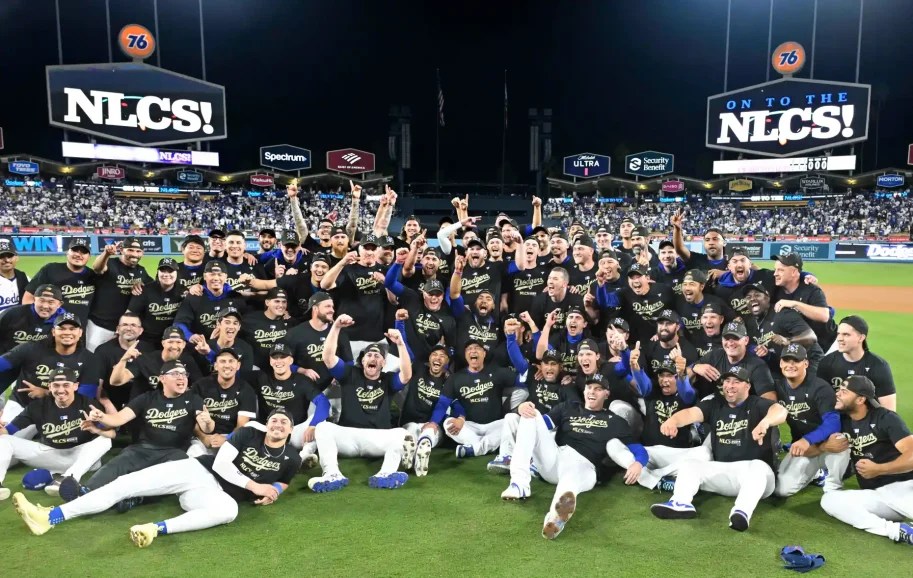
Ahead for the Dodgers: playing the Mets for the NL pennant.

They had a starting rotation most of which belonged in post-op. But the Dodgers are going to the National League Championship Series.

They had Shohei Ohtani, maybe the National League’s 2024 Most Valuable Player winner in waiting (though Francisco Lindor has a powerful claim), hitting a hefty home run in the first division series game but nothing much after. And they’re going to the NLCS.

They had Freddie Freeman, trying to play despite not giving a rolled ankle sufficient healing time, as close to plain ineffective as he’s ever been at any time in a brilliant career so far. And they’re still going to the NLCS.

Their starting picture so belonged in an orthopedic journal that they went to a Game Four bullpen game. And they’re still going to the NLCS.

They surrendered three homers to Padres superman Fernando Tatis, Jr. (two in Game Two, one in Game Three). And they’re still going to the NLCS.

They lost the sason series to the Pads and didn’t look quite as good on paper coming into the now-done division series. They’re still going to the NLCS.

They scored only two runs Friday night. But those were more than enough to send them to the NLCS.

The Dodgers did it with resilience. They did it with that eight-man bullpen game in the hostile arterials of Petco Park and the pen going lights out otherwise, to where the Dodgers were somehow able to shut the Padres out over the final 24 innings of the set.

They coaxed a magnificent Game Five start out of Yoshi Yamamoto, who turned a five-inning shutout over to that pen, where a mere four relievers were needed to finish what he started. On the first MLB postseason night featuring two Japanese-born starting pitchers, Yu Darvish was brilliant for the Padres over seven, except for two blemishes, and Yamamoto was better over five for the Dodgers.

But the Dodgers had to turn Dodger Stadium into Hernández Hideaway to get there, too, Friday night.

First, Kiké Hernández—back with the Dodgers for a second homecoming year after a detour to Boston, where he’d had a pocketful of postseason heroics for the Red Sox—punished Padres starter Yu Darvish with two outs in the bottom of the second, sending Darvish’s first service halfway up the left field bleachers.

Five innings later, Teoscar Hernández—a first-year Dodger after a tour taking him to Houston, Toronto, and Seattle, whose hefty grand slam pulled the Dodgers to within a run of the Padres in Game Three but only that—didn’t need full pillows. With one out, he hit Darvish’s 2-1 service to the same real estate his fellow Hernández reached.

Padres third baseman and slugger Manny Machado had perhaps the best post mortem from anyone in their silks: “We didn’t hit and score some runs. They did a tremendous job on the other side, on the pitching side. You have to give credit where it’s due. We just couldn’t string along hits. We had some opportunities, we couldn’t [push] through, and we fell short.”

That from a representative of the regular-season offense that threshed, of the team whose starting rotation could and often did dominate, and whose bullpen was one of baseball’s deepest of the year. The Dodgers said, essentially, in Kiké Hernández’s shameless postgame phrase, “[Fornicate] ’em all.”

“What was it,” said third baseman Max Muncy, “80 percent of the f—ing experts said we were going to lose? F— those guys. We know who we are. We’re the f—ing best team in baseball, and we’re out there to prove it.”

That won’t be as easy as they think. Awaiting the Dodgers are the Mets, who picked themselves up from the May scrap heap, rumbled their way to the postseason and through the first two rounds, have a lot more starting pitching depth (and lack of injury), a lineup with more depth than suspected going in, and (big “and”) they’re known lately for leaving bullpens wasted.

Both teams have their issues. The Mets need Pete Alonso to stay in the zone he’s rediscovered this postseason and closer Edwin Díaz to return all the way to form as he hinted in his last outing against the Phillies.

The Dodgers need length from at least two or three starters if they don’t want to tax that bullpen into letting the Mets do what they’ve done best this time around—make the final three innings their personal marquee stage. They also need Mookie Betts to continue becoming the Mookie Monster again after his slumpbusting bombs against the Padres.

This forthcoming NLCS does promise to see two teams throwing the proverbial kitchen sinks at each other as best they can with what they have. Whoever wins it stands to become a heavy World Series favourite.

Peter Seidler, RIP: “He saw the cup as three-quarters full”

Yu Darvish

Padres pitcher Yu Darvish arrives with flowers at the Petco Park memorial for Peter Seidler last Tuesday.

There have been exceptions to the axiom that no fan ever buys a ticket to a major league baseball game to see a team’s owner. One of them died last week, two days before his fellow owners voted foolishly to allow John Fisher’s hijack of the Athletics from Oakland to Las Vegas.

Fisher’s one of those owners whom fans would pay to demand he sell his team, in their more polite moments of fury. Yankee fans of the 1980s didn’t go that far but they didn’t mind having chances to let George Steinbrenner have it over his Mad Hatter-meets-the-King-of-Hearts style in that decade.

Conversely, fans loved seeking Bill Veeck out (and he, them) when he owned the Guardians (known as the Indians in his day), the St. Louis Browns, and the White Sox twice. So did Mets fans seeking out their original owner, Joan Payson; so have Met fans with current owner Steve Cohen. And so did Padres fans with Peter Seidler, who died last Tuesday at 63.

What Seidler had in common with Veeck, Payson, and Cohen was that he loved baseball genuinely and wasn’t afraid to wear it on his sleeve. He was known to walk around Petco Park with a baseball in his hand and a readiness to talk his love of the game at the slightest inspiration. Padres fans were known to wear team jerseys with his name on it as often as they wore those of various Padres players past and present.

Ground Floor Murals, a San Diego outfit known for having done mural tributes to various Padres players, wasted no time in hoisting one in Seidler’s memory last Tuesday evening on a wall in San Diego’s Little Italy section.

“Baseball is a social institution, and it always has been,” he said in a 2021 interview. “I believe to this day it’s America’s pastime, and the impact that the San Diego Padres can have on the city and county of San Diego is something like no other business can have. And that was important to me.”

He was talking about what provoked him to buy the Padres in the first place, in 2011, when by his own admission he was bored while undergoing treatment for non-Hodgkins lymphoma (a disease he’d beat twice) and discovering the team was for sale. He went to his first game at Petco Park. The simple allure of the ballpark joined his knowledge that San Diego had yet to party over a major sports championship.

Seidler was one of the grandchildren of legendary Dodgers owner Walter O’Malley but one who made his own way and fortune as a private equity investor. He joined his uncle, former Dodger successor owner Peter O’Malley, and his longtime friend Ron Fowler to buy the Padres, becoming its managing partner in 2020.

Peter Seidler

The Ground Floor Murals tribute to Seidler that first appeared last Tuesday night.

Seidler was known to be warm, gentle, and kind. Among other things, he was known equally around San Diego for his efforts on behalf of the homeless, which he believed was a problem that shouldn’t be left to government alone. He backed that belief by creating the Tuesday Group and getting involved with the Lucky Duck Foundation that reaches to homeless youth.

“Peter was probably the most positive person I knew,” Fowler told The Athletic‘s Dennis Lin after Seidler’s death.

To say he saw the cup as half-full is probably a misstatement. I think he saw it close to three-quarters full. He saw the possibilities, the upside in everything. He always said things could be fixed or “this will happen.” He just was extremely positive with how he looked at people, problems, everything. He always saw the good. I think that was the way he was in relationships, that’s the way he was in business, and obviously it served him well.

“How many baseball owners,” asked one owner, the Brewers’ Mark Attanasio, believed to be Seidler’s closest friend among the owners, “can you say are gentle?”

Like his counterpart in Philadelphia, John Middleton, Seidler had neither shame nor remorse in actually investing in his baseball team. Among a very dubious fraternity that seems more than ever to believe baseball’s common good equals making money for them, Seidler, like Middleton, really did believe there was honour in actually trying to win and keep winning.

“A lot of people thought that that San Diego would never be a baseball city,” Attanasio told USA Today‘s Bob Nightengale. “It’s a military town. It’s a beach town. He made baseball more than relevant. He brought passion to that fanbase, and that’s as loud a crowd as you will ever hear.”

Nobody pretends Seidler didn’t have a few trips and tumbles toward that goal. The Padres got as far as last year’s National League Championship Series but lost in five games to Middleton’s Phillies. They’ve gone to two postseasons in four seasons since Seidler became their managing partner.

He wasn’t afraid to take the big swing whether it delivered big or imploded big. For every Manny Machado to whom he showed the glandular dollars there was an Eric Hosmer to whom he showed the dollars but got an aged shell for his trouble. He committed big to shortstop Xander Bogaerts, pitchers Yu Darvish and Joe Musgrove, and infielder/outfielder Fernando Tatis, Jr.

But he didn’t deliver weekly fusillades demanding a World Series or bust like yesterday, either, before or after he ascended to the number one ownership slot. He didn’t demand summary executions monthly over bad spells or decisions on the field.

So James Shields turned out to be less than his old and overstated Big Game James reputation? So Hosmer turned out to be old before his time? No sweat. Seidler just picked himself up, dusted himself off, started all over again.

So the Padres faltered last June, recovered slightly in July, faltered again in August, then put on a September stretch to a) be proud of; and, b) miss the postseason by a few hairs? Nobody doubts that Seidler would have done whatever seemed needing to be done to fix that. Even if it meant potentially dealing rather than extending Juan Soto. Even if it meant letting Blake Snell, this year’s National League Cy Young Award winner, test his free agency market before possibly thinking of trying to re-up him for another tour.

When the owners locked the players out in 2021-22, the eventual five year collective bargaining renewal wasn’t good enough for Seidler: he actually wanted a ten-year deal.

Seidler’s death prompted an outpouring from Padres fans and from all around baseball, including a memorial set up at once outside Petco Park. Among the visitors to that memorial were several Padres players including Darvish, who probably spoke for most of Seidler’s players when he Xtweeted after the news broke:

My heart hurts with the unfortunate news of Peter Seidler’s passing. I’m sure everyone that knew him would agree with me when I say Peter was a truly wonderful human being, and being in his presence was always a blessing. He was a teacher of life, and taught me countless lessons form the all the interactions we had. May his beautiful soul rest in peace.

Would Seidler have voted against Fisher’s hijack of the A’s to Las Vegas after too many years of playing Oakland for fools? Would he have stood athwart his fellow owners (even Anastasio and Middleton) in standing athwart Fisher yelling “Stop!” while reminding them how they were forgetting baseball as a social institution and doing their level best to destroy what remained of that status?

We’ll never know now. Just as we don’t know why Middleton and Cohen—and maybe Attanasio, plus one or two other owners to whom the game’s good really does mean far more than just making money for it—threw their hands up, and let Fisher get away with gutting his team and without the usual relocation fee (waived by Commissioner Pepperwinkle) and with continuing to remain heavily enough on their revenue-sharing teat.

What we do know is that Seidler wanted his Padres to stand with and up to any of the other real or alleged big boys in baseball, and for his team and their fans not to back down to anyone for affection and achievement. The Padres didn’t win the World Series while he was alive and operating, but Seidler did whatever was needed to make sure it wasn’t for lack of trying.

As long as he ran the Padres, there was always the chance that somehow, some way, Seidler’s example might yet affect enough of his fellow owners that they might, maybe, begin to think of baseball once more as far more than just a moneycatcher, far more than just a rude interruption to turns on the cell phones. Might. Maybe.

Due diligence dropped over Clevinger?

Mike Clevinger, Olivia Finestead

White Sox pitcher Mike Clevinger  is accused of attacking  former girlfriend Olivia Finestead and their ten-month-old daughter. Was that why the Padres let him walk into free agency? Were the White Sox completely unaware of the MLB probe when they signed him?

Two major league teams sit on edge over righthanded pitcher Mike Clevinger. One is the White Sox, who signed him as a free agent over the offseason. The other is the Padres, who let him walk into the free agency pool.

The edge is a baseball government investigation into accusations that Clevinger slapped the mother of his ten-month-old daughter around, threw an iPad at her while she was pregnant, tried to strangle her, and threw a load of tobacco juice at the little girl herself.

Olivia Finestead told reporters Clevinger did both last June, while the Padres were in Los Angeles for a set against the Dodgers. She provided photographic evidence to support the accusation. She said she gave Clevinger “leeway” for a considerable period while trying to mediate to retrieve some of her possessions and establish parameters for supervised visitation between Clevinger and their daughter.

Clevinger himself faced the press on day one at the White Sox’s spring training compound in Glendale, Arizona. One moment, he said he wanted to address “the elephant in the room.” The next, he tried steering the presser back to baseball.

“I’m not going to hide away from it,” the righthander said. “I didn’t do anything wrong. It’s really embarrassing. It’s not who I am. Now I’ve got to sit here on my first day and answer questions about it like I am one of those people. It is devastating but I’m here to answer to the bell and I’m excited to see when the facts come out.”

That’s an intriguing way to put it. He’s “excited” to see when the facts come out? You can think of far less cavalier adjectives to apply to the net result of an MLB investigation training on whether you slapped a woman who gave birth to one of your three children and then threw what some might consider toxic waste at the little girl to whom she gave birth.

But no. Clevinger says wait until there’s “actual evidence . . . Just wait for there to be actual evidence before you start making judgments and stuff. This is about my children that I care about even more than this game.” (Clevinger has two older daughters with a different woman.)

Eyes fall upon the Padres, as San Diego Union-Tribune columnist Bryce Miller observed when the accusations were revealed last month, “because “[w]hat might concern fans and others trying to sift and sort what the Padres knew and could do about it sprung up when Finestead relayed that she had been talking to MLB’s Department of Investigations since the summer.”

Translation: What did the Padres really know, and how soon did they really know? Concurrently, what could they have done under MLB’s domestic violence protocol, which bars a club from disciplining an accused player without MLB permission. (Both MLB and the Dodgers put Trevor Bauer on ice in the first place, remember.)

“Were the allegations,” Miller asked, “part of the stew of reasoning for allowing Clevinger to wade into free agency, along with coughing up five runs in 2 2/3 innings against the Dodgers in the NLDS and failing to record an out against the Phillies in the NLCS? Were there character questions behind the scenes?”

Those questions turn into due diligence questions for the White Sox, who made Clevinger their first free agency addition this past offseason. Now, as the Chicago Tribune‘s Paul Sullivan wryly notes, he’s their number one albatross. “How much the Sox vetted Clevinger is another issue they need to examine but probably won’t,” Sullivan writes. “While they might not have known of the allegations when they signed Clevinger, as they said in a statement, the Sox obviously liked his character and believed he would be a good fit in the clubhouse.”

Put domestic violence to one side for one moment. The White Sox might have forgotten when Clevinger, then a Guardian (they were still known as the Indians at the time), violated COVID protocols in 2020. He and fellow pitcher Zack Plesac went out for a restaurant dinner and a card game with friends in Chicago without getting the team’s approval to go.

The team sent Plesac back to Cleveland in a private car but had no idea Clevinger was involved until he flew back to Cleveland with the team—including cancer-fighting pitcher Carlos Carrasco (a Met since 2021), who’d been immuno-compromised from his cancer treatments. Plesac decided it was all the media’s fault for reporting it, not his or Clevinger’s fault for doing it.

Then, Clevinger was merely immature and irresponsible. Now, he may have graduated from those to dangerous.

When White Sox general manager Rick Hahn was asked how the club could avoid walking eyes wide shut again into a situation involving a player under domestic violence investigation, the only thing missing from his word salad was dressing and croutons.

“We had several conversations at that time about what are we getting from a makeup standpoint,” Hahn told reporters. “There certainly were some positives in terms of work ethic and focus and desire to win and compete and understanding of his own mechanics and efforts to improve, which are positives. But there were maturity questions. He’d admit that probably by his own volition. That’s what I was referring to in terms of we’ve had similar guys who have had reputational questions.”

Most recently, it was Hall of Fame manager Tony La Russa, whom the White Sox brought back to the dugout despite a second DUI. Once a shrewd, forward-thinking skipper, La Russa’s in-game managing now drew him under fire enough despite a division title his first comeback season that, when his pacemaker barked, he retired after his second.

“That wasn’t a case of bad vetting but of Reinsdorf wanting La Russa to manage his team no matter what anyone else thought,” Sullivan writes. “La Russa could’ve bowed out once the news became public but didn’t feel the need . . . [He] never was going to get the benefit of the doubt from a large and vocal segment of Sox fans. Neither will Clevinger if he’s allowed to pitch in 2023. But unlike La Russa, Reinsdorf has no personal relationship with Clevinger, so there’s no need to pretend fans eventually will grow to like Clevinger.”

We should note in fairness that Finestead herself doesn’t look askance at the White Sox. “I was told the @whitesox didn’t have a clue of [Clevinger’s] investigation,” she posted online. “Can’t blame an organisation for something they don’t know.”

But there are still too many fans, baseball and other sports, who are too willing to overlook or forgive such grotesquery as domestic violence so long as those accused and exposed can get it done in the game. He beat/attacked his wife/child/girlfriend/one-night stand? The guy’s going to help pitch us to a World Series or quarterback us to the playoffs, so run along, old man, you bother us.

It should bother the Padres and their fans that they may have had little choice but to bite the bullet and wait until Clevinger left as a free agent.

It should bother the White Sox and their fans that they either got caught with their proverbial pants down signing him or that those in the front office responsible for vetting him fell short of full due diligence.

It should also bother Met fans that—after an offseason of bravery and boldness; wading into the free agency pool and coming up Justin Verlander, while turning away from Jacob deGrom and Carlos Correa over health concerns; re-upping keys Brandon Nimmo (outfield), Jeff McNeil (infield/outfield), and Edwin Diaz (relief pitching)—the Mets invited outfielder Kahlil Lee to spring training despite his own domestic violence issue. His former girlfriend, Keriwyn Hill, charges that he choked her and pulled her hair violently during an argument last May, while Lee played for the Mets’ Syracuse AAA team. (MLB is also investigating the Lee case.)

It should bother any decent human being. Just as it should bother us that there are still too many men who think touching a woman for any reason other than to express love is acceptable.

A mudswinging victory

Bryce Harper

Bryce Harper launches what proved his NLCS-winning two-run homer in the bottom of the eighth. Wild? The crowd went nuclear.

Bruce McClure, the membership ambassador for the Society for American Baseball Research, tweeted: “Why in the world did they insist on playing the [National League Championship Series] game in the pouring rain?” I had an answer immediately.

“Because,” I replied, “they wanted to see Bryce Harper drop every jaw in Philadelphia and elsewhere in the bottom of the eighth?”

“You win, good sir,” Mr. McClure answered.

Well, I didn’t win on Sunday afternoon. The Phillies did. At this writing, it’s fair to say those $330 million dollars Phillies owner John Middleton agreed to pay Harper over thirteen years might have been bargain-basement rate. It’s also fair to say no timetable should be placed upon the finish of Philadelphia going berserk over this.

One and a half innings after the elements and the mound mud they formulated helped the Padres to an overthrow one-run lead, and with J.T. Realmuto on first after a leadoff single against Padres reliever Robert Suarez, Harper checked in with the elements receding just enough and hit the biggest home run of his major league life. It took a little hair-raising in the top of the ninth to make it stick, but stick it did, sending the Phillies to the World Series.

“I knew he’d come with his best pitch,” Harper told Fox Sports field reporter/Sports Illustrated columnist Tom Verducci at one end of the dugout minutes after he ran it out. “I took the best swing I could. I just want to win this game.”

He’d just have to wait until the Phillies slithered out of a final Padres push in the ninth, when reliever David Robertson lost back-to-back one-out walks and gave way to Ranger Suárez, customarily a starter but also a lefthanded pitcher with a lefthanded batter due up.

Then Trent Grisham—a breakout star when the Padres slew the Mets’ dragon in the wild card series but almost a non-topic in this National League Championship Series—elected to try dragging a bunt for a base hit on Suárez’s first pitch. Neither he nor the Padres bargained on Suárez himself springing from the mound like a cat overdosing on Red Bull. Suárez threw him out at first almost in a blink.

The next man up was Austin Nola, the Padres’ catcher who hogged the headlines over the Padres’ lone NLCS win for starting the scoring with a base hit off brother Aaron on the mound for the Phillies. The only thing that might have made it sweeter if Big Brother Nola could land a hit now would have been if Little Brother Aaron was on the mound again.

But Little Brother was in the Phillies dugout on the same pins and cushions (thank you, Mrs. Ace) as his teammates until Big Brother skied Suárez’s first pitch to shallow right field, where Nick Castellanos ambled in, held off second baseman Juan Segura ambling out, and snapped the ball into his glove with the pennant attached.

Let the second guessing begin, mostly because it’s going to begin with or without any hint from me. The biggest one is probably going to be, thinking of the righthanded Robert Suarez staying in to face Harper the portside pulveriser, “Why the hell didn’t Bob Melvin bring Josh Hader in with Harper checking in at the plate?”

Reaching for the best bull in your pen when it’s shy of the ninth inning and your “save” situation is five minutes ago with a hard-mudslidden one-run lead isn’t just sound strategy, it’s absolutely mandatory. That’s smart baseball. Especially when your best just so happens to match ideally to their best and their best is due up next. Wasn’t that why the Padres dealt for Hader at the deadline, banking on the self-resurrection he’d make after leaving Milwaukee.

Of course it was. But just maybe Melvin just saw his Phillies counterpart do likewise with his best bull and get third-degree burned through no fault of either his or his man’s own. Melvin wasn’t going to let that happen to him or to his team. Mother Nature was being defiant enough all day long. And Harper had faced Robert Suarez in the eighth in Game Two, their only previous known confrontation—whacking into a double play.

The Padres mud-wrestled their way back from a 2-1 deficit in the seventh—Rhys Hoskins’s two-run bomb in the bottom of the third threatened to hold up otherwise despite Juan Solo’s solo satellite in the top of the fourth—because Phillies manager Rob Thomson’s reach for Seranthony Domínguez backfired under Mother Nature’s pouring.

The mound was muddy. The infield dirt was muddy. Both starting pitchers, Zack Wheeler for the Phillies and Yu Darvish for the Padres, had visible trouble keeping their landing feet from sliding more than a bare inch on the mudded mound downslope. Domínguez in the heavier rain had visible trouble holding and throwing his usually precise fastballs.

With Wheeler pushed out at the inning’s opening by Jake Cronenworth’s leadoff single, Domínguez fell behind 3-1 before throwing Josh Bell a fastball meaty enough to bang into right for an RBI double—after wild-pitching Cronenworth to second to make it simpler. After Domínguez looked to be finding a workable rain handle with back-to-back strikeouts, he threw two wild pitches while working to Grisham, enabling pinch-runner Jose Azocar to take third and score the Padres’ third run.

Grisham flied out to right for the side. Melvin surely appreciated having the lead handed to the Padres for the first and only time in the game. But seeing Thomson’s best-bull-forward move get thrown in the mud that dramatically must have put one thought in the back of his mind: We are not going to let that happen to us in this dreck.

Darvish surrendered an eighth inning-opening  double to right to Bryson Stott, yielding to Robert Suarez. Suarez wrestled through the seventh unscathed. Hader was up and throwing in the Padres bullpen. But Realmuto began Suarez’s eighth-inning scathing by whacking an 0-2 pitch into left for a clean single. (As clean as the wet conditions allowed, of course.)

Still no sign of Hader. Suarez and Harper wrestled through two 1-2 foul balls to 2-2. The next pitch was a sinker hanging up in the outer middle region of the strike zone. Harper launched it parabolically, the opposite way, into the left field seats. Every occupant of Citizens Bank Park dared to believe it. The Phillies had just won the pennant. The top of the ninth would be a mere formality.

Not exactly, of course. It wasn’t easy for either team to get here in the first place, no matter how easy the Phillies made it look shoving the Cardinals and the Braves aside, no matter how easy the Padres made it look shoving the Mets and the Dodgers to one side.

Both teams had to hit the mid-season reset buttons. The Phillies had to get to the postseason in the first place almost despite losing Harper first to designated hitter-only duty after a shoulder injury and then for two months with a thumb fracture—on a pitch from the Padres’ Game Three starter Blake Snell, of all people.

It took Harper long enough to get anything resembling his groove back in the first place. The Phillies claimed the final National League wild card in the nick of time. Harper found his groove almost the moment the postseason began. Now he stands as the NLCS’s Most Valuable Player. The stupid money (Middleton’s term for his willingness to spend and invest in the team) looks absolutely Mensa now.

Harper’s hit five bombs all postseason long thus far and tied a franchise record for postseason for extra base hits. He’s hit a lot of indelible nukes in his career. Not even the ultimate grand slam he smashed against the Cubs a little over three years ago compares.

That one will become just a footnote to his career. Wherever the Phillies go from here, this one’s going to be cast in plutonium.