On Harper telling Manfred where not to go

Bryce Harper

Bryce Harper, a player who suffers neither fools nor commissioners (did I repeat myself?) gladly . . .

Once upon a time, when John Glenn’s Mercury space flight ran into a brief postponement,  then-Vice President Lyndon Johnson all but demanded he be sent through the phalanx of press outside Glenn’s home to have some television time with Glenn’s wife, Annie. Rebuffed before the postponement, Johnson now thought it’d be just the thing if he could “console” Mrs. Glenn over the airwaves.

Mrs. Glenn wanted no part of Johnson’s publicity hounding. NASA, as Tom Wolfe phrased it so deftly in The Right Stuff (the book, not the movie, you miserable pudknockers), wanted no part of Mrs. Glenn’s demurrals: “There’s John, covered with sweat, drawn, deflated, beginning to feel very tired after waiting for five hours for 367,000 pounds of liquid oxygen to explode under his back . . . and the hierarchy of NASA has one thing on its mind: keeping Lyndon Johnson happy.”

You remember the film version, no? John, we’ve got a problem with your wife, said NASA’s program chief to the astronaut. Oh, no you don’t, Glenn said, figuratively, when replying to his wife that, if she didn’t want Johnson or the networks coming in, “then that’s it, as far as I’m concerned, they are not coming in—and I will back you all the way, one hundred percent, on this, and you tell them that . . . you tell them astronaut John Glenn told you to tell them that.”

NASA program chief to Glenn: John, it’s the vice president!! Glenn to NASA chief: You are way out of line here!  NASA chief: Yeah? Well, I’m thinking of changing the order of flight assignments! Six other Mercury astronauts, not all of whom thought as highly of Glenn as the nation would after his orbital flight and gutsy re-entry, five of whom might well have given their left testicles to be the first American into full orbit (the first two Mercury flights were up to the wild blue yonder, a brief kiss of space, then right back down to the ocean), said that’s what you think: Oh, yeah, Who you gonna get?

Now, my question: If one astronaut could tell a pushy vice president where not to go and get away with it, why on earth couldn’t one baseball player tell a pushy commissioner—whose tricks and rhetoric stand athwart the good of the game he professes to have first on his mind—where to go and get away with it.

I’m not going to repeat the names of the philistines who’ve called for Bryce Harper’s suspension or at least formal and loud enough reprimand after last week’s confrontation with Rob Manfred. The one in which Commissioner Pepperwinkle visited the Phillies clubhouse (as he does with all major league clubhouses each year) with his economic agenda to discuss, and Harper—one of the game’s most intelligent as well as talented and accomplished players—told him flatly that if he wanted to talk salary cap, “you can get the [fornicate] out of our clubhouse.”

Manfred subsequently said that he and Harper shook hands near the end of the meeting. Other reports suggested Manfred tried to contact Harper the following day but Harper declined. To reporters afterward, Harper said, only, “Everybody saw the words and everything that happened. I don’t want to say anything more than that. I’ve talked labor and I’ve done it in a way that I don’t think I need to talk to the media about it . . . I’ve always been very vocal, just not in a way that people can see.”

Perhaps the worst kept secret in baseball right now has been Manfred’s subtle-as-a-jellyfish-sting push to put a salary cap onto the negotiating table for the next collective bargaining agreement, though he doesn’t use the specific phrase “salary cap” and prefers now to use such language as baseball’s “economics.” The lesser volume of talk involving the far more necessary (and viable) salary floor—a requirement that baseball’s owners whose teams aren’t named the Dodgers, the Mets, the Phillies, or the Yankees, among an extremely few others, should either spend a negotiated minimum on player payroll or sell to ownerships more than willing to spend—tells you all you need and more than you want.

Manfred thinks he’s baseball’s grand protector and preserver. But for every one smart thought or plan he devises (smart and thoughtful: the universal designated hitter; the Field of Dreams Games) he devises numerous dumb and dumbers: The free cookie on second base to open each half inning; the continuing City Connect uniform abominations; abetting the Oakland Athletics’ abandonment of a fan base who loved them, in favour of an owner who let the team and their old park go to seed absent “public financing” [read: public fleecing]; NASCAR-like ad patches on uniform jerseys; redefining “permanent” as “lifetime” regarding the late, flagrant Pete Rose; and, the Speedway Classic (please don’t say you couldn’t see this one coming), in which a baseball field was implanted and a baseball game was played inside a NASCAR track, all sit as evidence for the prosecution.

Did you really love looking at the sentence linking to ESPN’s story of the Speedway Classic game between the Braves and the Reds, pushed to Sunday when the rain washed it out in the first inning Saturday? After red flag, [Eli] White’s 2 HRs let Braves lap Reds. See if you can tell where such a sentence as that fits better, especially since no major league team is named for either cars or curs: the Daytona 500, or the Westminster Kennel Club Dog Show. Should Bristol Motor Speedway have sent a home run pace car around the track after every homer . . . or a pack of greyhounds?

Don’t tell me about the Speedway Classic crowd breaking a major league attendance record. American immunity to novelty didn’t end with the pet rock, the Garbage Pail Kids, the Macarena, Beanie Babies, Furby, Pogs, and Fidget Spinners. The good news, otherwise: It broke a major league attendance record. The bad news, further: Bristol Motor Speedway ran out of food and drink on Saturday night; stories abound about motorists stopping at convenience stations and being crowded by Braves and Reds fans allowed to bring their own provisions Sunday.

Maybe a player making nine figures on a thirteen-year deal with six years and $153.2 million yet to come, playing for a team whose owner actually does operate as though the common good of the game isn’t solely to make money for himself*, isn’t quite the ideal man to speak up. But Barnum’s Law has yet to be repealed, and Manfred has proven himself one of its least apologetic supplicants.

————————————–

* Hark back to spring training 2019, when Bryce Harper signed his thirteen year/$330 million deal with the Phillies, after talking directly with Phillies owner John Middletown and all but ordering his agent Scott Boras to sit down and keep his big trap shut. After impressing Middleton with his knowledge of the game’s play and its history, not to mention asking how Middleton himself made a long, happy marriage work, Middleton had this to say to Boras

Scott, I want to tell you something, I’m not interested in talking about marketing dollars, ticket sales, billboards, concessions. There’s only one reason I’m talking to you, and that’s because I believe this guy can help us win. I’ve made enough money in my life, I don’t need to make more. My franchise value has risen dramatically over the last 25 years. I don’t need it to rise more. If it does, fine. I’m here to win, and I think your guy can help me win.

You want to know why players think owners and even commissioners lie whenever their lips move? Middleton is the rare contemporary MLB owner who speaks as a man who’s in it for the love of the game and behaves as though it’s not a mere platitude, whether in Philadelphia or Pudknock. (For the record, too, Harper as a Phillie has more than lived up to his end of the bargain, a few injury disruptions notwithstanding.)

Baseball’s sky isn’t falling, folks

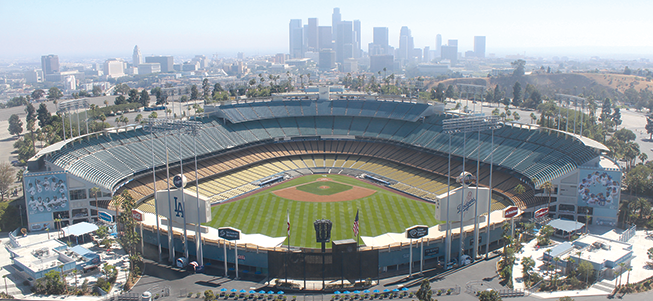
Dodger Stadium

No, folks, this is not the home of the new Evil Empire.

Ken Rosenthal isn’t the only one who’s slightly staggered that Rob Manfred actually tried to speak reasonably about the current ponderings of a baseball salary cap. Slightly, but perhaps not irrevocably.

Said Commissioner Pepperwinkle when some owners began making some pro-cap noise, “I am a huge believer in the idea that there are always multiple solutions to a particular set of concerns.” Said Rosenthal, though, playing the trust-your-mother-but-cut-the-cards card, “It’s possible, perhaps even likely, Manfred was playing possum when he spoke of ‘multiple solutions’ for revenue disparity.”

Let’s remember, as Rosenthal does by way of Forbes, that baseball in 2024 generated $12.1 billion in revenues, a new record even if it’s not as ritzy a record as Aaron Judge’s American League single-season home run record. The math says that’s an average $400 million per major league franchise.

Alas, some owners and team executives have begun to bellyache well ahead of the current collective bargaining agreement’s 2026 expiration. Rosenthal cites a few who may or may not surprise you: the Orioles’ new owner, David Rubenstein; the Yankees’ veteran owner Hal Steinbrenner; the Mets’s president David Stearns:

Rubenstein has said he wishes baseball a salary cap “the way other sports do.” Steinbrenner says those profligate Dodgers it’s difficult “for most of us owners to be able to do the kind of things that they’re doing now.” Stearns says baseball has “a little tougher time” figuring out how to keep stars who came up through the smaller market organisations in those organisations.

Not so fast, Rosenthal rejoins:

Funny, Rubenstein is a private equity billionaire who last March, with no assurance of a cap, had no problem paying $1.735 billion for the control stake of the Orioles . . . Funny, Forbes last March valued Steinbrenner’s team at a major-league high $7.55 billion and the Dodgers at $5.45 billion . . . Funny, Stearns previously worked for the Brewers, who play in the smallest market in baseball, yet signed outfielders Christian Yelich to a nine-year, $215 million contract and Jackson Chourio–after Stearns departed–to an eight-year, $82 million deal. And the Brewers . . . consistently find a way to compete.

“There is no disputing that small-market teams are at a financial disadvantage, and often lose star players,” Rosenthal continues. “But it’s also true that those teams occasionally keep some stars long-term, and perhaps could invest more of their revenue-sharing dollars in major-league payroll.”

Perhaps they could take the cue from the late Peter Seidler, whose Padres have been “proof that small-market teams should not operate as if they are doomed.” Seidler may also have been one of the only exceptions (countable on a single hand) to the rule that no fan ever pays their way into the ballpark to see the team’s owner. That’s how fan friendly he was before his death.

The Padres may or may not have spent all wisely, all the time. But as Rosenthal notes, they do have three postseasons in the past five years (including and especially the thriller with the Phillies that climaxed in Bryce Harper’s mud-bowl home run) and four consecutive attendance rankings in the top five.

“Make the luxury-tax thresholds higher, but the penalties steeper; about 50 percent of luxury-tax proceeds go to small-market teams,” Rosenthal adds.

Redistribute draft picks to give small-market clubs better positions and additional selections. Force those teams to spend by instituting penalties for falling below certain payroll thresholds, similar to the ones that exist at the top of the luxury-tax structure.

Don’t like those ideas? Fine, come up with others . . . How would the sport revive from another stoppage? The owners advocating for a cap should not even want to flirt with that question. Their “sky is falling” act is already growing tiresome. Fix the sport some other way. Or sell your damn team.

Meanwhile, Rosenthal’s Athletic colleague Jayson Stark reminds one and all that playing the “competitive balance” card while agitating for a baseball salary cap is about as credible as calling the NFL the true parity league or the Trump Administration the true stewards of the Constitution.

How many baseball teams broke decades-long championship droughts, fifty years or longer, since 2001? Stark asks. And, answers: Eight—the 2002 Angels, the 2004 Red Sox, the 2005 White Sox, the 2010 Giants, the 2016 Cubs, the 2017 Astros*, the 2019 Nationals, and the 2023 Rangers. How many NFL teams have done likewise since 2001? Three—the 2009 Saints, the 2017 Eagles, and the 2020 Chiefs.

Stark has more myths to bust, and bust them he does, admirably:

Come Sunday, the Chiefs sought their third straight Super Bowl and fourth in the past six years. Meanwhile, among baseball’s behemoths whom some owners and a lot of witless fans claim are Ruining The Old Ball Game while the NFL is the Any Team Can Win league, Stark points forth:

“The Dodgers? They’ve won four World Series in the last 59 years.” Perspective: Those four began shortly after the Beatles performed their final-ever American concert . . . in what was then the home of the Dodgers’ hated rivals up north in the Bay Area.

“The Braves? They’ve won four World Series in the last 121 years.” Perspective: They won their first Series just a few months before Archduke Ferdinand’s assassination launched the world war that made the world safe for World War II.

“The Red Sox? They’ve won four World Series in the last 106 years.” Perspective: Before the first of those, the United States had sixteen presidents–from a former Princeton president named Woodrow Wilson to a former baseball owner named George W. Bush.

“The Giants? They’ve won four World Series in the last 91 years.” Perspective: Prior to 2010, the Giants hadn’t won a Series since the year of America’s first black radio network, the first mass polio vaccinations for children (in Pittsburgh, where the Pirates would finish dead last in the National League), and Edward R. Murrow handed Sen. Joseph R. McCarthy a television knockdown punch.

“The Cardinals? They’ve won four World Series in the last 60 years.” Perspective: You can make it five in the last 61, with their 1964 Series triumph against the Yankees . . . to whom their Series-winning manager would repair as their next manager following the disgraceful pre-ordained dumping of Yankee skipper Yogi Berra.

“The Phillies? The Astros? They’ve won four World Series combined in the history of their franchises.” Perspective: The Phillies had to beat the Astros to win the 1980 pennant that led to their first-ever Series triumph—32 years before the Astros were the team to be named later in the swap that sent the Brewers to the National League and the Astros to the American League.

The Yankees? Their dominance and dynasties are just so Twentieth Century, even if their wealth isn’t. Stark reminds us that we’ve seen 22 World Series since baseball decided to slap the big spenders with the luxury tax. The Yankees have won—wait for it!—exactly one of those Series.

Oh, yes: The Empire Emeritus and the Damn Dodgers have met in exactly four World Series since America’s bicentennial birthday bash. Want to know the score? Dead heat: two Series each . . . and the Yankees won both of theirs during the disco era–1977 and 1978.

Before last fall, Stark would like to enlighten or remind you, regarding tangles between two out of the five fattest payrolls in the game over the past 35 Series, “a World Series like that had happened precisely three times in those 35 years: 2018 (Dodgers-Red Sox) … 1999 (Yankees-Braves) … and 1996 (also Yankees-Braves). And that’s it.”

Meanwhile, what Stark calls the Sport That’s Broken has seen twelve 2024 teams with Opening Day payrolls less than $130 million, but he points out that 1) all but two of those teams played October baseball over the past five years; and, 2) all but four of them made the postseason in the past two years.

By the way, the salary-cap NFL has had eighteen distinct Super Bowl champions in the 49 years since the Messersmith decision ended baseball’s reserve era. Before you holler a-ha! be advised that baseball without the salary cap has had 24 distinct World Series champions in the same 49 years.

Repeat after me: Baseball’s sky isn’t falling. How can you tell an owner is lying? When his or their lips form the word “poverty” or synonyms thereof while forming the phrase “salary cap.” But how can you tell fans hollering for a salary cap are disingenuous? When their lips don’t form the phrase “salary floor.”

Written for and published at Sports Central.