Baseball’s strategic non-command

Warren Spahn

That was then: “Hitting is timing. Pitching is destroying timing,” said Hall of Famer Warren Spahn. This is now: “Pitching is timing. Timing is supposed to make Nolan Ryan resemble a junkballer. Batter down? Oops!”

When Steve Dalkowski died a little over a year ago, the legends and myths about the nine-season minor league lefthander arose from the dead one more time. Howitzer arm? Dalkowski threw fastballs like cruise missiles.

Fans with seats behind the plate said no thanks when he was going to pitch—they didn’t want to come away with holes in their heads. He was that fast. And that wild.

Dalkowski finished his professional pitching career with 37 hit batsmen. That’s an average of four drills a year. The wildest pitching oat of his and many eras was kale compared to what’s going wild today, when as of this morning the Cubs pitching staff has hit a Show-leading thirty batters. (One batter drilled by a Cub every 44 plate appearances against them.)

At that rate, the Cubs staff is liable to do in less than two full months what Dalkowski took nine years to accomplish. The last I looked, there isn’t a Cub on staff whose fastballs inspire the kind of thing Red Sox utility infielder/pinch hitter Dalton Jones said of Dalkowski’s gas: “Hearing him warm up was like hearing a gun go off.”

Yet.

The outlier Dalkowski was in his time has become the norm in our time, and with about 200 percent more batters taking it on the chin . . . and anyplace else today’s uncontrollable fastballs can reach. As of this morning 476 major league batters have been hit by pitches—one drill every 80 plate apperances.

They’re not just free-floating knuckleballs or curve balls that break inside unexpectedly, either. These days, for whatever perverse reasons that only begin with the misuse of analytics, baseball organisations hunt and capture human howitzers who can throw lamb chops past entire packs of wolves—and practically nothing much else.

The trouble is that the newest generation of speedballers has about as much control as a politician’s mouth. The further trouble is that someone has the potential to become the next Tony Conigliaro—if not the next Ray Chapman. And the poor soul doesn’t even know it.

“Starting at the amateur level,” writes The Athletic‘s Ken Rosenthal, “the baseball industry has come to value stuff over command, velocity over artistry. According to baseballsavant.com, the average velocity of a four-seam fastball in 2008 was 91.9 mph; this season, it’s 93.6. The trend is not just a threat to the health of hitters, but to that of pitchers as well.”

Threat to their health? How about the night Cardinals reliever Genesis Cabrera opened an assignment by hitting Bryce Harper in the face-then-wrist—knocking his helmet right off his head between face and wrist, too—and Didi Grigorius in the back . . . back-to-back. Harper and Grigorius may have been lucky they weren’t beheaded back-to-back.

Cabrera wasn’t trying to relieve either man of a head or another part of their assorted anatomy. He looked and acted positively pained when Harper went down and Grigorius spun on the back drill.

Both players knew it, Harper going so far as to send Cardinals manager Mike Schildt a text message saying he knew Cabrera wasn’t trying to leave his head on the ground separately. Cabrera apologised after the game, too.

But you couldn’t ignore what Harper’s former Nationals teammate Ryan Zimmerman told the Sports Junkies podcast, either. “A couple years ago, these guys would be in Double-A or Triple-A for another year trying to learn how to pitch, but these teams just call them up to see if they can kinda hit lightning in a bottle,” Zimmerman said.

“If not, they send them back down. They don’t care if they hit four guys on the other team. What does it matter to them? The [general manager] of the other team is not in the box, so he doesn’t care. It’s a different kind of game but it is what it is and that’s where we’re at.”

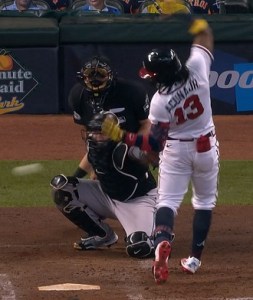
This past Saturday night, Ronald Acuna, Jr. got hit in the hand by Phillies reliever Sam Coonrod, on a pitch that would have been ticketed for reckless driving and traveling 32.8 mph above the highway speed limit. After gripping his limb in obvious pain, Acuna managed somehow to return to the Braves lineup the following day and score their first run. Coonrod and everyone else in baseball were lucky Acuna’s X-rays showed nothing but a contusion on his left pinkie.

One particularly interested observer was a Hall of Fame pitcher, John Smoltz, working the Fox Sports One broadcast of the game. Not only does pitching inside have elevation now that it didn’t always have in his day or past generations, Smoltz told his viewers, matching velocity with elevation equals playing with fire if your control panel goes AWOL.

“To pitch inside waist-down, there’s nothing really bad that can happen to a (batter),” said Smoltz, who hit 57 batters himself in a 21-season career for an average three a year. “And there’s nothing really bad that can happen to a pitcher, other than you maybe leave it over the plate and it’s a homer. Now everybody through analytics is trying to get it to the letters. You throw that at 98 mph, there are not a lot of pitchers who know where that pitch is going.”

Nobody’s blaming Coonrod, either, not the Braves or anyone else. Not even knowing Acuna tied an early April game against Coonrod by reaching for a slider going away and hitting it out. All Coonrod wanted to do was pitch Acuna to the inside of the zone, which pitchers must do to stay in command. The problem was Coonrod’s lack of command.

When Angels pitcher Jack Hamilton threw the pitch that blasted Tony Conigliaro in the face, the horror of Conigliaro going down caused too many people to believe Hamilton was nothing more than a reckless headhunter. And Hamilton didn’t pitch in a time when organisations and scouts lived by velocity uber alles without a thought of anything else.

To the day Conigliaro died there remained a considerable crowd remembering Hamilton as a hard thrower who was borderline careless. To anyone who’d give him a reasonably fair shake, Hamilton would say he couldn’t have been a headhunter if he tried—he didn’t have the kind of control to make it possible.

Indeed. He pitched eight major league seasons and actually hit only thirteen batters—short of two a year lifetime. (Charlie Morton hit thirteen in 2017 alone and he’s averaged sixteen a year in his career—including leading his league three times with sixteen, thirteen, and sixteen, and the entire Show once with nineteen.) If that’s a headhunter, watch me paste this pathetic palooka with a powerful paralyzing perfect pachydoimis percussion pitch.

Carl Mays took it on the chin for just about the rest of his life after one of his submarine spitters coned Ray Chapman in 1920. Not only did it provoke baseball to make the spitter an illegal pitch, it left Mays with a slightly unfair reputation as a headhunter—he retired with 89 hit batsmen in a fifteen-season career (average: seven a year) . . . and he’s not even among the top one hundred drillers of all time.

With the relief pitchers there’s an issue a few more have started thinking about. Normally, a manager who sees his pitcher wild would have gotten him the hell out of there before he got an opposing batter clobbered or his own team facing retaliation. Then came the three-batter minimum for relief pitchers, the sole exception being if they come in during a jam and get out of it facing less than three men.

It was a foolish rule to begin with even before Cabrera’s fateful drills of Harper and Grigorius. (Harper’s wrist injury kept him from playing in seven of the Phillies’ following eight games.) That relief minimum kept Schildt from taking Cabrera out of the game until after he faced a third Phillie, on a night he had absolutely no control. How long will Commissioner Nero and his head-up-their-you-know-what bosses let this stupid rule continue before someone does get killed?

And who has to have a career compromised or destroyed a la Conigliaro before the analytics mavens in today’s front offices quit chasing speed elevation uber alles and start chasing or developing pitchers who can learn how to control what they throw and think as well as thrust on the mound?

I don’t ask that question lightly. I’m an analytics maven myself. I believe more deeply than the deepest pennant contender that statistics are what Allen Barra has called them, the life blood of baseball. I can’t and never could watch every single baseball game ever played in my lifetime, so I look at the deepest of the deep stats when I want to know who really made the difference in those games and who really was (or is) as great as his Hall of Fame plaque suggests (or will suggest).

Those deepest-of-the-deep stats can also tell me whom among non-Hall of Famers actually belongs in the Hall of Fame (Dick Allen and Tony Oliva, anyone?) and whom among the Hall of Famers had no business being there except as a visitor. (Harold Baines, anyone?) One of the things those deeper stats can also tell me within all reason is which pitcher had Dalkowski-like heat or voluptuous breaking balls but had the kind of lack of control that might have made Dalkowski resemble the mature Sandy Koufax.

If I’m running a baseball organisation, and I see a young pitcher who can throw a ball through a cement wall but has no idea where it’s going, I should be crucified if I let that kid get anywhere near a major league mound before he gets the idea. Not before someone teaches him all the speed on earth means nothing if you don’t know where the ball’s going—or the one you get within the zone in spite of yourself gets hit into the Delta Quadrant.

Because one thing will remain true no matter the era: Show me a kid who’s got a sound barrier-breaking fastball, I’ll show you a major league hitter who’ll catch up to that fastball soon enough if the kid hasn’t got much of anything else to show that batter. Assuming he lives long enough after he gets coned by one of those speedballs.

Some of the old-school should still prevail. “Hitting is timing. Pitching is destroying timing,” said Hall of Fame lefthander Warren Spahn, whose fastest fastball would resemble a Lockheed Constellation compared to today’s Dreamliners. Today, hitting is still timing but pitching seems bent on making Hall of Famer Nolan Ryan resemble a junkballer. Batter down? Oops.

Spahn also had solid breaking stuff, a screwball he developed later in his career, and the kind of control an android would envy. Want to know how many batters Spahn hit in a 21-season career? Try 42—an average two a year. He also averaged only four wild pitches a year. Today’s impatient front office would deem him unsuitable for major league competition.

His fellow Hall of Famer Koufax once tied a single-season record for wild pitches—before the flaw in his delivery got spotted at last and corrected in spring 1961. Koufax had a fastball that exploded upward as it arrived at the plate and a curve ball voluptuous enough to make Jane Russell resemble Olive Oyl.

In twelve Show seasons Koufax hit only eighteen batters—an average two per year. But he didn’t just fix the hitch in his delivery in ’61. (He’d previously reared back far and hard enough that he cut half his strike zone sight off as he threw.) He learned at last how to think while he pitched. He knew what he was doing on the mound. Today’s front office would probably write him off for thinking too much and destroying radar guns too little.

It’s taken baseball’s best pitcher today eight seasons to hit twenty batters, an average of four per year. The last time he hit one was two years ago. This season he’s been shown throwing three figure speed—at almost any time of the game while he’s on the mound.

But he has something the rest of the pack with a couple of exceptions lacks: He knows what he’s doing on the mound and he also knows there’s an awful lot of real estate to cover within the perimeter of the strike zone. He also has more than just cruise missiles to throw—he’s got a wipeout slider and a changeup that could be accused plausibly of embezzlement.

You won’t see Jacob deGrom on the mound again until 20 May or later, thanks to an issue in his side that started with a lat muscle strain. Did he get it throwing one or two pitches a little harder than even he can throw them without great physical effort? Did he get it swinging the bat and/or running the bases? (DeGrom the Outlier is 7-for-15 as a batter this year.)

If the former, rest assured deGrom knows better. If the latter, it’s yet another argument for the defense on behalf of the universal designated hitter.

It might be fun watching deGrom bop hits but there’s no fun watching him get hurt swinging the bat or running the bases. Especially when you’re not paying deGrom (a converted shortstop) to get up there and slap his mound counterpart silly with his bat. But that’s an argument for another hour.

“[W]hy are pitchers such as Jacob deGrom, Gerrit Cole and Max Scherzer at the top of the sport?” Rosenthal asks, then answers. “It’s not simply because they throw hard. It’s also because they know how to locate. More of that, please, before more players get hurt.” Letting the kids play isn’t supposed to mean letting them blow someone’s brains out.

Cut the crap

Sandy Alcantara’s pitch ricochets off Ronald Acuna, Jr. in the third.

So far as the Miami Marlins seem concerned, the heir apparent to Freddie Freeman as the Atlanta Braves’s franchise face doesn’t wear a Braves uniform. He wears a target. Especially after he hits home runs, in the postseason and otherwise.

Here we went again Tuesday afternoon. Game One, National League division series. And, yes, it was weird enough that the Braves and the Marlins played in Houston’s Minute Maid Park, with the Braves as the home team.

Then Acuna hit the second pitch from Marlins starter Sandy Alcantara over the right field fence opening the bottom of the first. As is characteristic of the ebullient outfielder, he watched for the briefest moment before flipping his bat to one side on his way up the first base line to run it out.

Acuna had reason enough to celebrate even before the Braves demolished the Marlins with a comeback 9-5 win. He became the youngest man in Show history to hit a leadoff bomb in a postseason game. He and the Braves got to enjoy it until the bottom of the third, with the Marlins holding a 4-3 lead and Acuna at the plate with one out.

Alcantara threw at and hit Acuna on an 0-1 count with a 98 mph fastball. At least Alcantara waited until Acuna greeted him again instead of going completely infantile and drilling Freeman following Acuna in the first. That may be the only thing to his credit.

Acuna might have said after the game that he’s kinda, sorta, kinda getting used to being Fish fodder, but that didn’t mean he was necessarily thrilled to be so high on their hit parade when the third-inning pitch struck. He took a few steps forward, toward the mound, holding onto his bat a bit, and both Braves coaches and umpires surrounded him before he entertained any ideas about relieving Alcantara of his head or any other extremities.

“I looked over to their bench,” Acuna said post-game. “I said it’s been five times. At this point, I think we’ve become accustomed to it.” Not necessarily. If that were true, the Braves wouldn’t have engaged in a chirping contest with the Marlins before Acuna finally dropped his bat and took his base.

They also might not have answered the Marlins’ three-run top of the third with Marcell Ozuna doubling Acuna home following Freeman’s followup fly out and Travis d’Arnaud doubling Ozuna home to bring things back to within a run.

And they wouldn’t have bided their time, chased Alcantara out of the game in the seventh with a pair of inning-opening infield singles, one by Acuna himself, before Freeman forced Acuna at second with Yimi Garcia on the mound, Ozuna singled home Austin Riley to tie the game at four, and d’Arnaud hitting a 2-0 grapefruit far enough over the center field fence.

Nor would Ozzie Albies have followed d’Arnaud’s demolition with a base hit to chase Garcia in favour of James Hoyt, whose first service to Dansby Swanson disappeared over the center field fence, too.

That’s where the score stayed other than Matt Joyce’s excuse-me RBI single in the top of the eighth.

“I think it woke us up,” d’Arnaud said of Alcantara drilling Acuna. “And we took advantage of the momentum.” Said Braves manager Brian Snitker, “You better be good at going in and not hitting [Acuna] after a homer.”

Alcantara wasn’t, obviously. Nor was he especially good at covering his tracks after the game. Any expressions of the-ball-got-away-from-him/the-dog-ate-his-homework got vapourised when he added, referencing Acuna’s brief but interrupted advance to the mound, “If he’s ready to fight, I’m ready to fight, too, no matter what happens.”

Cut the crap.There was only one reason Acuna might have been ready to fight, and that was getting drilled his next time up after hitting one out and—oh, the hor-ror!—showing his pleasure over his feat.

Cut the crap. He’s hitting for a .318/.414/.665 slash line against them since he first faced them in 2018. It couldn’t possibly be that the Fish are fed up with Acuna making tuna salad out of them so far in his career.

Cut the crap. It doesn’t matter that has a .182 lifetime batting average against Alcantara into the proceedings. Maybe Acuna also felt like celebrating finally having something more to show than two walks, two strikeouts, and nothing else off the Miami righthander in ten previous plate appearances. Since when does that give Alcantara a license to drill when the first hit he surrenders to Acuna is a parabolic opening launch?

Jose Urena, whose 2018 drilling of Acuna after a bomb-flip got Urena suspended six games, has decent performance papers against Acuna otherwise, if not quite those of Alcantara’s: five strikeouts, three walks, four hits including that lone bomb, and a .235 batting average against him. But Acuna also has a .409 on-base percentage against Urena in 22 plate appearances. And he’s been hit twice in the bargain.

Cut the crap. I’ve said it before, I’ll say it again. You don’t want Acuna turning his bat into a helicopter rotor when he hits one out against you, stop throwing him cantaloupes to hit in the first place. You want to be a Fun Policeman, wear a police uniform and not a Marlins uniform on the mound.

It ruined Alcantara having a solid outing otherwise, until the Marlins bullpen—whose main men are the proud possessors of a 2.72 irregular season ERA—got dismantled in the seventh. It also put a little smudge on the Marlins’ 2020 reputation as a pleasant surprise who missed winning the National League East by finishing four behind these Braves.

But it also reminded close observers that Acuna has been bitten twice as often by the Fish as he’s been by any other major league team. MLB.com’s Mark Bowman was kind enough to point out that Acuna’s been drilled by Miami pitching once every 41.2 plate appearances—and once every 80 plate appearances by everyone else’s pitching staffs.

Acuna answered on social media after the game too. “They have to hit me because they don’t get me out,” he said in one tweet. “I’d like to take this time to apologize to absolutely NOBODY,” he insisted in an Instagram post. I’d like to take this time to say Acuna owes apologies to absolutely nobody.

It’s deja vu all over again for the Mets

2020-07-24 YoenisCespedes

Cespedes went into the seats in his return but deGrom added just more evidence for a non-support case Friday.

Pandemic delay or no pandemic delay, the 2020 season finds the New York Mets picking up just about where they left off last year. Not that beating the Atlanta Braves 1-0 on Friday was a terrible thing for them, of course. And not that Yoenis Cespedes, too long among the Mets’ living dead on the injured list, going long his first day back was terrible, either.

But their neglect of theirs and the National League’s best pitcher two seasons running, pending Jack Flaherty’s continuing maturation, continues yet. He’s too much a team player to say it, but surely Jacob deGrom thinks of games like Friday’s and thinks to himself, “It’s been lovely, but I have to scream now.”

Defending back-to-back Cy Young Awards, pitching like a future Hall of Famer, eight strikeouts in five innings, one walk, and one measly hit. (The innings limit was the Mets taking no chances after deGrom’s back tightness last week.) And nothing to show for it other than an ERA opening at zero.

Last year, deGrom had twelve such quality starts, averaging seven innings per, and came out with nothing to show for those. If his team played the way he pitched, he’d have been a 23-game winner and the Mets might have ended up in the postseason. Him definitely; them, might. As a former Mets manager once said, it was deja vu all over again Friday afternoon in Citi Field.

The Braves’ starting pitcher, Mike Soroka, got a grand taste himself of how deGrom must feel at times. He pitched six innings and, while he wasn’t deGrom’s kind of strikeout pitcher Friday afternoon, he did punch out three, scatter four hits, and come away with nothing to show for it but handshakes from the boss and whatever equals a pat on the back in the social-distancing season.

His relief, Chris Martin, wasn’t so fortunate. After ridding himself of Michael Conforto to open the bottom of the seventh on a fly out to deep enough center field, Martin got Cespedes to look at a first-strike slider just above the middle of the plate. Then he threw Cespedes a fastball just off it, and Cespedes drove it parabolically into the empty left field seats.

The piped-in crowd noise at Citi Field drowned out the thunk! when the ball landed in no man, woman, or child’s land. It was the game’s only scoring, but the Mets’ bullpen had a surprise of their own in store once deGrom’s afternoon was done.

They left the matches, blow torches, gasoline cans, and incendiary devices behind. They performed no known impression of an arson squad. They cleaned up any mess they might have made swiftly enough.

Seth Lugo, maybe the Mets’ least incendiary reliever last year, shook off a double to left by newly minted Brave Marcell Ozuna, and his advance to third on a passed ball, to get Matt Adams—signed but let loose by the Mets and scooped up by the Braves—to ground out to third and Austin Riley to look at strike three. Crowning two innings relief in which Lugo also made strikeout work of Alex Jackson and Ronald Acuna, Jr.

Justin Wilson, taking over for the eighth and looking like he was finding the right slots last year, shook off Dansby Swanson’s leadoff single to strike Adam Duvall out looking, before luring pinch hitter Johan Comargo into grounding out to second and striking Acuna out for the side.

Then Edwin Diaz, the high-priced closer who vaporised last year, opened by getting Ozzie Albies to ground out, shook off a walk to Freddie Freeman, and struck Ozuna out looking and Adams out swinging for the game.

Already freshly minted Mets manager Luis Rojas looks like a genius, or at least unlike a lost explorer. And Cespedes—about whom it was reasonable to wonder if he’d ever play major league baseball again—made sure any complaints about this season’s universal DH were silenced for this game at least.

“The funny thing is I joked with him before the game,” deGrom told reporters postgame. “I said ‘why are you hitting for me?’ He went out and hit a home run for us which was big. I was inside doing some shoulder stuff, my normal after pitching routine and yeah I was really happy for him.”

It didn’t work out quite that well for the Braves, with Adams going 0-for-4 with two strikeouts on the afternoon. Neither side mustered an especially pestiferous or throw-weight offense other than Cespedes’s blast.

But you half expected a low-score, low-hit game out of both deGrom and Soroka considering the disrupted spring training, the oddity of “summer camp,” and perhaps just a little lingering unease over just how to keep playing baseball like living, breathing humans while keeping a solid eye and ear on social distancings and safety protocols.

In a sixty-game season it all counts even more acutely than it would have on a normal Opening Day. The Mets and the Braves were each expected to contend this season before the coronavirus world tour yanked MLB’s plans over-under-sideways-down. They’re not taking their eyes off that just yet.

Before the game began, the Mets and the Braves—like the New York Yankees and Washington Nationals in D.C., like the Los Angeles Dodgers and San Francisco Giants by the Bay Thursday night—lined up on the baselines and held a long, long, long black ribbon. This time, with nobody kneeling before “The Star Spangled Banner” was played.

Maybe athletes can remind people that it’s dead wrong for rogue police to do murder against black and all people without running into the buzz saws of explicit national anthem protests and fury over the protests, after all.

The Braves have other alarms, though. Freeman, of course, is recently recovered from COVID-19 but two of their three catchers—Tyler Flowers and former Met Travis d’Arnaud—showed COVID-19 symptoms and went to the injured list. The good news: both catchers tested negative for the virus.

But lefthanded pitcher Cole Hamels hit the IL with triceps tendinitis. Not good. Every live arm counts in a short season, especially for legitimate contenders. Just ask the Mets, who’ll be missing Marcus Stroman with a calf muscle tear, even if Stroman historically heals quickly.

You hope both teams recover swiftly enough. You also hope the Mets find a way to make deGrom’s won-lost record look as good as he pitches and fast. Those non-support filing papers don’t take that long to draw up.


NLDS Game One: Fun cops vs. fun cops

2019-10-04 YadierMolinaCarlosMartinez

Was Yadier Molina (left) reminding Carlos Martinez about throwing stones in glass houses Thursday afternoon?

Oh, brother. You knew going in that things between the Braves and the Cardinals in a division series would be interesting, to say the very least. Especially knowing the set pits one precinct of fun police against another. Then you got reminded soon enough about being very careful what you wish for.

The Cardinals and the Braves put on a few shows for the price of one, before the Cardinals hung in to finish a 7-6 win Thursday afternoon. The Comedy of Errors, starring one of this season’s most vaunted defenses. The Late Show, starring both sides’ bombardiers Paul Goldschmidt, Freddie Freeman, and Ronald Acuna, Jr. And Get Off My Lawn, starring Cardinals pitcher Carlos Martinez out of the ninth inning bullpen.

When the Show’s number three team for defense in terms of runs saved (95), the number five team for turning batted balls into outs (.705), and the number thirty team for allowing errors (a mere 66) allows three Game One runs on extremely playable grounders, you try to remind yourself the Elysian Field demigods do have a sense of humour, if you’re a Cardinals fan.

When your franchise youth settles for a long single in the seventh, after taking a leisurely stroll out of the batter’s box, and barely arrives at first when he might have pulled into second when the right fielder turned to throw in after playing the ball off the height of the fence, you try to see it from the youth’s perspective, if you’re a Braves fan.

When Cardinal fan’s relief ace—who’s renowned for making like Tarzan when he nails strikeouts or induces critical outs—calls out the same youth for having a ball when he does hit one that’s no questions asked out in the bottom of the ninth and has a blast running it out, demanding the boy wonder respect him, Cardinal fan has to remind himself or herself that Mama said there’d be moments and brain farts like that.

When Braves fan has to listen to venerable veteran Freddie Freeman call out Ronald Acuna, Jr.’s earlier stroll, he or she needs every ounce of restraint to keep from reminding Freeman—and any other Brave sharing Freeman’s thinking—that, all things considered, being at second where he belonged in the seventh might not have gotten them more in the end.

With all the foregoing and more it almost felt as though the Cardinals hanging tough, coming back, yanking far ahead with a four-run top of the ninth, and still beating the Braves, was a tough loss. And weren’t things weird enough without Braves reliever Chris Martin going down for the rest of the series after straining his oblique . . . while coming in from the pen assigned to work the eighth? Without throwing a single pitch?

“Every out, every pitch is important,” said the Cardinals’ Matt Carpenter, who didn’t start but who pinch hit in the eighth and dumped the quail off Braves reliever Mark Melancon in the eighth to tie things up at three. “There’s a lot of adrenaline involved, but that’s what you play for, that’s why you’re here.”

“We’ve played all season expecting to win those type games. You give up that kind of lead, it’s tough to swallow,” said Freeman, who shot one over the center field wall one out after Acuna yanked a two-run homer into the same real estate in the ninth, then watched Josh Donaldson ground out and Nick Markakis look at strike three to end the Braves’ afternoon a day late and a dollar short.

Those two homers were joined by Golschmidt in the top of the eighth. Off Luke Jackson, who had to go in after Martin’s in-from-the-pen oblique tweak and watch Goldschmidt send his second pitch over the left field wall. They were the only bombs on a day both teams seemed hell bent on proving small ball hadn’t yet gone the way of the Yugo. If you didn’t know better, you’d have sworn some things were supposed to have been outlawed in recent times.

Things like Cardinals center fielder Harrison Bader not just beating out an infield single in the fifth and moving to second on—the horror!—a sacrifice bunt by Cardinals starting pitcher Miles Mikolas, but stealing third for the first such theft in a measly two tries off Braves starter Dallas Keuchel all year long. Not to mention Bader tying the game at one when he scored on Dexter Fowler’s ground out to second.

Things like Donaldson pushing the first run of the game home on what should have been dialing Area Code 4-6-3 in the bottom of the first but for usually easy-handed Cardinals second baseman Kolten Wong blowing his backhand toss to first leaving all hands safe and enabling his Braves counterpart Ozzie Albies—who reached on a walk in the first place—to score.

Things like the Braves taking a 3-1 lead in the bottom of the sixth with only one hit—with Donaldson plunked with one out, Markakis doubling him to third, pinch hitter Adam Duvall handed first on the house, and, a pitching change and a strikeout later, Dansby Swanson motoring to beat an infield RBI single that turned into an extra run home when Cardinals shortstop Paul DeJong’s throw to second bounced off Wong’s glove.

Except that most of the conversation turned around Acuna’s eighth-inning trot. Some of it came from Freeman, who knew how frustrating it was to lose a potential run in a one-run loss with a mistake that wasn’t the first such.

“But I think you have that conversation once,” the well-respected first baseman continued. “It’s kind of beating a dead horse after that if you keep having the same conversation over and over again. You have to know that was a mistake.”

“It could have been a double, but things happen,” was Acuna’s way of explaining it. “I didn’t speak with the manager about it. I just went out to enjoy the game. I always try to give my best, but these are things that sometimes get away from me. They are not things I want to do. As players, we always try to give our best effort, but we make mistakes, we are human.”

He’s right about players being human and making mistakes, of course; in this instance, he’d been there before this year and been benched briefly for it. So is Braves manager Brian Snitker right when he says, “He should have been on second. And we’re kind of shorthanded to do anything about it right there. You hate to see that happen.”

But it’s open to debate whether Alibes is right saying, “He probably scores in that inning if he’s on second base. It’s a big deal. He knows he needs to do better there.” Albies is probably right in his second and third sentences there. About scoring from second, not quite.

Because Albies followed Acuna immediately with a grounder that pushed Acuna to third, but Freeman got hit by a pitch immediately to follow and Donaldson’s immediate bullet liner—with Acuna likely to run on contact—would have been the double play it became regardless.

Then Martinez had to make all that look like the mere warmup for the main attraction, when Acuna had what Martinez believed a little too much of a ball around the bases after depositing a meatball practically down the pipe over the center field wall. “I wanted him to respect the game and respect me as a veteran player,” Martinez fumed afterward. “Just play the game.”

Martinez even had ideas about chirping a lecture or three toward the Braves dugout before his veteran catcher Yadier Molina interceded and nudged him gently but firmly back to the mound. This was almost too rich for words in a game featuring a pair of teams only too notorious around the sport for being fun police units.

You almost can’t wait for the Braves to fume the next time Martinez goes into his Tarzan act if he ends a dicey inning with a nasty strikeout: “We want him to respect us as the National League East champions and not just a bunch of plug-ins who needed all 162 games to get here.”

If that’s the way the Cardinals and the Braves are going to be—as if playing a delicious Game One division series thriller and spiller just wasn’t quite enough—then let them suit up for Game Two in business suits, for crying out loud. Huffing “just play the game” after demanding “respect” tells me (and should tell you) that someone forgot about the “game” part. And, about throwing meatballs to power hitters.

Impatience is no virtue

2019-08-14 RonaldAcunaJr

Ronald Acuna, Jr.’s fourth-inning bomb was almost half as important as bagging Todd Frazier trying to score in the sixth Tuesday night.

Zack Wheeler took the blame himself. The Mets pulled into heat-hammered Atlanta Tuesday and came up short against the National League East-leading Braves. Wheeler simply said he didn’t have it. But he had lots of help along the way to the 5-3 loss.

“It stinks,” Wheeler lamented after the game. “We’re on this run and I really didn’t give us a chance. This one’s on me.” Not entirely. A lot of the help Wheeler got came through the kindness of Braves left fielder Ronald Acuna, Jr.’s heart.

And if there’s justice in baseball world, Acuna should extend that kindness to Mets third base coach Gary DiSarcina and credit him with a major assist.

Because no sooner did Todd Frazier atone for a rally-compromising double play in the top of the sixth, whacking a double to the back of center field off Braves starter Max Fried, than Mets center fielder Juan Lagares lined a single right to Acuna playing in a none-too-deep left field positioning.

Frazier isn’t as swift afoot as he was earlier in his career, but even Hall of Fame road runner Rickey Henderson would have resembled Wile E. Coyote on a hit that shallow against a left fielder with an arm like Acuna’s.

You get why Frazier had eyes on the plate with the Mets down four runs at the moment. But DiSarcina should have thrown up a stop sign post haste. With the pitcher’s spot due to follow Lagares, and Wheeler’s evening over with recent acquisition Brad Brach up and throwing in the pen, the Mets were certain to send up a pinch hitter with Jeff McNeil, their leadoff man, due to follow if the pinch swinger could swing.

The light never even changed to yellow. Frazier rounded third at just about the moment Acuna let fly. Frazier was such a dead pigeon sliding toward the plate you got the impression Braves catcher Brian McCann tagged him out as a mere formality. And a grand chance to close the distance escaped the Mets.

“His arm,” said Acuna’s manager Brian Snitker, “is a weapon.” Disrespecting that weapon equals disaster.

Coming off taking two of three from the Nationals last weekend, winning the two in almost anti-textbook examples of doing things the hard way, the Mets let Fried and the Braves compel them to try doing it the hard way again. I said it before, I’ll say it again: crisis addiction only wins you so many games.

All night long, whenever they swung the bat the Mets swung as if they thought they could hit the ball right out of Fried’s hand. With Fried pitching exactly the way you’d expect a guy with a 1.38 walks/hits per inning pitched rate, patience would have been the Mets’ virtue. Tuesday night they approached Fried as though patience were what you saw in the doctor’s waiting room.

And the Mets better hope they duck another kind of crisis, after McNeil tweaked his left hamstring trying to hustle out a leadoff ground out in the top of the ninth. He flung his helmet to the ground in obvious discomfort, let a trainer escort him back to the dugout, and said after the game he didn’t feel anything pop.

“Just a little snag,” said McNeil, who undergoes an MRI Wednesday. “Nothing crazy.” He and the Mets better hope it’s nothing “crazy.” Things have been crazy enough for them this year.

The Braves are deep enough that they could withstand life without shortstop Dansby Swanson and rookie slugger Austin Riley for a spell, even if they have been only 17-13 since the All-Star break. And they’re deep enough that even that post-break record doesn’t hurt them after spending the first half eluding everyone else in their division at 54-37.

The Mets aren’t that deep no matter how they’ve looked since the break. They can’t afford to lose McNeil for any appreciable time. And they know it.

“It’s tough. He’s a huge part of this team. He brings fire every day to the field,” said Wheeler. “He’s a ballplayer and you need those type of guys on your team and you need them in the lineup. It’s unfortunate that happened, hopefully it’s not too serious and he can get back decently quick. We need his bat, that’s for sure.” His bat, and his passion.

Recently minted Joe Panik’s going to play a lot more second base now, and he can still whip his leather with authority as well as postseason experience. Bringing back prodigal veteran Ruben Tejada—whom the Mets re-signed in March, but who hasn’t played a major league game since he was a 2017 Oriole while hitting .337 at Syracuse this year—is a band-aid.

There wasn’t much Wheeler could do on a night he admits was an off night from keeping the Braves off the bases and the scoreboard. Acuna himself opened the proceedings with a base hit in the bottom of the first and, after Freddie Freeman sent him to third with a one-out single, Josh Donaldson singled him home. A fly out later, Matt Joyce singled to deep enough right to score Freeman.

The Mets were in a 2-0 hole before they got a second crack at Fried. They’d squandered the first one brilliantly. Pete Alonso and J.D. Davis wrung back-to-back walks out of the Braves lefthander, but Ramos with a near-perfect inner zone pitch to handle and pull whacked it instead to Charlie Culberson, the former Dodger now pressed into shortstop service until Swanson returns from the injured list. Culberson tossed to second for the inning-ending force.

They looked like they’d get to Fried in the top of the second when, after two quick enough outs, Lagares singled up the pipe and, of all people, Wheeler himself got plunked to set up first and second. Never one to look a gift horse in the proverbial mouth, McNeil drilled a single deep enough to left to send Lagares home and cut the deficit in half. But Mets shortstop Amed Rosario let Fried fool him with a slider that broke right under his bat for the side-retiring strikeout.

Freeman put things a tick further out of reach in the bottom of the inning with an RBI single. After the Mets wasted two-out baserunners in the third and the fourth, Acuna made it a little more tough to catch up in the bottom of the fourth. With one out and nobody aboard, Acuna wrestled his way back from 0-2, caught Wheeler’s two-seamer traveling right down Main Street, and sent it traveling over the left field wall.

Ender Inciarte turned a three-run Atlanta edge into a four-run distance in the bottom of the fifth, after Wheeler wild-pitched McCann (leadoff single) to second, hitting a double into the right field corner to send McCann home with the fifth and final Braves run.

But come the top of the seventh, it was Sun Trust Park’s scattered audience now in need of oxygen above and beyond the oppressive heat: the Braves went to the bullpen. And in came Luke Jackson, whose recent misadventures may not have spelled final disaster but were misadventures enough to make Braves fans wonder if he hadn’t been taking lessons in pressure pitching from last postseason’s version of Craig Kimbrel.

Now the Mets went to pinch hitter Luis Guillorme in the pitcher’s hole to lead off the seventh. And Jackson gave the home audience a better reason to put the nitro pills under their tongues. He got Guillorme to pop out to Culberson out from shortstop, then caught McNeil and Rosario overanxious enough to strike them out swinging back to back.

But then Snitker went to Shane Greene, the new toy from Detroit who was supposed to step into the lockdown job out of the Braves’ pen but whose ERA since joining the Braves is a ghastly 14.54. If even one fan in the stands pondered thoughts of Snitker taking pity on the Mets with this move, you couldn’t blame him or her.

Right off the bat, Alonso and Davis singled back to back to open the top of the eighth. And after Ramos forced Davis at second, Snitker took no more chances, bringing in former Met Jerry Blevins. Michael Conforto grounded one to first that got rid of Ramos at second but sent Alonso home with the well overdue second Mets run.

Out came Blevins and in came another former Met, Anthony Swarzak. Frazier singled Conforto to second promptly, and Lagares beat out a grounder to the back of first base to score Conforto almost as promptly, pushing Frazier to second, and suddenly the Mets were back to a mere two-run deficit. But pinch-hitter Panik, swinging a little over anxiously himself, grounded out to short for the side.

Drew Gagnon, recalled from Syracuse (AAA) for his third spell with the Mets this year, got rid of pinch hitter Rafael Ortega, Acuna, and Ozzie Albies almost in a blink in the top of the ninth. But after McNeil’s ham snagged, another trade deadline-minted Brave reliever, Mark Melancon, shaking off his Miami disaster admirably, struck out Rosario and Alonso swinging to end it.

There are teams up and down the standings against whom you can go into crisis and come out with your heads intact and triumphant. The Mets were reminded Monday night that the Braves aren’t one of them.

Neither is Acuna’s throwing arm. Give it even a fraction of an inch, and he’ll take as much distance as you let him get away with. Not to mention his trying and having an excellent chance of becoming only the third player 22 or under to hit forty or more into the seats in a season—behind Hall of Famers Mel Ott and Eddie Mathews, the latter a Braves legend in his own right.

If the Mets want to remain baseball’s hottest post-All Star break team and stay in the postseason hunt, they’d better not dismiss that reminder lightly. Especially against these Braves, who almost never show mercy to those asleep at the switch.