2021: Wanted—a Laundromat

Rob Manfred, baseball’s version of Rube Goldberg’s evil twin.

Once upon a time, when you could be sure . . . if it was Westinghouse, that once-ubiquitous home appliance maker trumpeted its angular front-loading washing machine thus: “You’ll love your Laundromat more every day!” There are those, and they may be legion, who think baseball today needs a Laundromat it can love more every day, too.

But the game may first need to remember where 2021’s laundry hamper is located. “[Major League Baseball]’s dirty laundry,” writes the irrepressibly irreverent Deadspin, “was only forgotten by the general public when some newer, shinier scandal made its way onto the scene.”

Deadspin thus began its proclamation of commissioner Rob Manfred as the eighth biggest idiot in 2021 sports. By the time you finish reading just that particular bill of particulars, you may come to think it’ll take an entire Laundromat—those vintage, Westinghouse-stocked,  self-service laundry versions of the very vintage self-service Horn & Hardart Automats, that is—to get MLB’s washing done.

Thanks to baseball’s owners and their off-season lockout, the keys to the Laundromat can’t and won’t re-open it for badly needed business. Thanks to Manfred’s determination to leave a legacy as having been baseball’s version of Rube Goldberg’s evil twin, baseball has continued calling the repairmen to fix what wasn’t broken while calling the dentist to set the limbs that were.

Manfred has dropped more balls than ever eluded the grasp of legnedary first base fumbler Dick (Dr. Strangeglove) Stuart. From almost the moment he succeeded Bud Selig in the commissioner’s chair, Manfred has seemed to administer baseball even further down the line Selig and his then-fellow owners once engineered while ignoring blissfully their roles laying the tracks: Baseball sucks! Bring the wife and kids! 

The Astros caught red-handed in an elaborate and illegal off-field-based electronic sign-stealing operation? The Red Sox caught using their replay room for sign-stealing reconnaissance assuming men on base to receive and transmit the purloined letters? By the rules, Manfred could only fine Astros owner Jim Crane $5 million, “which is roughly the price equivalent of a Nachos Bell Grande at Taco Bell to you or I,” Deadspin snarks. He couldn’t quite hit the Red Sox like that over turning what MLB itself provides each team at home or on the road.

But he could have imposed far more stern measures than stripping the Astros of a pair of key draft picks. He could also have imposed something more grave upon the Red Sox than letting them skate by suspending their manager and banishing their video room operator. As one presidential candidate once purred about the other’s party, in debate and on the campaign trail, he had his chance but he did not lead.

That was in 2020. Over a year later, all of that was almost (underline that) forgotten by your friendly neighbourhood Spider-Tack. As in, that new old-fashioned medicated goo pitchers deployed the better to get a grip on something upon which Manfred lacks a grip—making baseballs that are as viable for pitchers to throw as for hitters to hit. The inconsistent surfaces of the balls today compelled enough pitchers to seek medicated help. That some of them saw it as a fine shield for chicanery should have been anticipated, but wasn’t.

So Manfred cracked down . . . about a couple of months after he should have done so. It simply reinforced the suspicions of too many that this commissioner picks and chooses when to enforce particular rules. It also provoked them to ask why Manfred was more alarmed about potentially cheating pitchers than he was about the continuing lack of umpire accountability.

He certainly wasn’t all that alarmed about cheating baseballs. You read that right: after the season, it came forth from Business Insider that two types of balls were used during the year. One was a little more on the dead side, the other a little more on the lively side. The magazine cited an astrophysicist who analysed the balls, found them suspicious, and even spoke to an unidentified pitcher who thought, as I wrote elsewhere early this month, that baseball’s government might have engaged a little game chicanery of its own:

This pitcher thinks MLB was also looking to manipulate particular matchups with the variable balls: send the slightly more dead balls to such lesser sets as, say, the Detroit Tigers versus the Kansas City Royals, since nobody was going to be interested in them, but send the slightly livelier balls to the marquee sets such as the Boston Red Sox versus the New York Yankees.

If you’re looking for a thorough MLB investigation into what we might call Ballgate, save your vision. It hasn’t happened yet. Whether it will happen is only slightly more difficult to guess than it once was to guess which one among about eight different leg kicks and about sixteen different windups Hall of Fame pitcher Juan Marichal was likely to use to throw the next pitch your way.

(Which reminds me that the splendid staffers at Baseball Prospectus, in their book Extra Innings, once posited with splendid evidentiary supposition that the era of actual or alleged performance-enhancing substances might have been at least as much the era of actual or alleged performance-enhancing baseballs. So Commissioner Goldberg didn’t start ball chicanery, but it’s possible he’s presided over its current tricks and treats.)

After a few comical responses to on-the-spot Spider-Tack and other substance searches that could have and almost did provoke strip teases by the suspects under potential arrest, Manfred and his administration provided further evidence that today’s baseball handles scandal by engaging one somewhat worse than the incumbent. This time, the name was Trevor Bauer.

This time, Bauer was place on administrative leave over sexual misconduct  accusations described politely as salacious, with each period of leave extended going, going, going, until he was gone, goodbye, for the final two-thirds of the season. His Dodgers—who’d signed him big without doing complete due diligence last offseason; who won 106 games and still had to win the wild card game for postseason advancement (because their historic and division rival Giants won one game more)—almost went to the World Series without him.

Meanwhile, Manfred persisted with his COVID-shortened 2020 season’s tinkerings over the full 2021. On behalf of his often-questionable or at least mis-directed alarm over the length of baseball games, Manfred persisted with the free cookie on second base to open each extra half inning. He persisted with his rule that relief pitchers must face three batters at minimum before they can be relieved. The former remained a mere nuisance. The latter could have gotten someone killed.

That would be Bryce Harper, now the National League’s defending Most Valuable Player, but then taking an errant fastball off his nose and onto his batting-side wrist courtesy of Cardinals reliever Genesis Cabrera—on the first pitch of the top of the sixth. It could have knocked Harper’s block off. It did knock his batting helmet off. It scared the hell out of both teams and the Busch Stadium audience.

The next pitch Cabrera threw hit Phillies shortstop Didi Gregorius. The three-minimum rule still prevented Cardinals manager Mike Schildt from lifting a pitcher whose lack of control was obvious to all but the blind. Harper ended up suffering a terrible slump while he struggled to play through the wrist compromise yet recovered to post an MVP season. He also texted Schildt after the fateful game to say he knew Cabrera wasn’t trying to decapitate him.

“Whoever’s a fan of Bryce Harper, whoever has children that are fans of Bryce Harper, support that guy,” Schildt told reporters postgame. “Because what he sent over in a message today was completely a class act.” It was the diametric opposite of the commissioner’s act.

Commissioner Goldberg has also sought, ham-handedly, to make the game pay through the nose for any agreement to make the designated hitter universal. He wants a trade-off: I’ll give you the universal DH, but you give me an agreement that you lose your DH if you lift your starting pitcher sooner than six innings or thereabout. If you think he’s learned nothing from his three-batter relief minimum, wait until you see him flunk this one.

Just as relievers might enter a game having nothing left, for assorted reasons, starting pitchers often enough begin a game on the vulnerable side. If Manfred really thinks he’s doing the game a favour by forcing a team to sacrifice a game’s designated hitter, because the manager got his roughed-up starter out of there early enough before getting the guy killed to death, I think I may have found a buyer for that cut-rate Antarctican beach club.

If and when the owners and the players return to the negotiating table on behalf of ending this lockout, the players should give the owners and their barely-trained seal one answer to that:

Don’t even think about it. It’s long past time for the DH to be universal. Pitchers overall have never been hitters; those very few who were were outliers, and everyone with a brain knows it. We’re tired of wasting pitchers at the plate and watching rallies die. We’re really tired of losing pitchers to the injured list when they get hurt at the plate. The DH is long overdue in the National League, one of whose ancient owners dreamed it up in the first place. Deal with it. End of subject.

Manfred’s alarm at the length of baseball games has yet to address the truest of the culprits, broadcast advertising. You can look it up: Two minutes worth of commercials between half innings equals 36 minutes per nine-inning game. That’s before the commercials during in-inning pitching changes. (You might notice it takes less time for a relief pitcher to come in from the bullpen and throw eight game-mound pitches than it does to run the first minute’s commercial.) And, before extra innings, which are the two second-loveliest words in a true baseball fan’s vocabulary. (The loveliest, of course, are, “Play ball!”)

The next time you watch a game on television or listen on radio or online, make note of every commercial played during the broadcast from the first pitch to the final out. When you add the times of those commercials, you can’t say you weren’t warned that you might have seen a mere two hours’ worth of baseball for your trouble. Thus persists Manfred’s likeliest definition of the common good of the game: making money for it.

Thus, too, were soiled such luminous matters as the emergence of Shohei Ohtani as an international two-way major league mega-star. (And, the American League’s Most Valuable Player.) Such matters as the Braves picking themselves up from the loss of their franchise player-in-waiting Ronald Acuna, Jr. for the second half of the season, dusting themselves off with a trade deadline array of outfield-remaking deals, then wrestling their way to a sixth World Series game in which one of those newly-acquired outfielders, Jorge Soler, led the way bludgeoning the Astros home without another lease to the Promised Land.

Manfred presenting the Braves with the World Series trophy (you know, the one he once called a mere piece of metal) and Soler with the Series MVP award carried all the duplicity of Dmitri Muratov winning the Nobel Peace Prize for his fight to restore and enhance freedom of expression in Russia—and the Norwegian Nobel Committee enlisting Vladimir Putin to present it to him.

Is it going to take a one-hundred-washer Laundromat to clean up this mess? You can be sure . . . if it’s Manfredhouse.
The lockout is on

Before you start cringing while you lament the lockout, try to keep one thing in mind: It hasn’t canceled any games, regular, postseason, or World Series. Yet. If there must be a “work stoppage” for baseball, let it happen during the off-season. Let yourselves be fooled not one moment, either, that baseball has ceased going to work entirely.
About the only work that’s been stopped is contract offerings and signings between the owners and the players. Be advised that team front offices and staffs will continue going to work and players will continue their customary off-season routines preparing for the season to come.

That slightly surreal rash of tradings and free agency signings leading up to the deadline for the lockout—right down to the Red Sox trading Hunter Renfroe to the Brewers to bring home Jackie Bradley, Jr., he of the modest bat but the immodest outfield defense—is halted. That portion of the annual winter meetings involving the Show is pre-empted.

The lockout, as The Athletic‘s Evan Drellich observes, was somewhat inevitable “for months now, even years.” It’s the first “work stoppage” Major League Baseball has seen since the 1994 players’ strike.

That strike was pushed and provoked by the owners then. This “stoppage?” “Players have grown increasingly dissatisfied with club behaviors and the CBA that enables at least some of them,” Drellich writes, “and owners have shown little interest in making the concessions the players seek.”

Talks broke off a few hours before the Wednesday/Thursday midnight deadline after the owners refused to consider any economic proposal from the players unless the players agreed “in advance” to cease certain demands. Those demands, Drellich writes, include the time it takes a player to achieve free agency and changes to the current revenue sharing system.

The players believe with plenty of good reason that the current revenue sharing ways enable too much tanking, teams refusing to rebuild on the fly in favour of just throwing in the towel, allowing the major league product to perform like the St. Louis Browns while (it is alleged) they rebuild from the ground up.

Now hear this: Only two teams are known to have tanked successfully, meaning they tanked to rebuild and ended up in the Promised Land: the Astros and the Cubs. The Cubs tanked to build their 2016 World Series champion within just a handful of seasons; the Astros tanked likewise to build their long-since tainted 2017 World Series champion.

Time was when teams tried to urge certain star players out of the lineup the better to enable them to reach particular milestones before the home audience. It’s a lovely thing to behold when a man does it at home, but when his team tries maneuvering him into it it besmirches the competitive mandate.

That kind of tank usually drew a fury of indignation against the team that put coffers ahead of the honest competition, ahead of the presumption that a team must and does put its best possible lineup forth in the best interest of winning an honest contest.

Today’s tanking teams put coffers ahead of an honestly competitive season. In perhaps one of the top five perversions of “stop us before we over-spend/mis-spend/mal-spend again,” the owners would rather see a small handful of teams abuse their fans than demand such teams do what needs to be done to ensure at least an effort to compete.

Commissioner Rob Manfred audaciously calls it “this defensive lockout,” needed because the Major League Baseball Players Association’s vision for the game “would threaten the ability of most teams to be competitive.” If you believe that, my Antarctican beach club’s sale price has just dropped another hundred grand. “It’s simply not a viable option,” Manfred’s statement continues. “From the beginning, the MLBPA has been unwilling to move from their starting position, compromise, or collaborate on solutions.”

The union says the lockout was anything but “defensive”—“It was the owners’ choice, plain and simple, specifically calculated to pressure players into relinquishing rights and benefits, and abandoning good-faith bargaining proposals that will benefit not just players, but the game and industry as a whole.”

“This drastic and unnecessary measure,” says a statement from union director and former first baseman Tony Clark, “will not affect the players’ resolve to reach a fair contract. We remain committed to negotiating a new collective bargaining agreement that enhances competition, improves the product for our fans, and advances the rights and benefits of our membership.”

Do you notice that the owners through Manfred didn’t mention the fans but the players through Clark did? Do you notice the owners didn’t mention enhancing competition but the players did? The player are also concerned, rightfully enough, with younger players getting their major league earnings due and with younger players no longer subject to arbitrary whims that include suppressing them in the minor leagues when they’ve shown themselves Show ready.

“There’s also a feeling among players that front offices have become very good at manipulating the system to their advantage,” says the union’s chief negotiator, Bruce Meyer. “We want to make changes designed to incentivize competition for players, and remove disincentives for that competition. We want to find ways to get players compensated at an earlier stage of their careers when the teams are valuing them the most. And we want to preserve the fundamental principles of a market system.”

Tanking to one side, both sides have a couple of troublesome competition proposals. The owners are said to want a fourteen-team postseason; the players are said to prefer twelve.  Both should be rejected out of hand, no further questions asked, because postseason competition needs no further dilution than has happened in the wild card era.

Not long ago, there came a proposal for four-division leagues that might require expanding the leagues to another team each. I’ll see and raise: expand each league with one additional team each (and, this time, please do make damn sure there’s a real market for major league baseball in the new locales), but return each league to two divisions.

You’d actually have something resembling baseball the way it once was, after its first expansion: eight-team divisions, two in each league. Now, eliminate the damn wild cards and make it plain enough that either you’re playing for first place or it’s wait till next year, and don’t even think about tanking any longer.

Then, you remove the number one reason why the postseason loses its audience the deeper it progresses—saturation. Today’s postseason involves a maximum forty-two games. This still isn’t as crazy as the National Basketball Association’s maximum possible 98 postseason games, but it’s insane enough. In two divisions of eight teams each, baseball could (should) re-align itself to best-of-five League Championship Series and leave the World Series its best-of-seven self.

Guess what? In that re-alignment, you’d have a maximum of seventeen games, and the postseason wouldn’t even think of sneaking into the wee small hours of the month of November.

No, I’m not angling to become baseball’s next commissioner, but I’m only too well aware that the postseason has become a plaything through which the common good of the game becomes even more equal to making money for the owners and provoking the players to demand their cuts of it, too.

“[B]oth sides, after years of discontent, could be interested to test the other’s resolve,” Drellich says of the lockout now on. “The owners, as well, might believe that the free agents who remain when the lockout concludes will feel pressure to sign quickly, and therefore, at a discount.”

Don’t believe for one nanosecond that the owners should get away with crying poverty. Not when such new deals or extentions come forth as those recently handed to a Mets trio of Mark Canha, Eduardo Escobar, and (especially) Starling Marte; plus, Sandy AlcantaraJavier Baez, Byron Buxton, Wander Franco, Avisail Garcia, Kevin Gausman, Jon Gray, Robbie Ray, Corey Seager, Marcus Semien (is it me, or did the Rangers just drop about $512 million on new signings including Seager?), and (especially) Max Scherzer.

Unfortunately, the mid-level players often get bypassed during collective bargaining issues and often bear the brunt of whatever new CBAs cost. The talks usually involve “a league minimum and free agency eligibility,” as ESPN’s Buster Olney observes. “The players’ middle class, which has seen salary diminishment as a lot of teams apply analytics and identify cheaper replacement-level players, while other teams adopt the tanking strategy and cut payroll dramatically, has mostly been left out of those conversations.”

Scherzer isn’t the only player concerned about that plus making sure the owners can’t further suppress real competition and the full free agency picture. “Unless this CBA completely addresses the competition (issues) and younger players getting paid,” Max the Knife says emphatically, speaking as a member of the union’s eight-member player subcommittee, “that’s the only way I’m going to put my name on it.”

More competition issues? How about pushing the owners to push Manfred away from that ridiculous three-batter minimum for relief pitchers? How about pushing them to make the designated hitter universal, once and for all time, and eliminate the single most automatic out in the game? And, to make it so without one insane owners’ proposal that it be tied to a six-inning minimum for starting pitchers?

How about knocking it the hell off with monkeying around with the baseball itself (yes, MLB used two different sets of balls with two different actual weights in 2021—unbeknownst to anyone), then just develop and use a viable ball that favours neither pitcher nor hitter but makes it as level a confrontation as possible?

People thought Pete Alonso (Mets first baseman) was talking through his batting helmet when he waxed last June about MLB manipulating the balls themselves on behalf of impacting free agency. An astrophysicist discovered not only the different ball weights this year, but spoke to one unnamed pitcher who suspected the possibility that MLB might send different-weighted balls to stadiums hosting certain series: say, deader balls to sets between lesser teams but livelier balls to those hosting, say, the Yankees vs. the Red Sox.

I’d say that demands a full-throttle investigation. If people could and did go slightly mad over pitchers using that new old-fashioned medicated goo, they ought to go slightly more mad over ball cheating by baseball’s administration itself. The MLBPA should bring that up—and stick it in the owners’ ears.

The best news about this lockout is that it did happen during the off-season. Assorted analyses say strikes in sports are becoming things of the past. The bad news is that unreason isn’t going to become a thing of the past any time soon. Not, at least, until baseball’s ownerships today continue to prefer manipulation over competition, and the players increase their concern that competition be diluted no more.

Roots and Blues

Vladimir Guerrero, Jr.

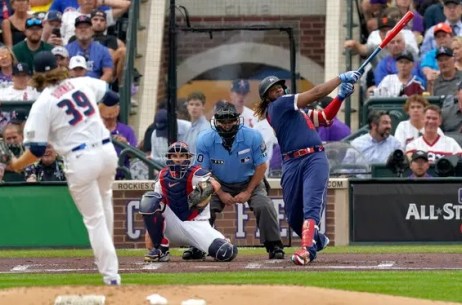
Vladimir Guerrero, Jr. takes Corbin Burnes across the Colorado state line in the All-Star Game. Manfred wants baseball back to its roots? How about also knocking off these hideous All-Star uniforms and letting the All-Stars represent their teams in their own uniforms again? It was good enough for the Home Run Derby, it should stay good enough for the All-Star Game.

Who are the faces of baseball today? Put the current injured lists to one side. Barring unforeseen complications or corollary issues, one and all on those lists now will be back either this season or next. Barring, too, one player of extraterrestrial achievement—you should spot the one most likely to produce it the rest of the year, too—it shouldn’t really be a singular face.

They should be players like Ronald Acuna, Jr., Pete Alonso, Mookie Betts, Shane Bieber, Kris Bryant, Nick Castellanos, Jacob deGrom, Rafael Devers, Freddie Freeman, Vladimir Guerrero, Jr., Bryce Harper, Aaron Judge, Clayton Kershaw, Trey Mancini, Shohei Ohtani, Max Scherzer, Juan Soto, Fernando Tatis, Jr., Mike Trout, Brandon Woodruff.

Instead, the face of the game, singular, seems to be its ten-thumbed, two-left-feet, too-lawyerly-for-his-own good commissioner, a man who seems almost never to let pass a chance to let the stars shine in baseball’s sky without sending up a homemade cloud.

On Home Run Derby Night, the Coors Field audience and baseball nation transfixed upon Ohtani (the prohibitive favourite), Soto, Mancini (the sentimental favourite), Guerrero, and Alonso (the eventual winner), among others. During the All-Star Game—which the American League won, 5-2—Ohtani and company were at least as watchable and discussable as those missing in action due to health concerns might have been.

So, perhaps naturally, Rob Manfred stepped all over himself yet again. Asked whom he thought the face of baseball is today, Castellanos named Manfred. Informed of that designation, Manfred said no. Then, he dropped a few matters to indicate his lips said no-no but there was yes-yes in his eyes.

He told a Baseball Writers Association of America meeting the day of the All-Star Game, “I think anything that distracts from the attention being on what goes on in the field is a bad thing.” Unfortunately, Commissioner Nero—who’s spent too much of his commissionership fiddling while baseball seems to burn—went on to do just that.

Manfred could well enough have waited until after the All-Star Game, confined his remarks to the BBWAA to just his thought on “distraction” from the All-Star field, then said he’d talk a little more the day after if they were willing to listen. (And who wouldn’t have been?)

I’ve already discussed his thought that the doubleheader of seven-inning games might disappear after this season. (And, why I think keeping the idea is sound as a nut.) Manfred also spoke of disappearing the free cookie on second base (known to wags as “Manfred Man”) to open each extra half-inning, a disappearance devoutly to be wished. As would be the three-batter minimum for relief pitchers. (Unless they enter during a jam and get rid of the side before batters two, three, or both appear.)

Unfortunately, Manfred didn’t address that third part, so far as I know. He must have been asleep at the switch the night Bryce Harper and Didi Grigorius got hit back-to-back by a fresh Cardinal reliever whose control took the night off but whose manager couldn’t relieve him legally until he faced his third batter.

The law of unintended consequences too often escapes Manfred’s lawyerly ways.

He also suggested he’d like to ban defensive overshifting, formally, as part of what he says is part and parcel of returning baseball “to its roots.” He suggests the owners are all in on that return, though long experience tells you that with most owners changes or restorations have less to do with the game itself and more to do with whether something means making money for it, which usually means for themselves.

Never mind that the shifts could and would be neutralised if teams start instructing their batters to take advantage of all that free real estate. Screw the unwritten rules. Just hit the ball onto it. Take first base on the house before the shifters can scramble for the ball. Even if the other guys have a no-hitter going to the final outs. I’ll say it again: you hand me that free territory with a no-hitter going, let your pitcher hold you to account when I show up on first on the house.

I’ll say it again: that, or an infield you know to be full of butchers enabling such base hits, should be the only time you want to see a widespread return of bunting. In all other situations, a bunt is a wasted out. Outs to work with are precious. Why waste a third of your inning’s resources and do the other guys such a favour?

You guessed it: I’m all in if Manfred really does bring the universal designated hitter back to stay in 2022. Guess which defensive position sports the Show’s worst slash line this year? (.109/.149/.142.) The worst OPS? (.291.) The most wasted outs? (No other positions show more than the catchers’ 40; these guys show 221.) A real batting average (RBA: total bases + walks + intentional walks + sacrifice flies + hit by pitches, divided by plate appearances) of .167?

Hint: Since the final decade of the dead ball era, they’ve hit a collective .166. Tell me how long a catcher, an infielder, or an outfielder would survive in the Show—if he was lucky enough to get to it at all—with that kind of hitting. Even if he was the defensive second coming (based on runs saved above their leagues’ averages at their positions) of Ivan Rodriguez, Keith Hernandez, Bill Mazeroski, Ozzie Smith, Brooks Robinson, Barry Bonds, Andruw Jones, or Roberto Clemente.

Manfred should consider the Pirates owner of 1891 who first proposed what we know now as the DH. About whose proposal a journal of the time, The Sporting Life, said in concurrence:

Every patron of the game is conversant with the utter worthlessness of the average pitcher when he goes up to try and hit the ball. It is most invariably a trial, and an unsuccessful one at that. If fortune does favor him with a base hit it is ten to one that he is so winded in getting to first or second base on it that when he goes into the box it is a matter of very little difficulty to pound him all over creation.

It wasn’t an invention of that nefarious American League. And if it hadn’t been for Chris (I am der boss pressident of der Prowns!) von der Ahe, reneging on a previous commitment to support William Chase Temple, when the idea came up at the next National League rules meeting, the NL would have had the honour of introducing what Pirates catcher-turned-Philadelphia Athletics manager Connie Mack tried but failed to introduce to the AL fifteen years later.

If you want to see a little more leveling out between pitching and hitting, be advised that when the DH is used this year (by AL teams, and by NL teams playing interleague in the AL Park) the DHs have the best OPS (.767) in Show at this writing. If you want more “strategy”—and you won’t throw things at me when I remind you that 95 percent of all “strategy” is plotted before the game begins—you should prefer that number-nine batting order slot go to either a second cleanup type or an extra leadoff type.

“Returning baseball to its roots” can be tricky. Even if it suggests Manfred might finally be willing to quit trying to prove that the birth child of that backstreet affair between Rube Golberg and the Mad Hatter should be a baseball executive.

It depends on the roots to which you want to return. How about eliminating regular-season interleague play? How about eliminating the wild card system that’s produced the thrills and chills of teams fighting to the last breath to finish . . . in second place?

How about a best-of-three division series with each league’s best first-place finisher having a bye while the other two winners slug it out? How about returning the League Championship Series to the best-of-five of its birth and childhood? How about thus eliminating October saturation and restoring the World Series to its proper primacy?

Unfortunately, those beg one further question right now: Since Manfred can’t seem to find the right way to make serviceable, field-leveling baseballs (easier to look into an acceptable stickum for pitcher grips, as he’s also doing), how far above his pay grade would those and other reasonable moves really prove?

Back to baseball’s roots? Be gone, hideous 2021 All-Star uniform! The threads (especially the American League’s “road” blue) made the horrific 1970s single-colour pajamas of some teams resemble something from Pierre Cardin. If players wearing their own uniforms, representing their teams, is good enough for the Home Run Derby, it’s still good enough for the All-Star Game.

Where have you gone, Bart Giamattio? A nation turns its lonely eyes to you.

On disappearing the seven-inning-game doubleheader

Rob Manfred

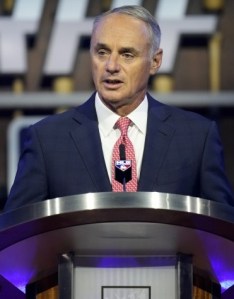
Commissioner Rob Manfred at the draft day podium. He wants to end doubleheaders of seven-inning games. He’s wrong.

Granted, the terms “good news” and “Rob Manfred” are too often oxymoronic. But in the immortal words of a once-legendary radio commentator, Gabriel Heatter, there’s good news tonight. (Well, this morning, when I sat down to write.) The free cookie on second base to open each extra half-inning, Manfred promises, will disappear after this season.

The bad news is that, when it comes to Manfred’s commissionership, for every piece of good news you risk the presence of five or more pieces of bad. This time, it’s the seven-inning doubleheader. That, too, will disappear after this season.

This commissioner oversees baseball with the mindset of a man believing the offspring of a back-street affair between Rube Goldberg and the Mad Hatter should be a baseball executive. Now, on Tuesday, Manfred told the Baseball Writers Association of America that the free cookie on second and the seven-inning doubleheader will bedevil them no more.

Reaching further for the good news, Manfred didn’t quite upstage the Home Run Derby in Coors Field. Even he couldn’t possibly upstage that event, nebulous as it might be. Not when Derby participants wore number 44 on their uniforms in tribute to the late Hall of Famer Henry Aaron.

Not when Mets first baseman Pete Alonso, winning a second consecutive Derby, repeated something else after blasting 74 into the seats or beyond: as in 2019, he earned more for one night’s work than he earned in an entire season’s worth of his Mets salary.

Not when Shohei Ohtani—the Angels’ flavour of the season with the incomparable Mike Trout missing enough of it with injuries so far, and the prohibitive favourite to beat the Derby into submission—proved exhausted enough that the Nationals’ outfield star Juan Soto sent him to an early rest-of-the-night-off in a round-one swing-off.

Not when Trey Mancini usurped Ohtani as a sentimental favourite thanks to his courageous conquest of cancer and his return thereafter, sending the Derby into a final-round showdown with Alonso that came up a bomb short.

Not when Alonso audaciously proclaims himself the best power hitter in baseball today when a) he’s not even in the top ten among the Show’s 2021 slugging percentages; b) he’s not even in the top ten among the Show’s 2021 OPSes; and, c) he’s not even in the top ten among the Show’s 2021 double, triple, or home run hitters.

Manfred may say now as then that the cookie on second to open each extra half-inning and the seven-inning doubleheader were motivated by pan-damn-ic health concerns. But those might have been valid reasons which just so happened to offer him cover to indulge his itch to experiment and his inability to distinguish between what does and doesn’t require repairs.

To the “purist” the doubleheader of seven-inning games is about as palatable as a Kaeopectate on the rocks. But if the Good Old Days Powers had pondered the idea in those alleged Good Old Days, the doubleheader might not have gone the way of the Duesenberg in the first place.

What I wrote in April is worth revisiting: if we must have doubleheaders, the doubleheader of seven-inning games makes perfect sense. And you Old Farts yammering about it being just more kowtowing to today’s candy-assed players are hereby invited to stuff it.

“We saw teams play three doubleheaders in a single week at times last year,” wrote CBS Sports’s Mike Axias then. “MLB has to assume something like that will happen again, in which case seven-inning doubleheaders are a necessity. You can’t ask players to run themselves into the ground like that.”

There’ve been 37 doubleheaders played through the All-Star break this season. There are ten more scheduled for the rest of the seasons, and that’s before any that should crop up as a result of single-game postponements. There are also serious side issues to ponder.

When Madison Bumgarner pitched a no-hitter in one half of a late-April doubleheader, he collided with a pair of colliding rules. The no-hitter was defined officially, a long enough time ago, as nine no-hit innings. Well, now. The doubleheader’s seven-inning game still counts as a complete game if you happen to pitch all seven innings. Does it make sense to award Bumgarner a complete game but not a no-hitter, since he pitched the game entirely under a rule he didn’t exactly help to enact?

Just as Joe and Jane Fan forget or ignore that pitching injuries are as old and as widespread as pitching itself, they forget that there was a time when the old nine-inning-game doubleheader wreaked as much havoc as health upon the game they profess to love.

Once upon a time, the bottom-feeding teams played the most doubleheaders. “Poor teams need an added inducement to convince the fans to come out and see them,” wrote Chris Jaffe in a 2010 Hardball Times doubleheader study. “Perhaps more importantly, when they traveled on the road their opponents needed an extra bit of persuasion to convince rooters to see what promised to be some lackluster on-field performances.”

During the Great Depression, from 1930-34, National League teams averaged 36 percent of their seasons’ scheduled playing doubleheaders and American League teams, 30 percent. During World War II, the NL’s teams averaged 46 percent and the American League, 45 percent. The National League fell one twin-bill short of playing over half its games in doubleheaders in 1945.

Of course, nobody thought (or gave a damn) what playing that many doubleheaders of nine-inning games might take out of the people you paid your money to see at the ballpark in the first place. (Hint: It wasn’t the owners.) The 1943 White Sox would probably love to disabuse you.

For whatever perverse reasons, those White Sox alone played an unconscionable 44 doubleheaders that year. They included eleven in July, eleven between September’s beginning and the 1 October regular-season finish, and 27 pairs of doubleheaders played either on back-to-back days or with a single off-day between them.

The hell with Hall of Famer Ernie Banks’s fabled catchphrase, “It’s a beautiful day—let’s play two!” How would you like to play 36 innings of baseball in two or three days straight by design rather than by extra-innings happenstance. Quit fooling yourself. You’d be more exhausted thinking about it than the men playing those innings in such a stretch were playing them.

Writing in Doubleheaders: A Major League History, Charlie Bevis—English instructor at Rivier College, Society for American Baseball Research member and author—devoted an entire chapter to Banks and “Let’s play two!” and came up . . . almost as unable to decide its veracity than could most who knew Banks during his Hall of Fame career and beyond.

Banks may have intended the phrase to signify nothing more than his genuine love for the game and his place in playing it. Bevis suggested plausibly that, whenever the idea first occurred to him, Banks may well have deployed it especially as a way to fight back against cantankerously careless Cubs manager Leo Durocher, who seemed almost as bent on showing Banks up as a washed-up veteran as he was on just about anything else.

But “Let’s play two!” took on too much life of its own at a time when the doubleheader became seen far more deeply as a burden than a blessing. “Banks’s attitude,” Beavis wrote,

helped to establish the romance surrounding the doubleheader as the concept entered its demise phase in the 1980s, when players and fans alike rapidly fell out of love with the seven-hour marathon that the doubleheader had become. “I’ve never heard anybody say they like doubleheaders, except Ernie Banks,” Mike Hargrove said in 1991. “And I think he was lying.” Just ten years after Banks was inducted into the Baseball Hall of Fame, the doubleheader was nearly extinct on the major league baseball schedule.

When he isn’t baseball’s version of Professor Pepperwinkle, Manfred’s barely able to conceal that his core belief is the common good of baseball equaling making money for the owners. Well. The old style doubleheader ended up turning into the separate-game, day-night doubleheader, because the owners weren’t making as much money with the single-admission twin-bill as they used to think they did.

What does Manfred wish to secure after 2021? Don’t be terribly shocked if the doubleheader of nine-inning games returns to the separate-game, day-night doubleheader. Don’t be terribly shocked, either, if such mundane corresponding issues as player health don’t matter a damn. To Manfred, and even to Joe and Jane Fan.

The doubleheader of seven-inning games was one of Manfred’s few sound ideas, whatever its impetus. It should be retained. Single admission. For the sake of those who, you know, play the games in the first place, and those who buy the tickets, even if those who buy the tickets don’t always know what’s good for themselves or for the game.

What took so long?

Trevor Bauer

Trevor Bauer waited as long to go on administrative leave for abuse as  Hector Santiago waited to get grounded ten days for actual/alleged naughty sauce. What’s wrong with that picture? Plenty.

Get caught with legal rosin mixing with your own natural sweat? You baaaaaad boy! No going out to play for you for ten days, Hector Santiago.

Take rough sex too far and leave a woman bruised, undergoing CT scans, and finally filing a restraining order against you this week, under penalty of perjury? You’re still starting in regular rotation, Trevor Bauer . . . on the Fourth of July. In Washington, yet.

At least, you were, until MLB did Friday what it should have done on Wednesday, when the details came forth, and put you on seven days’ administrative leave.

Until then, it looked as though Santiago took heavier immediate consequences for actual or alleged naughty sauce than Bauer did leaving a woman with head and facial trauma, a partial basilar skull fracture, and blood around where she accuses him of trying a back door slider while she was out cold and in no position to allow it.

You can run the entire history of professional baseball and find players disciplined quickly and heavily for behaviour a lot less grave that what Bauer’s accused of having done to the lady. But then you can also still find too many people learning about Babe Ruth’s penchant for partying with gangsters and hookers and thinking it’s still just part of the big lout’s appeal.

Maybe the Dodgers couldn’t discipline Bauer unilaterally at once, as Sports Illustrated‘s Stephanie Apstein noted Thursday afternoon. But there was no law saying manager Dave Roberts couldn’t decide to hand the ball to another pitcher to start in Bauer’s place, especially on the anniversary of a declaration saying we’re entitled to life, liberty, and the pursuit of happiness.

The pursuit of happiness isn’t supposed to leave a woman’s head resembling a boxing gym’s speed bag. Not even if she was looking for just a little rough and wild sex.

Unless I’ve been led down one or another primrose path, even a little rough and wild sex isn’t supposed to end in head and face trauma, a partial basilar skull fracture, and blood on the seat God provided the human anatomy. Compared to that, The Thrilla in Manila (Muhammad Ali vs. Joe Frazier, the brutal Act III) was a dance contest.

Baseball’s domestic violence policy, Apstein reminded us, includes that baseball’s government can put an accused player on paid administrative leave up to seven days while investigating the accusations. MLB and the Major League Baseball Players Association can extend that period by mutual agreement, she observes.

“Perhaps MLB is waiting until Sunday so as not to start the clock,” she continued. “If they wait, that would keep him out of action until after the All-Star Break. That may make sense legally. It is indefensible morally.”

These people are so consumed with technicalities that they can’t be bothered to do the right thing. “We are not going to start Trevor Bauer on Sunday.” Not “We are going to take away Trevor Bauer’s money.” Not “We are going to suspend him.” Not “We are going to release him.” Not “We are going to throw him in prison.” Just “We are not going to offer this man the privilege of striding out to a mound in front of tens of thousands of people who paid for a nice afternoon.”

Let’s remember the word “privilege.” That’s what playing professional, major league baseball is. It’s not a basic human right. You won’t find any clause in the Supreme Law of the Land declaring you have the absolute right to any particular line of work.

The document over whose anniversary baseball and the nation is about to make a red, white, and blue racket—the like of which probably hasn’t been seen in long enough, after last year’s pan-damn-ic rudely interrupted such things—doesn’t say, “We hold this truth further, that you have the right to your particular chosen job, period, no matter what criminal behaviour you might commit while thus employed.”

Apstein said commissioner Rob Manfred—a man who normally points the way to wisdom by standing athwart it—should have put Bauer on administrative leave immediately. She also said the Dodgers’ administration should have ordered Roberts to hand the Fourth of July ball to anyone but Bauer, instead of Roberts telling reporters he’s still giving Bauer the ball.

While she was at it, she zapped that brass for leaving Roberts out to answer press questions by himself.

“Instead,” Apstein continued, “fans of the Dodgers and of the sport and of civil society have to wait days to learn whether a man accused of breaking a woman’s skull will get to pitch on the Fourth of July in the nation’s capital.”

The Athletic‘s Dodgers reporter Fabian Ardaya tweeted Thursday afternoon that Roberts also said the team’s “direction” was to do nothing “until they get guidance from MLB.” Since when does a team need guidance from baseball’s government to just take the ball from one pitcher and hand it to another?

The Dodgers have their guidance now. It took only two days from The Athletic’s Brittany Ghiroli’s and Katie Strang’s running down the literally gory details in the restraining order filing to get it. It shouldn’t have taken that long.

MLB was still a little too slow on the proverbial uptake. So were the Dodgers. They should have gotten ahead of it and changed Fourth of July pitchers at minimum to open. This is a look about which “ugly” would be an understatement for the team half a game out of first in the National League West.

Why did Manfred and his office wait so long to put Bauer on administrative leave? When former Cubs shortstop Addison Russell was first accused of abuse against his then-wife in 2018, MLB put him on administrative leave at once. When Yankee pitcher Domingo German was accused likewise in 2019, MLB put him on administrative leave likewise.

Both were suspended in due course, but the players’ union approved extensions of the administrative leaves first. What on earth was the hesitation now?

The presumption of innocence? Legally, that’s in a court of law. Morally, you don’t surrender it when you remove a pitcher from duty whose mind is occupied by matters more grave than trying to sneak fastballs or breaking balls past Kyle Schwarber, Trea Turner, and Juan Soto on the Fourth of July.

“Would the union fight a similar extension with Bauer?” another Athletic writer, Ken Rosenthal, asked. Then, he answers at once: “Perhaps, if it believed the league was acting unfairly. The union, after all, exists to defend and assert the rights of the players. But based on the details in the domestic violence restraining order against Bauer, the union also might view a prolonged investigation into his conduct as warranted.”

Somehow, it’s still impossible to believe that a pitcher caught with his sweat mixing to legal rosin and ending up in his glove—which, by the way, MLB turned out not to have inspected—almost faced heavier immediate consequences than a player under legal restraining order over leaving a woman injured, feeling abused, and more than a little afraid.

“[H]ow ridiculous would it look for MLB to dock Santiago and not even buy time with Bauer, whose alleged offense is far more serious?” Rosenthal asked. “What exactly would Manfred’s trepidation be here?”

I’m still a little too trepiditious to ask. A baseball commissioner who’s already threatening to set records for terrible looks took two days to do what he had to do this time. “Terrible” isn’t the word for that look.