The Mets leave the Twins a mess for now

2019-07-17 PeteAlonso

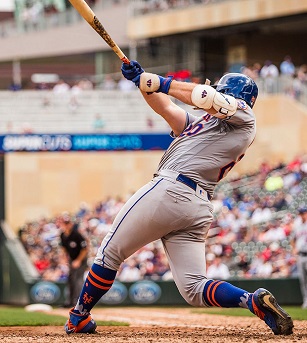
Pete Alonso hits . . . not just a two-run homer but a conversation piece Wednesday in the eighth.

Until the All-Star break the Twins, of all people, looked like the shock of the season with reasonable ownership of the American League Central. And the Mets looked like the National League’s clown show without the benefit of drawing laughs other than those mixing disgust and dejection.

Twins fans have taken the ride savouring every day so far. Mets fans have laughed like Figaro—that they might not weep.

Except when Pete Alonso catches hold of one, with or without men on, in the eighth inning or otherwise. Then, Mets fans weep for sheer joy. Unless their jaws hit the floor as on Wednesday afternoon, when Alonso didn’t just hit a two-run homer, he hit something liable to be picked up on satellite-orbiting radar.

This was one day after the Mets kind of snuck a 3-2 win past the Twins. A former Minnesotan of my acquaintance habitually believes anything good from the Twins is an illusion and anything bad a matter of established fact, phrasing it as politely as longtime Twins fans are reputed for being. Then came Wednesday’s top of the eighth and it was too much for even the most cynical Twins fan.

Who did the Twins think they were all of a sudden—the Mets?

It began with a walk. It climaxed with a monstrous home run. In between came the sort of thing for which the Mets are only too well disregarded and the Twins aren’t exactly among baseball’s most notorious practitioners.

Twins reliever Matt Magill opened by walking Robinson Cano, the designated hitter on the day, who’s come to that point in his career where he’ll take his base any way he can get there, unfortunately for the Mets. Then, Magill struck out Todd Frazier and Michael Conforto swinging in succession. Followed by Amed Rosario shooting a base hit up the pipe for first and second. And then it happened.

Mets second baseman Adeiny Hechevarria sent a fly toward the left field track. Eddie Rosario, sunglasses wrapped snugly around his eyes, drifted back with a perfect bead on the ball until, so it looked, even the sunglasses couldn’t keep his eyes focused as the sun hit the lenses with a nova-like blast. The ball descended to his glove, then rebounded right out of it.

Cano and Rosario hit the jets and scored handily. Then Jeff McNeil doubled off the right field wall to send Hechevarria home. Dominic Smith—who’d smashed a pinch-hit three-run homer to give the Mets a 5-3 lead in the first place an inning earlier—sent McNeil home with a single.

Up stepped Alonso. He looked at two sliders sailing up to the plate under the strike zone floor. He looked at another slider hitting the inside wall of the zone, barely. Then he saw a slider hanging up in roughly the same spot, maybe an inch further on the inside of the plate. And he sent it halfway up the third deck past the left field fence, bouncing off an empty seat and past a female fan who’d bent over futilely trying to grab the ball.

It was only Alonso’s first bomb since he won the Home Run Derby in Cleveland over a week earlier. But the 474-foot flog couldn’t have been any deadlier if he’d hit it with a sledgehammer and not a bat.

Magill got Mets catcher Wilson Ramos to ground out to end the carnage—temporarily. The Twins kindly sent reserve shortstop Ehire Adrianza out to take one for the team in the top of the ninth. The poor guy ended up taking three for the team thanks to a two-run triple (Amed Rosario) and an RBI double (Hechavarria).

Alonso himself looked as though he took pity on the Twins when he ended that inning with a hard ground out to third. Then Mets reliever Chris Mazza shook off a run-scoring ground out in the bottom of the eighth to work two solid relief innings and finish the 14-4 flogging.

These Twins opened the day with a cozy five-and-a-half-game lead over the Indians in the AL Central. But the Indians spent Monday and Tuesday dropping sixteen runs on the toothless Tigers for 8-6 and 8-0 final scores. And the Tribe didn’t seem likely to just roll over and play dead for the Detroit pussycats Wednesday night.

All of a sudden, the Twins thumping and bumping their way into being one of baseball’s 2019 feel-great stories looked very vulnerable after the Mets got through with them in a two-game set.

It didn’t start that way for the Mets. Already in certain disarray because of assorted issues and controversies on the field, in the clubhouse, and in the front office, they were forced to change plans when Zack Wheeler—scheduled to start Tuesday, in a certain trade-deadline-period showcase—hit the injured list with shoulder fatigue instead.

Forcing the Mets to turn to a bullpen game by using Steven Matz, a starter recently moved to the bullpen to fix himself, as an opener. Maybe it was an omen, because a lot of the kind of peculiar fortune that went against the Mets so far on the season went their way for a change.

Like in the top of the first, when McNeil and Conforto moved to third and second on a passed ball, Cano sent McNeil home with a sacrifice fly, and an error by Jonathan Schoop at second allowed Conforto home. Like when Rosario got to score while Conforto beat out a grounder to shortstop in the top of the fifth. And when six Mets relievers kept the Twins scoreless—despite loading the bases on closer Edwin Diaz—after the fourth.

A little more of that and a lot less of the kind of thing that turned them into a hybrid between nursery school and a slapstick academy and the Mets might not have made the wrong kind of truth out of rookie general manager Brodie Van Wagenen’s preseason challenge, “Come get us.”

Don’t look now, but the Mets are 5-1 including now a four-game winning streak since the All-Star break. And they’ve just taken a pair from the reputed threshing machine of the AL Central, including Wednesday’s human rights violations. It may or may not mean a turn of their sad seasonal tide, but this was one time the Mets didn’t need to ponder calling their therapists after a game.

Nor does being sliced, diced, pureed, and nuked Wednesday afternoon mean the Twins face a turn of their otherwise joyous seasonal tide in the wrong direction, either, just yet. But you might forgive them if they pondered calling Dial-A-Shrink for a few minutes.
This Derby doesn’t quite fit that well

2019-07-09 PeteAlonsoHomeRunDerby

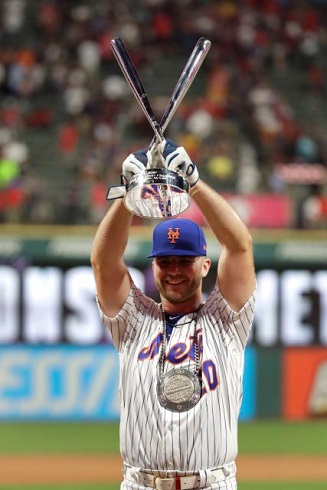
One of the 2019 Mets’ few bright lights, Pete Alonso proudly hoists his Home Run Derby winning trophy Monday night.

The remade/remodeled rules of the thing enabled Pete Alonso to win Monday night’s Home Run Derby in Cleveland’s Progressive Field. And Alonso, who’s one of the extremely few bright lights on a Mets team described charitably as a basket case, would have been the star of the show all around if it wasn’t for the kid named Vladimir Guerrero, Jr.

Gone is the longtime ten-outs window through which the Home Run Derby’s participants had to perform in the past. In is the three-minute, no-outs window through which they get to mash to their hearts’ content and their swings’ contact. Through that window did the chunky Blue Jay mash his way into becoming half of the only father-and-son tandem ever to win the Derby.

And, into the hearts of both the packed Progressive Field (commentators invariably noted the full house stayed full from late afternoon until the Derby finished) and the television audience. Hitting 91 home runs on the evening can do that for you, especially if you’re as effervescent as this son of a Hall of Famer showed himself to be.

It was great entertainment.

But it wasn’t baseball.

And there was the chance going in that this year’s Derby could be won by a guy who wasn’t even an All-Star in the first place.

As likeable as he is, as promising as his future still appears to be despite his awkward career opening after he’d turned the minors into his personal target practise, Guerrero isn’t even a member of the American League’s All-Star team. And Joc Pederson, whom Guerrero beat to set up the final showdown with Alonso, isn’t a member of the National League’s All-Stars this time. The Derby operates by a slightly different set of criteria than the All-Star Game, which has problems enough every year.

But Alonso is an All-Star. So is Alex Bregman, the Astros’ deft third baseman who often seems to be six parts Little Rascal and half a dozen parts high on laughing gas, and you’re never quite sure which side dominates at any given time. Bregman was eliminated in the Derby’s first round after a mere fourteen blasts. He may not necessarily have been complaining.

Watching the showdown between Guerrero and Pederson, who put on a big show of their own (including two swing-offs) before Guerrero yanked his way to the final showdown with Alonso, Bregman got off the arguable second best line of the night: I couldn’t imagine three rounds of that. I was gassed after two minutes of it. The arguable best line of the night? It showed up on Twitter: Joc Pederson’s going after that $1 million like he’s behind in his rent.

And, on television, Dodger pitcher and All-Star Clayton Kershaw inadvertently provided the most charming moment—his two young children, Cali and Charley, accompanied Daddy to the ballpark for the Derby. There was Cali Kershaw, pretty in pink, pumping her hands and hollering, “Let’s go, Joc! Let’s go, Joc!” The little lady’s a natural scene-stealer, just as she was during last year’s National League division series.

This year’s Derby winner added $1 million to his bankroll for his effort. In Alonso’s case, earning $1 million for one evening’s glorified batting practise all but doubles what he’s earning all season long as a Met. And, entering the Derby and the All-Star break, Alonso out-performed the guy down the freeway in Philadelphia who signed a thirteen-year, $330 million contract by the time spring training was about two-thirds finished.

Alonso also made good on his very public promise to divide ten percent of the Derby prize money equally, if he won, between the Wounded Warriors project (which aids post-9/11 military wounded) and the Stephen Siller Tunnel to Towers Foundation, named for the firefighter who lost his life on 9/11 trying to save lives in the World Trade Center.

“There’s a lot I was hitting for tonight,” the exhausted Met said after he was handed the winning medal and trophy. “I’m just happy that I can donate some money to the causes that I wanted . . . I mean, I have the utmost respect for the people that put their lives on the line every single day. And I just want to show my gratitude, because a bad day for me is a lot different than a bad day for the service men and women that serve this country.”

Whom among the Derby participants is also an All-Star? Ronald Acuna, Jr. (Braves), Josh Bell (Pirates), Matt Chapman (Athletics), and Carlos Santana (Indians). Ridiculously, one of the Derby semi-finals was between two guys who aren’t even All-Stars this year. Alonso beat his fellow All-Star Acuna to set up the showdown with Vlad the Impaler, Jr.

Even an observer who isn’t irrevocably wedded to the more stubborn of baseball’s traditions is justified in saying that the Home Run Derby is more entertainment than baseball, since it is tied explicitly to the All-Star festivities, if it invites those who didn’t make either All-Star team as well as those who did.

And one is reminded even briefly that Yankee star Aaron Judge pre-empted any participation in this year’s Derby during spring training, when the Leaning Tower of the South Bronx said he was more concerned with helping his team win games after the All-Star break than with joining and winning a Derby. Judge won the Derby in 2017. His second-half performance wasn’t quite the same as his first half, and he won the American League’s Rookie of the Year award anyway. (He also may have exacerbated a shoulder issue while swinging for his Derby win.)

I analysed Derby winners’ seasons at the time Judge declined and discovered at least half of them had lesser than equal or better second halves of the regular seasons in which they won their Derbies. Last year’s champion, Bryce Harper (now a Phillie), had a better second than first half, to name one; Guerrero’s Hall of Fame father (then an Angel) had a lesser second than first half when he won the Derby, to name one more.

It’s great entertainment.

But it isn’t baseball.

And, contrary to the naysayers, nannies, and nattering nabobs of negativism (thank you, William Safire, of blessed memory), baseball games are better entertainment than million-dollar batting practise. Even million-dollar batting practise that turned out to contribute to two extremely worthy causes.

If there’s a 50-50 chance that a Derby winner will have a lesser than better second half after winning the prize, with or without Alonso’s admirable charity intentions, it’s a little more alarming for baseball than it is engaging for Joe and Jane Fan.

And guess who’s going to be the first to complain, of course, if and when their heroes in the Derby become less at the plate and in the field, especially if and when their teams hit the stretch drive running.