Don’t kill the ump, San Diego

Xander Bogaerts, D.J. Rayburn

This is the pitch umpire D.J. Rayburn called strike three (wrongly) instead of ball four. This was not the reason the Padres lost Game Three of their wild card set against the Cubs Friday.

You know something? I’m probably at the front of the line wishing for Robby the Umpbot’s advent at last.  But don’t even think about trying to tell me the Padres getting nudged out of the postseason by the Cubs is plate umpire D.J. Rayburn’s fault.

Yes, Rayburn absolutely blew what should have been ball four to Xander Bogaerts in the top of the ninth of National League wild card Game Three. The pitch was low, with enough clearance between the ball and the strike zone floor to pass a Frisbee through it.

Yes, Bogaerts absolutely should have been on first. No matter how bright it wasn’t that he slammed his bat to the ground, all but forcing Padres manager Mike Schildt out of the dugout in a flash to keep things from getting worse.

Yes, the Padres absolutely should have had the proper chance to keep their late game revival going, after Jackson Merrill led the inning off with a healthy blast into Wrigley Field’s right field bleachers. That looked even more pointed when Cubs reliever Brad Keller hit the next two batters he faced, Ryan O’Hearn and Bryce Johnson, both on 1-2 counts, forcing Cubs manager Craig Counsell to lift Keller for Andrew Kittredge.

It was still first and second and one out. The Padres didn’t have the bases loaded as they probably should have had, but they still had the tying runs on the pads and a potential tie-breaking run or two due at the plate.

But Jake Cronenworth grounded to shortstop making it second and third. And Freddy Fermin flied one to the back of center field but not far enough to escape being the Padres’ third out of the game and last out of the season.

And that, ladies and gentlemen, not D.J. Rayburn, is what cost the Padres the wild card set and sent the Cubs forth to open their NL division series with a 9-3 loss to the Brewers.

Because all game long, the Padres couldn’t cash in their baserunners with the American Express card. They left eight men on base. They batted six times prior to the ninth with men in scoring position and stranded them. They had no solution for the Cubs’ superior fielding and seemed unable to find holes between those fielders to push or shoot too many balls.

They had second and third in the top of the fifth, when Gavin Sheets singled with one out and Fermin doubled him to third an out later . . . but Fernando Tatis, Jr. flied out to right.

They had Bogaerts on second when he stole the pad an out after he opened the top of the seventh with a base hit . . . and stranded him with a line out to second and a fly out to deep center.

They had Fermin on third in the top of the eighth after his leadoff single turned into taking second on a one-out wild pitch, then taking third on an infield ground out . . . and there he was stranded, on another infield ground out.

Meanwhile, the Cubs ended a faltering Yu Darvish’s start in the top of the second with a bases-loaded single, pushing him out and Jameson Tallion in, and Tallion walked the second Cub run home before getting a strikeout and an inning-ending double play.

From their, the teams traded bullpen shutout innings until Michael Busch led the bottom of the seventh off against Robert Suarez with a blast into the right center field bleachers.

The 3-1 Cubs win may well mean the closing of this group of Padres’ window for postseason triumph. They may have been lucky to get to the wild card series with an offense that led the Show in out-wasting sacrifice bunts but came home 28th in home runs. Their hitters sent 77 out at home, but their pitchers surrendered 86 in the same playpen.

Their biggest names weren’t exactly bombardiers, outside Manny Machado hitting 27 or more for the 10th time in his career. Bogaerts and Merrill missed significant time due to injuries; Bogaerts hit only 11 out and Merrill, 16. Tatis, he who proclaimed himself capable of being the best player in the game last February, settled for 25 bombs on the season and one measly single during the wild card set.

Their pitching may be somewhat suspect going forward, with Darvish likely approaching the end of a career often brilliant and sometimes frustrating, Dylan Cease and Michael King possibly departing as free agents, and Joe Musgrove entering 2026 on the comeback trail from Tommy John surgery.

And who knows what the upshots for the clubhouse and the front office will be as a result of the late owner Peter Seidler’s widow Sheel Seidler’s lawsuit to wrest control of the team from her brothers-in-law? Who knows whether A.J. Preller will be allowed to try wringing out one more miracle or handed his head on a plate in a bid to begin fresh blood injections, considering his contract expires after next season and Seidler isn’t here to have his back?

But don’t lay the blame for this early Padres postseason exit on Rayburn. He certainly did blow that crucial ninth-inning call, but he wasn’t the man at the plate turning all those Padre runners into castaways.

That was the wild card week that shouldn’t have been

Bryson Stott

Bryson Stott’s grand slam Wednesday, and Royce Lewis’s two bombs Tuesday, were the most fun of this week’s less-than-fun wild card games.

Well, that was fast. Four wild card series, four sweeps. A grand total of two runs scored by both the American League’s losing teams. The National League’s managed to score sixteen between them, but the winners scored 22 between them to the AL winners’ 16. Lovely.

Except for a very few moments among two wild card series winners, saying those winners shot the proverbial fish in the proverbial barrel is something like saying the sun arose, the sky’s blue, the tide’s rushing in, and the television cash kept pouring into MLB’s kitty, properly competitive baseball be damned.

The wild card idea for baseball was dubious from its birth, of course. But the arrival of three wild cards per league has now hit rock bottom. And don’t ask if baseball’s postseason could possibly become any weaker. Someone in the commissioner’s office might hear you and plant the appropriate seed in Rob Manfred’s garden of weeds

Bad enough that the race for the wild cards is a house of cards where legitimate pennant race competition is concerned. Go ahead and say it, go ahead and say you find nothing wrong with the thrills and chills and spills of teams fighting to the last breath to finish . . . well enough in second or even third place to qualify for championship play.

Go ahead and tell me the Rays looked like a fourth-best-regular-season-record team in getting thumped and stumped by the eighth-best Rangers in their own sorry excuse for a ballpark. Go ahead and tell me the ninth-best Blue Jays looked like a worthy postseason team after getting shoved aside by the AL Central champion Twins—the Show’s eleventh-best team on the season.

Go ahead and tell me the thirteenth-best team on the season, the Marlins, had any business being in the postseason with key pitchers injured after getting destroyed by the Phillies. Tell me the NL Central-winning Brewers looked like baseball’s fifth-best regular season team when they got dumped by the twelfth-best Diamondbacks, who may yet receive their own come-uppance from the NL West beasts out of Los Angeles.

The most excitement these wild card games delivered was the Twins’ Royce Lewis becoming the first number one draft pick ever to clear the fences in his first two postseason plate appearances ever, and Phillies second baseman Bryson Stott putting a still-reachable Game Two out of reach with a sixth-inning grand slam to the rear end of the lower right center field seats.

The most ginned up controversy came in Game Two of one of the American League sets, when Blue Jays manager John Schneider lifted his seemingly cruising starting pitcher José Berríos after three shutout innings. Schneider had only been very public saying he was going all pitching hands on deck (minus Game One starter Kevin Gausman) for a game he had to win to stay alive. You expected him to think of less when he’s facing win-or-be-gone that early?

How many stopped to ponder that the Blue Jays bats going missing in action did more damage—well, far more lack of damage—than Schneider lifting a pitcher who might have had maybe two more innings in him during which there was a reasonable chance of him showing how he gets torched as soon as the opposing order’s third time around arrives?

And what about Vladimir Guerrero, Jr., coming off a fine if not superstar regular season, getting careless on second with two out in the top of the fifth and Twins starter Sonny Gray finishing his fifth shutout inning by picking Guerrero’s tail feathers off second cleanly with second and third and Bo Bichette at the plate?

The Twins weren’t exactly causing traffic jams at the plate themselves, not with five runs scored across the set and three courtesy of Lewis. But the Blue Jays’ offensive inertia did far more to cost them than lifting Berríos could have done. This was baseball’s ninth-best regular season team getting pushed, shoved, and bumped home by baseball’s eleventh-best team.

That’s also why the Brewers are going home for the winter sooner than they planned. They needed far more than Christian Yelich and Willy Adames to swing and didn’t get it. And they have other issues to face, too. Their manager becomes a free agent and their two best pitchers—both under one final coming year of team control—may not be getting paid what their worth if they stay in Milwaukee. There may have gone the Brewers’ window for awhile, after winning an NL Central that some say nobody else really wanted to win.

Maybe it’s finally time for the Show’s government to start thinking of four-division leagues, and thus a postseason in which nobody gets to the dance unless their butts were parked in first place when the regular season ended. Maybe it’s time that, once agreeing upon that, each league’s divisions are placed into a pair of conferences with regular-season interleague play sent the way of stone bases once and for bloody all.

Maybe it’s time for best-of-three division series, best-of-five conference series, and the return of the best-of-five League Championship Series. Keeping the World Series prime at a best-of-seven.

Think about it. Commissioner Pepperwinkle and his minions will still get all the postseason games and postseason television money they could fantasise about. But this time, it’d be on behalf of far more honest competition, far more honest pennant races, and nobody on the edges of their seats waiting to see who finishes . . . second and even below.

When the best news of wild card week proved to be Mets general manager Billy Eppler resigning—maybe to duck being canned over forcing now-former manager Buck Showalter to use still-struggling, still-portly Daniel Vogelbach in the 2023 Mets’ lineups, despite his bat proving he didn’t deserve to be there so often, maybe out of Eppler’s need to justify the 2022 deal that brought him aboard in the first place—you know this year’s wild card sets were flushed.

Because we baseball fans, even those attention-deficit fans to whom Commissioner Pepperwinkle seems to pay the most attention anymore, didn’t sign up to see what we saw this week. Not even Lewis and Stott could acquit that.

Stick this!

Joe Musgrove

Lend Me Your Ear Dept.: Having the umps check Joe Musgrove (second from left) for new old-fashioned medicated goo on his ears and elsewhere looked like desperation from Buck Showalter as Musgrove and the Padres bumped the Mets to an early winter vacation Sunday night.

Few things in this world are as profound as the wrench that happens when an individual resembles a genius one night and a fool the next. Unless it’s when a team resembles a well-lubricated Porsche one night and a two-stroke Trabant the next.

That wrench sent Buck Showalter and his Mets home for the winter after they played a Saturday and Sunday that put their entire season into microcosm. Including the re-exposure of the lacking that turned them from National League East dominators to division sliders finally settling for second best after a self-deflating previous weekend in Atlanta.

It also sent Showalter from being the skipper with the nerve to throw The Book to one side, and his best relief pitcher into the game when its “save situation” presented itself earlier than the ninth inning, to the one who thought a too-little/too-late gamesmanship exercise might knock the Padres off their game slightly more than mid-way through.

That was when the Padres didn’t expose it for them. The Mets’ few lackings this year included offensive depth past the middle of the batting order. The Padres out-lasted them in this wild card series when the lower end of their order suddenly figured out how to hunt, peck, hector, pester, and puncture.

The Padres didn’t lack for issues all year, either, but they rode Joe Musgrove and two relievers to a 6-0 Game Three one-hit shutout, on a night Musgrove simply fed the Mets things they could only hit with moderate contact to Padre defenders on red alert. The nearest Musgrove came to disaster was when Mark Canha sent one deep enough to right center field to send Trent Grisham crashing into the wall after he caught the drive with only inches to spare.

The Mets might have loved nothing more than the crash actually yanking Grisham out of the game. All series long he’d gone from the nothing-special regular season element, whose seventeen home runs didn’t negate puny plate performance papers otherwise, into a 1.917 wild card series OPS. His Real Batting Average on the season: .422. His RBA in the wild card set: 1.167.

The only thing better than moving Grisham to one side for the Mets would have been ridding themselves of Musgrove, who pitched the first no-hitter in Padres history in April and pitched Sunday night as though he’d made the Mets into the classic cartoon volunteers for a cartoon magician’s guaranteed-to-embarrass magic tricks.

Showalter thought he might do what his batters couldn’t entering the bottom of the sixth. He ambled out of the Mets dugout and asked Alfonso Marquez’s umpiring crew to check Musgrove for, shall we say, that new good-old-fashioned medicated goo. Marquez delivered the message to a slightly flustered Musgrove promptly.

“He said, ‘Buck wants to take a look at your glove, your face, your hat, all that stuff’. I said: ‘You take what you want, man’,” Musgrove said postgame. The umpires took looks at all that stuff, including an almost comical-looking inspection of Musgrove’s admittedly shining ears and lobes.

What irked Showalter was information handed him that indicated the spinning rate on Musgrove’s pitches were higher Sunday evening than they were all season long. Baseball government’s obsession with foreign substances (Spider-Tack, et. al.) and lack of apparent concern for consistently made and grippable baseballs was bound to yield oddities but nothing quite like this until that moment.

“When you see something that jumps out at you . . . I get a lot of information in the dugout,” Showalter said postgame. “We certainly weren’t having much luck the way it was going. That’s for sure. But I’m charged with doing what’s best for the New York Mets. And however it might make me look or whatever, I’m gonna do that every time.”

“Was that what he did?” asked Padres third baseman Manny Machado, who had a respectable if not spectacular wild card series himself, who happened to be a measly three feet from Musgrove while the pitcher was being frisked, and who knows Showalter from playing for him as an Oriole. “I wasn’t sure. I mean, how many hits did Joe give up? He gave up one hit? That’s pretty smart by them.”

Maybe not as smart as Machado charitably allowed. Showalter’s shortstop Francisco Lindor seemed uncertain himself. “There were some talks in the dugout,” he told reporters. “Buck made the decision to go check him. I respect that. I respect his decision. At the end of the day, hats off to Musgrove. He flat-out beat us.”

Padres manager Bob Melvin didn’t find it that amusing. If anything, he found it a character assassination attempt. “The problem I have is that Joe Musgrove is a man of character,” he fumed. “Questioning his character, that’s the part I have a problem with and I’m here to tell everybody that Joe Musgrove is above board as any pitcher I know, any player I know, and unfortunately the reception he got after that was not warranted.”

That’s a reference to the Citi Field crowd chanting “Cheater, cheater!” at Musgrove post-check. Maybe the crowd became as desperate as Showalter’s sticky-stuff gambit made him look. Maybe they remembered Musgrove was a member of the 2017 Astros whose sign-stealing operation leaves that triumph suspect for all time, even though the pitchers had nothing to do with it. Maybe they forgot Musgrove admits to being embarrased to wear his ’17 Series ring because of his then-team’s shenanigans.

They certainly didn’t consider that the guy from El Cajon which is a very brief commute from San Diego, the guy who grew up rooting for the Padres, was a guy who took the mound amped up with thoughts that he really was living the dream, handed the ball in a Padres uniform on the most important night of his life to date.

“I dove into the fact that we got all the fans in San Diego waiting for this moment,” Musgrove said. “The girlfriends and wives here. The fan base that followed us from San Diego, and I tried to put that on my shoulders and carry.” That fan base had a contingency enough in Citi Field Sunday night that you could hear the “Beat L.A.!” chants as the game neared the finish.

The only question for these Padres now is whether they can and will beat the ogres of the National League West awaiting them in a division series come Tuesday night. They survived the loss of Fernando Tatis, Jr. to a shoulder injury and then a suspension over actual/alleged performance-enhancing substances. It doesn’t mean they’ll survive the Dodgers. But they may not make it that simple, either.

There’s no “only” question for these Mets entering their long winter.

Sunday starter Chris Bassitt embarrassed himself. It only began when Bassitt loaded the bases with two outs in the top of the second before another of the Padres’ final third in the order, catcher Austin Nola, swatted a two-run single . . . on 0-2.

“I was just beating myself,” he said honestly of his four-inning performance. “Looking back at the Atlanta start, I’m not sure how many runs they scored on walks, and then tonight I know they scored two guys on walks. Not too proud of that.”

It was the last thing Bassitt needed with free agency looming for him. He’s not the only one in that position. Saturday’s pitching heroes, starter Jacob deGrom and reliever Edwin Díaz, face free agency, too: deGrom by way of exercising his contract opt-out, Díaz by the expiration of a deal that once looked like a franchise embarrassment before he corrected himself and went from nothing like Seattle to this season’s never-better performance papers.

Brandon Nimmo, one of three Mets to acquit himself series-long at the plate, also faces free agency, as do pitchers Carlos Carrasco, Taijuan Walker and Trevor Williams. General manager Billy Eppler, who looked like a genius last winter in signing or acquiring Max Scherzer, Starling Marte, Eduardor Escobar, Bassitt, and Canha, doesn’t look so sharp for not having made a trade deadline fortification move even rummaging an admittedly thin trading floor.

And the Mets don’t look so smart for having built themselves so surely around deGrom and Scherzer they failed to have a consistent rotation behind that pair when their health faltered. Scherzer still looked ailing from his season-long oblique trouble when he was battered in the first wild card set game. DeGrom pitched just enough to his standard to give the Mets room for their Saturday night special.

But the lack of offensive depth behind Marte, Pete Alonso, Nimmo, and NL batting average champ Jeff McNeil burned them, too. When Marte was lost from earliest September through the start of the wild card set with a finger fracture, that lack behind the remaining three bit the Mets where it really hurt. The team on-base percentage for the set was a weak .283.

And with Max the Knifed on Friday, plus Marte playing the wild card set despite the lingering finger issue, the Mets’ health maintenance may need yet another review and remake.

None of which will dissolve the sting of their Sunday embarrassment. The Padres didn’t bomb the Mets into submission Sunday night, they just pecked, poked, prodded, and pushed on a night the Mets had no answer for Musgrove other than one desperation gambit.

The night before, Showalter resembled a prudent man who learned a hard lesson for bringing in Díaz—his and the league’s best closer on the season—in the seventh when the save situation was then and not the ninth. Sunday night, Showalter resembled a flailing  man overboard who’d take an anchor for a life preserver.

“Let me phrase this the right way,” said Mets broadcaster Gary Cohen, not doing these games since ESPN carried them but appearing on an SNY postgame show.

Buck Showalter is completely in his rights to ask the umpires to check a pitcher for foreign substances. It’s up to umpires then to decide whether it’s an appropriate thing to do. I thought that considering the circumstances, 4-0, sixth inning, season on the line, it smacked of desperation and it was fairly embarrassing I thought for Buck to do that in that spot. It was not necessary. As it turned out, Musgrove was not cheating. If you’re going to pull a stunt like that, you better be right and Buck wasn’t right.

Lucky for Showalter that he doesn’t believe he’s too old to learn. We’ll to learn soon enough what he learned from this weekend that might do him right in managing a team that may yet have a different enough look next year than the one he almost led deeper into this postseason.

Who says the old can’t learn?

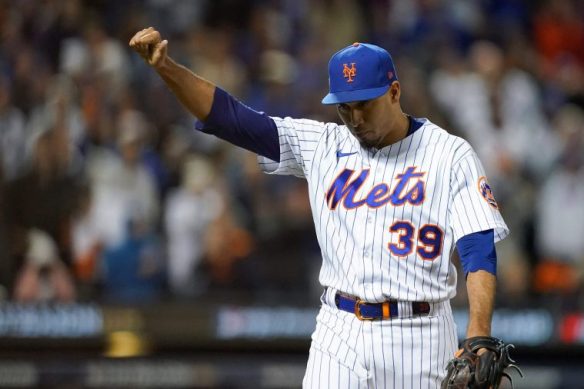
Edwin Díaz

Edwin Díaz did exactly what Buck Showalter brought him in to do . . . in a true “save situation—in the seventh, not the ninth Saturday night. For Showalter it was once bitten, twice bitter old lesson learned deeply enough.

The next time you see or hear any baseball elder tell you he or she is too “old” to bother learning something new, just show them Buck Showalter. He’s the Mets manager who learned one of the hardest lessons in baseball history and finally got to prove it when he absolutely had to prove it on Saturday night.

It kept his Mets and their skipper from an early winter and eons of second-guessing while they banked a 7-3 Game Two win. In the bottom of the inning in which Showalter showed at last that he really did learn something from the worst disaster of his managing career.

When they still played a one-or-done wild card game, in 2016, Showalter wouldn’t even think of his Orioles’ (and baseball’s, then) nuclear-hot relief option Zack Britton in the bottom of the eleventh. He stayed with faltering Ubaldo Jiménez because it wasn’t a “save situation” in a two-all tie, after all, despite the Blue Jays having first and third with one out.

Edwin Encarnación’s monstrous three-run homer into the Rogers Centre second deck told Showalter and the world that managing to one of baseball’s most nebulous statistics can be suicidal. It also told reminded a stubborn world that “save situations” aren’t strictly ninth-inning lead protection.

Showalter’s been second, third, fourth, and fifth guessed over that one ever since. When asked directly, he could never bring himself to re-open his mind from that moment. Either he’d say, “You just have to wear some things“; or, as he did immediately in that interview, “I can sit here and tell you ten things you may not know about that situation, but nobody wants to hear it.”

Except everybody wanted to hear it. Come the top of the seventh inning in Citi Field Saturday night, with a hard-held two-all tie but the Mets’ season in danger of ending in a wild card series sweep, Showalter found himself in a save situation in the truest sense of the phrase.

This time, Showalter planned for just this possibility. Once bitten, twice lesson learned. This time—just like his Saturday night starter Jacob deGrom pitching six innings of stout, eight-strikeout, two-run ball; just like his bombardier Pete Alonso breaking a two-all tie with a leadoff homer—the manager rose to the occasion.

No “closer” was deadlier than Edwin Díaz on the regular season. (1.31 ERA; 0.90 fielding-independent pitching; 118 strikeouts in 62 innings’ work.) And there Díaz was, up and throwing in the sixth, while deGrom retired the side on a strikeout, a fly to deep enough right, and a ground out.

Social media went half berserk just seeing Díaz warming up, never mind thinking Showalter would be insane enough (their words) to “burn” his closer that early. Except that a one-run lead, in a low-scoring game, for these Mets who sputtered their way toward finishing a 101-win season, after owning the National League East most of the season, qualified as the single most important save situation of their year.

“Buck bringing in Edwin Díaz in the 7th,” tweeted The Cooperstown Casebook author Jay Jaffe, “but only to underscore the fact that he’s still not bringing in Zack Britton.”

So Showalter went to Díaz Saturday night the way he didn’t even think about Britton in 2016. Díaz got Trent Grisham, who’d helped wreck Max Scherzer and the Mets in Game One with the long ball, to bounce out right back to the box, surrendered a four-pitch walk to Josh Bell, but then got back to back ground outs. And the Mets’ previously slumbering bats accepted that awakening happily.

They’d already chased Padres starter Blake Snell after Brandon Nimmo broke a one-all tie with an RBI single in the fourth. They withstood Jurickson Profar’s re-tying RBI single off deGrom in the top of the fifth before Alonso greeted reliever Nick Martinez as rudely as he knew how, sending the inning’s first pitch into the left field seats.

Now they had Adrían Morejón to handle out of the San Diego pen. Their manhandling of him only began with Francisco Lindor—who started the evening’s scoring with a first inning home run, after a leadoff single was wiped immediately by a double play—hitting a line single to open, and taking second on a wild pitch before Morejón walked Alonso and Mark Canha on tenth-pitch full counts.

Up stepped Jeff McNeil, the National League’s “batting champion.” Through the infield into right went his two-run double and out of the game went Morejón in favour of Pierce Johnson. Johnson had Eduardo Escobar pinned at 0-2, but Escobar un-pinned himself with an RBI single, then had pinch-hitter Daniel Vogelbach at 2-2 when Vogelbach lofted a sacrifice fly to deep right center.

Just like that the Mets broke the game open enough. Then Johnson struck out a pair following Tomas Nido’s base hit. Now what would Showalter do? Would he dare to leave Díaz in for a second go-round in the eighth and risk his unavailability for Game Three? Especially with about a 45-minute layoff while the Mets rolled up that four-run bottom of the seventh?

He dared. Díaz got Manny Machado to ground out back to the box to open. After walking Bell he struck Jake Cronenworth out on three straight pitches. Then Showalter made sure he wouldn’t lose Díaz for Game Three if needed, lifting him for Adam Ottavino, who caught Brandon Drury looking on 2-2 for the side.

“I was feeling great,” Díaz said postgame. “I thought I could get Drury out, but [Showalter]  told me that he needed me tomorrow and this was enough for today. So, I said let’s win the game tomorrow.”

It was a bloody good thing the Mets seventh made the Showalter/Díaz pay off, because Ottavino in the ninth worked like anyone but the owner of a 2.06 ERA and 0.97 WHIP on the regular season: leadoff walk, a hit batsman, a fly out, a pair of walks including to Machado pushing the third Padres run home.

Showalter went to Seth Lugo, and Lugo lured Bell into grounding out right back to the box for the side and the game. Leave it to the Mets to salute their skipper’s gambit—the absolute right move to have made, with the game and the season that squarely on the line—with a four-run inning and still have to perform another high-wire act to escape with the win, anyway. That’s still so Mets, right?

Maybe this will be the beginning of the final end of the dubious “closer” and “save” things. Maybe this, at last, will lock down once and for all that you don’t save your best relief option purely for the final inning, because a real save situation presents itself any time at all during a game.

That was then: “This is simple: Showalter screwed up,” ESPN’s David Schoenfield harrumphed. “Even the smartest men are capable of ineffable stupidity,” harrumphed Jeff Passan, then with Yahoo! Sports but now with ESPN. Keith Law began an entire chapter arguing against the save statistic in Smart Baseball with that sad 2016 brain freeze.

This is now, apparently: Too much of baseball world talking about Showalter’s “unusual” or “unconventional” move. But a one-run lead against a tenacious Padres team that’s survived a few blows of their own to get here in the first place, too, can blow any time in the final three innings.

The Mets were very much in a real, not an artificially-contrived-by-nebulous-rule, save situation in the seventh Saturday night. This time, the Buck didn’t stop, blink, flinch, or shrivel. Neither did his team.

A 66-year-old skipper made liars out of the old fart contingency that insists they’re “too old” to learn new if should-be obvious lessons. Showalter proved you don’t get old on earth until you get dead on earth. And dead is what the Mets might have ended up without that proof.

Waste not, want not

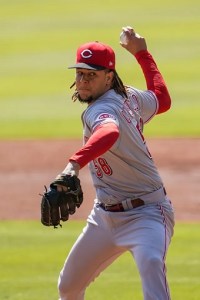
Like Trevor Bauer in Game One, Luis Castillo’s Game Two effort was wasted by the Reds’ absentee bats and futile running.

Joey Votto said going in that his Cincinnati Reds in the postseason, however rough and tumble things had to be to get them there, would be a “[fornicating] nightmare.” He just didn’t bargain on every man in a Red uniform at the plate or on the bases being their own worst nightmares.

If the Reds wish to remain postseason competitive, waste management means waste avoidance. Because if you don’t avoid waste, no matter how efficient your pitching might be, you’ll get wasted the way the Atlanta Braves wasted the Reds late but imperatively Thursday afternoon.

The Reds’ irregular season’s grind just to claim one of this year’s ten wild cards got wasted, too, even worse than Marcell Ozuna and Adam Duvall wasted relief pitcher Raisel Iglesias’s canteloupes.

Nobody wants to take anything away from the National League East-winning Braves. They clung stubbornly in their wild card set, held on to win Thursday, 5-0, and didn’t let the Reds’ stellar starting pitching blow the spirit out of them no matter how long it took. The Reds made it a little too simple for them in the end.

The Reds won’t live this one down too readily. They’re going to have to try explaining how they became the first team in Show history to be shut out for an entire postseason set, 22 innings worth, even if it was a mere best-of-three.

They’re going to have to try explaining how Trevor Bauer in Game One struck out twelve Braves without walking a soul or surrendering a run, without getting credit for a win, but with the Reds losing in the thirteenth inning on the game’s only run—on a measly RBI single by likely National League Most Valuable Player Freddie Freeman.

They’re going to have to explain how Luis Castillo’s first-ever postseason start produced seven strikeouts in five and a third innings, only one run surrendered, only one batter walked, and Iglesias getting blown up in the eighth after Lucas Sims spelled Castillo with an inning and two-thirds of spotless relief.

Ronald Acuna, Jr. doubling home Austin Riley off Castillo with two out in the fifth only made it 1-0. But Iglesias walking Freeman to open the eighth was flirting with death. Death accepted the invitation when Ozuna found a 1-0 meatball so irresistible he yanked it into the empty left center field seats.

Walking Ozzie Alibes after striking Travis d’Arnaud out following that launch wasn’t advisable, either. How inadvisable came too clear when Duvall licked his chops at an even meatier, 0-2 meatball, and sent it out down the left field line.

“Such a professional hitter,” Braves rookie starting pitcher Ian Anderson said of Ozuna after the game, calling Ozuna the life of the club all year long. “Loves the big moment. And I know it was getting to him a little bit, the way his at-bats had unfolded up until that point. Yeah, he couldn’t have been happier, and we couldn’t have been happier for him. That was a huge hit for the team. You could kind of sense that the dugout relaxed then, just a little bit.”

The Braves now wait to see who wins the win-or-be-gone game between the Miami Marlins and the Chicago Cubs in Wrigley Field, which might have been played Thursday but for the rain saying “not so fast.”

The Reds are also going to have to explain why they couldn’t find more than two hits off Anderson but found their way to nine strikeouts against the rook making his first postseason start following six irregular season assignments and a shimmering 1.95 ERA.

Those thirteen runners the Reds stranded need some explaining, too. So does having nothing to show against three Braves relievers from the seventh through the ninth.

They’re also going to have to explain why a team with baseball’s worst collective batting average (.212) despite a few offensive upgrades last winter couldn’t find ways to avoid becoming baseball’s first to be shut out of an entire postseason series.

How many times did the Reds answer opportunity’s knocking with “Go away, we gave at the office?”

When they greeted Max Fried in Game One with back-to-back singles giving them first and third and nobody out, only to see Votto—Mr. On-Base Machine—ground out to first, Eugenio Suarez line a badminton shuttlecock to Ozzie Albies at second base, and Mike Moustakas ground out?

When manager David Bell thought he could get away with a play that even the Little League won’t try all that often, having Kyle Farmer on first and Aristedes Aquino on third try a double steal the Braves could smell from about five minutes prior to attempt, with Aquino bagged in an even more kiddie-looking rundown?

When Bell sent spaghetti-bat veteran Freddy Galvis out to pinch hit for Shogo Akiyama with two out and two on in the top of the twelfth, despite Akiyama hitting well enough down the stretch to earn the opportunity, and Galvis rewarded Bell for his unexpected faith by looking at strike three right down the middle?

When they spent Game Two with no non Venezuelan-born Red getting a single base hit, and no Red from any geography reaching base between Galvis’s walk in the second and his off-the-pillow base hit up the first base line in the fifth? When no Red from there got so much as a hit by pitch to reach base and seven out of the final thirteen Red batters struck out?

Their number one irregular season issue, their inability to hit in multiples in most innings, swallowed them deeper than the Braves’ own pitching turned out to do.

“You can look at the defensive positioning, you can look at hard-hit balls that didn’t go for hits,” Bell said after the Game Two loss. “But, it’s something we have to take a closer look at because all teams are really good at defensive positioning and can hit into bad luck at times. Why did that happen for us? We just have to really take a close look at it. We did all year. Yeah, I say, we absolutely do believe in our guys, we made adjustments as much as we possibly could. But we have to find a way to get better.”

Right he is. Every Reds position player except for three will be back in 2021, and enough of them will be on the far enough side of thirty years old. They’ll still have most of their solid pitching, though the Braves didn’t get to see Sonny Gray this week, but Bauer could walk into the free agency market this year with as many potential suitors as a debutante.

Another, older Ian Anderson, leading a British band known as Jethro Tull, sang the epitaph for this year’s Reds a little over half a century ago: It was a new day yesterday, but it’s an old day now.