“Ladies and gentlemen, your Orphan Athletics”

Oakland Coliseum

Vegas may beware more than abused A’s fans think . . .

The way things aren’t happening with John Fisher’s bid to hijack the Athletics out of Oakland and into Las Vegas, you shouldn’t be shocked if the Orphan Athletics becomes the team’s semi-official name for a spell or two.

At this writing I don’t know which thought is the more profound thought: A’s fans in Oakland desperate to see Fisher sell the team to someone willing to keep them in Oakland, or baseball fans in Las Vegas who don’t seem all that anxious to have them here.

Hear me out. Having their Triple-A team, the Aviators, playing in that lovely little ballpark up in the Summerlin area is one thing, and a very nice thing, too. But wanting major league baseball by Fisher’s ways and means is something else entirely.

You couldn’t ask for more proof of my suspicion that Las Vegas isn’t in as big of a hurry to welcome the A’s as first believed than its mayor’s own publicly expressed ambivalence.

Earlier this week, Mayor Carolyn Goodman said she thought the A’s should stay and work things out in Oakland. Until she didn’t. On Tuesday morning, she said, “You have the fan base there. We already have the Raiders. Each city needs to have that spirit of sports . . . I love the people from Oakland. I think they deserve to have their team.” On Tuesday afternoon, after the you-know-what hit the you-know-what, she said, whoops.

“I want to be clear that I am excited about the prospect of major league baseball in Las Vegas,” she began her backpedal, “and it very well may be that the Las Vegas A’s will be come a reality that we will welcome to our city.”

. . . [I]t is my belief that in their perfect world the ownership of the A’s would like to have a new ballpark on the water in Oakland and that the ownership and the government there should listen to their great fans and try to make that dream come true.

Should that fail, Las Vegas has shown that it is a spectacular market for major league sports franchises.

Translation, in part: Fisher should renew his oft-failed efforts to strong-arm Oakland into building him a new ballpark for which he’d have to pay little to nothing, but if he still can’t by all means he should continue putting the bite on Las Vegas and on Nevada whole to do it. For a team his ten-thumbed, toeless touch has reduced to what was once just their official emblem—a white elephant.

“Goodman was not speaking with any real authority on this matter,” writes The Athletic‘s chief of Bay Area coverage, Tim Kawakami. “But just take her skepticism—she literally said the A’s should figure out how to build in Oakland—as a representation of the Las Vegas demographic that never seemed too excited about the A’s relocating to Nevada.”

Just like with every other demographic, business or fan: The more you get to know Fisher’s operation, the less faith you have in anything good happening.

To me, the most telling point wasn’t Goodman’s comments. It was that her clear ambivalence about the A’s in Las Vegas was met with nearly total silence among powerbrokers in that region. Ambivalence on top of ambivalence. Where was the rallying cry from all those businesses and fans supposedly lining up to welcome the A’s? Where was the energy? Why didn’t anybody with clout step up to bellow that the mayor was wrong and the A’s will take this town by storm in 2028, which is the new theoretical finishing date?

Maybe Las Vegas won’t get really excited about possibly being the new home of the A’s until or unless Fisher sells the team. But Oakland’s going to insist that, if he does, he sell the A’s to Oakland interests who’d be more than happy to keep the A’s there and maybe build a ballpark for which they, not the local or county or even state taxpayers, will pay.

And the rest of MLB’s owners “don’t want to force Fisher to sell the team,” Kawakami writes. “But if anything’s going to get them thinking about it, or at least to suggest quite strongly to Fisher that it’s well past time to pass this team to someone else, it’ll be if he blows this Las Vegas situation.”

Don’t bet against that, either.

Fisher’s track record includes blowing two significant proposals back in the Bay Area, one at Laney College (with or without bothering to check with California’s Board of Regents to be sure property at the campus was available in the first place), one at Howard Terminal. (Where Fisher said, essentially, “Build me a delicious real estate complex and let’s throw a ballpark in for good measure.”) Not to mention blowing whatever chance the ancient and decrepit Coliseum had to be rebuilt.

Speaking of which, the A’s Coliseum lease experies after this season. Where will they go from there until, in theory, their intended Las Vegas ballpark gets built? In fact, there’s still no plan other than just plopping one onto the property of the soon-to-be-history Tropicana Hotel. There’s also no known, firm, secured plan coming from the Fisher camp to play A’s home games anywhere else, though speculation includes Sacramento, Salt Lake City, and the Aviators’ Las Vegas Ballpark.

Somehow, I just don’t think turning the A’s into what Kawakami describes as a barnstorming AAAA-level team is the best way to make friends, influence people, and turn Las Vegas ambivalence into Las Vegas popping champagne and partying hearty over the pending A’s relocation.

Remember, as Kawakami does: The A’s have lost 214 games over 2022-2023. Their television lucre by way of MLB is going to be cut short big enough if they end up playing their home games on the road, pardon the expression. That’s not exactly going to inspire Fisher to invest in improving the major league product or the farm system.

“I can’t imagine how the A’s will be any better than they’ve been the last two seasons, and they might be worse,” Kawakami writes. “Until 2029 or 2030.”

Meanwhile, the Nevada State Education Association, one of the state’s teachers’ unions, has filed suit to challenge how legal was and is that $380 million in taxpayer money state lawmakers voted and Gov. Joseph Lombardo signed to hand the A’s to build the ballpark that might never be. The suit argues the gift is illegal because it failed to undergo the required two-thirds majority vote in both state legislature houses, getting approved by simple majority instead.

The money’s actually contingent on building at the Trop prop. The NSEA suit follows their appeal after a court struck down a ballot initiative forcing the $380 million to a public vote of approval.

Meanwhile, Oakland fans continue their efforts to persuade someone, anyone to force Fisher to sell the A’s. Fan groups Last Dive Bar, the Oakland 68s, and others have called for boycotting Opening Day against the Guardians. The A’s answer is offering possibly-unprecedented buy one-get one tickets for the game.

That’s only slightly less absurd than the prospect of thinking about ballpark announcers hailing before first pitch time, “Ladies and gentlemen, your Orphan Athletics!”
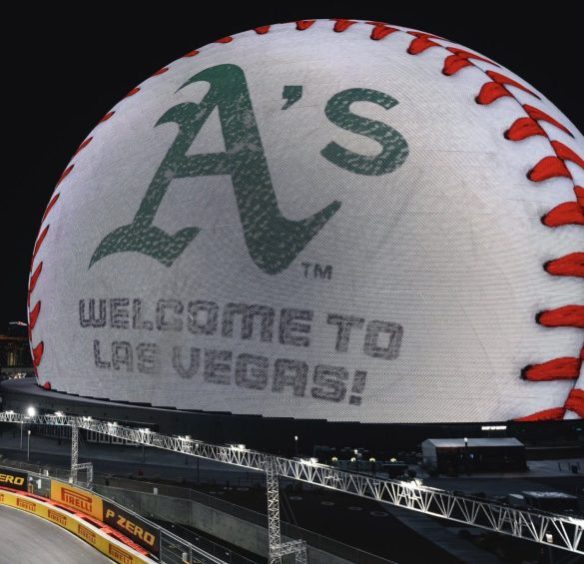
Viva Las VegA’s?

The Sphere

Oakland A’s fans may not be the only ones hoping this blast around Las Vegas’s Sphere proves to be baseball’s version of Dewey Defeats Truman.

Ladies and gentlemen, your Las Vegas Athletics of Oakland. At least, they will be as of 2028, now that baseball’s owners voted unanimously to allow John Fisher to hijack the A’s from a city who loved them but whose leaders, for assorted reasons, refused to let Fisher strongarm them into a new development with a ballpark thrown in for good measure.

I write as a baseball analyst and as a lifelong fan. Would I love to see major league baseball in Las Vegas, where I’ve lived since 2007? You might as well ask if I’d love to discover a million tax free dollars at my front door. But I’m hard pressed for now to know which about the A’s situation is worse.

Is it Fisher discovering not every Oakland muckety-muck had turnips for brains and wouldn’t just build him that development and hand it to him on a platinum serving tray? Is it that the A’s now get to turture Oakland a few more years before they’re actually ready and able make the move?

Is it Las Vegas’s and Nevada’s powers that be jumping eyes wide shut into handing Fisher $380 million worth of the funding for a projected billion dollar-plus ballpark adjacent to The Strip, funding that’s liable to hike when the usual unanticipated cost overruns cost Nevada taxpayers more than the billion the A’s are “expected to arrange?”

The only thing possibly standing in the way of finishing the Fisher hijack is a Nevada pollitical action committee whose interest is public education forcing Nevada’s $380 million to a public November 2024 vote. “Were that to happen,” write The Athletic‘s Evan Drellich and Melissa Lockard, “and were the public to subsequently vote against providing the money, the move could be, at the least, delayed.”

Dare to dream. Well, the Oakland fan group the Last Dive Bar does. “So what’s to say this Vegas [move] is going to be this glaring success?” asked Last Dive Bar member Bryan Johansen of Lockard—right before answering.

They have what they didn’t have all those times (in previous attempts to move) in that they have the support of the commissioner to move and they have a city that just says, yeah, do whatever you want here. But it’s still Fisher and he still has to do that work, and he still has to put a shovel in the ground. And to today, he hasn’t been able to accomplish that, so there’s still a glimmer of hope that he’s not going to be successful and will be forced to either sell or work something out in Oakland.

The A’s have been in Oakland three years longer than they spent in their native Philadelphia. RingCentral Coliseum, the home they’ve known since moving there from Kansas City in 1968, has been a living, neglected wreck for what now seems eons. And Oakland was willing to give a $375 million commitment to a new A’s stadium if only Fisher and his trained parrot David Kaval left things at that.

But Fisher and Kaval insisted on pushing the $12 billion Howard Terminal development project with a ballpark thrown in for good measure. Oops. Now the A’s, which have been allowed to devolve into the American League’s first among known basket cases, stand likely to be turned into a game-wide hate object thanks to an owner about whom decriptions as ten-thumbed might be polite.

“But what could have worked better?” asks Deadspin‘s Sam Fels, who answers almost promptly:

The tiniest ballpark in the tiniest market in a climate inhospitable for getting to the park or sitting outside? Or a gleaming new [Oakland] park right downtown that included far more of a footprint for Fisher and revenue streams in the nation’s tenth biggest market, in one of the wealthiest areas in the country? Isn’t it just possible, with all of that, that the A’s might have become the big market team that the Bay Area suggests they should be? Well, not under Fisher’s ditch-focused guidance, but under someone with a few neurons that fire at the same time? Did anyone think the Giants were a big market team before they moved into their palace in downtown San Francisco?

The alleged Las Vegas plan is to build a retractable roof ballpark where the Tropicana now sits. That still counts on that which cannot always be counted upon, travelers silly enough to hit Vegas at the peak of summer’s notoriously dry roasting heat, to see a team in which they normally have no rooting interest.

Las Vegas without such travelers has sports fans to burn. (No pun intended.) Baseball fans are more numerous than outsiders might suspect. They could in theory jam the future ballpark and still not do it enough—not with a ballpark said to be planned for 30,000-35,000 seats—to compel Fisher to do anything much more than entertain thoughts of selling the team.

But they might have done it for a new expansion team. Oops. Commissioner Pepperwinkle and his minions seem to believe Vegas needs an “established” team—whether or not it’s the (ahem) white elephant into which Fisher turned the A’s—instead of something splashy new. Never mind that Vegas has lived as much and maybe a little more on the splashy new as the tried and true.

Thoughts of Fisher selling the team have been prime on A’s fans for about as long as Fisher’s owned them. This past season merely amplified those thoughts with the prominent and rousing “Sell the Team!” chants among those A’s fans who still refused to let RingCentral’s wreckage deter them. The very thought of Fisher selling to one who cares about the team may have been what Disney legend Annette Funicello called the dream that’s a wish the heart makes.

Whether the buyer will be someone who actually believes a baseball team should be built to compete and win as best as possible to win is impossible to predict for now. So is whether such a buyer will be willing to take the A’s as far off the larger revenue sharing teat as possible, considering Fisher having to keep them on it isn’t really going to make him true friends among the owners who approved his hijack.

This is not Walter O’Malley being squeezed out of Brooklyn by a capricious, tyrannical city and state building czar determined never again to allow privately owned sports facilities built on New York land. This is the latest in a long run of baseball owners with the wherewithal but not the will to build entirely out of their own pockets without one. thin. dime. of public money factoring in.

It’s also the latest in a long run of municipalities who think there’s nothing wrong with fleecing their constituencies on behalf of creating or luring major league sports teams that don’t always prove to be saviours of local economies without the locals or the visitors paying through their noses, bellies, and any other passages possible.

Not to mention the latest in a too-long run of the A’s looking to get out of their dilapidated digs but finding the wrong ways to do it, or the wrong opponents to cross. Wanting to escape that was one thing. Going deliberately into the tank after the pan-damn-ic season while still trying to fleece their home city was something else entirely.

As The Soul of Baseball author Joe Posnanski writes in Esquire, “They seemed on their way to San Jose at one point—the city wanted the team so badly that they actually sued Major League Baseball—but the Giants’ said that San Jose belongs to them and blocked the move. After that, the city of Oakland and the State of California put almost $800 million on the table in infrastructure, tax kickbacks, and various other goodies.

“This hasn’t proven to be enough . . . Fisher believes he can get more, that he needs more, that he deserves more.”

The Sphere, that big, $2.3 billion dollar Las Vegas ball of animated light on the outside and overpriced concert and other event seating on the inside, which may be liable to lure more people watching the outside than listening and watching on the inside, couldn’t wait to blast the news on the outside.

A’s fans in Oakland, who have suffered two lifetimes’ betrayals and refuse to surrender without a fight, may not be the only ones hoping that’ll end up equaling Dewey Defeats Truman.

Keep your veto pen wet, Gov. Lombardo

Once the Athletics’ uniform insignia, this now represents what John Fisher has made of the A’s. And, what Nevada’s cactus-juice-for-brains lawmakers approved for taxpayer financing to move to Las Vegas. It’s your move, Gov. Lombardo.

Let’s put it this way, as Deadspin‘s invaluable Sam Fels has, in more words than I’m about to sketch: Nevada, you’re being had. You have better odds playing for the Megamillions slot jackpot ($14 million) won two months ago by a man in a Reno casino than you have that the Oakland Athletics will make it worth soaking your taxpayers for $350 million plus to build it when they may not come the way the A’s think.

Fels wrote before the state Assembly gave its blessing toward enabling A’s owner John Fisher and his enabler, baseball commissioner Rob Manfred, to count on that minimum $350 million tax soak to build a ballpark on the Las Vegas Strip that isn’t liable to draw anywhere near what Fisher and Manfred think it will. The Assembly approved it a day after the state Senate signed off on it eyes wide shut.

Newly-minted Nevada governor Joseph Lombardo is expected to sign it all. Before he does, you wish he’d read Fels’s warning. Not only are the A’s moving from a large market they threw under the proverbial bus, when they couldn’t shove their once-planned Howard Terminal project of mass real estate investment with a ballpark thrown in for good measure down Oakland’s throat, but they’re planning to build the smallest ballpark in the Show.

Fels warns properly that the A’s may be counting on most of Las Vegas, if not most of Nevada, having just as much cactus juice for brains as their state legislature and, apparently, their governor. The forthcoming ballpark, as planned now, and as Fisher and Manfred want you to believe, means 27,000 tickets sold per game, which is ninety percent capacity for 81 home games. Not so fast, Fels hollers: Nobody sells that much per game all home season long.

You know who doesn’t sell 90 percent of their seats on average? The Dodgers (86 percent). You know who else didn’t? The Best Fans In Baseball, Cardinals (87 percent). Neither did the Yankees (also 87 percent). Are we really supposed to believe that the A’s, run by the duopoly of knuckleheadedness that is John Fisher and David Kaval, are going to produce a team that’s going to draw 90 percent capacity through July in the desert?

Fisher, Kaval, and Manfred say of course you’re supposed to believe it. They’re a trio of Mad Hatters. Except that the Mad Hatter was unapologetically honest about inviting you to come have some tea because he had no tea. The disingenuity from which Fisher, Kaval, and Manfred spring is enough to make smarmy politicians the essence of candor.

Maybe the lawmakers should have asked a major league ballplayer who just so happens to be native to Las Vegas. He grew up the son of a Yankee fan and with friends who became Braves fans (thanks to superstation TBS); Dodger or Padre fans (since each team is a mere four and a half hour reach from Vegas by car); or, Cub or White Sox fans, thanks to lots of Chicago people moving to Vegas over three decades prior to his 1992 birth.

“Are they really going to sell out for a Yankees game on a Friday night?” asks Bryce Harper, now a Phillie for life and hoping to keep things that way. “Is it going to happen? I don’t know. I have no idea. I don’t think anybody knows . . . Do you think people are going to drop the Cubs or the White Sox to be A’s fans? There’s no way. No chance. But that five- or six-year-old, in the next ten years, they could grow up A’s fans. In ten years, you could have a lot of fans.”

Depending, of course, on one small detail nobody’s convinced the A’s can tend so long as Fisher ownes the club and Kaval is his trained parrot. “You can’t have (out-of-state) fans having to push this team,” Harper goes on. “You can’t have that. You need a fan base. They’re going to have to build a fan base, big time . . .”

They’re going to have to build behind a player. Who is that player going to be? Because it has to start next year . . . If they go to Vegas next year, you have to be able to go, ‘We’re going to get this player. We’re going to spend $300 million on him. And this is what it’s going to be.’ And he’s your guy. You have to build around that player. But it has to be a dude. It can’t be a middle-of-the-road guy. It has to be a dude. And it should be two.

Some people seem to think that if the NHL’s Golden Knights could thrive in Las Vegas—not to mention win a Stanley Cup Tuesday night, the second-fastest Cup win for an expansion team in NHL history—there’s hope for the A’s. Uhhhhh, not so fast, folks.

The Knights were born as an NHL franchise in 2017. In what’s surely one of the most grotesque cases of timing in this century’s sports history, great misfortune led to unforeseen reward. The Mandalay Bay atrocity of that year brought the best out in the newborn Knights, whose organisation from the front office to the men on the ice dove headfirst into helping a shattered city rehorse, financially and spiritually.

That cemented the Knights in turn as a “Vegas Born” city favourite. So did smart administration and solid play enable reaching the Stanley Cup final in their newborn season. The A’s won’t be Vegas born, they’ll be Vegas imported. (A joke since I moved to Las Vegas in 2007: if you’ve lived here seven years, you’re considered a native.) And it’ll be like importing pestilence, not princeliness.

When the Dodgers and the Giants went west for 1958, Los Angeles and San Francisco at least had the pleasure of welcoming teams whose owners believed in true competition and were recent World Series winners. (The Giants in 1954; the Dodgers, 1955.) When the A’s move a little ways east, unless Lombardo gets whacked with a wake-up stick, Las Vegas may have the dubious pleasure of welcoming what was once just the team’s uniform breast insignia: a white elephant.

(Harper: “I don’t think they should use the A’s name. I really don’t. I don’t think it’s fair to anybody in Oakland for that to happen. I really don’t. I think they should rebrand it. That’s my own personal opinion. Maybe people in Vegas might think differently. They might love the Las Vegas A’s name. You already have the [WNBA’s] Aces and they’re really good. You’re not going to take a New York Yankees fan and change them into an A’s fan overnight.”)

RingCentral Coliseum reverse boycott night.

Part of the scene from Tuesday night’s “reverse boycott” at RingCentral Coliseum. “Vegas Beware,” indeed!

On the same night the Knights secured the Stanley Cup by flattening the battered Florida Panthers, 9-3, in the finals’ Game Five, frustrated A’s fans in Oakland turned out large enough for a “reverse boycott.” Perfect timing: The A’s won (beware the shock factor) their seventh straight game. (“Break up the A’s!” became an immediate punch line.) The day after, of course, they reverted to their 19-51 form losing to the Rays.

“It was never going to stop the [relocation] process,” writes The Athletic‘s Tim Kawakami of the “reverse boycott,” never mind fans hoisting their now-customary banners demanding Fisher either sell the team or pay for his own relocation fully. “But the sights, sounds and emotional flavor of that 27,000-plus crowd were all indelible and important.”

MLB owners will not be persuaded by it, of course. They see the free win in Las Vegas, and they’re going to take it. But sometimes civic defiance just needs to happen. Sometimes the moral moment lingers even in the wake of a larger loss. Maybe especially then.

. . .This is a bad deal for Las Vegas, not only because of potential shortfalls that Fisher isn’t required to cover but also because I’ve not seen any deal language about who’s paying for overruns—which isn’t the only thing about this deal that seems to be unsettled. Do you trust Fisher in a $1.5 billion deal with tons of gray area? I wouldn’t.

. . . Oh, man, the final few months of this season are going to be brutal at the Coliseum, and possibly through next season, which is when the lease expires. I expect Fisher and Kaval to come up with a plan to play their home games somewhere in Nevada next season. But the most likely options are the minor-league stadiums in Las Vegas and Reno, and I can see the players union not being in love with those scenarios.

So there will be a lot of bumpiness in the coming weeks, months and years, to be sure. But soon, it’s likely to be all Nevada’s headache, not Oakland’s anymore. And Fisher will still be Manfred’s headache, too. That’s not going away. Manfred got one problem solved Wednesday, but he gave up a lot for it—that is, if you consider legacy, honor and moral standing important.

Legacy? Manfred’s legacy is liable to be trying to fix what wasn’t broken; ignoring what was and might remain broken; surrendering to the attention-deficit fan rather than enhancing the fan who knows baseball is a thinking person’s game requiring patience and the long view; and, now, enabling a billionaire who trainwrecked a colourfully-historic team and a fan base that loves them to move it out of town and jam too much of the cost down another town’s throat.

“This thing has the potential to be an absolute disaster,” Fels writes, “that will rob a passionate baseball city that’s been [screwed] over repeatedly of its team to give a team to a market that likely won’t want it after too long. But hey, Rob Manfred’s happy as long as Fisher didn’t have to pay for a stadium himself.”

Look. We in Las Vegas would love major league baseball. We’ve made the minor-league Aviators either the Pacific Coast League’s top draw or near enough to it since their lovely little ballpark was built and opened. And we know the only way the Show would work would be in a ballpark with any kind of retractable roof. The summer game would be played dry roasted otherwise. (The average Vegas temperature between the final third of June and the end of August: about 101 degrees. The known highs: As high as 120.)

But I think we in Las Vegas, and in Carson City, should have told Manfred, Fisher, and Kaval, “Halt right there,” when they decided they were going to abandon their Oakland loyalists—after abusing them no end—to come our way and stick us with a bigger bill for a bigger deception than they think they can deliver.

Manfred has spoken lovingly about expanding the Show to two more teams. That’s what Las Vegas should have had if he was that bent on planting a major league team here. Gov. Lombardo should awaken himself, be certain his veto pen has a full tank of ink, and tell Manfred, Fisher, and Kaval: If you want us to come, you build it and you pay for it.

No free lunch for the Sinkin’ A’s

This was once the Athletics’ uniform insignia. Now the A’s themselves are a white elephant—whose owner wants to jam down Las Vegas’s throat after he couldn’t strong-arm Oakland for new digs while deflating the team.

Look, again, to your non-laurels, 1962 Mets. The Oakland Athletics, proud owners of a nine-game losing streak and possibly counting, are off to the worst start of any major league team since the turn of the century. The turn of the 20th century, that is.

After losing 5-2 to the Astros Friday, the A’s sit as the none too proud owners of a 10-43 record after 53 games. The 1962 Mets sat with a 15-38 record through their first 53, after splitting a doubleheader with the Cubs. This year’s A’s stand a chance at knocking the 120-loss ’62 Mets out of the books for baseball’s most beaten team.

The Original Mets, of course, were formed of the National League’s flotsam and jetsam in its first expansion draft and became baseball’s last unintentional comedy troupe. These A’s, in all earnestness, are born of an owner’s ten-thumbed-and-toeless touch. They’re as entertaining and funny as the “Daddy, Daddy” joke about the missing Cabbage Patch Kid and an order to eat the cole slaw.

It’s anything but funny that the A’s may be on the threshold of a free lunch in Las Vegas. Commissioner Rob Manfred says the rest of MLB’s owners could vote some time in June on whether to allow the A’s to move to Vegas—if Nevada’s state legislature is blind or fool enough to approve soaking Nevada’s taxpayers to hand the A’s a new ballpark whose early indications show disaster a distinct possibility.

The preliminary design shows a partially retractable-roof, 30,000-seat park to stand where the soon-to-be-gone Tropicana Hotel & Casino stands, with a long walkway to the home plate entrance and nothing substantial in the way of parking. It’s not unattractive. Even if you’re reminded of early Mets manager Casey Stengel’s reaction to seeing Shea Stadium for the first time: “The park is lovelier than my team.”

All indications seem to be Manfred and his minions thinking the A’s will draw their support purely from walking tourists. Oops. Las Vegas has a population above and beyond the travelers making their pilgrimages to the city’s famous casinos, resort shows, and other entertainment along the fabled Strip and the almost-as-fabled Fremont Street Experience. The city’s real population (653,843) is a little less than half the population of the Bronx. Those who don’t live behind the Strip like coming to the Strip, anyway.

They also like baseball, seemingly. The AAA-level affiliate of the A’s, the Aviators, have led the Pacific Coast League in attendance ever since they became an A’s affiliate, playing in a charming, newly-built Las Vegas Ballpark since 2019. They averaged about 532,000 fans a year in the ten-thousand seat park. Those who think there’s little market for baseball in Vegas, think again.

Double oops. Maybe they did think about it. The artist rendering of the ballpark-to-be lacks parking. Let’s hazard a guess. They think the locals who won’t be walking to the park from the Strip will have to park in adjacent hotel-casino parking garages and then walk to the park. Too many of those garages charge hefty for parking now. Wait until they think about jacking the charges on game days. (Earl Weaver, Hall of Fame manager: This ain’t football. We do this every day.)

An artist rendering of what the A’s propose to soak Las Vegas to build. Where to park? Nearby hotel casino garages? Oops.

It would be nicer if Las Vegas was to get a major league team that behaves and thinks like a major league team. Under John Fisher’s ownership the A’s have behaved and thought like . . . a Triple-A team lacking affiliation. Fisher’s too-well-recorded shenanigans in Oakland have made rubble of a storied-enough franchise and fools of baseball’s Lords, who usually do splendid work making fools of themselves.

Las Vegas isn’t a huge television market. Baseball’s self-immolating television rights and restrictions don’t make things simpler. But the National Hockey League’s Las Vegas Golden Knights, now playing the Dallas Stars in the Western Conference finals, left cable television for free TV. They’re also tapping national as well as regional advertisers. Assuming Fisher isn’t prepared to sell the A’s any time soon, it’s not a given that he’d push toward the same things. More’s the pity.

I’ve lived in Las Vegas since 2007. Would I like major league baseball in town? You might as well ask whether I love playing a Gibson guitar. But here’s another jolt of reality for you: Las Vegas is a lovely place to live, climate-wise . . . from about the second week in September through about the second week in June. Around that are summers that mean a classic Beach Boys ode to having fun all summer long is greeted by a Las Vegas listener with two words. And they ain’t “surf’s up.”

The Aviators in their open ballpark play predominantly at night, when the heat is only slightly less oppressive than Vladimir Putin’s Russian regime. The A’s in Vegas, if they get the park toward which they aim, would probably not even think of opening the dome from about 10 June through about 8 September. Not unless they want to hand out buttons along the lines of those the Giants handed hardy fans in their ancient, oppressively chilled Candlestick Park: Veni, vidi, vixi—we came, we saw, we survived.

That, of course, presumes that there are a) Nevada legislators with something more than oatmeal for brains; and, b) baseball owners with likewise. It’s frightening to think you stand a slightly better chance finding brains among lawmakers.

(You’re laughing at the idea of the A’s being “storied?” They had a dynasty or three during their Philadelphia tenure. They had a couple of well-chronicled and well-remembered powerhouses in Oakland: the Swingin’ A’s who won three straight World Series from 1972-74; the Bashing A’s who owned the American League West from 1988-90 [and won a World Series around an earthquake in 1989]; the Moneyballers who made frugality and on-base percentage virtuous and owned the AL West from 2000-2003.)

That was then. This is now. The Sinkin’ A’s have a tentative agreement with Nevada governor Joseph Lombardo and other local muckety-mucks to seek a mere $380 million in tax dollars toward a ballpark estimated to cost $1.5 billion. Said muckety-mucks, writes The Athletic‘s Ken Rosenthal, “evidently consider it a win that public financing might account for less than 25 percent of the 30,000-seat ballpark’s construction cost. To which I ask: Have they seen the A’s play?”

Or, have they seen how the A’s in their non-glory might distort the championship picture? The American League East is a division in which the weakest team is two games above .500 at this writing. They could have three wild card contestants under the dubious new system. But only one might earn a card, as Rosenthal points out, because, in the AL West in which the A’s now play, the Rangers could win that division but the Mariners and the Astros could claim the other two cards by going 13-0 each against the A’s, which is doing things the easy way.

Don’t laugh. It could happen. As of this morning, the Mariners are 7-0 against the A’s and the Astros, 4-0. “[T]he A’s are so horrifyingly bad,” Rosenthal writes, “the possibility of them having an outsized impact on the postseason should tick off the owners of the AL East clubs, and frankly all of the other owners, too.”

It should also tick Lombardo, local Vegas leaders, and Nevada lawmakers off, too, that a man whose team opened the 2023 season with a team payroll only $17 million higher than Aaron Judge’s 2023 salary, and can’t be trusted to put a genuinely competitive team on the major league field, can even think about such a sad sack drawing in Vegas.

The tourists are liable to think soon enough that, if they’re going to get fleeced, they may as well get there the old fashioned way—at the tables. The locals, of whom there are far more than Fisher, Manfred, and even Lombardo think, know that, if we must see a white elephant, we prefer it on the A’s chests during throwback uniform days.

Some of us, too, have smarts enough to know this: The days of municipalities being soaked for sports stadiums must end. Team ownerships aren’t exactly impoverished. The NFL’s Las Vegas Raiders (they, too, came here from Oakland) got themselves a new playpen called Allegiant Stadium. Tourists will be paying for it for three decades to come by way of Vegas’s notorious room taxes; locals will pay for it by way of “bonds that are a general obligation of Clark County, putting taxpayers on the hook once the reserves run dry.”

In other words, Las Vegas gave the store away to get the Raiders. To get the A’s, it’s not unrealistic to think Las Vegas might give the shopping mall away.

A franchise relocation requires 75 percent of baseball’s owners to approve. The AL East’s owners could make note of the wild card kink described earlier, decide the A’s and their addlepated gnat of an owner are more trouble than they’re worth, and vote no. (They might also ponder that they’re being soaked, too—for revenue shares to a team whose owner won’t return the favour with legitimate competition.) But that would be only 16 percent. If they’re smart, they’re going have to do some smooth maneuvering to get another nine percent to do the right thing.

Brains now require telling Fisher and his minions, not to mention Manfred and his:

You reduced the A’s to the kind of rubble that attracts protestors to the near-empty park and boycotts otherwise. You failed to strong-arm Oakland or Alameda County or California whole into building you a new real estate paradise with a ballpark thrown in for good measure. You want to bring your POS (Planned Obsolescence Show) to Las Vegas? Pay for it yourselves, or stay the hell out.

Sure. Censor fans. That’s the way to solve the A’s.

RingCentral Coliseum

Ryan Noda’s two-run homer flew to this general location Friday night. MLB.com thought you didn’t need to see the protest banners by frustrated A’s fans when sending it forth as a highlight—until the censored clip went viral and howls forced the site to restore the original.

Not brilliant. MLB.com got caught with its censorship pants down all the way around its ankles Saturday. Apparently, someone at the network was not amused that a) the Athletics actually have fans at all; and, b) fans at Friday’s game against the Reds — all 6,423 of them — were likewise unamused at the condition into which their ten-thumbed owner John Fisher has rendered them.

The live game broadcast Friday had no funny business. When A’s first baseman Ryan Noda smashed a two-run homer in the bottom of the seventh, to shave a Cincinnati lead down to 8-5, the flight of the ball into the right field seats passed very visible protest banners draped from a railing.

The banners demanded Fisher sell the A’s, presumably to interests who’d be reasonable about building the A’s a new, hazard-and-poisons-free ballpark in Oakland rather than failing to strong-arm Oakland into all but handing them a new ballpark on a plate as a kind of by-the-way portion of a ritzy new real estate development.

But MLB.com decided those hunting game highlights didn’t need to see such nonsense. It allowed an awkward-looking edit of Noda’s blast to circulate without so much as a hint of the protest linens in sight. The edit probably made those who hadn’t seen the live broadcast wonder if they’d lost their ball-tracking skills. The edited footage went viral. Only then did MLB.com restore the original footage.

“We were unaware of the edit,” said an unnamed MLB.com spokesman to the San Francisco Chronicle‘s A’s beat writer Matt Kawahara. “When it came to our attention, we corrected it as it isn’t consistent with our policy.” If you buy that, my Antarctican beach club just shaved another couple of thousand off the sale price.

This is hardly the first time baseball’s government or an individual team’s administration has played the censor. Following are just some such examples:

In 1964, the White Sox tried to stick veteran relief pitcher Jim Brosnan with a contract clause prohibiting him from writing for publication without the organization’s prior approval of what he wrote. Brosnan already wrote a pair of somewhat controversial, from-the-inside best-sellers, The Long Season (about his 1959 between the Cardinals and the Reds) and Pennant Race (about the Reds’ surprise pennant), all by his lonesome, even. He’d also written other magazine articles since.

Brosnan essentially told the White Sox where to stick it and retired to a life of writing, advertising, and sportscasting, until his health declined and he died at 84 in 2014.

Censorship in baseball isn’t new by any means. The White Sox wanted Jim Brosnan to submit to team approval before writing for publication; then-commissioner Bowie Kuhn tried to suppress Jim Bouton based on a small magazine excerpt. Both pitchers told both overlords where they could plant it.

In 1970, commissioner Bowie Kuhn tried directly and clumsily to suppress another veteran pitcher’s book, Jim Bouton’s Ball Four, his deep diary of his 1969 between the expansion Seattle Pilots and the Astros to whom he was traded late that August. Having read nothing but a brief magazine excerpt from the book, Kuhn demanded Bouton sign a statement saying it was all the doing of his nefarious editor Leonard Shecter. Undeterred, Bouton all but demanded Kuhn plant it where the sun didn’t have a chance.

The sore-armed right-hander, who’d taken to throwing the knuckleball to keep his career alive, after arm issues began eroding him circa 1965, retired after a send-down to the Astros’ minors. Bouton became a sportscaster for local New York news, tried a comeback in 1977-78 that ended after a few gigs with the Braves, and re-retired to a kind of renaissance life of writing, co-creating Big League Chew gum, restoring an old ballpark here and there, and ballroom dancing with his second wife, before cerebral amyloid angiopathy took hold of him after a 2012 stroke. He died at 80 four years ago.

As the 1980s moved forward, Yankee fans became anywhere between more restless and more revolted over owner George Steinbrenner’s ham-handed rule. The Boss took to ordering Yankee Stadium security to confiscate protest banners for openers and their creators for continuers. And that was only for openers. As a 1989 Banner Day gathering began under the right field stands, it included a fan named Bob DeMartin, dressed in a monk’s robe and a Yankee cap, brown beads and sandals, carrying a Grim Reaper’s scythe from which hung the sign, “Forgive him, Father, for he knows not what he does.”

DeMartin was removed from the House That Ruthless Rebuilt post haste. According to the New York Times sports columnist Dave Anderson (the second sportswriter ever to win the Pulitzer Prize for distinguished commentary, after his colleague Red Smith), Yankee Stadium ops director Bill Squires removed DeMartin because his garb and sign were “sacriligious.”

“Maybe so,” Anderson wrote, “but if God is a Yankee fan, He had to be chuckling at that sign along with all those who saw it. To many, it was more charitable than sacrilegious.”

Early in the 1980s, Karl Ehrhardt, the crafty Mets fan known as the Sign Man for his well-made game-punctuating signs over the previous decade and a half, found himself on the wrong side of the Mets administration. He’d been critical of the Mets’ dissipation in the second half of the 1970s (WELCOME TO GRANT’S TOMB went one of his fabled signs, referring to imperious, patrician front office leader M. Donald Grant), and the Mets quit inviting him to team functions outside Shea Stadium. So Ehrhardt removed himself from the ballpark for most of the rest of his life.

And, when the 2021 American League Championship Series moved to New York, Yankee Stadium security decided a fan named David Taub—showing up for the game dressed as Oscar the Grouch in a trash can, referencing the Astros’ illegal, off-field-based electronic sign-stealing operation of 2017-18—didn’t need to be allowed into the park. The security guard who rousted Taub claimed the Astros complained to baseball government about protest signs and implements on the road. The Astros claimed neither they nor commissioner Rob Manfred were “aware” of any such complaints.

The price for that Antarctican beach club just dropped another couple of thousand.

No fans in baseball are as frustrated as A’s fans. Unless you count Angel fans who only thought they would be done with the Arte Moreno nightmare at last. A’s fans have more than enough reason to be, thanks to their owner willfully breaking the team in half during his tenure while trying and failing to get Oakland to hand him a new ballpark on a plate and casting his none-too-lonely eyes upon Las Vegas.

Las Vegas seems blind enough to go like lambs to the proverbial slaughter handing Fisher what he wants, a new home without it costing him one thin dollar either in its development or the A’s resurrection to competitiveness. And Manfred seems more interested in getting Fisher what he wants, fans and taxpayers be damned, than getting a true reading of the room—or should that be a funeral parlor?—in which A’s fans commiserate and mourn.

But MLB.com’s clumsy bid to censor those A’s fans still willing to come to their sewage mistreatment plant of a stadium shouldn’t go quietly, either.

This essay was written originally for Sports-Central.