Where was Rob?

Baltimore Orioles fans

The commissioner’s lack of thought or action over the unwarranted Kevin Brown suspension is more than just a terrible look.

In 1988, the Democratic National Convention rocked to Sen. Edward M. Kennedy’s list of doings and concurrent demands of Republican presidential nominee George H.W. Bush, “Where was George?” Those who knew too well of (speaking politely) Kennedy’s rakish and adulterous ways snarked right back, “Dry, sober, and home with his wife.”

This week’s uproar over Orioles broadcaster Kevin Brown’s suspension on perhaps the most nebulous grounds imaginable should have prompted the demand, “Where was Rob?”

Since not enough owners proved dry and sober enough to look all the way deep, the commissioner has another term to serve, through 2029. How delicious is this: Manfred got his extension on the same day Brown was last seen and heard on television for the Orioles. And from the moment we learned the Orioles took Brown’s matter-of-fact comparison between the Orioles’s lack of success in the Rays’ home stadium the past couple of years and its success there this year as fouling their nest, Manfred’s silence has been as deafening as a heavy metal concert.

The clip in question has been viral this week. It’s impossible to hear it and conclude that Brown was anything other than absolutely complimentary about the 2023 Oriole turnaround in Tropicana Field. The turnaround was included in the team-provided game notes. That didn’t stop Orioles boss John Angelos or a designated subordinate from suspending Brown.

It took Awful Announcing to unearth the suspension. It took about ten seconds from their posting it aboard the social media site formerly known as Twitter for the suspension to go pandemic-level viral. It took about that much time, too, for the Orioles to start taking it on the chin for Angelos’s stupidity. But it’s still too much time without a peep from the so-called steward of the game.

Major league broadcasters poured out support for Brown en masse. One, Yankee broadcaster Michael Kay, said that if Angelos didn’t like Brown speaking the plain facts, “then he’s thin-skinned, he’s unreasonable, and he should actually get a call from Rob Manfred, the commissioner of baseball, because it’s unconscionable that you would actually suspend a good broadcaster for no reason whatsoever.”

So far as anyone knows at this writing, Angelos hasn’t gotten the call. Not even after broadcast legend Al (Do you believe in miracles? Yes!) Michaels said (to ESPN’s Jeremy Schaap), “I thought that it was either a joke or there was something much more insidious behind the suspension. And now that I realize that it had everything to do with what was said about Tampa Bay and playing the Rays. I agree, there should be a suspension here. They should suspend the doofus that suspended Kevin Brown.”

Manfred is renowned for a good many things that don’t include statesmanship. Baseball’s version of Winston Churchill he isn’t. But the commissioner has a very broad mandate within the rules outlining his job to act in the best interests of baseball and to act against a team, a player, a manager, an umpire, anyone who’s done something he believes detrimental to the game and the trust the public holds for it.

Commissioners have not always deployed that broad power wisely, of course. Without saying so outright, or with mealymouthed denials, Kenesaw Mountain Landis upheld the disgraceful colour line that wouldn’t be broken until after his death. (His successor, Happy Chandler, told Pittsburgh Courier legend Wendell Smith, “I’m for the Four Freedoms, and if a black boy can make it at Okinawa and go to Guadalcanal, he can make it in baseball”—and proved it by approving Branch Rickey’s signing of Jackie Robinson.)

Bowie Kuhn tried and failed to suppress Jim Bouton’s Ball Four but succeeded in stopping Charlie Finley’s post-Messersmith fire sale of several key Athletics players. The former merely left Kuhn resembling a damned fool. The latter, with its concurrent cap of $400,000 for player sales, probably did as much as any capricious free agency spending spree to abet the salary structure’s inflation and block truly less-endowed teams from sustained financial competitiveness.

And Fay Vincent’s foolish attempt to strong-arm three Yankee officials including then-manager Buck Showalter out of their testimony on behalf of drug-troubled relief pitcher Steve Howe just might have been the wick that lit the powder keg forcing Vincent—already in enough owners’ crosshairs over intervening in the 1990 spring lockout and other business issues—to resign before he could be fired in 1992.

Maybe Manfred didn’t like the thought that calling Angelos out or even disciplining him over the Brown suspension might amount to biting one of the hands that feeds him. Maybe he thought that calling Angelos out or even disciplining him over Brown would have compelled him to address the known Oriole brass objections to Brown’s observation included implications that they were “cheap.”

Translation further: Maybe Manfred thought calling out and disciplining Angelos over Brown would amount to admitting the Orioles tanked their way to where they are today. Manfred has objected to tanking verbally in the past while doing little to nothing in the public perception to put a stop to something that amounts to fan abuse. Tanks for nothing.

But there are times when a commissioner must consider that, as longtime New York Times writer George Vecsey once formulated (and as I’ve borrowed shamelessly over the years), the common good of the game isn’t the same thing as merely making money for the owners.

Manfred thought nothing of dropping a heavy fine upon Astros owner Jim Crane;  suspending general manager Jeff Luhnow, manager A.J. Hinch, and former bench coach Alex Cora; and, eliminating key draft picks from the team over the next couple of years, after the exposure and investigation of Astrogate. If he could act in the game’s best interest over its worst cheating scandal ever, he could certainly act on behalf of saying there’s no place for censorship on the baseball air.

He could, but he hasn’t.

Brown is due to return to the Orioles’ television booth tonight, when the American League East leaders open a weekend series against the Mariners in Seattle. Sports Illustrated‘s Jimmy Traina offers a sobering point when suggesting that Brown will be in a somewhat untenable position going in:

He’ll return to the airwaves with no explanation of him going MIA. His every word will be dissected and fans watching, while admiring and respecting Brown, will fully expect him to watch his every word, which hurts his credibility.

The poor guy has basically been neutered. A quick check of Brown’s Twitter account shows he hasn’t tweeted since July 26. Before that, Brown rarely went two or three days without tweeting. He’s probably terrified to say anything because he knows he can’t address the injustice he experienced honestly.

It’s just surreal to think about the irreparable damage that has been done by the Orioles in this situation.

“Free Kevin Brown” chants in Camden Yards a couple of nights ago must have fallen upon deaf ears in the commissioner’s office. Those fans would have been justified completely if they’d altered those chants with chanting “Where was Rob?” This time, answering “Dry, sober, and home with his wife” won’t be enough.

The doofus who suspended and thus may also have neutered Brown remains unsuspended yet. Where is Rob?
Bird brains

Kevin Brown

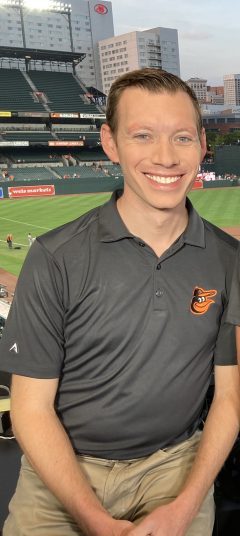
Kevin Brown, in the Orioles broadcast booth at Camden Yards. He’s said to be returning 11 August—the Orioles’ administration must have felt the heavy heat when the suspension they won’t call a suspension went viral.

I had to look. On 23 July, which proves to have been Orioles announcer Kevin Brown’s last day on the television air, the Orioles won a second straight from their American League East rival Rays in Tampa Bay. They’ve won nine of thirteen since. So, at least, the Orioles icing Brown so witlessly didn’t affect the team on the field.

The Oriole ownership that thinks it was worth suspending Brown indefinitely for pointing out what was in the team’s own game notes guides—that the Orioles did better in the Rays’ stadium this year than they had over the previous two—had better not even think that nine out of thirteen means they can win no matter who’s doing the television play-by-play.

Because if they’re foolish enough to think that, the roasting they got from Gary Cohen, the lead broadcaster for the hapless Mets, whom the Orioles just spent a weekend sweeping (and out-scoring 19-6), may seem like a jacuzzi bath compared to what they’d invite then.

“That was really all he said,” Cohen said of Brown’s plain-fact, non-opinion description of the Orioles’ issues in Tropicana Field. Then, with Mets first base legend and co-colour analyst Keith Hernandez sitting to his right, as the Mets led the resurgent Cubs 5-1 in the bottom of the fourth Monday night, Cohen let the Orioles have it but good.

And for that, the Baltimore Orioles management decided to suspend Kevin Brown. Let me just say one thing to the Baltimore Orioles management. You draped yourself in humiliation when you fired Jon Miller, and you’re doing it again. And if you don’t want Kevin Brown, there are 29 other teams who do.

It’s a horrendous decision by the Orioles. I don’t know what they were thinking. But they’ve gotten exactly the reaction that they deserve. And it’s just a shame, because the Orioles are playing so well, and now they’ve diverted attention from that, and now made themselves a laughingstock.

Cohen is hardly alone among baseball’s broadcast family. Some of them, and some of us writers, would say we don’t know if the Orioles’ administration was thinking. It wasn’t as though Cohen had failed to speak on behalf of telling it like it is on the air in the past. The Mets beat writer for The Athletic, Tim Britton, remembered a 2019 interview in which Cohen couldn’t understand why every baseball organisation doesn’t believe in letting its broadcasters speak the truth.

“Many believe that in not telling the truth, that you’re doing a service to the organization, and the fact of the matter is it’s just not true,” Cohen said then. “Because if everything is great and everything is sunshine, then when things really are great, there’s no differentiation.”

Part of being a baseball fan is experiencing the highs and lows as they happen and understanding them for what they are. I think that’s what the Mets have always allowed their announcers to do. There’s always a line to tread, there’s always a path that would be the wrong one to go down, but if you do your job correctly, then you know where those lines are and you express yourself in a well-informed way. Then everybody wins.

If only Cohen had been around for a time when it wasn’t quite true with the Mets. When an ancient Mets regime trashed and then sent Hall of Fame pitcher Tom Seaver out of town in the notorious “Saturday Night Massacre” in 1978, the Mets ordered cameras not to show dwindling Shea Stadium crowds, or fabled “Sign Man” Karl Ehrhardt holding up his once-fabled WELCOME TO GRANT’S TOMB placard.

They also didn’t let their announcing team speak of it readily, much the way the Orioles today are known to object when certain former players are mentioned on broadcasts. Finally, the original Mets broadcast team of Lindsay Nelson, Bob Murphy, and Ralph Kiner broker up when Nelson—fed up with both the censorship and the dismantled Mets’ losing ways—took a hike.

Cohen may not remember either that a later Mets administration decided they’d had it with  Tim McCarver’s analytical candor, too, telling him to take a hike in favour of Seaver himself (who’d been a Yankee TV analyst for five years), whom the Mets believed was more likely to be a “team player.” (Read: Shill.) But he was hardly alone in roasting the Orioles, merely the one who went absolutely viral first and most when Awful Announcing‘s scoop on the suspension hit social media running.

“Somebody didn’t like the facts very much,” said the Red Sox’s lead television announcer, Dave O’Brien, calling the Brown suspension “a fiasco, that that’s allowed to happen. And I think every announcer in the league feels the same way . . . I thought it was a joke, initially, when I read it.”

“It’s amazing to me,” said Yankee broadcaster Suzyn Waldman, while the Yankees met the White Sox in Chicago. “How can you do your job if you can’t tell the truth? But he didn’t even say anything negative. He was extolling how good they are, because look what they’ve done this year, and in the past they didn’t do it. So I don’t understand. When I saw the clip, I was waiting for him to say something horrible. And it was not.”

“[Brown] continuously provides an example worth emulating & sets a high bar,” Xtweeted Royals play-by-play announcer Jake Eisenberg. “That not only goes for on the air, but also off the air. This situation is ridiculous, and that’s an understatement at best.”

The Orioles’ administration may have felt higher-temperature heat than a Las Vegas summer over the disgrace. The Athletic has Xtweeted “sources with knowledge” have told their reporter Britt Ghiroli that Brown will return on 11 August. When Ghiroli herself reached the Orioles for comment, the team declined and “a spokesperson” for co-owner John Angelos even said “there was no suspension”—but refused to answer her followup questions.

“Who cares what they called it?” she fumed. “We all know what it is.” Indeed we do. We also know it exposed the Oriole brass as censorious bird brains.

Censorship, Oriole style

Kevin Brown

Kevin Brown, discoursing on the Orioles’ previous futility against the Rays in Tampa Bay versus their success there this year through that evening . . . the discourse that got him suspended indefinitely, as things turned out. (NASN screen capture.)

Apparently, all you have to do is speak the truth on the air, and if the baseball team whose games you announce or analyse is owned by people for whom the truth is inconvenient, you can be suspended indefinitely. The MASN’s lead Orioles play-by-play man, Kevin Brown (not the former major league pitcher), has learned the hard way.

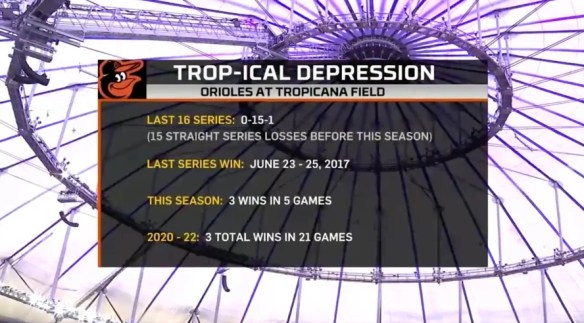
All Brown did was say on the air that the Orioles—the American League’s most pleasant surprise of the year, leading the East—had won more games against the Rays in Tampa Bay this year (three out of five) than over the previous three. (Three of 21.) It was the plain truth. No insult intended. It wasn’t even an opinion.

But Brown seems to have been suspended indefinitely since late July, when he made the foregoing observation advancing a series finale between the two teams in Tropicana Field. The jarring scoop belonged to Awful Announcing Monday:

[We’ve] confirmed through multiple sources familiar with the situation that Brown has been suspended indefinitely, that it came after the Rays series, that he only wound up on the radio for the Phillies’ series thanks to another controversy about a different announcer’s apparel, and that the comment here seems to be what’s at issue. The Orioles dispute an official suspension took place, but none the less Brown has been off television since July 26th.

The online outrage only begins with The Cooperstown Casebook author Jay Jaffe: “OMG this is the weakest sauce imaginable by the Orioles.” But this is hardly the first time the owning Angeloses have spread this kind of weak sauce.

The factual graphic behind Brown’s fateful observation.

In 1997, Peter Angelos all but fired his lead radio announcer Jon Miller. The reasons included speculation that Miller’s weekend gig as a lead ESPN baseball announcer (with Hall of Fame second baseman turned colour commentator Joe Morgan) rankled both the Orioles and their radio flagship WBAL. Until they didn’t.

“Orioles officials,” wrote the Washington Post‘s Mark Maske, “said Angelos disliked Miller’s willingness to criticize the team harshly on the air when it wasn’t playing well.” Oops.

Miller, of course, went on to become the voice of the Giants in San Francisco. He probably saw oceans of downs and oceans of ups calling Giants games for what are now 26 years. He’s also accepted the Frick Award as a Hall of Fame broadcaster, in the same season the Giants won the first of three World Series titles in the span of five years.

Nobody seemed to want Miller fired when two Diamondbacks errors but three baserunning mistakes by then-Giants outfielder Ruben Rivera, ending with Rivera thrown out at the plate, prompted Miller to pronounce, “That was the worst baserunning in the history of the game!”

Whether Brown ends up staying with the Orioles on the air or whether he finds himself compelled to move onward (if he does, there should be no shortage of teams ready and willing to bring him to their mikes), this gives a disgraceful look to a baseball team who has gone from notorious tanking to AL East leadership and become must-see television approaching the hard stretch drive.

The Angeloses are hardly pioneers in baseball censorship. When the Yankees ended 1966 in dead last place (this was quite before divisional play), another Hall of Fame voice, Red Barber, committed his own such heinous crime—denied a camera pan of a near-empty Yankee Stadium, Barber intoned, “I don’t know what the paid attendance is today, but whatever it is, it is the smallest crowd in the history of Yankee Stadium, and this crowd’s the story, not the game.”

Oops. Among the reported mere 413 in the stands was Michael Burke, appointed by CBS (who’d bought the Yankees controversially in 1964) to oversee the Yankees. When the season ended officially, so ended Barber’s decade-plus Yankee tenure. The Ole Redhead elected to retire from there, but his purge was as wrong then as is Brown’s suspension now.

“Speak what you perceive as the truth,” said the late Hall of Fame broadcaster Tim McCarver. “If that’s outspokenness, that’s fine.” That was said after the Mets dumped him as a television analyst in 1998, proclaiming outspokenness wasn’t all that fine—and that Hall of Fame pitcher/franchise icon Tom Seaver, a Yankee broadcaster for five years, would do better as a “team player.”

Brown wasn’t even being outspoken, and he’s been put in the deep freeze for who knows how long. It’s difficult not to imagine the Angeloses answering “Honesty is the best policy” with “That’s what you think.”