ALCS Game One: Miller time for the Mariners

Bryce Miller, George Springer

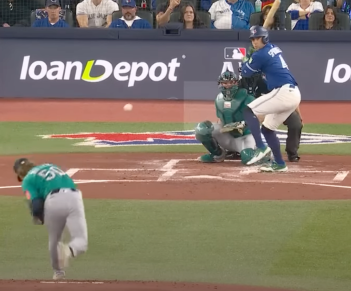
George Springer is about to demolish Bryce Miller’s first pitch of ALCS Game One. It was the only score Miller would allow over six otherwise spotless innings on short enough rest. (Fox Sports television capture.)

At the split second George Springer’s bat connected with Bryce Miller’s first pitch of this year’s American League Championship Series, you could be forgiven if you heard Mariners fans groaning. When the ball banged the Canada Dry sign above the right center field bullpen, you might have heard the groaning turn to moaning.

One pitch, one swing, the 21st postseason bomb of Springer’s career, and only the third leadoff bomb in League Championship Series history since pitch counting began in 1988, according to The Athletic‘s Jayson Stark. Just like that, the Blue Jays took a lead.

And Springer’s opposite-field smash on a fastball away, sending him past Hall of Famer Derek Jeter for fifth place on the all-time postseason bomb list, wasn’t the only reason Mariners fans groaned and moaned.

In the top of that first inning, they groaned, moaned, and fumed when the Mariners didn’t call for a review of that play at the plate on which Cal Raleigh (one-out hit, advancing to third on followup hit) was tagged out when it appeared he’d managed to get his foot on the plate through the legs of Jays catcher Alejandro Kirk. But television replays showed Raleigh’s foot landed a second or two after Kirk tagged his torso.

Were the Mariners unduly alarmed after Springer sprang?

Not after Miller wriggled out of further trouble in the form of a pair of walks courtesy of inducing a pair of line drive outs and a short fly out.

Not after Miller matched Jays starter Kevin Gausman point for point, dollar for dollar, from that point forward, until Raleigh atoned for missing the first inning score by squaring Gausman up, with two out in the top of the sixth, and driving a 2-2 service a little further than Springer’s traveled, about five rows up into the bleachers above that bullpen.

Not after Jays manager John Schneider decided that a followup walk to Julio Rodriguez should be he end of Gausman’s evening before he might incur jn any further damage. That came soon enough when Gausman’s relief Brendon Little wild-pitched Rodriguez to second and surrendered Jorge Polanco’s sharp opposite-field line RBI single to left to crack the one-all tie.

Not after Randy Arozarena wrung a leadoff walk out of Jays reliever Seranthony Dominguez in the top of the eighth, stole second and third while Raleigh suffered a called strikeout, then—after another walk to Rodriguez—came home on another Polanco steak, this time a spanker bouncing three times through the infield and a few more into right.

“I just choked up and wasn’t trying to do too much,” said Raleigh postgame about his bullpen-clearing blast. “I was just trying to get bat on ball and really put something in play, maybe find a hole. I didn’t want to punch out again.” He didn’t seem to mind putting that ball out of reach, out of play, and out of sight, either.

Kevin Gausman, Cal Raleigh

Raleigh is about to smoke Gausman’s splitter for a trip above the right field bullpen . . .

Aside from all that, it was Miller time. For a guy pitching on three days’ rest for the first time in his major league life. For six inning of one-run, two-hit baseball that including getting rid of seventeen of his final nineteen batters. He needed a little comfort from Raleigh at the mound while navigating his way out of that first-inning fire, but that was enough.

Miller went two innings longer than Mariners manager Dan Wilson expected him to go on short rest, only nobody told Miller until he was done for the night.

“They didn’t tell me anything, any plan,” said the lad who threw 27 pitches in the first inning and 49 the rest of his outing. “So I was going out there just letting it rip until they came out and got me.”

“That was incredible from him,” said Mariners reliever Matt Brash (now, there’s a classic name for a relief pitcher), who was one of three Mariners bullpen bulls along with Gabe Speier and Andres Munoz to pitch perfect innings once Miller’s time expired for the evening. Thus the 3-1 Mariners win Sunday night.

“I knew this was the biggest start of my career so far,” said Miller, whom one report revealed stood in Rogers Centre’s center field’s farthest location from the plate staring that direction to help focus, “and I just wanted to get out there and mentally kind of get in a zone and visualize having success on the mound.”

Miller’s season wasn’t always so simple. After a 2.94 ERA in 2004, he ran into elbow inflammation twice and an inflated ERA. He didn’t find himself on his horse fully until some time in August. Then he gave hints of his postseason potential in ALDS Game Four, pitching 4.1 shutout innings against the Tigers.

Remember: These Blue Jays are the ones who demolished the Yankees 34 runs worth in their American League division series and made the Bronx Bombers resemble the Bronx Broken. The Mariners got rid of 23 of the final 24 Jays hitters while they were at it. All of a sudden the Joltin’ Jays didn’t look all that intimidating despite Springer’s first-pitch flog.

Remember, too: These Mariners played fifteen innings Saturday to come out of their ALDS alive and reasonably well and leaving the Tigers for dead. They had to fly cross country and into Canada and endure a four-hour departure delay when mechanical issues forced their airline to get another plane up to Seattle from Los Angeles. They didn’t even have time for a Rogers Centre workout before ALCS Game One.

I’m not sure I’d recommend this as a continuous practise, but it seems as though now and then a team that should have been suffering exhaustion can turn one of the league’s howitzer corps to one side for one night. Now we’ll get to see if the Mariners can manhandle the Jays on a proper night’s sleep and with a proper pre-game workout.

We may even get to see Miller on the mound in a game that would mean the pennant for the Mariners if they win. The lad’s already proving that unthinkable isn’t necessarily impossible.

The valiant but vanquished Mariners

Jeremy Peña

The Mariners fought the Astros off long and luminously in their ALDS Game Three, but Astros rookie Jeremy Peña brought the fight near to the end with his eighteen-inning, scoreless tie-breaking bomb that proved the end of the Mariners’ season.

Maybe nobody really expected the Mariners to get to their first postseason since the wake of the 9/11 atrocities in the first place. Maybe nobody really expected them to stay there when they up and bumped the Blue Jays to one side in a wild card series.

But they did.

Maybe nobody expected them to survive against the American League West ogres from Houston. Even if they made a reasonable enough-all-things-considered 7-12 showing against them on the regular season. Even if they’d beaten the Astros two out of three in two first-half sets.

They didn’t.

But a three-game sweep out of their division series still stings, no matter how valiant the Mariners effort was. Even if the series was as close as a closed clothespin, the Mariners compelling the Astros to win the first two games by comeback.

Mariners fans and just about everyone else couldn’t possibly have been surprised that Yordan Alvarez was the bombardier who flattened the Mariners in Games One and Two, first with that jolting three-run homer to turn a 7-5 lead into an 8-7 Game One win in the bottom of the ninth, then with a just-as-jolting two-run homer in the Game Two bottom of the sixth.

But going long distance two games’ worth in Game Three to see it end via Astro rookie Jeremy Peña’s leadoff bomb off Penn Murfee, after Luis (Rock-a-Bye) Garcia held them at bay over four relief innings with only one measurable threat against him, had to sting soul deep.

After a marathon exhibition of run prevention—the 42 combined strikeouts (20 by Astro batters, 22 by Mariners batters) set a postseason record; the Astros going 11-for-63 and the Mariners going 7-for-60 all night, it couldn’t feel otherwise.

“It’s kind of what we’re accustomed to, playing those tight games and finding a way,” said Mariners manager Scott Servais postgame Saturday night. “I mean, that is a big league game, with the pitching and defense that was fired out there. We just weren’t able to put anything together.”

“This at-bat,” Pena said, after his homer broke the foot-thick ice at last, “was not going to be possible if our pitching staff didn’t keep us in the ballgame. They dominated all game. Their pitching staff dominated all game.”

Sometimes you had to think what was wrong with these Astros—if they were going to prevail anyway against the Seattle upstarts, how the hell could they not have just done it in the regulation nine? Didn’t they want to avoid wheeling Justin Verlander to the mound in a Game Four if they could help it?

Now, of course, Verlander and Framber Valdez can have a little extra rest/rejuvenate time before opening the Astros’ unprecedented-in-the-divisional-play-era sixth consecutive American League Championship Series. They won’t know their opponent until things are settled between the Guardians and the Yankees in New York Monday night.

But how could these Astros, whose stocks in trade include becoming the biggest pains in the ass in the AL West with runners in scoring position, do worse with RISP (0-for-11) than the Mariners (0-for-8) did all night long?

How could Kyle Tucker and Jose Altuve hitting back-to-back one-out singles and pulling off a double-steal in the top of the second end with Mariners starting pitcher George Kirby striking Chas McCormick out to strand them?

How could Kirby plunk two Astros in the top of the third—Alvarez leading off, Trey Mancini to set up ducks on the pond—and escape with his life after McCormick’s deep fly to center was run down and hauled down by Julio Rodríguez?

How could the Astros plant first and second on Kirby with one out in the top of the seventh—and strand them by way of Christian Vazquez flying out to center and Altuve striking out?

How did Mariners reliever (and erstwhile Rays bullpen bull) Diego Castillo slither out of second and third and one out in the top of the ninth by striking Vazquez and Altuve out back-to-back swinging?

How did six Mariners out of the bullpen keep the Astros hitless from the tenth through the fifteenth, with their only baserunner of the span coming when Paul Sewald plunked McCormick to open the the top of the twelfth?

And how did Murfee save Matthew Boyd’s bones midway through the top of the sixteenth, after Boyd surrendered a base hit (Alex Bregman) and a walk (Kyle Tucker) following a leadoff fly out? Murfee got Yuli Gurriel to line out to fairly deep right center and Aledmys Diaz to pop out beyond first base in foul ground.

The longer this one went, the more improbably it continued to look. And not one muscle in T-Mobile Park dared obey any Mariner fans’ thoughts of making for the exits.

The Mariners proved just as good at leaving runners for dead as the Astros until the eighteenth. They stranded Cal Raleigh on third in the second, Ty France on first in the third, J.P. Crawford on first in the fifth, Rodríguez on second (a two-out double) in the eighth, Eugenio Suarez (leadoff single) and Mitch Haniger (one-out plunk) in the ninth, France (two-out walk, then stealing second) on second in the thirteenth, Haniger on first in the fourteenth, and Carlos Santana (two-out single; to second on a wild pitch) on second in the seventeenth.

This game threatened to end as a classic case of long-term, non-constructive abandonment against both side. (For the first time in his major league life Altuve took an 0-for-8 collar, big enough to fit Secretariat.) It only began with Astros starter Lance McCullers, Jr. pitching two-hit, six-inning shutout ball, and Mariners rook Kirby plus his defense keeping the Astros at bay for seven innings despite six hits and five walks.

Raleigh, the Mariners catcher, played all eighteen innings with a thumb fracture and a torn ligament or two that he’s dealth with for over a month. Some call it toughness. Others might call it foolishness.

He had a Clete Boyer kind of regular season at the plate: 27 home runs (leading all Show catchers) plus 20 doubles but a .284 on-base percentage. He clinched the Mariners’ postseason trip in the first place with a game-winning home run; he scored what proved the game-winning run that pushed the Blue Jays out of the postseason.

The league-average Mariners backstop who handled his pitchers well enough to help them deliver a collective 3.30 ERA on the season struck out three times in six plate appearances Saturday night, batted only once with a man in scoring position, in the bottom of the ninth, and hit into a force out.

At last Raleigh will be able to visit a hand specialist and get that paw repaired. Who knows what further damage catching two games’ worth without a break might have done? The spirit may be willing but more often than not all or part of the body can be defiant. Which reminds me that Rodríguez’s late-season back injury needs to be pondered more thoroughly, too—did he feel lingering after-effects the rest of the way?

But Peña turned on Murfee’s full-count fastball almost down the central pipe and sent it over the left center field fence and turned all eyes upon him. Peña, the rookie who slotted in at shortstop for the departed Carlos Correa. And, earned no less than his manager Dusty Baker’s lasting respect.

“You could tell by his brightness in his eyes and his alertness on the field,” Baker said postgame, “that he wasn’t scared and he wasn’t fazed by this. Boy, he’s been a godsend to us, especially since we lost Carlos, because this could have been a disastrous situation had he not performed the way he has.”

It proved a disastrous situation for the Mariners in the end. They’re likely to remain competitive with a few patches to sew and gaps to fill during their off-season. But nobody can accuse them of going down without one of the grandest and longest fights in postseason history, either. Be proud, Seattle. There was honour to spare in this defeat.