On the other hand . . .

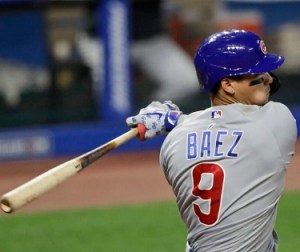
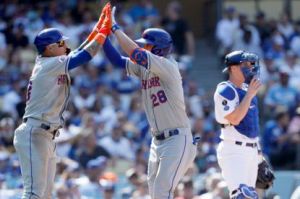
Javier Baez, J.D. Davis

The Good Javy (left, after scoring on J.D. Davis’s [center] two-run bomb in the seventh) returned from the injured list and doubled down against the Dodgers Sunday afternoon.

This time, J.D. Davis didn’t shrink. Either with one man on or with the bases loaded.

This time, too, trade deadline addition Javier Baez came off the injured list, swung like a pro, scored like a pro, and doubled down, literally. He put a small shot of rocket fuel into a team looking like the living dead too often this month.

This time, the Mets may have left eight men on but they also sent seven runs across the plate. They’ve now done that only twice since 21 July. And, this time, too, they didn’t let the Dodgers take a single lead all Sunday long.

The bad news is that Sunday’s 7-2 win to stop the Dodgers’ winning streak at nine probably won’t be enough to salvage the Mets’ 2021. They’d need a finish from here that you can describe politely as miraculous to do that. Losing eleven games in the standings this 6-15 doesn’t leave room for miracles.

But let’s worry about that later. Right now, let’s savour Baez cashing in Brandon Nimmo (leadoff full-count walk, on which he sprinted up the line to first) with one out, sending one ricocheting off the left center field fence in the top of the first, with Nimmo gunning home all the way from first.

Let’s savour Davis shooting one the other way up the right field line to send Baez home, and Jonathan Villar with two outs punching a quail into short center, Davis scoring when Cody Bellinger’s throw in brought Dodger catcher Will Smith well out in front of the plate.

Let’s savour Villar trying to take second on the throw in and Smith throwing wild enough to let Villar have third on the house, before a foul out caught by Dodger starter David Price ended the inning at three for the Mets.

Let’s savour the Dodgers getting only a pair back in the fourth, when Bellinger reached Mets starter Marcus Stroman for a two-out, two-run line single to right, making Stroman pay for walking the bases loaded ahead of Bellinger—whose season has been compromised badly by a couple of nagging leg issues and not having been able to recuperate properly from off-season shoulder surgery.

Let’s savour the Mets catching Bellinger in an inning-ending rundown out, catcher to short, Baez playing his old position in Francisco Lindor’s absence, feinting a throw toward third to keep A.J. Pollock from even thinking about a score before tagging Bellinger as he tried turning back toward second.

Let’s savour Stroman managing to keep the Dodgers at bay long enough for Baez to hustle a single into a double after two swift outs in the top of the seventh and Davis, right behind him, hitting the first pitch he saw from Dodger reliever Phil Bickford on a line over the left field fence.

Let’s savour the Mets loading the pads with one out in the top of the ninth off Dodger reclamation project Shane Greene—Nimmo’s base hit to right, Pete Alonso taking another plunk for the team, then Baez taking another plunk for the team.

And let’s savour Davis yet again, a day after he’d swung through a Max Scherzer meatball with the bases loaded for a strikeout. This time, Davis recovered promptly from falling into an immediate 0-2 hole. He wrung his way from there to a walk on four straight balls, resisting the temptation to pull the trigger on a sinker that sunk just a little too far below the strike zone floor for ball four and Nimmo trotting home.

But let’s not fool ourselves. These Mets may have a few energy reserves left, but there’s just a little too much still missing to give them much more than prayers. On paper, they’re only seven games out of first in the National League East. On the field and at the plate, Sunday’s showing is what they’ll need only every day from now on, practically, to have the prayer of even a prayer.

It may require what they may not have the rest of the way.

So just spend today thinking about Baez maybe playing his way into an extension that would keep him around the keystone with Lindor, when Lindor returns days from now.

Think about the Good Javy re-joining Lindor to turn the second base region into the swamp where base hits get sunk into ground outs. Lindor may have struggled at the plate this year but he remained a shortstop Electrolux. (Thirteen defensive runs above the league average shortstop before he was injured.)

Think about the Good Javy who turns the plate into his personal game-changing playpen, providing an energy jolt through this team that not even Con Edison could deliver, just the way he did Sunday afternoon.

Don’t think about the Bad Javy who chases pitches that deserve to escape, the one who tries a little too often to hit eight-run homers on pitches that provide the power just by the bat giving them a kiss. Not until or unless he shows up again, that is.

Think about the Good Javy outweighing the Bad Javy enough to convince Mets owner Steve Cohen it’ll be worth it to keep him around and use him as the perfect out to purge Robinson Cano, who’s due back for 2022.

Don’t say the Mets “will eat” Cano’s money for the final two years of his deal. That meal already went through the digestive tract and out the other end. They accepted him as part of the deal when they wanted relief pitcher Edwin Diaz that badly from the Mariners. Once his current suspension ends, Cano’s going to get paid whether or not he suits up for the Mets again.

Cano isn’t the defensive second baseman he used to be. He hasn’t been the hitter he once was since 2016, either. That’s something to ponder especially if wisdom finally prevails otherwise and the designated hitter finally becomes universal to stay.

The Mets may not be that inclined to have back a 38-year-old millstone drydocked an entire season over actual/alleged performance-enhancing substances, his second such suspension in four years. The Good Javy showed up in time Sunday to start helping make that decision so simple for the Mets that even Joe Biden could make it without screwing the proverbial pooch into a blood bath.

Gone, Cubs, gone

Anthony Rizzo, Kris Bryant

That was then: Anthony Rizzo clutching and hoisting the off-balance throw Kris Bryant (17) made to end the 2016 World Series as world champions. This is now: They’re not Cubs anymore.

I called it the Code Blue Series when the contestants were confirmed. One team that hadn’t won the World Series since the premieres of cellophane, the Geiger counter, and the Model T Ford. The other, a team that hadn’t won the Series since the threshold of the Berlin Airlift.

“I’m sleeping with this thing tonight,” crowed Anthony Rizzo, speaking post-game, about the double play ball he caught on the relay to start Chicago’s post-National League Championship Series parties. “Are you kidding me?”

The same Rizzo who clung to the dugout rail in Game Seven of that surreal 2016 World Series, admitting to teammate and eventual manager David Ross that he was on the brink of his nineteenth nervous breakdown.

“I can’t control myself right now. I’m trying my best,” Rizzo said.

“It’s understandably so, buddy,” Ross replied, with a very knowing smile. He’d been there, done that, with the 2013 Red Sox.

“I’m emotional,” Rizzo admitted.

“I hear ya,” Grandpa Rossy replied.

“I’m an emotional wreck.”

“Well, it’s only going to get worse,” Ross advised. “Just continue to breathe. That’s all you can do, buddy. It’s only gonna get worse . . . Wait until the ninth with this three-run lead.”

Once upon a time, possibly thanks to Chicago newspaper legend Mike Royko, the maxim was that the teams with the most ex-Cubs lost. That was then, this was the 2016 Series: The Cubs—the team with the fewest ex-Cubs and the most ex-Red Sox—won. After a couple of that-almost-figures hair-raisers, none raising more hair than Game Seven.

Now, third baseman Kris Bryant—subject to the most trade rumours the past two years—is traded to the National League West-surprising Giants. Shortstop Javy Baez is traded to the National League East-leading-almost-by-default Mets, where he’ll gladly play second base for the chance to hold the keystone with his buddy Francisco Lindor at short. And first baseman Rizzo has become a Yankee.

The 2016 core is gone, Cubs, gone. Four men from that team now remain.

Ross retired as a player after that Series triumph and has managed them since last season, having days enough now when he must think Lucifer’s practical jokers have made him a too-frequent target. Right fielder Jason Heyward’s stellar defense once atoned for his feeble bat, but he isn’t quite the defender he used to be even if he’s still a shade above the league average for run prevention. Catcher Willson Contreras remains a mainstay and leads the team with his 3.2 wins above replacement-level.

And Kyle Hendricks, who pitched magnficently enough in the 2016 Series, leads this year’s Cub rotation with an ERA two ticks from four despite his twelve credited wins.

The Cubs approached Friday’s trade deadline all-in on selling while the selling was good, because their National League Central chances were anything but and the last of the true core was due to hit the open market. And the team administration has a lot to atone for, for having failed to fortify the team viably in the seasons to follow the 2016 heights.

It’s still too telling that the single most fun moment in Cubs baseball this season came from Rizzo, the first baseman taking the mound on the wrong end of a blowout, striking out his Braves buddy Freddie Freeman to laughs all around the park—especially between those two.

If the Dodgers hadn’t swept in and swept the Padres to one side in the Max Scherzer lottery, the Great Cub Fire Sale might have dominated the proceedings entirely.

But it’s hard not to think about that World Series now that Bryant, Rizzo, and Baez are gone at last. Especially after Rizzo made an almost immediate impression with his new team Friday night. (Yankee announcer Michael Kay called Rizzo “the linch pin” of the 2016 Cubs.) He broke a scoreless tie between the Yankees and the Marlins by sending a 1-0 hanging cutter into the second deck behind right field in the top of the sixth. (The Yankees went on to win, 3-1.)

It’s hard not to remember Dexter Fowler’s eighth-inning home run off then-Indians relief ace Andrew Miller in Game Four. Making Fowler the first Cub to hit a World Series homer in Wrigley since Chuck Klein—in 1935. And, making him the first African-American Cub to hit a World Series homer ever.

It’s hard not to remember Bryant—with the Indians six innings from the Promised Land— parking a 1-1 pitch into the left center field bleachers off then-Indian Trevor Bauer to start turning the mostly quiet Confines crowd on the Chicago leg of the Series into a nuclear meltdown of joy in Game Five.

It’s hard not to remember Rizzo and eventual Series MVP Ben Zobrist scoring in the first in Game Six, after Indians outfielders Tyler Naquin and Lonnie Chisenhall misread and misplayed Addison Russell’s shuttlecock fly to right center. Or, after the Cubs loaded the bases to push Indians starter Josh Tomlin out, Indians reliever Dan Otero feeding Russell grand salami with mustard.

It’s hard not to remember Jake Arrieta pitching to Naquin with the bases loaded and two out in the bottom of the fourth, same game, and striking Naquin out on one of the nastiest divers Arrieta ever threw in his life.

It’s hard not to remember Game Seven, especially. When Ross had to atone for a horrible throwing error past Rizzo one inning by smashing a one-out homer the next. When the late rain delay prompted Heyward’s clubhouse pep speech.

When Rizzo took the free pass in the top of the tenth, took third on an RBI double, and scored after another intentional walk and a base hit to left—the base hit being Miguel Montero’s second-most important bases-loaded hit for the Cubs that postseason.

When Bryant picked off Michael Martinez’s short grounder on the dead run, with two out and a run in to close the Cub lead to a single run, then threw a little off balance and herky-jerky at that to first—and Rizzo snapped the ball in his mitt as dearly as he might have clung to the Hope Diamond after a daring heist.

Russell forced himself off the Cubs and out of the Show entirely in due course, after the sick case of his abuse of his wife exploded into headlines and forced his suspension. He played in the Korean Baseball Organisation last year and plays in the Mexican League this year.

Montero talked his way out of Chicago. First, he complained about his loss of 2016 postseason playing time to Ross and Willson Contreras behind the plate. Then, in 2017, he was gone for good after blaming Arrieta publicly for the Nats running wild on his arm on the bases in a June game. Two subsequent hiccups of comeback bids with the Blue Jays and the Nationals—retired.

Zobrist, who came to the 2016 Cubs after winning the 2015 Series with the Royals—a down 2017, a comeback 2018, retired after 2019. Now, he’s undergoing a painfully public divorce in which his wife’s accused of having an affair with the minister they engaged for marital counseling in the first place.

Arrieta—allowed to walk as a free agent after a 2017 that began his still-ongoing decline phase. Jon Lester, who somehow got past his throwing issues to first base and stood tall enough when it counted—now a National-turned-Cardinal. John Lackey, pitching for his third different Series winner—retired after fifteen seasons and a down 2017. Aroldis Chapman, the howitzer relief pitcher but a domestic abuser himself—a Yankee since 2017.

This week? The Cubs’ place in the race was probably sealed for the season when they lost eleven straight from 25 June through 6 July, but seven of the eight players they moved by Friday’s deadline also stand to hit the open market after the season. Resurgent relief pitcher Craig Kimbrel—dealt to the crosstown White Sox and right back into the races—has a 2022 option.

Maybe the real end of this generation of Cub contenders came in 2018, during the second half of which they lost 22 games in which they scored one or none. Including the humiliations of scoring a measly two runs in back-to-back losses that cost them the NL Central title and the NL wild card in one thirtysomething-hour period.

Maybe it was sealed once and for all by 2019, when they lost a pair of humiliating series in the last two regular season weekends and, as ESPN writer Jesse Rogers observed, the Joe Maddon era ended when the skipper “wasn’t able to out-manage the mistakes the front office saddled him with.”

“The Ricketts family had cut back on payroll spending while continuing to use Wrigleyville as a private cash machine,” writes the redoubtable veteran scribe Rick Morrissey of the Chicago Sun-Times. “The franchise didn’t keep up with other contenders in terms of on-field talent. It settled for being very good instead of great. The idea—always—is to win. Cubs fans got that, which is why they were irritated when the club didn’t get a whiff of the World Series again.”

Maybe that was what irritated the remake/remodel/re-conquer mastermind Theo Epstein enough at last to swap the Cubs’ front office for a gig in the commissioner’s office, where he now works helping to get baseball back to where it once belonged, a balance between pitching and hitting. He won’t have his hands tied by ownership caprice anymore. We think.

It stung when Ross kept Bryzzo out of the Thursday lineup at home, denying them a final appearance before the Wrigley faithful. He said Rizzo already had the day off pre-planned and was concerned about giving Bryant’s legs a rest. Cub Country didn’t need anyone to say maybe the front office handed Grandpa Rossy an order the better to keep the deals to come from being wrecked.

We saw Bryant in tears on his cell phone in the Cubs dugout at Nationals Park Friday, receiving the news he was going west. We saw Rizzo taking his young family to walk the Wrigley Field grounds one more time the day before, before he went east. Those sights will linger for Cub Country almost as vividly as Bryan’s off balance pick and throw of Martinez’s grounder to Rizzo to finish 2016 will. (This is gonna be a tough play, Bryant—the Cubs! Win the World Series! hollered announcer Joe Buck.)

President of baseball operations Jed Hoyer says the deals helped the Cubs duck a complete rebuild thanks to the youth the deals bring back. “Was it emotionally difficult? Yes,” he said to Rogers. “Do I think it was absolutely the right thing for the organization? I do.”

Nature of the beast. Hoyer was only too well aware of other teams going all the way to the end of their team control only to require years of rebuilding. Teams like the Phillies, the Tigers, and the Giants, the last of whom have begun making noise that’ll be amplified a bit with Bryant on board.

“They ran to the end of the cliff and fell off and they had to rebuild,” he continued. “We were willing to go to that point if this was a winning team this year, but we weren’t, so with that we were able to speed that process up dramatically.”

But going from “Go, Cubs, Go!” to gone, Cubs, gone, still stings. Even if we’ll always have 2016.

Mistakes don’t equal murder

Will Craig, Javier Baez

Will Craig, after taking the errant throw pulling him down the first base line and into unexpected infamy . . .

“I guess I’m going to be on the blooper reels for the rest of my life,” said Pirates first baseman Will Craig last Friday, before the team’s game with the Rockies was postponed by rain. And, the day after Cubs shortstop Javier Baez deked him and his into a third-inning rundown that looked like the year’s funniest television moment in the moment.

It wasn’t all that funny in retrospect when Joe and Jane Fan plus Joke and Jerk Sportswriter/Talk Show Commentator started painting Craig as though he flunked the casting calls for Howard the Duck.

“It all boils down to me losing my brain for a second,” the 26-year-old Craig continued. “I take full responsibility for it and now will just try to keep moving forward. I know I’m a good defensive player and I can do a lot of good things on that side of the ball.”

The snarky side might suggest Craig and the Pirates who collaborated with him on the season’s most surrealistically slapstick play thus far handled things like men who’d learned their infield basics from the 1962 Mets.

Observing his coming place on eternity’s blooper reels indicates Craig—who won a Triple-A Gold Glove during his minor league life—has at least the sense of humour those ancient Mets needed just to get through that first calamitous season without losing their marble. Singular.

Maybe, too, the fact that neither the Pirates nor the Rockies look destined to reach this year’s postseason works in Craig’s favour. If he’d suffered last Thursday’s mishap in a postseason game, especially a World Series game, Joe, Jane, Joke, and Jerk alike would do everything in their power to make the rest of his baseball life—and maybe his life life—a living death.

Baez batted with two out and Cubs catcher Willson Contreras aboard in the top of the third, with the Cubs ahead 1-0. Baez whacked a sharp ground ball to Pirates third baseman Erik Gonzalez. He picked the ball cleanly. Then, he threw to first well enough off line to pull Craig forward, several feet down the line and in front of the pillow.

Craig had only to tag Baez or touch first for inning over. Then Baez got cute. Enough to break Craig’s concentration and prior knowledge for just long enough.

With about three feet between himself and Craig, he hit the brakes and went about-face back toward the plate, with Craig chasing him down the line instead of thinking about just tagging first. This is the kind of thinking lapse to which major league rookies are prone—even those with outstanding defensive reps in the minors, as Craig had—and into which even grizzled veterans can and do get caught sinking.

Contreras kept gunning it all the way home. Craig flipped to catcher Michael Perez. Contreras slid under the tag and Baez took off back to first. Perez threw past second baseman Adam Frazier looking to cover the base and Baez hit the afterburners for second.

I’m still trying to fathom how Craig ended up the sole goat on the play. Why does he wear the horns alone, when Gonzalez’s off-line throw started the whole megillah in the first place? Why does he wear the horns alone, when Perez threw well past first instead of bagging Baez there?

Baez basically had second on the house and the Cubs had a 2-0 lead. It became 3-0 when Cubs center fielder Ian Happ dumped a quail into short right center on which Baez with a good jump scored.

The official scoring on the play, according to Baseball-Reference, reads thus: Javier Baez—Reached on E3 (catch) (Ground Ball to Weak 3B to 3B); Contreras Scores/No RBI/unER; Baez out at 2B/Adv on E2 (throw).

Where were the Pirates to cover their rookie mate’s head and hide? Committing a pair of chargeable errors, that’s where. Where were the Pirates in the dugout to remind Craig in the immediate moment, step on first? Maybe they were as dumbstruck as everybody else in PNC Park when the thing began to unfurl. Maybe.

At least Craig’s manager had his post-game back. “He made a mistake and that’s it,” Pittsburgh manager Derek Shelton said. “You don’t option a guy [to the minors] because of the fact he made a mistake. We make mistakes in all realms of life. It just happened to be something nobody’s ever seen before.”

I didn’t mention the 1962 Mets just to be cute. Writing Can’t Anybody Here Play This Game? about that embryonic troupe, Jimmy Breslin swore the Mets infield lapsed almost likewise in the eighth inning of the first game of a doubleheader with the Cardinals.

Yes, I saw those Mets. They had Who the Hell was on First, What the Hell was on Second, You Didn’t Want To Know Who was on third, and You Didn’t Even Want To Think About It at shortstop. If it could have happened to anybody in the past, those Mets were them.

Breslin swore first baseman Marv Throneberry—the Original Mets’ original super-anti-hero—got so caught up trying to catch Cardinals third baseman Ken Boyer in a rundown (they had Boyer cold, according to Breslin) that he and fellow Met infielders Rod Kanehl and Charley Neal forgot about Hall of Famer Stan Musial on third—to Musial’s slack-jawed amazement, before The Man shot home with what proved the winning run.

That was Breslin’s story. I had to be a spoilsport and look it up. I looked at every game log involving the first games in every doubleheader between the Mets and the Cardinals in 1962. They played three doubleheaders against each other that year. That play never happened.

There ain’t much good you can write about us, but I don’t see where that gives people the right to make stuff up, lamented Hell’s Angels president Sonny Barger about their notoriety in the mid-to-late 1960s. All that bullshit, hell, ain’t the truth bad enough for ’em?

The ’62 Mets may not have pulled a mental mistake quite as grave as Craig’s, not against the Cardinals, anyway, but that didn’t give Breslin any more right to misremember than it gives Joe, Jane, Joke, and Jerk the right to make Craig resemble the most blundering bonehead on the block this side of . . .

No, we’re not going to exhume Bill Buckner’s corpse. Or John McNamara’s. Or those of Fred Merkle, Freddie Lindstrom, Ernie Lombardi, Mickey Owen, Johnny Pesky, Charlie Dressen, Ralph Branca, Casey Stengel, Gene Mauch, Willie Davis, Dick Williams, Curt Flood, Tommy Lasorda, or Donnie Moore.

We’re not going to haul the still-living among Tom Niedenfuer, Don Denkinger, Mitch Williams, Dusty Baker, Grady Little, Buck Showalter, Matt Weiters, the ’64 Phillies, the ’69 Cubs (and every Cub from the [Theodore] Roosevelt Administration through the Obama Administration), the ’78 Red Sox, the ’07 Mets, the ’17 Nationals, and maybe every St. Louis Brown who ever walked the face of the earth, before the court, either—kangaroo or otherwise.

They failed despite their efforts, often as not in baseball’s most broiling hours. They suffered momentary lapses of eyes, ears, and minds, too, and with a lot more at stake than what’ll yet prove a meaningless game between two National League bottom feeders.

Joe, Jane, Joke, and Jerk still don’t get what Thomas Boswell (whose pending retirement will still be a loss to baseball wisdom) wrote upon Moore’s 1989 suicide:

Nobody will ever be able to prove that the haunting memory of giving up Dave Henderson’s home run in the 1986 American League playoffs led Moore to commit suicide. Maybe, someday, we’ll learn about some other possible cause. [Alas, we did.–JK.] But right now, what some people are saying, and many are thinking, is that this “goat” business isn’t funny anymore . . .

The flaw in our attitude—perhaps it is even an American predisposition with Puritan roots—is to equate defeat with sin. The unspoken assumption is that those who lose must do so because of some moral flaw.

Rookies make mistakes. Well-seasoned veterans make mistakes, even if they’ll be misremembered by even the funniest and sharpest reporters. Even managers who win ten pennants and seven World Series (including five straight to open) in twelve years make mistakes—the way Hall of Famer Casey Stengel did, when he failed to plot his pitching to allow his Hall of Famer Whitey Ford three instead of two 1960 World Series starts.

Hall of Famer Bill Mazeroski and his Pirates still say thank you. Ford steamed quietly about it for years, until Stengel finally apologised to his old lefthander and earned Ford’s forgiveness. (Remember that when you think of a certain fan base’s unspoken motto, To err is human, to forgive must never be Yankee policy.)

Rookies and veterans alike also have things unexpected happen to them that turn routine plays into disasters you’d think made Hurricane Katrina seem like just a bathroom pipe break, the way Joe, Jane, Jerk, and Joke paint the poor souls.

Lucky for Craig that he does have that sense of humour about it. He’s already proven he’s made of better stuff than his critics and howlers, which doesn’t take all that much.

Dark are baseball’s video rooms

Javier Baez wants his and other players’ in-game television back.

The following program is not brought to you in living colour, on NBC or elsewhere around the Show. Javier Baez, Chicago Cubs shortstop, is not amused.

Baez is having less than an exemplary season at the plate as it is without being frustrated because a valuable tool he and most players use during games is denied them this year.

They can’t duck into the video room during games this season to review their prior plate appearances or pitching turns during games, spot mistakes, and adjust accordingly when they check in at the plate or on the mound next.

“To be honest, it sucks because I make my adjustments during the game,” Baez told ESPN writer Jesse Rogers Monday, and that was after he picked up three hits while his Cubs beat the St. Louis Cardinals, 5-1. “I watch my swing. I watch where the ball went, where the contact was. I’m mad. I’m really mad about that we don’t have it.”

Baez thinks, not without reason, that it simply wasn’t right for baseball’s government to put the entire Show on video restriction simply because of the malfeasance of two known teams at least. Think of Mom and Dad grounding all the kids because one broke into the liquor cabinet while the others were nowhere within two miles of the scene of the crime.

As Rogers writes, “In-game video was taken away this season in the wake of the Houston Astros sign-stealing scandal.” But the culprit wasn’t Astrogate alone.

Bad enough: the Astros either adjusted an existing camera illegally or installed another one just as illegally to enable off-field-based sign stealing. Nowhere near as bad, though enough Astro fans think otherwise, of course: the Boston Red Sox didn’t adjust or install cameras, but they did develop off-field-based sign-stealing reconnaissance by way of their existing video room.

Video rooms are in all ballparks behind both dugouts. The Rogue Sox Replay Room Reconnaissance Ring involved someone deciphering pitch signs on existing screens, then signaling a baserunner to send the sign to the hitter. The Rogue Sox exercised a sophisticated if sneaky variation of old-fashioned gamesmanship, but doing it by way of the video room was a major no-no.

Unlike the Astros’ extracurricular installations or adjustments, whichever they were, MLB itself installing the video rooms handed the Red Sox and every other team surrendering to similar temptations the keys to the liquor cabinet expecting they’d be good little boys and not even think about drinking unlawfully.

“[P]rotocols put in place during the coronavirus pandemic all but assured that there would be no way to monitor usage properly,” Rogers writes. “Now players can’t watch their at-bats until after games.”

The old-school old farts would remind you, of course, that once upon a time, in the dark days before technology advanced at warp speed to destroy Life As We Knew It When the Going Was Good, coaches and managers observed batters and pitchers and suggested adjustments accordingly, if not necessarily astutely, all by their own selves. With no subversive help from God or those subversive technocrats from General Electric, RCA, Bell & Howell, IBM, Wollensak, or others.

(Oops. Wollensak’s and other hand-held spyglasses and telescopes ended up in the hands of such off-field sign-stealing cheaters as the 1940 Detroit Tigers, the 1948 Cleveland Indians, and—especially—the 1951 New York Giants, to name a few.)

What brass balls on early 1950s Brooklyn Dodgers manager Charley Dressen, then. Dressen once helped Gil Hodges break out of a ferocious batting slump by commissioning a filmmaker to shoot hours of footage of the beleaguered first baseman at the plate. Then, he showed Hodges on extensive film the backward mis-step he’d take in the box—his back foot pulling himself and his swing off line—and gave a successful suggestion on how to keep that step from hurting his swing. Career saved.

The nerve of such people as the now-late Lou Brock. In the mid-1960s, he first took up the practise of filming enemy pitchers to study everything he could about their mound  tendencies and how he might exploit them for more efficient basepath crime. (I don’t want to be in your goddam movies, Brock!—Hall of Fame pitcher Don Drysdale.) From Kodak to Cooperstown.

The gall of such people as the late Hall of Famer Tony Gwynn. In the early-to-mid 1980s, Gwynn started carrying a video recorder and player around with him, at home and on the road, while his wife shot and captured his plate appearances so he could study them as a rabbinical scholar studies the Talmud, during and after games alike, and correct any mistakes or flaws he happened to catch.

Today’s baseball player can normally survive a tough plate appearance or turn on the mound, duck into the video room at next opportunity, and observe and adjust on the fly. Or, have a successful turn, then study and retain what he did right. Argue against such legitimate helpmates? You might as well argue the American family never had it so good as when they had to beat the dust and dirt of the rugs and slipcovers hanging on clotheslines, instead of reaching for the Electrolux.

This is not to suggest that a batter or a pitcher has lost the capability to think hard enough on their own and figure necessary adjustments. Minds greater than baseball minds rarely say no to all the sound help they can get from all the sound sources they can find, technological or otherwise.

Try to convince yourself that even such a Hall of Famer as Ted Williams would have said no to seeing some film of himself at the plate and catching the occasional kink or further refining the betters. When he met and befriended Gwynn late in life, Teddy Ballgame surely approved of Captain Video’s private television production operation on behalf of (the horror) improving himself at the plate.

Set to one side the temptations that manifest because boys will be boys, in Houston, Boston, and anywhere else, and video lacks what even the best managers and coaches have no matter how well they train themselves or get themselves trained otherwise. Video doesn’t lie, or at least surrender to coaches’ biases based on how they swung or pitched back in their Good Old Days.

(How many coaches ruined how many players by trying to bend them to their own former playing ways or toward presumed styles? Possible racial considerations to one side, the Cubs traded Lou Brock after they couldn’t make him into the pure slugger he really wasn’t. The Mets once thought their phenom pitcher Dwight Gooden needed to stop trying to miss bats and add off-speed pitches he couldn’t throw comfortably though their pitching coach Mel Stottlemyre once did. Hall of Fame talent ruined: Gooden’s confidence and in due course his shoulder and his career were compromised.)

After the Astrogate/Soxgate kerfuffles, baseball’s government decided the video room’s future would include specially hired and trained security the better to keep the game’s grand theft felons from even thinking about future replay room reconnaissance cheating. Baez doesn’t exactly object to the idea. He just didn’t think the future wouldn’t be right now.

“We didn’t cheat. We’re not cheating, and we got to pay for all this,” he told Rogers. “It’s tough . . . but a lot of players are struggling, too. A lot of stars are struggling, and I’m just one more. The way that it is is not the way we play baseball. And I need video to make adjustments and during the game. It doesn’t matter who is there to watch us. It doesn’t matter if we have all the police the MLB wants to send over here.”

In this pandemically truncated season played in conditions unheard of in previous seasons, many players aren’t struggling but many players are. The reasons are varied widely. And it isn’t as though Baez is crying out from the subterranean depths. His Cubs at this writing have the best record in the National League Central and the fourth-best in the entire league. Somehow.

Once upon a time, in 1980, the hits on the music charts included a ditty called, “Video Killed the Radio Star.” The lack of video in this Quiet, Please! Geniuses Playing with Mental Blocks season isn’t going to kill the baseball star. (Shane Bieber, Jacob deGrom, Yu Darvish, Zack Greinke, Clayton Kershaw, Juan Soto, Fernando Tatis, Jr., and Mike Trout, call your offices.)

But it’s not making their serious work of play simple, either.

Don’t blame or curse the writers, bros

2019-06-23 SethLugo

Seth Lugo, who shouldn’t have been left in to start the eighth Sunday, after surrendering Javier Baez’s difference-making three-run homer.

Maybe the most frequent refrain around last year’s Mets was Jacob deGrom pitching like a virtuoso but his team losing for him regardless. It didn’t stop him from winning a deserved Cy Young Award then. But it stopped him and the Mets from banking a badly-needed win in Wrigley Field Sunday afternoon.

And it threatened to turn into a rumble in the clubhouse jungle after the game, after manager Mickey Callaway heard one too many questions around the likely theme, “What on earth were you thinking or not thinking when you let Seth Lugo go out for a second inning when he didn’t exactly have even his C+ game to work with?”

Not to mention Mets pitcher Jason Vargas challenging Newsday writer Timothy Healey to a fight as the postgame interviews ended. “I’ll knock you the [fornicate] out, bro,” Vargas snapped, when Healey first stood his ground after Callaway demanded team public relations people escort him away.

A man who surrenders four earned runs in four and two thirds innings, as Vargas did Friday in a game the Mets hung in to win 5-4, should spend more time thinking about knocking hitters out at the plate than knocking reporters out for doing nothing more than, you know, their jobs.

Because there was deGrom Sunday afternoon, with a nine-strikeout, two-run, six-hit start, shaving another point or two off his ERA, his breaking balls coming out to play very nicely with others starting in the second, playing a little too nice for the Cubs’ comfort, mostly, and coming out after six innings with a 3-2 Mets lead.

And there was Lugo—arguably the Mets’ most reliable bullpen bull this year so far, after shaking away some early-season struggling—unexpectedly laboring through the seventh, though the box score by itself won’t show it. He needed ten pitches to surrender a leadoff single to Victor Caratini and six to coax pinch hitter Daniel Descalso into dialing Area Code 5-4-3 before getting Albert Almora, Jr. to ground out for the side.

Listen up. It wasn’t the writers who decided it was better to send a less-than-fully-armed Lugo out to pitch the eighth instead of opening with a fresher Robert Gsellman, who’d been loosening up during the seventh.

It wasn’t Healey who fed Kyle Schwarber a sixth-pitch hanger on which Lugo was lucky The Schwarbinator didn’t hit across the street but rather up the middle for a none-too-deep base hit. Or, who walked Anthony Rizzo on 3-1 after Kris Bryant flied out to center. Or, who had Javier Baez in the hole 0-2 before serving him a slider that slid insufficiently enough to be sent into the right field bleachers.

Goodbye, 3-2 Mets lead. Hello, 5-3 Cubs lead to stay, after Pedro Strop took care of Robinson Cano and Carlos Gomez on back-to-back swinging strikeouts before pinch hitter Dom Smith lined out to right for game and series split.

And, goodbye for the time being to the good feelings of Rookie of the Year candidate Peter Alonso busting the National League’s record for home runs before the All-Star break Saturday and becoming the Mets’ all-time rookie home run leader Sunday when he sent Cole Hamels’s changeup seven or eight rows into the left field bleachers in the top of the fourth, leading off and tying the game at one.

Not to mention Tomas Nido—the backup catcher who isn’t much at the plate but is valued because he works so well with deGrom in spite of Callaway’s insistence that not even a Cy Young Award winner should have a personal catcher—surprising one and all in the top of the fourth with a 1-0 rip into the center field bleachers to give the Mets the lead they’d expand when deGrom himself snuck an RBI single through the middle later in the inning.

What did Callaway, Vargas, and any other earthly or otherwise being in Mets silks think the writers were going to ask about after a loss like that? Hall of Famer Ryne Sandberg’s performance leading the Wrigley faithful in “Take Me Out to the Ball Game” during the seventh-inning stretch?

Actually, the first subject was Edwin Diaz, the Mets’ closer. Why wasn’t Diaz considered for a five-out save at the earliest sign of eight-inning trouble? “Just because you think so?” Callaway retored to Yahoo! reporter Matt Ehalt, who asked the question. “Absolutely not. We have a very good plan, we know what we are doing and we’re going to stick to it.”

If that’s the case, why not send Gsellman out to work the eighth from the outset, since it wasn’t exactly hidden from plain sight that Lugo laboured through the seventh?

Then came the questions about Lugo starting the eighth, including from Healey, apparently, and then came the testiness from Callaway and, in time, Vargas, who needed Gomez and Noah Syndergaard to restrain him before Healey finally departed.

A manager who’s been considered on the hot seat over dubious in-game strategies and his bullpen management since just about the second week of the season is in no position to bark “Get this [maternal fornicator] out of the clubhouse” at anyone, never mind a reporter seeking clarification on the non-move that turned the game away from the Mets in the first place.

Callaway said he thought Healey was being sarcastic when saying “See you tomorrow, Mickey,” after the questionings ended. First the skipper told Healey not to be a smartass. Then came the expletives undeleted.

Healey tried to assure Callaway he wasn’t being sarcastic but Callaway wouldn’t quit. He said much later Sunday the testiness began with “See you tomorrow, Mickey,” a harmless pleasantry rendered unpleasant when Callaway snapped back with Vargas in earshot and, apparently staring at Healey for a considerable period. “(I) recalled asking him if everything was OK,” Healey said.

Apparently not. That was when Vargas threatened to knock Healey the [fornicate] out, bro. “[T]hen Vargas took a couple of steps toward me,” Healey said. “Some people said charged—charged is super-strong.”

Whether Healey was right or wrong, so long as he and the other writers in the postgame interviews weren’t insulting Callaway and Vargas and merely asking tough but reasonable questions about the critical moment in the Mets’ loss, Callaway and Vargas stepped over a line. Office holders holler “fake news” as much over reporting they simply don’t like as over false reporting. But even they’re not known customarily to throw obscenities in reporters’ faces under or after tough questioning. (We think.)

“No matter what the reporter did,” veteran reporter Ken Rosenthal of The Athletic said, “this can’t happen . . . The problem is Mickey Callaway probably should’ve been fired a month ago . . . ever since, this has been lingering over this team . . . everybody is simply waiting.”

“While Callaway has never had an outburst like this before with a reporter, the second-year manager has pushed back when asked critical questions,” Ehalt himself wrote later Sunday. “Vargas had not had an incident like this with a Mets reporter since he joined the team last year.”

Diaz himself also urged someone, anyone, to get Healey out of the area, but apparently Diaz and other Mets feared the altercation getting even more serious. They had to be unnerved already by their manager and one of their pitchers jumping all over Healey as it was. Especially if it was as much out of character for Vargas as seems to be the case.

After Healey finally disappeared, some reporters lingered to talk to Diaz. Without incident, apparently. But these Mets are a tense outfit right now and may have been long before Sunday afternoon’s follies.

The bullpen new general manager Brodie Van Vagenen built for this season is mostly mis-built. Some of his acquisitions have misfired. Former closer Jeurys Familia, re-acquired for this season, has proven an arsonist as as a setup man. And veteran second baseman Robinson Cano looks too vividly like an aging imitation of the one-time star who parlayed his Yankee success into glandular dollars in Seattle from whom the Mets took him in the deal that made Diaz himself a Met.

Under criticism this year for periodic loafing, Cano looked even more so Sunday, on a second-inning grounder that turned into a too-easy step-and-throw double play. And he showed his age in the fourth, unable to throw on to first while in mid-leap over a slide at second, to finish a likely double play.

And, there are still the Wilpons in the executive command post still unable or (Met fans and some writers accuse) unwilling to overhaul the organisation and allow a sound balance between analytics and game sense to take hold.

The Mets are good at jumping to apologise for their manager’s and pitcher’s out-of-line behaviour toward the reporters doing nothing worse than being reporters. If Callaway, Vargas, and any other Mets really thought no one would ask about why Lugo was left in to work the eighth after he was—by his own admission—less than at full power in the seventh, the question becomes whom among these Mets still have their heads in the game.

The team didn’t need to apologise. It should have been the manager and the pitcher doing it. No matter how beleaguered they are in fact or in supposition, no matter how out of character it might have been, they behaved out of bounds.

Callaway looked at first like he’d survive the vote of confidence he got publicly after the Mets suffered a weekend bushwhacking by the Marlins last month. Now the Mets may yet end up having to apologise for having engaged a manager as far in over his head as Callaway seems increasingly to be.