Fans alone don’t pay the salaries anymore

Mets Fans

Mets fans at the ballpark. The conceit that fans alone pay players’ salaries ended long before enough of these folks were actually born.

If there was one somewhat dominant retort to the Javy Baez-Francisco Lindor-Kevin Pillar thumbs-down prior to Monday, it was reminding the miscreants that the fans pay their salaries. Well, now. Has anyone really stopped to think about whether that’s really true anymore?

Guess what. It hasn’t been true for longer than you think.

It was true once upon a time, when baseball teams were owned almost entirely by rich men and women for whom it was secondary to the enterprises that made their wealth in the first place. (Jacob Ruppert, longtime Yankee owner, was a brewer by profession; Walter O’Malley, longtime Dodger owner, was an engineer and attorney by profession.)

Some of them did it because they genuinely loved the game. (See Bill Veeck, Horace Stoneham, Joan Payson, to name two.) Some of them did it for things like dumping excess income to duck Uncle Siphon’s tax hounds. You get the idea.

In that generation, men such as Dan Topping (eventual Yankee co-owner) thought he could strong-arm his manager Ralph Houk into changing his lineups to get Mickey Mantle, the fans’ presumed preference over that interloper Roger Maris, the better shot at breaking Babe Ruth’s single-season home run record in 1961.

Topping apparently reminded Houk the fans paid his salary. To his eternal credit, Houk reminded Topping—with or without succumbing to the temptation to tell Topping where to stuff it—that, the last he looked, his job as the manager was to arrange the lineup most likely to, you know, win baseball games and Yankee pennants first and foremost.

That was then, when baseball teams really did depend upon the gate to earn their keep. This has long been now, when baseball ownership isn’t just a group of wealthy sportspeople indulging passions: Baseball fans haven’t paid the lion’s share of player salaries for a few decades.

By way of multiple sources, you can look it up if you so desire: Ticket sales account for maybe 30something percent of a baseball team’s revenues. The concession stand takes get divided between the owners and the vendors/manufacturers who provide the beer, dogs, snacks, merchandise, and chatzkehs sold at the ballpark. Those vendors and manufacturers also have that little matter of paying the people who cook, pour, and sell the goodies.

All those player jerseys and player-specific souvenirs? For one thing, they’re not sold at the ballparks exclusively. For another, they have nothing to do with player salaries. For a third, the take there gets split evenly between the clubs and the players’ union . . . and the union distributes their take evenly among all players, no matter whose goodies are how popular. Scrubby Sackostones gets the same share as Shohei Ohtani.

You might want to consider all that the next time you lament how much you spend on food, drink, and souvenirs at the game. If you really think the owners and their vending partners today would cut concession prices, if they could get away with suppressing players’ pay again, I’ve just cut the sale price again on that Antarctican beach club.

Broadcast revenues? Whether it’s those national broadcast rights that fetch megabillions, or the local broadcast rights that fetch individual teams from millions to billions depending on markets, those dollars plus the revenue shares certain teams get from certain other teams get paid before a season even begins. Thanks to baseball’s continuing, insane blackout rules, you can’t watch as much as you think, still.

Ballpark naming rights? You don’t pay for those, either. The companies who buy the rights do. Count your blessings. You wouldn’t have come up with such names as Guaranteed Rate Field, Minute Maid Park, American Family Field, Oracle Park, Globe Life Field, Citi Field, or Petco Park. (Would you?)

On the other hand, you know as well as I that there isn’t a major league ballpark anywhere named for any of the men who made you love the game in the first place—except in Los Angeles and the south Bronx. It’s not the players’ fault you can’t watch a game in Thomas Field, Bagwell Park, Yount Yards, Mays Field, Rodriguez Park, Seaver Stadium, or the Gwynn Grounds.

Let’s try something for argument’s sake. Let’s assume just for funsie that baseball fans really do still pay player salaries. In the non-sporting world, those who pay the salaries have certain rights of authority over those who get paid the salaries. But those who pay those salaries are held to certain levels of accountability—including whether they cross the line between authority over and abuse of the hired hands.

Baseball fans never were and never are held officially to that kind of accountability. Not merely for booing, hissing, or holding nasty sounding signs up, though it does behoove fans to remember that that bad play, or that game-losing pitch or error, isn’t caused by non-hustle, brain freeze, or mediocre arm, as often as you think.

Players make their best efforts and still come up short seventy percent of the time. It’s the game’s nature, for better or worse. Those who continue to obsess about baseball’s  “unwritten rules” might want to consider the one nobody had to write in the first place: when people play a game, somebody isn’t going to win. (If a team is that bad, how about holding to account the front office fools who mis-assembled it in the first place?)

Fans have long gone beyond booing, hissing, and holding up snarky signs. In today’s social media universe, they can rip an errant player or a losing team about a hundred new ones—when they’re feeling civil. When they’re not feeling civil, they can, do, and have levied threats against the lives of players and the players’ families.

“Sadly, this is considered ‘normal’ in professional sports’,” tweeted Indians pitcher Nick Wittgren after a bad outing at July’s end. “It’s happened to 90% of players I know and basically after every bad outing a player has. But there is nothing normal about threatening someone and their family’s lives.”

Unless it’s someone like Benjamin Tucker Patz—the California gambler who pleaded guilty last month to threatening the lives of several Rays and one White Sox player, after a July 2019 game the White Sox won in extra innings—fans throwing death threats at players and player families are almost never held to account.

Patz faces up to five years in the federal calaboose. It’s a shame he can’t face five years per threatened player. Writing for the Internet Baseball Writers Association of America’s Here’s the Pitch newsletter, I suggested it was time to think about doing likewise to the not-so-famous Twitterpated, Instagrammarians, Facebookies, any social media slugs who think it’s a laugh and a half to threaten players and their families’ lives over bad days, bad nights, bad slumps, even whistleblowing.

Tell me why you think the price of a ticket or your beers, snacks, and chatzkehs gives you the right to forget baseball players aren’t androids or automatons. Tell me what fount of wisdom told you that merely paying a baseball player $1 million or $10 million a year means Britt Reid turns automatically into the Green Hornet. Tell me why you think a player struggling during a multi-season, nine-figure contract—or while trying too hard at first to live up to such a contract—gives you the right to be as subhuman as possible.

You want to cling to the long-gone idea that you pay player salaries? If your boss was an abusive son of a bitch to you on the job, you’d have every right to demand him or her being brought to account—and maybe fired. Don’t go there about ballplayers knowing what they signed up for. They signed up to play baseball in public, they didn’t sign up to be saints. Or, to just suck it up when fans go from mere displeasure to incessant abuse and even danger.

Don’t go there unless (hah! you thought you’d escape another mention) you’re willing to go to work with 55,000 people right there in your cubicle, on your dock, in your warehouse, at your drive-through, in your operating room (God help surgeons if their hospitals take the old colloquial “operating theater” seriously beyond a few med students/interns observing from above) . . . and another several million listening in on the Internet, on television, on the radio.

Don’t go there unless you’re ready to just suck it up if you make a mistake on the job, or especially if you get injured on the job doing nothing more than your job . . . but all those people are ready to dismiss you witlessly and hammer you mercilessly as a fragile weenie because you’re silly enough to think it’s not a clever idea to go back to work until your health is restored fully.

(Hands up to every Cub fan who remembers when Leo Durocher’s demoralising of his 1969 pennant contenders included leaving injured players afraid that, if they spoke up when they were injured in the line of duty, as more than a few were, the Lip would rip them as quitters.)

Don’t go there unless you can just suck it up, when those people crowding you on your jobs and listening over the airwaves decide you’re witless bums who deserve to die —with your wives and children—because you committed no crime worse than making an honest mistake or not being better than the other guys for more than two games.

Try to remember that—out from behind the often one-sided relationship between fans and players—all Baez, Lindor, and Pillar did was give playful thumbs down. They didn’t flip you the bird. They didn’t throw firecrackers at you. They didn’t shoot bleach at you with water pistols.

They didn’t burn the White House, sink the Titanic, wreck Mrs. Lincoln’s date night, trigger the Malbone Street subway wreck, blow up the Hindenburg, bring down the World Trade Center, introduce the coronavirus, or make the world safe for Billy Big-Mouth Bass.

The players are supposed to just suck up the booing, hissing, snarky signs, and even death threats. But the fans—who don’t pay their salaries, after all—aren’t supposed to just suck up a measly thumbs-down. Got it.

On “booing” the boo birds right back

Francisco Lindor, Javier Baez

A creative way to zap the boo birds the way maybe every other ballplayer has ever wanted to boo them right back?

Oh. The horror. You’d think they shot the Thunderbirds down during a pre-game flyover.

If the Citi Field boo birds were going to boo the Mets when they tried their best and came up short, a few Mets decided they were going to give the boo birds a thumbs-down of their own when they tried their best and came up big enough.

They didn’t hand Afghanistan back to the Taliban, blow up the number 7 el, stink bomb the New York Stock Exchange, incincerate the Metropolitan Museum of Art, or resurrect the Pontiac Aztek.

Javy Báez, Francisco Lindor, Kevin Pillar, and a few other of their Mets mates, have had it with the boo birds. After hits in Sunday’s 9-4 win against the likewise tumbling Nationals, they either stood on base or crossed the plate with thumbs-downs. Almost at once, social media and enough of the media media exploded like Little Boy at Hiroshima.

Báez seemed to be singled out especially for such use, misuse, and abuse. By God, we’ve had it with him. Never mind how slick he is playing second base, who needs this prima donna who can’t stop swinging at the unhittable? 

Note that Báez and Lindor were pretty much in the thick of the Mets’ win. Lindor scored the game’s first run on a balk, after reaching on a force out and taking third on a passed ball in the first. Báez took a Mets lead back with a two-run homer in the fourth. Lindor sent home the Mets’ final two runs with a double to left in the eighth.

When we don’t get success, we’re going to get booed,” Báez told reporters after Sunday’s game. “So they are going to get booed when we get success.” Since the players aren’t likely to be heard if they actually boo vocally, it seems, Báez and his mates took up the playful thumbs-down as the next best thing.

Seemingly, it began early in August. Apparently, assorted Yankees once picked up the same idea from a visiting Met fan in 2017.

They’re only too well aware that the Mets entered August three and a half ahead in first place in the National League East and approach August’s end having gone 8-19 for the month thus far. They don’t have to flip on the next television newscast, hit Twitter running, or read the horror stories in the next newspaper editions to know it.

Owner Steve Cohen needled the Mets’ offensive woes in a tweet almost a fortnight ago. Even he didn’t quite go full George Steinbrenner about it. Lindor himself agreed with Cohen. Bank on every Met agreeing. Nobody else had to tell them.

If there’s one thing a professional baseball player knows, it’s when he’s not getting the maximum desired result out of his work. But he also knows how helpless he really is against fans who don’t really see or couldn’t care less about the grand paradox that playing a game professionally requires work. More work than people think.

He also knows there are times when he might have been booing himself right along with the boo-birds in the seats. But there’s an ocean-wide divide between booing an apparent lack of hustle and booing a lack of result despite the hardest hustle, the hardest-hit ball, the best-thrown pitch that disappeared over the fence.

It’s bad enough that Mets team president Sandy Alderson fired a shot back that looks only too well as though he or the entire team administration waited for just the right (wrong?) moment to ignite:

Mets fans are understandably frustrated over the team’s recent performance. The players and the organization are equally frustrated, but fans at Citi Field have every right to express their own disappointment. Booing is every fan’s right.

The Mets will not tolerate any player gesture that is unprofessional in its meaning or is directed in a negative way toward our fans. I will be meeting with our players and staff to convey this message directly.

“Upon further reflection,” tweeted Sports Illustrated writer Emma Baccellieri, “what’s really amazing to me is that the Mets *already had a statement* to use in the event of wanting to apologize for gestures made toward the crowd (Mr. Met flips off a fan, 2017), and they just made a new, worse, more dramatic statement.”

“Last thing and then I’m going to bed and trying to erase this stupid day from my memory,” tweeted Alison McCague, a Ph.D. geneticist and policy analyst by profession, who also writes for the online Mets journal Amazin’ Avenue. “It’s not just the booing. It’s the going after players’ wives and kids online and DMing slurs to them all the time. Large chunks of sports fans just don’t see players as human beings.”

I’ve been saying that for years.

It’s tempting to wonder whether Alderson would have threatened any Met players responding in kind to such death threats. It’s also to wonder why certain other teams weren’t tempted to do something similar to what Báez, Lindor, Pillar, and other participating Mets have been doing this month.

Teams such as practically every St. Louis Brown that ever showed up at the ballpark at all.

Teams such  as the ones that inspired the gag about the Philadelphia wedding in which the clergyman pronounced the happy couple husband and wife and then told the gathering, “You may now boo the bride.”

Teams such as the one caught red-handed in an illegal, off-field-based, extralegal-camera-aided, electronic sign-stealing scheme—but who now have only five players from that team left on this year’s roster.

I’ve also been saying something else for years, too. Let’s give Alderson one benefit of the doubt and agree that the right to boo comes with the price of a ticket. But let’s give Báez, Lindor, Pillar, and any other thumbs-downing Mets the benefits of certain doubts, too.

What would Joe and Jane Fan do if they had to go to their jobs every day—in the office, in the board room, on the dock, in the warehouse, behind the wheel of their truck or bus or cab, at the clinic, on the assembly line, at the drive-through, you name it—knowing 55,000 people would be right there on top of them and a few million more would be watching on television or the Internet or listening next to a radio?

What would Joe and Jane Fan do, if the merest missed or mistakenly sent memo, bad merger, slip on a puddle, dropped parts box, missing package, missed red light, hastily and imperfectly affixed component, or misinterpreted order, resulted in 55,000 people live and a few million more clinging to broadcasts booing their heads off, or even sending them death threats, for either simple human mistakes or despite-best-effort shortfalls?

How would Joe and Jane Fan like it when the media hammer them unto eternity for such mistakes and shortfalls, even if they proved the lone mistakes of otherwise respectable careers?

If Joe and Jane Fan think they could step in for the Báezes, Lindors, Pillars and company that effortlessly, ask them if they could take the demoralising grief heaped eternally upon baseball’s hapless designated goats.

Ask whether Bill Buckner, John McNamara, Fred Merkle, Freddie Lindstrom, Mickey Owen, Johnny Peskyheldtheball (so help me God, you’d have thought that’s the way Red Sox fans of yore pronounced his name between 1946 and 1967) Ralph Branca, Gene Mauch, Willie Davis, Tom Niedenfuer, Don Denkinger, Donnie Moore, Mitch Williams, and Grady Little weren’t tempted to boo right back when the opportunities arose.

Ask Joe and Jane Fan if they would have succeeded where the 1964 Phillies, the 1969 Cubs (and every Cub on the planet from 1909 through the end of 2015), the 1978 Red Sox, the 2006-07 Mets, the 2017 Nationals, this year’s Orioles, and maybe every last Washington Senator not of the 1924 model didn’t.

Joe and Jane will answer “yes” at the drop of a hat, a beer, or a ground ball. Ken Griffey, Jr. jumping fences to snatch home runs into long outs didn’t jump as big as the lie detector needles will at that answer.

All Báez, Lindor, Pillar, and maybe a couple of other Mets did was something close enough to something maybe every other man who’s ever worn a major league uniform has wanted to do, when they know good and bloody well that they’re doing the best they can with what they’ve got and they’re still being treated like criminals on the perp walk.

If you think otherwise, you’re missing a great deal on my Antarctican beach club.

On the other hand . . .

Javier Baez, J.D. Davis

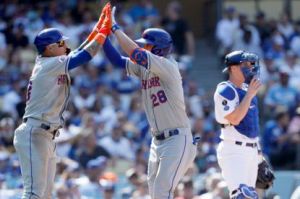
The Good Javy (left, after scoring on J.D. Davis’s [center] two-run bomb in the seventh) returned from the injured list and doubled down against the Dodgers Sunday afternoon.

This time, J.D. Davis didn’t shrink. Either with one man on or with the bases loaded.

This time, too, trade deadline addition Javier Baez came off the injured list, swung like a pro, scored like a pro, and doubled down, literally. He put a small shot of rocket fuel into a team looking like the living dead too often this month.

This time, the Mets may have left eight men on but they also sent seven runs across the plate. They’ve now done that only twice since 21 July. And, this time, too, they didn’t let the Dodgers take a single lead all Sunday long.

The bad news is that Sunday’s 7-2 win to stop the Dodgers’ winning streak at nine probably won’t be enough to salvage the Mets’ 2021. They’d need a finish from here that you can describe politely as miraculous to do that. Losing eleven games in the standings this 6-15 doesn’t leave room for miracles.

But let’s worry about that later. Right now, let’s savour Baez cashing in Brandon Nimmo (leadoff full-count walk, on which he sprinted up the line to first) with one out, sending one ricocheting off the left center field fence in the top of the first, with Nimmo gunning home all the way from first.

Let’s savour Davis shooting one the other way up the right field line to send Baez home, and Jonathan Villar with two outs punching a quail into short center, Davis scoring when Cody Bellinger’s throw in brought Dodger catcher Will Smith well out in front of the plate.

Let’s savour Villar trying to take second on the throw in and Smith throwing wild enough to let Villar have third on the house, before a foul out caught by Dodger starter David Price ended the inning at three for the Mets.

Let’s savour the Dodgers getting only a pair back in the fourth, when Bellinger reached Mets starter Marcus Stroman for a two-out, two-run line single to right, making Stroman pay for walking the bases loaded ahead of Bellinger—whose season has been compromised badly by a couple of nagging leg issues and not having been able to recuperate properly from off-season shoulder surgery.

Let’s savour the Mets catching Bellinger in an inning-ending rundown out, catcher to short, Baez playing his old position in Francisco Lindor’s absence, feinting a throw toward third to keep A.J. Pollock from even thinking about a score before tagging Bellinger as he tried turning back toward second.

Let’s savour Stroman managing to keep the Dodgers at bay long enough for Baez to hustle a single into a double after two swift outs in the top of the seventh and Davis, right behind him, hitting the first pitch he saw from Dodger reliever Phil Bickford on a line over the left field fence.

Let’s savour the Mets loading the pads with one out in the top of the ninth off Dodger reclamation project Shane Greene—Nimmo’s base hit to right, Pete Alonso taking another plunk for the team, then Baez taking another plunk for the team.

And let’s savour Davis yet again, a day after he’d swung through a Max Scherzer meatball with the bases loaded for a strikeout. This time, Davis recovered promptly from falling into an immediate 0-2 hole. He wrung his way from there to a walk on four straight balls, resisting the temptation to pull the trigger on a sinker that sunk just a little too far below the strike zone floor for ball four and Nimmo trotting home.

But let’s not fool ourselves. These Mets may have a few energy reserves left, but there’s just a little too much still missing to give them much more than prayers. On paper, they’re only seven games out of first in the National League East. On the field and at the plate, Sunday’s showing is what they’ll need only every day from now on, practically, to have the prayer of even a prayer.

It may require what they may not have the rest of the way.

So just spend today thinking about Baez maybe playing his way into an extension that would keep him around the keystone with Lindor, when Lindor returns days from now.

Think about the Good Javy re-joining Lindor to turn the second base region into the swamp where base hits get sunk into ground outs. Lindor may have struggled at the plate this year but he remained a shortstop Electrolux. (Thirteen defensive runs above the league average shortstop before he was injured.)

Think about the Good Javy who turns the plate into his personal game-changing playpen, providing an energy jolt through this team that not even Con Edison could deliver, just the way he did Sunday afternoon.

Don’t think about the Bad Javy who chases pitches that deserve to escape, the one who tries a little too often to hit eight-run homers on pitches that provide the power just by the bat giving them a kiss. Not until or unless he shows up again, that is.

Think about the Good Javy outweighing the Bad Javy enough to convince Mets owner Steve Cohen it’ll be worth it to keep him around and use him as the perfect out to purge Robinson Cano, who’s due back for 2022.

Don’t say the Mets “will eat” Cano’s money for the final two years of his deal. That meal already went through the digestive tract and out the other end. They accepted him as part of the deal when they wanted relief pitcher Edwin Diaz that badly from the Mariners. Once his current suspension ends, Cano’s going to get paid whether or not he suits up for the Mets again.

Cano isn’t the defensive second baseman he used to be. He hasn’t been the hitter he once was since 2016, either. That’s something to ponder especially if wisdom finally prevails otherwise and the designated hitter finally becomes universal to stay.

The Mets may not be that inclined to have back a 38-year-old millstone drydocked an entire season over actual/alleged performance-enhancing substances, his second such suspension in four years. The Good Javy showed up in time Sunday to start helping make that decision so simple for the Mets that even Joe Biden could make it without screwing the proverbial pooch into a blood bath.

Lindor’s April shudders

Francisco Lindor

He’s his usual high-flying self at shortstop, but Francisco Lindor seems pressing too hard at the plate. So far.

It’s not even close to a new story, and it won’t be the last time you hear or see it. Star player signs gigabucks deal and presses out of the season gate to have first month about which “terrible” gets applied liberally. Anywhere else it might be merely alarming. But New York isn’t anywhere else, alas.

You’d think the watchword of the New York sports fan is, “To err is human, to forgive is not New York policy.” They’re not going to sink—yet—to the reputed depths of Philadelphia fans who inspire such gags as the Philly wedding clergyman pronouncing a newlywed couple husband and wife before telling new husband and gathering alike, “You may now boo the bride.”

New York fans have their own expectations and demands, evidence and actualities be damned, even if they’re not going to go Philadelphia just yet. (Or are they?)

Yankee fans, of course, have the patience of a barracuda whose three squares of the day are delayed; to them, anything less than an annual World Series ring is treason. When the Yankees lose it’s God’s will, somebody else’s fault, or time to throw out the first manager of the season. And that’s with George Steinbrenner gone to the Elysian Fields for over a decade.

Who’d have thought they’d see the day when Yankee fans make The Boss resemble Job? Who’d have thought another Steinbrenner (Hal) would epitomise calm seas compared to (a favourite phrase of his father’s) the fannies in the seats?

Met fans are a little more patient. It’s in their DNA. The team was born making edgy comedy while finishing below the basement. They’ve won a few pennants and a couple of World Series, experienced times troubled enough to make the Black Plague resemble the Paisley Underground, watched excellent teams collapse, and survived team overseers and administrations that could be tried in court for premeditated malfeasance.

But even the most patient, good-humoured Met fan has limits.

It’s one thing for the Citi Field boo birds to beat their wings and squawk every time Jacob deGrom pitches knowing there’s no jury on earth who’d rule against him if he files non-support papers on his mates—or entertains even microscopic thoughts of post-game manslaughter.

They’re watching virtuoso pitching on behalf of a team whose bats are so inexplicably paralysed on his game days deGrom himself has to think about delivering base hits (the outlier has six in thirteen plate appearances) and even runs batted in (he has two), when he checks in at the plate and sees the unlikely presence of a man on base ahead of him.

Come to think of it, Met fans are probably unsure what to make of a segment almost as bright so far as deGrom is virtuosic continously: the bullpen that once caused seven-eighths of New York to consider filing arson charges. The five main bulls—Edwin Diaz, Miguel Castro, Trevor May, Jeurys Familia, and Aaron Loup—have a combined 1.46 ERA/1/49 fielding-independent pitching rate in 41 collective gigs over which they’ve surrendered a mere (count them!) seven earned runs.

Right now, they’ll cheer and holler wildly for that livestock. Let those April showers turn into Mayhem, however, and Met fans will treat that cattle like burnt meatloaf almost in the same time it takes to snap their fingers for the waiter.

The bad news is that Mets bats not belonging to Pete Alonso (.837 OPS), Brandon Nimmo (.870 OPS), and J.D. Davis (1.089 OPS) are a stalled production line. None is singled out more for his season-opening plate futility than a freshly-minted import shortstop.

Getting used to deGrom pitching like a Hall of Famer with his mates hitting like Hall of Shamers in his starts is one thing. But flapping and squawking over Francisco Lindor is something else entirely. They didn’t quite bargain on SuperLindor showing up with only half his A-game calibrated for the new season.

Let’s get the contract business out of the way first. Lindor wouldn’t be the first gigabucks player to sign his first serious big-bucks deal and press it at the plate trying too hard to live up to it. If you want a single example, hark back to Hall of Famer Mike Schmidt. He signed his first big multi-year deal starting in 1978—and had a rather down season at the plate to start that term.

The most cynical of the most cynical Phillies fans dismissed Schmidt as dogging it. Those who paid the closest attention to him knew he was only too anxious to live up to the new deal’s notices and implications. Even if he did win one of his ten Gold Gloves that year. The following year, Schmidt hit like his usual self again (40+ home runs, 210+ runs produced, etc.), led the National League in walks, and made one of his twelve All-Star teams.

For all his pressing at the plate now, Lindor’s still an above-plus study at shortstop. He’s still helping save runs with the leather, legs, and arm. He still has a fielding average 22 points above the rest of the league’s shortstops, and his range factors are still about 30-35 points above the rest. He’s also turned fourteen double plays thus far, well enough on pace to get near his career average 72.

He’s also picking it up when it comes to ducking the strikeout at the plate. Now, I don’t go as nutshit as too many others seeing high strikeout totals, if only because I’d rather see a batter strike out than whack into a double play, but Lindor’s striking out only 11 percent of the time he’s at the plate . . . and taking walks 11 percent of the time. The strikeout rate is lower than his career percentage; the walk rate, higher.

Lindor’s been hitting about as many ground balls as fly balls and that may equal hard batting luck, since he’s not hitting too many weak balls so far. When he does reach base, so far he’s taking extra bases on followup hits 88 percent of the time—his career such average is 47 percent, which is more than just a good rate.

Joe and Jane Fan forget something about baseball players. Allow me to remind you: They’re not automatons or holograms, they’re human beings. No two of them are alike entirely. For every Mike Trout or Mookie Betts who lives up to the implied mandate of a new gigabucks deal right out of the proverbial chute, there’ll be ten struggling powerfully to live up to such deals at the outset or even through the first full season after they sign them.

“It’s interesting and it’s funny, and it sucks,” the usually ebullient shortstop told reporters on a conference call last week. “It doesn’t feel right, for sure. Interesting because it’s the first time that it happened in my career. And funny because I’m getting booed and people think I’m going to go home and just think, oh, why am I getting booed? I get it. They’re booing because there’s no results. That’s it.”

Derek Jeter would empathise. He was as close to a Yankee god as you could get and ended up in the Hall of Fame. But even he took it on the nose and in the brain on the bad days and nights. “I don’t blame them. We would have booed ourselves tonight,” he often said after such games. Jeter understood only too well how quickly a ballplayer might go from hero to villain—sometimes before 24 hours passed.

Don’t kid yourself that it doesn’t really sting. Lindor’s learning fast enough: Come up short as far as New York Fan is concerned and you’re the worst thing to hit town since the November 1965 power blackout. Come up long, you’ll find fewer places more ready to shower you with their love, affection, keys to the city, and maybe first born children, too.

If the right to boo, hiss, catcall, hang snarky banners, or flood Twitter indignantly comes with the price of a ticket to the ballpark, there’s an implicit correlation that says you don’t really know whether a player is just dogging it or is driving himself to nineteen nervous breakdowns trying to deliver.

The appropriate answer when Joe or Jane Fan huffs, “For x hundred bazillion dollars I could hit the you-know-what out of that slop,” is to reply, “If you could, you’d have been there instead.”

“I can’t hit like Vada Pinson,” said a social media baseball group member discussing the old Reds outfielder, “but he can’t make strawberry shortcake like me.” Lucky him. By age fifteen I couldn’t even hit like Strawberry Shortcake. I made a major leaguer with a paltry .200 hitting average and a mere .300 Real Batting Average (RBA) resemble Mike Trout.

A shortstop with a .537 lifetime RBA (once again: total bases + walks + intentional walks + sacrifice flies + hit by pitches, divided by total plate appearances) might also suggest that if one must endure a slump for any reason, it’s better to slump in April than down the stretch of a pennant race.

New York Fan still needs to be reminded that pennant races won in April and May are the exceptions, not the rules, outside a closet full of Yankee pennants in the last century plus the 1986 Mets. That one player won’t make or break a pennant except in very extraordinary conditions. Not even if he signs for nine figures over the ten years to follow this one.

Lindor gets his lucre

341 million more seasons to smile than Lindor already had making himself a Met.

The night before Opening Day, Francisco Lindor went from prospective off-season free agent to a Met for life. The morning after Lindor became a $341 million Met, the anticipated enough Opening Day duel between Jacob deGrom and the Nationals’ Max Scherzer got postponed thanks to five Nats players and one team staffer testing positive for COVID-19.

Lindor was already the catch of the offseason when the Mets reeled him in from the Indians with pitcher Carlos Carrasco in exchange for Amed Rosario, Andres Gimenez, and two prospects. That one showed things stood a fine chance of being far different under the Steve Cohen regime than they were under the former Wilpon government.

But would the gigarich Cohen be willing to open the vaults deep to keep Lindor beyond his walk season? Turns out that he would, after a little tussling and a few hiccups. Especially after Lindor turned spring training into his personal coming-out party as a Met.

All Lindor wanted, it turns out, was for someone—preferably his new bosses—to acknowledge that, sure, Fernando Tatis, Jr.’s hot stuff and liable to stay that way, and sure, the Padres weren’t stupid to lock him down and make him a Padre for life, but there was someone else playing shortstop on the baseball street who’d shown and proven a little bit more (well, a lot more) than Tatis had just yet.

When the Mets first offered Lindor $325 million, Lindor—whose smiling style can provide alternative power in the event of a major blackout—said nice, but not so fast. He’d have had to be willfully blind not to notice the Padres invested $340 million in a shortstop who’s played just shy of a full season’s worth of games in two years. He wanted just a little bit more—$1 million more as things turned out.

A little nudge here, a little tug there, a little bump yonder, and Lindor got what he wanted. Just $1 million more worth of evidence that he’d done already what the Padres hope Tatis continues doing. Even if the tradeoff for getting just that much more acknowledgement meant Lindor also looks at $50 million deferred money.

“When it came to negotiating his contract, Lindor was comparable to Tatis only in the sense they play the same position,” writes Ken Rosenthal of The Athletic. “Lindor, 27, was one year away from free agency. Tatis, 22, was four years away. And in terms of career accomplishment, Lindor had produced five seasons of at least 4.0 Wins Above Replacement, according to FanGraphs, and Tatis had yet to produce one.”

The thing they have in common otherwise is how much plain fun both Lindor and Tatis are to watch. They’re studies in controlled incendiaries at the plate; they’re studies in acrobatics at shortstop. So far. Barring catastrophic injury or other unforeseen unforced troubles, they’re likely to be that for a long enough time to come.

Lindor’s played six Show seasons; Tatis has played 143 Show games so far. This is how they compare in terms of my Real Batting Average metric: total bases (TB) x walks (BB) x intentional walks (IBB) x sacrifice flies (SF) x hit by pitches (HBP), divided by total plate appearances (PA):

Player PA TB BB IBB SF HBP RBA
Francisco Lindor (6 yrs, per 162) 732 319 59 27 8 5 .571
Fernando Tatis, Jr. (143 games) 629 325 57 2 4 10 .633

Tatis is equivalent to the hot first-season wonder. Lindor’s a six-year veteran. If Tatis after six years shows an RBA of .571 or better, he belongs at Lindor’s level. But Tatis isn’t just going to have to keep it up at the plate. He’s going to have to step it up major bigtime in the field. For that equivalence of one season, Tatis has saved 18 runs below his league average. For six seasons, Lindor has saved 56 runs above his league average.

Tatis is the prodigy, the work in progress. Lindor’s the established positional model. If he’s aware that he’s proven himself a top-of-the-line all-around shortstop, you can’t blame him for believing the Mets—or his next employer, should he have chosen to play 2021 out and hit what might be a crowded offseason market throttled by dependence on the next CBA negotiations and outcome—should pay him just so.

Without Lindor’s presence the coming shortstop division of the next free agent class is going to be formidable enough. Unless one of these players lands himself an extension to his liking before the 2021 season finishes playing out, here they are, according to RBA so far:

Player PA TB BB IBB SF HBP RBA
Javier Baez 2708 1201 128 30 12 22 .504
Carlos Correa 2583 1089 272 17 27 15 .550
Corey Seager 2301 1034 207 15 12 16 .558
Trevor Story 2541 1228 213 10 9 21 .583
Francisco Lindor 3510 1531 284 27 36 25 .542

Story, of course, benefits from the Coors factor; neutralised and his RBA might be somewhere more between Lindor and Correa. Now, put them all in the field, see who’s saving runs how far above his league average, and it’s no contest:

Player TZR
Javier Baez +11
Carlos Correa +30
Corey Seager +23
Trevor Story +41
Francisco Lindor +56

With Lindor off the market, Story is the best all-around shortstop in the coming free agents’ class by the raw numbers, but that Coors factor may or may not factor likewise into whether his payday might come that close to Lindor and Tatis.

Tatis landing his Padres lifetime meant that Lindor’s market would take a big leap flying high. Now Lindor’s jumped the coming shortstop market up, of course. But—assuming the CBA negotiations don’t put any kind of crimps into the real market values of players—Baez, Correa, Seager, and Story may see better dollars than they thought they’d see without getting close to Lindor’s bank account to come.

Assume a fair market and intelligence to match coming for argument’s sake. Story and Correa should see larger lucre than Seager and Baez. But that’s only on assumption. We don’t know yet what the coming CBA will deliver.

The bad news is that I’m pretty sure of one thing the coming CBA won’t deliver. The Major League Baseball Players Association isn’t likely to even think about revisiting the player pension plan and giving a reasonable shake to the class that was frozen out of the plan’s 1980 re-alignment capriciously and unfairly: short-career major league players from 1949-80.

Those players include a small handful of one-time Mets. Players such as Bill Denehy, the pitcher traded to the Washington Senators after a single injury-disrupted season as a Met, so the Mets could bring Gil Hodges from Washington to manage them.

Players such as Bill Wakefield, whose lone major league season was as a Met reliever in 1964 when he set a team record for appearances. Players such as outfielder Rod Gaspar and infielder Bobby Pfeil of the 1969 Miracle Mets. Players such as 1970s outfielders George (The Stork) Theodore and Leon Brown. And more.

The 1980 re-alignment changed pension vesting to 43 days major league service and health care vesting to a single day’s major league time. But it excluded players with short careers who played between 1949 and 1980. Some who follow the issue believe one reason was that they were seen as little more than September call-ups, though most of the players frozen out made teams right out of spring training.

The sole redress those players have received since comes from a 2011 deal between then-commissioner Bud Selig and then-players union director Michael Weiner: they have the pre-1980 short-career players $625 per quarter for every 43 days major league service, up to four years worth. The bad news: it doesn’t allow the players to pass those dollars to their families upon their deaths. The worse news: Weiner’s own death, taking further chances for better redress off the table so far.

Cohen has shown he wasn’t kidding when he said he was willing to spend and invest reasonably in reviving the Mets and securing them as a competitive Show team. Perhaps if the players union continues refusing to do better by the short-career players frozen out of the full pension realignment, Cohen—like me, a Met fan since the day they were born—might think about doing something better just for his own former Mets.

I’ve said it before, but I’ll say it again: It’s worth considering, and doing. Think about the props Cohen would earn if he, an owner, starts with his own team what the union still won’t think about with all 614 remaining un-pensioned short-career major leaguers. Maybe he’d inspire other owners with comparable dollars and love of the game to do likewise for theirs.

Denehy, Wakefield, Gaspar, Pfeil, Theodore, Brown, and other such short-term former Mets were among the players who supported the union during their major league lives, walking pickets, surrendering small incomes otherwise, the better to see the days when a Francisco Lindor could count before taxes on $341 million going into the bank thanks to a far more fair and open market than that in which they played.

Someone needs to make a serious move. If the union can’t or won’t, why not an owner? Especially one who’s been as unapologetic in his love for his team and the game as Cohen has been?