The Polar Bear of Baltimore

Pete Alonso

The Polar Bear gets his wings in Baltimore.

Those running baseball front offices will never lack for pressure. But there are always those among them who inflict the pressure upon themselves. Sometimes the intentions are noble. Sometimes the foresight is far. Sometimes the vision is blurry. Sometimes the blur becomes blindness.

Today’s Oriole fans have the unexpected luxury of believing their team’s president Mike Elias means business, when he says he was looking to take the Orioles’s promising lineup over the top and signing Pete Alonso was the means to that end.

Today’s Met fans have what they think is the too-familiar lack of luxury in believing their team’s president David Stearns is either talking through his head gear or blowing smoke, when he says the Mets were wary of going as far ahead in time with Alonso as the Orioles ultimately did.

Those Met fans, who’ve made a dark art out of pronouncing a season lost after a single bad inning on Opening Day, can’t fathom how a first baseman who’s still a young enough man, and has been one of their team’s most consistent power hitters since his 2019 arrival, became un-affordable beyond three years and unworthy of even receiving an offer this time around.

Stearns hasn’t kept his wish to upgrade the Mets defensively a state secret. The unfortunate flip side of Alonso’s batting prowess has been his fielding lack of it. As good as he is on the double play, as excellent as he is at snatching throws in the dirt, Alonso has slightly negative run prevention plus below-league average range factors.

The Orioles seem to be counting on Alonso’s formidable bat making up for the fielding shortfalls. The Mets seemed unwilling to continue taking that chance no matter how many home runs, no matter how many extra base hits, no matter that Alonso nudged Darryl Strawberry to one side as the franchise’s all-time home run hitter.

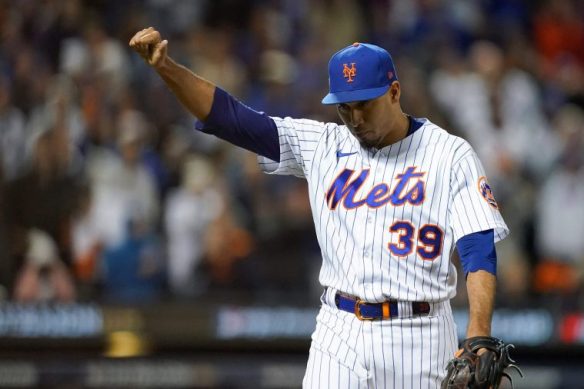
Alonso wasn’t the first free agent Stearns allowed to change addresses. The day before the Orioles landed him, relief ace Edwin Diaz elected to sign with the Dodgers. Three years and $96 million—and the largest average annual value for a reliever yet—wasn’t a figure the Mets couldn’t equal if they were thinking in three-year increments as seemed to be the case with Alonso.

So what made the bullpen bellwether return west? Part of it might have been Stearns signing bounceback relief candidate Devin Williams, with whom he was familiar from their time in Milwaukee. Part of it, too, and perhaps especially, might have been their coaching overhaul following the season included Jeremy Hefner, a pitching coach Diaz liked and respected.

The 2025 Mets had pitching issues that had nothing much to do with Hefner. But Diaz took his dismissal to mean the Mets suddenly got unserious about something dear to his heart.

“I spent seven years in New York,” the righthander said after he signed with the Dodgers. “They treated me really good. They treated me great. I chose the Dodgers because they are a winning organization. I’m looking to win, and I think they have everything to win. Picking the Dodgers was pretty easy.” Owitch.

And Alonso? He was both a fan favourite and an undisputed team leader, on the field and off it, known as much for his charitable acts as his bat and his fun-loving leadership style. But he spurned a significant extension offer a few years ago, and he re-upped with the Mets last winter in the face of a thinner market, taking two years with an opt-out after 2025. He exercised it after a big bounceback season and found a more accommodating new market.

Never underrate the power of betting on yourself and winning big even if it’s moving from the Grand Central Parkway to Cal Ripken Way.

“I’ve really enjoyed playing in New York,” said the Polar Bear, whose Oriole introduction included a large stuffed white polar bear on the table to his right and a brief struggle to button up his new Orioles jersey properly. He took number 25 only because his long-familiar number 20 has been long, long retired by the Orioles in honour of Hall of Famer Frank Robinson.

“I’m very gracious for that opportunity,” continued Alonso, who may have landed himself the Yogi Berra Malapropriety Award with that phrasing. “There’s some amazing people over there. Whether it be the locker room staff, clubbies, it was phenomenal. I really enjoyed my time. But this right here, this organization, this city, I’m so proud to call it home.” Double owitch.

“Losing franchise stalwarts Díaz and Alonso on back-to-back days is something a Mets fan might have expected from the Wilpon ownership—only with some ridiculous positive spin on how the team will be better for it,” said The Athletic‘s Ken Rosenthal.

Now, fans might wonder if Fred and Jeff Wilpon are practicing voodoo on David Stearns and owner Steve Cohen.

Stearns and Cohen have not said much of anything. That’s to be expected as they start to clean up the mess they’ve created, the baseball equivalent of a flooded kitchen floor. But they had better provide some answers quickly, and with actions, not words.

Maybe reuniting with Stearns gives Williams a clean shot at a big bounceback following a testy 2025 in Yankee pinstripes. Maybe bringing aging, injury-recovering Marcus Semien aboard—at the cost of another fan favourite, Brandon Nimmo, going to the Rangers—helps the Mets begin the defensive remaking Stearns has sung as a mantra. Maybe adding Jorge Polanco on a two-year deal helps likewise, especially since Polanco can play first as well as second with some pop at the plate. (He hit 26 homers last year.)

Alonso solves a huge portion of half the Orioles’s issues. They need pitching upgrades and  the best Alonso can do about that is help give that staff runs to work with. But they’re getting a class act who seems unable to wait to have a clubhouse impact as well as a scoreboard one.

“How I’m going to help is share my experience, and pretty much share whatever has helped me kind of step and rise to the occasion,” said Alonso, who has a sterling postseason resumé including an intergalactic moment or two. “I want to be an open book, pretty much to everyone in the clubhouse. For me, I take pride in that. Not only do I love performing, but ultimately I love forging great relationships and being a great teammate.”

That sounds like just the kind of guy the Mets should have wanted to keep.

Published originally at Sports Central.
Freak vs. foolish injuries

Edwin Diáz

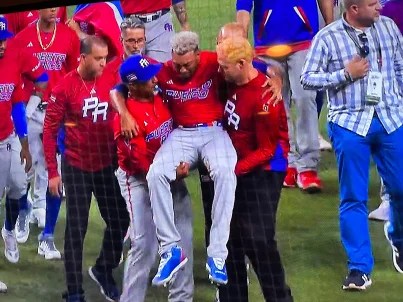
Edwin Diáz helped off the field after a freak season-ending knee injury while celebrating Puerto Rico’s quarterfinal advance in the WBC.

No, it’s not happy news that Mets relief ace Edwin Diáz is going to miss the 2023 season after tearing his patellar tendon celebrating Puerto Rico’s World Baseball Classic win. (Diáz and teammates whooped it up after beating the Dominican Republic to advance to the WBC quarterfinals.) But no, this does not exactly fall under the heading of Incredibly Stupid Injuries By Guys Who Ought to Know Better.

Further: I’d be all-in on shifting the WBC to a time of year when baseball players are in better shape to compete. Mets pitcher Max Scherzer thinks it might supplant the All-Star Game entirely and enable a full week’s worth of a mid-year break. That might be worth a look, if you can get past teams having similar concerns about their stars adding wear and maybe injuries as the stretch drive approaches. Might.

Meanwhile, the WBC means something to every player who signed up for it, whether representing MLB’s home country or representing their own home countries. They’re putting it on the line for the sort of honour that escapes the like of Keith Olbermann with his insouciantly sexist conclusionThe WBC is a meaningless exhibition series designed to: get YOU to buy another uniform, to hell with the real season, and split up teammates based on where their grandmothers got laid.

Diáz is also not the only one who went in, either, on a fresh or potential delicious multi-year, nine-figure deal. That’s how many millions Shohei Ohtani figures to make when he hits the market this fall, assuming the Angels decide to let him walk all the way into someone else’s arms?

You think Diáz tearing his patellar celebrating a key win is dumb at all, never mind the worst of the dumb? You sure don’t know the real history of incredibly foolish injuries. Diáz’s was a freak injury. It could have happened at a family wedding during some particularly exuberant whooping-it-up. It could have happened walking out to his car from the mall. He wasn’t even a hundredth as foolish as the following roll of baseball players and their incredibly weird injuries:

Bite Me Dept.—1923: Nondescript pitcher Clarence Bethen put his false teeth into his hip pocket, thinking he looked meaner on the mound when they were out. His lifetime 7.32 ERA thinks otherwise. But in one game he actually hit a double, slide hard into second—and took a bite in the butt from the pocketed choppers.

CONCLUSION: That wasn’t what they meant by putting your teeth into your work. (What was Bethen expecting when he pulled up at second—an immediate corned beef on rye with mustard?)

Jim and Jill Went Down the Hill Dept.—1967: Cy Young Award-winning Red Sox pitcher Jim Lonborg went skiing after the season. That’s where he suffered the torn left knee ligaments that cost him half the 1968 season and left him far less than the pitcher he was in 1967. It’s said Lonborg’s companion on that trip was actress Jill St. John, of whom he may or may not have been in hot pursuit down the slope.

CONCLUSION: Well, nobody could blame anyone for giving a Jill St. John hot pursuit. Except maybe Lonborg’s manager, Dick Williams, who probably took it as a) a devastating loss going into 1968; and, b) a personal affront to himself. Not necessarily in that order.

(Lonborg’s happy ending: he became a respected New England dentist after his pitching career ended, retiring from practise in 2017.)

Chumpionship Ring Dept.—1970: Braves closer Cecil Upshaw thought demonstrating his slam dunk technique by way of an awning on the street was a clever idea . . . until it cost him the entire season, after his ring got caught in it and he damaged ligaments in his hand.

CONCLUSION: Leave the slamming dunks to the ones who get paid to do them. The ones who wear NBA or WNBA underwear.

Take Him Out of the Ball Game Dept.—1983: On an off day for the Royals, Hall of Famer George Brett broke his toe running from . . . his kitchen to his living room, to continue watching a Cubs game, specifically to see his buddy Bill Buckner hit.

CONCLUSION: That was a foolish idea no matter whom Brett couldn’t bear not to see at the plate.

Rolling Blunder Dept.—1985: Vince Coleman, the Cardinals’ road running base thief, got his foot caught in a tarp-rolling machine at Busch Stadium before Game Four of the National League Championship Series. Incurring a bone chip in his knee and a foot bruise, Coleman—who set a rookie record for stolen bases that year—was stopped for the rest of that postseason.

CONCLUSION: It’s a lot safer to put your foot in your mouth. (Coleman did, a few times during his major league career.) But, seriously, this, too, was more of a freak accident than Vincent Van Go deciding to challenge a tarp roller to a footrace.

Cowboy Down Dept.—1986: Hall of Famer Wade Boggs once missed a week with a back strain suffered when . . . pulling on a pair of cowboy boots. This gave pulling yourself up by your own bootstraps a bad name.

CONCLUSION: Easy does it.

Oh, What a Mangled Web Dept.—1990: Then-Blue Jays outfielder Glenallen Hill fell out of bed and right into a glass table—suffering bruises and cuts on elbows, knees, and legs—as he . . . awoke violently from a nightmare about spiders.

CONCLUSION: Calling your friendly neighbourhood Spider-Man . . .

Ice, Ice, Baby Dept.—1993: Hall of Famer Rickey Henderson fell asleep with an ice bag on his foot . . . and the Man of Steal suffered a nasty case of frostbite, which froze him out of three August games.

CONCLUSION: There’s more than one reason not to doze off during a game.

Sorry, Wrong Number Dept.—1994: Relief pitcher Steve Sparks once thought that just because a motivational speaker he’d seen could rip a thick phone book in half he could do it—until his dislocated shoulder told him, “No, you can’t.”

CONCLUSION: Don’t believe everything you see.

Bed Sore Dept.—2002: Outfielder Marty Cordova once suffered a bad sunburn across his face . . . on a tanning bed.

CONCLUSION: Tan, don’t burn, get a Coppertone tan.

Oh, Deer! Dept.—2005: Promising Rockies rook Clint Barmes was given some choice deer meat by elder teammate Todd Helton. The venison won the battle when its weight caused Barmes to fall and break his collarbone. He went from leading National League rookies in most offensive categories to journeyman after recovering.

CONCLUSION: Presume that Bambi isn’t exactly one of Barmes’s favourite films.

Pie in the Sky Dept.—2010: Marlins utility man Chris Coghlan tore the meniscus in his left knee when . . . he fell while trying to smoosh a pie in the face of Wes Helms, who’d just won a game for the Fish with a bases-loaded single.

CONCLUSION: It might have been a good thing Helms didn’t win it with a grand slam—Coghlan might have been tempted to try hitting him with a whole bakery truck.

Honey, I Forgot to Look Dept.—2012: Jonathan Lucroy reached under his bed for a sock and didn’t see his wife fiddling with suitcases on the bed. One of the suitcases fell over the bed and onto Lucroy’s hand. He hit the disabled list after trying but failing to hide that he couldn’t grip his bat properly.

CONCLUSION: Look out above.

Baggage Claim Dept.—Royals catcher Salvador Perez punished his knees enough in thousands of squats behind the plate without blowing the opening of the 2018 season when he suffered a torn medial collateral ligament in his knee . . . while carrying a heavy suitcase up some steps.

CONCLUSION: There are reasons Mr. Otis invented the (ahem) safety elevator.

Now you tell me what’s worse or what’s less responsible—a freak accident while celebrating a tournament win? Or, blowing a season showing on the street that you could have busted a backboard any old time you chose?

Who says the old can’t learn?

Edwin Díaz

Edwin Díaz did exactly what Buck Showalter brought him in to do . . . in a true “save situation—in the seventh, not the ninth Saturday night. For Showalter it was once bitten, twice bitter old lesson learned deeply enough.

The next time you see or hear any baseball elder tell you he or she is too “old” to bother learning something new, just show them Buck Showalter. He’s the Mets manager who learned one of the hardest lessons in baseball history and finally got to prove it when he absolutely had to prove it on Saturday night.

It kept his Mets and their skipper from an early winter and eons of second-guessing while they banked a 7-3 Game Two win. In the bottom of the inning in which Showalter showed at last that he really did learn something from the worst disaster of his managing career.

When they still played a one-or-done wild card game, in 2016, Showalter wouldn’t even think of his Orioles’ (and baseball’s, then) nuclear-hot relief option Zack Britton in the bottom of the eleventh. He stayed with faltering Ubaldo Jiménez because it wasn’t a “save situation” in a two-all tie, after all, despite the Blue Jays having first and third with one out.

Edwin Encarnación’s monstrous three-run homer into the Rogers Centre second deck told Showalter and the world that managing to one of baseball’s most nebulous statistics can be suicidal. It also told reminded a stubborn world that “save situations” aren’t strictly ninth-inning lead protection.

Showalter’s been second, third, fourth, and fifth guessed over that one ever since. When asked directly, he could never bring himself to re-open his mind from that moment. Either he’d say, “You just have to wear some things“; or, as he did immediately in that interview, “I can sit here and tell you ten things you may not know about that situation, but nobody wants to hear it.”

Except everybody wanted to hear it. Come the top of the seventh inning in Citi Field Saturday night, with a hard-held two-all tie but the Mets’ season in danger of ending in a wild card series sweep, Showalter found himself in a save situation in the truest sense of the phrase.

This time, Showalter planned for just this possibility. Once bitten, twice lesson learned. This time—just like his Saturday night starter Jacob deGrom pitching six innings of stout, eight-strikeout, two-run ball; just like his bombardier Pete Alonso breaking a two-all tie with a leadoff homer—the manager rose to the occasion.

No “closer” was deadlier than Edwin Díaz on the regular season. (1.31 ERA; 0.90 fielding-independent pitching; 118 strikeouts in 62 innings’ work.) And there Díaz was, up and throwing in the sixth, while deGrom retired the side on a strikeout, a fly to deep enough right, and a ground out.

Social media went half berserk just seeing Díaz warming up, never mind thinking Showalter would be insane enough (their words) to “burn” his closer that early. Except that a one-run lead, in a low-scoring game, for these Mets who sputtered their way toward finishing a 101-win season, after owning the National League East most of the season, qualified as the single most important save situation of their year.

“Buck bringing in Edwin Díaz in the 7th,” tweeted The Cooperstown Casebook author Jay Jaffe, “but only to underscore the fact that he’s still not bringing in Zack Britton.”

So Showalter went to Díaz Saturday night the way he didn’t even think about Britton in 2016. Díaz got Trent Grisham, who’d helped wreck Max Scherzer and the Mets in Game One with the long ball, to bounce out right back to the box, surrendered a four-pitch walk to Josh Bell, but then got back to back ground outs. And the Mets’ previously slumbering bats accepted that awakening happily.

They’d already chased Padres starter Blake Snell after Brandon Nimmo broke a one-all tie with an RBI single in the fourth. They withstood Jurickson Profar’s re-tying RBI single off deGrom in the top of the fifth before Alonso greeted reliever Nick Martinez as rudely as he knew how, sending the inning’s first pitch into the left field seats.

Now they had Adrían Morejón to handle out of the San Diego pen. Their manhandling of him only began with Francisco Lindor—who started the evening’s scoring with a first inning home run, after a leadoff single was wiped immediately by a double play—hitting a line single to open, and taking second on a wild pitch before Morejón walked Alonso and Mark Canha on tenth-pitch full counts.

Up stepped Jeff McNeil, the National League’s “batting champion.” Through the infield into right went his two-run double and out of the game went Morejón in favour of Pierce Johnson. Johnson had Eduardo Escobar pinned at 0-2, but Escobar un-pinned himself with an RBI single, then had pinch-hitter Daniel Vogelbach at 2-2 when Vogelbach lofted a sacrifice fly to deep right center.

Just like that the Mets broke the game open enough. Then Johnson struck out a pair following Tomas Nido’s base hit. Now what would Showalter do? Would he dare to leave Díaz in for a second go-round in the eighth and risk his unavailability for Game Three? Especially with about a 45-minute layoff while the Mets rolled up that four-run bottom of the seventh?

He dared. Díaz got Manny Machado to ground out back to the box to open. After walking Bell he struck Jake Cronenworth out on three straight pitches. Then Showalter made sure he wouldn’t lose Díaz for Game Three if needed, lifting him for Adam Ottavino, who caught Brandon Drury looking on 2-2 for the side.

“I was feeling great,” Díaz said postgame. “I thought I could get Drury out, but [Showalter]  told me that he needed me tomorrow and this was enough for today. So, I said let’s win the game tomorrow.”

It was a bloody good thing the Mets seventh made the Showalter/Díaz pay off, because Ottavino in the ninth worked like anyone but the owner of a 2.06 ERA and 0.97 WHIP on the regular season: leadoff walk, a hit batsman, a fly out, a pair of walks including to Machado pushing the third Padres run home.

Showalter went to Seth Lugo, and Lugo lured Bell into grounding out right back to the box for the side and the game. Leave it to the Mets to salute their skipper’s gambit—the absolute right move to have made, with the game and the season that squarely on the line—with a four-run inning and still have to perform another high-wire act to escape with the win, anyway. That’s still so Mets, right?

Maybe this will be the beginning of the final end of the dubious “closer” and “save” things. Maybe this, at last, will lock down once and for all that you don’t save your best relief option purely for the final inning, because a real save situation presents itself any time at all during a game.

That was then: “This is simple: Showalter screwed up,” ESPN’s David Schoenfield harrumphed. “Even the smartest men are capable of ineffable stupidity,” harrumphed Jeff Passan, then with Yahoo! Sports but now with ESPN. Keith Law began an entire chapter arguing against the save statistic in Smart Baseball with that sad 2016 brain freeze.

This is now, apparently: Too much of baseball world talking about Showalter’s “unusual” or “unconventional” move. But a one-run lead against a tenacious Padres team that’s survived a few blows of their own to get here in the first place, too, can blow any time in the final three innings.

The Mets were very much in a real, not an artificially-contrived-by-nebulous-rule, save situation in the seventh Saturday night. This time, the Buck didn’t stop, blink, flinch, or shrivel. Neither did his team.

A 66-year-old skipper made liars out of the old fart contingency that insists they’re “too old” to learn new if should-be obvious lessons. Showalter proved you don’t get old on earth until you get dead on earth. And dead is what the Mets might have ended up without that proof.

Five straight for the Thumb Bunch

Jeurys Familia, Pete Alonso

Jeurys Familia and Pete Alonso have a victory handshake after the Mess (er, Mets) won their fifth straight Friday night—with plenty of help from the Thumb Bunch.

Almost a full week ago, the Mets were likely to be number one on a baseball fan’s hate parade. You know, you can’t have those ornery spoiled brats giving thumbs down when doing things right to the fans who spent most of August booing their heads off during what seemed, once and for all, like a classically surreal Met implosion.

You could only imagine the curses and hexes fans wanted to place on their heads for their dissing the people who pay their goddam salaries. Never mind that fans alone, or even predominantly, haven’t really paid baseball players’ salaries in decades.

But the Mets looked so vividly like 2021 baseball’s biggest self-inflicted trainwreck last month that you could still be forgiven for expecting a complete collapse. Maybe even firing squads in the clubhouse and guillotines outside the ballpark.

The hell with Pete Alonso’s happy talk channeling his inner Tug McGraw. Maybe Alonso didn’t use the specific phrase “ya gotta believe,” and McGraw in 1973 deployed it sarcastically after a lame rah-rah clubhouse speech by then-Mets lord M. Donald Grant. But when he said, “If you don’t believe in yourself, then who else is going to believe,” around 10 August, things only got worse instead of better.

Maybe Alonso really was onto something after all. Because look who’s won five straight including the two games last weekend that brought the thumbs-downing to a boil before the weekend ended. Look who’s even figured out a way to blow a lead in the ninth to force extra innings and then won the game in the extras, anyway.

Never mind that the streak’s come at the expense of two other sputtering teams, the Nationals and the Marlins. The way the Mets looked for most of August, they could have lost handily to a lineup of nine arthritic maids, a pitching staff of five one-armed janitors, a bullpen of seven legless movers, and a bench of six quadriplegics.

But ever since the down-thumbing suddenly caught the attention of the rest of the world, the Mets have outscored the opposition 27-13. And on Friday night, they took a precarious 2-0 lead to the bottom of the ninth, watched Edwin Diaz surrender a leadoff home run (to Juan Soto) and an RBI double (to Riley Adams) to tie . . . and pried four unanswered runs out of the Nats in the top of the tenth to win, 6-4.

Let’s not kid ourselves just yet. The Mets get to abuse the Nats in Washington for four more games this weekend, then they get to fly to Miami to inflict a little more use, misuse, and abuse of the Marlins. After that? They come home to host three clubs who can be called many things without pushovers being one of them: the Yankees, the Cardinals, and the Phillies.

There’s something to be said for gaining momentum even at the expense of the also-rans. And the Mets did claw their way back to .500 and to a mere four games out of first in the National League East.

Sure, they got some help from the Fish flattening the second-place Phillies 10-3 Friday night. Sure, they got some help from the Rockies eking out a 4-3 win over the first-place Braves. But a team that started August leading the division by three, and almost ended the month trailing by eight the night before the current streak began, has a few reasons to be happier.

Happier, but not quite to the delirious level just yet?

But let’s not spoil the fun. OK? Not the day after ancient Rich Hill pitched like a young man over six scoreless innings. Not the day after everyone in the Mets bullpen not named Diaz pitched three innings of one-hit, scoreless baseball.

Not after Diaz shook off those tying runs—and a scary collision between tying runner Andrew Stevenson and Mets catcher Chance Sisco that knocked Sisco out of the game at once—by ironing up and using a strikeout (of Carter Kieboom) and a ground out (by Luis Garcia) to strand the potential winning Nats run.

Not the day after Javier Baez, one of the Thumb Bunch, poked a one-out double down the right field line in the top of the second and came home almost at once when Michael Conforto—who’d gone from extension lock to question mark with a season’s worth of struggling—ricocheted a single off Nats starter Sean Nolin’s shoulder to send him there.

Not the day after Alonso, Mr. Belief, squared Nats starter Sean Nolin up on the first two-out, one-on pitch in the top of the third and yanked it as far down the right field line as he could for the RBI triple.

Not the day after Alonso drove Francisco Lindor—another of the Thumb Bunch, now deployed as the free cookie on second to open the New York tenth—home with a line single into the right center field gap.

Not the day after a third Thumb Buncher, Kevin Pillar, followed a free pass to Conforto by ripping a liner all the way down the left field line, sending Alonso and Conforto home as if they were escaping for their lives, Conforto following Alonso with an Olympic-level dive across the back of the plate.

Not the day after pinch hitter J.D. Davis was handed another free pass and Jonathan Villar cashed in at once by singling Pillar home for the fourth Met run of the tenth.

Not the day after Jeurys Familia returned to a once-familiar role, closing it out with a leadoff punchout and a pair of swift ground outs in the bottom of the tenth.

“As you can imagine,” Alonso the Believer said post-game, “it’s great. It’s awesome to rip off (five) in a row. [But] we just have to win every possible game that we can. Regardless of the standings, we can only control what we can control. There’s ebbs and flows in the season and right now we’re just looking to finish strong.”

“The whole thing is just the creativity as the game is kind of presenting what it is showing you as a pitcher, as a conductor,” Hill said post-game of his own solid outing. “You saw a variation of a lot of different things out of my mechanics tonight. It wasn’t necessarily just a traditional leg lift and a pitch and the timing was all the same. Trying to disrupt the timing is the whole art of pitching.”

So Hill isn’t as succinct as Hall of Famer Warren Spahn. (Hitting is timing, pitching is destroying timing.) But he sure pitched and sounded just as smart. Especially facing the heart of the Nats order three times, bringing them up empty, and surrendering only three hits overall during his six splendid.

Maybe the Nats helped the Mets’ cause by some rather uncharacteristic basepath mistakes. But if pitching is disrupting or destroying timing, then winning in large enough part is making the other guys pay for their mistakes. Usually, this year, the Mets have paid through the nose (and any other orifice) for theirs.

Enjoy it while it lasts. However long it lasts. Seeing the August Mess come back to life for even five games was still a pleasure. They might (underline that) even have a few more surprises in store when they come home from their current trip to the division swamps.

“Every game is really huge at this point of the year,” Alonso said. Stick to that attitude, Mets.

It’s deja vu all over again for the Mets

2020-07-24 YoenisCespedes

Cespedes went into the seats in his return but deGrom added just more evidence for a non-support case Friday.

Pandemic delay or no pandemic delay, the 2020 season finds the New York Mets picking up just about where they left off last year. Not that beating the Atlanta Braves 1-0 on Friday was a terrible thing for them, of course. And not that Yoenis Cespedes, too long among the Mets’ living dead on the injured list, going long his first day back was terrible, either.

But their neglect of theirs and the National League’s best pitcher two seasons running, pending Jack Flaherty’s continuing maturation, continues yet. He’s too much a team player to say it, but surely Jacob deGrom thinks of games like Friday’s and thinks to himself, “It’s been lovely, but I have to scream now.”

Defending back-to-back Cy Young Awards, pitching like a future Hall of Famer, eight strikeouts in five innings, one walk, and one measly hit. (The innings limit was the Mets taking no chances after deGrom’s back tightness last week.) And nothing to show for it other than an ERA opening at zero.

Last year, deGrom had twelve such quality starts, averaging seven innings per, and came out with nothing to show for those. If his team played the way he pitched, he’d have been a 23-game winner and the Mets might have ended up in the postseason. Him definitely; them, might. As a former Mets manager once said, it was deja vu all over again Friday afternoon in Citi Field.

The Braves’ starting pitcher, Mike Soroka, got a grand taste himself of how deGrom must feel at times. He pitched six innings and, while he wasn’t deGrom’s kind of strikeout pitcher Friday afternoon, he did punch out three, scatter four hits, and come away with nothing to show for it but handshakes from the boss and whatever equals a pat on the back in the social-distancing season.

His relief, Chris Martin, wasn’t so fortunate. After ridding himself of Michael Conforto to open the bottom of the seventh on a fly out to deep enough center field, Martin got Cespedes to look at a first-strike slider just above the middle of the plate. Then he threw Cespedes a fastball just off it, and Cespedes drove it parabolically into the empty left field seats.

The piped-in crowd noise at Citi Field drowned out the thunk! when the ball landed in no man, woman, or child’s land. It was the game’s only scoring, but the Mets’ bullpen had a surprise of their own in store once deGrom’s afternoon was done.

They left the matches, blow torches, gasoline cans, and incendiary devices behind. They performed no known impression of an arson squad. They cleaned up any mess they might have made swiftly enough.

Seth Lugo, maybe the Mets’ least incendiary reliever last year, shook off a double to left by newly minted Brave Marcell Ozuna, and his advance to third on a passed ball, to get Matt Adams—signed but let loose by the Mets and scooped up by the Braves—to ground out to third and Austin Riley to look at strike three. Crowning two innings relief in which Lugo also made strikeout work of Alex Jackson and Ronald Acuna, Jr.

Justin Wilson, taking over for the eighth and looking like he was finding the right slots last year, shook off Dansby Swanson’s leadoff single to strike Adam Duvall out looking, before luring pinch hitter Johan Comargo into grounding out to second and striking Acuna out for the side.

Then Edwin Diaz, the high-priced closer who vaporised last year, opened by getting Ozzie Albies to ground out, shook off a walk to Freddie Freeman, and struck Ozuna out looking and Adams out swinging for the game.

Already freshly minted Mets manager Luis Rojas looks like a genius, or at least unlike a lost explorer. And Cespedes—about whom it was reasonable to wonder if he’d ever play major league baseball again—made sure any complaints about this season’s universal DH were silenced for this game at least.

“The funny thing is I joked with him before the game,” deGrom told reporters postgame. “I said ‘why are you hitting for me?’ He went out and hit a home run for us which was big. I was inside doing some shoulder stuff, my normal after pitching routine and yeah I was really happy for him.”

It didn’t work out quite that well for the Braves, with Adams going 0-for-4 with two strikeouts on the afternoon. Neither side mustered an especially pestiferous or throw-weight offense other than Cespedes’s blast.

But you half expected a low-score, low-hit game out of both deGrom and Soroka considering the disrupted spring training, the oddity of “summer camp,” and perhaps just a little lingering unease over just how to keep playing baseball like living, breathing humans while keeping a solid eye and ear on social distancings and safety protocols.

In a sixty-game season it all counts even more acutely than it would have on a normal Opening Day. The Mets and the Braves were each expected to contend this season before the coronavirus world tour yanked MLB’s plans over-under-sideways-down. They’re not taking their eyes off that just yet.

Before the game began, the Mets and the Braves—like the New York Yankees and Washington Nationals in D.C., like the Los Angeles Dodgers and San Francisco Giants by the Bay Thursday night—lined up on the baselines and held a long, long, long black ribbon. This time, with nobody kneeling before “The Star Spangled Banner” was played.

Maybe athletes can remind people that it’s dead wrong for rogue police to do murder against black and all people without running into the buzz saws of explicit national anthem protests and fury over the protests, after all.

The Braves have other alarms, though. Freeman, of course, is recently recovered from COVID-19 but two of their three catchers—Tyler Flowers and former Met Travis d’Arnaud—showed COVID-19 symptoms and went to the injured list. The good news: both catchers tested negative for the virus.

But lefthanded pitcher Cole Hamels hit the IL with triceps tendinitis. Not good. Every live arm counts in a short season, especially for legitimate contenders. Just ask the Mets, who’ll be missing Marcus Stroman with a calf muscle tear, even if Stroman historically heals quickly.

You hope both teams recover swiftly enough. You also hope the Mets find a way to make deGrom’s won-lost record look as good as he pitches and fast. Those non-support filing papers don’t take that long to draw up.