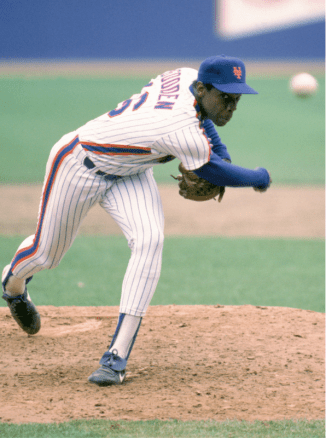
Gooden’s number retirement gives pause

Dwight Gooden

Whether throwing his multi-movement fastball or the curve ball known as “Lord Charles,” Dwight Gooden owned hitters and electrified Met fans in 1984-86.

A week ago, Stephen Strasburg finally got to make official what was determined last August and bungled almost at once: his retirement. A career worth of elbow and shoulder issues, brought to a head and then by thoracic outlet syndrome (TOS).

The former Nationals righthander leaves memories of the number-one draft pick who delivered so-often-brilliant pitching, harsh struggles, a World Series MVP in 2019, and a deadly posteason pitching resumé. (1.46 lifetime postseason ERA; 2.07 lifetime postseason fielding-independent pitching.) He’s not the only pitcher with flawed mechanics who succumbed (in his case, the inverted-W arm positioning before delivering), and he won’t be the last.

But on Sunday, the Mets did honour to a pitcher for whom the craft came naturally, with mechanics unflawed resembling an elegant young assassin on the mound, but whom the Mets decided inexplicably was the unbroken pitcher who needed to be fixed.

They retired Dwight Gooden’s uniform number 16, forty years after his staggering Rookie of the Year season. It’s the eighth team number the Mets have retired. (Jackie Robinson’s 42 is retired MLB-wide.) And, other than that of 1969 Miracle Mets manager Gil Hodges, it may contain the saddest story. Hodges’s time on the Mets’ bridge ended with a fatal heart attack in spring 1972. Gooden was ruined by his own team.

“Had New York’s [spring 1986] decision makers been present in 1506 when Leonardo da Vinci was painting the Mona Lisa,” wrote Jeff Pearlman in The Bad Guys Won, “they would have insisted on a mustache and larger ears. Here they had Gooden, called ‘the most dominant young pitcher since Walter Johnson’ by Sports Illustrated, and it wasn’t good enough.”

That spring, Gooden stood as the National League’s defending Cy Young Award winner approaching his third major league season. In his first, he pitched a Rookie of the Year season leading the entire Show with 276 strikeouts (smashing Herb Score’s rookie strikeout record in the bargain), a 1.69 fielding-independent pitching rate (FIP), a 1.07 walks/hits per inning pitched rate (WHIP), and an 11.4 strikeout-to-walk ratio. He saw and raised in his second season: he led the Show with 268 strikeouts, a 229 ERA+, and a 2.13 FIP, while being credited with a Show-leading 24 wins and 1.53 ERA.

And, over those first two seasons, Gooden became a Mets matineé idol while leaving National League batters (not to mention the American League side he struck out in the 1984 All-Star Game) wondering what became of their lumber: opposing batters hit .201 against the tapered young black man they called Dr. K.

Nobody could hit him. And he threw as though he was born to it. Every movement was both elegant and unforced, from his small windup (lifting his hands to his face) to his high-enough leg kick, his turn to hide the ball behind his right thigh, before throwing almost purely overhand and striding to the plate, in near-perfect timing, as though taking a long, unhurried step over a rain puddle.

He never looked uncomfortable. He never looked as though forcing a pitch. He threw a fastball with more movement than a dance company. He threw a curve ball with such a big trajectory that the pitch normally called Uncle Charlie was called Lord Charles when Gooden threw it. It was the third most voluptuous curve ball I have ever seen, behind only those thrown by Hall of Famers Sandy Koufax and Bert Blyleven. They were the only pitches Gooden had, the only ones Gooden needed.

“Every game,” he’d come to remember about those first two seasons but 1985 in particular, “I could put the ball where I wanted it.” Every Gooden game, you could feel Met fans thinking to themselves: Strike out twenty! Win thirty! See you in Cooperstown, Doc!

Much later than that, alas, Gooden would come to look back upon those two seasons and wonder, with no disingenuousness, how he did it at all. He knew he’d set an ionospheric bar for himself. Someone within the Mets’ brain trusts decided, inexplicably, that the evidence meant nothing. The Mona Lisa needed the ‘stache and ear job, anyway.

It might have been pitching coach Mel Stottlemyre, whom Perlman noted spent all 1985 marveling at Gooden and fantasised about what Gooden might do with another pitch or two: “That’s what he set out to do–teach the best pitcher in baseball to be better.” On the surface it sounds noble enough. But did Stottlemyre miss the memo saying you can’t improve on perfection?

“All through [spring training 1986],” Pearlman wrote, “Stottlemyre had Gooden toy with a changeup and a two-seam fastball, two pitches he did not throw. It was hard to watch. Gooden was a trouper, but the confidence he exuded on his fastball and curve ball never attached itself to the other pitches. He felt awkward and unsure.”

“I remember catching him one day in the bullpen and they were working with him on the two-seam,” said Mets backup catcher Ed Hearn. “I’m thinking, What the hell is this? He was a power pitcher with tons of movement, and they’re trying to teach him movement? What the hell for?”

“I always thought they should have left Doc alone,” said Hall of Fame catcher Gary Carter, who came to the Mets in 1985 and caught all but three of Gooden’s games. “Mel thought teaching him a third pitch would be to his advantage. But he didn’t need it. He needed someone to say, ‘Hey, you’ve been successful. Just keep going at it.’ But they didn’t’. I also think it hurt his shoulder. The pitches didn’t feel natural to Doc, and pitching was so natural to him. It just wasn’t smart.”

Emphasis added, because indeed Gooden did develop serious shoulder issues over the next several years.

The Mets’ general manager, Frank Cashen, also urged Gooden to shorten his leg kick the better to keep baserunners from taking off on him. Oh. You think a man against whom the league hits a whopping .201 has that much to worry about with baserunners? Assistant GM Joe McIlvaine went Cashen one worse: he told manager Davey Johnson, “If we can reduce Doc’s pitches, we can save his arm. He doesn’t need 200 strikeouts to succeed.”

Two hundred strikeouts is exactly what Gooden would deliver in 1986. He also delivered a 2.84 ERA but a 3.06 FIP, and the opposing on-base percentage jumped 24 points higher than in 1985. He’d pitch respectably in the 1986 National League Championship Series against the Astros; he’d get thumped twice by the Red Sox in the ’86 World Series. That year, Gooden no longer resembled the complete dominator he’d been in 1984-85.

Gooden did have an unconscionable workload for that young a pitcher: he may have thrown over 10,800 pitches in 1984-85, according to some reports, and that’s not including warmups before his starts or what he threw on his between-starts throwing days. Still. Look again at the comments of Hearn and Carter. That’s how a guy to whom pitching came that naturally, without apparent body stress other than the normal effects of pitching almost five hundred innings in the Show at ages 19-20, got compromised as badly as Gooden was.

There was one way where you could assign Gooden any blame for his reduction from off-the-charts great to merely good. He was known to be so pliant and accommodating, with his manager and coaches, and with the public (he was the no-questions-asked most popular Met on a team with several stars including Carter, Keith Hernandez, and Darryl Strawberry), that he left himself open to the wrong advice as well.

Dwight Gooden

With former teammate Mookie Wilson to his right, under an umbrella, Gooden in the rain talks to the Citi Field audience: “My health is good, my mental health is good and today I get to retire as a Met. And I want all you guys to know, you guys are part of this. Thank you so much.”

“In the pursuit of excellence,” Pearlman wrote, “Gooden made a tremendous mistake. He listened to everyone.”

Thus a young man who resembled a scientifically-sculpted model for effortless, untaxing pitching was sent from Hall of Fame-great his first two seasons to merely a good pitcher who might brush up against greatness again now and then—for the rest of his 16-year major league career. He’d lead his league in only two categories ever again (FIP, 2.44; homers per nine, 0.4; both in 1989); he’d throw a no-hitter later in his career (as a Yankee).

From 1984-86, Gooden’s FIP was 2.31 and his ERA was 2.28. For the rest of his career: 3.95 ERA, 3.69 FIP. From ’84-’86: 9.0 K/9; 3.4 K/BB. The rest of his career: 6.8 K/9; 2.1 K/BB.

Gooden’s too-well-chronicled battles with substance abuse (which got him into rehab in early 1987, delaying his season’s beginning, and got him suspended for all 1995, in between which other reputed disgraces came and went) have obscured the true reasons why he was knocked down from a perch that pointed him to the Hall of Fame. Baseball Reference ranks him the number 87 starting pitcher ever. Being inside the top hundred is remarkable enough, considering what was done to him and what he began doing to himself, of course. And in that order.

Several of Gooden’s old Mets teammates came to do him honour Sunday afternoon, including a surprising Strawberry, who’d suffered a heart attack a month earlier and may not have been expected to make it. (“I had to be here for Doc,” Strawberry told a reporter. His own Mets number 18 will be retired in June.) Hernandez and Ron Darling, now two-thirds of the Mets’ respected television broadcast team, were there. So were relief pitchers Roger McDowell and Jesse Orosco, outfielder Mookie Wilson, third baseman Howard Johnson, and outfielder/pinch hitter Lee Mazzilli, among others. So was Carter’s widow, Sandra.

Gooden walked out to the field on a blue carpet, lined with people holding up K placards such as those hanging from the old Shea Stadium railing in the deep outfield seats, the old K Korner that tracked every Gooden strikeout during every Gooden game.

He thanked Citi Field fans and Mets owner Steve Cohen Sunday afternoon, the fans for standing by him through everything great, good, and bad, and Cohen—who’s been as enthusiastic about acknowledging Mets legends as the Wilpons were reluctant, previously—for enabling him to retire officially as a Met . . . almost a quarter century after he threw his last major league pitch.

Then, he threw a ceremonial first pitch to his grandson, Kaden.

Several times, Gooden’s big smile made him look once more like the child prodigy who owned baseball for two transdimensional seasons, the one whom the younger Denzel Washington might have portrayed on film with astonishing physical accuracy. The smile must have grown exponentially when the Mets did him further honour by beating the Royals, 2-1, in the Sunday afternoon game to follow.

But it also made me remember what the very regime that took the chance on Gooden so young did to him when they decided perfection was insufficient.

This essay was published originally at Sports Central.

Watching your language, baseball division

Detroit Tigers Manager Sparky Anderson watches his

Sparky Anderson, who murdered the King’s English now and then but whose baseball lyricism was second to few.

There are times—in cyberspace or otherwise—when stumbling upon something you missed when it first arrived can sting rather than charm. Especially if it’s a fine essay on baseball jargon, and you discover you’re just as guilty as everyone else of making mincemeat out of it. Or, you rediscover that you’re a repeat offender who’d better be grateful he doesn’t live in a state with a three-strikes law.

The essay in question is Allen Barra’s, from The Atlantic, in June 2012. He took a good, long look at what became of baseball’s language and was not amused. More saddened than infuriated, Barra decided, with apologies to Yogi Berra (whose biographer Barra admires him for his syntax as much as his baseball virtuosity), that he wished baseball people really hadn’t said half the things they’ve said since, oh, around 1980.

I’d love to be able to say much as changed. But then I’d love to be able to say I’m not guilty of failing to pay my syntax, too. Say, regarding runners in scoring position, which bothered Barra as “an ugly and imprecise term, originating mostly with broadcast announcers.” Once we had a runner on second, a runner on third, or runners on second and third, customarily. We’ve had runners in scoring position since the Reagan Administration.

“The new phrase means, of course, a runner in position to score on a single,” Barra wrote, “which is true only if the base runner is not Jason Giambi, who generally needs a double to have a break-even chance of scoring from second. Used indiscriminately. . . it is not merely vague and confusing, it’s incorrect. You can just as easily call the batter’s box a ‘scoring position’.”

Especially if the batter is someone like, say, Tommy La Stella, the Angels’ new toy, acquired in an offseason deal with the Cubs where he’d made himself into a useful substitute (wait, just wait) but didn’t exactly threaten to become the next Mike Trout. Oops. At this writing La Stella has hit exactly as many home runs this season (ten) as he’d hit in his entire previous major league career. He also has a season’s OPS just 72 points below Trout’s. At the rate he’s going now, La Stella is in scoring position when he merely checks in at the plate.

On the other hand, someone did come up with something other than “the bases loaded” to describe, well, the bases loaded. I could be wrong but I think it was Rex Hudler, then an Anaheim/Los Angeles Angels broadcaster, who went swimming and came up with a beauty: “ducks on the pond.” He didn’t say “ducks in scoring position, either.” One up for Raspasaurus Rex.

Barra had no great love for pitchers versus position players, either. Hard to blame him. “When I played Babe Ruth League ball we had pitchers and regulars, the latter term referring to players who play every day,” he wrote. “Now we’ve got something called ‘position players,’ which takes up two more syllables than ‘regulars’ and is misleading, since pitcher is as much of a position as the other eight spots. We also have ‘role players,’ which says nothing and takes up two more syllables than ‘subs,’ short for substitutes. ‘Role players,’ too, is inaccurate; doesn’t every player on the team have a role?”

Yankee substitutes of the late 1950s-early 1960s had a term for themselves. Tell me scrubeenies doesn’t sound friendlier, and funnier, to the game and to the ear, than “role players.” It won’t cost you an extra syllable, either.

Coaches and managers have roles, too. But let’s not get too technical. I’m pretty sure the announcer who dreamed the term up decided “position players” was a sensible way to distinguish everyday men from not-quite-everyday pitchers. I’m also pretty sure men walked on the moon, women won’t become pregnant from a mere kiss, and children think of only one thing when it comes to their parents. (Divide and conquer, and thank you, Danny Thomas.)

Barra also didn’t like “velocity” for extremely fast fastballs, “location” for what we used to call “pinpoint control” or “excellent control,” or “walkoff hit/home run” for “game-ending hit/home run.” (I’d also like to know just when and just why “home run” became a compound word.) But he didn’t complain about “gas,” “bullets,” “BBs,” or “cheese” for extremely fast fastballs.

Showed him the high cheese, then I punched him out with the yakker—Hall of Famer Dennis Eckersley. In case you wondered, “yakker” in what was once known as Dial-Eck referred to a curve ball. Curve balls are also known as benders, 12-to-6, and Uncle Charlie. Then Dwight Gooden had to spoil it: his curve ball was so curvy and so deadly when he was on it became known as Lord Charles. Lord, have mercy.

I may be wrong but I think we have legendary Braves pitching coach Leo Mazzone to thank for turning pinpoint control into a real estate pitch. It did and does get a little sickening after awhile, listening to pitchers talk about “location, location, location.” Even if they were such Mazzone charges as Hall of Famers Greg Maddux, Tom Glavine, and John Smoltz.

Just once, I’d pay money to hear any pitcher talk about painting, working, climbing, hitting, or using the corners the way Hall of Famer Whitey Ford or anyone speaking and writing about him once did. Let a pitcher speak of his failure to “locate” his pitches, I’d like to ask him when, where, and how he misplaced them. Maybe that was the problem. “Sorry, Skip, I lost that hanger.” We found it for you, kiddo, we retrieved it from behind the ballpark.

(Which reminds me: If there’s one sportswriter question that should earn immediate excommunication, it’s “What were you thinking?” after a hitter’s been humiliated with a called third strike breaking into the zone when he least expected. Or, after a pitcher’s been hit for a ten mile drive. What do you think a hitter was thinking about getting frozen alive? What did you think a pitcher was thinking about getting taken across the state line? In front of 35,000-55,000 in the ballpark and about ten million on television or next to radios? I guarantee it wasn’t, “I thought to myself, what a wonderful world.”)

The game-winning home run gave the winner great praise, Barra wrote, referencing Bobby Thomson and Bill Mazeroski specifically. The walkoff home run, he frowned, is “a term that thumbs its nose at the loser since the team in the field begins to walk off as soon as the ball clears the fence, while the batter is still circling the bases.”

And, while the winning team pours out of dugout and bullpen at once, and en masse, the better to commemorate the blast by turning the blaster into game-winning hamburger. “I’m just about out of breath,” heaved David Freese after he hit that staggering game-winning, 2011 World Series-tying home run in the bottom of the eleventh of Game Six. “I just got beat up by thirty guys.”

Barra admired Virginia Woolf’s admiration for Ring Lardner, whose best stories and articles were “about games, for one may guess that Mr. Lardner’s interest in games has solved one of the most difficult problem of the American writer; it has given him a clue, a center, a meeting place for the diverse activities of people whom a vast continent isolates, whom no tradition controls. Games give him what society gave his English brother.”

In other words, Barra continued, “millions of immigrants, no matter what language they spoke when they came here, came together around baseball. And that happened because even if you knew just a little English you could, by listening to the broadcasts, learn baseball Baseball language once drew newcomers into the game. Now, it’s becoming a language that shuts many people out, one that makes them feel as if what’s happening on the field is something a little more complicated than they thought. The ultimate result is that we all end up knowing less—particularly about baseball.”

And yet. “We try every way we can think to kill this game, but for some reason nothing nobody does never hurts it,” said Hall of Fame manager Sparky Anderson, who could have been tried by jury for murdering the King’s English (not to mention the Queens, the Bronx, the Manhattan’s, and the Staten Island’s) now and then, but whose baseball lyricism was second to few. And who never saw men in scoring position sent home on walkoff hits off misplaced pitches. (I think.)

But I’m getting a little ahead in the count. (In baseball, that’s a good thing. In writing, it isn’t.) To Barra, turning fielding into defense and hitting into offense is, well, offensive. “When, exactly, did ‘fielding’ become ‘defense’? The word fielding perfectly described what a baseball team in the field was doing. Defense was the term common to basketball.”

I have one answer: I can remember Mets broadcaster Bob Murphy, of blessed memory, opening a 1960s home game broadcast by “setting up the dee-fense for the New York Mets.” Little by little I heard more people doing it. Defense was also a term common to football and hockey, too. The last I looked, sporting goods stores still don’t sell defenders’ gloves.

“For that matter, when did hitting and base-running get lumped together under the leaden term ‘offense’?” Barra added. “Were ‘batting’ and ‘hitting’ and ‘base running’ too quaint for an audience that also watched football and basketball? When did we decide that because football and basketball had offense and defense that baseball had to have them, too?”

Unfortunately, people who ought to know better decided long enough ago that baseball itself had to have things football and basketball had, too. Things like diluted championships, salary caps, and other cancers.

When baseball first went to divisional play, it didn’t have “playoffs”—it had League Championship Series. Then, baseball introduced the wild cards. In 2012 it introduced the second wild cards. And speaking of wild cards, leave it to baseball—which makes gambling Original Sin—to describe a batter hitting with two balls, two strikes, two out and two men on, as “deuces wild.” That one’s aces in my book.

Once upon a time, baseball’s only known wild Cards were the Gas House Gang, that bunch of particularly randy, rowdy 1934-35 St. Louis Cardinals. (The 1957 Braves, the 1986 Mets, and the 1993 Phillies were just a bunch of wild and crazy guys.) How long, now, before baseball’s governors, arbiters, and shepherds introduce not just every team in a division, practically, going to play for a championship with the World Series becoming something with an unrecognisable name?

Hey, it could be worse. At least three major team sports have identifiable championships. We have the World Series, still; not even Rob Manfred is willing to throw that one out of the game. The National Football League has the Super Bowl, and they’re welcome to it, never mind that it sounds more like something—in hand with the scrambled brains of football play—you’d see involving a wrestling title.

The National Hockey League has had the Stanley Cup Finals to itself since the folding of the original World Hockey League in 1926, after the Montreal Maroons defeated the Victoria Cougars. The National Basketball Association has . . . the NBA Finals. They can’t even call it the Naismith Finals, never mind that that’s the trophy the winner wins. How boring, for a sport of perpetual motion, whose championship trophy is named after its founding father.

Once upon a time, if the occasional fight broke out on the baseball field, we had Red Barber to thank for telling us we had quite a rhubarb going there. Wouldn’t you rather have a rhubarb than a bench-clearing brawl? (We once had Barber to thank, too, for describing the bases loaded as “FOB”—full of Brooklyns.) It beats the hell out of “donnybrook,” which sounds more like naming a soap opera super couple than a rhubarb, anyway. (I wonder: did the couple have themselves a donnybrook over the rhubarb?)

We have Barber’s disciple and successor, Vin Scully, to thank for the can of corn—the easy outfield fly. The can of corn probably originated in the old-time grocer picking off a high-mounted can of food with a hook stick, prompting it to drop almost lazily into his apron, unless the rest of the shelf’s contents came down upon his head first. Name me one football, basketball, or hockey term that was born in the A&P. (Oops! Today we’d say Wal-Mart.)

I once promised to send every last gasp of gibberish in my baseball writing out (at the plate and otherwise) to the best of my ability. And I know I broke that promise so liberally so often you could mistake me for an elected official. Or, decide to run me for office in the first place. William F. Buckley, Jr., wherever you are, may I borrow your immediate response to the question of the first thing you’d have done if you’d been elected? (It wasn’t, “I’m going to Disneyland,” either.)

I’ve sent more than my share of men in scoring position home on misplaced pitches turned into walkoff hits, and I didn’t even show them the high cheese, never mind that I couldn’t punch them out with the yakker. (Guilty, Judge Robinson: I’ve used “punchout” for strikeout. Yes, I know it wasn’t Muhammad Ali throwing one at Joe Frazier. I throw myself upon the mercy of the court, Your Honour.)

I plead no contest. But as Michael Corleone once said to his wife—when she reminded him it was seven years since he promised the Family would be completely legitimate in five years—“I’m trying, darling, I’m trying.” As James Thurber once said, you could look it up. But I’d rather you take my words for it.