“They think you’re supposed to win running away”

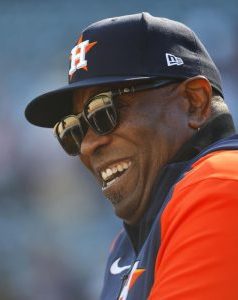
Dusty Baker

“After awhile, you just get tired of answering questions.”—Dusty Baker.

The Yardbarker headline says, “Dusty Baker blames surprising source for retirement.” Then, citing his interview with The Steam Room podcast hosts Ernie Johnson and Charles Barkley, they note the “surprising source” is “bloggers and tweeters” Baker deemed unfair. Baker is not necessarily wrong.

“We had a lot of success here, Ernie and Charles, and then the last couple of months here weren’t very pleasant, because we weren’t ten games ahead,” Baker said of his Astros, whom he managed to a seventh American League Championship Series game this year and in pan-damn-ic short 2020, plus a 2021 World Series loss in six but a 2022 World Series ring—also in six.

You spoil people. They think you’re supposed to win this every year running away and it’s not like that. Every year’s different.

There was a whole bunch of criticism from 30-year-olds and bloggers and tweeters that I’m not doing this and I don’t know that, and I told my wife, ‘You know, I’m kind of tired of this and tired of the scrutiny and if I could go manage and show up at say 6:30 for a 7 o’clock game and leave 30 minutes after the game, don’t do the (pregame and postgame interviews), I could manage for another four or five years.’ You know what I mean? After a while, you just get tired of answering questions.

God and His servant Casey Stengel only know success can soil and spoil. In certain ways, the 74-year-old Baker and his Astros were actually fortunate. Their run of sustained success is comparatively recent. Astro fans actually have time to reconsider, reflect, and remind themselves that sustained success may not always live long. Their own franchise history might be a fine place to start.

They might look to those longtime American League ogres who carried slightly more than half a century worth of pennants and slightly more than a quarter century worth of World Series titles into the current century. Yankee fans are nothing if not spoiled rotten enough to believe a) the World Series is illegitimate without the Yankees in it; and, b) they are as entitled to Yankee success as the Yankees themselves.

They might look to the National League West owners, too. Those Dodgers who’ve won ten of the past eleven NL West races, including eight straight before 2021 and the past two consecutive, and who had considerable success in the second half of the 20th Century. Starting with winning six pennants (including two pair of back-to-back flags) and Brooklyn’s only World Series in eleven years; continuing with four pennants and three World Series rings within their first nine years in Los Angeles.

Dodger fans are almost as spoiled as Yankee fans these days. And, almost as frustrated. They may not yet think a World Series is illegitimate without the Dodgers in it, but they can’t fathom any more than the team itself how the Dodgers could win ten of eleven NL West titles with only one pennant and Series ring to show for it.

If Baker (once a Dodger player himself) thinks bloggers and tweeters were rough on his Astros this year, he may not have seen how rough they were on the Yankees and the Dodgers. That roughness almost makes any hammerings on the Astros for not running away with the AL West this year seem like love taps.

Baker also may not have seen how much rougher than that were lots of blogging and tweeting fans of other teams upon whom atomic expectations fell at the season’s beginning but upon whom atomic deflations fell almost as fast. Met fans of the past several years have come to believe a season lost upon one bad inning—in April, never mind when big moves became big falls.

Don’t get me started on Cub and Red Sox fans, even if the former finally broke its long World Series drought almost eight years ago and the latter have more World Series rings this century (four) than anyone else. Or Cardinal fans, priding themselves as the best in the game but guilty of unnecessary roughness when the Redbirds finished at the bottom of the weak-enough NL Central this year after a decade of nine first or second place finishes in eleven seasons. Or Braves fans, respoiled by recent success after the comparative drought following that protracted NL East ownership of the 1990s-early Aughts.

Baseball is about rooting and caring, but too many fans take protracted defeat and failed high expectations personally. There may never again be the Yankees’ 20th Century dominance. God willing, the Yankees today won’t succumb to the temptation too many of their fans still ask: What would George do? More fan bases than just the Yankees’ base see lack of success and wish their teams had that kind of owner. Not so fast, folks.

There may take several if not many years before the next small dynasty comes out to play. Nobody guarantees that a solid club of Rangers who just won the World Series in five thrilling games can do it again, and again, and again, consecutively or at least consistently. Nobody guarantees the Astros’ success run will continue indefinitely.

The advent of the blogosphere and social media makes fan frustration seem about a thousand times more intense than when all we had was the morning paper, the evening news sports reports, and assorted retrospective books by which to go. Interviewers asking foolish or even stupid questions didn’t begin with Xtwitter.

Brutal fan attacks didn’t end with the letters to the editor sections. Death threats, even, didn’t end when Roger Maris (single season) and Hall of Famer Henry Aaron (career) finished knocking the Sacred Babe to one side in the arguable two most hallowed pages of the record books.

Baker’s hardly the only manager who ever got fed up with the witless who come forth worse than whatever mis-step they’re criticising. He may be the first to retire over it. Some of us think we should consider ourselves fortunate if certain players don’t retire when the social media universe attacks them without knowing the possible wherefores behind what they’re attacking.

Questioning mediocrity is one thing. But when once-glittering star players decline when they’re not exactly old men just yet, the social mediaverse seems to prefer hammering first and asking questions later. Even when it sees those players among the walking wounded on the injured list, the social mediaverse is only too prepared to dismiss them as fragile goldbricks still.

Go ahead and say Baker finally couldn’t stand the heat so he walked out of the kitchen at last, if it makes you feel good. But ask yourselves, honestly, how many of you would really be willing to go to work when it’s before five-figure audiences in a ballpark and seven figure audiences watching television, listening to radio, watching online, Xtweeting as they watch, or all the above.

That’s what I thought.

ACLS Game Five: Drill, brawl, and another drill

ALCS Game Five

The Rangers and the Astros scrum in the ninth in ALCS Game Five, after Adolis García (bottom-most left) went ballistic when hit by a first pitch from Astros reliever Bryan Abreu.

With one dazzler of an American League Championship Series Game Five play, Rangers second baseman Marcus Semien may have thought he’d saved their season. With one swing an inning later, Adolis García may have thought he’d guaranteed that save.

But that swing provoked a foolhardy act by an Astros reliever costing the team said reliever plus manager Dusty Baker for the rest of the game. And thus provoked, José Altuve sent the Rangers’ season onto life support with one swing in the top of the ninth, leading to a 5-4 Astros win.

The Astros did their level best to continue proving to the Rangers that they were the unmovable force on the road, which they were all season long. The Rangers did their level best to say, “not so fast,” on Friday afternoon. At least, until García inadvertently poked the Houston bear.

There was nothing wrong with García celebrating the moment he unloaded on Astro starter Justin Verlander with Corey Seager (one-out double, then to third on Sean Carter’s single) aboard in the bottom of the sixth, sending a first-pitch fastball over the left center field fence. There was everything wrong with Astro reliever Bryan Abreu drilling García on the first pitch in the eighth.

Abreu was ejected while both benches emptied. Astros manager Dusty Baker argued so vociferously with the umpires that he was ejected post haste. When order was restored, Astros finisher Ryan Pressly had to slither out of the first-and-second jam and did it with a force out and two strikeouts to follow.

Then, Pressly had to slither out of a jam of his own making, surrendering back-to-back singles to Mitch Garver and Josiah Heim, before a line out, a fly out, and a swinging strikeout banked a game the Astros could have lost almost as readily as they won it.

In between those jams, Altuve batted with two on (Yainer Díaz, leadoff single; pinch hitter Jon Singleton, wal), nobody out, and José Leclerc on the mound for the Rangers after relieving Aroldis Chapman to retire the side in the eighth. The delay may or may not have affected Leclerc. Altuve reached down for a down-and-in 0-1 pitch and sent it up and out, over the left field fence.

No one can really prove Abreu’s intent. Watch a replay of the pitch. Astros catcher Martín Maldonado is set for a pitch coming low under the middle of the zone. The pitch shot up and in and off García’s left tricep. García got right into Maldonado’s grille as if thinking Maldonado might have called for a duster but set up to make it look unintentional.

Six umpires called drilling García deliberate. If Abreu really wanted to drill him, he might have disguised it better (say, throwing the duster on the second or third pitch, assuming there would be one) instead of letting him have it on the first pitch. Abreu probably knows well enough to know that you should worry more about getting the man out than sending him messages about previous over-exuberance—especially when you weren’t the one at whose expense he was over-exuberant.

García isn’t exactly a green rookie. It took him long enough to make the Show to stay as it is. Had he just taken his base, he might have kept the Rangers in the game instead of triggering a bench-clearing brawl that ended up possibly harming Leclerc with the extra down-time.

“Everybody on their side is going to say it wasn’t [intentional],” said Rangers second baseman Marcus Semien. “Everybody on this side is going to say it was.”

“I was saying, ‘My bad, it wasn’t on purpose’,” Abreu said postgame. “He was like, ‘bullsh@t’.”

“We know it’s the playoffs,” said umpiring crew chief James Hoye. “We don’t want to make a mistake in a situation like that. So we’re going to make sure that everybody is on the same page, that we all felt the same way. And to a T, all of us felt like that pitch was intentional.”

It’s not impossible, too, that the umpires acted more upon the moment’s emotions when ejecting Abreu for the pitch, García for launching the scrum, and Baker for arguing as wildly as he did over Abreu’s ejection. Abreu did end up hit with a two-game suspension. He could wait until before Game Six to appeal, which would keep him available for Six and Game Seven if it goes that far, though it might keep him out of the World Series’s beginning if the Astros get there.

García probably escaped suspension because he was drilled and furious, but it would not have been out of line for baseball’s government to suspend him, either, for launching the brawl in the first place instead of just taking his base. Especially since his immediate target was Maldonado, not Abreu.

“My plan for [García],” Abreu said postgame, “was just to try to get the ball up and in. That’s my plan with him—up and in, and slider down and away. I just missed the pitch and he just overreacted.”

“I think the optics of the situation are really bad,” said Rangers first baseman Nathaniel Lowe. “It’s the playoffs. You’re allowed to get excited. He got excited. He celebrated because that was a huge swing for us. To have to wear 98 [mph] on the arm after something like that, it’s pretty disappointing.”

Altuve’s ninth-inning nuke made the optics a little bit worse for the Rangers now. The ALCS moves back to Houston. Granted the Astros weren’t a great road team this season, granted the Rangers took it to them in the first two games in Houston this set, but the Astros are not exactly pushovers. Especially not with someone like Mighty Mouse able to hit bombs when the eleventh hour is about to toll.

But it doesn’t keep Baker from a few trepidations over whether the García drill might linger in the minds of both teams if things get testy in Game Six, which is scheduled to pit Framber Valdez starting for the Astros against Nathan Eovaldi for the Rangers.

“I don’t have a crystal ball,” he said Saturday during a workout in Houston. “I mean, it’s going to be what it’s going to be. You have to wait and see, just like me. We don’t script it; it just happens.” That’s just about the last thing either team needs right now.

A pitcher’s lament, a manager’s triumph

Dusty Baker

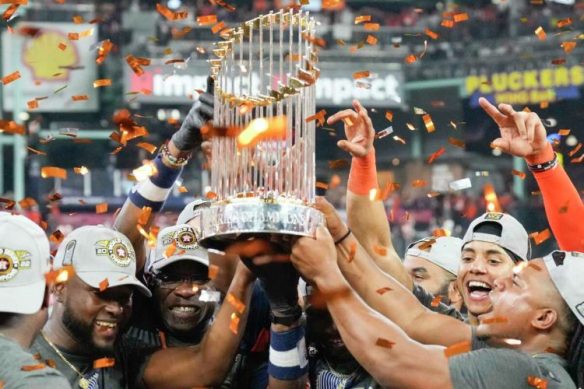
Astros manager Dusty Baker (second from left) joins his players—including Game Six starting pitcher Framber Valdez and World Series MVP Jeremy Peña (second from right), the first rookie to win that prize—hoisting the Series trophy after beating the Phillies 4-1 Saturday night.

If Jose Alvarado wants to find the nearest deep cave into which to make his residence until spring training, nobody should fault him. Not everyone can perform the impossible at will.

The Phillies’ redoubtable lefthanded reliever came into the bottom of the sixth of World Series Game Six with one key mission, take care of the Astros’ lefthanded munitions expert Yordan Alvarez with runners on the corners and one out. It might have been easier for Tom Thumb to scale the Empire State Building with a crosstown bus on his back.

This could have been construed as Phillies manager Rob Thomson believing he was still living a charmed life in his first two-thirds season on the bridge. Believing that a hard-won 1-0 Phillies lead could be kept in place or possibly enlarged the rest of the way.

Believing his righthanded starter Zack Wheeler wasn’t the right matchup for Alvarez looming with two occupied bases. Believing Alvarado would avoid the disaster into which he pitched when brought in for the same matchup in Game Five and hit Alvarez on the first pitch.

All Alvarez did now with a 2-1 pitch was send it over the farthest ledge behind center field, into some seats beneath a Blue Cross/Blue Shield advertising sign. All that did was sink the Phillies and yank the Astros to what they, and their fan base, needed in the worst way possible, a no-questions-asked, untainted World Series conquest.

Alvarado didn’t get beaten doing what he knew he wasn’t supposed to do. He didn’t get beaten serving a meatball without sauce. He got beaten throwing one of his best pitches, a nasty, shivering two-seam fastball, to a bomber who can and often does turn your best pitches into nuclear warheads no matter how they swivel up to the plate.

“Nothing moving. It didn’t move,” Alvarado said postgame. “If it moved, he had no chance. When he hit the ball, the sound says, ‘OK, that’s gone’. Because the guy is a power hitter. I watched it. But, again, sometimes you win, and sometimes you tip your cap.”

But Alvarado was wrong. The pitch moved enough. He got beaten by a hitter who moved his bat more than enough into it. Don’t condemn him. Don’t demand his post-haste measuring for a guillotine brace.

“[Y]ou’ve got Alvarado throwing 99 mph left-on-left sinkers,” Kyle Schwarber said. “And [Alvarez] ran into it and hit it out. Tip your cap. That’s a good hitter over there. I would take [Alvarado] on him any day of the week.”

Embrace Alvarado for having the guts to stare into the belly of the best a second straight World Series game and not run home to Mami at the very thought of it. A man with a regular-season 1.92 fielding-independent pitching rate earns more than a little respect.

Thomson may have some real explaining to do, though, as to why he kept Nick Castellanos—whose bat was as feeble as his glove had become a half-out-of-nowhere defensive weapon during the Series—batting behind Bryce Harper and, essentially, affording Harper as much protection as a tot with a pop gun offers a Brinks truck.

Just don’t be stupid enough to blame Alvarado for the Phillies’ inability to make Schwarber’s leadoff homer in the top of the sixth stick long enough to buy some insurance. Be better than that, this time, Phillie fan.

These upstart, self-resurrecting Phillies finally couldn’t hit what these Astro pitchers served them. They lunged at too many breakers instead of forcing them to come to their wheelhouses, they let too many fastballs elude them, and when they still had three innings left to overthrow the 4-1 Astro lead that stuck, they couldn’t and didn’t summon up enough.

Then give these Astros their due. Give them the credit they deserve for finally overcoming one World Series loss in which they won nothing at home, a second when they ran into a chain saw made in Atlanta, and the single worst cheating scandal in 21st century baseball, if not all baseball history.

Give these Astros the credit for playing untainted, un-sneaky, un-shifty (except on one or the other side of the infield here and there), unapologetically excellent baseball to beat these Phillies in six usually thrilling games.

Give them credit for making hash out of Commissioner Rube Goldberg’s more-cookies-for-everyone, three-wild-cards postseason array, not to mention defying the early-round upsets over the biggest-winning regular season teams, and living up to their 106 game-winning season where the 111 game-winning Dodgers couldn’t.

Give splended Astros rookie shortstop Jeremy Peña his props for earning both the Most Valuable Player Award of the American League Championship Series and the World Series (the first rook ever to win a Series MVP and a Gold Glove for his defense) and for damn near making Houston forget it ever had a fellow named Carlos Correa holding shortstop down.

Give center fielder Chas McCormick his props for running down what would have been J.T. Realmuto’s at-minimum eighth-inning double in Game Five and leaping to catch it before hitting the Citizens Bank Park scoreboard wall and landing in a heap on his back while leaving his imprint on the warning track and holding onto the ball like a life preserver.

Give Game Six starter Framber Valdez and the Astro bullpen their props for keeping the formerly vaunted Phillies offense—capable of turning games around in single swings until running into a no-hit wall in Game Four—from getting any ideas above and beyond The Schwarbinator’s liner into the right field seats.

And then give Astros manager Dusty Baker the biggest hug you’ve got to give for a man who’s been in this game fifty-four years as a player and manager, won a World Series ring as a player, had several postseason heartbreaks including World Series losses as a manager, and finally reached the Promised Land.

Baker really had to do this one the hard way. He took on the uphill job of managing a team riddled by the disgrace of Astrogate and their inability to speak entirely forthrightly about their 2017-18 cheating including about it being part of their 2017 Series triumph. It was comparable to Gerald Ford trying to clean up after the Nixon Administration’s Watergate mess.

But Ford lost the only presidential election for which he stood after that. Baker withstood the Astrogate heat, kept his head as the self-battered organisation turned itself and its Show roster over and away from the Astrogate stench, and brought his Israelites across the Jordan at last.

“Game Six has been my nightmare,” Baker told his team in the clubhouse after this Game Six. “I ain’t lying. I was like, damn that, man. We’re going to win today. I got Game Six off our ass, off my ass. We’ve got (Justin Verlander’s first credited World Series) win off his ass. And I’m telling you, you guys played your asses off. I didn’t have to do [poop].”

Baker and Game Sixes formerly meant disaster. 2002 World Series: he lifted starter Russ Ortiz with his Giants up 5-0 and ostentatiously handed Ortiz the “game ball.” The Angels thrashed back with three runs each in the next two innings, then ran away with Game Seven.

2003 National League Championship Series: Baker’s Cubs were five outs from going to the World Series when a double-play grounder bounded off his shortstop instead of turning two, opening the dam for a five-run Marlins rally and a Game Seven loss.

Game Six, last year’s World Series: Baker’s Astros didn’t incur anything close to those two disasters. The Braves made sure of that by shutting them out 7-0 to win the Series.

Now he couldn’t forget what his father told him after the 2002 deflation: “Man, after the way you lost that one, I don’t know if you’ll ever win another one.” Now, the son could be sanguine about the father’s fatalism.

“I was, like, I didn’t really want to get to Game Six again, but I was like, well, maybe this is how it’s supposed to be,” the son said Saturday night. “My dad didn’t mean anything negative . . . back in the old school, there was such thing as negative motivation. In the new school, negative motivation doesn’t work.”

No team had quite the negative motivation these otherwise filthy-dominant Astros have had since their 2017-18 cheating, which went above and beyond anything else devised and executed by teams past, exposing and staining them in the wake of their 2019 World Series loss.

It’s the black mark on a franchise that’s gone to six straight American League Championship Series and won four of them. A franchise that’s won two World Series titles over six years with a .622 winning percentage over those six regular seasons, something  almost never done, according to Hall of Fame writer Jayson Stark, by the greatest teams.

Not the Oakland Mustache Gang of the early 1970s. Not the Big Red Machine. Not the 1996-2002 Yankees. Not the Aughts’ Red Sox. Not the 2010s Giants. You’d have to go back to the 1953-58 Yankees—those of Hall of Famers Yogi Berra, Whitey Ford, Mickey Mantle, and manager Casey Stengel—to find one from the post-World War II era.

But guess what, ladies and gentlemen? Only three position players remained from the Astrogate teams. And they had almost nothing to do with the biggest of the big Series moments for these Astros and this manager. Air Yordan? Flying Jeremy? Tucker the Man and His Dream? Framber Valdez (is Coming)? Cristian (Soldier) Javier and his no-hit-opening oratorio? Every member of the bullpen that just rolled a Series ERA of 0.83? They didn’t show up until the Astrogate aftermath.

What the Astros needed most, said broadcast legend Bob Costas, himself a Frick Award winner thus enshrined in the Hall of Fame, was “to win outside the shadow of 2017 . . . ”

There will always be skeptics because of ’17. But they have now been a truly excellent team for a sustained period of time. I think fair-minded people already have put this in its proper context and proper proportion. So by winning again, especially with Dusty Baker as one of the faces of it, and five years removed from 2017, I think most people will have a fair sense of it.

Guess what else we can do now? We can put to bed forever all the talk over all the years about the long-suffering Baker’s “entitlement” to win a World Series at last.

It was both annoying as the day was long and absolutely unworthy of the man himself, the man who loved and encouraged all his players, from the last man on the roster to the cock of the walk, to exercise their abilities as they are, rather than as anyone else demanded, and was loved back by anyone who dealt with him over all those seasons.

Baker felt less “entitled” to anything than those who admire him and even criticise him when need be felt for him. Now he can put all that in a trunk, flashing one of his signature toothpick-punctuated grins, and lock it tight.

“After a while,” he said thoughtfully after Game Six, “I quit listening to folks telling me what I can’t do. All that does is motivate me more to do it because I know there’s a bunch of people in this country that are told the same thing, and it’s broken a lot of people. But my faith in God and my mom and dad always talking to me made me persevere even more.”

The 73-year-old man who once took too much blame for a few extraterrestrial calamities now didn’t give himself quite enough credit. There’s only so much Mom, Dad, and even God can do for a man, with a World Series or anything else.

“We’re going to play to the end”

Kyle Schwarber

Kyle Schwarber hitting his first-inning bomb off Justin Verlander in Game Five. “We’re going to play all the outs. We’re going to see where it takes us,” he says approaching Game Six. The “where,” of course, is up to Zack Wheeler and the Phillies against Framber Valdez again.

Approaching World Series Game Six, the Phillies could lean on the experience of one member who’d been there, done that, down 3-2 in a Series, then took the final two and the world championship. That was seven years ago, when he was a Cub, his season began (thanks to injury) in the World Series, and the Cubs finally did what seven-eighths of the earth thought wouldn’t happen in its lifetime.

“We’ve overcome a lot of things throughout the course of this year to be in this position,” said Phillies left fielder/bombardier/periodic base thief Kyle Schwarber as the Phillies traveled to Houston Friday. “I think when we get there, you’re going to see a really resilient club and we’re going to play until the very end and we’re going to see where it takes us.”

Funny, but that’s just about what every 2016 Cub said, too, when the then-Indians had them on the ropes with the Series returning to Cleveland for Games Six and Seven.

That was then: the Cubs pushed, shoved, pitched, and pounded their way through two arduous games. This is now: The Phillies, whose World Series drought is barely an eleventh of those Cubs’, will have to do all that plus rip, snarl, tear, slice, dice, and air fry. Just as when he was a 2016 Cub, the Schwarbinator won’t surrender, to these Astros or anyone else.

“It’s going to take everything,” said Schwarber, who did what he could to keep the Phillies from losing Game Five when he opened with a nasty home run off future Hall of Famer Justin Verlander in what proved a to-the-max 3-2 Phillies loss. “It’s going to take everyone. We’re excited. Trust me. Sure, it’s frustrating, but we’re also very excited.”

The Phillies are in a strange position this postseason. They enter Game Six with their first series deficit since they wrestled their way to the final National League wild card in the first place. Beyond that, they have reason not to fear. They’ve come back several times to get here in the first place.

Game One of the wild card set against the Cardinals? Down 2-0 in the top of the ninth. Then: bases-loaded hit batsman, two-run single, run-scoring infielder’s choice, RBI single, and a sacrifice fly, and two Cardinal runs in the bottom of the inning weren’t enough to deny the first win of a Phillie sweep.

Game Four, National League Championship Series? A four-run Padres first didn’t exactly bury them alive. Bottom of the first: Two-run homer (Rhys Hoskins), RBI double (Bryce Harper). Deficit cut to one. Bottom of the fourth: Tying RBI single. Bottom of the fifth, after Juan Soto put the Padres back up with a homer? Two-run homer (Hoskins, again), RBI double (Harper, again), RBI single, two-run Phillie lead. Bottom of the sixth: Solo bomb (Schwarber), three-run lead. Bottom of the seventh: Solo bomb (J.T. Realmuto), four-run lead, ultimately four-run win.

Game Five, NLCS? Call it the Mud and Guts Game if you must. Bottom of the third: Phillies take a 2-0 lead with another Hoskins two-run thump. Top of the fourth: Soto cuts the San Diego deficit in half with another solo smash. Top of the seventh, with the Citizens Bank Park rain turning the field into a swamp and pitching grips and strides into mush and mire? The Padres take a 3-2 lead with an RBI single and two wild pitches enabling a run. Bottom of the eighth? Harper fights and fouls his way to a dramatic opposite-field two-run homer. Two Phillies relievers make it stick for the pennant.

Game One, World Series? Kyle Tucker’s two bombs help the Astros bushwhack Aaron Nola in the first three innings. So the Phillies return the favour by ripping five out of Verlander—RBI single and immediate two-run double in the top of the fourth; two-run double in the top of the fifth. The score stays tied at five until Realmuto breaks it for keeps with a leadoff bomb in the top of the tenth, and David Robertson survives a double, a walk, a wild pitch for second and third, and gets the game and win-ending ground out.

All the Phillies need to do now is continue overcoming that nasty 0-for-20 with runners in scoring position until Jean Segura slapped an RBI single in the eighth in Game Five. They need Zack Wheeler to be his best self on the Game Six mound. They need to continue overthrowing their earlier reputation for defensive mishaps and cut the Astros off with more of the glovework and derring-do they began flashing during the Philadelphia leg of the Series.

They need, in other words, to be better than the best of their selves that pulled them into the Series and into the 2-1 Series lead the Astros wrested away from them on their own soil. Astros Game Six starter Framber Valdez, who manhandled them in Game Two, also in Houston, intends to let them do nothing of the sort.

“I think I’m just going to try to continue doing what I’ve been doing all season,” Valdez said through an interpreter after Game Five. “Just try and attack hitters early, try to breathe, try to stay calm, try to meditate. It’s something that’s really exciting. I think it’s something that really adds a lot to your career, and I’m really excited for this opportunity.”

It’ll add something to the Astros’ resume, too: their first untainted World Series rings. Not to mention handing their manager Dusty Baker—the man who steadied the Astro starship after it was strafed by the in-house phasers of Astrogate, keeping his gradually turning-over team playing through the aftermath, three seasons following its exposure, despite the organisation’s turmoil and grotesqueries—the first World Series triumph of his long and mostly distinguished managerial career.

The Astros know the Phillies won’t be simple pickings despite shutting them out back-to-back in Philadelphia, once with a combined no-hitter. It’s the Phillies’ job not to make things simple for the Astros.

“What a better storybook ending,” asked Castellanos, whose limp bat is almost forgotten when you’ve seen his defense turning into must-see television all of a sudden, “than if we can go there and win this in Game Seven?”

First things first, Schwarber would remind one and all.

“We’ve got a pretty good pitcher going for us in Game Six,” the Schwarbinator says. “We’ve got to be able to bounce back offensively. I don’t think anyone believes more in this group than we do. That’s going to be a big thing for us. We’ve just got to be able to play all the outs. We’re going to see where it takes us.”

First, it needs to take them past the Astros in Game Six. Then the Phillies can worry about who writes their storybook ending—the team of Roger Towne and Phil Dusenberry (who wrote the screenplay for The Natural); or, any given Astro, plus Jack Benny and Fred Allen, climaxing their long-running mock on-air feud while satirising the notorious weeper quiz show Queen for a Day:

Allen: An expert operating the Hoffman Pressing Machine will press your trousers
Benny: Now wait a minute! (Studio audience laughter and noise.) Now wait a minute, Allen!
Allen: Keep your shirt on, King!
Benny: You bet I’ll keep my shirt on!
Allen: All right, folks, tune in again next—
Benny: Come on, Allen, give me my pants!
Allen: Quiet, King!
Benny: Where are my pants?
Allen: Benny, for fifteen years I’ve been waiting to catch you like this.
Benny: Allen, you haven’t seen the end of me!
Allen: It won’t be long now!

The Phlogging Phillies

Alec Bohm

Only 119 years after Jimmy Sebring hit the first one, off Hall of Famer Cy Young, Philadelphia’s Alec Bohm hits the 1,000th home run in World Series history off Houston’s Lance McCullers, Jr.

The mound can be the loneliest place on a baseball field at either of two extremes. One is when a pitcher is within the final out of consummating a perfect game. The other is when he’s getting murdered on that hill, in any game, never mind a World Series contest.

Lance McCullers, Jr. actually pitched two and a thirds clean innings in Game Three Tuesday night. It took two two-run innings him to get there, and it took two murderous swings to finish his night in the wrong page of the record book, on the absolute wrong end of a 7-0 Phillies win.

But don’t suggest, as the Fox Sports broadcast team and enough of the Twittersphere did, that McCullers might have been tipping his pitches. The Phillies sat so hard on his breaking balls and waited him out so patiently it seemed impossible to believe the guy who returned from a flexor pronator injury to post a 2.36 ERA since August was as vulnerable as he was in Game Three.

“I got whupped,” McCullers said emphatically postgame. “End of story. We got beat up pretty bad, and I got beat pretty bad. I obviously wanted to pitch well, and pitch much better than I did, but at the end of the day, all I can do at this point is get ready to go for a potential Game Seven.”

It may not be unreasonable to question whether the Series gets quite that far, after the Phillies—satisfied to split the opening pair in Houston and come home to the raucous sound of their stop sign-shaped playpen—blasted McCullers in three out of the four and a third innings the righthander managed to pitch.

And, hit the 1,000th home run in World Series play since the Series was introduced in 1903 while they were at it.

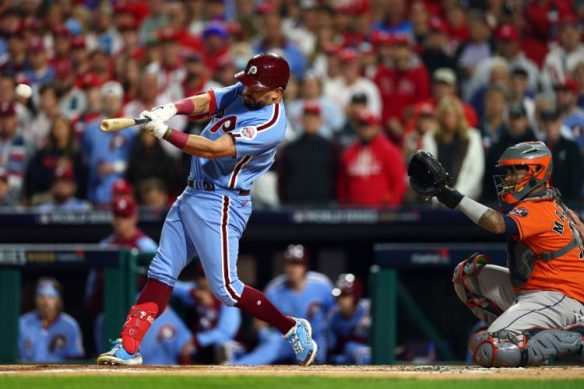
Bryce Harper, bottom of the first, with Kyle Schwarber aboard (leadoff walk) and two out—saw only one pitch in that plate appearance, a slightly hanging knuckle curve ball. He hung it two thirds of the way up the lower right center field seats. That made for the sixth time this postseason that Harper sent first pitches flying long distance. It also made for him starting his first World Series game ever in front of a home audience with a bang.

Alec Bohm, leading off bottom of the second—He got a little whispering from Harper before he checked in at the plate leading off. Then he got a McCullers sinker to open that didn’t sink quite enough off the middle of the plate and lined it into the left field seats. Series home run number one thousand, since Pittsburgh’s Jimmy Sebring legged an inside-the-park job off Hall of Famer Cy Young in 1903’s Game One.

Brandon Marsh—Two evil-looking strikeouts later, Marsh hit a 2-0 slider high enough above Astros right fielder Kyle Tucker . . . and in and out of a young fan’s glove above the right field wall. An umpires’ review confirmed what Marsh just finished running out: The fan hadn’t crossed the top of the wall when the ball bounded off the wall top and into and out of his glove back onto the field. Home run. Jeffrey Maier remains singular in fan infamy.

The Schwarbinator—After McCullers pitched two three-and-three innings and looked to be settling in well enough, Schwarber came up with Marsh aboard (one-out line single to right) in the bottom of the fifth and detonated a 1-2 changeup far over the center field fence. Into a greenery of Forest of Arbor Vitae trees.

Rhys Hoskins—Immediately following Schwarber’s nuke, Hoskins wrestled McCullers to a 2-2 count, then drove it about five rows into the left field seats. It also drove McCullers out of the game at last, not to mention driving Astros manager Dusty Baker toward the second-guessers’ booth.

“Hitting itself is a contagious thing without the crowd,” said Hoskins postgame. “But, you throw in the crowd and the noise and the cheers, and I think it just makes it more contagious.” And, noisy. If they’d used a decibel meter in Citizens Bank Park Tuesday night, it would have been broken after the game’s first pitch.

That’s when Phillies starter Ranger Suárez threw Jose Altuve an outside sinker that the Astros’ mighty mite lined the other way to right, and Phillies right fielder Nick Castellanos ran in hard before catching it as he fell into a slide. “When Castellanos made that play in right field,” said Phillies catcher J.T. Realmuto, “that was about as loud as I’ve ever heard that stadium.”

“It actually made me think about it,” said Suárez through his interpreter. “If we start like this, then we’re only going to finish even better.” How right he proved to be, even if his five smooth innings pitched turned out to be the footnote to the Phillies’ phlogging.

But why hadn’t Baker gone to his bullpen when the Astros were down by a more manageable four, on a night McCullers didn’t exactly have his A-game? Particularly remembering that the Yankees forced McCullers to battle in Game Four of the American League Championship Series, even if the Yankees didn’t wreak half the Phillies’ Game Three havoc?

Why did Baker let his man stay in long enough to set his own record of surrendering five bombs in a single Series game, enabling the Phillies to be the first in Series history to hit five bombs in five innings of a single game?

“The thought process,” Baker said postgame, “was the fact that he had had two good innings, two real good innings. Then they hit a blooper, a homer, and then I couldn’t get anybody loose. It was my decision.”

Baker brought Ryne Stanek in to stop the fifth inning bleeding and Stanek did his job by striking out the two Phillies he faced to end the inning. Then Baker went to Jose Urquidy, usually a starter but tasked as the long man out of the Astro pen for the postseason.

If the mound itself can be the loneliest place, the second-loneliest might be the long man’s status when his team’s played nine postseason games without need of a bullpen long man. Urquidy was almost the Astro pitching staff’s forgotten man until Tuesday night.

And it wouldn’t have been unreasonable to expect him to show enough rust when he arrived and went to work, even though Urquidy himself told reporters postgame that he works every day, a little warming up pregame, a lot of mental preparation during, just in case.

Except for inning-opening baserunners he wild pitched to second and third in the bottom of the sixth, though, Urquidy managed somehow to keep the carnage from metastasising the rest of the way. Making Baker look just a little foolish for letting McCullers start to see the Phillie lineup a third time in the fifth despite his two clean preceding innings.

“It was kind of mind-boggling,” Baker said, “because he doesn’t give up homers. He usually keeps the ball in the ballpark . . . What can I say? The line score looks bad, but they were just hitting us.”

“Give those guys credit,” McCullers said.

So what did Harper tell Bohm, before the Phillie third baseman checked in and laid McCullers’s first second-inning pitch to waste? Neither Harper nor Bohm would say when asked. “Nothing,” Bohm said, with a little grin.

“I think anytime you have information, you want to be able to give that to your teammates at any point,’’ was just about all Harper would say of it. “So anytime I can help my teammates, throughout the whole season we’ve done that.”  But helping his teammates also sent Harper yet another place into the record books.

His last plate appearance in the Bank prior to Game Three ended in the opposite-field, mud-drenched two-run homer he hit that ended up sending the Phillies to the Series in the first place. Then he detonated the first pitch he saw in the Bank Tuesday night. Nobody before him finished his LCS work at home with a bomb and started his World Series work at home with a bomb a week later.

“He’s a showman,” Realmuto said. “That’s what he is. There’s no doubt about that. He lives for these moments. He really feeds off this crowd and the emotions that they bring. And he doesn’t ever seem to let us down in those moments.”

Phillie shortstop Bryson Scott could only marvel at the early bombings, the first time five of a team’s first twenty batters ever homered in a single Series game at all, never mind against the same man on the mound.

“Ooh,” Stott began. “Bohm’s was cool. Line drive . . . Schwarber’s, though . . . Well, Rhys’ was cool, too. But Schwarber’s, into the trees . . . Bryce’s was awesome, too . . . But Schwarber’s into the trees . . . Oh, and Marsh’s was cool . . .The tree ball, though.” Based on the Gospel According to Stott, the Schwarbinator went tree for Game Three.

But Bohm hit the record books in a way that nobody else possibly can. One hundred and nineteen years after the Series first. Not the Bryce that’s right. Not the Monster Marsh. Not Rhys’s Pieces. Not the Schwarbinator.

The only thing the Bohmbardier seemed able to say after the game was no, man, we might be built like the ancient Strategic Air Command, but we’re really just the Third Army in disguise. “Guys aren’t trying to go up there and just hit homers. We’re hitters. Guys were working at-bats. Guys are taking singles the other way. And sometimes they make a mistake and we get ‘em.”

Sometimes, says the guy who connected on the first Game Three pitch he saw. I just hope the fan who came up with the Bohmb in the stands was told of the millenial milestone and sends it right to the Hall of Fame. Where it’s displayed behind a tiny plaque engraved, only, “Bohm’s Away!”