On Freese and perspective

David Freese

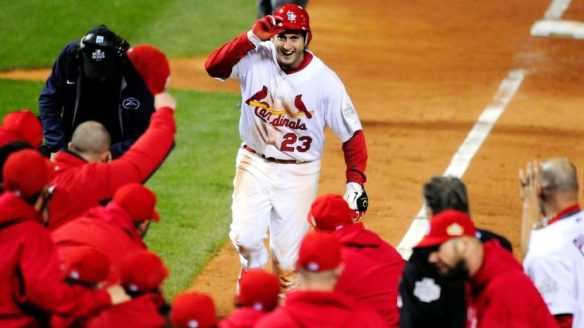
David Freese comes down the third base line after sending the 2011 World Series to a seventh game with a leadoff blast in the Game Six bottom of the eleventh.

If there’s one sub-pastime that animates baseball faithful almost as much as the game itself, it’s arguing. Especially about who belongs in the national Hall of Fame, and who doesn’t. Now you’re about to ponder a twist you probably never thought you’d have to consider.

You may never hear of any Hall of Famer declining the honour because he felt honestly that his career really didn’t justify it. But now there’s David Freese, the biggest of the big from the 2011 World Series, who’s turning down his election to the Cardinals’ team Hall of Fame because he feels his career doesn’t justify it.

The Cardinals aren’t the only team whose greatest moments were often written by others than their national Hall of Fame legends. But I’d be willing to bet they’re the only one who’ve just had one of those authors turn their own team Hall of Fame down. If I’m wrong, I’d be glad to know whom else.

This is a team who’s had enough big moments to stock a warehouse. Including, but not limited to, Hall of Famer Grover Cleveland Alexander (who was or wasn’t hung over) fanning Hall of Famer Tony Lazzeri with the bases loaded in the 1926 World Series, an inning before the Redbirds threw Babe Ruth out stealing to end it—with Hall of Famer Lou Gehrig on deck while Bob Meusel was at the plate.

There was Hall of Famer Enos Slaughter’s mad dash home in the 1946 World Series. There was Hall of Famer Bob Gibson’s perseverance in Game Seven of the 1964 World Series, then busting Hall of Famer Sandy Koufax’s single Series game strikeout record in 1968. There was Jack (The Ripper) Clark’s monstrous three-run homer to snatch a pennant from the Dodgers who were an out away from forcing a seventh 1985 National League Championship Series game.

There was Hall of Famer-in-waiting Albert Pujols’s glandular home run off Brad Lidge that only staved off the Cardinals’ elimination in the 2005 NLCS; and, his three bombs in 2011 World Series Game Three—starting in the sixth inning, finishing in a kind of reverse cycle. (A three-run shot, a two-run shot, and a solo shot.)

And, almost superceding the entire foregoing, Freese in Game Six of that Series. You had to have some kind of mojo working to supercede all that. Freese had it that night. When he hit a game-tying, opposite-field triple with the Cardinals down to their final strike in the ninth; then—in the bottom of the eleventh—sent the Series to a seventh game (which his team also won) by hitting a full-count, leadoff homer straight over the center field fence.

It added the World Series MVP to a trophy case that already included Freese’s being named the 2011 NLCS MVP as well. He’d done bloody well splendid for a kid who’d grown up a Cardinals fan, gave up on the game before college, but took it up again to become the Padre for whom the Cardinals traded aged Jim Edmonds only because they needed a third baseman with a little pop in their minor league system.

Then he earned the starting 2011 third base job, missed time early when hit on the hand by a pitch, and returned to play out the season with a Cardinals team that more or less backed into the postseason when the Braves collapsed as the Cardinals managed to reheat just enough.

“[S]ure, he might trade his career for a Hall of Fame career, but then again he might not,” wrote The Athletic‘s Joe Posnanski in 2020, recounting his own sixty top baseball moments. “There are 270 players in the Baseball Hall of Fame. There is only one player who grew up in St. Louis and got to live the dream again and again for the team he grew up loving. I suspect David Freese is pretty happy with how it turned out.”

Freese’s happiness has been won hard enough. He’s spent a lifetime battling clinical depression, including a lapse into alcoholism as a way to battle it. He kept quiet about that battle until well after he’d left the Cardinals: he didn’t take it to the public until eight months after he married Mairin O’Leary and—after two seasons as an Angel—had become a Pirate.
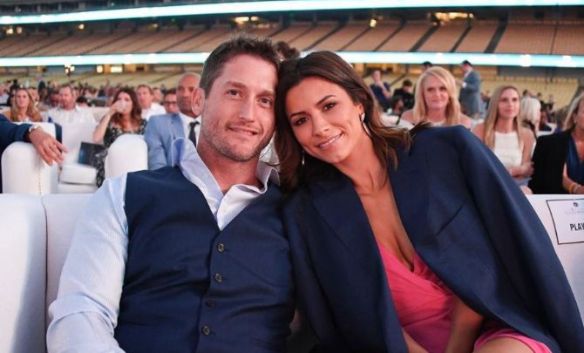
David and Mairin Freese

Freese with his wife, Mairin. They met and married after he left St. Louis and began putting his inner burdens—including the outsized weight of the hometown sports hero—in their proper places.

“It’s been fifteen-plus years of, ‘I can’t believe I’m still here’,” Freese told USA Today‘s Bob Nightengale then. “You win the World Series in your hometown, and you become this guy in a city that loves Cardinal baseball, and sometimes it’s the last guy you want to be. So you start building this façade, trying to be something I was not. And the whole time, I was scared to death what was going to happen to me after baseball.

” . . . Who knows where I was headed, but as long as I was here, I had so many friends here, I wasn’t good at just saying no. I wanted to please people, make everyone happy, and that became impossible.”

He came to his hard-earned inner peace only after the Cardinals traded him away. (Then-manager Mike Matheny told him candidly it might be the only way he could begin remaking himself.) He had one or two more moments in the postseason sun, as a Dodger in 2018. He hit a pair of leadoff bombs—in Game Six of that NLCS and in Game Five of a World Series the Dodgers lost in five to a Boston Rogue Sox team of replay room reconnassance rapscallions.

Then, he retired after the 2019 season. Long after he’d begun enjoying life outside baseball, including learning the piano and becoming an avid traveler with his wife and two young sons. “Freese no longer saw his stupefying 2011 postseason as a cross to bear from behind the wall of depression,” I wrote in 2020.

He looked forward to taking his . . . son to a live Cardinals game in due course. Not to mention showing the little boy what Daddy delivered in Game Six. And all that postseason, including a still-record fifty total bases and 21 runs batted in.

. . . The guy who made St. Louis baseball the happiest place on earth in 2011 fought hard enough to get to happiness with how his baseball legacy turned out in the first place.

That’s the guy who took an honest look at his career and, still at peace and happiness with how it turned out, decided he was honoured that Cardinal fans voted him into the team’s Hall of Fame but that they gave the honour to the wrong player.

Lots of not-so-greats have come up bigger than their own selves in baseball’s biggest hours. Such men as Al Gionfriddo, Dusty Rhodes, Don Larsen, Moe Drabowsky, Al Weis, Donn Clendenon, Gene Tenace, Brian Doyle, Bucky [Bleeping] Dent, Dave Henderson, Mickey Hatcher, Sid Bream, Mark Lemke, Tony Womack, Edgar Renteria, Scott Spiezio, David Eckstein, Steve Pearce.

They don’t all get the chance to prove publicly that they were better men than their isolated moments at the top of baseball’s heap. This weekend, Freese struck a big blow for putting a brief spell of baseball greatness into the kind of perspective that comes only from a man who made himself greater than his signature professional achievement.
Freese’s pieces, revisited

2020-07-12 DavidFreeseSeriesMVP

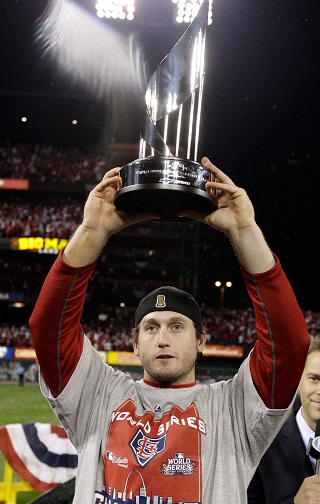
David Freese hoists the 2011 World Series MVP trophy. He’d also won that National League Championship Series MVP.

Notoriously enough at the time, Hall of Famer Reggie Jackson pre-Yankee mused aloud, “If I played in New York, they’d name a candy bar after me.” When fellow Hall of Famer Brooks Robinson was given a day at Baltimore’s old Memorial Stadium, on the threshold of his retirement, the host of the event told the cheering crowd, “Around here they don’t name candy bars after Brooks—they name their children after him.”

When David Freese made the St. Louis Cardinals’ difference in the 2011 National League Championship Series, I noted—after recalling he first thought his trade from the San Diego Padres to the team for whom he grew up rooting madly, the Cardinals, was a joke—“(E)veryone except citizens of Milwaukee might be laughing with the National League Championship Series’ most valuable player.”

In St. Louis, of course, they may be ready to name a candy bar after him. Freese’s Pieces, anyone? It isn’t everyone who comes up from oblivion to out-slug Albert Pujols when Pujols is having the best postseason set of his career, or drives home a ferocious exclamation point on it Sunday night with a first-inning blast that merely starts the Cardinals en route a secured trip to the World Series.

Who knew after Game Six of that NLCS that Freese’s series would prove a mere dress rehearsal for the big event to come? Not even Freese himself, about whom Joe Posnanski—amidst a series in The Athletic remembering sixty transcendent baseball moments—writes with loving eloquence that he was one kid who got to live every baseball kid’s backyard or schoolyard dream, suiting up for the home team he grew up loving, and hitting the blasts that either send the team to the Promised Land or yank them back to the threshold.

Most such kids would sell their souls to get a chance to do it for the home team even once. Freese did it twice, also in Game Six, but this time during the 2011 World Series. He tied it with a two-run triple in the bottom of the ninth and won it with a leadoff home run in the bottom of the eleventh. Telling the Texas Rangers, “Not so fast,” he sent the set to the seventh game his first-inning, game-tying two-run double would help the Cardinals win.

Think about the roll of Cardinals World Series heroes and from whence they came in the first place. Grover Cleveland Alexander (pitching and winning Game Six to send the 1926 Series to a seventh game his team would also win)—Elba, Nebraska. Pepper Martin (hitting .500 in a seven-game 1931 Series)—Temple, Oklahoma. The Dean brothers (Dizzy: two wins; Paul, two wins, including Dizzy’s Game Seven shutout, 1934 Series)—Lucas, Arkansas. Enos Slaughter (the Mad Dash, Game Seven, 1946 Series)—Roxboro, North Carolina. Bob Gibson (MVP of the 1964 and 1967 Series)—Omaha, Nebraska. Darrell Porter (MVP of both the 1982 National League Championship Series and World Series)—Joplin, Missouri. David Eckstein (resident pest and MVP, 2006 World Series)—Sanford, Florida.

Did somebody mention Sandy Koufax? He got to be a World Series hero twice for his hometown Dodgers, the MVP of the 1963 and 1965 Series—but that came after the Dodgers left Brooklyn for Los Angeles, and after a serious hitch in Koufax’s delivery was caught at last and fixed in spring training 1961, turning him from an untamed talent into an off-the-charts Hall of Famer.

Think a little bit, too, of how many players were Hall of Famers who came up too short in postseasons if they got there at all. Of how many—like Freese—who weren’t Hall of Famers on the best days of their regular season lives, but played like Hall of Famers when they did get to the big postseason dance. Of how the Freeses of the game live the truth of Gene Hackman’s valedictory in (of all things) the football film, The Replacements: “Greatness, no matter how brief, stays with a man.”

(Eckstein? Al Gionfriddo? Dusty Rhodes? Sandy Amoros? Don Larsen? Moe Drabowsky? Al Weis? Donn Clendenon? Gene Tenace? Brian Doyle? B.F. Dent? Dave Henderson? Mickey Hatcher? Sid Bream? Tony Womack? Edgar Renteria? Luis Sojo? Scott Spiezio? Scott Podsednik? Carlos Ruiz? Pablo Sandoval? Steve Pearce? Call your offices.)

Porter came the closest to being a homegrown Series hero, Joplin being a measly four-hour, 284-mile drive to St. Louis. Freese was born in Corpus Christi, Texas, but raised in St. Louis’s Wildwood suburb. He’d set Wildwood’s Lafayette High School’s single-season record of 23 home runs and a .533 batting average in his senior year, but felt burned out enough by baseball to spurn a baseball scholarship at the University of Missouri to try studying computer science instead.

So much for that idea. After visiting Lafayette during a summer while working in his school district’s maintenance department, Freese gave baseball another shot at two other schools and—the year Eckstein made himself the cockroach the Detroit Tigers couldn’t exterminate in the 2006 Series—made himself the Sun Belt Conference’s player of the year. The Padres drafted him in 2006’s ninth round.

2020-07-12 DavidFreese

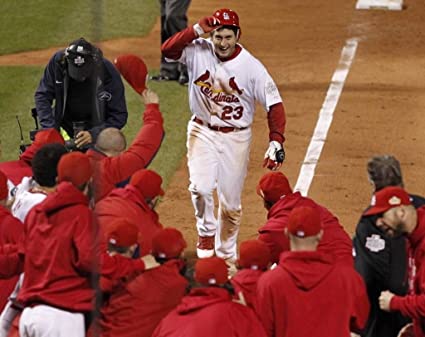
Freese about to hit the plate in a swarm of teammates, Game Six, 2011 World Series. “I just got beat up by thirty guys,” he laughed to reporters afterward. It was nothing compared to how depression was beating him up inside.

The Cardinals sent a spent Jim Edmonds to San Diego to get Freese in 2008 because they needed a solid minor league third baseman. Then, with former Angels World Series MVP Troy Glaus injured, the Cardinals needed Freese—until they didn’t. He didn’t turn up in the Cardinals’ fatigues again until 2010, where a hot start turned unfortunately into a season-ending ankle injury that June.

His 2011 threatened to be injury compromised, too, a hand fracture when hit by a pitch costing him 51 games. After his return, he finished the regular season with a flourish of eight hits in the final nine games. Then came the NLCS. Then came the World Series. Then came first and second with two outs for Freese in the Game Six bottom of the ninth, against Rangers closer Neftali Feliz. Then came Freese on 1-2 down to his and the Cardinals’ final strike—of game, set, and season.

Then came Freese swinging at a fastball on the outer half of the plate. “The beauty of it,” Posnanski wrote at the time, “was that in the instant after the ball was hit, it had a chance to be anything.”

He had obviously hit it well — the ball cracked off the bat — but there was no telling how well. It had a chance to be a home run. It had a chance to be an out. I have written before that there is nothing in sports like the successful Hail Mary pass in football, and the main reason is that no two Hail Mary passes are alike. Sometimes they deflect from one receiver to another. Sometimes they bounce off the defenders’ hands and back to a waiting receiver. Sometimes the pass just drops into a pile and sticks in a receiver’s hands. Really, there are countless geometrical possibilities. Baseball doesn’t usually have that kind of geometry. Home runs are home runs. Singles are singles. Pop-outs are pop-outs . . . But Freese’s fly was something like a Hail Mary. There was just no telling how it would turn out while the ball was in the air.

Rangers right fielder Nelson Cruz misjudged where the wall was, playing in the Rangers’ no-doubles defensive alignment, and the ball sailed over his head and into the wall. It sent the game to extra innings, where Josh Hamilton restored the Rangers’ two-run lead with a home run in the top of the tenth but a pair of singles, a run-scoring ground out, and Lance Berkman’s two-out RBI single—with the Cardinals again down to their final strike—tied things up again, this time at nine each.

Then Jake Westbrook kept the Rangers to a mere base hit in the top of the eleventh and Freese led off the bottom against Mark Lowe. Remember, now, that this was also the Series in which Pujols channeled his inner Reggie Jackson in Game Three, hitting three home runs—from the sixth inning forward, nourishing a 16-7 blowout. Who could possibly top that?

For that matter, who could possibly top Freese’s Game Six-tyer? The one that turned eight innings of somewhat sloppy baseball into three innings to come of surrealistic baseball? The answer turned out to be Freese himself. On a full count. On what looked like a changeup hanging into the middle of the plate. Over the center field fence, onto the green lawn beneath the Busch Stadium batter’s eye. With Hall of Famer Nolan Ryan, then the Rangers’ president, watching from the field level seats in abject disbelief.

Trotting around the bases as the Rangers left the field, Freese slammed his batting emphatically onto the third base line, down between his briefly leaping legs, a few feet before he hit the plate to be buried by a swarm of celebrating teammates. “I’m just about out of breath,” Freese told reporters in an on-field post-game interview. “I just got beat up by thirty guys.”

His Hall of Fame manager Tony La Russa—whose Game Five bullpen communication breakdown got close to vaporising his image as a tactical master and big-picture strategist, and who should have blown his team to world-tour vacations for pulling his kishkes back out of the incinerator—could only say, “You had to see it to believe it.”

This was a player who battled clinical depression his entire life, fell into alcoholism while battling it and suffered a small number of accidents and incidents before he became a Cardinal, then took the battle public eight months after he married and while in the Busch Stadium visitors’ clubhouse as a Pirate. “I’ve had moments like that since high school, to be honest,’’ he told USA Today‘s Bob Nightengale in 2017.

It’s been 15-plus years of, “I can’t believe I’m still here.” You win the World Series in your hometown, and you become this guy in a city that loves Cardinal baseball, and sometimes it’s the last guy you want to be. So you start building this façade, trying to be something I was not. And the whole time, I was scared to death what was going to happen to me after baseball.

. . . Who knows where I was headed, but as long as I was here, I had so many friends here, I wasn’t good at just saying no. I wanted to please people, make everyone happy, and that became impossible.

What happened was the Cardinals trading Freese to the Los Angeles Angels in November 2013, the Cardinals knowing Freese needed to leave in the worst way possible to blow the pressures away. That was part two of what began resolving his inner turmoil. He met part one at his friend’s media studio a week before the deal, an intern named Mairin O’Leary—who became Mairin Freese in the simplest ceremony possible, in a Pittsburgh coffee shop in September 2016. Over a crepes breakfast.

Freese had one more chance at postseason glory as a 2018 Dodger. He did his part, hitting leadoff home runs in Game Six of the NLCS and Game Five of the World Series, but the Dodgers fell to the Boston Rogue Sox who may or may not have deployed their now-infamous replay room reconnaissance ring sign-stealing plot during that postseason.

When he retired after last season, Freese no longer saw his stupefying 2011 postseason as a cross to bear from behind the wall of depression. He looked forward to taking his almost three-year-old son to a live Cardinals game in due course. Not to mention showing the little boy what Daddy delivered in Game Six. And all that postseason, including a still-record fifty total bases and 21 runs batted in.

“It’s going to be cool when Kai understands and I show it to him,” Daddy told the St. Louis Post-Dispatch as he retired, “and he says, ‘Is that really you on the TV?’ He understands it’s me now if he’s watching and there’s a closeup of me hitting or something. It is going to be cool (showing him the World Series ring). Look at that damn squirrel. He might not care, which might even be cooler.”

Kai Freese will have to wait, unfortunately, until the coronavirus world tour dissipates enough to let the games bring the fans back to the stands. His father has probably told him, “Trust me, it’ll be worth the wait.”

“There are 270 players in the Baseball Hall of Fame. There is only one player who grew up in St. Louis and got to live the dream again and again for the team he grew up loving,” Posnanski writes, observing the contrast between Hall of Famers who lacked for truly signature moments and ordinary men who have one that transcends the game itself. “I suspect David Freese is pretty happy with how it turned out.”

The guy who made St. Louis baseball the happiest place on earth in 2011 fought hard enough to get to happiness with how his baseball legacy turned out in the first place.