Be prepared for Show over

2020-07-27 MiamiMarlins

The Marlins players—not team management, not health/safety experts—elected to play Sunday despite COVID-19 already hitting some of them. Now eleven players at least plus two coaches are COVID-19 positive. Where were the adults in the room?

MLB and the players’ union,” tweeted ESPN’s Buster Olney early Monday morning, “made the mutual decision to try to play a season this year, and those two entities share the ethical responsibility of pausing, postponing or cancelling if that’s what is in the best interests of players and staffers. The Marlins’ situation tests this.”

The Miami Marlins’ situation is that fourteen people with the team, mostly players but a few coaches, tested COVID-19 positive while the Fish opened the truncated regular season in Philadelphia. Including their scheduled Sunday starter against the Phillies, Jose Urena. The team has postponed at least their Monday home opener against the Baltimore Orioles.

A series postponement may not be unlikely. Which might disappoint the Orioles purely on baseball terms, having just accomplished the unlikely feat of beating the Boston Red Sox two straight (7-4, 7-2) on opening weekend, after getting their brains beaten in 13-2 to open the set.

Exactly where the Marlins so affected caught the infections is still, pardon the expression, up in the air. They played an exhibition against the Braves in Atlanta the day before the regular season finally began, and the infected players and coaches could have been hit either in the Truist Park clubhouse or in the Citizens Bank Park clubhouse.

The New York Yankees were supposed to open in Philadelphia Monday night and station themselves in the same visitors clubhouse the Marlins just vacated. Says ESPN, “Sources told . . . Marly Rivera that the Yankees have been informed that the visitors’ clubhouse has been completely fumigated several times. The Yankees also brought their own clubhouse personnel down from New York City to work the game, if it happens. No decisions have been made yet, sources said.”

That was early Monday morning; now as I write it’s later Monday morning. A season postponement? It may happen. Major League Baseball convened an “emergency meeting” Monday in the wake of the Marlins’ situation. The Yankees-Phillies game for Monday is postponed, too. And, yes, this is getting quite out of hand.

But a season postponement may not happen yet, either. USA Today‘s Bob Nightengale reports, “There will be additional priority testing for teams who have an outbreak, MLB officials say, but no serious talks as of yet cancelling or pausing the season. In the words of one owner on the conference call: ‘Obviously, the situation is fluid’.”

How brave and bold of them.

With the coronavirus world tour still playing and only too many people still treating it from somewhere between carelessness and ignorance, getting a major league baseball season going from any point this summer was going to be tricky enough. We knew that right out of the proverbial chute, when young Washington Nationals star Juan Soto tested COVID-19 positive on Opening Day, though he’s asymptomatic just yet.

For all the fun and folly accompanying the season’s long-delayed opening, it’s no kind of fun when fourteen Marlins test positive over opening weekend. That followed two Braves sent home after testing positive but no symptoms showing yet.

When the Nats hosted the Yankees to open the delayed season, there was commissioner Rob Manfred sitting on national television talking more about . . . his sixteen-team postseason array. The designated hitter wasn’t even a millionth of the gimmick that idea is. It only begins with removing more than half the urgency of a regular season whose competitive urgency was already diluted by its wild card system.

Sure we’ve loved it when wild-card winners turn up the last team standing with the World Series trophy hoisted high. Including the Nationals, who did it last October after a staggering regular-season comeback. But we’re not fools. We know damn well that the wild card system has equaled asking fans to sit on edge over the thrills, spills, and chills of teams fighting to the last breath for . . . second place.

Manfred and his Major League Baseball Players Association counterpart Tony Clark have a genuine burden on their hands trying to navigate the sport through a terrible pandemic that’s yanked their country and half the world over, under, sideways, down. And the big thing for Manfred opening was a postseason array that might, maybe, probably see the sport’s best teams knocked out early and often.

“If Manfred’s judgment is this bad or if he is this pliant to the money lust of his bosses,” fumed the Washington Post‘s most valuable player, Thomas Boswell, “then what chance is there that he will have the backbone or the leadership skills to shut down this season if needed?”

Backbone? Leadership skills? Like the New York Police Department brass who sooner sent a few flunky cops to trial rather than root out the bottom-top corruption it took Frank Serpico and David Durk going to The New York Times to even try rooting it out, Manfred didn’t have the backbone to bring the powers of his office to bear and drop real hammers against the Houston Astros and the Boston Red Sox over their caught-red-handed, off-field-based, electronic sign-stealing cheatings.

Manfred slapped three managers and a general manager—whose teams executed them without Manfred—but the owners allowing it on their watches and the players availing themselves of it got away with it. You think that’s the Manfred who’s going to have the backbone to stop the season if the viral infections metastasise among the troops?

At his bosses’ behest, Manfred forced Clark and his charges to fight a ridiculous-sounding counter-battle against the owners using the coronavirus tour’s shutdown of spring training and the regular regular season to shove a de facto salary cap for the season down the players’ throats. That’s Manfred’s idea of backbone.

“The scary core of MLB’s predicament — and soon the NBA’s and NHL’s, too — is: Playing our sport is what we do, who we are and how we make our money,” Boswell wrote. “We’re going to try to do it until the virus stops us.”

From all over the world we’re learning the lesson that this is a terrible basic assumption. You get ahead of this virus before it even looks like a problem, or it ends up crushing you. South Korea, Japan, Australia, Canada and Germany, with a combined population of 325 million (the United States has 330 million) had 15 deaths Thursday. Arizona, with 7.2 million, had 89 dead.

You don’t measure disaster for a country — with refrigerator trucks lined up with corpses — the same way you measure it for a pro sport. But how do you measure it for a sport? I don’t know . . . League bosses, who are not at risk, and athletes, who think they are invulnerable, are both going to be tempted — to keep playing chicken with the virus until it makes them stop.

As most of the world already knows, by then it is usually disastrously too late.

You saw it yourself watching the games that finally arrived. Enough players, coaches, managers were playing chicken. Please. There’ve been how many ballplayers who played through injuries, “manning up,” earning their praises, and ultimately hurting their teams because they were fool enough to play through injuries? What’s trying to play unmasked and unsafe through a pestiferous pandemic, then? Supermanning up?

That was before the depth of the Marlins’ infections emerged. And now emerges, from the Philadelphia Inquirer, that deciding to play Sunday’s game in Philadelphia wasn’t decided by MLB, by Marlins team leadership, by the union, by health and safety experts, but by . . . Marlins players, by way of a group text message. Fish playing chicken. Bet the Phillies clucked, too, if not necessarily with unanimous approval.

I admit it. It was easy enough to bask in the Show’s return and either forget or keep as an aside the risk that the coronavirus would have innings enough to play among the games and the teams. Even while some of the worst ramifications of baseball’s gimmicky 2020 season experiments—the free runners on second to start each extra half-inning; the three-batter minimum for relief pitching appearances—delivered things uncomfortably between the rock of disaster and the hard place of farce.

Taking a few small but profound safety precautions doesn’t exactly mean the end of the world as we know it. No matter how many would-be God, Juniors in government from the top down really do want to use it as cover for their next nefarious real attacks on what remains of our freedom.

What a country. We were the “can-do” people for so many generations. When somebody told Ben Franklin to go fly a kite, Ol’ Ben said, “Hell, yes. Who cares if it looks like rain?” And lightning struck.

We gave the world the lightning rod, swivel chairs, automatic flour mills, suspension bridges, fire hydrants, compression refrigeration, coffee percolators, circular saws, dental floss, lathes, doorbells, lock-stitch sewing machines, combine harvesters, solar compasses, Morse code, circuit breakers, sleeping cars, ice cream makers, rotary printing presses, jackhammers, safety pins, dishwashers, fire alarm boxes, elevator brakes, burglar alarms, breast pumps, and submarines.

We gave it condensed milk, light bulbs, mass-produced toilet paper, electric stoves, escalators, vacuum cleaners, motorcycles, refrigerator cars, air brakes, fire sprinklers, mimeographs, synthesisers, air brushes, phonographs, cash registers, metal detectors, electric irons, electric fans, thermostats, photo film, electric mixers, fuel pumps, stop signs, smoke detectors, and zippers.

We gave it medical/surgical gloves, mufflers, remote control, batteries, the assembly line, hearing aids, air conditioning, offset printing, the powered airplane, automatic transmission, traffic lights, toggle light switches, hydraulic brakes, toasters, polygraphs, garage doors, radio arm saws, audiometers, instant cameras, electric razors, freon, sunglasses, car audio, electric guitars, bug zappers, and the Richter scale.

We gave it programming languages, fluorescent lamps, digital computers, fiberglas, xerography, Teflon, deodorant, cruise control, microwave ovens, space observatories, Tupperware, credit cards, transistors, defibrillators, supersonic aircraft, cable television, and correction fluid, a.k.a. Liquid Paper. (Hey, hey, she was a Monkee’s mother!)

We gave it bar codes, the artificial heart, voltmeters, lasers, LEDs, weather satellites, jumbo jets, personal computers, microprocessors, e-mail, cell phones, the Heimlich maneuver, digital cameras, ethernet, stealth aircraft, and the Internet.

For openers.

We fought and beat dreaded diseases past, and we made a few of them extinct while we were at it. We also fought and won a couple of world wars and finally defeated the most ruthless and bloody tyranny ever to rule anywhere on earth. We also invented baseball as the world’s known it roughly since the year before one of us invented pressure tape.

You’re telling me that the “can-do” people are now the “don’t-even-think-about-it” people? You’re telling me the people who invented all the above now consecrate and abet leadership and neighbourly luddism that tries to rule us without knowing a coronavirus from a computer virus?

All of a sudden it looks easier for the Cleveland Indians and the San Diego Padres to think about winning a World Series than it did for us to beat smallpox and polio. (You don’t want to know the bureaucratic loop-de-loops Edward Jenner and Jonas Salk would be put through today to get their vaccines to, you know, the people who need them.)

God forgive me, it was too easy to get lost in the thought that the Show was really back no matter what. Even with the piped-in crowd noise. Even with the cockamamie-looking empty ballparks other than cardboard cutouts of humans and other living creatures. It was even easier to laugh our fool heads off when Adam Duvall’s home run Saturday bopped the cutout of Jeff McNeil’s Alaskan malamute puppy right in the snoot.

Well, it was just as easy to anticipate the return and itch for major league ball no matter the lingering risks. It’s not so easy or funny anymore. As much as I might enjoy the games themselves, for all the gimmickry and all, I’d rather wait till next year than continue the risk that more than just a school of Marlins have to fight the damn virus.

Mr. Manfred, Mr. Clark, show some real backbone and be ready to just say no to the rest of the season. To pay the players their pro-rated 2020 salaries, thank them for giving it the old college try, and call it sick pay. Then—assuming more of them haven’t tested positive in the interim—to send them home to safety and their loved ones.

Don’t even think about how the owners can’t possibly afford it. Everyone from the rock-bound coast of Maine to the smoggy shores of California knows that’s only slightly less of a lie than anything out of a politician’s mouth.

We went almost four months without the Show. If we have to, we’ll survive without it the rest of the year. Because too many people still aren’t wising up and living safe just yet, and too many leaders are still using it as an excuse to play Gods, Jr. And, from the early look of it, too many players, coaches, and managers still do think or act as though they’re invulnerable.

In more than one way, the Marlins just told baseball world otherwise. “[H]ere we have it,” writes a rueful Stephanie Apstein for Sports Illustrated, “the least surprising possible outcome of MLB’s decision to fly some 1,500 people around the country, from one coronavirus hotspot to another, buttressed by a hope and a prayer and instructions not to spit, in service of playing baseball: They have to stop playing baseball.”

We have to have adults in the room. Now.
A virus, a prayer, a return for Freeman

2020-07-19 FreddieFreeman

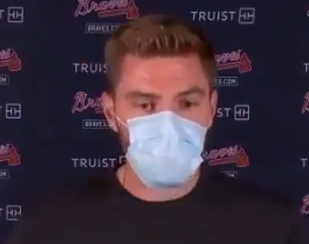
“I said, ‘Please don’t take me,’ because I wasn’t ready.”—Atlanta Braves first baseman Freddie Freeman, describing the worst night of his COVID-19 battle.

These days it’s fair to suggest first baseman Freddie Freeman is the face of the Atlanta Braves. He’s had a solid career thus far and— assuming baseball and American life re-discover normalcy if and when the coronavirus world tour finally dissipates—it’s safe to assume he’ll continue that way when healthy.

He’s had a few seasons interrupted by injuries and one truncated season-to-be interrupted rudely by COVID-19 itself. It was enough to make him thankful for his recovered health and the small things, considering the shake he incurred while suffering with the illness.

When baseball began its “summer camp” version of delayed spring training, Freeman was one of four Braves to test positive for the coronavirus. Pitcher Touki Toussaint showed no symptoms, though, and returned to the Braves on Friday. The other two—lefthanded relief pitcher Will Smith and utility infielder Pete Kozma—haven’t returned yet.

And, there came one point where Freeman feared he’d go from incumbent Brave to dead duck. That was the day his fever spiked to 104.5, usually the level at which you’d also suffer pneumonia. (Fair disclosure: your servant has fought and beaten pneumonia twice in his adult life.) It also spiked him into prayer.

“I said a little prayer that night,” he told a Saturday conference call. “I’ve never been that hot before. My body was really, really hot . . . I said ‘Please don’t take me,’ because I wasn’t ready.”

Freeman’s coronavirus adventure began when—after he “tested negative on the intake” and felt “great” on 30 June—he awoke two days later in the wee small hours feeling a swarm of body aches. “I didn’t know,” he said. “It didn’t cross my mind that it was coronavirus when I woke up that morning.”

It’d cross his mind soon enough, alas.

“I went to bed late and didn’t get enough sleep,” Freeman continued. “So I took some Tylenol, some ZzzQuil and finally got back to bed. Then I woke up around 11:30 and I immediately grabbed my phone and texted my wife and said, ‘Something is wrong. I need you to bring a thermometer.’ They gunned my forehead and it said 102 fever. I looked at it and said, ‘I think I need to call George (Poulis, the Braves’ trainer). I think something is different’.”

It was. The Braves got him a medical appointment, on 3 July, and the test came back positive.

“The crazy thing is, [that] Friday morning, I woke up in a pool of sweat, gunned my forehead and it said 98.2, so I had no fever that morning,” Freeman said. “That was 7:30 in the morning. So I went to the field because I was waiting for the test, I hit, I threw, I worked out and I ran at my house and felt completely fine. By 2 p.m., it hit me like a ton of bricks. I came back and I was like ‘Wow. I’m not feeling very good.’ It just snowballed after that.”

He spiked that shivery 104.5 that night. “Thankfully, George wasn’t awake when I texted him because I probably would’ve gone to the hospital,” he said. “Ten minutes after that, I gunned my forehead again and I was 103.8, then 103.2, then 103.6. So I was like, ‘If I go above 104 again, I’ll probably have to start ringing the phone and try to figure this out.”

That’s about when Freeman began to pray. Awakening the following morning with a mere 101.5 temperature, he figured that much he could take and feel relief. That Friday night, he said, was the worst of it, if you didn’t count that it interfered with fatherhood over the week that followed.

“I’d stand up, get dizzy and I’d have to sit back down. Trying to tell my 3-year-old not to come around me was difficult,” he said. “I wore masks, gloves, I was playing cars with them. Ten minutes after playing cars with them I’d have to sit down. I was a little fatigued and tired. Then, every three hours it felt like I had to take a nap.”

A week after those first symptoms, Freeman still didn’t feel great until he had yet another nap. When he awoke, though, he felt great enough to hail his wife, Chelsea, and ask for copious carbohydrates. She obliged with some Italian food. Come Saturday morning he’d gone nine days with no further symptoms, and a lot of gratitude.

So far, no more body aches, contradictory chills, and short losses of his senses of smell and taste. While his wife and an aunt continue recovering after they, too, tested positive, Freeman returned to Truist Park after a second consecutive negative test. He said his family did everything right to avoid the virus but “it still somehow got to me.”

The Braves would love to get to him as many plate appearances as possible before the truncated regular season begins, but Freeman isn’t entirely sure just how ready he’ll be. His manager, Brian Snitker, isn’t exactly worried. “I don’t think I have to look for anything,” Snitker told reporters. “If he’s out there he’s going to be ready.”

Despite sore legs the day after a Friday workout, Freeman bopped a run-scoring triple over the head of the Braves’ face-in-training, Ronald Acuna, Jr., in Saturday’s intrasquad game. He also made an over-the-shoulder running catch of a foul pop. You’d have been hard pressed to find any Brave happier to have their first base anchorman back than Freeman himself.

“I feel like I’m a kid in a candy store again,” he told that conference. “You forget sometimes how much you love this game. I did truly miss it. I was so excited when I got to the yard.”

It didn’t come without a few painful disruptions. When outfield mainstay Nick Markakis decided to opt out of playing in 2020, Freeman in the thick of COVID-19 was a huge factor after speaking to the first baseman by telephone. “Unfortunately,” Freeman said, “that was my worst day He just wasn’t into it, and I totally, totally get it.” The followup call between the two a couple of days later totally, totally affirmed Markakis’s decision. Freeman still gets it.

Surely he also gets that his return to the Braves was a badly-needed adrenaline shot. With Markakis out of this year’s picture, the Braves took a flyer on free agent outfielder Yasiel Puig—until Puig himself tested coronavirus positive. There went that idea. And, likely, there went Puig’s 2020, until he clears the medical protocols with two consecutive negative tests.

“I am sad that this has happened,” Puig tweeted, “but I believe that everything is in God’s timing and that my return to MLB will happen in His perfect timing.” He’ll need that kind of faith now, especially, unless God has a direct advance line on which teams might turn up needing experienced outfield help after Puig recovers and stays negative.

The cliche about waking up to smell the coffee has a certain resonance with Freeman now. “It didn’t dawn on me that I lost my taste and smell until my aunt went and got me a coffee and I couldn’t taste the coffee,” he said. “So we went and grabbed barbeque sauce and I put it up to my nose and couldn’t smell anything. I tried to taste it, couldn’t taste anything. So that lasted four days. Other than that, it was just bad the first three days for me.”

Freeman will be happier when his family is back to normal and he can be ready to go come Opening Day, when the Braves open against the New York Mets in Citi Field.

“We’re going to try. That’s the whole goal, for me to be ready Opening Day,” he said. “Thankfully, it’s not like a normal spring training. We can control the games. So the whole plan, talking to (Snitker), I’m going to be getting five or six at-bats for the next five days . . . I’m trying to get potentially thirty at-bats over the next five days. I did a full workout yesterday. We’re going to take it day by day.”

Day by day. MLB’s season watchword. With no guarantee for the time being that it will proceed without further nasty surprises. At least, whether just awakening or in the mood for a cup later in the day, Freeman can smell the coffee now. In more than one way.


Rank desertion? Don’t even go there.

2020-07-11 BusterPosey

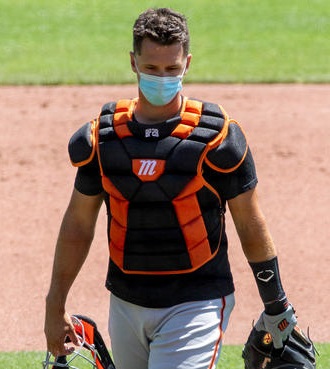
San Francisco Giants catcher Buster Posey has opted out of playing this year for the sake of his children—an incumbent pair of twins and a pair of twin newborns freshly adopted. Some dare call it desertion—erroneously.

Whatever else you think about those major league players who have opted out of playing in 2020, or who think about doing so, here’s something that shouldn’t come into play: someone snarking about such players committing “rank desertion.” (So help me, that’s how someone phrased it in one online baseball forum.) Ignore them. Let them rant their heads off, but you’re under no obligation to listen.

That’s one of the beauties of free speech, what’s left of it. You can rant your head off any old time and place it strikes you to rant. You also bear no known mandatory obligation to listen to any particular ranter for any particular reason.

Militarily, of course, “rank desertion” equals one soldier, sailor, marine, or airman, or a group of them, walking away from their units or posts without call, usually but not exclusively in wartime. In civilian terms, “rank desertion” implies someone or a group of someones walking off the job where there’s no known option aside from a labour strike or formal resignation to do it.

The players were given the opt-out option after all those weeks of haggling between the owners trying to game them out of agreed-upon-in-March pay protocols before they finally agreed to give what remained of a 2020 season a try. Handed that option, those players exercising it cannot be accused credibly of rank desertion.

There’s a coronavirus still on world tour, to various extents, and baseball players play and sojourn in places that still present exposure risks they’re not entirely anxious to bring home. Especially when they have loved ones considered in the high-risk category.

San Francisco Giants catcher Buster Posey may be the highest-profile player to opt out of the season to date. There but for the curse of injuries might he be in the Hall of Fame conversation; maybe two or even three more injury-free seasons on his jacket might keep him there. He could still get those seasons beginning next year.

As was his right under the current protocols, Posey thought more than twice about the twin babies he and his wife, Kristin, are adopting. They were born prematurely last week and at this writing remain in neonatal intensive care. The San Francisco Chronicle says the little girls are doing well enough in the circumstance.

Already the father of incumbent twin children, Posey weighed the risk and pondered the opt-out option that has yet to be rescinded. Then, he made his decision for the sake of his children’s health. The same decision Los Angeles Angels demigod Mike Trout continues weighing as the birth of his first child with his wife, Jessica, looms next month.

Trout isn’t exactly on poverty row so far as major league baseball players are concerned. Neither is Posey, even if Trout is above and beyond his and any other player’s pay grade. Atlanta Braves outfielder Nick Markakis has a family to consider as well, and he’s not exactly going to be among the poor by opting out of 2020, either, as he did during the week now past.

Two factors moved Markakis to opt out, the risk to his family and the very real COVID-19 infection incurred by his franchise co-face face teammate Freddie Freeman. (Braves fans have a case to make that Freeman now shares the distinction with Markakis’s fellow outfielder Ronald Acuna, Jr. Markakis also admits playing with no audience at first doesn’t exactly pose a thrill.)

Markakis spoke to Freeman by phone and learned fast enough. “Just hearing him, the way he sounded on the phone, it was tough,” he told reporters last Monday. “It was kind of eye-opening. With everything that’s going on, not just with baseball but all over the world, it makes you open your eyes.”

Felix Hernandez, the longtime Seattle pitching bellwether now trying to resuscitate his career with the Braves, has also opted out of 2020. So has Michael Kopech, the Chicago White Sox pitcher who’d otherwise hoped to begin his return from his 2018 Tommy John surgery. So has Colorado Rockies outfielder Ian Desmond, whose teammate Charlie Blackmon was hit with COVID-19 and who has alarms about equal to health alarms for doing so.

On health terms, Desmond and his wife, Chelsey, are already parents of four young children and Mrs. Desmond is pregnant with their fifth. That’s the immediate reason Desmond exercised his opt-out option. But it provided him a chance to speak publicly enough on social and even spiritual terms.

Desmond—who is bi-racial—laments what the George Floyd murder at police hands in Minneapolis re-exposes of society in general and, from his perspective, the game he loves otherwise. “Think about it: right now in baseball we’ve got a labor war,” Desmond began in a round of jolting but thought-provoking Instagram posts.

We’ve got rampant individualism on the field. In clubhouses we’ve got racist, sexist, homophobic jokes or flat-out problems. We’ve got cheating. We’ve got a minority issue from the top down. One African American GM. Two African American managers. Less than 8% Black players. No Black majority team owners.

Perhaps most disheartening of all is a puzzling lack of focus on understanding how to change those numbers. A lack of focus on making baseball accessible and possible for all kids, not just those who are privileged enough to afford it.

If baseball is America’s pastime, maybe it’s never been a more fitting one than now . . .

Other opt-outs, also for familial health concerns, include Los Angeles Dodgers pitcher David Price (who has yet to throw a pitch in regular-season competition for them), and three Washington Nationals: first baseman and elder statesman Ryan Zimmerman, relief pitcher Joe Ross, and catcher Welington Castillo.

Baseball’s coronavirus testings have not exactly proven the epitome of consistency or coordination. Teams like the Giants, the Nationals, the Houston Astros, the St. Louis Cardinals have postponed several “summer camp” workouts over them. Astros third baseman Alex Bregman skipped a subsequent Astros workout when his test didn’t arrive back on time. That had a few of his teammates more than a little shaky.

“We want to know how these test results are going to work out for us,” said outfielder Michael Brantley. “Not having Alex here today was just another day he didn’t get to prepare. As I read around the league, a lot of players are voicing their opinions that we need our test results back faster.”

You can say anything you wish about those players opting out and others yet to come who opt out of 2020 for their health’s sake first. If baseball’s testings continue being that inconsistently performed and handled, would you really be shocked to see more players deciding their health and their families’ health just can’t be entrusted to that? Regardless of their salaries?

You can also say as you wish about Desmond’s not-to-be-dismissed-out-of-hand thoughts regarding the first American team sport to end segregation officially while still having issues 73 years later accepting and assimilating non-white personnel on and off the playing field. You don’t need to demand a quota system to say baseball can, should, and must do a better job of it.

Much as we’ve missed a major league season thus far, we seem to need reminders more often than comfortable that certain things cut both ways. Things like the “human element,” for example. The traditionalists screamed blue murder over technological advances they thought (erroneously) would erode the “human element.” But it isn’t just traditionalists dismissing the opting-out as rank deserters.

That dismissal is a plain, no-further-discussion-necessary false dismissal of, what do you know, the human element. The element that says baseball players are not invincible androids who can’t be felled by or transmit disease but mere human men, prone to all manner of incurring and transmitting affliction, particularly during a pandemic that’s become as much a political football as a challenge to medicine.

The rank desertion accusers should be asked how swiftly they’d step in and take the risk for the sake of playing a game much beloved but not without risk. When they answer, “five minutes ago,” they should be asked just as promptly whether they’d like to bring an infection back to their loved ones.

The crickets should be heard playing the entirety of a classic jazz album—In a Silent Way.

The Show will go on, but . . .

2020-06-23 ManfredBallsOK, so the universal designated hitter won’t be coming just yet. That ought to settle the more stubborn traditionalists, who forget often enough that there’ve been a few traditions baseball was better off without and moved to eliminate them appropriately.

But it looks like we’re going to have major league baseball this year, after all. It also looks like it’s going to be nerve wracking, not just because of a sixty-game season by itself but because the continuing coronavirus world tour may make a few more stops baseball isn’t going to like.

The Philadelphia Phillies and the Toronto Blue Jays have had to close their Florida camps when five Phillies-organisation players and one such Blue Jay tested COVID-19 positive. As of Sunday, according to USA Today‘s Bob Nightengale, forty players and/or team staffers have tested positive for the virus.

And when the Show teams return to work a quick-and-dirty delayed spring training, it looks like they’ll be doing it in their home cities instead of at their normal spring training camps in hard enough-hit Arizona and Florida. Which makes things perhaps a little simpler for most but a little trickier for the Miami Marlins, the Tampa Bay Rays, and the Arizona Diamondbacks.

That assumes the players can handle such a brief spring training. The Major League Baseball Players Association has until five o’clock Eastern time today to let MLB know the players can report for such abbreviated and re-located spring training by 1 July, with a projected 24 July season opening. Not exactly the (all things considered) ideal Fourth of July season opening many thought would have been big enough.

While you ponder how not-so-great both sides in the MLB impasse have looked, ponder concurently why there was such an impasse in the first place. The owners and commissioner Rob Manfred tried to renege on a late March deal with the players, plain enough and simple enough, for all the complications that followed. If you want a thumbnail sketch here and now, you won’t get much better than NBC Sports’s Craig Calcaterra:

The terms of that basic framework: the players earned the right to receive prorated pay for however many games played and Major League Baseball would get to decide how many games would, in fact, be played. In light of that, one might’ve assumed that when it came time to set up a 2020 season, it’d be a pretty straightforward thing: the owners, per the March Agreement, would simply say “we’ll play a season of X games” and it’d be done.

Except when the owners first spoke, and proposed an 82-game season in early May, it came with a catch: a demand that the players give up their previously-negotiated right to prorated pay and accept different financial terms. Legally speaking the owners had no right to ask for that and the players were under no obligation to negotiate that. They declined to do so and, instead, countered with various proposals on season length and did not negotiate pay rate. The owners, nonetheless, spent more than a month asking for the players to abandon their rights to prorated pay, proposing multiple alternative schemes. It was not until June 17 — after the players said they would no longer negotiate if MLB kept including pay concessions in their offers and, instead, simply demanded that MLB impose a season and be done with it — that MLB came back with its first offer that complied with the March Agreement.

In shorter words, it took the Show this long to start setting a season because the owners tried—in the middle of a pandemic scaring the hell out of a country that needed the Show to help keep morale alive when nobody knows just when the coronavirus world tour will end at last—to use it as a shield to pull a fast one on the players whose previous inconsistent unity came together the moment they smelled this rat.

Calcaterra also reminds us that relations between the owners and the players weren’t exactly friendly before the pandemic forced baseball’s limbo in March:

The owners had been eating the players’ lunch in recent years, having negotiated a couple of owner-friendly labor deals and, on top of that, putting the screws to players in free agency. In light of that there was already a lot of mistrust and, with the current Collective Bargaining Agreement set to expire in December 2021, each side was already beginning to mobilize for labor battle. Reacting to the pandemic and coming to some sort of an agreement to deal with it would’ve been difficult in even the best of circumstances, and the owners and the players were nowhere close to being in the best of circumstances as the 2020 season was about to get underway.

The players’ lesser cohesion between 2016 and March may have seduced the owners into thinking that, with their continuous tries at reneging on the March agreement, they “could, once again, exploit rifts in the union and get a favorable deal as a result.” Oops. The players hollered foul and stuck to it. For now.

The questions to come include whether they’ll stay so cohesive when it comes time to negotiate a new collective bargaining agreement after the 2021 season. Neither Manfred nor Players Association executive director Tony Clark come out of this mess looking better.

Manfred is exposed as a commissioner unwilling to translate his express power to act for the good of the game into acting as though that good is more than making or saving money for the owners . . . who also forgot what a horrible look it would be when they spent so much time trying to trash what they agreed to in March they were seen as ignoring health implications in MLB’s return.

Clark, though, is seen now as a union leader who doesn’t always read pulses properly and doesn’t always see the bigger picture, including the prospect of recent negotiations and owners’ maneuverings leaving free agency to face what some writers call a potential blood bath.

Or, as Cincinnati Reds pitcher Trevor Bauer tweeted Monday, “So we gave up shares of playoff money, eliminating the qualifying offer for 2021, paycheck advance forgiveness, Covid 19 protections, and protection for non guaranteed arb contracts for next year in order to hold on to our right to file a grievance.”

Bauer had tweeted earlier that the pandemic wasn’t the right time for a battle: “If there’s going to be a fight, the time for that fight is after the ’21 season when a new CBA is negotiated. … We’re doing irreparable damage to our industry right now over rules that last AT MOST 16 months. What kind of sense does that make?”

Nothing about 2020 has made any kind of sense so far. The owners looking terrible makes the same sad sense it always has. The players’ union looking foolish now doesn’t. Everyone in and around baseball knows that.

But at least they kept the universal DH from poisoning the pond, right?