Underhanded Counselling?

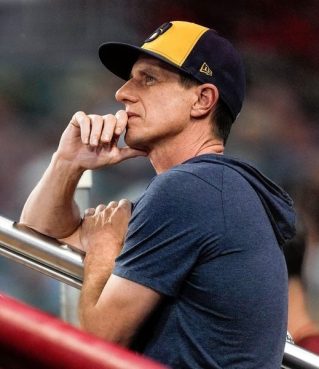
Craig Counsell

No, the Cubs did not poach Counsell from the Brewers. What they did to David Ross, however . . .

Would you blame David Ross if you discover he feels like the husband who was thrown over with little to no warning because the wife decided something better was available? OK, that’s not really a fair analogy. Grandpa Rossy is seven years younger than Craig Counsell. But considering the Cubs’ treatment, he might as well be seven years older.

But something isn’t passing the proverbial smell test about Counsell’s hiring and Ross’s firing.

First, let’s clear this one at once. The Cubs didn’t poach Counsell. Not from the Brewers or from anyone else. Counsell’s contract expired first. He didn’t exactly lack for interest once it became known he intended to test his own managerial market. But test it he did, as a proper free agent.

Now, that said, the manner in which the Ross firing and Counsell hiring were done was a weak look. Team president Jed Hoyer had a deal done with Counsell before flying to Ross’s Florida home to meet and execute Ross, the guy from whom Hoyer said he wasn’t really looking to move on. The headline on The Athletic‘s Patrick Mooney’s take said it with jarring simplicity: “David Ross’s downfall as Cubs manager? He isn’t Craig Counsell.”

Just like Rick Renteria wasn’t Joe Maddon. Just like, as things turned out, Maddon—on whom the Cubs “soured” almost too swiftly when they faded from World Series drought busters to also rans—wasn’t Ross, who’d been one of his more valuable role players for that almost surrealistic 2016 World Series run but received a front-office grooming for the bridge to follow after his retirement.

Maddon also proved not to be Counsell. It was Counsell’s Brewers who chased Maddon’s Cubs down in 2018, possibly putting Maddon onto a very warm seat the heat from which swelled a year later—when the Cubs fell from contention, had a chance to knock the Cardinals out of the races, but got swept by the Cardinals in Wrigley Field in their final home set of the year.

Hopefully, someone in the Cubs’ orbit has tipped Counsell to watch his back in case the Cubs’ administration decides, somewhere along the road, no matter what success that administration allows him to have, that he’s not whomever they’d like to romance and marry in due course.

Especially if, as they did with Ross, the Cubs announce he’s their guy in public only to romance a purported upgrade behind closed doors. Especially if they announce Counsell’s their guy despite a season being ended at the hands of Counsell’s now-former team. With the way the Cubs are administered, nothing’s impossible, including infamy.

This isn’t the single most suspicious fire-and-hire I’ve seen in a lifetime of baseball watching. Nothing compares to the shameful Yankee double switch of 1964. They canned an undermined Yogi Berra the day after the Cardinals beat his Yankees in the World Series. Then, they hired Johnny Keane, the skipper who’d just beaten him in that Series.

We learned only later that then-Yankee GM Ralph Houk had every intention of dumping Yogi after the season, no matter what, even backchanneling during the season to gauge Keane’s interest in the Yankee job, if the Cardinals were ready to let him go before their own pennant race comeback and triumph.

At least Ross didn’t get it the way the Mets once dumped an embattled Willie Randolph, either. Feeling fire under his hindquarters over the Mets’ blowing a seven-game National League East lead in September 2007, Randolph and his Mets opened 2008 34-35 and he was fired—after managing a doubleheader split in New York, then flying coast-to-coast to Anaheim to manage a win over the Angels, and getting fired . . . at 3:11 a.m.

As a manager, Ross was better than some, perhaps not as good as others. He earned his players’ trust even as the Cubs administration allowed a championship team to dissipate and a seeming team of also-rans to replace it. Yet he steered them deftly through the 2020 pan-damn-ic and into that surrealistic postseason. And his Cubs played hard in 2022, especially after the All-Star break, and despite the front office fire-selling at that year’s trade deadline.

In 2023, a Cubs team not supposed to compete competed. They pulled themselves to .500 by 27 July, then to 78-67 on 11 September. But from there they collapsed to going 5-12 to finish the season. They’d ended August taking two of three from Counsell’s Brewers but ended the season losing two of three to them.

Counsell’s NL Central-winning Brewers returned to first in the NL Central to stay on 3 August and probably secured it with a nine-game winning streak during that month’s second half, though going 8-4 to finish the regular season didn’t hurt. Then they got swept right out of the wild card series by the eventual NL pennant-winning Diamondbacks.

Except for pan-damn-ically short 2020, Counsell had only one losing season on the Brewers’ bridge. They reached nine postseasons and one National League Championship Series under his command. And Counsell earned respect for managing those runs despite the Brewers not exactly being or behaving like more than a small-market team.

When his contract with the Brewers expired, many were the speculative stories sending Counsell to a very different Mets organisation, under still-new ownership and now administered by the man who hired him in Milwaukee in the first place, David Stearns. Counsell built a reputation as a communicative players’ manager in tune with the game’s analytic side and in synch with the human side.

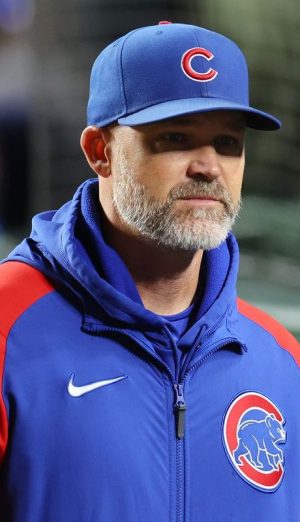
David Ross

So much for being “their guy” . . .

I saw some speculation that Counsell leveraged the apparent Mets interest in him to carve a large contract out of whomever might win his favour at all. But I also saw smarter observations that the Wisconsin-reared and rooted Counsell—the winningest manager in Brewers history—didn’t want to stray far from home in any job change.

He got what he wanted and more, the Cubs signing him for five years and $40 million to steer their Ricketty ship. That alone may do wonders on future markets for steadily successful managers who are usually expected to work for comparative peanuts and be bosses to players who could buy and sell them for the equivalent of a year’s worth of sales taxes.

The Cubs may not fall into big bidding wars for this winter’s free agency class, but they’re expected to be active enough to fortify a team that looked like a rising team often enough in 2023. Cub fans know only too well how swiftly expectations can turn, of course, but let’s leave it be for now.

I would repeat my earlier counsel to Counsell: watch your back—and not just from Brewers crowds ready to hammer you the first time you lead the Cubs to Milwaukee for a series. The next rising managerial star might turn Cub eyes toward him at the first sign of availability, too. And it may not matter whether or not you continue building a resume that might include managing the Cubs to another World Series title, either.

It took Ross—a World Series hero as a role player on the 2016 Cubs, who hit his final major league home run during that staggering Game Seven—several days to speak out about his execution. Telling Talahassee Democrat writer Jim Henry that anger is poison to him, Ross preferred gratitude:

There was a lot of people who worked really hard alongside me. … I am really thankful for the four years I got, coming from zero coaching experience to getting the chance to manage such a great organization that has impacted my life in a great way. There’s great people there. I really don’t have a whole lot negative to say, to be honest.

I get mad from time to time but I have a lot to be thankful for.

Few men and women pick up and dust off from their unexpected purgings with that kind of grace. The Cubs should consider themselves fortunate that Grandpa Rossy didn’t elect to stay away from future team commemorations as long as the incumbent ownership and administration is in place. As with the case of a certain Yankee legend, nobody might blame him if he did.

Grand opening of the 40/70 Club

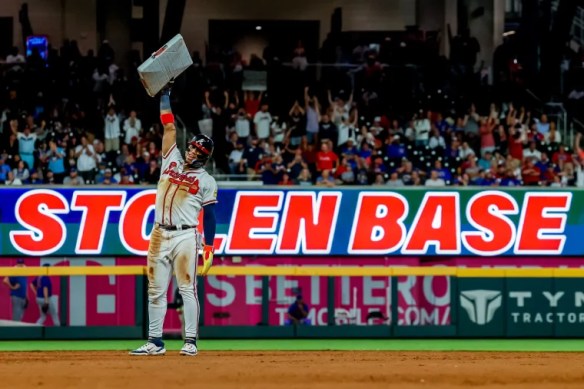
Ronald Acuña, Jr.

Ronald Acuña, Jr. channeled his inner Rickey Henderson after stealing the base that opened the 40/70 club Wednesday night. Some social media scolds plus a Cub broadcaster or two were not amused.

When A. Bartlett Giamatti died unexpectedly in 1989, eight days after pronouncing Pete Rose persona non grata from baseball, the New York Times columnist George Vecsey observed that investigating the Rose case kept the commissioner—a lifelong baseball fan—from sitting in the stands too often.

But Giamatti was there when Hall of Famer Nolan Ryan nailed career strikeout five thousand, Vecsey remembered in his sweet, sad elegy, “ticking off least one Oakland player who thought he detected Giamatti rooting for Ryan.”

Giamatti knew that baseball is about rooting, about caring. Let us envision him on the edge of his seat, a smile softening his gray beard and somber eyes, his fists itching to pump the air as Ryan blew his heater past Rickey Henderson.

The milestone strikeout happened 22 August 1989, in the top of the fifth, during a stretch drive game in Arlington. The Express was already the first man to strike four thousand batters out in his career, never mind even thinking of five thousand, before he opened the inning dispatching the Man of Steal after a full count.

Surely Giamatti appreciated that he was seeing two sides of baseball history in that moment, one Hall of Famer-to-be going where no pitcher had ever gone before, and doing it at the expense of another Hall of Famer-to-be while he was at it. In a pennant race, yet.

Henderson’s Athletics beat Ryan’s Rangers, 2-0, that day, keeping the Rangers ten back in the American League West while keeping a two-game lead over the Angels. But the ovation in Arlington Stadium for Ryan’s milestone drowned out the Rangers’ broadcasters on television and the stadium’s P.A. announcer.

There may have been an A’s player ticked to think Giamatti was rooting for Ryan to land the milestone, but I don’t recall anyone else complaining about the broken flow of the game while Rangers fans cheered Ryan loudly enough to be heard across the Rio Grande.

There was also no social media as we know it today to allow such complaints then. Thus did Ronald Acuña, Jr. break a precedent Wednesday night in his home ballpark in Atlanta and incur some social media heat the following day over the on-the-spot celebration breaking the flow of the Braves’ contest against the Cubs.

Just as Ryan was the first man to strike five thousand batters out, Acuña became the first Showman to hit forty home runs or more in a season and steal seventy bases in the same season. The founding father of the 40/70 club, who’d also founded the 40/50 and 40/60 clubs.

With Ozzie Albies at the plate for the Braves, after Acuña opened the bottom of the tenth with a base hit to send free inning-opening second base cookie Kevin Pillar home with the re-tying fifth Braves run. Acuña took off on Daniel Palencia’s first pitch and dove into second under catcher Yan Gomes’s throw.

Acuña raised his arms acknowledging the Truist Park crowd going berserk in celebration. Then, Acuña wrested the base out of the dirt and hoisted it above his head. Just the way Henderson did in his 1991 moment when he passed fellow Hall of Famer Lou Brock, stealing third as baseball’s all-time theft champion.

“That’s about as good as it gets,” said Braves manager Brian Snitker, ejected from the game in the second when he argued that the Cubs’ Jeimer Candelario fouled a pitch that was ruled a checked swing. (Television replays showed Snitker had the blown call right.) “I thought it was great when he picked up the bag. The fans had to love that. We all did because it was a special moment.”

Maybe the fact that Acuña opened the 40/70 club in the bottom of an extra inning, instead of midway through a game, as Ryan and Henderson had done previously, had an impact on the social media scolds wanting to spank the Braves’ center fielder for taking time to bask in smashing another precedent. (He’s already gone where no leadoff man has gone before, hitting 41 home runs in the number one lineup slot, eight of which were hit when he was the first batter of a game, and eighteen of which were hit when he opened an inning.)

But the Braves, already the NL East champions, had something significant to play for as well, the top seed in the coming postseason, giving them home field advantage through the entire National League Championship Series if they make it there. Once the theft celebration ended, Albies rapped the next pitch down the right field line to send Acuña home with the winning Braves run.

Had Acuña not stolen second in the first place, he wouldn’t have been likely to get past third since the ball was hit sharply enough and fielded swiftly enough.

“It’s crazy what he’s done,” said Albies post-game. “I told myself I need to come through right here. Whatever it takes. I’m happy I came through in that spot and we won that game.”

“It’s one of those numbers that wasn’t impossible but seemed impossible,” said Acuña, referencing that a player could hit forty bombs or steal seventy bases but good luck finding the one man who could do both. Until Wednesday night.

Maybe some of the scolds were Cub fans anxious that the game proceed apace, knowing the Cubs hung by the thinnest thread in the NL wild card race. It would be neither impossible nor incomprehensible. Cubs broadcasters Boog Sciambi and Jim Deshaies were unamused at both Acuña removing the base and the Truist Park scoreboard people showing a quick montage of Acuña’s run to the milestone. Which, in turn, incurred some social media heat sent Sciambi’s way.

Somehow, one couldn’t shake the thought that, if it was a Cub swiping a base in Wrigley Field to establish a new club, that Cub would have given in and done precisely as Acuña did to celebrate the milestone. And no Cub broadcaster would have dared to scold him for breaking the game flow, regardless of inning.

Baseball is indeed about rooting and caring. That includes individual milestones regardless of the hour, day, week, or month. From wherever he happened to be in the Elysian Fields, rest assured A. Bartlett Giamatti gave in and pumped his fist the moment Acuña arrived safe at second. Good for him. Good for baseball.

How to avenge an unwarranted plunk

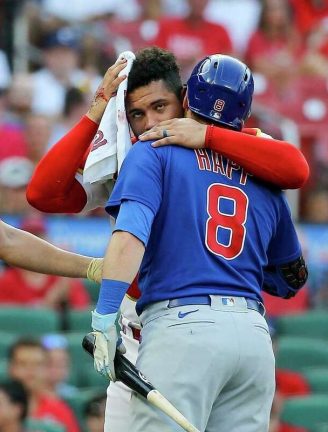
Willson Contreras, Ian Happ

Contreras and Happ embracing, after Happ’s backswing caught Contreras on the coconut, quite accidentally—which didn’t stop Cardinals starter Mike Mikolas from buzzing, then drilling Happ in wrongful retaliation Thursday.

Memo to: St. Louis Cardinals. Subject: The Backswing Bop.

Dear Cardinals: We don’t care how long, how deep, and how bristling is your ages-old rivalry with the Cubs. Nobody checks in at the plate looking to conk a catcher on the coconut with a backswing, no matter what kind of swing he has, long, short, whatever. And, no matter that the catcher is set up so far inside for an inside pitch that he might have been lucky if his head didn’t meet the batter’s lumber.

P.S. When your conked catcher and the batter in question—who happen to be former Cub teammates— hug on the catcher’s way off the field, right then and there you should take it to mean peace, and let’s play ball.

You do not want your starting pitcher taking the perverted law into his own hands going back to work by buzzing that batter upstairs before planting one squarely on his backside. Not if you want to keep your pitcher in there instead of seeing him thrown out of the game, turning things over to an unprepared bullpen that’s liable to get pried, pricked, pounded, and poked for ten runs over the eight and a third innings to come.

Unfortunately, that’s exactly what happened after Cardinals starter Miles Mikolas threw one up and in to Cubs left fielder Ian Happ, in the top of the first, making the count 3-1, before drilling Happ squarely in the top of his right rump roast on the next pitch. There were actually two things wrong with that drill.

Thing one: Mikoas was dead wrong to even think about sending “messages” to Happ and the Cubs at all. Happ wasn’t even close to trying with malice aforethought to catch Willson Contreras on the cranium with his backswing. Their hug as a cut and bleeding Contreras left the game told each other, I didn’t mean to hit you, dude. I know, dude. We’re good.

Thing two: Doing it with two out and resurgent Cody Bellinger on deck was an invitation to potential trouble of the kind having nothing to with machismo retaliation and everything to do with the scoreboard kind. The only kind the Cubs were willing to pursue.

It was also liable to produce exactly what it did produce immediately, Mikolas getting tossed from the game. To the none-too-subtle outrage of the Cardinals’ broadcast team who seem to believe accidents deserve assassination attempts in reply. Come on! You gotta be kidding me! You have got to be kidding me! Have a little feel for baseball. Have a little feel for the game. That’s awful.

What’s awful is a pitcher not seeing his catcher’s injury was unintentional and throwing twice straight at the batter, the second one hitting him. No “feel for the game” justifies throwing at a batter over a pure accident. What did Mikolas expect for playing that kind of enforcer? The Medal of Honour?

“[The umpires] had a meeting and decided to toss me,” a seemingly unrepentant Mikolas said postgame. “The umpires can believe what they want to believe. That was their choice. They believed there was intent there and that’s all umpires need.”

One pitch a little too far up and in, followed by the next pitch bounding off Happ’s posterior, was rather convincing evidence. So, exit Mikolas (and Cardinals manager Oliver Marmol); enter Dakota Hudson, who wasn’t going to get a lot of time to heat up because Mikolas didn’t leave the game on account of being injured.

Hudson promptly surrendered a base hit to Bellinger and walked Cubs right fielder Seiya Suzuki on five pitches before walking shortstop Dansby Swanson with the bases loaded and surrendering a ground-rule, two-run double to designated hitter Christopher Morel, before Cubs catcher Yan Gomes grounded out for the side.

The Cubs extorted three more runs out of Hudson before his day’s work was done, on a pair of third-inning RBI singles and a run-scoring fourth-inning forceout. Hudson’s relief, Andrew Suarez, was greeted rudely when Cubs center fielder Mike Tauchman planted a 2-2 fastball over the center field fence opening the top of the sixth, before a pair of one-out walks in the top of the seventh paved the way for Gomes to slash a two-run double.

During all that, the Cardinals had nothing much to say other than Contreras’s successor, Andrew Knizner, hitting Cubs starter Justin Steele’s first offering of the bottom of the fourth into the left field seats. Not until Knizner batted in the eighth with one out and Cardinals first base insertion Alec Burleson on second (leadoff double) and hit another one into those seats.

It made Knizner the first catcher to enter a game off the bench instead of in the starting lineup and hit a pair over the fences since . . . Cubs manager David Ross, as a Brave on 14 June 2009. “You don’t have much time get ready,” Knizner said postgame. “You just trust your instincts.”

The Cubs said, well, we’ll just see about that in the top of the ninth. Especially after late catching insertion Miguel Amayo was hit by a pitch before being forced at second to set up first and third, from which point Tauchman beat an infield hit out enabling Morel to score the tenth Cub run.

The 10-3 score held up, bringing the Cubs back to .500. They’d sent their own message back to the Cardinals. You want to drill one of ours because of an accidental shot in the head, we’re going to drill you the right way—with hits and runs.

Not even Mikolas (and, apparently, possibly-departing Cardinals pitcher Jack Flaherty) appearing to invite them to come out of their dugout for, ahem, a little chat, could sway them into anything but answering on the field, at the plate, on the mound.

Contreras’s wound was closed with special glue. “I feel good and I want to make sure I’m ready to go tomorrow,” he told reporters. “I wanted to stay in. It was bleeding really bad. It was bad for me because I wanted to stay in there.” Officially, he’s listed day-to-day at this writing.

Having now won eight of their last nine games, the suddenly-hot Cubs have not been without their problems thus far this season. Going back to nursery school with a willfully juvenile opposing pitcher wasn’t one of them.

Danny Young, RIP: The hard climb and fall

Danny Young

It took Danny Young just over a decade to make the Show, and a shoulder injury following a harsh cup of coffee to return home.

The 21st Century’s first official grand slam wasn’t hit in the United States. The Mets and the Cubs opened the 2000 season on 30 March in Japan’s Tokyo Dome. The game went to an eleventh inning, and Cubs manager Don Baylor sent a longtime minor leaguer named Danny Young to the mound to pitch the top half.

The first student from Woodbury, Tennessee’s Cannon High School to make the Show in the first place, Young started auspiciously enough, getting two quick outs on a grounder to shortstop by Robin Ventura and a pop fly around the infield by Derek Bell. Then he surrendered a base hit to Todd Zeile before walking the bases loaded by way of Rey Ordóñez and Melvin Mora.

Mets manager Bobby Valentine sent Benny Agbayani out to pinch hit for relief pitcher Dennis Cook. Young’s first pitch to him missed for ball one. Agbayani hammered the lefthander’s second pitch over the center field fence. After Jay Payton’s followup double, Young escaped when Edgardo Alfonso flied out to center field.

“Even though I gave up a grand slam, I still looked around and it’s like, ‘That’s Mark Grace right there. I’ve got Sammy Sosa in the outfield’,” said Young—found dead at home at 51 Sunday—to Fox Sports. “They patted me on the back and let me know it was going to be all right. I had a lot of the guys come to me and say, ‘Welcome to the big leagues.’ They were like, ‘Things like this happen.’ I should have gotten out of the inning. It was just nerves and knowing within myself that something was wrong.”

It took Young long enough to get to the Show in the first place. Drafted by the Astros at nineteen in 1990, he played for nine minor league teams affiliated to three major league franchises over the decade to follow before he finally made the Cubs after the turn of the century. He never complained about being drafted in the 83rd round, either.

“If I was a first-rounder,” he once told Fox Sports writer Sam Gardner, “I might not have made it, because I had a thirst and a hunger to make it because of where I was drafted. If they’d have set a million dollars down in my hand at that time, there’s no telling where I would have ended up. So maybe that was just meant to be my turn.”

He simply didn’t expect to be on the wrong side of history when he finally got his turn in a Cub uniform in Tokyo.

He knew he’d had control issues from the outset—in his first minor league season he struck 41 batters out in 32.2 innings, but he also walked 39—but he also knew he could learn plenty enough about the game he loved but knew too little about. “I struggled just because it was a new process for me,” he told Gardner. “I still had this fear of making a mistake and the coaches just thought, at the time, ‘This guy is just having a hard time picking this stuff up’.”

Before they released him to be picked up by the Pirates organisation, the Astros even tried as radical a class as they could think of: they hired Hall of Fame pitcher Sandy Koufax, then working free-lance as a roving pitching instructor, to work with Young and with a kid named Billy Wagner in spring 1994.

Young had absolutely no idea who his new teacher was.

“Then I come to find out a couple years later,” Young said, “and people are looking at me like, ‘Dude do you know who you were with?’ I just didn’t know baseball, but they didn’t know that I didn’t know baseball. I just went out there and pitched.” Ever the gentleman, Koufax gave Young a signed ball that Young kept in a clear ceramic ball on a pedestal in his home.

“[I]t was overwhelmingly mind-blowing, the things that he knew about the directional part of pitching that I didn’t really grasp at first,” Young told Gardner of his Hall of Fame teacher. “And as I went along, it got better. I was a late bloomer, so I didn’t really understand the concepts that he was teaching me, but he taught me to find a comfort zone and how to tune out the crowd and what’s going on around me.”

The Pirates, too, remained as patient as possible as Young continued to struggle finding the comfort zone Koufax preached. As in the Astros organisation, Young tried everything he could think of, from changing deliveries and arm angles to changing speeds and back. Only when the Cubs picked him in the 1997 Rule 5 draft did Young begin to smell something close enough to success, or at least real major league potential.

He moved up the chain until he made the team in spring 2000. After Agbayani’s Tokyo blast, the Cubs returned Stateside and Young got into the next three straight games against the Cardinals. The first outing: two walks in two-thirds of an inning but no runs allowed. The second: a two-out double by Fernando Tatis, Sr. but another scoreless escape. Maybe Young was getting it at last.

The third: disaster—a pair of two-out walks, leaving a mess for his relief Brian Williams to clean up in the fourth inning, a mess that continued with a bases-loaded walk, a grand slam by J.D. Drew, and three runs charged to Young that he wasn’t on the mound to surrender himself.

The Cubs sent him back to Iowa after that. Young continued struggling until he finally spoke up further about an issue he’d felt in Tokyo, when he first mentioned to Mark Grace—after a pickoff throw that bounced to first—that he felt something wrong with his shoulder. It turned out his rotator cuff required major surgery, the first of five on the shoulder.

After 2000, Young retired from the game he’d never really had the chance to learn even rudimentarily in a Woodbury where baseball wasn’t exactly a well-taught sport. At least, not until Young returned home to spend the rest of his life raising his family and teaching and coaching the game to local kids.

“I played tee-ball, played Babe Ruth, played Dixie Youth Baseball and high school, but there was no real coaching,” he told Gardner. “And for the [coaches], that was no fault of their own. We hauled hay, we fished, we did whatever we did, and then we went out on the field and had fun. We had teams, but it wasn’t competitive. I mean, I ended up being a right-handed hitter because none of the coaches knew how to teach me how to hit left-handed.”

If only the Danny Young who went home to teach the game on his native ground had been available to the Danny Young who originally caught the Astros’ eyes, however deep in that 1999 draft. He might have had more to show for his long slog to the Show, and in the Show itself.

He never struck a major league hitter out, he walked six, he surrendered five hits, but he kept a big league attitude. For himself, and for his wife, Sarah, their six children, and their two grandchildren. The battler who surrendered this century’s first major league grand slam should only know peace and fulfillment in the Elysian Fields to which he was taken—cause unknown at this writing—too soon.

Bruce Sutter, RIP: Like skipping a rock

Hall of Fame relief pitcher Bruce Sutter with the Cardinals en route their 1982 World Series winner.

“It’s unhittable,” said Hall of Fame manager Dick Williams about Hall of Fame relief pitcher Bruce Sutter’s split-finger fastball, “unless he hangs it, and he never does. It’s worse than trying to hit a knuckleball.” Another Hall of Fame manager, Whitey Herzog, has said that Sutter would never have become injured if he’d remained a Cardinal.

Sutter, who died of cancer Thursday at 69, became a Cardinal in the first place, in 1980, because the Cubs with whom he’d arisen to become a groundbreaking relief pitcher in the first place got caught flatfoot, when the combination of salary arbitration and free agency smashed into a grave if unintended error by longtime owner Phil Wrigley.

The elder Wrigley’s mistake, according to Peter Golenbock in Wrigleyville: A Magical History Tour of the Chicago Cubs, was leaving half his estate to his wife, Helen, whose own death meant the Wrigley estate being taxed heavily twice and leaving son William III, who’d inherited the Cubs, strapped for running the team until or unless he could sell it.

In due course, Bill Wrigley’s financial picture would wreak havoc enough on the Cubs. Sutter himself would remember (to Golenbock) the Cubs having a good team or two followed by a disgruntled team full of veterans who came over from established winners and not liking the Cubs’ post-’79 decline.

About 1979, too, the husky righthander remembered, “That was the year . . . we lost a game to the [Phillies], 23-22. You’re going to ask who gave up the last run, aren’t you? It was a Mike Schmidt home run—off me.” Hitting his second bomb of the day, the Hall of Fame third baseman conked one off Sutter and up the left center field bleachers with two out in the top of the ninth. The Cubs—whose own bombardier Dave Kingman hit three out (one onto a Waveland Avenue porch while he was at it)—went down in order in the bottom against former Big Red Machine relief star Rawly Eastwick.

Sutter learned the split-finger fastball from a minor league coach named Fred Martin and rode it to a 2.33 fielding-independent pitching rate, a 3.42 strikeout-to-walk rate, and a 1.05 walks/hits per inning pitched rate as a Cub. He won the National League’s Cy Young Award for 1979 while he was at it. Then he won a $700,000 salary for 1980 in arbitration.

The only relief pitcher never to have started a major league game when inducted into the Hall of Fame in 2006, Sutter found himself one of the 1980 Cubs’ few leading lights, with a 2.64 ERA and a league-leading 28 saves. He also found himself a Cardinal after that season, after the Cubs under Wrigley’s financial distresses couldn’t pull the trigger on a longer-term deal with deferrable money.

Enter Herzog, who’d only coveted Sutter for half the time Sutter pitched for the Cubs. Only too acutely aware of what happens to even great teams without shutdown relief—he’d been purged as the Royals’ manager after front office disputes trying to get them better relief pitching, before All-Star reliever Dan Quisenberry came into his own—the White Rat, doubling as general manager, brought Sutter to St. Louis for Leon Durham and Ken Reitz plus a spare part named Ty Waller.

Sutter delivered in St. Louis—he nailed down Game Seven of the Cardinals’ 1982 World Series triumph— in large part because Herzog and his then-pitching coach Mike Roarke knew even more than the Cubs how to manage a pitcher whose money pitch just so happened to put arms and shoulders in danger if not handled properly. “[N]obody knew [Sutter’s] motion better than Mike Roarke,”  Herzog wrote in You’re Missin’ a Great Game:

I knew Bruce had to come back behind his ear, then straight over the top, with his delivery. He threw that nasty split-finger pitch, which made the ball look like a rock skipping on water—tough to pick up, let alone hit—but it puts a violent torque on the arm. When you think of the guys who live by that pitch . . . how many had a couple of great years, then dropped off the map?

. . . Well . . . Roarke and I were watching Sutter throw in [spring training] and I saw he was coming kind of three-quarters, bringing the ball out to the side and across. I said, “Holy moly, Mike, he’s all out of whack!” We got right on his ass about it, and he straightened it out. No harm, No foul. Bruce saved a lot of games for us; we saved him more damage than anybody knows.

You know what? If he’d stayed with the Cardinals, Bruce would never have gotten hurt.

Sutter left the Cardinals as a free agent after the 1984 season. Owner Gussie Busch decided to share the top decision making with two Anheuser-Busch leaders, Fred Kuhlmann and Lou Sussman, and they weren’t exactly as amenable to Herzog as Busch himself was, according to Golenbock’s The Spirit of St. Louis.

Herzog swore the pair “jerked” Sutter around over a no-trade clause; second baseman Tommy Herr swore Sussman angered Sutter during their talks. “Bruce wanted to stay in St. Louis,” remembered Herr.

I don’t think the money was that big of a deal. It became more of a personality conflict. Lou Sussman was handling the negotiations for the Cardinals. At some point, Lou rubbed Bruce the wrong way, and Bruce just said, “The heck with it. I’m going somewhere else.” Bruce did it just to spite Lou. And that was unfortunate, because we felt Bruce was just such a weapon for us.

Bruce Sutter

Before the beard: a portrait of the artist as a young Cub . . .

Braves owner Ted Turner showed Sutter a pile of money.` (Six years, $10 million, guaranteed contract.) But Turner couldn’t show Sutter a staff that knew how to manage his workload and keep him from letting his delivery and his bullpen warmups (he was warmed up far less judiciously in Atlanta than in St. Louis) wreck his shoulder at last.

He suffered inflammation in the final third of August 1985 plus a pinched nerve, the injury that almost kept him buried in the minors in the beginning, before Martin taught him the splitter. He would never be the same pitcher again. Had he not fallen under the Braves’ then-dubious care, Sutter’s percentage of inherited runs to score would have ended below 30 percent, splendid work for any relief pitcher.

He may have seen his career collapse in Atlanta, but the Pennsylvania native found Georgia life agreeable enough to stay there with his wife, Jayme, and their three sons. He was the only player inducted into the Hall of Fame in 2006 by way of the writers’ vote, an appropriate position considering how he’d helped to change his baseball craft.

His Hall of Fame teammate Ozzie Smith and Hall of Fame Reds catcher Johnny Bench needled him wearing fake, long gray beards as they escorted him to the podium. Sutter made hitters fear the beard from the bullpen long before anyone heard of one-time Giants bullpen stopper Brian Wilson, but he struggled to stay composed addressing and thanking his wife during his acceptance speech.

We were together through the minor leagues, through the major leagues, and now the Hall of Fame. I love you very much, I appreciate everything you have done and continue to do. I wouldn’t be here without you. I know we have some challenges to face in our future, but we’ll do ’em as we always have, together.

Their marriage was a love that endured almost as long as his love for baseball. So did several friendships Sutter made during his career, such as now-Hall of Fame teammate Jim Kaat, who ended his career as a Cardinal while Sutter anchored their bullpen.

“I feel like a brother passed away,” Kaat told a reporter. “I knew Bruce deeper than just about any other teammate. We spent a lot of time together, and as happens when your careers end, you go your separate ways. But we stayed in touch and considered each other great friends.”

The particular challenge didn’t scare Sutter. Whether throwing that rock-skipping splitter past fellow Hall of Famers out of the bullpen (let the record show that except for two homers each, Mike Schmidt and Willie Stargell, to name two, couldn’t hit him with a warehouse door), or making a half-century marriage raising three sons and becoming beloved grandparents to six in an often self-immolating world, there was no challenge to which Sutter seemed  allergic.

“Heaven needed a big time save,” tweeted longtime baseball analyst Dinn Mann. “Marvelous pitcher, even better person,” tweeted USA Today columnist Bob Nightengale. Baseball will miss him on earth only slightly less than his family will.