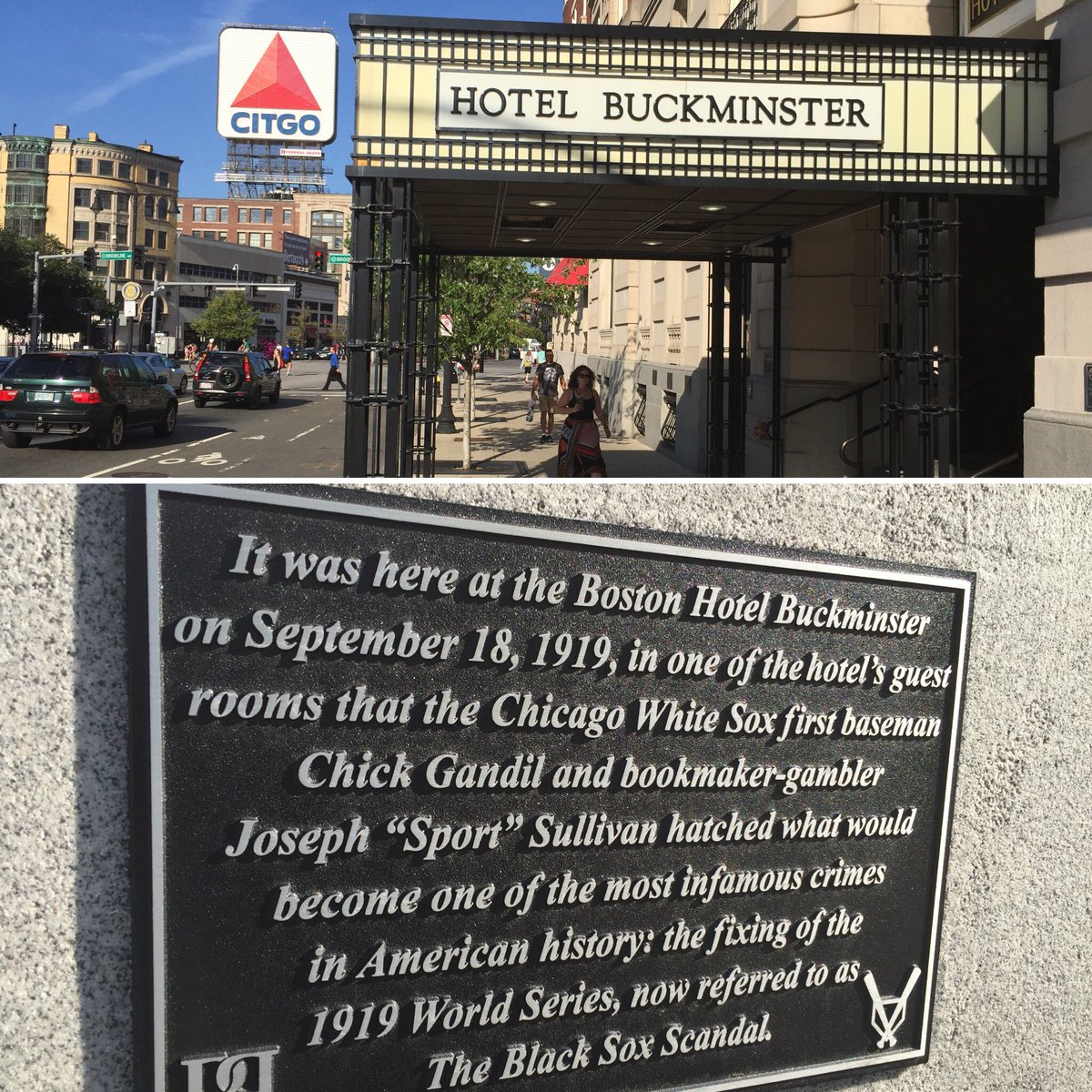
“[A]n incredible lapse of judgment, as well as a failure of character, on Jackson’s part.”
Today is the 136th anniversary of Jackson’s birth. Today, as also happens whenever the subject of Jackson arises around social media, there are those continuing to plead on his behalf and those arguing that he and his fellow Black Sox have no behalf, so far as the World Series fix and scandal are concerned.
Often as not, today and other days, Jackson’s name arises whenever someone’s provoked to mention and re-argue the Pete Rose affair. Rose, of course, was banished for violating the rule the Black Sox and other baseball gambling scandals of that era provoked, Rule 21(d).
Jackson was clearly the best position player among the 1919 White Sox, and he just might have become a Hall of Famer had it not been for his portion of the Series fix. He didn’t instigate the fix. Unlike Black Sox ringleader Chick Gandil, Jackson wasn’t exactly a patron of the demimonde or the gambling underworld.
But he did accept an envelope with $5,000 worth of payoff money, handed him by pitcher Lefty Williams. Society for American Baseball Research writer Jacob Pomrenke probably phrased it best:
Before going home [after the 1919 Series], Jackson went to [White Sox owner Charles] Comiskey’s office in the ballpark and waited to see the Old Roman. Jackson wanted to tell Comiskey about the fix and possibly to return the money he had received. He stayed for several hours, but Comiskey holed up in his office and Jackson eventually left without talking to the White Sox owner.
In February 1920 team secretary Harry Grabiner traveled to Jackson’s home in Savannah and signed him to a substantial raise, a three-year deal for $8,000 per year. Jackson operated a successful poolroom there and a dry-cleaning business that employed more than 20 people. He and [his wife] Katie used the money he had received for fixing the World Series to pay for his ill sister Gertrude’s hospital bills.
Rather than wait until he could see Comiskey, by barging in if necessary, perhaps, he went home, signed a new deal, tended his off-season business, and used his Series fix money. He used it for a noble reason, but he still spent his share of the fix money rather than push harder to turn it over to Comiskey or anyone else in baseball who mattered.
Those who continue the push to see Jackson paroled from baseball’s Phantom Zone and eligible for Hall of Fame enshrinement often point to his surface 1919 World Series statistics: his .394 on-base percentage, his .563 slugging percentage, his .956 OPS, his .375 batting average. But what do you come up with if you burrow past the surface.
What follows is a table showing Jackson with men on in that Series. GO: ground outs. FO: fly/pop outs. ROE: reached on an error. Runs +/-: How far his team was ahead or behind when he batted with runners on. W/L: whether the White Sox won or lost the game.
| Shoeless Joe Jackson with Runners On, 1919 World Series | ||||||||||
| Game | PA | H | K | BB | GO | FO | ROE | RBI | Runs +/- | W/L |
| One | 1 | 0 | 0 | 0 | 1 | 0 | 0 | 0 | -5 | L |
| Two | 2 | 1 | 1 | 0 | 0 | 0 | 0 | 0 | 0; -3 | L |
| Three | 1 | 0 | 0 | 0 | 0 | 1 | 0 | 0 | +2 | W |
| Four | 1 | 0 | 0 | 0 | 0 | 0 | 1 | 0 | 0 | L |
| Five | 2 | 0 | 0 | 0 | 1 | 1 | 0 | 0 | 0; -5 | L |
| Six | 3 | 2 | 0 | 0 | 0 | 1 | 0 | 1 | -3; T4 | W |
| Seven | 3 | 2 | 0 | 0 | 0 | 0 | 1 | 2 | 0; +1; +2 | W |
| Eight | 4 | 1 | 0 | 0 | 1 | 2 | 0 | 2 | -4; -8; -5 | L |
Jackson batted .167 with men on base from Games One through Five, and the White Sox fell into a 4-1 Series deficit. (He also looked at strike three in one of those Game Two appearances.) Then, they played three straight elimination games, winning the first two. Over all three, he batted ten times with runners on, got five hits, and reached on an error.
But in the final chance for the White Sox to stay alive and push the Series to a ninth game***, he was 1-for-4 with runners on, driving two in with that knock . . . with the game still well beyond the White Sox reach.
Fair play: Compromised by factional dissent and compromised pitching as it was entering the Series, the White Sox faced a tougher team than they expected to face. Contrary to long standing, still stubbornly clinging myth, the 1919 Reds were no pushovers. They could very well have beaten the White Sox in a straight-no-chaser Series. The Reds were tainted unjustly twice by gambling scandals: their 1919 Series triumph, and the Rose affair seventy years later.
“[Jackson]’s participation [in the Series fix] consisted solely of trusting Gandil,” Pomrenke wrote, “a stunning amount of faith in a man whom he didn’t know very well. It was an incredible lapse of judgment, as well as a failure of character, on Jackson’s part.” Trusting Gandil, and caving to shortstop Swede Risberg, whom Gandil deputised to (shall we say) persuade Jackson to join the fix, and by whom Jackson felt well intimidated when he pondered backing out of the fix when not receiving his promised dollars at first.
That said, the deepest view of the Series says Jackson didn’t really look as though he started batting to win until the White Sox began facing elimination in Game Five, and in the third straight such elimination game Jackson and the White Sox fell too far short.
You can say for certain that Jackson wasn’t the sole reason the White Sox lost that Series. You can’t say for dead last certain that Jackson deliberately tanked in the first five games. You can’t say whether he didn’t, either. What you can say, alas, is that Jackson did accept an envelope of fix money, that he didn’t try harder than one failed day to get out from under it, and that he didn’t speak cleanly about the fix until facing the infamous grand jury before which he and pitchers Williams and Eddie Cicotte described the fix in full detail.
That one “incredible lapse of judgment [and one] failure of character” cost Jackson his major league career and his standing in “organised baseball” was a shame and a tragedy. Flawed men and women have lost far more than Jackson for even single lapses. Even Moses lapsed but once. And his punishment was far more grave than losing a potential Hall of Fame berth.
——————————
* Not long after writing that essay, I wrote and published a tribute to the late pitcher Jose Lima, for which I drew on an elegy I’d written at the time of his unexpected death. Quite inadvertently, I forgot to include a disclaimer that portions of the new piece were published previously.
The publication called me for plagiarism before I could correct the error and dropped me post haste. No appeal. Even my two editors at that publication couldn’t prevail after they, ahem, went to bat for me, but I remain grateful for their faith to this day.
I’m sure I’m not the only writer who ever got dinged and dropped for plagiarising himself, or herself. But I’ve been careful to a fanatic extent to be sure that, if ever again I use passages I’ve written before, I say at the piece’s bottom that portions were published previously. As were some portions of this essay.
** First baseman Chick Gandil, the fix’s originator, retired from major league baseball before the 1920 season after a contract dispute.
*** The 1919-1921 World Series sets were best-of-nines in a concerted attempt generate more revenue as well as hike baseball’s popularity.


 Throneberry Fields Forever