ALDS Game Two: From blowout to squeaker

Mitch Garver

Mitch Garver’s third-inning grand slam proved the difference maker as the Orioles turned an  early blowout into a squeaker of a win for the Rangers Sunday.

Until this weekend, the last time the Orioles were swept in a series was in May, by the Blue Jays. During the regular season, the Orioles were a .642 team on the road. Now, they’re on the threshold of an American League division series sweep, but they’re counting on that traveling mojo to overthrow a Rangers team that won’t be overthrown without a fight.

Not after the Orioles turned a 9-2 blowout in the making into an 11-8 squeaker in Game Two Sunday. Not after the Orioles couldn’t do better than Aaron Hicks’s three-run homer with one out in the bottom of the ninth. Not after the Rangers battered them for nine runs in the first three innings, including and especially Mitch Garver’s grand slam in the third.

Not after the Oriole bullpen was so deeply deployed following a Game One loss that saw theirs ranks pressed into duty after four and two thirds. Today’s travel day from Baltimore to Arlington may not necessarily give them relief. Not facing a Rangers team that hasn’t played at home in a fortnight but hit 53 home runs more at home than on the road during the season.

“We just came up a little bit short today, but that built a lot of momentum going into the next game,” said Orioles leftfielder Austin Hays after Game Two. “Nobody laid down. We didn’t give away any at-bats. We continued to fight. We were able to get into their bullpen and work on those guys a little bit. I feel good moving forward, but we know we’ve got our work cut out for us.”

That’s a polite way to put it. They played .500 ball against the Rangers in six regular season games, but they blew their home field advantage to open this division series. A team that hasn’t seen home in a fortnight can be presumed hungry to put an end to this set as soon as possible, by any means necessary.

The Rangers proved that when they started Garver, a backup catcher who played in only half the regular season games, and sent him out for his first postseason appearance this time around. In a game the Orioles opened with a 2-0 lead after one full inning, but the Rangers slapped rookie Orioles starting pitcher Grayson Rodriguez silly with a five-run second, Garver checked in at the plate with one out followed by three straight walks.

Orioles reliever Bryan Baker left the pillows loaded for his relief, Jacob Webb. On 3-1 Webb elevated a fastball, and Garver elevated it six rows into the left field seats.

Rangers manager Bruce Bochy—who came out of retirement to shepherd the Rangers after all those years and those three World Series rings managing the Giants—said pregame that it was “just time to get [Garver] out there.” Garver may have given the boss the most expensive thank-you present of the postseason thus far.

“He’s got big power,” Bochy said postgame, “and that’s big at that point in the game. Really was the difference in the game.”

So were the eleven walks handed out by eight Orioles pitchers, including a postseason record five to Rangers shortstop Corey Seager. So were the mere three hits in thirteen Oriole plate appearances with runners in scoring position, which explains a lot about how the Orioles actually out-hit the Rangers (fourteen hits to eleven; .973 to .891 game OPS) but fell three short in the end.

Also in too-vivid contrast were the fruits of each team’s trade deadline moves. Or, in the Orioles’ case, lack thereof. The Rangers moved to bring future Hall of Famer Max Scherzer into the fold but also added starter Jordan Montgomery and reliever Chris Stratton in a deal with the Cardinals.

The Orioles moved to bring another Cardinal pitcher, Jack Flaherty, aboard at the deadline. But Flaherty, once a glittering Cardinal comer, hasn’t been the same pitcher since a 2021 oblique injury and a 2022 shoulder injury. He pitched his way out of the Oriole rotation and now looks to be the long man out of the bullpen.

He got a shot at showing what he could do in that role when it looked as though it would be just mop-up work Sunday. The good news: He surrendered only one run (on Garver’s double play grounder in the fifth) in two innings’ work. The bad news: He contributed to the Oriole walking parade with three of his own, including two in the fifth.

Some say the Orioles standing practically pat at the trade deadline instead of going for any kind of impact deal may yet come back to bite them right out of the postseason, especially after their own pitching depletion (losing top starter John Means and closer Félix Bautista especially) late in the season. Others fear the Orioles were more concerned with their usual penny pinching plus censoring a lead broadcaster over a positive graphic the team itself fashioned for a broadcast.

Montgomery handled the Orioles well following the two-run first, at least until he surrendered a pair in the fourth on an RBI single (Jorge Mateo) and a sacrifice fly (Ryan Mountcastle.) But when Orioles rookie star Gunnar Henderson greeted him with a full-count leadoff home run and Hicks followed with a base hit, Montgomery’s day ended and the ordinarily wobbly Ranger bullpen took over.

That bullpen kept the Orioles quiet until the bottom of the ninth, when Brock Burke handed Henderson a one-out walk and Hays singled him to second. Bochy reached then for José Leclerc, and Hicks—the erstwhile Yankee who never really found his best footing in the Bronx—reached for a one-strike service and drove it into the right field seats.

It was a little vindication for Hicks the day after he blew a hit-and-run sign in the Game One ninth, leaving Henderson a dead duck on the pond when he was thrown out at second, before Leclerc finished the 3-2 Rangers win. After his up-and-down Yankee life, Hicks looked like an Oriole blessing after he signed in May following his Yankee release. After Sunday, he looked like an Oriole hope once again.

An Oriole hope is just what Baltimore needs now. But Ranger hopes won’t exactly play to an empty house come Tuesday. At the end of the former, survival. At the end of the latter, a chance to play for the pennant.
Party hearty, Baltimore, but . . .

Baltimore Orioles

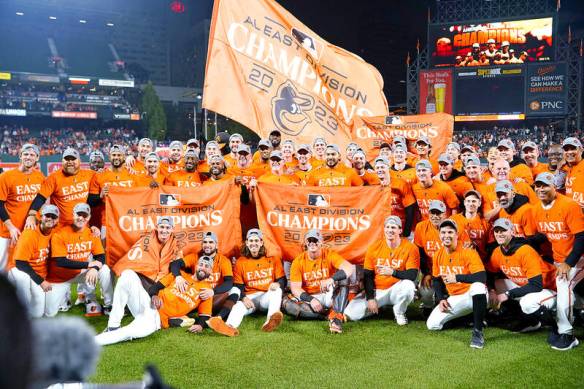
Your American League East champions, who got here the hard, disgraceful way.

You hate to dump rain upon the Oriole parade just yet. But their clinch of both the American League East and home field advantage through the end of the American League Championship Series (if they get that far in the first place) isn’t exactly the early climax of a simon-pure story.

Of course it’s wonderful to see the Orioles at the top of their division heap and Baltimore going berserk in celebration. Of course it’s wonderful to see the first team in Show history ever to lose 100+ in a season flip the script and win 100 within three years.

Of course it’s wonderful that the Orioles are going to stay in Camden Yards for three more decades at least, an announcement that came in the third inning Thursday. It sent the audience almost as berserk as they’d go when Orioles third baseman Ramón Urias threw the Red Sox’s Trevor Story out off a tapper to secure the clinch.

Of course it’s wonderful that we don’t get to call them the Woe-rioles, or the Zer-Os anymore. And of course it’s going to feel like mad fun rooting for the Orioles to go deep in the postseason to come, even one that remains compromised by too many wild cards and too many fan bases thus lost in the thrills and chills of their teams fighting to the last breath to finish . . . in second place or even beyond for a nip at the October ciders.

Unfortunately, it’s not easy to forget how the Orioles got to this point in the first place. In plain language, they tanked their way here. There’s no way to sugarcoat it.

However marvelous and resilient they were all season, however much of a pleasure it’s been to see this year’s Orioles behaving like their illustrious predecessors of 1966, 1970, 1983, and numerous other division champions and pennant winners, they got here via tanking. That should never be forgotten. It should never happen again. To the Orioles or any other conscientious major league team.

It started after their 2016 season ended too dramatically. When then-manager Buck Showalter kept to his Book and his Role Assignments, declined to have his best relief pitcher Zack Britton ready and out there, because it wasn’t a quote save situation. Leaving faltering Ubaldo Jimenez on the mound to face Toronto’s Edwin Encarnación. Baltimore still won’t forget the three-run homer Encarnación parked in the second deck of Rogers Centre with the Blue Jays’ ticket to the division series attached.

They tanked from there forward, picking up from where they left off after 1988-2015. They finished dead. last. in the AL East in three of the four seasons to follow. (A fourth-place finish broke the monotony.) As of a hot August 2021 day when the Angels (of all people) bludgeoned them 14-8, including thirteen runs over three straight innings, they were 201-345—after having been the American League’s winningest regular-season team from 2012-2016.

Before the 2021-2022 owners lockout ended and spring training began, The Athletic‘s Dan Connolly came right out and said it, even though he admitted it didn’t really bother him: rebuilding the entire organisation, ground up, and giving almost all attention to the minors and the world baseball resources but so little to the parent club, “produces a tank job in the majors.”

They weren’t the only tankers in the Show by any means. Famously, or perhaps infamously, the Astros tanked their way to the 2017 World Series—which turned out to be tainted thanks to the eventual revelations that the 2017-18 Astros operated baseball’s most notorious illegal, off-field-based, electronic sign-stealing scheme.

They were preceded by the 2016 Cubs, who tanked their way to that staggering World Series conquest. Like the Astros, the Cubs came right out and said it: they were going into the tank in order to win in due course. The 2016 Cubs don’t have the 2017-18 Astros’ baggage, and their conquest was mad fun, but their fans endured a few seasons of deliberate abuse to get there.

Yes. I said it again. Just like Thomas Boswell did in July 2019. “It’s dumb enough to tear down a roster that is already rotten or old or both,” he wrote.

But it’s idiotic to rip up a team that has a chance to make the playoffs, even as a wild card, especially in the first era in MLB history when six teams already are trying to race to the bottom. With more to come? What is this, the shameless NBA, where tanking has been the dirty big lie for years?

. . . With the Orioles (on pace for 111 loses), Tigers (111), Royals (103), Blue Jays (101), Marlins (101) and Mariners (98) all in the same mud hole wrestling to get the same No. 1 draft pick next season, we’re watching a bull market in stupidity. And cupidity, too, since all those teams think they can still make a safe cynical profit, thanks to revenue sharing, no matter how bad they are . . .

. . . In the past 50 years, losing usually leads to more losing — a lot more losing. I’ve watched it up close too often in Baltimore. In 1987-88, the Birds lost 202 games. Full rebuild mode. In the 31 seasons since, the Orioles have won 90 games just three times. At one point, they had 14 straight losing seasons. Why did D.C. get a team? Because the Orioles devalued their brand so much that there was nothing for MLB’s other 29 owners to protect by keeping a team off Baltimore’s doorstep.

Baseball has seldom seen a darker hour for its core concept of maintaining the integrity of the game. Commissioner Rob Manfred is either asleep or complicit.

Too many teams are now breaking their implicit vows to the public. They’re making a profit through the back door as money gushes into the game from revenue streams, many of them generated over the Internet, which are divided 30 ways. For generations, fans have believed that they were “in it together” with their teams. Bad times made everybody miserable — fans, players and owners alike. Now, only the fans take it in the neck.

And in the back.

So this year’s Orioles, a genuinely fun and engaging team, with a lot of genuinely fun and engaging players, have won 100 games for the sixth time in their franchise history. They have the home field postseason advantage for as long as they endure through the end of the American League Championship Series. They’re liable to make things interesting for any team looking to dethrone them this postseason. Just like their former glory days.

It’s wonderful to see Camden Yards party like it’s 1969 again. Or 1970-71. Or 1979-80. Or the scattered good seasons between then and now. But it should be miserable to think of how they got here in the first place. It should be something no Oriole fan, no baseball fan, really, should wish to see again.

Tanking is fan abuse, plain and simple. It also abuses the game’s integrity. That integrity has taken more than enough shots in the head from other disgraces perpetuated by its lordships. Don’t pretend otherwise.

But now that we’ve got that out of our system, for the time being, let’s celebrate. The once-proud organisation that gave us the Brooks-and-Frank-Family Robinson era, The Oriole Way, and the era of Steady Eddie and Iron Man Cal (though beating the 1983 Philadelphia Wheeze Kids could have been called shooting fish in a barrel), is going back to the postseason at last.

And, this time, let’s pray, that when a true as opposed to a Role-or-Book “save situation” crops up in the most need-to-win postseason game, manager Brandon Hyde won’t leave his absolute best relief option in the pen—a dicey question, considering they’ve lost closer Félix Bautista (now to Tommy John surgery), even with Yennier Cano emerging to look like a grand candidate—waiting while a misplaced, faltering arm surrenders a season-ending three-run homer before their time.

Maybe these guys have what it takes to wrestle their way to a World Series showdown with that threshing machine out of Atlanta. Maybe they won’t just yet. Let’s let Baltimore and ourselves alike enjoy the Orioles’ October ride while it lasts, however long it lasts. The loveliest ballpark in the Show has baseball to match its beauty once again.

Brooks Robinson, RIP: Swept up to the Elysian Fields

Brooks Robinson

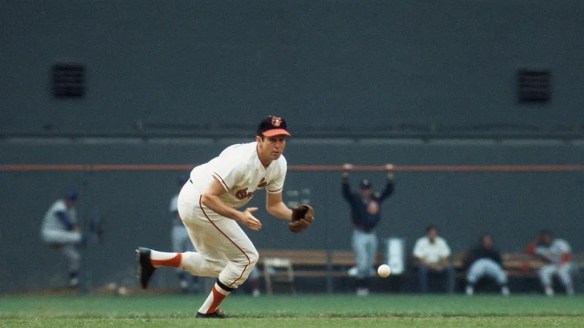
Nothing got past The Hoover too often in two decades at third base.

When Hall of Fame third baseman Brooks Robinson celebrated his 83rd birthday, I couldn’t resist having a little mad fun with his nickname, actual or reputed. Commonly known as the Human Vacuum Cleaner, I recalled longtime Washington Post writer Thomas Boswell calling him The Hoover.

Considering how he beat, swept, and cleaned at third base for two decades, I thought Boswell had it more dead on. So did Reds first baseman Lee May during the 1970 World Series. May first called Robinson—who died at 86 on Tuesday—the Human Vacuum Cleaner at that time. Then, May asked, right away, “Where do they plug Mr. Hoover in?”

Anyway, I thought of other great fielders at third and otherwise. Almost none of them were quite on Robinson’s plane. (“I’m beginning to see Brooks in my sleep,” lamented Reds manager Sparky Anderson during that Series. “I’m afraid if I drop this paper plate, he’ll pick it up on one hop and throw me out at first.”) But they were some of the best their positions ever hosted.

Fellow Hall of Famer Mike Schmidt combined breathtaking power at the plate with his own kind of sweeping and cleaning at third. Considering that plus his sculpted physique, I thought that, for him, it could only be the classic Electrolux, the sleek tank vacuums of 1924-2004.

You couldn’t possibly top The Wizard of Oz for Ozzie Smith at shortstop, but I tried. For him, I designated Aero-Dyne, the model name of Hoover’s first tank-style vacuum cleaner. Nor could you possibly top Graig Nettles’s actual nickname, Puff the Magic Dragon, and I was kind enough not to try. But for others, I came up with things like these:

The Constellation—Roberto Clemente. Hoover’s once-famous, Saturn-shaped canister, born as a swivel-top in 1951, seems to fit Clemente since it often seemed that his ways of running balls down and cutting baserunners down did emanate from somewhere beyond this galaxy.

The Courier—Andruw Jones. That machine was Sunbeam’s brilliant 1966 idea of stuffing vacuum cleaner works into what resembled a Samsonite hard-shell suitcase. Jones traveled so many routes so well becoming baseball’s all-time run-preventive center fielder that you could only think of him as the Courier delivering messages of doom to opposition swingers and runners.

The ElectrikBroom—Keith Hernandez. Mex was as sculpted at first as Schmidt was at third. As vacuum cleaners went, the classic Regina ElectrikBroom was the Bounty paper towel of its time: the quicker picker upper. That was Hernandez at first base.

Eureka—Ken Griffey, Jr. Tell me you saw him turn center field into his personal playground and making spectacular catches without thinking, “Eureka!” 

The Hoover Junior—Mark Belanger. Robinson’s longtime partner at shortstop and the second most run-preventive player at his position ever behind The Wiz. The only reason he won’t be in the Hall of Fame is because he couldn’t hit if you held his family for ransom.

The Kirby—Kirby Puckett. Should be bloody obvious. 

The Premier—Johnny Bench. Should be self explanatory if you saw him behind the plate. (After watching Robinson’s third base mastery against his team in that 1970 Series, Bench quipped of his MVP award, “If he wanted the [MVP prize] car that badly, we’d have given it to him.”)

The Roto-Matic—Clete Boyer. That Yankee third base acrobat moved around so much cutting balls off at the third base pass you could have mistaken him for the swiveling hose atop Eureka’s canister cleaner of the same name.

The Royal—Curt Flood. The king of defensive center fielders when Mays began to show his age. (Maybe it should have been a wet-dry vac, since it was said so often that three-quarters of the earth is covered with water and the rest was covered by Flood.)

The Swivel-Top—Willie Mays. That General Electric canister of the early 1950s boasted of giving you “reach-easy” cleaning, and Mays was nothing if not the reach-easy center fielder of his time.

There was more to Robinson, of course, than just his third base hoovering. There was the decency that enabled this white son of Little Rock, Arkansas, to welcome African-American son of Oakland, California by way of Beaumont, Texas Frank Robinson, upon the latter’s controversial trade out of Cincinnati after the 1965 season. “Frank,” Brooks said, “you’re exactly what we need.”

Brooks & Connie Robinson

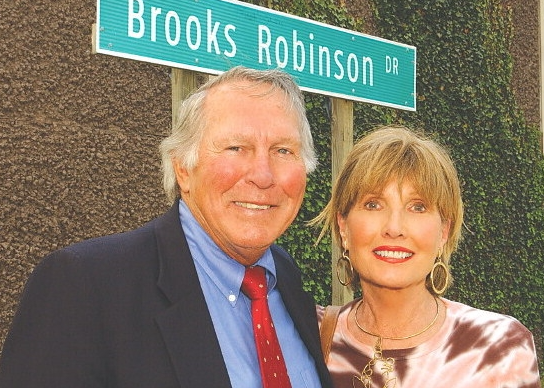
Brooks Robinson and his wife, Connie, at the dedication of Brooks Robinson Dr. in Pikesville, Maryland, just off the Baltimore Beltway, in 2007. The Hoover and the stewardess whose feet he swept her off aboard a 1959 flight to Boston were married 63 years.

There were the eighteen All-Star Games, the sixteen straight Gold Gloves, the 1964 American League Most Valuable Player award, the 1970 World Series MVP. (Forgotten amidst the beating, sweeping, and cleaning at third base that Series: The Hoover hit a whopping .429 with his plate demolition including two home runs.)

There were the 39.1 defensive wins above replacement level (WAR) and the 105 OPS+, making Robinson one of only two players ever to have 30+ dWAR and an OPS+ over 100. The other? Fellow Hall of Famer Cal Ripken, Jr.

There was the end of his career, the final two seasons when the Orioles essentially carried him despite his diminution at the plate and his age-reduced range at third—simply because a) they thought so well of him as a man, and b) they knew he needed the money. Bad. And he wouldn’t in position to benefit from the advent of free agency.

He was broke and in debt thanks to his off-season sporting goods business. Not because he made mistakes but because he was taken advantage of. “At every turn,” Boswell wrote (in The Heart of the Order), “Robinson’s flaw had been an excess of generosity.”

How could he send a sporting goods bill to a Little League team that was long overdue in paying for its gloves? He’d keep anybody on the cuff forever. Said Robinson’s old friend Ron Hansen [one-time Orioles middle infielder], “He just couldn’t say no.” As creditors dunned him and massive publicity exposed his plight, Robinson answered every question, took all the blame (including plenty that wasn’t his), and refused to declare bankruptcy. He was determined to pay back every cent. With great embarrassment, he returned tens of thousands of dollars that fans spontaneously sent him in the mail to soften his fall.

When the Orioles gave him a Thanks Brooks Day upon his 1977 retirement, the master of ceremonies was Associated Press writer Gordon Beard. “Around here,” he said, “people don’t name candy bars after Brooks Robinson. They name their children after him.”

This was the fellow who’d autograph anything proffered—including, it’s been said, a pet rock and a bra. A fellow who so appreciated what he was able to do for a living for his first two decades of adulthood that, when the end came nigh, he could only be grateful for having been there at all.

“Every player I’ve ever managed,” cantankerous Orioles manager Earl Weaver told Boswell, “blamed me at the end, not himself. They all ripped me and said they weren’t washed up. All except Brooks. He never said one word and he had more clout in Baltimore than all of them. He never did anything except with class. He made the end easier for everybody.”

Robinson in retirement climbed out of his financial hole well enough, becoming a popular localised Orioles broadcaster in the 1980s with a flair for candid and perceptive analysis even when it meant being critical. If he lacked anything in those years, it was ambition. He never sought to manage in baseball and he never sought a national audience on the air, but he did have partial ownership of a pair of minor league teams for a time.

The Orioles have retired only six uniform numbers and one is Robinson’s number 5. His statue looms inside Camden Yards, where the Orioles and the Nationals observed a moment of silence before Tuesday night’s game, lined up outside their dugouts, in respect. The American League East-leading Orioles beat the Nats, 1-0.

Robinson also served as chairman of the Major League Baseball Players Alumni Association’s board of directors. If there’s any single blemish on his resumé, it’s that he didn’t move the group toward helping to gain redress for pre-1980 short-career players frozen out of the 1980 pension re-alignment. “He dropped the ball, says A Bitter Cup of Coffee author Douglas Gladstone. “He never went to bat for them, many of whom were his teammates.”

In recent years, the first-ballot Hall of Famer dealt with health issues such as prostate cancer (he 32 radiation treatments), a subsequent followup surgery, and a fall that hospitalised him with a shoulder fracture in 2012. He also became an Orioles special advisor, insisting that it be tied to community events. He was quoted as telling owner John Angelos he’d do anything except make baseball decisions: “That’s passed me by, if you want to know the truth.”

The only love deeper than baseball in Robinson’s life was his wife, Connie, whom he met in 1959 aboard an Orioles flight to Boston when she was a stewardess on board. (They married in 1960.) When he auctioned off his volume of remaining memorabilia (My children, they have everything they ever wanted from my collection), the proceeds went to a foundation the couple established for worthy Baltimore causes, a Baltimore adopted son to the end.

Now The Hoover will beat, sweep, and clean the Elysian Fields. He might even pick up a paper plate and throw Sparky Anderson out at first.

Where was Rob?

Baltimore Orioles fans

The commissioner’s lack of thought or action over the unwarranted Kevin Brown suspension is more than just a terrible look.

In 1988, the Democratic National Convention rocked to Sen. Edward M. Kennedy’s list of doings and concurrent demands of Republican presidential nominee George H.W. Bush, “Where was George?” Those who knew too well of (speaking politely) Kennedy’s rakish and adulterous ways snarked right back, “Dry, sober, and home with his wife.”

This week’s uproar over Orioles broadcaster Kevin Brown’s suspension on perhaps the most nebulous grounds imaginable should have prompted the demand, “Where was Rob?”

Since not enough owners proved dry and sober enough to look all the way deep, the commissioner has another term to serve, through 2029. How delicious is this: Manfred got his extension on the same day Brown was last seen and heard on television for the Orioles. And from the moment we learned the Orioles took Brown’s matter-of-fact comparison between the Orioles’s lack of success in the Rays’ home stadium the past couple of years and its success there this year as fouling their nest, Manfred’s silence has been as deafening as a heavy metal concert.

The clip in question has been viral this week. It’s impossible to hear it and conclude that Brown was anything other than absolutely complimentary about the 2023 Oriole turnaround in Tropicana Field. The turnaround was included in the team-provided game notes. That didn’t stop Orioles boss John Angelos or a designated subordinate from suspending Brown.

It took Awful Announcing to unearth the suspension. It took about ten seconds from their posting it aboard the social media site formerly known as Twitter for the suspension to go pandemic-level viral. It took about that much time, too, for the Orioles to start taking it on the chin for Angelos’s stupidity. But it’s still too much time without a peep from the so-called steward of the game.

Major league broadcasters poured out support for Brown en masse. One, Yankee broadcaster Michael Kay, said that if Angelos didn’t like Brown speaking the plain facts, “then he’s thin-skinned, he’s unreasonable, and he should actually get a call from Rob Manfred, the commissioner of baseball, because it’s unconscionable that you would actually suspend a good broadcaster for no reason whatsoever.”

So far as anyone knows at this writing, Angelos hasn’t gotten the call. Not even after broadcast legend Al (Do you believe in miracles? Yes!) Michaels said (to ESPN’s Jeremy Schaap), “I thought that it was either a joke or there was something much more insidious behind the suspension. And now that I realize that it had everything to do with what was said about Tampa Bay and playing the Rays. I agree, there should be a suspension here. They should suspend the doofus that suspended Kevin Brown.”

Manfred is renowned for a good many things that don’t include statesmanship. Baseball’s version of Winston Churchill he isn’t. But the commissioner has a very broad mandate within the rules outlining his job to act in the best interests of baseball and to act against a team, a player, a manager, an umpire, anyone who’s done something he believes detrimental to the game and the trust the public holds for it.

Commissioners have not always deployed that broad power wisely, of course. Without saying so outright, or with mealymouthed denials, Kenesaw Mountain Landis upheld the disgraceful colour line that wouldn’t be broken until after his death. (His successor, Happy Chandler, told Pittsburgh Courier legend Wendell Smith, “I’m for the Four Freedoms, and if a black boy can make it at Okinawa and go to Guadalcanal, he can make it in baseball”—and proved it by approving Branch Rickey’s signing of Jackie Robinson.)

Bowie Kuhn tried and failed to suppress Jim Bouton’s Ball Four but succeeded in stopping Charlie Finley’s post-Messersmith fire sale of several key Athletics players. The former merely left Kuhn resembling a damned fool. The latter, with its concurrent cap of $400,000 for player sales, probably did as much as any capricious free agency spending spree to abet the salary structure’s inflation and block truly less-endowed teams from sustained financial competitiveness.

And Fay Vincent’s foolish attempt to strong-arm three Yankee officials including then-manager Buck Showalter out of their testimony on behalf of drug-troubled relief pitcher Steve Howe just might have been the wick that lit the powder keg forcing Vincent—already in enough owners’ crosshairs over intervening in the 1990 spring lockout and other business issues—to resign before he could be fired in 1992.

Maybe Manfred didn’t like the thought that calling Angelos out or even disciplining him over the Brown suspension might amount to biting one of the hands that feeds him. Maybe he thought that calling Angelos out or even disciplining him over Brown would have compelled him to address the known Oriole brass objections to Brown’s observation included implications that they were “cheap.”

Translation further: Maybe Manfred thought calling out and disciplining Angelos over Brown would amount to admitting the Orioles tanked their way to where they are today. Manfred has objected to tanking verbally in the past while doing little to nothing in the public perception to put a stop to something that amounts to fan abuse. Tanks for nothing.

But there are times when a commissioner must consider that, as longtime New York Times writer George Vecsey once formulated (and as I’ve borrowed shamelessly over the years), the common good of the game isn’t the same thing as merely making money for the owners.

Manfred thought nothing of dropping a heavy fine upon Astros owner Jim Crane;  suspending general manager Jeff Luhnow, manager A.J. Hinch, and former bench coach Alex Cora; and, eliminating key draft picks from the team over the next couple of years, after the exposure and investigation of Astrogate. If he could act in the game’s best interest over its worst cheating scandal ever, he could certainly act on behalf of saying there’s no place for censorship on the baseball air.

He could, but he hasn’t.

Brown is due to return to the Orioles’ television booth tonight, when the American League East leaders open a weekend series against the Mariners in Seattle. Sports Illustrated‘s Jimmy Traina offers a sobering point when suggesting that Brown will be in a somewhat untenable position going in:

He’ll return to the airwaves with no explanation of him going MIA. His every word will be dissected and fans watching, while admiring and respecting Brown, will fully expect him to watch his every word, which hurts his credibility.

The poor guy has basically been neutered. A quick check of Brown’s Twitter account shows he hasn’t tweeted since July 26. Before that, Brown rarely went two or three days without tweeting. He’s probably terrified to say anything because he knows he can’t address the injustice he experienced honestly.

It’s just surreal to think about the irreparable damage that has been done by the Orioles in this situation.

“Free Kevin Brown” chants in Camden Yards a couple of nights ago must have fallen upon deaf ears in the commissioner’s office. Those fans would have been justified completely if they’d altered those chants with chanting “Where was Rob?” This time, answering “Dry, sober, and home with his wife” won’t be enough.

The doofus who suspended and thus may also have neutered Brown remains unsuspended yet. Where is Rob?

Bird brains

Kevin Brown

Kevin Brown, in the Orioles broadcast booth at Camden Yards. He’s said to be returning 11 August—the Orioles’ administration must have felt the heavy heat when the suspension they won’t call a suspension went viral.

I had to look. On 23 July, which proves to have been Orioles announcer Kevin Brown’s last day on the television air, the Orioles won a second straight from their American League East rival Rays in Tampa Bay. They’ve won nine of thirteen since. So, at least, the Orioles icing Brown so witlessly didn’t affect the team on the field.

The Oriole ownership that thinks it was worth suspending Brown indefinitely for pointing out what was in the team’s own game notes guides—that the Orioles did better in the Rays’ stadium this year than they had over the previous two—had better not even think that nine out of thirteen means they can win no matter who’s doing the television play-by-play.

Because if they’re foolish enough to think that, the roasting they got from Gary Cohen, the lead broadcaster for the hapless Mets, whom the Orioles just spent a weekend sweeping (and out-scoring 19-6), may seem like a jacuzzi bath compared to what they’d invite then.

“That was really all he said,” Cohen said of Brown’s plain-fact, non-opinion description of the Orioles’ issues in Tropicana Field. Then, with Mets first base legend and co-colour analyst Keith Hernandez sitting to his right, as the Mets led the resurgent Cubs 5-1 in the bottom of the fourth Monday night, Cohen let the Orioles have it but good.

And for that, the Baltimore Orioles management decided to suspend Kevin Brown. Let me just say one thing to the Baltimore Orioles management. You draped yourself in humiliation when you fired Jon Miller, and you’re doing it again. And if you don’t want Kevin Brown, there are 29 other teams who do.

It’s a horrendous decision by the Orioles. I don’t know what they were thinking. But they’ve gotten exactly the reaction that they deserve. And it’s just a shame, because the Orioles are playing so well, and now they’ve diverted attention from that, and now made themselves a laughingstock.

Cohen is hardly alone among baseball’s broadcast family. Some of them, and some of us writers, would say we don’t know if the Orioles’ administration was thinking. It wasn’t as though Cohen had failed to speak on behalf of telling it like it is on the air in the past. The Mets beat writer for The Athletic, Tim Britton, remembered a 2019 interview in which Cohen couldn’t understand why every baseball organisation doesn’t believe in letting its broadcasters speak the truth.

“Many believe that in not telling the truth, that you’re doing a service to the organization, and the fact of the matter is it’s just not true,” Cohen said then. “Because if everything is great and everything is sunshine, then when things really are great, there’s no differentiation.”

Part of being a baseball fan is experiencing the highs and lows as they happen and understanding them for what they are. I think that’s what the Mets have always allowed their announcers to do. There’s always a line to tread, there’s always a path that would be the wrong one to go down, but if you do your job correctly, then you know where those lines are and you express yourself in a well-informed way. Then everybody wins.

If only Cohen had been around for a time when it wasn’t quite true with the Mets. When an ancient Mets regime trashed and then sent Hall of Fame pitcher Tom Seaver out of town in the notorious “Saturday Night Massacre” in 1978, the Mets ordered cameras not to show dwindling Shea Stadium crowds, or fabled “Sign Man” Karl Ehrhardt holding up his once-fabled WELCOME TO GRANT’S TOMB placard.

They also didn’t let their announcing team speak of it readily, much the way the Orioles today are known to object when certain former players are mentioned on broadcasts. Finally, the original Mets broadcast team of Lindsay Nelson, Bob Murphy, and Ralph Kiner broker up when Nelson—fed up with both the censorship and the dismantled Mets’ losing ways—took a hike.

Cohen may not remember either that a later Mets administration decided they’d had it with  Tim McCarver’s analytical candor, too, telling him to take a hike in favour of Seaver himself (who’d been a Yankee TV analyst for five years), whom the Mets believed was more likely to be a “team player.” (Read: Shill.) But he was hardly alone in roasting the Orioles, merely the one who went absolutely viral first and most when Awful Announcing‘s scoop on the suspension hit social media running.

“Somebody didn’t like the facts very much,” said the Red Sox’s lead television announcer, Dave O’Brien, calling the Brown suspension “a fiasco, that that’s allowed to happen. And I think every announcer in the league feels the same way . . . I thought it was a joke, initially, when I read it.”

“It’s amazing to me,” said Yankee broadcaster Suzyn Waldman, while the Yankees met the White Sox in Chicago. “How can you do your job if you can’t tell the truth? But he didn’t even say anything negative. He was extolling how good they are, because look what they’ve done this year, and in the past they didn’t do it. So I don’t understand. When I saw the clip, I was waiting for him to say something horrible. And it was not.”

“[Brown] continuously provides an example worth emulating & sets a high bar,” Xtweeted Royals play-by-play announcer Jake Eisenberg. “That not only goes for on the air, but also off the air. This situation is ridiculous, and that’s an understatement at best.”

The Orioles’ administration may have felt higher-temperature heat than a Las Vegas summer over the disgrace. The Athletic has Xtweeted “sources with knowledge” have told their reporter Britt Ghiroli that Brown will return on 11 August. When Ghiroli herself reached the Orioles for comment, the team declined and “a spokesperson” for co-owner John Angelos even said “there was no suspension”—but refused to answer her followup questions.

“Who cares what they called it?” she fumed. “We all know what it is.” Indeed we do. We also know it exposed the Oriole brass as censorious bird brains.