
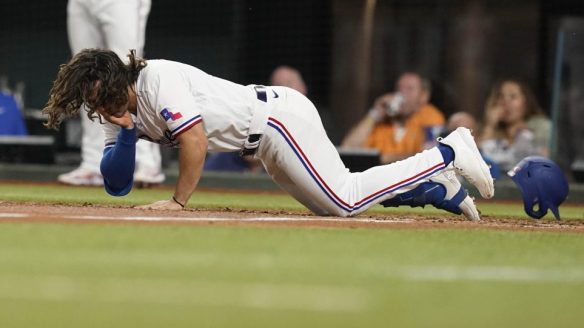
Josh Smith took one for the team Monday—a slider in his face . . .
Maybe it depends upon your definition of “good news.” Rangers outfielder Josh Smith took one on the jaw in the third inning Monday, on an 89 mph slider from Orioles relief pitcher Danny Coloumbe. A Rangers trainer looked him over before he walked off the field under his own power, but Smith was sent to the hospital regardless.
“We did take him to the ER,” said Rangers manager Bruce Bochy, the former three-time World Series-winning Giants manager now in his first season out of retirement. “He had some CT tests. They came out clean. So, we got good news there. He’s feeling better as I’m speaking right now. Tomorrow, we’ll just reevaluate him.”
Coloumbe himself was in the game that early because Orioles starter Kyle Bradish was knocked out of the game an inning earlier. Not by a Rangers uprising—the Orioles held on to win, 2-0—but by a line drive off his right foot, courtesy of Rangers catcher Jonah Heim. Initial X-rays showed no fracture but Bradish is out for now with a bruise.
If you want to call it that, Bradish was a little more fortunate than Smith. Not just because Heim’s liner nailed his foot and not his face, but because the liner was measured as traveling 104 mph.
Go ahead and say baseball ain’t beanbag if you must. But at least acknowledge that batters injuring pitchers on bullet-train line drives back to the box aren’t trying to be cute or sending messages. Neither are pitchers injuring batters even on 89 mph sliders they’re not throwing as purpose pitches and may not be able to control.
There was also Boston’s Justin Turner and San Diego’s Austin Nola taking pitches in the face during spring training. There were Bryce Harper (Phillies) and Kevin Pillar (then a Met) each taking one in the face two seasons ago. There’ve been others. Too many others. On both sides of the ball.
Unless Commissioner ADD and his rules-changing fetishists take a hard look at another rule change or two, someone’s going to get killed, either by a pitch or a line drive in the head. Maybe the first change should be moving the pitching rubber back at least the equal distance to the length of home plate.
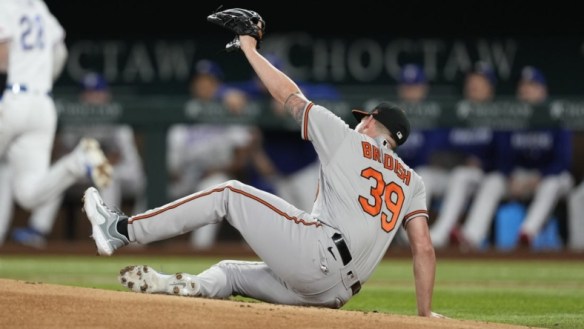
. . . an inning after Orioles starter Kyle Bradish was hit in the right foot by a comeback line drive. Bradish was lucky—it could have been his face.
Right now, you think the rubber is 60’6″ from the plate. You’re wrong. As my cherished Mets/Senators/Tigers friend, former pitcher Bill Denehy, pointed out to me when we first talked four years ago, the actual distance is 59’1″ from the front of the plate. The 60’6″ is the distance from the rubber to the back point of the plate. Throw in a pitcher who can break three digits on the speedometer with a long stride, and the distance shortens. Dangerously.
Denehy was the player sent to the Senators to finish the agreement by which Hall of Famer Gil Hodges became the Mets’ manager. Today he’s almost as passionate about moving the rubber back for safety’s sake as he is about the struggle to get full major league pensions for himself and 500+ other pre-1980, short-career players frozen out when the owners and the players’ union re-aligned the pension plan in 1980.
“What baseball hasn’t seemed to take into account is, if you go back forty years ago, the average fastball back then was probably about 85 miles an hour,” the former righthander said by phone from his Florida home Monday.
You had your exceptional pitchers who could throw at 95, or Nolan Ryan who was over 100. As the fastball has increased . . . they’re also not taking into account the size of the ballplayer. You now have several pitchers 6’8″ or 6’10”. When you look at a pitcher that tall, he’s going to take a stride as long as seven feet. If you take that closer to home plate, you’re throwing 100 mph not at 59’2″ but less than that because of the stride that person takes.
That’s looking from the mound side of the equation. Now, look at it from the batter’s box. Denehy is just as emphatic about it. As well you might expect of a pitcher who experienced two batted balls hitting him in the head, a hit just off his eye in college and once off the side of his face in the minors.
“Because of the strength and the velocity of the balls coming off the bat nowadays,” he said, “a pitcher, if he throws his all out fastball like the majority of the relief pitchers do today, he’s not going to be in that perfect fielding position. If a ball is hit around the head area, he’s not going to have the time to be able to get the glove up to deflect or move his head in one direction or the other to get out of the way of a line drive.”
The day before we spoke of it, the Yankees’ Giancarlo Stanton hit a home run that traveled 485 feet at 118 mph. Some drives, line and otherwise, have been measured traveling as fast as 122 mph. When you watch a game on television and note what the exit velocity of a batted ball is shown to be, picture that ball traveling not into the outfield or over the fence but up into the pitcher’s face.
Because of the strength and velocity of the balls coming off the bat nowadays, [a pitcher’s] not going to be in that perfect fielding position. If a ball is hit around the head area, he’s not going to have time to be able to get the glove up to deflect or move his head in one direction of the other to get out of the way of a line drive.—Bill Denehy, former major league pitcher.
The control issue has two sides to it. Those tasked with finding fresh talent still seem to prize velocity uber alles. It’s no longer just a pleasant joke that an absolute control pitcher such as Hall of Famer Greg Maddux, who couldn’t throw a ball through a sheet of paper but knew what he was doing on the mound and knew where to put his pitches, wouldn’t get even half a second look as a prospect today.
Those who note the inconsistency of manufactured baseballs the past few years struggle to convince baseball’s government that too many of the inconsistently-made balls are difficult if not almost impossible for pitchers to control even if they’re not trying to throw bullet-train fastballs alone.
The independent Atlantic League tried moving the rubber back in 2021. Wrote Bleacher Report‘s Brett Taylor, “Unlike other changes that were met with skeptical acceptance, that one was never particularly popular, nor did the data bear out that it was getting the intended results (more balls in play, as batters should have a little more time to make contact).”
The cited link is a Ringer piece by The MVP Machine co-author Ben Lindbergh with Rob Arthur. The piece said the rule was designed to “increase action on the basepaths, create more balls in play, improve the pace and length of games, and reduce player injuries.” Notice which one was the last of four considerations noted.
Ray Chapman was killed by a fastball to his head in 1920; Hall of Famer Mickey Cochrane was nearly killed by one in 1937. It took several experiments, too many of which were laughed out of town, before batting helmets became mandatory between 1953 (when Branch Rickey’s Pirates began using them) and 1971 (when the last grandfathered such player retired).
But Herb Score may have been lucky to be alive after Gil McDougald’s line drive crashed into his face in 1957. His pitching career was compromised soon enough, after his elbow blew out while making an impressive early 1958 return. It left him never the same pitcher again, but he lived a full life after the mound as a beloved Cleveland baseball broadcaster from 1964-1997.
Hall of Famer Mike Mussina took one on the mound in 1998. Three years later, he called his injury “almost entirely mental,” as if saying that overcoming any fear that any ball he threw would be hit right back to him was harder than getting hit in the face. He was lucky a broken nose was all he got from it.
It’s no funnier when a pitcher gets drilled in the face than when a batter gets it. Spare us the mental toughness bit, please. Mental toughness is admirable but it should not be tested by injuries that can be made a little more preventable—and a lot less potentially fatal.
Do you want to see pitchers going to the mound and batters going to the plate with football helmets and facemasks on their heads? Didn’t think so. The absolute least you can do for their protection—screw basepath action, more balls in play, and paces of play—is move the damn rubber back another seventeen inches. (And, dammit, start making consistent baseballs fair to both pitchers and batters that even the speed-uber-alles pitchers can control.)
Baseball’s supposed to be the thinking person’s sport. It’s too long past time for the game’s thinking people to do some hard thinking and doing about this.

 Throneberry Fields Forever