NLCS Game Four: Second verse, worse than the first?

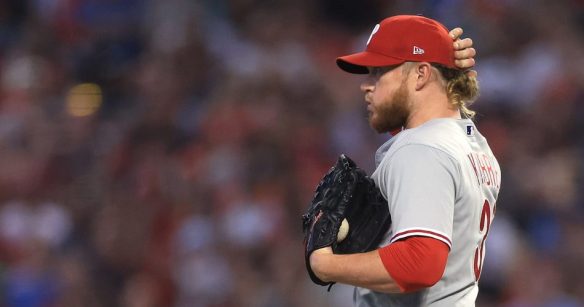
Craig Kimbrel, Alek Thomas

Diamondbacks pinch hitter Alek Thomas hitting the game re-tying home run off Phillies reliever Craig Kimbrel in the bottom of the Game Four eighth.

“He’ll be available tomorrow,” Phillies manager Rob Thomson said of his just-chastened reliever Craig Kimbrel after National League Championship Series Game Three ended with Kimbrel surrendering a game-ending, game-losing RBI single, “and he’ll be ready to go.” Those may yet prove to be the nine most frightening words in the Phillies’ or their fans’ vocabularies. This week, this weekend, and maybe this year.

They may not necessarily bring Kimbrel himself much comfort in his heart of hearts, either.

Let’s be absolutely fair and say what we still can’t bring ourselves to say while we’re busy booing, hissing, and dreaming up new and snarkier insults to spread all over social media. There isn’t a professional baseball player alive who doesn’t go onto the field knowing that one mistake, one errant swing, one misstep, one missed pitch, could turn him into a fan piñata for life, or close enough to it.

Let’s also be absolutely fair and say Cardiac Craig didn’t cost his team the pennant yet. The game he allowed the Diamondbacks to tie so late, before his successor reliever José Alvarado served the RBI hit that broke the tie to stay, did nothing worse than tie this NLCS at two games each. Neither team’s season is over just yet.

But is Thomson just as willing to say after Game Four what he said of Kimbrel after he surrendered the Game Three-losing hit?

All Kimbrel had to do going out for the bottom of the eighth inning Friday night was keep the frisky young Diamondbacks from doing anything about a late and hard-earned 5-3 Philadelphia lead. He wasn’t even asked to finish the game. Just keep it there before Thomson could hand off to, say, José Alvarado for the ninth.

Groucho Marx would say it was “so simple a child of five could do it. Now, somebody send for a child of five.” It’s not impossible that a child of five could have come away with only a little singe. Kimbrel came away deep fried.

For all the gags about his high wire relief style, nobody pretends it’s fun to surrender a late, game-turning home run at all. There isn’t a child alive who dreams of going out to the mound in one of The Big Ones and getting his brains blown out. But it really becomes a microcosmic season in hell when it’s pinch hit by a spaghetti bat whose major league value over two seasons is plus defense in center field, enough to atone for the weak bat with nineteen defensive runs saved above the league average.

The fair supposition was that Diamondbacks manager Torey Lovullo sent Alek Thomas out to pinch hit for third baseman Emmanuel Rivera hoping only that a lefthanded bat against the righthanded Kimbrel might pick up enough of a hit to push Lourdes Gurriel, Jr. from second to third.

Kimbrel had opened by feeding Gurriel—who’d robbed J.T. Realmuto of at least extra bases with a leaping catch at the fence in the second—a 2-2 fastball to hit into left for a leadoff double. Then, after designated hitter Evan Longoria lined out to left, Kimbrel started behind Thomas, 3-1. It became 3-2 after Thomas fouled one off.

Then, Kimbrel served up a fastball just enough up and off the middle of the plate. It wasn’t a terrible pitch. Nothing on Thomas’s resume through that moment suggested he’d get anything better with it than a line drive base hit the other way, possibly to be stopped before it left the infield.

But the spaghetti bat pulled it, somehow, into the Chase Field pool behind the right field fence. Tying the game at five each. Tying the stomachs of Philadelphia fans in the ballpark and back in the City of Brotherly Love into knots. It wasn’t the game-losing hit by any definition, but those fans could only have thought, second verse, worse than the first.

A called strikeout later, Kimbrel threw Ketel Marte a meatball right down the pipe and Marte rapped it into left for a base hit. Only when Kimbrel plunked Corbin Carroll on the first pitch did Thomson reach for further relief and bring Alvarado in.

Too late. Alvarado fell behind Gabriel Moreno 3-1, then Moreno singled up the pipe to score Marte for the 6-5 Snakes lead the Phillies didn’t overthrow in the ninth. (Yes. It’s more than a little unfair to hang Kimbrel with the “loss” when he wasn’t even on the mound to surrender the hit that plated what proved the winning run.)

Maybe we should say couldn’t. Kyle Schwarber—who’d first put the Phillies on the scoreboard with a leadoff blast in the top of the fourth—hit Diamondbacks finisher Paul Sewald’s first two-out pitch into the right field corner for a double. But Sewald got Trea Turner to strike out swinging for the game.

What happens to Kimbrel in these moments during such postseasons? What happens to any relief pitcher whose line of work includes going into a game tasked with holding a tight lead, escaping a nasty jam, or just finishing off the opposition in the final frame, only to see it blow up in a single pitch?

The best of that profession had to have their moments of doubt. The best of that profession have been broken in the moment, even and especially the biggest moment. Even Mariano Rivera, the Hall of Famer whose closing career postseason statistics would equal a fluke regular season for a lesser talent, suffered the horror of losing a World Series with one pitch to an ancient Diamondback named Luis Gonzalez.

The Mariano shook that one off, picked himself up, and went on with his Hall of Fame career. Kimbrel generally does likewise after an outing, even if he leaves behind a trail of work that tells observers that, even when he comes out alive, it still feels as though his team lost instead of won.

If the moments are too big for Kimbrel, he almost never lets it show. If they’re too big for him, he probably wouldn’t go out there time and again risking a game, his reputation, and maybe his (and his team’s) nervous system. He’s known both off the charts success and off the charts faltering, regular and postseason alike. Since (and especially during) the 2018 postseason, Kimbrel outings leave people feeling often enough as though his teams lose even when they win.

At 35 years old, Kimbrel must wonder to himself how many more such moments (and how many dollars on his contract) are worth the strain. Others, of course, must wonder how many more such moments the Phillies are willing to risk. They’ll have a spiritual advantage getting the set back to Citizens Bank Park, of course. But they’d rather have a series advantage going home, too.

“We’ve got to talk about that,” Thomson said postgame, when the question became changing Kimbrel’s role to come. “Do you put him in a little lower-leverage spot? I don’t know. I’ll talk to him with [pitching coach] Caleb [Cotham], talk through it, and see where we’re at.” That was a far turn from Thomson’s pregame vote of confidence: “I trust [his bullpen]. Has [Kimbrel] scattered the zone at times? Sure. But if you look at our charts, everybody’s had a little bit of a hiccup, but they’ve bounced back. So you’ve got to trust that.”

Some social media mavens raised the name Mitch Williams, the zany and nerve-challenging Phillies lefthander who served up a World Series-losing home run to Joe Carter three decades ago. They thought the Wild Thing got too wild, too crazy, too reckless.

But it turned out that then-manager Jim Fregosi and then-pitching coach Johnny Podres forgot to tell Williams to back away from the slide-step—put on to keep Hall of Famer Rickey Henderson from as much of his usual basepath mischief as possible (a futile hope, of courae)—that altered and rushed his deliveries and his fastballs.

With Podres already having visited the mound, and neither he nor Fregosi finding a sign to send with the order, Williams was doomed when his slide-stepped fastball went into Carter’s wheelhouse instead of up and away where the Wild Thing wanted it and might have thrown it out of his normal delivery.

The three-legged mistake of Fregosi, Podres, and Williams lost the Phillies a World Series. Kimbrel’s high-wire mistake merely tied an NLCS game. “I rolled up in here and cost us two games,” said Kimbrel postgame, clearly not pleased with himself. “The bright side is we’re still tied at 2-2 and we’ve got a game here tomorrow, then we get to Philly.”

Forced to a bullpen Game Four in which the bulls ran short, Kimbrel ran out, and a few early defensive mistakes made life tougher for the Phillies than it should have been, they  need Zack Wheeler to pitch an even better Game Five Saturday than he did enabling the Phillies to win Game One.

They also need Aaron Nola to be his Game Two self in Game Six back home. Their bullpen, whose main men have worked 14.3 innings in this set, needs a huge break. They need to quit underestimating this tenacious crew of Diamondbacks, no matter how silly they’ve slapped Snakes starters Merrill Kelly and Zac Gallen, the latter of whom squares off against Wheeler on Saturday.

They can’t afford to risk Kimbrel tearing it even once more, either.
NLCS Game Three: Cardiac arrested

Craig Kimbrel

“Some days you get them, and some days you don’t.”—Phillies relief pitcher Craig Kimbrel, gotten but good by the Diamondbacks in Game Three.

Two League Championship Series Game Threes, two postseason juggernauts stopped. One night, the Astros slap aging and rusted Max Scherzer silly en route making the ALCS a 2-1 affair. The next afternoon, the Diamondbacks do what Cardiac Craig Kimbrel all but begs them to do and turn the NLCS likewise into a 2-1 affair.

Until both the Phillies and the Diamondbacks more or less snuck single runs home in each half of the seventh, their Game Three was mostly a pitching clinic. In fact, until Diamondbacks reliever Ryan Thompson wild-pitched Bryce Harper home in the top of the seventh, no scoreless postseason game ever ended its scoreless status that way.

Both starters, Ranger Suárez for the Phillies and rookie Brandon Pfaadt for the Diamondbacks, pitched into the sixth without so much as a peep across the plate on either side.

The bullpens took over and, while a few things got a little dicey between them, they held the tie and threatened to send the game to extra innings. Then Phillies manager Rob Thomson made his big mistake. He called upon Kimbrel to hold fort for the bottom of the ninth.

If this game was in Philadelphia, even the Phillies’s loud and loyal fans would have had the crash carts on double red alert. But in Chase Field, the Diamondbacks’s snake pit, the only thing anyone on that crowd wanted to hand Kimbrel was a loaded triple-decker hamburger smothered in heavy sauce.

This was a little too classic Kimbrel. He fell behind Lourdes Gurriel, Jr. leading off, 3-0, pumped two strikes called on the corner, watched Gurriel foul a pair off, then walked him low and away.

He fell behind Pavin Smith, a late game entry pinch hitting for the day’s designated hitter Evan Longoria two innings earlier, 2-0, Gurriel stealing second on the second pitch.

Then, a swinging strike, followed by a grounder up the middle that Phillies third baseman Bryson Stott grabbed on a slide but left himself no play. With Gurriel the potential winning run now on third.

Next was Emmanuel Rivera, playing third for the Diamondbacks. Kimbrel got his first first-pitch strike of the assignment while Smith took second on fielders’ indifference. A foul strike, a ball low, then a grounder toward third speared by Phillies shortstop Trea Turner, who threw home and nailed Gurriel at the plate.

Back in Philadelphia, the sigh of relief probably crossed three state lines—but the crash carts remained online and on double red alert. With good reason.

Kimbrel started Snakes shortstop Geraldo Perdomo with a ball way off the plate before Perdomo fouled the next pitch away and swung for strike two. This was the first time Kimbrel got ahead of a batter in the inning. That’d teach him. Two straight balls, low, to follow. Ball four to load the pillows. A first pitch strike to second baseman Ketel Marte. A second pitch fastball a little up . . .

Bing! It wasn’t up enough for Marte to miss shooting it back up the pipe for a base hit sending Smith home with the game winner.

Yes, it was only Game Three. Yes, the Phillies still have the NLCS advantage. But, yes, they may have to think twice before deciding they can live with the cardiac side of Kimbrel much longer.

“He just couldn’t find the zone consistently,” said Phillies manager Rob Thomson postgame, “and sometimes that happens to Kim,” Thomson said. “But he’ll be available [for Gamr Four], and he’ll be ready to go.”

Hear me out. This guy has been a great pitcher in the past. Somehow, he still holds a lifetime 2.47 fielding-independent pitching rate (FIP), a 0.99 walks/hits per inning pitched rate, and a 3.87-1 strikeout-to-walk ratio, not to mention a 14.2 strikeouts-per-nine rate. But his real greatness may well be behind him, even if he was an All-Star in his first Phillies season this year.

Now, let’s look at Kimbrel by dividing his career between his final of three regular seasons with the Red Sox and his seasons since:

Craig Kimbrel ERA FIP WHIP BB/9 K/9 K/BB
2010-2018 1.80 1.81 0.91 3.3 14.8 4.44
2019-2023 3.57 3.68 1.16 4.1 13.0 3.15

Yes, he can still strike the other guys out like a virtuoso. But since leaving Boston he’s walking about one more per nine than before and striking one less out. He’s allowing more to reach base in the first place since leaving Boston. His ERA/FIP were about dead even during those great first nine seasons of his career, but they’re two runs higher since that 2010-2018 term. And, from 2019-23, his FIP (kind of your ERA when the defense behind you is taken out of the equation) is eleven points higher than his ERA.

Since somehow earning six saves despite a 6.74 ERA in the 2018 postseason, Kimbrel has been up and down in October. In 2020, he pitched an inning and a third shutdown relief in the National League wild card game for the Cubs. In 2021, he appeared in three American League division series for the White Sox—and surrendered two earned runs in three innings.

Until Thursday afternoon, Kimbrel this postseason looked great if you didn’t look past the surface numbers. In division series Game One he got the side in order to finish the Phillies’ win—without a strikeout. But he needed Johan Rojas’s spectacular running catch in division series Game Four’s seventh to save him in the Phillies’ win.

He got the NLCS Game One save credit with a swinging strikeout and a game-ending double play—after he walked his second batter of the ninth. Entering Game Three, Kimbrel had an ERA of zero . . . but a 3.71 FIP. But after Game Three, they became 2.09/5.07.

A 5.07 FIP is not conducive to late-inning survival.

“Some days you get them, and some days you don’t,” Kimbrel said, too matter-of-factly, after the game ended. “Today just wasn’t my day.”

Remember: It wasn’t Kimbrel’s fault the Phillies’ usually formidable offense was kept to three hits on the day, or scored their only run of the game on a walk, an infield hit, a double play pushing Harper to third, and the wild pitch enabling Harper to score. But given the chance to push Game Three to extras tied at one, Kimbrel went cardiac once too often.

That may not be a thrill or a chill the Phillies can afford much longer. If at all.

He’ll be available tomorrow, and he’ll be ready to go. Which “he’ll”—the guy who can be as tight shutdown as they come, or the guy who can’t stop the high wire act until the cable snaps under his feet? These Phillies deserve to know, because these Diamondbacks won’t be kind if the wrong one’s ready.

NLCS Game Two: Was it loud enough?

Merrill Kelly

Arizona pitcher Merrill Kelly leaving NLCS Game Two in the sixth inning and hearing it from the Citizens Bank Park crowd whose sound he underestimated. He ended up bearing the least of the Phillies’ destruction on the night.

Maybe nobody gave Diamondbacks pitcher Merrill Kelly the memo. Maybe he missed the sign completely. Wherever Kelly happened to be, if and when he was warned not to poke the Philadelphia bear and his native habitat, he learned the hard way Tuesday night and the Diamondbacks whole were dragged into class.

Maybe the Braves sent him a message he never saw. You remember the Braves. The guys trolling Bryce Harper after their second division series game, when Harper got doubled up on a very close play following an impossible center field catch to end the game. They learned the hard way, too. They’re also on early winter vacation.

Before this National League Championship Series even began, Kelly was asked whether the heavy metal-loud Citizens Bank Park crowd might have a hand in the field proceedings. He practically shrugged it off, though in absolute fairness he wasn’t exactly trying to be mean or nasty.

“I haven’t obviously heard this place on the field, but I would be very surprised if it trumped that Venezuela game down in Miami [in the World Baseball Classic],” said Kelly, a righthander whose countenance bears a resemblance to comedian Chris Elliott and who’s considered a mild-mannered young man otherwise. “When Trea [Turner] hit that grand slam, I don’t think I’ve ever experienced—at least baseball-wise, I don’t think I’ve ever experienced an atmosphere like that so I hope that this isn’t louder than that.”

That grand slam jolted Team USA into the semifinal round. By the same Trea Turner who’d start Kelly’s Tuesday night with a jolt, hitting a one-out, one-strike pitch into the left center field seats in the bottom of the first. 

Kelly may not have been trying to be snarky, but The Bank let him have it early and often, first when he was introduced pre-game time and then when he took the mound for the bottom of the Game Two first. Loud, clear, and unmistakeable.

The only things Kelly faced louder and more clear than that were Turner’s score-starting blast, the one-ball, two-out laser Kyle Schwarber sent off Kelly’s best pitch, a changeup, into the right field seats in the third, and the 2-1 skyrocket Schwarber sent into the right center field seats leading off the bottom of the sixth.

“He’s really effective because he has a plus-plus changeup,” Schwarber said postgame. “He threw it 2-0 and kinda gave me the window. That’s what it looks like coming out of there. I think that was the first strike [on a] changeup I saw. [The home run pitch] was a little bit more down and away. But, I mean, it came out of the same height. So those are things that you look for.”

“They’re good big-league hitters,” Kelly said of the Phlogging Phillies postgame. “That’s what good big-league hitters do. They don’t miss mistakes.” Neither did The Bank’s crowd, serenading him with “Mer-rill! Mer-rill” chants at any available opportunity. But Kelly actually pitched decently despite the bombs. He only surrendered three hits, but walking three didn’t help despite his six strikeouts.

He’d also prove to have been handled mercifully compared to what the Phillies did to the Diamondbacks bullpen in a 10-0 Game Two blowout.

Once they pushed Kelly out of the game, with two out in the sixth and Turner aboard with a walk, they slapped reliever Joe (Be Fruitful and) Mantiply with a base hit (Bryson Stott), a two-run double (J.T. Realmuto), and another RBI double (Brandon Marsh). Just like that, the Phillies had a four-run sixth with six on the board and counting.

Then, Mantiply walked the Schwarbinator to open the Philadelphia seventh. Diamondbacks manager Torey Lovullo reached for Ryne Nelson. One out later, Harper singled Schwarber to third, Alec Bohm doubled them home with a drive that hit the track, Stott hit a floater that hit the infield grass between Nelson plus Diamondbacks third baseman Evan Longoria and catcher Gabriel Moreno, Realmuto singled Bohm home and Stott to third, and Nick Castellanos sent Stott home with a sacrifice fly.

This time they didn’t need Harper to provide the major dramatics. He’d done enough of that in Game One, hitting a first-inning, first-pitch-to-him, first-NLCS-swing, first-time-ever-on-his-own-birthday nuke one out after Schwarber hit his own first-pitch bomb. That game turned into a 5-3 Phillies win. On Tuesday night, they turned the Diamondbacks into rattlesnake stew.

They made life just as simple for Game Two starter Aaron Nola as for Game One starter Zack Wheeler. Wheeler gave the Phillies six innings of two-run, three-hit, eight-strikeout ball; Nola gave them six innings of three-hit, seven-strikeout, shutout ball. It was as if the Philadelphia Orchestra offered successive evenings of the Brahms Violin Concerto in D Major—featuring Isaac Stern one night and Itzhak Perlman the next.

“It’s a little more hostile and a little more engaging,” said Turner of the Bank crowd after the Phillies banked Game One. “I think [Kelly] can maybe tell you after tonight what it’s like, but I wouldn’t put anything past our fans. Our fans have been unbelievable. They’ve been great. I don’t know what decibels mean, but I guess we did something cool for AC/DC concert level decibels the other night . . . I would just wait and see and we’ll see what he says after [Game Two]”

“They’re up all game on their feet from pitch number one till the end,” said Nola postgame. “I feel like you don’t really see that too much around the league. That just shows you how passionate and into the game they are. They know what’s going on, and that helps us a lot.”

That was not necessarily what Lovullo wanted to hear before or after the Game Two massacre ended. “Everybody’s talking about coming into this environment,” he said, audibly frustrated, “and I don’t care.”

We’ve got to play better baseball. Start with the manager, and then trickle all the way down through the entire team. We’ve got to play Diamondback baseball . . . Diamondback baseball is grinding out at bats . . . driving up pitch counts, catching pop ups . . . win[ning] a baseball game by just being a really smart, stubborn baseball team in all areas.

That assumes the Phillies will just roll over and let them play it. The wild-card Diamondbacks who steamrolled two division winners in the earlier rounds to get here in the first place looked like anything except an unlikely juggernaut after getting manhandled in Philadelphia. They shouldn’t take the Phillies for granted once the set moves to Chase Field, either.

The Phillies might have been a one-game-over-.500 road team on the regular season, but they beat the Diamondbacks in Chase Field three out of four—a couple of weeks after the Snakes beat them two out of three in The Bank. Until this NLCS it was a little over three months since the two teams tangled. It certainly didn’t phaze the Phillies.

“I still think we’re real confident,” said Kelly. “I think there was a lot to be said about us after the All-Star break about how bad of a slump that we went into. I’ve seen in this clubhouse, I’ve seen from these guys that we haven’t gotten rattled all year. And I don’t want us to hang our heads and pout about it this time.”

But let’s say the Diamondbacks iron up and find ways to neutralise the Phillies’ offensive bludgeons and pitching scythes which, admittedly, might require a kidnapping or three. Let’s say they win all three games at Chase. They might become the only team to be at a disadvantage with a 3-2 series lead.

Because guess where the set would return then. And, unless my prowling has missed something this morning, Kelly didn’t have one word to say about that crowd after Game Two came to its merciful end. It must have been more than loud enough for him.

Snakes alive!

Arizona Diamondbacks

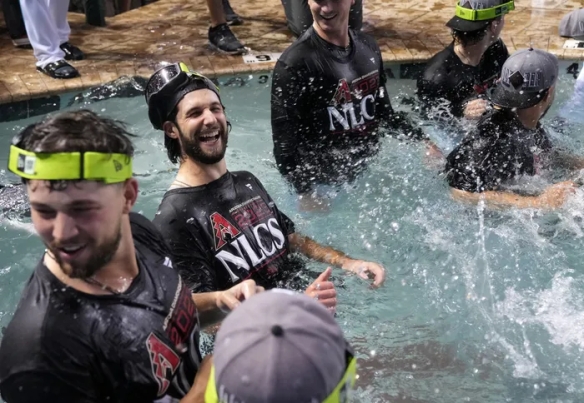
Assorted Diamondbacks take a victory dip in the Chase Field pool after they swept the Dodgers in their NLDS Wednesday.

This may actually be the worst Dodger takedown of all time. They’ve suffered legendary takedowns as much as legendary triumphs in their storied history, but this one may actually out-rank all the others.

Worse than the day the Philadelphia Whiz Kids’ veteran Dick Sisler ruined them on the season’s final day after Cal Abrams couldn’t score from first to keep the pennant-losing game out of an extra inning.

Worse than the day Bobby Thomson ruined Ralph Branca after a second-half Giants surge from thirteen games back through the lens of Leo Durocher’s telescopic from-the-clubhouse sign-stealing.

Worse than the day a still-not-himself Sandy Koufax couldn’t hold the Giants off in another pre-division play, three-game pennant playoff deciding game. Worse than the week the Orioles swept them in a World Series.

Worse than the day Tommy Lasorda let Tom Niedenfuer pitch to Jack (the Ripper) Clark with first base open and the Dodgers an out from forcing a seventh National League Championship Series game. Worse than back-to-back World Series losses in 2017-2018.

Never before were the Dodgers swept out of a postseason set in which all three Dodgers starting pitchers including a future Hall of Famer combined to pitch four and two thirds innings.

And never before had any team surrendered four postseason home runs in a single inning until Lance Lynn, the husky righthander who was the Dodgers’ key trade deadline pitching pickup, but who surrendered a Show-leading 44 home runs all regular season long, went to work for the third inning of their National League division series Game Three.

Geraldo Perdomo, Diamondbacks shortstop—leadoff home run. Ketel Marte, Diamondbacks second baseman, an out later—home run. Christian Walker, Diamondbacks first baseman, an out after that—home run. Gabriel Moreno, Diamondbacks catcher, following Walker, and after a long drive ruled just foul—home run.

None of baseball’s classic slugging teams ever did in any postseason what the Snakes did in that inning. Not the Ruth-Gehrig Yankees. Not the Foxx-Simmons-Grove Athletics. Not the DiMaggio-Berra-Mantle Yankees. Not the Boys of Summer Dodgers. Not the Mantle-Maris Yankees. Not the Swingin’ As or the Big Red Machine. Not the Pittsburgh Lumber Company, Harvey’s Wallbangers, or the Bash Brothers A’s.

“I’m a fan, too,” said Diamondbacks manager Torey Lovullo, after his Snakes banked the 4-2 win, the division series sweep, and a date with either the Phillies or the Braves in the National League Championship Series, “and I was looking at it thinking, what in the world is happening here?”

So were the Dodgers. Maybe all series long, never mind in the third inning Wednesday night.

“You look at the game, the series, they outplayed us, and there’s no other spin to it,” said manager Dave Roberts. “As far as our clubhouse, it’s just a lot of disappointment.”

As far as the Diamondbacks clubhouse, this team of rising youth, veterans who’ve been called “quirky” among other things, role players, and about as much star power yet as a cactus plant, has arrived. They slipped into the postseason via the wild card system after an 84-win season, swept the Brewers out of the wild card series, then dismantled a Dodger team full of stars who’d usually dismantled them while owning the National League West for most of a previous decade.

And they couldn’t have cared less about the financial power behind that Dodger star power, either. “We shouldn’t be worried about what their payroll is or who they’ve got over there,” said Snakes outfielder Alek Thomas after Game Three. “We’re just worried about what’s right in here in this clubhouse. You saw that this series.”

“They kept punching us in the face,” lamented Dodgers utility man Enrique Hernandez, “and we weren’t able to get back up.”

Just when did the Diamondbacks and their fans really start believing they might have more than a few lessons to teach the pitching-compromised Dodgers (three injured starters, a fourth on administrative leave over domestic violence charges) and the country this time around?

Was it when they bludgeoned six runs out of a possibly still-ailing and finally out of fuel Clayton Kershaw in the Game One first?

Was it when they pried three Game Two first-inning runs out of Bobby Miller, the Dodger rookie who’d looked promising enough over the regular season but now looked as though he was in enough over his 24-year-old head?

Was it after Lynn actually spent the first two Game Three innings on cruise control despite a pair of second-inning hits, before Perdomo hit a 2-1 meatball over the right center field fence, Marte hit a 1-0 service into the right field seats, Walker hit a 3-1 meatball into the left field seats, and Moreno hit a full-count hanging slider into the left center field seats to end Lynn’s night?

Was it when the Diamondbacks’ bullpen, formerly cause for plenty of alarm, left the torches behind long enough to surrender only four of the six series-long Dodger runs?

The Dodger bullpen did what their starters couldn’t do and kept them alive and within reach in the final two games. But their big bats couldn’t do anything, either. Mookie Betts and Freddie Freeman may have posted Most Valuable Player-style regular seasons, but after fueling the Dodgers lineup all year long they went 1-for-21 together in the division series.

“I know for sure I did absolutely nothing to help us win,” Betts acknowledged. It was the first postseason series of his entire career in which the Mookie Monster went hitless.

“It doesn’t feel real,” Diamondbacks rookie star Corbin Carroll said after Game Three ended. This is a team with whom the Dodgers had their regular season way from 2021-2023, the Dodgers going 38-13 against them over the span.

But the division-series beatdown they laid upon the Dodgers was real enough. And it’ll feel even more real to the Dodgers as they face a winter whose number one mandate will be figuring out how to turn their regular-season dominance into anything other than postseason submission.

NLDS Games One: The Atlanta Chop Slop, the Los Angeles funeral parlour

Truist Park

Trash talk? Have at it. Trash the field over a call going against you? What was this, Braves fan?

Neither the Dodgers nor the Phillies expected simple National League division series this time around. Not with both teams coming in with what some call patchwork pitching. But one came out looking better in their Game One while the other came out looking like the remnant of a nuclear attack.

The Phillies and their pitching managed to keep the Atlanta threshing machine from threshing Saturday afternoon, winning 3-0. Starting with a first-inning nuking of future Hall of Famer Clayton Kershaw, the Diamondbacks laid waste to the Dodgers Saturday night, 11-2. On the arms of big enough bats and a starting pitcher who was usually close enough to Dodger batting practise.

Letting starter Ranger Suárez go no more than three and two thirds, knowing they’d have a day off between Games One and Two, the Phillies went to a bullpen game, essentially. And that bullpen finished what Suárez started, shutting the Braves out over the remaining five and a third. The Braves who hit a record 307 home runs on the regular season looked as though they had paper towel tubes for bats.

None more glaring than the founding father of the 40/70 club. Ronald Acuña, Jr. went 0-for-3 with a walk, and his evening’s futility included an embarrassing called strikeout in the fifth, when—with first and third and one out—the second Phillies reliever of the evening, Seranthony Domínguez, planted a fastball right on the low inside corner.

Small wonder that Braves manager Brian Snitker could and did say, postgame, “I think it was more their pitching than our hitting.” Indeed.

Braves starter Spencer Strider pitched boldly enough, striking eight out and scattering five hits in seven innings’ work. But the Phillies still pried two runs out of him, both with Bryce Harper the big factor. First, Strider threw wild enough trying to pick Harper off first in the top of the fourth, enabling Bryson Stott to single him home with the first run. Then, Strider threw Harper enough of a meatball to disappear into the Chop House seats behind right field with one out in the top of the sixth.

“Strider, man, he’s one of the best in the game. You know he’s going to come at you and throw his best at you,” Harper said postgame. “So just trying to get a pitch over and was able to get the slider up and do some damage.”

Except for Acuña’s surprising silence, and the eighth-inning catcher’s interference call with J.T. Realmuto at the plate and the Phillies with the bases loaded, enabling the third Phillie run home, the Braves at least looked stronger in Game One defeat than the Dodgers did. Even Strider, who became the first postseason pitcher ever to lose twice against a team against whom he’s well undefeated in the regular season.

The Diamondbacks didn’t let Clayton Kershaw—all 35 years old of him, with possible lingering shoulder issues plus eight days of rest leaving him with little enough to offer—get out of the first alive. Their 35-year-old journeyman starter Merrill Kelly, who didn’t turn up in the Show until age 30 in the first place, manhandled them for six and a third after the Snakes bit Kershaw deep in the first.

For the regular season’s final two months, with a 2.23 ERA over eight starts, Kershaw seemed to tell age and his shoulder alike where to stuff it. Then Kershaw took the ball Saturday night. What’s the saying about too much rest being as hazardous to a pitcher as too little rest can be?

Ketel Marte opened with a double to the back of left center field, and Corbin Carroll began showing why he’s in the Rookie of the Year conversation with a prompte RBI single. Tommy Pham—the same Tommy Pham who called out the lack of work ethic among second-tier Mets teammates with whom he played before the trade deadline—rapped a short single to left for first and second.

Then Christian Walker, a veteran first baseman who hadn’t been anything much special before 2022, hit one so far to the back of the left field bleachers some wondered how the ball didn’t leave the ballpark structure. Just like that, Dodger Stadium resembled a funeral parlour. And, just like that, Kershaw resembled the corpse for whom the audience came to mourn.

A ground out by Lourdes Gurriel, Jr. and a walk to Alek Thomas later, Evan Longoria sent Thomas all the way home with a double to deep center field, hammering the final nails into Kershaw’s coffin.

“Embarrassing,” the lefthander said postgame. “You just feel like you let everybody down. The guys, a whole organization, that looked to you to pitch well in Game One. It’s just embarrassing, really. So I just feel like I let everybody down. It’s a tough way to start the postseason. Obviously, we still have a chance at this thing, but that wasn’t the way it should’ve started for me.”

Kershaw’s postseason history is a direct contrast to the regular-season career that guarantees him a place in Cooperstown. Until Saturday night, enough of that sad history came by way of leaving him in too long or by circumstances above and beyond his control.

Entering Game One with a 5.49 ERA against the Dodgers lifetime but a 7.03 ERA against them when pitching in Dodger Stadium, Kelly pitched six and a third shutout innings before turning it over to a bullpen that kept the Dodgers to one hit. The bad news: the hit was a two-run triple by Will Smith off Miguel Castro. The good news: The Snakes could afford such generosity by then, since it cut an 11-0 lead by a measly two runs.

Kelly’s keys included forgetting how the Dodgers treated him like a piñata in regular season play. “I’m watching our guys beat up on one of the best pitchers that we’ve ever seen in our lives and watching them do it in the first game I’ve ever pitched in the playoffs,” he said postgame. “I felt if I gave those games any attention I was going out there behind the eight-ball before I even stepped on the mound.”

This time, Kelly went out there with a six-run cushion, then saw it padded to nine by a three-run second including Carroll leading off against Dodger reliever Emmet Sheehan with a drive into the right field bleachers. Kelly was now comfortable enough that he could have pitched from a high-backed leather office chair and incurred no damage.

The only thing that should have and apparently did embarrass the Braves was the Truist Park crowd throwing drinks onto the field after catcher Sean Murphy’s mitt grazed Realmuto’s bat by a thin hair. You could hear it on replays that didn’t exactly show it too clearly, but Murphy’s lack of challenging the call affirmed it.

Trea Turner—who started a spectacular double play with Acuña (leadoff walk) on third to end the bottom of the eighth, diving left for Ozzie Albies’s ground smash and backhanding to second baseman Stott—scored on the interference. The rain of drinks into the outfield annoyed both the Braves and their manager.

“There’s no excuse for that,” Snitker snapped postgame. “It’s scary because those water bottles, when they come, they’re like grenades. It could really seriously injure one of our players.”

That’s what the miscreants don’t stop to think about. Against a team whose fan base is usually considered one of the worst in the game. (Remember the Philadelphia wedding: the clergyman pronounces the happy couple husband and wife before telling the gathering, “You may now boo the bride.”) Be better, Braves fans.

Only the silence in Dodger Stadium following the Diamondbacks’ early and often abuse of Kershaw and Sheehan kept the big National League division series headlines elsewhere from reading, “Chop Slop.”