

The Blight Sox, on the threshold of possessing the American League’s longest losing streak, depending upon what they can or can’t do with the Athletics, of all people, Tuesday night.
The number twenty-one has meanings profound (a winning hand at blackjack; the legal age of consent in most places), historical (a fabled New York restaurant and Prohibition-era speakeasy), and disgraceful alike. (The 1956-58 television game show that ignited the infamous quiz show scandal.) It was also the uniform number of 29 White Sox players over the team’s history.
As of Monday night number 21 became something more sinister. In Chicago, that is. The White Sox lost their 21st consecutive game. Somewhere in this favoured land, the sun is shining bright, the band is playing somewhere, but the White Sox are under a massive cloud with the threat of funeral marches sounding too clear.
The Athletics, of all people, dropped it upon the Blight Sox. The team so reduced by their ten-thumbed, brain-challenged owner that it was thought the A’s would bury themselves a live in what’s still their farewell season in Oakland beat the White Sox 5-1 in the A’s rambling wreck of a ballpark.
Once upon a time, the White Sox tied the game at one. The A’s said, don’t even think about it, scoring four more. And there was no joy back in Windville when the mighty Senzel (Nick, that is) struck out to end consecutive loss number 21.
This is the longest such streak of sorrow since the Orioles opened 1988 0-21; the 21 losses are an American League record now shared. The streak followed the 27-67 record the White Sox amassed from Opening Day through 5 July. They have only to lose three straight more to pass the 1961 Phillies and six straight more to pass the 1889 Louisville Colonels of the antique American Association. And, unlike those 1988 Orioles, these White Sox may have lost their sense of humour along the way.
Says White Sox manager Pedro Grifol, whose seat may resemble a stovetop burner, “Everybody knows what it is. It’s 21 in a row. It sucks. It’s not fun. It’s painful. It hurts. You name it. However you want to describe it.”
Said 1988 Orioles manager Frank Robinson, installed after Cal Ripken, Sr. skippered them to the first six straight losses, “Nobody like to be the joke of the league, but we accept it”—after showing a visiting reporter a button he kept in a desk drawer saying, “It’s been lovely, but I have to scream now.”
Says White Sox left fielder Corey Julks, who managed a highlight-reel catch to save a run, “Don’t dwell on the losses. Try to learn from them and get better each day.”
Said Hall of Fame shortstop Cal Ripken, to a reporter new on the Oriole beat when that 1988 streak hit the big Two-Oh, “Join the hostages.”
Said Grifol, “It’s not for lack of effort. Nobody wants to come out here and lose. We’ve just got to put a good game together and put this behind us.”
Said Robinson, “Nobody’s really gone off the deep end. All except one game, there’s been a real effort.”
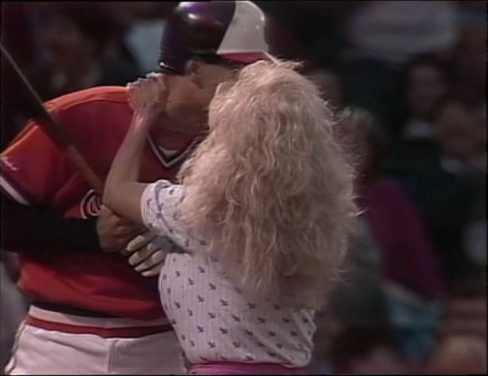
When the ’88 Orioles needed a little extra mojo after losing two straight following the end of their epic losing streak, Morganna the Kissing Bandit planted one on Hall of Famer Cal Ripken, Jr.—and they battered the Rangers for her trouble.
Said former White Sox manager Ozzie Guillen to Athletic reporter Jon Greenberg, after Greenberg suggested White Sox owner Jerry Reinsdorf and general manage Chris Getz were waiting for Grifol to manage one more win before executing him, “That means Pedro is 100 games under .500 since he got the job. Hoo, hoo boy.”
Said Robinson, told of a radio personality who promised to stay on the air until those Orioles finally won a game, “We’re gonna kill the poor guy.”
Come 29 April 1988, Baltimore’s old and long-gone Memorial Stadium was sold out, the crowd broke out the ancient championship-aspiring chant “O-R-I-O-L-E-S” . . . and the Orioles won at last, 9-0. Their opponent then? A different collection of White Sox. Out of whose starting pitcher Black Jack McDowell they pried five runs (four earned), out of whose bullpen they banged four more, in a game featuring two Hall of Famers on each side, with the Oriole Hall of Famers—Ripken and Eddie Murray—each hitting home runs and the whole team pounding eleven hits to the White Sox’s four.
After two straight Oriole losses to follow, Morganna the Kissing Bandit showed up to plant a wet one upon Ripken . . . and they battered the Rangers, 9-4. Ripken hit one out that day, too. It wasn’t enough to salvage an Oriole season in which they played below .500 ball in each month. (Morganna wasn’t about to become a single team’s attitude adjustment mascot, either.) But it might have kept the sting of 0-21 cauterised awhile.
Now, the White Sox don’t have someone else to confront them trying to end a losing streak. This time, the White Sox have to try again. They’re not finding laughs, they’re hearing that their own Hall of Fame legend Frank Thomas is scolding them: “I don’t want to hear no more: ‘We’re trying.’ No more: ‘They’re working hard every day.’ No, it’s time to snap. It’s time to kick over the spread.”
The 1961 Phillies were managed by Gene Mauch, a man to whom kicking the postgame food spread over came as naturally as song to an oriole. Grifol doesn’t yet impress as a man ready to turn a table full of food and drink into a Jackson Pollock floor painting. Yet. But if the White Sox don’t escape Oakland with at least one win, don’t bet against the homecoming spread in Guaranteed Rate Park being served under armed guards.
Don’t look for Morganna to bring a little mojo. She’s been retired a quarter century and has no known intention of making a comeback. But upon whom would anyone suggest she plant one, if she did? Maybe upon Grifol, when he brings out the lineup card. If nothing else, it might loosen the manager up to the point where he can say, “It’s been lovely, but I have to scream now.”
 Throneberry Fields Forever