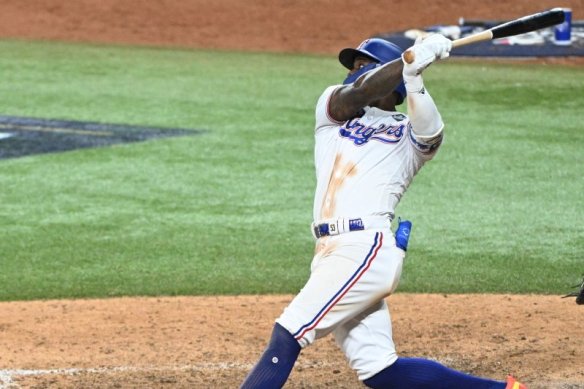
WS Game One: But of course

Adolis García

The Cuban defector who rocked a pitcher named Castro for the World Series Game One-winning bomb he’s hitting here . . .

In a more just and far more sane world, this World Series would not feature baseball’s eight-best team (the Rangers) hosting baseball’s twelfth-best (the Diamondbacks). No matter how much fun it was to watch the games by which they got here. This, folks, is Commissioner Pepperwinkle World.

It’s a world where the fun in watching baseball’s Davids slay its Goliaths, as happens often enough, is perverted into a premeditated dilution of the championship race. Where teams who dissipate down the stretch can still sneak into a postseason and trash the joint.

Commissioner Pepperwinkle didn’t create today’s championship dilution, he simply finished and metastasised what his predecessor/former employer began. And while he now says he’s willing to “discuss” this format and that dilution after hearing “enough complaints and chatter” around it, don’t wait in line too long expecting him to heed and adjust.

Unless you count whether their owners voted yay or nay upon Pepperwinkle’s perversion, it’s hardly the Rangers’ or the Diamondbacks’ fault that they could and did ride to this Series while leaving the bigger teams to the winters of their malcontent. “If the die was cast—meaning, that if I win 100 in the regular season, I’m going to win the World Series—I don’t think that’s as interesting as what we have witnessed over the last month,” he added.

Well, just as it couldn’t hurt to watch the earlier wild card, division, and League Championship Series anyhow, it can’t hurt to watch this half-serious World Serious anyhow.

Say what you must about how they got here. These Rangers (who did tie for a division title) and these Diamondbacks (who finished a well-distant second in their division) are having fun while being deadly serious. The Diamondbacks didn’t let bother them that they weren’t supposed to survive the Brewers, the Dodgers, or the Phillies. The Rangers didn’t let bother them that they weren’t supposed to shove their fellow Texans from Houston to one side.

Come Friday night, until Rangers shortstop Corey Seager sent the game to extras with a mammoth two-run homer, it looked as though the Diamondbacks might open by doing to the Rangers what they’d done well enough entering the Series: pitching, pecking, picking, and occasionally pounding their way to a win.

Then a Cuban defector hit a Game One-winning home run off a pitcher named [Miguel] Castro in the bottom of the eleventh.

That won it for the Rangers, 6-5. It also gave Adolis García eight bombs for this postseason and left him one shy of Daniel Murphy’s record of homering in six consecutive postseason games. It should also have sent the Diamondbacks pitching staff a rudely-awakening message: Thou shalt not plunk Adolis García and expect to live.

First, after Seager tied the game off Paul Sewald with Leodys Taveras aboard and a parabola to the rear of the right field seats in the ninth, García was hit on the hand by a Sewald pitch. Late Rangers insertion Austin Hedges struck out for the side. But two innings later, with one out, García hit a 3-1 sinker the opposite way over the right field fence.

Twelve years to the day earlier, the Cardinals’ David Freese wrecked the Rangers when the Rangers were a strike away from winning the 2011 World Series in six games—first with a game-tying triple in the ninth; then, after the game was re-tied in the top of the eleventh, with a full-count leadoff shot over the center field fence.

Figure this if you can: García’s Game One winner Friday night sent him right past Freese himself for the most runs batted in (22) in a single postseason. It might not have happened had García not made a spectacular course correction on Diamondbacks rookie star Corbin Carroll’s two-out, ninth-inning drive to right, overcoming a bad first step to run the ball down and snatch it at the wall.

That might have given these relentless enough Diamondbacks a final lease on Game One life. But no. Then Seager unloaded in the bottom of that inning off Diamondbacks finisher Paul Sewald, the first genuine dent in a Diamondbacks bullpen that was postseason excellent entering the Series and worked three scoreless among three relievers Friday night. Setting the extra-inning stage for García to do what hasn’t been done since Kirk Gibson in the 1988 World Series—win Game One with a walkoff homer.

Maybe doing it on the twelfth anniversary of Freese’s jolts means these Rangers might find the mojo those Rangers lost so horrifically?

In a game where the Rangers took an early 2-0 lead (Evan Carter’s first inning RBI double and García singling him home immediately to follow) but the Diamondbacks bit Rangers starting pitcher Nathan Eovaldi hard for a three-run third and five runs in four and two-thirds innings; where the Rangers went 1-for-7 with men in scoring position to the Snakes going two-for-8; and, where the Ranger bullpen pitched six and a third innings’ two-hit, shutout relief, Seager and García’s late explosions will be what’s remembered the most.

Kind of a shame, too. In the top of the third, Diamondbacks shorstop Geraldo Perdomo finally dropped a bunt you couldn’t call a wasted out. Remember: In six known “bunt situations,” only one leaves you a better chance to score after than before the bunt: first and second, nobody out. That’s what Perdomo had when he dropped one back to the box and pushed Alek Thomas (leadoff infield single) and Evan Longoria (immediate followup single) to third and second, respectively.

Carroll followed and hit a two-strike, two-run triple to the absolute back of center field, then scored the third Snakes run while Ketel Marte grounded out to first base. The Rangers took one back to re-tie in the bottom of the third when Mitch Garver wrung a bases-loaded walk out of Diamondbacks starter Zac Gallen, but Tommy Pham re-snatched the lead when he unloaded on Eovaldi to open the top of the fourth, sending one  over the left field fence. An inning later, Marte sent Perdomo (leadoff single) home with a double, and 5-3 it stayed until Seager in the ninth.

Seager may not mind playing second banana to García even if his handiwork set García’s up. He hollered out uncharacteristically in his joy after he launched his bomb. But after the game, he preferred not to think about that again. “You never think about your own success,” he said. “You think about how that team came together, how that team performed.”

In the American League Championship Series, remember, García unloaded a three-run homer in Game Five and got drilled by a pitch his next time up. All that did was jolt him into the Games Six and Seven bombings that helped yank the Rangers here in the first place. Two batters after Seager unloaded, García was hit by a pitch again, on his hand.

He shook it off. He stole second but was stranded. He bided his time. Then came the eleventh. He didn’t answer the bell, he rang it. Ask him now what the biggest bomb of his life is, and he’ll tell you. “We’re in the World Series,” he said. “I think, honestly, this is the first.”

Unless there’s a more absurdist Elysian Fields script to be delivered later in this Series (put nothing past that heavenly troupe of stinkers), and García finds himself hitting the Series winner, it may yet prove to be the loudest home run in Rangers history.

ALCS Game Seven: Seriously!

Adolis García

García after scoring in the first after his own long RBI single. It was the prelude to a two-bomb, five-hit, five-steak night and nailing the ALCS MVP.

They may yet call the now-concluded American League Championship Series The Adolis García Show. And all it took was getting enraged over being hit by a Game Five pitch to kick the usually exuberant Rangers right fielder into overdrive that went to warp speed in Game Six then ludicrous speed in Game Seven. Seriously?

There are plenty who say the two sweetest words in a baseball fan’s vocabulary are “Game Seven.” They certainly were for the Rangers Monday night, blowing the Astros away from the ALCS, 11-4, taking all four games played in Houston while they were at it, and hoisting García as the ALCS Most Valuable Player while they were at it.

How do you possibly follow a dramatic late-Game Six grand slam after spending the earlier parts of that game striking out four times? García made the answer too easy in Game Seven: A first-inning RBI single for the second of three Ranger runs in the frame. A leadoff home run in the top of the third. A two-run single in the top of a four-run fifth. A one-out homer in the top of the eighth.

And, more than a little egg on the face of Astros relief pitcher Bryan Abreu, who’d drilled García so noisily in Game Five but came into Game Seven with the Astros already on life support. With one and all mindful that his two-game suspension wouldn’t be served until next season, after all, Abreu drilled the Rangers’ designated hitter Mitch Garver with one out in the top of the sixth, the out being (of all people) García popping out to Astros first baseman José Abreu.

One out later, Rangers first baseman Nathaniel Lowe hit a two-run homer to make things 10-2. García’s eighth-inning bomb might not have been absolutely necessary given the final outcome, but had to be as delicious an exclamation point to slam onto this set as anything else the Rangers might have found in making sure the Astros’ chances to become repeat World Series winners disappeared.

Seriously!

The Astros hardly helped themselves in the end. Bedeviled by injuries during the season and, almost inexplicably, playing below .500 at home while being a road powerhouse, manager Dusty Baker had to juggle and struggle to keep them in the races as well as take advantage of the Rangers’ September struggles to win the American League West by dint of having won the season series against the Rangers.

They knew the Rangers wouldn’t be pushovers. They had to know the Rangers made themselves more formidable with the five-game winning streak by which they opened their postseason. They simply didn’t bargain for how formidable the Rangers would prove in the ALCS despite the Astros winning all three games of the Arlington leg of the set.

In those three, the Astros out-scored the Rangers, 23-12 in Globe Life Field. But in Minute Maid Park, the Rangers out-scored them, 27-10, including back-to-back blowouts in Games Six and Seven. Any Astro fans thinking the road-warrior nature of the set would turn after Astros second baseman José Altuve’s dramatic three-run homer in the top of the Game Five ninth had that thinking yanked inside-out several times over.

The Astros only looked as though they seized the ALCS momentum there, and when DH Yordan Alvarez opened Game Six’s scoring with an RBI single in the top of the second. But Garver answered with a solo homer in the bottom of that inning, Rangers catcher Jonah Heim parked a two-run homer in the third, and—after another Houston run in the sixth—Garver whacked an RBI double in the eighth and García dropped his three-run bomb in the ninth.

And that bomb turned out to be just a prelude to García’s Game Seven destruction. On a night now-ancient Max Scherzer could have been had, but with only three runs to offer including veteran third baseman Alex Bregman’s third-inning, one-out solo homer, the Astros were had, instead.

They got nothing off Jordan Montgomery, usually a Rangers starter but coming out of the bullpen on an all-hands-on-deck night for both sides, over two innings despite pushing to first and second in the fourth. They could pry only one run out of Aroldis Chapman with Alvarez’s RBI single in the seventh; they could yank only one run out of Rangers finisher José Leclerc when Altuve hit Leclerc’s first pitch of the ninth down the line and over the right field fence.

This time Altuve’s eleventh-hour demolition went to no avail.

The Rangers jumped all over Astros starter Cristian Javier after Marcus Semien opened with an infield ground out. Corey Seager batted next and fired the opening salvo with a drive over the right center field fence. A walk and a theft of second later, García sent one flying toward the left field wall and stood a moment or two admiring it before it clanged off the wall and he was held to a single.

Before anyone had a chance to roast him for the moment’s admiration, García atoned for the extra base he didn’t take on that hit by stealing second himself, enabling Garver to send him home. By the time the evening ended, almost nobody was liable to remember that that first-inning drive might have just missed being a homer.

“He was hot,” Baker said postgame, “and he’s been hot the whole series. We did strike him out quite a few times. But he got us. There’s a whole bunch of stuff you can point to in that ballgame. And so we just got beat. Sometimes there’s no rhyme or reason. Sometimes you lose and sometimes you get beat. There’s a difference. We got beat.”

This time, no Astro pitcher even thought of letting García have it with a pitch his next time up after that long single. If anything, Astroworld and elsewhere was more likely to question why Baker didn’t elect to pitch around him the rest of the way. And, why Baker didn’t get one of his higher-leverage relief arms, Hector Neris, up and ready before Rangers left fielder Evan Carter’s two-run double started the Ranger runaway in the fourth.

First, they may have to finish questioning why he clung stubbornly to weak-hitting veteran catcher Martín Maldonado instead of reaching for better-hitting Yainer Díaz (whose season included 45 extra base hits) later in games.

They may also revisit questioning why owner Jim Crane and his front office pulled in no pitching depth last winter, letting Baker lean heavily on inconsistent Javier and Framber Valdez, and rookies Hunter Brown and J.P. France, while dealing with early-season injuries to Altuve and Alvarez. That’s where Crane felt enough of a pistol to his head that he gave the go signal when future Hall of Famer Justin Verlander was made available for trading by the Mets who’d signed him as a free agent last winter.

The Rangers didn’t make it easy for themselves to get here, starting September 1-6 and finishing it 2-4 to fall into a tie with the Astros after they were up in the AL West by as many as 6.5 games at one point in June. Keeping the proverbial eyes on the prize wasn’t exactly simple after that.

“When you get the right group of guys with the right leader in the dugout,” said general manager Chris Young, himself a former major league pitcher including for the Rangers his first two years, “you never underestimate a group’s talent and the way they come together and the way they pull for each other. It’s not always about the team with the most talent. It’s the team with the right talent.”

None more right, it turned out, than a guy on whom the Cardinals gave up and the Rangers almost did. García—who defected from Cuba on a flight layover in Paris following a not-so-successful stint in Japan—was signed by the Cardinals but designated for assignment by them. The Rangers signed him, designated him, but had to keep him when he found no takers.

Lucky they. García became a two-time All-Star including this season. Then, the Rangers came to this postseason and he turned it into his coming-out party. Especially Games Six and Seven. Especially setting a new postseason record with fifteen ALCS runs batted in, thirteen of which came in the set’s final four games.

But the Rangers and people around the team point to things that might have been obscured during his Game Five explosion over getting drilled his next time up after a three-run homer. They talk about his exuberance, yes, but they also use words and terms like “work ethic,” “a good leader,” and “empathy.” They’re not words just thrown around the way the Rangers threw the Astros around in the end.

“The ones who really dig in and lean in to the moment and enjoy it,” said Michael Young, a longtime favourite as a Rangers player who now works in their front office, “are the ones who have the most success. These last two games, there is nobody who had more fun than Adolis did. He enjoyed every last pitch. And it was obvious.”

The Rangers await whomever comes out on top between the Phillies and the Diamondbacks in National League Championship Series Game Seven Wednesday night in Philadelphia. The Astros go home to a few questions and few simple answers.

Their success in recent years, including six division titles in seven years, four pennants, and two World Series titles (the first of which will remain tainted forever, alas), may have spoiled them a little. Even to the point where they’ve started talking the way you expect out of the Yankees.

“Not a success,” Maldonado said of the year as a whole. “Of course not. I think for us a success is winning the World Series.”

“No,” Bregman said. “I think winning the World Series is a success.”

But now Baker has spoken of retiring at last. Altuve and Bregman enter the final season of their contracts. Veteran outfielder Michael Brantley—who missed most of the season recovering from shoulder surgery, then hit for a modest .653 OPS this postseason despite a home run helping the Astros nail their division series triumph—is thought to be considering retirement. There could be a few other changes coming.

Right now, the Rangers wouldn’t change a bloody thing. And their manager Bruce Bochy—who came out of retirement to take the bridge thinking a shot at the World Series was worth it, and who’s now managed thirteen postseason elimination games to wins as well as five pennants plus having three World Series rings managing the 2010s Giants—wouldn’t change a thing.

“So much heart and determination,” Bochy said of his Rangers as the champagne sprayed the clubhouse Tuesday night. Maybe none bigger than the outfielder who’d led the Rangers’ blast furnace all the way to a World Series engagement.

Seriously!

ALCS Game Six: Seriously?

Adolis García

That was Game Five: Adolis García at home, plunked and brawling over it. This was Game Six: García’s grand slam in Houston turning a tight Ranger lead into a blowout win.

Were the Elysian Fields demigods drunk Sunday night? Did Bryan Abreu appealing his two-game suspension, enabling him to pitch if called upon, absolutely have to mean he and Adolis García would square off again, in the top of the eighth, two nights after their confrontation turned into a bench-clearing brawl, three ejections, and the Astros taking a 3-2 American League Championship Series lead?

And did García just have to shake off his fourth swinging strikeout of the Game Six evening at Abreu’s hand only to turn a tight Ranger lead into a 9-2 blowout with a grand slam in the top of the ninth? Seriously?

Of course, to both. Because a) those demigods can rarely resist the opportunity for farce. And, b) because this is baseball, where (said before, saying again) anything can happen—and usually does.

The top of the ninth was absurd enough, with the Rangers loading the pillows on Astro reliever Rafael Montero with a leadoff walk (Josh Jung), a fielding error when José Altuve couldn’t handle Leodys Taveras’s high chopper charging in from second, and Marcus Semien setting García’s moveable feast table with a sharp base hit to left.

This is where you could see those Elysian demigods snickering behind their heavenly brewskis as Astros manager Dusty Baker brought Ryne Stanek in from the bullpen. Stanek got credit for the “win” when the Astros blew the Rangers out in Game Four, and now someone among the demigods had to have had the devil on the horn reminding him to collect his due.

First, Stanek hit Corey Seager with a pitch on 1-0 to send Jung strolling home with the fifth Rangers run. Then, Stanek had García at a 1-1 draw, before throwing him a fastball right atop the bull’s eye of the strike zone. It disappeared midway back into Minute Maid Park’s Crawford Boxes faster than any known American highway speed limit allows.

Thanks, Dev, you could hear the Elysians purring. Eff you, Ol’ Splitfoot, you could hear Astroworld fuming.

Two air outs to follow ended the inning but not García’s glory. On the night Abreu could pitch while appealing his two-game suspension for throwing at García in Game Five, García—who probably should have drawn a similar suspension for starting the brawl to follow when he got into Astro catcher Martín Maldonado’s grille over the driller—made himself the Rangers’ man of the hour.

Maybe even the entire ALCS, too. Even if Rangers starting pitcher Nathan Eovaldi could stake a claim with six and a thirds’ stout two-run, five hit pitching in which he struck out fourr and walked three. But Eovaldi, the solid defenders behind him, and the solid enough bullpen bulls to follow him, made you ponder whether they were merely toying with the Astros allowing a pair of runs on a first-inning RBI single (Yordan Alvarez) and a sixth-inning sacrifice fly (Mauricio Dubón).

Before García unloaded, he’d spent the night striking out swinging twice against Astro starter Framber Valdez, once against Astro reliever Phil Maton, and of course against Abreu. He looked so overmatched in those turns at the plate you could have forgiven him for wondering whether to carry a window, a door, or a great oak tree up to the plate his next time up.

Concurrently, Rangers designated hitter Mitch Garver enhanced one of his finest postseason nights—a game-tying solo bomb in the second; a two-out single telegraphing Josh Heim’s two-run homer in the fourth—by taking out late insurance for his team. After Abreu struck García out, Garver slashed a 3-1 slider on a high line to left that bounced once, ricocheted with a clang off the scoreboard wall, and enabled road-running mid-game Rangers left field insertion Evan Carter (leadoff infield hit; steal of second) to come home in the eighth with the fifth Rangers run.

The Minute Maid audience spent most of the evening booing lustily every time García checked in at the plate and cheering just as lustily every time he struck out. Then he sliced that ninth-inning salami. That was enough to quell the crowd’s appetite and send them starting to strike for the exits before the bottom of the ninth.

And, for Rangers reliever Andrew Heaney to throw four pitches for three ground outs to end the game. If you were an Astro fan still in the ballpark, those four pitches seemed like a mercy killing, no matter that the ALCS was now merely tied at three, but given this year’s Astros’ comparative weakness on the road including a 1-4 postseason record there so far.

Just don’t ask Astros left fielder Michael Brantley. “That doesn’t matter,” he said postgame. “It’s in the past. We need to turn the page and be ready for tomorrow.” They’ll need a lot more than page turning if precedent still matters—including the one saying that no team who lost more at home than on the road in the regular season has yet reached a World Series.

“It’s something you can’t explain,” Dubón said. “We could come tomorrow and win tomorrow and everybody would forget about it. It’s part of baseball. We win on the road. This year, we didn’t win at home and we have one more game to prove it.” Unfortunately, for this year’s Astros, that last remark could be taken two ways.

The Rangers probably couldn’t care less. They were a home powerhouse (.617 percentage) and just under .500 on the road during the season. Three of the four best road teams this year (the Braves, the Orioles, the Dodgers) were punted out of the postseason early.

The Astros, number four on the road overall, might be on the threshold of a postseason exit, but they’re still the Astros, and—in the phrasing of a one-time Astros coach—they’re not out of it until they’re out of it.

And the Rangers know it. Seriously.

Ask them why it’s been the visitors walking into the other guys’ houses and looting and plundering them, and Garver is stuck for an answer. “Seems a little odd nobody is winning at home,” he said postgame. “And I would like for it to stay that way.”

Stuck for an answer, too, is manager Bruce Bochy. “That’s the million dollar question,” said the man who managed the Giants to three World Series-winning games in five years on the road. Including the first of the lot—against a different collection of Rangers, in 2010. This group won’t take the Astros for granted no matter where they’re playing.

“I said it in August, it’s going to be a dogfight all the way to the end,” said Garver. “Really, really good ball club on both sides. They have pitching. They have hitting. But so do we. It’s one game to settle it all, and I think everyone is excited for that.”

Bochy is on record prominently as saying he doesn’t really like a lot of drama. Do you think Game Six changed his mind a little? He’d just been handed the Astros’ heads on a plate courtesy of one of the most dramatic late-game detonations in his team’s history.

“It’s been entertaining with me,” he said postgame. “It’s intense. There’s no getting around it. People ask you, ‘Are you having fun?’ Yeah, it’s fun, you try to enjoy it, but it’s intense out there. That’s what I came back for, to be in this situation. It’s exciting”

Seriously? What happened to the wish for little to no drama? Maybe Bochy knows that wish’s last stand disappeared the moment García’s salami did. Seriously.

ACLS Game Five: Drill, brawl, and another drill

ALCS Game Five

The Rangers and the Astros scrum in the ninth in ALCS Game Five, after Adolis García (bottom-most left) went ballistic when hit by a first pitch from Astros reliever Bryan Abreu.

With one dazzler of an American League Championship Series Game Five play, Rangers second baseman Marcus Semien may have thought he’d saved their season. With one swing an inning later, Adolis García may have thought he’d guaranteed that save.

But that swing provoked a foolhardy act by an Astros reliever costing the team said reliever plus manager Dusty Baker for the rest of the game. And thus provoked, José Altuve sent the Rangers’ season onto life support with one swing in the top of the ninth, leading to a 5-4 Astros win.

The Astros did their level best to continue proving to the Rangers that they were the unmovable force on the road, which they were all season long. The Rangers did their level best to say, “not so fast,” on Friday afternoon. At least, until García inadvertently poked the Houston bear.

There was nothing wrong with García celebrating the moment he unloaded on Astro starter Justin Verlander with Corey Seager (one-out double, then to third on Sean Carter’s single) aboard in the bottom of the sixth, sending a first-pitch fastball over the left center field fence. There was everything wrong with Astro reliever Bryan Abreu drilling García on the first pitch in the eighth.

Abreu was ejected while both benches emptied. Astros manager Dusty Baker argued so vociferously with the umpires that he was ejected post haste. When order was restored, Astros finisher Ryan Pressly had to slither out of the first-and-second jam and did it with a force out and two strikeouts to follow.

Then, Pressly had to slither out of a jam of his own making, surrendering back-to-back singles to Mitch Garver and Josiah Heim, before a line out, a fly out, and a swinging strikeout banked a game the Astros could have lost almost as readily as they won it.

In between those jams, Altuve batted with two on (Yainer Díaz, leadoff single; pinch hitter Jon Singleton, wal), nobody out, and José Leclerc on the mound for the Rangers after relieving Aroldis Chapman to retire the side in the eighth. The delay may or may not have affected Leclerc. Altuve reached down for a down-and-in 0-1 pitch and sent it up and out, over the left field fence.

No one can really prove Abreu’s intent. Watch a replay of the pitch. Astros catcher Martín Maldonado is set for a pitch coming low under the middle of the zone. The pitch shot up and in and off García’s left tricep. García got right into Maldonado’s grille as if thinking Maldonado might have called for a duster but set up to make it look unintentional.

Six umpires called drilling García deliberate. If Abreu really wanted to drill him, he might have disguised it better (say, throwing the duster on the second or third pitch, assuming there would be one) instead of letting him have it on the first pitch. Abreu probably knows well enough to know that you should worry more about getting the man out than sending him messages about previous over-exuberance—especially when you weren’t the one at whose expense he was over-exuberant.

García isn’t exactly a green rookie. It took him long enough to make the Show to stay as it is. Had he just taken his base, he might have kept the Rangers in the game instead of triggering a bench-clearing brawl that ended up possibly harming Leclerc with the extra down-time.

“Everybody on their side is going to say it wasn’t [intentional],” said Rangers second baseman Marcus Semien. “Everybody on this side is going to say it was.”

“I was saying, ‘My bad, it wasn’t on purpose’,” Abreu said postgame. “He was like, ‘bullsh@t’.”

“We know it’s the playoffs,” said umpiring crew chief James Hoye. “We don’t want to make a mistake in a situation like that. So we’re going to make sure that everybody is on the same page, that we all felt the same way. And to a T, all of us felt like that pitch was intentional.”

It’s not impossible, too, that the umpires acted more upon the moment’s emotions when ejecting Abreu for the pitch, García for launching the scrum, and Baker for arguing as wildly as he did over Abreu’s ejection. Abreu did end up hit with a two-game suspension. He could wait until before Game Six to appeal, which would keep him available for Six and Game Seven if it goes that far, though it might keep him out of the World Series’s beginning if the Astros get there.

García probably escaped suspension because he was drilled and furious, but it would not have been out of line for baseball’s government to suspend him, either, for launching the brawl in the first place instead of just taking his base. Especially since his immediate target was Maldonado, not Abreu.

“My plan for [García],” Abreu said postgame, “was just to try to get the ball up and in. That’s my plan with him—up and in, and slider down and away. I just missed the pitch and he just overreacted.”

“I think the optics of the situation are really bad,” said Rangers first baseman Nathaniel Lowe. “It’s the playoffs. You’re allowed to get excited. He got excited. He celebrated because that was a huge swing for us. To have to wear 98 [mph] on the arm after something like that, it’s pretty disappointing.”

Altuve’s ninth-inning nuke made the optics a little bit worse for the Rangers now. The ALCS moves back to Houston. Granted the Astros weren’t a great road team this season, granted the Rangers took it to them in the first two games in Houston this set, but the Astros are not exactly pushovers. Especially not with someone like Mighty Mouse able to hit bombs when the eleventh hour is about to toll.

But it doesn’t keep Baker from a few trepidations over whether the García drill might linger in the minds of both teams if things get testy in Game Six, which is scheduled to pit Framber Valdez starting for the Astros against Nathan Eovaldi for the Rangers.

“I don’t have a crystal ball,” he said Saturday during a workout in Houston. “I mean, it’s going to be what it’s going to be. You have to wait and see, just like me. We don’t script it; it just happens.” That’s just about the last thing either team needs right now.