Mike Marshall, RIP: A prophet scorned

Mike Marshall

Mike Marshall, pitching in the 1974 All-Star Game.

One of Jim Bouton’s teammates on the Ball Four Seattle Pilots was a young righthanded pitcher named Mike Marshall. “I’m afraid Mike’s problem,” Bouton observed, “is that he’s too intelligent and has too much education.”

Marshall’s intelligence and education brought him a groundbreaking 1974 Cy Young Award—the first relief pitcher so honoured. It also brought him a doctorate in exercise physiology, a lifetime of learning, remaking, and trying to teach his art, and further affirmation of his sense that baseball’s entrenched couldn’t decide whether he was a nutbag, a menace, or both.

The doctor has gone to the Elysian Fields. Marshall died Monday at 78. His ideas about pitching remain, even if it took baseball a near-eternity to catch on and even if the game’s most advanced thinkers still don’t get a lot of them.

On the mound, Marshall set one of those records that sets the old school alight and indignant at once. Alight because he appeared in 106 1974 games, pitching 208.1 innings every one of them in relief, and was credited with fifteen pitching wins in relief, not to mention a 0.75 earned run average in the only postseason in which he got to pitch.

Indignant, because that old school continues lamenting the lack of durability among even relief pitchers nowadays. The old school’s ongoing failure to comprehend that no two human beings, never mind pitchers, are constructed entirely alike is one thing Marshall spent his post baseball life doing his best to transcend.

Four years after his Cy Young season, Marshall completed a doctorate in exercise physiology. His graduate education began as much on the mound as it did in the laboratory. If you’d asked Marshall himself, as ESPN writer Jeff Passan once did when Passan still wrote for Yahoo! Sports, Marshall would have told you the mound was his laboratory.

“I’m a researcher,” Marshall told Passan in 2007. “People forget that about me. That’s where my heart is. I pitched baseball, really, as the lab experiment of my research to see if it worked. Turned out it did. I don’t need any more validation that I know something about baseball. I know what works. That’s the greatest truth there is. I have a responsibility to give it back. Nobody wants it? Hey. That’s not my problem.”

Tommy John was one teammate who wanted it long before Marshall attached a doctorate to it. Marshall figured out (and loved reminding people) it was John’s ulnar collateral ligament that blew on the lefthander, leading Dr. Frank Jobe and the surgery that’s long since borne John’s name. Passan noted in ’07 that Marshall also suggested John adopt a regimen including exercises involving swinging his arm at his side with an iron shot-put ball.

Thus did John pitch thirteen major league seasons after his groundbreaking surgery.”We would just look at him and go, ‘He’s kind of wacko’,” John once said. “Yet you saw these feats. What I saw him do, there had to be a reason for it.”

One point in Marshall’s favour was that he didn’t come from the Dick Radatz school of hard-throwing relief monstrosities. His money pitch was a screwball of the kind that normally compromises if not ruins pitching elbows in younger men (Hall of Famer Warren Spahn developed his somewhat late in his career), but he was a pitcher who preferred to out-think both the opposing batter and his own body.

It wasn’t his intellect but a childhood accident that launched Marshall’s interest in kinesiology, that study of the human anatomy’s mechanics. At age eleven, he rode in a car with his uncle and the car was hit by a train, killing the uncle and hospitalising the boy with back injuries. During that hospital stay, the boy became fascinated with just how the whole human body actually works.

He earned his bachelor’s degree at the University of Michigan in 1965, while he was in the Phillies’ organisation. “Marshall applied his college course load to pitching and began to develop his own theories of pitching and pitching mechanics,” wrote Bruce Markusen in The Hardball Times in 2010.

He even devised an unusual pickoff move, in which he twisted his body in the direction of first base while making a throw to second base. The move looked painful, to say the least, but Marshall executed the maneuver without hurting his arm.

What Marshall sought most, after a delivery flaw caused him shoulder issues, was to simplify both the art and the physics of pitching on behalf of performing it as painlessly as possible for as long as possible.

“[H]e used high-speed film to analyze himself and noticed that if a pitcher pronates his forearm, it protects his elbow and shoulder,” wrote Passan, “pronating” being turning your hand so your palm faces down or in. “Marshall continued to refine the motion, adding the pendulum swings, where musculature prevents elbow-ligament damage, and the step forward, to prevent the arm from flying out and locking up. Marshall’s theory: Apply all force toward home plate instead of wasting it laterally with complicated wind-ups.”

Mike Marshall

“I’m afraid Mike’s problem is that he’s too intelligent and has too much education.”—Jim Bouton, Marshall’s teammate on the Ball Four Seattle Pilots.

Marshall began to look like a comer at last with the Montreal Expos of 1971-73. After the Expos traded him to the Dodgers for aging outfielder Willie Davis in December 1973, Marshall performed the impossible in relief. After 1974, though, Marshall’s flaws—including an impatient personality, an intolerance toward those who didn’t at least listen to his developing beliefs, and unapologetic activism in the Major League Baseball Players Association—got him traded to the Braves in mid-1976.

He finished 1976 strongly enough with the Braves but four bad appearances to open 1977 got him sold to the Rangers, where he struggled with injuries before becoming a free agent for the first time. He signed with the Twins and, at ages 35-36, had two sterling seasons before a bad 1980 opening got his outright release. Except for the Mets taking a flyer on him for 1981—and him responding with a 2.62 ERA in twenty games at age 38—Marshall never pitched in the Show again.

He took up the life of the itinerant pitching guru after throwing his last major league pitch. If it was too late for him to continue refining and developing his theories for his own work, he could still bring it to those aspiring to the art after him.

“A major part of Marshall’s teaching involves the highly unusual pitching motion that he advocates,” Markusen observed.

With this delivery, the pitcher has no real leg kick. He does not rotate his hips toward second base. After the pitcher lifts the ball over his ear, he follows through with an extreme pronation—turning the wrist outward with his thumb pointing toward the ground. By following these precepts, Marshall believes, pitchers can become injury free.

I’ve seen Marshall demonstrate this pitching motion on HBO and the MLB Network. It looks painful and awkward. Then again, maybe I’m just imagining that it’s pain-inducing because I’m so used to watching the classic pitching delivery. After all, Marshall knows a lot more about the human body, and the ways that its limits can be stretched, than I do.

Marshall also developed theories and demonstrated their operation regarding the rate and ways a baseball turns out of a pitcher’s hand decades before anyone else thought of analysing spin rates. “Even today, Marshall’s theories are finding new life,” Passan wrote for ESPN upon Marshall’s death.

On his website in 2003, he posited a theory he called “The Marshall Effect” . . . The premise was that the way a baseball is made, the Magnus effect—the phenomenon that predicts that a ball moving through space should do so rationally—was incomplete. There was something else making balls move, and Marshall believed that it had to do with the seam orientation of pitches. Eighteen years later, the concept Marshall introduced — now being referred to as seam-shifted wake—has invigorated a baseball physics community that believes it is perhaps the most important breakthrough in decades for understanding how pitches move.

Marshall ran his own low-rent teaching academy for a couple of decades. Descriptions melded together might make you think of a makeshift pitching lane with maybe a couple of small sheds and shacks, but there he worked and thought and taught, in the futile hope that maybe someone within baseball’s artery-hardened establishment would decide that maybe he really wasn’t baseball’s version of Anton Mesmer.

“I got tired of appeasing the stupid,” Marshall told Passan in that 2007 encounter, answering why he finally quit corresponding with most people inside the official game.

“Put it this way,” said Jeff Sparks, once an also-ran Tampa Bay relief pitcher who found and got wise to Marshall’s philosophies when it was too late to save his pitching career but not too late to learn regardless. “If [Marshall’s] way of throwing becomes the mainstream, what does every pitching coach who has been preaching the traditional pitching motion forever and has no idea how to teach this have?”

“[T]he baseball world sees him for what he hasn’t done, and that is consistently produce major-league-caliber players,” Passan observed then. “And so develops the Catch-22: Teams think Marshall is too much of a kook to send him top-of-the-line talent and elite players avoid him because they don’t want any sort of associated stigma.”

That wasn’t good enough for Markusen, either. “Really, what would be the harm in some major league organization taking a few of its struggling young minor leaguers—pitchers who are not considered prospects—and having them adopt the Marshall philosophy?” he asked. “If they have no chance of reaching the major leagues using their current mechanics, what would they stand to lose by giving another approach a try?”

It was done all the time before and after Marshall developed his pitching thought, just not Marshall’s way. We’ve read how many stories about this or that pitcher changing approaches and deliveries to go from nothing special to never better? We’ve pondered how many times that pitching really isn’t just a matter of rearing back and firing without control, thought, or purpose?

We’ve pondered how many injuries to how many pitchers that we’ve thought to ourselves could have been avoided with more intelligent management and something better than a still lingering inclination toward patch-him-up/get-him-back-there quackery?

Marshall now reposes serene in the Elysian Fields, where Jim Bouton might have welcomed him home telling him, “Around here, you’ll probably get occasional visits from other prophets. Other people the world thought were out of their minds, too. About things a lot more grave than getting hitters out, winning pennants, and trying to save pitchers.”

Away from baseball, those who surely didn’t believe Marshall was out of his mind included especially his late first wife, Nancy; his second wife, Erica; and, his daughters Deborah, Rebekah, and Kerry. They mourn something unique having gone from their world, and ours, a truly individual mind. We’re left only to ponder what he might have contributed if that mind trained elsewhere than upon the game he loved.
When sucking it up sucks

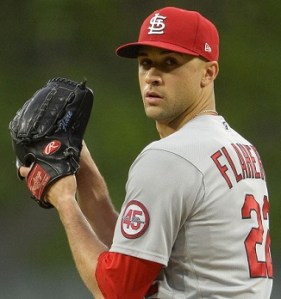
Jack Flaherty

If you’re ailing, speak up. You might save yourself some worse injury grief—even immediately.

The one pitcher the Cardinals could not afford to lose, especially missing two other key starting pitchers, is lost to them now. For who knows how long. It raises a dilemna almost as old as baseball itself: Who’s responsible for knowing or revealing when a player, any player, is injured enough to remove him before further damage is done?

Jack Flaherty admitted he started feeling tight in his side while pitching in the bottom of the fifth in his hometown Dodger Stadium Monday evening. But his turn in the batting order was due up in the top of the sixth and—right after Justin Williams led off with a home run to cut the Dodger lead to 2-1—he went out to the plate.

Flaherty swung on 0-1 at an outer-edge service from Dodger righthander Trevor Bauer, foul ticked it, and grimaced noticeably during the swing before hopping around the plate area in discomfort. He remained at the plate to finish the turn, taking a low ball one and then a called strike three. Then Cardinals manager Mike Shildt removed him from the game.

Now Flaherty’s on the ten-day injured list with a no-doubt oblique strain, and the Cardinals expect him to miss more time than that. With fellow key starters Miles Mikolas and Dakota Hudson already on the list—and baseball suffering quite the injury epidemic already this season—this is exactly what the Cardinals don’t need.

The question before the house—provoked in part by a social media debate into which I fell after noting Flaherty gone to the ten-day injured list Tuesday but likely to be out longer—is this: Should Shildt have been aware his man was ailing and either a) pinch-hit for him right off the bat in the sixth; or, b) removed him at once following the fateful swing to let another hitter finish the turn?

You might think the manager’s job includes awareness of his pitcher’s condition in the moment. Sometimes that awareness causes managers unwarranted grief, as Tampa Bay’s Kevin Cash can tell you from Game Six of last year’s World Series. But often as not that awareness does the manager a big favour when he has all his other marbles in the right place.

Should Shildt himself have noticed Flaherty feeling tight in the bottom of the fifth? Open to debate. Should he have seen Flaherty in obvious discomfort swinging on that foul tick and pulled him on the spot for a pinch swinger to finish the plate appearance? Open to debate likewise.

It’s not unprecedented for a batter to be pulled for assorted reasons during a plate appearance and for a pinch hitter to finish the turn. But there’s a missing link between the fifth and the sixth: Flaherty himself, and whether he thought to speak up and admit he wasn’t feeling quite right.

The Cardinals’ most valuable pitcher probably had no business at the plate or staying in the game to get there in the first place. If last year’s universal designated hitter had been made permanent from this year forward, as it most assuredly should have been, Flaherty wouldn’t have even had to worry about checking in at the plate.

Maybe in that instance, the tightness he felt in the fifth would have eased up with a half-inning off for good behaviour and allowed him to pitch one more inning—this time, with a one-run lead. Maybe.

Shildt had an option on his bench if he wanted it, lefthanded swinger Matt Carpenter. Carpenter hasn’t been the hitter he once was for about three seasons, now, but he would have been a hitter at all. He’s not historically the most dangerous man at the plate with two strikes, but he does have ninety hits including 23 home runs lifetime when hitting with two strikes on him.

With the bases empty, nobody out, and the Cardinals back to within a run of the Dodgers after Williams’s leadoff blast, do you really want a pitcher—a breed that’s hitting a whopping .109 with a glandular .146 on-base percentage and a swollen .141 slugging percentage—at the plate to start turning a one-run deficit into a tie game at minimum? (Sit down and shut up, Old Fart Contingency.)

No, you wouldn’t, if you could help it. Flaherty himself is no big bopper at the plate. Not hitting .185 this season, he isn’t.

Talking during a post-game press conference, Flaherty admitted he doesn’t like coming out of games on his own volition if he can help it. Bulldogging pitchers earn plenty of gold stars. But they like other players also bulldog themselves into bigger trouble when they don’t give their bodies the benefit of the doubt.

The injury you try playing or pitching through today can and too often does turn into the one that knocks you out for a lot longer than you’d like. Depending on the time of the season, it also might help cost your team a postseason shot. With twelve players on the IL before Flaherty joined them, and a bullpen faltering (and overtaxed) too often already, the Cardinals could afford to have him among the missing about as much as a cobra can afford dinner, dancing, and a hotel reservation with a mongoose.

Even in today’s baseball there remains a cultural dilemna. Speak up when you’re hurting, there’ll still be those who look at you as a softie, maybe whisper thus half behind your back. Clam up when you’re hurting, they’ll call you a bulldog now but curse the day you were born when you’ve been disabled awhile with a far more severe problem and they find themselves in the pennant race’s rear view mirrors.

The old school managers weren’t always the most empathetic lot when it came to injuries, either. Maybe none was more notorious than Leo Durocher, whose problems blowing the 1969 National League East title including demanding his Cubs speak up when ailing—then denouncing them as “quitters” whenever they did speak up.

When Fred Hutchinson managed the Reds before his death of cancer in 1964, he once lifted his ace-in-the-making Jim Maloney—despite Maloney working on a potential no-hitter—beause he spotted Maloney in forearm discomfort. “When you have an arm like that,” Hutch told reporters post-game, “you don’t take chances.”

His successors Dick Sisler and especially Dave Bristol treated injuries as mortal sins, especially involving pitchers. “If he can just get the ball to the plate, he’s not hurting,” Bristol was once quoted as saying. Hutchinson was a former pitcher who knew better. Bristol was a former minor league infielder who pitched now and then, and his brains went to sleep on him. Maloney developed rest-of-career shoulder trouble after Hutchinson was gone and a concurrent unfair reputation as a crybaby when he did speak out now and then about his continuously barking shoulder.

Remember when another former Reds pitcher, reliever Rob Dibble, snarked his way out of a Nationals broadcasting job for zapping young Stephen Strasburg coming out of a game with what seemed forearm issues at the moment? “Suck it up, kid. This is your profession,” Dibble huffed. “You chose to be a baseball player. You can’t have the cavalry come in and save your butt every time you feel a little stiff shoulder, sore elbow . . . stop crying, go out there and pitch. Period.”

Turned out Strasburg had more than just a forearm issue—he faced Tommy John surgery. He’s had injury issues throughout his career; until last year, he pitched damn well when healthy. Including when he stood as the 2019 World Series MVP. Dibble should have known even better than Hutchinson actually did—he’d missed the entire 1994 season after shoulder surgery and was gone within two years. Suck it up, kid.

Sandy Koufax sucked it up in 1965-66, after learning his pitching elbow was arthritic. He’d already gone from no great shakes through 1960 to off the charts from 1961-64. In 65-66, he went from off the charts to the tenth dimension aided by a medical regimen that could have killed him if the workload (699 innings over those two seasons) didn’t.

Then—gone. Koufax decided sucking it up, even to win two of his three Cy Young Awards, back-to-back pennants, and a World Series, wasn’t worth living what he feared would be a compromised life. Good for him. It ensured his baseball immortality. And, it let him make a liar out of F. Scott Fitzgerald and the author’s maxim about the lack of second acts in American life.

(It also spared us the sight of a Hall of Famer in decline, letting Koufax leave at 30 frozen forever as a young lancer who turned plate appearances into battles against the unarmed.)

By the way, Shildt eventually did call upon Carpenter to pinch hit Monday, an inning later. Except that Dodger manager Dave Roberts promptly lifted Bauer and compelled Shildt to pull Carpenter back, when Roberts brought in lefthander Victor Gonzalez, in favour of righthanded hitting Lane Thomas. Gonzalez struck Thomas out for the side.

An inning earlier, perhaps Roberts would have let Bauer work his way through. As it was, after Flaherty finished his standing plate appearance before leaving the game entirely, Tommy Edman reached on an infield throwing error and Dylan Carlson hit one over the center field fence to give the Cardinals their only lead of the game.

Maybe if Carpenter had pinch hit to finish Flaherty’s plate appearance, he might have tagged a hit or reached otherwise (he’s walked fourteen times this year and still has a good enough eye at the plate to keep doing it) and instead enabled a 4-2 score after five and a half inning. (The Cardinals went on to lose, 9-4.)

From every account and appearance, Shildt is not an insensitive man. He’s had his moments of snark and foolishness, but they’ve been few enough so far. Right now, he’s in a pennant race in which he’d love to stay all the way. He can’t afford to let his wounded stay quiet before they go from ailing to disaster.

Unless you believe as I do that the universal DH is an idea whose permanent time is overdue enough, Flaherty didn’t get injured doing something he shouldn’t have been doing. He got hurt on the job doing his job. As one Twitter respondent said to me, it sucks that he got hurt but that’s part of the game.

Indeed. Not just to pitchers, either: Fernando Tatis, Jr. took an early exit in the sixth Tuesday night when he felt tightness in the same area, too. The Padres are keeping him day-by-day to be safe. Young as he is, Tatis probably knows any compulsion to suck it up risks making things more painful.

If Flaherty felt compelled to keep quiet about his side tightness after the bottom of the fifth Monday, Shildt might consider talking to him and the rest of his players. He could tell them it does themselves or the club no good to stay quiet when hurting.

“Talk up and sit down now, rather than hit disaster down the stretch. You’re not less of a man for being injured, but you’d be less of a man if it went from bad enough to worse.” That’s what Shildt could and should tell his Cardinals. That’s what Jayce Tingler might want to tell his Padres, too. That’s what any manager should want to tell his team.

Enough is way beyond enough, already

Jack Flaherty

Flaherty in discomfort after fouling off an outer-edge pitch in the sixth Monday. He grimaced with gritted teeth as he swung—and could face IL time with an oblique strain.

Bad enough: Someone had to drag it out of Jacob deGrom that his freshly-ended stay on the Mets’ injured list came because he strained his side while . . . swinging the bat. Worse, now: Jack Flaherty could miss a start at minimum for the Cardinals now that he’s got an apparent rib cage injury after he dinged it . . . swinging the bat.

As if the overall futility of pitchers swinging at the plate isn’t enough reason to implement the universal designated hitter. (Anyone who says deGrom with his .450 hitting average isn’t an outlier is either blind or willfully ignorant.) The injury risk isn’t just someone’s equally perverse fantasy.

Flaherty was pitching well enough against the Dodgers Monday evening when he batted against Trevor Bauer in the top of the sixth. He swung with a slight lunge at an outer-edge pitch on 0-1 and fouled it off, a clenched-teeth grimace very visible on his face as he swung. Then he hopped around the plate area in plain discomfort.

Cardinals manager Mike Shildt took no chances. After Flaherty struck out looking, Shildt lifted him from the game at once. With a 2.90 ERA, a 9.7 strikeout-per-nine-inning rate, and a 1.03 walks/hits per inning pitched rate, Flaherty is the one Cardinals starting pitcher above all whom Shildt cannot afford to lose for any length of time.

The good news was the Cardinals dropping a three-spot on Bauer in the inning: Justin Williams leading off with a home run off the right field foul pole; then, after Tommy Edman reached on a throwing error, Dylan Carlson hitting one over the center field fence.

The bad news was the Dodgers jumping the Cardinals bullpen for four in the bottom of the sixth to re-take the lead. Max Muncy’s one-out double against reliever Ryan Helsley was followed a base hit later by another Cardinal reliever, Genesis Cabrera, walking Cody Bellinger to load the pads, then walking Will Smith to re-tie the game at three, striking Gavin Lux out looking, but surrendering a three-run double on the fifteenth pitch to Chris Taylor before . . .

Well, now. What was that Thomas Boswell wrote two years ago about getting tired of watching rallies killed by the cop-out of pitching around competent number eight hitters to strike out the opposing pitcher? Cabrera put Dodger second baseman Zach McKinstry aboard and then struck Bauer himself out for the side. “In the AL,” Boswell wrote then, “you must pitch your way out of a jam, not ‘pitch around’ your way out of it.”

Flaherty’s batting injury threw a stone into Shildt’s gears. The righthander working in front of a hometown crowd had surrendered two runs on back-to-back solo bombs but checked in at the sixth-inning plate after wiping out eight straight Dodgers including one string of five straight strikeouts. Then Flaherty went from cruise control to road hazard with one swing.

Barring unforeseen circumstances there was no way the manager wanted to go that early to the bullpen that leads the entire Show with 120 walks this season. They’ve also walked more batters with the bases loaded (fifteen) than they’ve surrendered hits (fourteen) with ducks on the pond.

“I felt a little tightness, and it was more just felt we should check it out more than anything,” said Flaherty during a post-game press conference. “A little bit of tightness I felt, and thought it was something to bring up. More just to be safe . . . I’m sitting here just fine. I’ll get up out of this chair just fine. I’m moving around all right. I don’t ever leave games. I don’t ever come out of games. It was just something just wanted to check out.”

That’s his story, and he’s sticking to it, never mind that averaging five and two thirds innings per start this year he comes out of games, all right, just never during a working inning. He felt the little bit of tightness first while pitching the fifth. Then after swinging on that foul tick it looked like enough that Shildt decided enough was enough.

“The tightness is in the torso,” wrote the St. Louis Post-Dispatch‘s Derrick Goold, “and the concern will be that Flaherty has an injury to the oblique that could lead to a lengthy absence. He was being re-evaluated late Monday night, and it’s likely the team will have scans taken of his torso.”

If those scans show further damage than just a little tightness, it’s disaster for the Cardinals as well as for Flaherty. They’re in second place and half a game behind the Cubs in the NL Central despite the Cubs leading the Show with their current injured list population.

We’re not exactly talking about one of the great hitting pitchers here, either. Flaherty’s hitting average is .125 this season. Jacob deGrom he ain’t. Not on the mound, of course, as good as he is out there, but especially not at the plate.

The entire Cardinal pitching staff is hitting .070 this season to date. The team is fifteenth in Show for runs scored and runs allowed, but you might see them a little higher for runs scored if they didn’t have to waste plate appearances with those .070-hitting pitchers.

DeGrom’s Mets are rock bottom in the entire Show for runs allowed. They’re also at rock bottom for runs scored, alas. Think they might have a few more runs on the board if their pitchers didn’t have to drag their happy hides to the plate? The Mets’ pitchers are hitting .167 as of this morning’s stats. Remove deGrom and it wouldn’t be that high by a long shot.

You tell me which is more important to the Mets or any team—a .450-hitting pitcher who’s a too-obvious outlier among his breed? Or, a pitcher whose 0.71 ERA (with a 1.08 fielding-independent pitching rate) could hold up all season long and leave him in a league of his own? (DeGrom isn’t shown atop the leaderboards for ERA and FIP only because—with the Mets having played only 46 games, plus his IL turn—he’s pitched only 51 innings so far; or, just shy of seven innings a start.)

Commissioner Nero decided last year’s universal DH wouldn’t be this year’s at minimum. The issue will return to the table when the current collective bargaining agreement expires after this season. Some say the days of NL pitchers hitting will end there. Some say not quite yet. Those days deserve to end permanently at last.

From the end of the 20th Century’s first decade through the end of the 21st Century’s first decade, pitchers overall have hit .155. They’ve made Willy Miranda resemble Willie Mays. Do Nero and the chump contingent insisting that pitchers taking turns at the plate means “real” baseball need more evidence on behalf of ending the National League’s “traditional” refusal of the designated hitter? (Which really amounts to refusing an idea that was first hatched by one of its own owners before the turn of the 20th Century.)

Try just two items to start:

* Continuing regular-season interleague play makes a further mockery of that NL “tradition,” since pitchers have to bat when such games are played in the NL team’s park but NL pitchers get a breather at the plate when the games are played in the AL parks.

(Incidentally, 2020’s pan-damn-ically inspired irregular season was the first time the leagues tied in regular-season interleague play. Since the interleague virus was introduced in 1997, the American League has fanned the National League’s behind: 3,315-3,047. The National League has led in interleague play only four times since 1997 and not once since 2003.)

* This season’s slash line at the plate for all Show pitchers as of this morning is .108/.145/ .140. The slash line for National League pitchers at the plate as of this morning: .107/.145/.137. Now, remove deGrom from the picture—the NL’s pitchers would be hitting .101.

Go ahead, call for continuing to send outlier deGrom to the plate for a lousy six-point hike in the pitchers’ overall hitting average. In a year where nobody can really decide what to think about offense and how declined it is in the first place.

In a year when deGrom has spent time on the injured list because of a plate appearance,  Flaherty is now in danger of spending likewise because of one, and Diamondbacks pitcher Zac Gallen is missing “weeks” due to an ulnar collateral ligament strain he first incurred during late spring training . . . taking batting practise.

You want to continue risking pitcher health through non-pitching injury? You really want to continue watching pitchers not named Jacob deGrom (or even further-outlying Shohei Ohtani—who doesn’t bat on his pitching days normally and damn well shouldn’t) wasting precious outs at the plate? You really want to keep watching rallies die when the opposing pitcher pitches around your good number eight batter to strike your pitcher’s ass out?

Be my guest. If “traditionalists” don’t care about exposing themselves as baseball bigots by rejecting real evidence on behalf of lamely-excused prejudice, neither do I.

———————————-

Situation update: Jack Flaherty did indeed hit the ten-day injured list Tuesday—with an oblique strain that may keep him out more than ten days or “just a couple of weeks.” Was it worth it for a foul tick followed by a called strikeout?

Mistakes don’t equal murder

Will Craig, Javier Baez

Will Craig, after taking the errant throw pulling him down the first base line and into unexpected infamy . . .

“I guess I’m going to be on the blooper reels for the rest of my life,” said Pirates first baseman Will Craig last Friday, before the team’s game with the Rockies was postponed by rain. And, the day after Cubs shortstop Javier Baez deked him and his into a third-inning rundown that looked like the year’s funniest television moment in the moment.

It wasn’t all that funny in retrospect when Joe and Jane Fan plus Joke and Jerk Sportswriter/Talk Show Commentator started painting Craig as though he flunked the casting calls for Howard the Duck.

“It all boils down to me losing my brain for a second,” the 26-year-old Craig continued. “I take full responsibility for it and now will just try to keep moving forward. I know I’m a good defensive player and I can do a lot of good things on that side of the ball.”

The snarky side might suggest Craig and the Pirates who collaborated with him on the season’s most surrealistically slapstick play thus far handled things like men who’d learned their infield basics from the 1962 Mets.

Observing his coming place on eternity’s blooper reels indicates Craig—who won a Triple-A Gold Glove during his minor league life—has at least the sense of humour those ancient Mets needed just to get through that first calamitous season without losing their marble. Singular.

Maybe, too, the fact that neither the Pirates nor the Rockies look destined to reach this year’s postseason works in Craig’s favour. If he’d suffered last Thursday’s mishap in a postseason game, especially a World Series game, Joe, Jane, Joke, and Jerk alike would do everything in their power to make the rest of his baseball life—and maybe his life life—a living death.

Baez batted with two out and Cubs catcher Willson Contreras aboard in the top of the third, with the Cubs ahead 1-0. Baez whacked a sharp ground ball to Pirates third baseman Erik Gonzalez. He picked the ball cleanly. Then, he threw to first well enough off line to pull Craig forward, several feet down the line and in front of the pillow.

Craig had only to tag Baez or touch first for inning over. Then Baez got cute. Enough to break Craig’s concentration and prior knowledge for just long enough.

With about three feet between himself and Craig, he hit the brakes and went about-face back toward the plate, with Craig chasing him down the line instead of thinking about just tagging first. This is the kind of thinking lapse to which major league rookies are prone—even those with outstanding defensive reps in the minors, as Craig had—and into which even grizzled veterans can and do get caught sinking.

Contreras kept gunning it all the way home. Craig flipped to catcher Michael Perez. Contreras slid under the tag and Baez took off back to first. Perez threw past second baseman Adam Frazier looking to cover the base and Baez hit the afterburners for second.

I’m still trying to fathom how Craig ended up the sole goat on the play. Why does he wear the horns alone, when Gonzalez’s off-line throw started the whole megillah in the first place? Why does he wear the horns alone, when Perez threw well past first instead of bagging Baez there?

Baez basically had second on the house and the Cubs had a 2-0 lead. It became 3-0 when Cubs center fielder Ian Happ dumped a quail into short right center on which Baez with a good jump scored.

The official scoring on the play, according to Baseball-Reference, reads thus: Javier Baez—Reached on E3 (catch) (Ground Ball to Weak 3B to 3B); Contreras Scores/No RBI/unER; Baez out at 2B/Adv on E2 (throw).

Where were the Pirates to cover their rookie mate’s head and hide? Committing a pair of chargeable errors, that’s where. Where were the Pirates in the dugout to remind Craig in the immediate moment, step on first? Maybe they were as dumbstruck as everybody else in PNC Park when the thing began to unfurl. Maybe.

At least Craig’s manager had his post-game back. “He made a mistake and that’s it,” Pittsburgh manager Derek Shelton said. “You don’t option a guy [to the minors] because of the fact he made a mistake. We make mistakes in all realms of life. It just happened to be something nobody’s ever seen before.”

I didn’t mention the 1962 Mets just to be cute. Writing Can’t Anybody Here Play This Game? about that embryonic troupe, Jimmy Breslin swore the Mets infield lapsed almost likewise in the eighth inning of the first game of a doubleheader with the Cardinals.

Yes, I saw those Mets. They had Who the Hell was on First, What the Hell was on Second, You Didn’t Want To Know Who was on third, and You Didn’t Even Want To Think About It at shortstop. If it could have happened to anybody in the past, those Mets were them.

Breslin swore first baseman Marv Throneberry—the Original Mets’ original super-anti-hero—got so caught up trying to catch Cardinals third baseman Ken Boyer in a rundown (they had Boyer cold, according to Breslin) that he and fellow Met infielders Rod Kanehl and Charley Neal forgot about Hall of Famer Stan Musial on third—to Musial’s slack-jawed amazement, before The Man shot home with what proved the winning run.

That was Breslin’s story. I had to be a spoilsport and look it up. I looked at every game log involving the first games in every doubleheader between the Mets and the Cardinals in 1962. They played three doubleheaders against each other that year. That play never happened.

There ain’t much good you can write about us, but I don’t see where that gives people the right to make stuff up, lamented Hell’s Angels president Sonny Barger about their notoriety in the mid-to-late 1960s. All that bullshit, hell, ain’t the truth bad enough for ’em?

The ’62 Mets may not have pulled a mental mistake quite as grave as Craig’s, not against the Cardinals, anyway, but that didn’t give Breslin any more right to misremember than it gives Joe, Jane, Joke, and Jerk the right to make Craig resemble the most blundering bonehead on the block this side of . . .

No, we’re not going to exhume Bill Buckner’s corpse. Or John McNamara’s. Or those of Fred Merkle, Freddie Lindstrom, Ernie Lombardi, Mickey Owen, Johnny Pesky, Charlie Dressen, Ralph Branca, Casey Stengel, Gene Mauch, Willie Davis, Dick Williams, Curt Flood, Tommy Lasorda, or Donnie Moore.

We’re not going to haul the still-living among Tom Niedenfuer, Don Denkinger, Mitch Williams, Dusty Baker, Grady Little, Buck Showalter, Matt Weiters, the ’64 Phillies, the ’69 Cubs (and every Cub from the [Theodore] Roosevelt Administration through the Obama Administration), the ’78 Red Sox, the ’07 Mets, the ’17 Nationals, and maybe every St. Louis Brown who ever walked the face of the earth, before the court, either—kangaroo or otherwise.

They failed despite their efforts, often as not in baseball’s most broiling hours. They suffered momentary lapses of eyes, ears, and minds, too, and with a lot more at stake than what’ll yet prove a meaningless game between two National League bottom feeders.

Joe, Jane, Joke, and Jerk still don’t get what Thomas Boswell (whose pending retirement will still be a loss to baseball wisdom) wrote upon Moore’s 1989 suicide:

Nobody will ever be able to prove that the haunting memory of giving up Dave Henderson’s home run in the 1986 American League playoffs led Moore to commit suicide. Maybe, someday, we’ll learn about some other possible cause. [Alas, we did.–JK.] But right now, what some people are saying, and many are thinking, is that this “goat” business isn’t funny anymore . . .

The flaw in our attitude—perhaps it is even an American predisposition with Puritan roots—is to equate defeat with sin. The unspoken assumption is that those who lose must do so because of some moral flaw.

Rookies make mistakes. Well-seasoned veterans make mistakes, even if they’ll be misremembered by even the funniest and sharpest reporters. Even managers who win ten pennants and seven World Series (including five straight to open) in twelve years make mistakes—the way Hall of Famer Casey Stengel did, when he failed to plot his pitching to allow his Hall of Famer Whitey Ford three instead of two 1960 World Series starts.

Hall of Famer Bill Mazeroski and his Pirates still say thank you. Ford steamed quietly about it for years, until Stengel finally apologised to his old lefthander and earned Ford’s forgiveness. (Remember that when you think of a certain fan base’s unspoken motto, To err is human, to forgive must never be Yankee policy.)

Rookies and veterans alike also have things unexpected happen to them that turn routine plays into disasters you’d think made Hurricane Katrina seem like just a bathroom pipe break, the way Joe, Jane, Jerk, and Joke paint the poor souls.

Lucky for Craig that he does have that sense of humour about it. He’s already proven he’s made of better stuff than his critics and howlers, which doesn’t take all that much.

There’s plenty unfair about veiling player injuries

Bryce Harper

Bad enough: Bryce Harper—here about to be nose-coned by a Genesis Cabrera fastball—suffered a wrist injury on this pitch that sapped him at the plate in May. Worse: his manager Joe Girardi still thinks it’s fine to lie about player injuries.

Phillies manager Joe Girardi says sharing injury information with the press is “somewhat unfair to us.” It’s not exactly fair to a lot of people, especially the injured player(s). Especially with this season’s injuries seeming to come in multiples, which too many observers feared possible, if not likely, after last year’s pan-damn-ically inspired short, irregular season.

Last Tuesday, Bryce Harper was finally put on the injured list with a wrist injury. His manager was forced to admit he’d lied previously about Harper’s actual condition, saying he gave Harper last Sunday off, maybe to help the right fielder start shaking a slump away.

Never mind for the moment that the Phillies have real player depth problems. The Athletic‘s Matt Gelb isolates a more severe problem: “There might be a larger issue when it reaches this point: The Phillies would rather engage in subterfuge to trick the opposing manager than play with an actual full roster.”

You might recall Harper taking a hard and fast Genesis Cabrera pitch off his nose onto his left wrist leading off the sixth in St. Louis near April’s end. At that moment, between Harper getting dropped and followup Phillies batter Didi Grigorius taking the next pitch off his ribs, the outrage was over both Phillies being injured with those pitches and the abject stupidity of the three-batter minimum rule for relief pitchers.

The rule denied Cardinals manager Mike Schildt the option of getting Cabrera the hell out of there on a night he clearly lacked control of his bullets. The umpires’ refusal to eject Cabrera after Grigorius got drilled outraged the normally mild-mannered Girardi enough to get himself the ho-heave after making a pantomime of ejecting Cabrera himself following the umpire warnings.

But something was clearly wrong with Harper in the month to follow. His April finished with a 1.063 OPS (.448 on-base percentage; .615 slugging percentage). Now his May finishes with a 179-point OPS drop, to .884. His on-base percentage dropped 53 points; his slugging percentage, 126 points. He went from 48 total bases the season’s first month to 13 in May.

The Phillies may have had depth problems most of the season so far, but someone in that organisation should have seen something wrong with Harper. The lefthanded-swinging right fielder was clearly unable since the Cabrera drill to hit hard when making contact, and enemy pitchers figured it out early enough to keep pounding him with fastballs. He should have been send to the injured list far sooner than now.

But no. And Girardi thinks just keeping his mouth shut about who’s hurt where and how badly is going to help? If the other guys’ pitchers figured Harper’s swing was weakened and exploited him accordingly, does Girardi really think he’s doing Harper or anyone else on his team any favours by not talking up?

“There is a distinct advantage to the other manager if I tell you a guy’s wrist is hurt,” Girardi said last Tuesday, after the Phillies finally had to surrender and send Harper to the injured list.

And the idea here is to win games . . . I understand you want to know. But there are distinct advantages that I can give another club if they know everything that’s going on over here. So I’m sorry that I had to do that. But we’re trying to win games, and he’s just not ready to go. I thought he’d be ready on Monday or Tuesday. He’s not.

News flash: The other guys already know who doesn’t look right. Especially if he has an injury history the way Harper does.

Marlins manager Don Mattingly, whose team hadn’t faced the Phillies in April but did so twice this month, figured it out immediately last Sunday, when he saw Harper on the Phillies bench last Sunday wearing a red pullover shirt but not his Phillies uniform top. Mattingly and his Marlins knew Harper wasn’t going to play before Girardi finally had to quit lying his way around the issue.

Harper still has his career-long critics, of course, but even they acknowledge (however begrudgingly) that he hates to sit a game out unless he absolutely must. Baseball men “know to never read too much into Girardi’s words because he was notorious for less-than-truthful injury updates when he managed in New York,” Gelb observed.

Then Harper told Girardi last Sunday morning the wrist still wasn’t right. Come Monday, Girardi fed the press a line about merely deciding Sunday night he’d give Harper an extra day off.

Sure, Joe. Let Joe and Jane Fan think all he needs is an extra day’s rest. Let them think they haven’t seen what their own eyes tell them. Let them think the man’s just slumping. Let them think he’s just struggling as he’s done at times in the past.

Anything except letting the other guys think what they already know because they’ve been in the game long enough to know better. The hell with your guy’s reputation or health. Even if he should have been sent to the injured list and the real doctors long before he finally was. It’s going to do your team how much good now?

It’s not that Joe and Jane Fan always know when a player struggles because his health compels the struggle. They see such a player—whether a replacement-level player or a $300 million dollar gigastar—and assume without knowledge that the man is either having a slump or exposing himself as the overrated bum they always knew him to be.

It gets even better when Joe and Jane start rhapsodising about the Good Old Days of the Grand Old Game. When ballplayers were invariably warriors, real men who played through broken limbs or even tuberculosis. Joe and Jane don’t like to be reminded that in the Good Old Days of the Grand Old Game players had so few choices about things in general and baseball medicine, such as it was, in particular, that baseball medicine could have been hauled before the boards to answer for downright malpractise.

Red Schoendienst

Everyone in the league knew something was wrong with Hall of Famer Red Schoendienst in 1958—then he was diagnosed as having played the year with tuberculosis. Fat lot of good that did him or his Braves.

Even today, you can find a player who finds as much reason to trust his team medical staff about as far as he could throw a subway train, then goes to a more reliable doctor—and gets himself into hot water with the team. It’s hell if you do and hell if you don’t.

Did I say tuberculosis? Joe and Jane love reading about the “guts” it took 35-year-old Hall of Fame second baseman Red Schoendienst to play 106 games in 1958—including stretching a double into a triple on the basepaths during the World Series—despite everyone in the National League including his own team knowing something was badly wrong with the ten-time All-Star, who knew what?

Yankee Hall of Famer Mickey Mantle remembered Schoendienst being exhausted beyond normality after pulling up at third on that hit. Diagnosis after the season: tuberculosis. Missed practically the entire 1959 season. His Braves lost that Series to the Yankees, then lost the 1959 pennant in a playoff against the Dodgers.

Mantle spoke of Schoendienst in his 1964 book (with Babe Ruth/Casey Stengel biographer Robert W. Creamer) The Quality of Courage. Exactly what good did it do his team or himself that Schoendienst “courageously” played through a disease that could have killed him, infected others, and then missed most of the following year?

A player who earned his living as much with his second base defense as his bat, Schoendienst was never the same player again. He hung around for portions of four more seasons before becoming a successful manager, and even his second base abilities drained away before he called it a playing career.

It’s not that Joe and Jane Fan share a particularly acute or enduring memory today, either. They spent more time bemoaning the Jacoby Ellsbury contract with the Yankees for his protracted absences than they did bemoaning the fact that Ellsbury spent so much time in drydock because of assorted injuries he’d actually incurred, you know, playing the game. (Did I mention the manager when Ellsbury first joined the Yankees was Joe Girardi?)

They also tended to forget that teams carry particularised insurance covering those big contracts in the event of injuries. They’d rather carp about such players “stealing” money from their teams as if they went out with premeditation and malice aforethought to get injured during games.

The biggest idiots among the fans still think Albert Pujols “stole” millions from the Angels, rather than stopping to think the reason Pujols dropped so far off the table in the first place was his lower body health, only starting with a frightening recurrence of plantar fasciitis after his first Angels season.

It doesn’t take much to leave a player anything but the player he was until that one particular injury, either. Especially when he’s still only 28 years old. Playing through a wrist injury did Harper no favours at all. In April: he swung and missed 26 percent of the pitches he saw in the strike zone and still posted that 1.063 OPS for the month. After the Cabrera drilling: he swung and missed at 37 percent of what he saw in the zone—and his OPS cratered.

“Beyond the simple fact that no Girardi updates for the remainder of his time as Phillies manager can be taken at face value,” Gelb writes, “there have to be real questions about Harper. Is there more than a sore wrist at play here?”

If there isn’t, it shouldn’t be a shock, either. A single injury can and too often does send a player from the Hall of Fame track to the wrong side of the track. It’s bad enough Joe and Jane Fan couldn’t care less. It’s worse when his own manager thinks the solution includes lying through his teeth about it.