Halt right there, Mr. Mayor

Hall of Famer Joe Morgan with Cincinnati mayor John Cranley.

Spare us, please, the political (lack of) class and its hyperbolic weigh-ins when sporting events transcend the particular sport itself, for better or worse. Or, when a sport legend passes on to the Elysian Fields. Mourning the death of a Reds legend, Cincinnati’s mayor proclaims concurrently a standing for the Reds’ arguable greatest team that the evidence rejects.

Hall of Fame second baseman Joe Morgan’s death Sunday provoked an outpouring of loss and grief to be expected of a player whose performance equaled his gifts and who was at least as good a man as he was a baseball player. It also provoked Cincinnati mayor John Cranley to amplifying knowledge and wisdom by standing athwart both.

“We all know the Big Red Machine was the greatest baseball team of all time,” Cranley tweeted upon the news of Morgan’s death, accompanied by a photograph of himself and Morgan at an outdoor event. “Joe Morgan was the MVP of both back-to-back ‘75 and ‘76 Reds World Series wins, making him the greatest second baseman of all time. This is a devastating loss to the MLB and Cincinnati. RIP to a legend.”

What do you mean we, white man?

Let’s get the second hyperbolic out of the way first. Back-to-back Most Valuable Player awards are staggering achievements in their own right. If those alone illustrate a player’s cumulative greatness, Roger Maris (1960-61)—whose greatness was short-enough lived, thanks to six parts injuries and half a dozen parts the searing the 1961 Babe Ruth home run chase left upon him—would have reached Cooperstown in a walk. So would Dale Murphy (MVP, 1982-83), if injuries hadn’t hastened and turned his decline phase into a cliff dive.

Back-to-back MVPs alone didn’t leave Morgan as the arguable greatest second baseman in Show history. His all-around play at the plate, on the bases, and at second base, to say nothing of the most wins above replacement-level player for any second baseman playing a truly integrated game, accomplished that. You could remove Morgan’s MVPs and he would still shake out as being that great.

Now to the first. The Big Red Machine was the greatest team in the National League in its time. No questions asked. If you measure by consecutive World Series wins, the 1970s Reds were the only NL team to do it. Two American League teams did it, too: the Bronx Zoo Yankees (1977-78) and the Oakland Athletics earlier in the decade.

Oops. The Swingin’ A’s won three straight Series (1972-74) in the middle of winning five straight American League Wests. Including their beating the Machine in seven in 1972.

If you’re going by Hall of Famers on those teams, be careful. The Machine had three Hall of Famers (Morgan, Johnny Bench, Tony Perez) and might have had a fourth (Pete Rose) if he hadn’t had a problem with, you know, all that other stuff. Oh, all right, let’s give the Machine the four Hall of Famers just for argument’s sake.

For much of the 1960s the San Francisco Giants had five Hall of Famers in their ranks: Orlando Cepeda, Willie McCovey, Juan Marichal, Gaylord Perry, and Willie Mays. One of them (if you have to ask) is considered the arguably greatest all-around player who ever walked the face of the earth when fellow Hall of Famer Mickey Mantle isn’t. Here’s how many World Series those great Giants teams won: none.

They only reached one World Series and lost in six games to the last of the vintage Yankee teams. Those Giants had a little problem on their hands known as the Los Angeles Koufaxes to thwart them at their peaks. They weren’t the only Hall of Fame-packing team of that time to fall short, either.

Quick: Name the team with four Hall of Famers and not even a single shot at the Promised Land. Hint: Their manager burned them out down the stretch in the one season they almost won the National League East. Since you had to ask: the four Hall of Famers in question are Ernie Banks, Ferguson Jenkins, Ron Santo, and Billy Williams.

Let’s remove the Machine’s should-have-been Hall of Famer now and leave it with three. Well. The 1967-68 St. Louis Cardinals had a trio of Hall of Famers. (Cepeda, Lou Brock, Bob Gibson.) They went to back-to-back Series and won one of them. The 1969-74 Baltimore Orioles packed a trio Hall of Famers. (Jim Palmer, Brooks Robinson, and Frank Robinson in 69-71.) They won five of six American League Easts and one World Series in three straight trips. The Seattle Mariners of the mid-1990s had a Hall of Fame trio, too. (Ken Griffey, Jr., Randy Johnson, Edgar Martinez.) They’re still looking forward to their first World Series appearance, never mind conquest.

A few days before Morgan’s passage, Hall of Fame pitcher Whitey Ford passed away while watching his Yankees play the Tampa Bay Rays in an American League division series. Ford could have told Cranley plausibly that several generations of Yankee teams, including the ones for which he pitched, make the Big Red Machine resemble the Little Red Caboose.

Ford became a Yankee smack dab in the middle of their five-year World Series-winning streak. That provokes me to compare the first seven seasons of those Casey Stengel Yankees to the first seven seasons of the Machine. Allowing for the lack of divisional play in those Yankees’ time and the shorter seasons (by eight games), this is the result:

Team Won Lost Pennants World Series Titles
New York Yankees (1949-55) 686 389 6 5
Cincinnati Reds (1970-76) 683 443 4 2

The Machine is almost dead-even in the wins column but 54 ahead in the loss column. If you were to add eight games a season to the 1949-55 Yankees, it’s not implausible that they’d have totaled 700 wins or better and 400 losses or better.

Those Yankees do have a claim the Machine wouldn’t have wanted: a 103-win season in which they finished second—by eight games, yet, to an Indians team that picked 1954 to have their career year, so to say. (The Machine had three 100+ win seasons and won the NL West in all three.)

Did I forget to mention that those Yankees had four Hall of Famers aboard at a time a few times? The 1950 Yankees (Ford’s rookie season) included Ford, Yogi Berra, Joe DiMaggio, and Phil Rizzuto. When Ford returned from military service in 1953, they had Ford, Berra, Rizzuto, and Mickey Mantle. Don’t go there, Mr. Mayor. They’ll match their questionable Hall of Famer Rizzuto to your questionable Hall of Famer Perez.

(Their primary National League rivals, the Boys of Summer Brooklyn Dodgers, had to settle for three, too: Pee Wee Reese, Jackie Robinson, and Duke Snider. Sandy Koufax was a beyond-marginal 1955 rookie.)

Fair enough. It’s not entirely fair to compare the Machine to the Berra-DiMaggio-Ford-Mantle Yankees. It’s a lot more fair to compare the Machine to a more contemporary aggregation:

Team Won Lost Pennants World Series Titles
New York Yankees (1996-2002) 685 445 5 4
Cincinnati Reds (1970-76) 683 443 4 2

The Machine is almost dead even to the Derek Jeter-Mariano Rivera Yankees. (They, too,  might have packed three Hall of Famers, if Roger Clemens hadn’t been considered persona non grata from Cooperstown because of actual or alleged performance-enhancing substance suspicions that have yet to be proven once and finis.) Almost.

Those Yankees, however, won five pennants and four World Series—including three straight—playing in slightly more difficult postseason conditions. I don’t need a lot of convincing that the Machine would likely have done just as well if they’d played in a three-division league having to plow through two postseason sets to reach the World Series. But the Yankees did have to play in such conditions to win one more pennant and two more leases on the Promised Land.

There are lots of teams who would kill for a piece of the Machine’s five division titles, four pennants, and two World Series conquests in seven years. There are also teams who would kill for a .686 single-season winning percentage. The Machine teams never posted a winning percentage quite that large. (Its best: 1975’s .667.) But one of their ancestral teams did.

Wait for it—the 1919 Reds. The ones who could damn well have beaten the infamous Black Sox in a straight-no-chaser World Series. There’s a cause for you if you’re interested, Mr. Mayor. How about a little agitation on behalf of removing the Black Sox taint from the 1919 Reds’ claim on the Promised Land? Your forebears wuz robbed.

The day of living dangerously

SHAZAM!! Manuel Margot, training for the Olympic pole-vault team in the second inning Tuesday.

If you thought like me that Game One was The Little Bang Theory, what should we call Game Two? How about, The Day of Living Dangerously? For the Tampa Bay Rays, that is. They beat the Houston Astros, 4-2, Monday afternoon, but it looked for awhile as though they decided to defy a suicide pact.

Actually, it looked as though their usually-reliable bullpen bull Nick Anderson made and then abrogated the suicide pact, at the last split second before his end of the bargain would have required him firing the bullet through his head.

He’d surrendered back-to-back-to-back singles to Yuli Gurriel, Josh Reddick, and pinch-hitter Aledmys Diaz. He gave up the run to get George Springer to whack into a step-and-throw double play to second. Then, he re-loaded the pillows with back-to-back, four-pitch walks to Jose Altuve and Michael Brantley.

For a few brief and none-too-shining moments, with the shadows crawling across San Diego’s Petco Park, you could see the Rays’ dreams of somehow, maybe chasing the Astros home for the winter a little prematurely by Astro standards going up in a cloud of dust when Alex Bregman hit Anderson’s fastball just off the middle to him.

All afternoon long, the Rays took everything the Astros dished out, which was about ten times as much as the Rays could muster, and still clung to the lead they took in the first after the nice Astros were generous to a fault with them with no score, two out, and Randy Arozarena on first with a base hit to left instead of his customary home run.

Specifically, Altuve proved the generous one. The usually sure-handed, sure-armed second baseman snapped up Ji-Man Choi’s grounder to shallow right into the shift but threw offline enough to first baseman Yuli Gurriel to set up first and second. Setting Manuel Margot up to hit Astro starter Lance McCullers, Jr.’s second pitch to him into the left field cutouts.

From there it went thus: McCullers, way out-pitching his former Astros rotation mate Charlie Morton . . . and leaving after seven innings, in the seventh of which Rays catcher Mike Zunino—with two out and nobody aboard—hit a 1-1 sinker that didn’t sink enough over the center field fence.

The Astros, Dr. Peppering the Rays at the plate, outhitting them 10-2-4 . . . and still unable to paint the scoreboard more than Carlos Correa hitting otherwise effective Rays reliever Pete Fairbanks’s 1-0 fastball a lot further over the center field fence than Zunino’s would travel.

Every Astro hitter except Bregman having at least one hit on the day . . . and still going a measly 1-for-4 with runners in scoring position.

Diver down . . .

The problem was the Rays playing like they thought they were the 1969 Mets. Acrobats, jugglers, and precision shooters in the field. Maybe the only thing the Rays didn’t have going for them on defense was the 82nd Airborne. And maybe they think, who the hell needs those guys after Margot’s shazam! in the top of the second.

Gurriel (one-out single) on third, Martin Maldonado (two-out ground-rule double) on second, two out, and Springer swinging on 1-1. The ball sailing up and toward the right field line. Margot chasing across the sun field, glove shielding his eyes enough to keep the ball in sight. The high sidewall coming into quicker sight as the ball angled to foul ground. Margot taking a flying leap.

Olympic pole vaulters don’t clear their bars like that. Do they?

He speared the ball one-handed a split second before his torso hit the wall’s top fence brace and he bent over that brace and fell into a straight-down dive on the far side, bending just in time not to land flat on his head. Then he sprang up almost as swiftly, somehow, thrusting his glove hand up in a perfect Lady Liberty impression.

Shazam!

The Petco Park audience would have heaved a sigh of relief enough to blow a typhoon from the shores of California to the rock-bound coasts of Maine—if there’s been a real crowd in the park, that is.

When he sprang up almost as swiftly to show he held onto the ball, the Petco Park audience would have heaved a sigh of relief enough to blow a hurricane from the shores of California to the rock-bound coasts of Maine—if there’d been a real crowd in the park, that is.

After all the foregoing plus that near brain-scrambling pole vault of a catch, wouldn’t you think that even an Anderson who might still have been a little gassed or hung over from his Friday night’s labour would think twice before compelling a high-wire act with no guarantee of a trampoline to break his and the Rays’ fall.

Bregman’s high liner sent center fielder Kevin Kiermaier back. And back. To the track. At the wall. Caught. Game over. Crash carts taken off white-hot alert. Oxygen ventilators shut down for the night.

Every other Rays heart still threatening to break through their owners’ rib cages and skins. Every Astro probably wondering to themselves whether it would take nuclear weapons and exterminators to rid themselves of these death-defying pests. Maybe they’ll call the 82nd Airborne. Ringling Brothers and Barnum & Bailey Circus is out of business, you know.


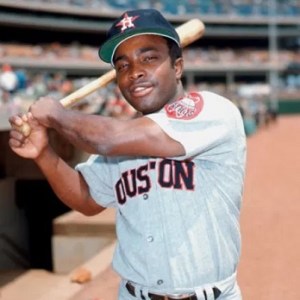
Joe Morgan, RIP: The Machine’s main man

A portrait of the artist as a young Astro.

In terms of watching and following and loving baseball, I went back a very long way with Joe Morgan. In the early years of the Houston franchise, from the Colt .45s to the Astros, Morgan was one of the three Astros I knew immediately, the others being his middle infield partner Denis Menke and pitcher/eventual manager Larry Dierker.

At the plate Morgan was already something of an on-base machine whose smarts with a bat, not to mention unusual power for middle infielders in the 1960s, got challenged only too often by the cavernous-enough Astrodome. Around second base Morgan and Menke were as sleek and coordinated a double play team as you ever saw.

The Hall of Famer who’s widely considered the greatest all-around second baseman ever to play the game died Sunday at 77 in his Danville, California home after a long battle with leukemia developed from myelodysplastic syndrome and with a form of polyneuropathy.

We don’t know yet whether Morgan died watching his one-time, long-time Astros opening the American League Championship Series with a loss to the Tampa Bay Rays, as Hall of Fame pitcher Whitey Ford died at home watching his Yankees tangle with the Rays last Thursday.

But one thing we do know is that the Astros handed the Cincinnati Reds the keys to the kingdom, not to mention two leases in the Promised Land, when they included Morgan—the final but most important gear in the Big Red Machine—in an eight-player swap with the Reds after the 1971 season.

The question is, why. The answer is, most likely, Harry Walker, the last Astros manager for whom Morgan played.

Aside from Walker tending to treat his non-white players like children with the brains of turnips, Harry the Hat had a habit from hell. He fancied himself a great hitting guru (he wasn’t) who’d had one unlikely success that he couldn’t live without trying to lather, rinse, repeat, repeatedly, in the years to come of his managing career.

The unlikely success was Matty Alou. He let Walker—newly installed to manage the Pittsburgh Pirates for 1966—convince him to marry a heavier bat to choking up and slap-and-tickling his way on base. Just the way Walker himself did in his own playing career. Then Alou made a huge mistake. He won the 1966 National League batting title with one of the emptiest .342 hitting averages you ever saw. He’d finish his career as one of the emptiest .300 hitters you ever saw.

Alou also finished his career with practically the same average run production per 162 games lifetime as Walker did: 120 for Harry the Hat, 117 for Alou.

When Walker took the Astro bridge, he went to work at once. He saw a pack of smart, solid hitters with decent power and able to reach base reasonably enough and failed to see them. Because what he really wanted to see was a lineup full of Matty Alous. He wanted to repeat his striking success with Alou (his batting average in ’66 was 82 points higher than his lifetime average going into that season) in the worst way possible.

And the worst way possible is exactly what Harry the Hat got for his trouble.

He tried to convince Morgan to channel the inner Matty Alou he didn’t have. He tried turning Bob Watson into the all-fields hitter he wasn’t and, while he was at it, turning Watson from a first baseman (which he was, more than capably) into a catcher (which he wasn’t, less than capably). He also tried to convince Jimmy Wynn to barrel up less and worry about his batting average more, never mind Wynn being one of the National League’s most consistent power hitters.

The fact that Wynn was an on-base machine himself by way of his smarts working out walks when need be didn’t turn up on Walker’s limited radar. Walker seemed to believe being smart enough to take the base on balls when the pitches didn’t look too hittable equaled laziness, lack of hustle.

Morgan was self-assured enough to stand athwart Walker regardless. Wynn couldn’t convince Harry the Hat that his strikeouts were an awful lot better than hitting into double plays. And neither Little Joe nor the Toy Cannon were exactly shy about letting the skipper know just that.

They tangled with Walker. (Jim Bouton, whose Ball Four covered his short stint with the 1969 Astros, remembered Wynn holding an empty rifle to Walker’s hotel room door just to blow off steam.) They lost.”The pruning of ‘troublemakers’ is a yearly project with the Astros,” snarked The Sporting News in 1971, “particularly so since Walker has been manager.”

More important, when Reds general manager Bob Howsam offered Lee May, Tommy Helms, and Jimmy Stewart to the Astros for Morgan, Menke, Ed Armbrister, Jack Billingham, and Cesar Geronimo, Astros GM Spec Richardson pounced. Richardson couldn’t yet admit that his malcontents had good reason for their malcontent and that his manager’s inveterate search for a lineup of Matty Alous did the Astros exactly one favour: none.

It did the Reds the biggest favour in their history. For the first five seasons of Morgan’s life as a Machinist, the Reds won four National League Wests, back-to-back pennants, and back-to-back World Series. The back-to-back Promised Land leases were accompanied by Morgan’s back-to-back National League Most Valuable Player awards. For the first five seasons of Morgan’s all-around, elbow-flapping, nail-driving tenure as a Machinist, he was the absolute best player on the team.

He was worth 47.8 wins above a replacement level player in just those five years. No other Red was close. Not Johnny Bench (32.4), not Pete Rose (31.4), not Tony Perez (18.3). The pain in the neck opponents saw at the plate or playing second base wasn’t just in their eyes. The objective and deeper measurements say the Big Red Machine would not have been at peak efficiency and would not have won without him.

Morgan even got to make a return engagement with the Astros after the Reds began dismantling the Machine rather than accommodate to the new free agency era. The Astros brought Morgan home on a free agency signing and he got to be part of the Astros’ surprise but engaging run to the 1980 National League Championship Series.

He even got to help the 1983 Philadelphia Wheeze Kids into the postseason. Not to mention joining the Giants and hitting the season-killing blow for the Dodgers, a two-out, three-run homer in the bottom of the seventh putting the game out of reach and assuring the Dodgers of a second-place NL West finish.

In later life Morgan became a popular and respected baseball announcer, providing insight astride Jon Miller’s play-by-play for years of ESPN’s Sunday Night Baseball. He also became a member of the Hall of Fame’s board of directors. He was friendly and open, talking to anyone with a brain and discouraging people from calling him anything more formal than Joe, especially fellow former players.

His aplomb could be disarming, such as when he and Miller were at the mikes when the Loma Prieta earthquake rudely interrupted the 1989 World Series. “Well, I grew up in the Bay Area,” he said dryly, “so I’ve been in earthquakes before.” He wasn’t exactly bragging about it.

He was engagingly candid and realistic about his on-air presence and style. “I don’t see myself as a Larry King or somebody,” he once said. “When you do interviews, sometimes it turns to interrogations. I’m more of a conversationalist, not throwing hardball questions.”

Yet even he could never entirely avoid the mistreatment to which black people remain subject. He was once detained roughly in 1988, at Los Angeles International Airport, by undercover police assuming him a drug courier.

“Over the next hours, the nightmare deepened, and it was all because I was just another black man,” he wrote in his memoir. “No longer a celebrity, as anonymous as any other black man, I was exposed to whatever fury was going to be meted out.” He proved his identity at police headquarters and was also exposed to a $796,000 settlement in his favour by the Los Angeles City Council.

Morgan’s most wounding flaw as an analyst was his war against sabermetric analysis. This engaging man, with one of the finest minds his sport has ever known, dismissed the very idea of deep analysis of his sport, of which statistics are the very life blood, in the kind of shrillery and incoherence you’d sooner expect of an office seeker rejecting what was plain to see in front of him as an illusion, if not fake news.

Even when sabermetrics rated Morgan the greatest second baseman ever to play the game, ahead of Hall of Famer Rogers Hornsby. To Morgan, Hornsby’s .358 lifetime batting average reigned supreme. Hornsby’s lackings as an all-around second baseman, and his compiling outrageous batting stats in a heavily hitter-friendly, all-daytime, non-integrated game, didn’t even register.

This was the same man whose gracious Hall of Fame acceptance speech included, “I take my vote as a salute to the little guy, the one who doesn’t hit 500 home runs. I was one of the guys that did all they could to win. I’m proud of my stats, but I don’t think I ever got on for [those].”

So let us remember Morgan the strong-willed little big man, flapping his left arm in the batter’s box before ripping a screaming line drive or a high-lining home run, turning basepaths into guerrilla warfare turf like his hero Jackie Robinson, making second base a place for the death of an enemy rally, the field lieutenant absolutely sure he’ll clear out the thickets for himself and his troops to neutralise all opposing weapons.

Let’s also remember Morgan the family man, raising two daughters who became college athletes, divorced when he and his first wife drifted apart but remarrying happily and having twin daughters with his second wife. Morgan makes the sixth Hall of Famer we’ve lost to the Elysian Fields this surrealistic season, but their loss can only be deeper.

A cruel, unfair rep for Rick Renteria

Rick Renteria, fired by a second rebuilding Chicago team in six years.

It takes tough men to survive being executed as baseball managers by both teams in two-team major league cities. Rick Renteria’s in Hall of Fame company in that regard. Ladies and gentlemen, re-introduce yourselves to Rogers Hornsby, Leo Durocher, Casey Stengel, Yogi Berra, and Joe Torre.

The bad news is that Renteria doesn’t yet have the distinction that quintet enjoys. Hornsby, Durocher, Stengel, Berra, and Torre at least got to go to a World Series with one or both their same-city teams. (The Lip took a few Dodgers and a couple of Giants teams to the World Series; Yogi took the 1964 Yankees and the 1973 Mets to the World Series.)

Renteria is now the manager two Chicago teams trusted to shepherd rebuildings but not to take either the Cubs or the White Sox to the Series at all. Joe Maddon was handed the privilege of taking the Cubs to the Promised Land in 2016; the White Sox now aren’t far from reaching the Series at all.

If it happened to you, you might feel as though you were the right man to build the building only to run into a snooty, harrumphing doorman who decided you weren’t high class enough to step into the lobby, never mind get anywhere close to the penthouse. And don’t even think about trying the service entrance.

Renteria took his White Sox on a delightful romping dance to second place in the American League Central with not even a 3-8 irregular season finish spoiling. Unless it did in the eyes of the White Sox administration who might have thought only a deep postseason run would be enough to save Renteria’s grizzled hide.

The good news: the White Sox opened their wild card series with Lucas Giolito taking a perfect game to the seventh and with a home run-governed 4-1 Game One win. The bad news: The A’s outlasted the White Sox in Games Two and Three and the White Sox went home for the winter. Bloodied slightly, unbowed definitely.

Renteria took flak during his tenure for bullpen management, but it seems most likely the game that sealed his fate was Game Three. When he pulled his opener Dave Dunning with two on but two out, escaped with his life, but played musical bulls the rest of the way with the bulls unable to keep a 3-0 White Sox lead from imploding into a four-run Oakland fourth and two-run Oakland fifth, with nothing but an RBI single in the fifth in reply.

“[D]espite a still-thin pitching staff, the White Sox won 35 of 60 games in pandemic ball and reached the postseason for the first time since 2008,” wrote USA Today‘s Gabe Laques upon Renteria’s purge. “And that meant it was time for Renteria to go.”

You could say it was less Renteria’s fault than Maddon’s unexpected availability that prompted the Cubs to send him packing in 2014. You could have said it regarding the White Sox with more authority if Renteria’s bullpen management hadn’t become suspect enough even before the White Sox got bumped to one side by the A’s.

With an established core of young and somewhat-veteran position players and a nice harvest of nice young pitching coming, the White Sox bridge may now be one of the three or four top available commands.

But it doesn’t disinfect the stain laid somewhat cruelly upon Renteria: he’s like the Navy captain considered good enough to command the leading air group carrier—until it’s time to plot the battle of Midway.

Mully & Haugh radio co-host David Haugh is unamused. “White Sox reveal themselves a bottom-line, cutthroat organization by firing Rick Renteria after first playoff season since 2008,” Haugh fumed in a Monday midday tweet. “That is fine and Sox prerogative if they think that’s necessary to get to next level. Just don’t pretend culture or integrity matter—only winning does.”

There were those on the White Sox themselves who questioned the team’s clubhouse leadership. If you took veteran pitcher Dallas Keuchel at his word in mid-August, the question became whether Renteria kept his end of the leadership bargain or whether some White Sox players, no matter their success, might have backed away somewhat.

“We’ve got some guys coming out and taking professional at-bats, being professional on the mound and doing what it takes to win,” said Keuchel after a tough 5-1 loss to the Detroit Tigers.

We’ve got some guys kind of going through the motions. So we’ve got to clean a lot of things up, and if we want to be in this thing at the end of the season, we’re going to have to start that now . . . We have to show up every day, and even if there are no fans, we have to make sure that we are ready to go. And if we’re not ready to go, we have to fake it until we make it. [The loss to the Tigers] was one of the first games that I’ve seen very subpar play from everybody.

If Renteria didn’t swing the hammer when absolutely necessary or trusted his players to police themselves, it’s on the players who pulled back on the rudder just enough to slow the course just enough.

When George Steinbrenner dumped Yogi Berra infamously, sixteen games into 1985, The Boss purred, “I didn’t fire Yogi, the players did.” Crass in light of him having promised Yogi a full season’s work, but unfortunately true as often as not.

Maybe the White Sox just weren’t quite as ready for prime time this year as they may be next. Renteria still deserved the chance to see if he could graduate them all the way up from My Mother, the Car to Saturday Night Live.

Renteria isn’t likely to stay unemployed for very long. There are still some rebuilding teams (with or without having tanked their way into it) who might find him the perfect bridge commander. Maybe one of them will ignore the precedent, hire him to lead the rebuild finish, then give him a little finishing school on bullpen management himself and let him take the ship to the battle to take the Promised Land back.

Until then, he can amuse himself by the company he now keeps. There is far worse company he can keep than Hornsby, Durocher, Stengel, Berra, and Torre. Even if Torre’s the only one of the quintet still alive to let him commiserate if he chooses.

The little bang theory

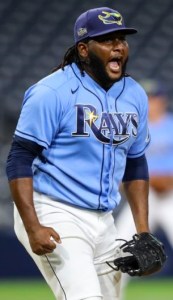
Diego Castillo, after closing the Rays’ ALCS Game One win Sunday night.

How bizarre was Game One of the American League Championship Series? Aside from being played in a National League ballpark, that is? Aside from the Tampa Bay Rays having a barely quenchable thirst for doing things the hard way and making the other guys do things likewise?

They beat the Houston Astros 2-1 Sunday night. Just as they beat the New York Yankees 2-1 to get here in the first place. Except that’s where the similarities end, no matter how good the Rays are at minimalism.

They’re to the low score what the Astros are to the big bang. They’ve played three postseason games thus far scoring two runs or less—and won two. Everyone else this postseason scoring two or less? Three wins, nineteen losses.

They struck out thirteen times against Framber Valdez and three Houston relief pitchers—and won. Just the way they did against the Yankees to get to the ALCS, and just the way nobody else this postseason has.

The Rays are about as intimidated by striking out as David was by Goliath. All year long including this postseason, you can look it up, they struck out thirteen times or more in twelve games—and won eight. Anyone else? Not even close. They’d rather strike out than hit into double plays.

They endured Sunday night without going to most of their A-list bullpen bulls. Nick Andersen and Peter Fairbanks didn’t even poke their noses out of their holes. Remember: there’ll be no days off during the ALCS, either. He who tends his bullpen best is liable to be he who survives with the least damage.

The lone Rays A-lister available Sunday after last Friday’s Yankee wrestling match was Diego Castillo. Largely because the chunky righthander himself told his boss he had at least an inning in him despite throwing 29 pitches over two innings to end the ALDS.

“Man,” said manager Kevin Cash after Sunday’s game, “he’s a stud. He was the one that was available between Nick, Pete and himself. We felt he could give us an inning.” So Cash brought him in to squelch a bases-loaded mess into which C-list reliever Aaron Loup managed to hand the Astros in the top of the eighth. No pressure.

Castillo threw one pitch to Astros first baseman Yuli Gurriel. It was an intended sinkerball that hung up around Gurriel’s hands. Gurriel whacked it on the ground up the middle and right to the oncoming Rays second baseman Brandon Lowe. Lowe executed the step-and-throw inning-ending, disaster-ducking double play.

“We needed the ball on the ground,” said Rays catcher Mike Zunino after the game. “That’s the first thing. When Cashie left the mound, I told [third baseman Mike] Brosseau that he was going to get the ground ball.” So Lowe got it instead. Nobody’s perfect.

Sunday night wasn’t a Night of the Pitchers with a dramatic eighth-inning home run making the final difference between the two top teams in the American League East. This was the Amazing Randi versus David Copperfield with one hand behind their backs and one eye obstructed behind a patch.

It was the night the Astros’ young lefthanded lancer Framber Valdez came pretty much as advertised out of the chute. And, the night the Rays’ lefthanded, former Cy Young Award winning veteran Blake Snell came to prove he could get away with sticking his head into the lion’s mouth and yanking it out the split half second before the lion could snap its jaws around his neck.

It was the night the designated home team Rays went 1-for-8 with men in scoring position and left nine men on base, versus the designated visiting Astros went 2-for-8 with men in scoring position and left ten men on, with both teams having what looked like scores in the making snuffed by swift and slick pitching to some swift and slick infield defense.

It was also the night Jose Altuve hit a Snell meatball into the left field seats on 2-1 in the top of the first, Randy Arozarena found a Valdez sinker that didn’t sink under the middle of the zone to sink behind the center field fence in the bottom of the fourth, and a leadoff walk followed by a pair of grounders back to the mound and a clean base hit plating Rays shortstop Willy Adames in the bottom of the fifth.

From there it was a contest to see whose bullpen depth mattered more and whose offense might turn possibles into plotzes worse. When it finally finished, the Rays stood at 33-0 when when leading after the seventh this year and holding a Show-leading 73-game winning streak when leading in the eighth.

They also stood proud Sunday night with a now 16-5 record in one-run 2020 games, the .762 winning percentage the best in major league history. The little engine that could? The Rays are the little engine that do.

“The one thing you learn about our club over 60 or 162,” Cash told reporters, “we’re in a lot of tight ballgames. And tight ballgames, you’ve got to teach yourself how to win those. That’s mistake-free, playing clean. There’s no margin for error and I think our guys take that approach every single night when they take the field.”

Tight ballgames? If Game One got any tighter there would have been crash carts in the cutout-filled seats and oxygen ventilators in the on-deck circles.

“They do some things that are unusual,” said Astros manager Dusty Baker before the game. If understatement is an irrevocable requirement for Manager of the Year, Baker might have this year’s award nailed down tight shut.

But Cash solidified his own airtight case, taking baseball’s version of of the 99 Cent Store (O Woolworth, where is thy sting?) to the top of the American League East irregular season heap and to the postseason’s number-one seed. He’s the director of the Rays starring in The Little Bang Theory.

They shoved the Toronto Blue Jays out of the wild card series in half a blink, wrangled the Empire Emeritus out of the division series, and neutralised the postseason-resurgent Astros’ big bats into cardboard tubes to open this week’s showdown.

They did it despite Snell seeming bent on setting new major league records for getting himself into more full counts than the law allows and escaping when it looked like the coppers had the cuffs around his wrists ready to click shut.

They did it despite Valdez striking out eight in six mostly splendid innings and the youthful enough Astros bullpen looking as though they’d been studying the Rays for what to do, how to do it, and when to do it.

No, the Rays had to suck the Astros into joining them for an act that made the Flying Wallendas resemble cartoon amateurs. They even had to find their own kind of exclamation point, with Castillo striking out Altuve, the pint size power plant who’d started the evening with the long ball, on a nice, nasty, diving-away slider to close it out at last.

Last fall, the Rays lost a division series to the Astros in five games but proved they could play up to and with the big beasts when given the chance. This fall they’re proving that the great white whales don’t stand that much of a chance against a pack of hell-bent-for-blubber anchovies. So far.