Ask not for whom the Bellinger tolls

You call that a bat flip??

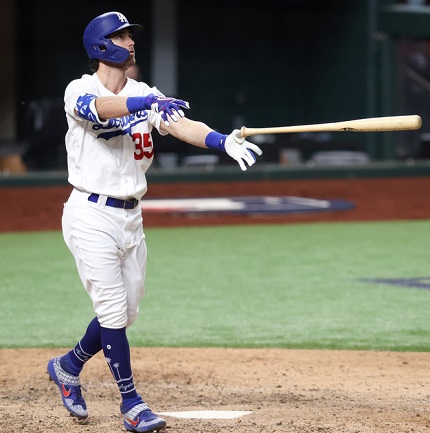
If Cody Bellinger’s going to be the long distance October hero, he’s going to have to work on those bat flips. The billiards cue-like toss he offered up in the bottom of the seventh Sunday night would get him laughed out of the parlours of our Jose Bautistas and Willson Contrerases.

Hit what proves to be the pennant-winning home run in the bottom of the seventh? C’mon, bro, don’t hold back. Give us the real deal. Give us that flip that needs a meal and a stewardess on board. Show Contreras his upper deck-high flip was just a little ring toss by comparison. Trust us, Cody, it won’t hurt.

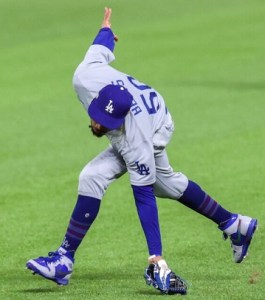
Especially not after Mookie Betts, who thought nothing of breaking into the happy dance after scaling back-turned up the right field wall to snatch a possible triple from Marcell Ozuna Saturday, forgot to bust a move or ten after he flat robbed Freddie Freeman of a home run with another running, back-scaling, up-the-wall catch in the fifth Sunday night.

It wouldn’t have hurt, annoyed, angered, or outraged anyone any deeper than the Atlanta Braves wounded themselves when they TOOTBLANned* their way out of a fourth-inning rally that might have put them beyond the Los Angeles Dodgers’ reach in National League Championship Series Game Seven.

Bellinger’s eighth-pitch drive into the right field seats off Atlanta reliever Chris Martin was at least as dramatic as the seventh-inning blast he launched in Game Seven of the 2018 NLCS. It won’t supplant Kirk Gibson’s legless Game One-winning launch in the 1988 World Series. Bellinger has an entire World Series to come to show he has that kind of drama in him.

Nobody would put it past him. Yet. He picked the perfect moment to shake off a season during which he waged war with his own plate mechanics and an NLCS during which it looked like he’d spend his entire time running into the same kind of hard outs that drove Houston’s Alex Bregman out of his gourd in the American League Championship Series.

Be very afraid, Tampa Bay Rays. These Dodgers have a few boppers to match your own Randy Arozarena. They hit a staggering sixteen home runs as a team in the entire NLCS. That’s as many as some teams hit in an entire month.

Bellinger was preceded by Enrique Hernandez, pinch hitting for Joc Pederson to lead off the bottom of the sixth, against A.J. Minter, the rookie Brave who opened so magnificently in Game Five (striking out seven of nine batters). Hernandez worked Minter to an eighth pitch and sent it over the left center field fence to tie Game Seven at six.

You Rays may also need all of your band of defensive aerialists, acrobats, high-wire walkers, and human cannonballs to counteract one all-in-one Betts. The Dodgers can slap and flap the leather with the best in the business, but they’re not exactly the Flying Wallendas or even the 1969 Mets. Except for the guy wearing number 50 patrolling right field.

Who will offer absolution to the left side of the Braves infield that got themselves caught on the wrong side of a two-for-the-price-of-one baserunning mishap that may have been Sunday night’s true game-turner?

If it comforts Dansby Swanson and Austin Riley any, their fraternal flop didn’t exactly put paid to this NLCS the way Babe Ruth’s beyond-insane, out-by-five-miles stolen base attempt ended the 1926 World Series in the St. Louis Cardinals’ favour. Close enough but not quite the coffin nailer enough will try to secure it.

Swanson and Riley are the guys you really feel for after the Dodgers’ nerve-exposing 4-3 win. They picked the absolute wrong night to become two Lonnie Smiths for the price of one. No, I rescind that, right here and now.

In that 1991 World Series, inside the Richter-scale-busting racket of the old, gone, distinctly unlamented Metrodome, Smith got fooled just long enough by Minnesota Twins keystone Chuck Knoblauch and Greg Gagne, catching Smith’s sight running from first and performing a pantomime double play . . . when Terry Pendleton ripped a rocket into the left center field gap that should have sent Smith home with a scoreless tie-breaking Game Seven run.

Corey Seager pronounces Austin Riley and the Braves’ fourth-inning rally DOA.

Unfortunately for Swanson, Riley, and the Braves, the Dodgers weren’t trying any trickery Sunday night. They were down 3-2 in the fourth and trying merely to hang in and find a way to revive and prosper. They weren’t even expecting Swanson and Riley to be on second and third in the first place.

They got there because Dodger reliever Blake Treinen—in to clean up a small mess left behind by Tony Gonsolin that resulted in the third Braves run—wild pitched them from their original first and second stations. And they’d gotten those courtesy of Gonsolin serving Ozzie Albies an RBI single.

Now Treinen got Braves left fielder Nick Markakis to ground one to Dodger third baseman Justin Turner playing well enough down the line. Turner fired home and caught Swanson dead about six feet from the plate. Catcher Will Smith threw back to Turner, who took a flying leap like Superman taking off in flight to tag Swanson—with Riley, perhaps insanely, trying for third anyway after initial hesitation.

The problem was Dodger shortstop Corey Seager backing up the Swanson rundown. Trying to take the base under guard that heavy might get you points for chutzpah but DOA otherwise. As Riley was when he got tagged and bagged. As the Braves were from that point forward.

“It was huge,” lamented Braves manager Brian Snitker post-game. “It’s hard to score runs in the postseason. The infield’s back so you see the ball up the middle. That’s where normally we’re a really good baserunning team. We just did the fundamental things wrong.”

How can you say the Braves died with a 3-2 lead? Center fielder Cristian Pache grounded out to shortstop to finish killing that fourth-inning rally. Then Dodger relievers Treinen in the fifth, Brusdar Graterol in the sixth, and Julio Urias in the seventh through ninth kept the Braves to one lonely baserunner (a sixth-inning walk to Albies) the rest of the game.

The Braves will too often note and too long remember that they slapped an early 3-0 lead out of Dodgers opener Dustin May and then Gonsolin. They’ll remember May walking Ronald Acuna, Jr. and Freeman on eight consecutive pitches and Marcell Ozuna singling Acuna home in the top of the first. They’ll remember Swanson greeting Gonsolin rudely by hitting a 1-1 pitch over the left field fence leading off the second.

But they’ll also remember the Dodgers solving starter Ian Anderson’s changeup early enough to lay off it and start hitting some hard balls around, just biding their time until they could pry through. They’ll remember Smith hitting Anderson’s inside curve ball for a two-run single in the third. They’ll never forget Hernandez and Bellinger ringing the bells.

“It’s just the mentality we have,” Seager said postgame. “Show up that day, win that day. This team does a very good job being in the moment. You gotta stay in that moment, be in the moment and let the chips fall where they may. Right now, they’re falling our way.”

Entering Game Seven the Braves scored one less run all irregular year long than the Dodgers scored. Exiting Game Seven and the postseason they still ended up scoring one less run overall—but six less in the NLCS. They may remember trading Game Three and Four blowouts and reaping the sweet fruits of Bryse Wilson shaking off an irregular season’s 4.02 ERA to pitch like a Hall of Famer starting Game Four.

They may also remember they’ve been pushed out of postseasons with far heavier blows than they took Sunday night. But they might also want to remember that they shook off that nasty 13-1 blowout by the Cardinals in last year’s division series to take a second consecutive possession of first place in the National League East, no matter how bizarrely truncated 2020 was.

The Braves will be back. Count on it. They may even have forged the beginnings of a beautiful postseason rivalry with the ogres from the National League West. It’ll just have to keep until next season. Sure it would have been lovely to see the Braves tangle with the Rays in the World Series. Southeast rising.

But won’t it be a little more fun to think that the Tampa Bay Davids might have a shot at taking down the Los Angeles Goliaths? With or without these Dodgers’ recent snakebitten history, that ought to be fun, fun, fun—until or unless Daddy takes the slingshot away.

——————————————————————————

* TOOTBLAN—Thrown out on the bases like a nincompoop. Invented originally for former Chicago Cubs infielder Ryan Theriot, whose baserunning skills were described politely as less than average.

All Betts were on

Betts in the happy dance after his fifth-inning aerobatics.

Max Fried watched Justin Turner’s first-inning launch leave the yard Saturday. He looked for all the world like a man who’d come home to find his house cleaned out by burglars. With no idea how the hell they got past the gates, vault doors, barred windows, and armed guards. Or where they found the stones to return to the scene of the crime laughing.

Turner launched exactly three pitches after Corey Seager hit a 1-0 service over the right field corner fence. On a Saturday afternoon during which Los Angeles Dodgers starter Walker Buehler found his best side when the Dodgers needed it in the worst way possible, all that was the next-to-last thing Fried and his Atlanta Braves needed when they were one win from the World Series.

The last thing they needed, of course, was the Dodgers winning National League Championship Series Game Six, 3-1, and with maybe the key Dodger aid being That Catch in the top of the fifth.

If you thought Fried looked shocked in the first, don’t ask how he looked after Mookie Betts—who’d just cut Freddie Freeman’s two-liner to right center off to stop it from becoming extra bases—ran back on Marcell Ozuna’s deep drive, leaped with his back turning against the high Globe Life Park fence, and one-handed it before it might have struck either the yellow line or a hair’s width beneath it.

There wasn’t a soul on earth who blamed Betts for the berserk happy dance into which he broke from the split second his feet returned to the ground. He saved a certain run and probably signed the Braves’ Game Six death warrant while he was at it. Not to mention provoking a hyperbolic outcry from a longtime stalwart of Red Sox Nation.

Hey LA!” tweeted self-described Boston Globe sports columnist emeritus Bob Ryan. “See that catch? You’d better damn well treasure Mookie. Worst mistake we made since selling The Babe to the Yankees.” Referring, of course, to the platinum-rich Red Sox refusing to even think about handing Betts what the Dodgers eventually did after they landed him in last winter’s blockbuster trade.

The catch will cling tighter to the memory if the Dodgers manage to win Game Seven on Sunday. At that, they’ll call it the one that turned the whole NLCS around and not just the one that signed, sealed, and delivered the Braves’ Game Six fate. They’re certainly calling it the one that makes Betts’s Game Five catch—the running shoestringer off Ozuna that turned into an inning-ending double play off Ozuna’s early-tag baserunning mistake—resemble a measly warmup.

In a pandemically-rearranged postseason loaded with fielding shows, including but not limited to the American League champion Tampa Bay Rays’ acrobatic aerialists, Betts blew all of those into near-oblivion. Even Manuel Margot’s pole-vaulting catch in Game Two of the ALCS.  “That’s an unbelievable play by an unbelievable player in a big moment,” Seager said post-Game Six.

“A tick behind last night’s play, but it just shows the athleticism,” said Dodgers manager Dave Roberts. “Right there, Walker was kind of stressing a little bit. And so to make that play to get out of it . . . was huge. [Betts] just impacts the game in so many ways.”

Second understatement of the day about the play. Since becoming a full-time right fielder in 2016, Betts had 104 defensive runs saved at that position. That’s only ten times any other right fielder in the entire game.

“I didn’t know he’d got it that good,” Betts told MLB Network’s in a field interview. “I just kind of kept going and, you know, I got to the wall, I could have got to the point of no return, I got to jump and go for a catch and come down with it. ”

Buehler wasn’t the only Dodger finding and delivering his best side in National League Championship Series Game Six. Oft-maligned manager Roberts didn’t suffer a single brain vapour. His oft-maligned bullpen—which seems to trigger “Danger, Will Robinson” warnings the minute Roberts reaches for it this postseason—didn’t waver, never mind melt.

Even embattled closer Kenley Jansen, whose issues really are bound more to his physical changes than his mind or his repertoire, got two outs on two pitches to open the ninth before needing four pitches to put pinch-hitter Pablo Sandoval and the 3-1 Dodger win into the safe deposit box. It was as though the Braves made the once-powerful Sandoval a sacrificial lamb just to be done to play one more day.

You’re going to face the best hitters in the world and you can’t lose confidence,” said Jansen, who ended the game at the expense of a Kung Fu Panda who’s not even close to the younger teddy bear who homered three times in the first game of the 2012 World Series. “If you’re going to lose confidence then just quit.”

Saturday’s play began with the distinct possibility of both pennants being taken on the same day. It ended with the Dodgers living to play a Game Seven, the Braves frustrated that they’d have to play a Game Seven, and the Rays finally finishing what they started and sending the Houston Astros home for the winter.

NLCS Game Six also left the Dodgers 32-8 for the year in games where they scored first and the Braves 11-20 when the other guys score first. It also left Buehler—who stood with his right arm extended up and his hand in a fist saluting Betts’s hair-raising catch—the proud owner of a lifetime 18-0 won-lost record in games where he’s staked to a 3-0 lead.

The only reason Roberts lifted Buehler after six was the righthander beginning to tire after scattering seven hits and striking out six without walking a single Brave. After Betts saved the bacon of Buehler, the Dodgers, and every Dodger fan in creation, Blake Treinen coming in for the seventh saved his own hide after a leadoff triple (Nick Markakis) and a one-out RBI double (Ronald Acuna, Jr.) by striking Freeman out swinging and convincing Ozuna to fly out to Betts a little less dramatically.

Fried at least kept the Braves in the game until the bottom of the seventh. He’d outlasted the Dodger starter who’d outpitched him, but his mates couldn’t find other ways to pry open a Dodger bullpen that’s known as much for keeping the crash carts on white-hot alert as for driving the opposition into the ground with its speedy sinkers and hard breakers.

Loading the bases with nobody out in the top of the second? Two strikeouts and a ground out left the ducks on the pond. Going 2-for-11 with runners in scoring position all day? Not the way to overcome that early Dodger attack, that ironed-up Dodger pitching, and that Betts taking a flying leap to end the fifth.

“When you throw a letter-high curveball to Seager, he’s going to do what he did to it,” said a humbled Fried post-game. “A fastball right down the middle to Turner, he did the same. I felt like I was searching for it, instead of going after guys and hitting spots.”

Braves manager Brian Snitker finally decided Fried did all he could with his 109 pitches and brought Darren O’Day in with two out and one on. O’Day needed shortstop Dansby Swanson to keep Will Smith’s nasty one-hopper from turning into a nastier base hit, Swanson backhanding it on the run and throwing over to second to force Turner for the side.

Fried did at least spare the Braves from dipping too deep into their own rising bullpen. They may well need it if the Dodgers find ways to puncture Game Seven starter Ian Anderson Sunday night. “We’re in a good spot,” said Snitker to reporters. “I like the guy that we’re going to pitch. The bullpen, everybody can pitch. Everybody’s available tomorrow. We’ll see what we do.”

They may have to think about having Betts kidnapped just to be on the safe side.

The pennant-winning Rays do several favours

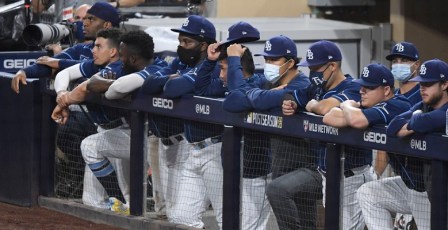
Your American League champion Tampa Bay Rays, with Randy Arozarena (right front) holding his ALCS MVP award.

For those of you who still love to ponder baseball in economic terms alone, have your fun now. The third-lowest 2020 payroll in the Show just finished off the third-highest—after knocking off highest to have the opportunity. Shout it out loud. The Rays win the pennant! The Rays win the pennant!

They who have the gold don’t always rule. For that matter, neither do they who have the platinum.The Tampa Bay Rays—lucky to have a couple of steel pieces amidst a cache of aluminum, tin, and Reynolds Wrap—are one trip shy of the Promised Land as of Saturday night.

After pushing past the New York Yankees’s platinum a little over a week earlier, the Rays  melted the Houston Astros’ gold into a 4-2 win in Game Seven of the American League Championship Series. Playing twelve games in thirteen days, the Rays beat both in final win-or-be-gone games. That only begins to describe their flair for the impossible.

This collection of bargains enough to make you think Woolworth’s was reincarnated as a baseball team became the first in major league history to stand on the threshold of a postseason series sweep, lose the next three straight, then win the first elimination game they’d face in the set.

They became the first to send out a starting pitcher against another starting pitcher with whom he’d collaborated previously to win a seventh World Series game. Charlie Morton got the better of Lance McCullers, Jr. with five and two-thirds innings of two-hit shutout ball on his part and just a little help from the friends he says are an honour to play and compete with.

They became the first to feature a rookie hitting a seventh bomb just in the postseason, when left fielder and series MVP Randy Arozarena sent Lance McCullers, Jr.’s 2-2 fastball over the right center field fence in the bottom of the first—after McCullers hit Manuel Margot with the first pitch of the inning.

They had Mike Zunino—a Seattle trade surrender whose steady defense got undermined by a few passed balls in Game Six but whose power is steady enough when he isn’t injured—provide the rest of their Saturday night scoring with a one-out, full-count launch into the left field seats of McCullers in the second and a one-out sacrifice fly off Jose Urquidy working relief in the sixth.

And, after manager Kevin Cash hooked Morton with a better too soon than too late attitude, the Rays’ bullpen wavered and bent only in the eighth, when Carlos Correa—who’d hit Nick Anderson for the game-winning bomb in Game Five—knocked a bases-loaded two-run single off Pete Fairbanks, who then got Alex Bregman to climax his series-long futility with a furiously swinging strikeout.

If Morton follows through on earlier hints that he might actually retire at 37, he’ll retire as a member in good standing of one elite club. Name the five pitchers who’ve had multiple scoreless starts in postseason winner-takes-it-all games. The answers: Morton plus Madison Bumgarner, Bret Saberhagen, Hall of Famer John Smoltz, and Hall of Famer-to-be Justin Verlander.

Saturday night was Morton’s fourth time out in such a game and his third as a starter. In every one of them, he never threw a pitch while his team was behind. The modest righthander who starts his delivery slow motion before his right arm becomes a whip, whom the Rays could afford because his injury history made him a bargain, really has been late-career better than advertised. If you needed a reminder, he rid himself of thirteen of his twenty batters on three pitches or less.

Arozarena also became the first rookie to hit seven homers in a single postseason. He may have been the only one who wasn’t counting. “I try not to pay attention to the statistics,’’ he said postgame, “but with the Iinternet and everyone bringing it up, you’re kind of aware of it. Honestly, I don’t pay attention to the statistics outside of me and what I can control.”

When Fairbanks shook off Yuli Gurriel’s one-out single to right to strike Josh Reddick out and get Aledmys Diaz to fly out to Margot in right, it would have touched off an all-night party in Tampa Bay if not for the coronavirus social distancing protocols. Those protocols also kept the jubilant Rays from much more than what Zunino said was confetti-tossing and Silly String shooting.

“We’ve done a great job to make it as fun as possible . . . but there’s nothing better than popping bottles and having that seep in and burn your eyes,” the catcher said post-game. That’s one reason why even the World Series winner, whomever it may prove to be, might be the first to reach the Promised Land and holler out, “Wait ’till next year,” hopeful that the pandemic recedes enough to let baseball get back to whatever normal it can achieve.

“Probably more so this year than any other year, the motivation is doing it for each other,” Morton said. “You adhere to protocols; you’re social distancing from families at home. Telling their kids they can’t hug them. This has brought out a level of humanity and empathy that you wouldn’t see in a normal season.”

It also kept baseball’s Public Enemy Number One in the wake of Astrogate from facing the slings, arrows, protest banners, and live catcalls sure to have greeted them on road trips if the pandemic hadn’t substituted cardboard cutouts for live fans.That was the biggest unexpected break the Astros—having enough with being exposed as illegal high-tech cheaters—could have received.

Fans settled for social media slappings plus masking and social distancing while greeting the Astros’ team bus live with slings, arrows, protest banners, trash cans (the mode by which they sent the illegally stolen signs to their hitters in 2017 and part of 2018) and live catcalls whenever the bus pulled into the road ballpark’s parking lot.

The Rays did the Astros and the rest of us another favour by pushing them home for the winter. Assume as you shouldn’t that the Los Angeles Dodgers send the Atlanta Braves home for the winter in Game Seven of the National League Championship Series Sunday. (The Braves aren’t going to go down without a fight, their Game Six futility to one side.) The Rays prevented a World Series dominated by too-much-is-more-than-enough talk about a grudge rematch.

There’s probably no way on earth Astrogate will be forgiven or forgotten for a long time to come. But the spectre haunting America of the Astros going back to the World Series this time around haunts no more. The last thing the Series needs when America needs the Series most is to be half dominated by Astrogate regurgitation and appetites for revenge.

Be certain the Astros will return to the Series in due course. When they do, they’re liable to be just about finished with what has to be done put Astrogate into the past at last—roster and organisation turnover. They have the makings of an impressive young bullpen and a few young positional talents ready to come into their own, too.

The Rays also did us all a bigger favour than even the foregoing. Not only will there be no losing team in the World Series, there’ll be only division winners squaring off. All that early postseason mess, all commissioner Rob Manfred’s apparent wet dreams about permanently expanded postseasons. Put it behind you for now.

Just pray that Manfred doesn’t take the wrong message from it and dance this mess around permanently. Reminder: the Rays had the American League’s best irregular season record. And real division champions—of however truncated an irregular season—will battle to get to the Promised Land. That’s the way it should always be.

The only thing left is for the Rays to come to terms with going from faceless to familiar. That could prove the simplest and most pleasant of their battles.

Symphony for shoestrings

Maestro Betts.

This time, Dave Roberts got it right. It didn’t hurt that his Los Angeles Dodgers behaved like Dodgers when they absolutely had to in National League Championship Series Game Five, either.

Meaning they ironed up when they were down in the fourth inning, with eighteen outs between them and yet another winter full of recriminations.

All it took was someone reminding them there come times for the band to break into “Symphony for Shoestrings.” Someone like Mookie Betts in the third inning.

The Atlanta Braves didn’t have a Dodger managerial lapse through which to shove a tank yet. They’d scratched their first two runs out while their youthful opening pitcher, A.J. Minter, setting precedent by making his first major league start in a postseason game, struck out seven in his three innings including the side in the third.

“I surprised myself a little bit,” Minter told the Atlanta Journal-Constitution. “Coming into the game, I just wanted to set the tone, attack one guy at a time and not worry about pitch count. Just come out and be aggressive and get us off to a good start.”

He got them off to a very good start. What happened after he was lifted for Tyler Matzek to start the fourth wasn’t his fault. The Dodgers bumped, ground, and swung their way back to a 7-2 win while their own company of opener Dustin May and six further relievers made sure the Braves couldn’t even think of an overthrow.

Roberts managed his pitching just right all night long and neither pushed a panic button nor fell asleep at any switch. His Dodgers also ran, if you add as you should Betts’s staggering catch and double play in the third to stop a third Braves run. Just don’t ask Betts about it.

If you want him to tell you which moment changed the game in the Dodgers’ favour, it was first baseman Max Muncy hanging in to walk against Braves reliever Will Smith to set up first and second in the sixth—after Betts himself had his leadoff beat-it-out single turned into a one-out force eliminating him at second base—for Dodgers catcher Will Smith.

You read it right. Your eyes didn’t play tricks. Will Smith versus Will Smith. The first time namesakes faced each other in postseason play. The Braves’ Smith and the Dodgers’ Smith wrung their way to a full count, Smith not taking the bat off his shoulder once. Then, Dodger Smith swung on what some umps might have called ball four. And hit it about six or seven rows into the left field seats.

“Last night hurt,” Dodger Smith said post-game, referring to the late-enough Clayton Kershaw hook that opened the gates for the Atlanta tanks to barrel in. “We got back on the same page, a little motivation, I guess. We were coming out tonight hungry and ready to go.”

He didn’t deny that facing his namesake in the postseason was exciting. “I faced him once last year in the regular season,” he told MLB Network’s Harold Reynolds, “but yeah, [this] was a big swing for us.”

“He battled his ass off the whole time,” said Friday night’s two-bomb Dodger shortstop Corey Seager of his and their Smith.

“He put together a really good AB, took some really tough pitches, then put a good swing on a pitch inside and got the head to it and clipped me,” said the Braves’ Smith post-game. “Oh, well.”

“Oh, well” isn’t going to work when the two combatants square off for Game Six. The Braves still have the 3-2 NLCS lead but they’ve been reminded these Dodgers aren’t exactly pushovers just yet. Not even if the Game Six pitching match to begin will be Max Fried against Walker Buehler. The Braves won’t just take for granted that there’s yet another too-classic postseason Dodger dissipation on the horizon.

Sure the Smith smash overthrew what was then a 2-1 Braves lead for keeps, so sure it was one game changer. But Betts doesn’t give himself enough credit. He only stopped any momentum the Braves might have had left for the night three innings earlier with his legs, his glove, and his arm.

He ran in when Braves shortstop Dansby Swanson with second and third and two outs hit a soft sinking liner to shallow right and caught it on the shoestring, firing home in a bid to bag Marcell Ozuna at the plate. Ozuna slid across the plate just as the throw reached Dodger Smith—but oops! Dodger bench coach Bob Geren called for a review. He’d seen Ozuna tag a hair too soon as Swanson’s sinker hit the web of Betts’s glove.

Side retired. Inning-ending double play. “If you’re talking about momentum shifts,” Roberts said post-game, “that’s the play of the year for me. I just thought there was no way he’d make that play. He’s just kind of the straw that stirs us.”

“A big play like that, a big moment, changes everything for you,” Seager said. “You go into the dugout with some energy, you scratch some runs and the whole thing changes.”

Betts isn’t buying it. So far as he’s concerned, it’s everyone with a job to do and he’s just one of the crew. “Our backs are against the wall,” he said. “It’s all hands on deck, and we’re showing emotion and helping each other out.”

Seager didn’t waste any time leading off the bottom of the third against Matzek. He caught hold of a 2-1 fastball and drove it over the center field fence to cut that early, scratchy 2-0 Braves lead in half in the first place. Four innings later, after struggling Chris Taylor doubled with two outs and Betts promptly singled him home against Braves reliever Jacob Webb, Seager turned on the first pitch and yanked it into the right field seats.

“That guy is something else,” marveled Braves manager Brian Snitker. “He’s one of those guys who never gives an at-bat away. It’s very impressive. He’s a dangerous, impressive hitter.”

By the time youthful Braves outfielder Cristian Parche robbed Muncy blind of an eighth-inning home run, it was too little, too late for the Braves in Game Five. Even the much-maligned Dodger bullpen held fort when they absolutely had to hold it. Right down to much-embattled closer Kenley Jansen handed that four-run lead for the ninth and striking out the side to finish.

Sometimes it takes just one gig with a little extra oxygen to hit the reset button the right way. Doesn’t it?

Most eyes will be upon San Diego Saturday night, where the Tampa Bay Rays will learn once and for all whether they can hold the Houston Astros off to go to the World Series or the Astros will finish what they’ve started, becoming the Show’s second team ever to win a pennant after being down 3-0 in their LCS.

NLCS Game Six may seem like a modest afternoon opening matinee by comparison. But the Dodgers and the Braves have no intention of playing it that way.

The waiting is the hardest part

The Rays, looking just the way you expect a team that’s gone from the 3-0 threshold of the World Series to the 3-3 threshold of . . .

What the hell happened Friday? Did the Houston Astros merely iron up? Did the Tampa Bay Rays merely melt down? Was the truth somewhere in the middle? Does it mean the Astros getting the least likely trip to the World Series since 2004?

Forget the Beatles. This is Tom Petty’s turn to sing:

The waiting is the hardest part.
Every day you see one more card.
You take it on faith, you take it to the heart.
The waiting is the hardest part.

Don’t the Astros and the Rays know it. We have to wait to Saturday to find out whose waiting was the hardest part for what redemption. The Rays couldn’t put the Astros away after a 3-0 American League Championship Series-opening lead, after all. What was once their set to win is now anybody’s to lose.

Every day, these Rays see one more card turned any way but their way. On Friday night the Astros didn’t need anyone to hit one out in the ninth to beat the further-dissembling, further-static Rays, 7-4, in Petco Park. You can’t win all your postseason games with eleventh-hour, record-book dramatics. Sometimes you have to win the old-fashioned way, catching your worthy adversary self-weakened and pouncing while the pouncing is good.

All the Astros needed other than a four-run fifth to overthrow an early Rays lead was to not remind the Rays to pay attention to the early warning signs. Such signs as their refusing to lay off Astros starter Framber Valdez’s swan-diving curve balls and make him throw more fastballs. Such signs as resisting the temptation to try hitting six-run homers whenever they did coax fastballs out of the young sprout.

They also needed to make the Rays forget that starting Blake Snell carried a risk, too. Entering Game Six only two Astros in the day’s starting lineup had career batting averages lower than .300 against him while seven had lifetime marks against him over .400.

It didn’t hurt, either, that Brandon Lowe, the Rays’ semi-regular second baseman playing left field Friday, chose the worst possible nanosecond to throw the wrong way when his partners could have cut an Astro run off at the plate and maybe stopped the fifth-inning bleed.

If he had stopped the bleed the Rays might be preparing for the World Series. Might. It’s not that the Rays are unaccustomed to doing things the hard way, it’s that they’re not getting too accustomed to making things more difficult than they should be.

And if you do that to these Astros, you discover the harder way that they aren’t exactly renowned for showing mercy to the walking wounded. They’re more liable to cut your heart out than let you live long enough to receive a transplant. When you have an opening, shove with your shoulders, Casey Stengel preached to his imperial 1950s Yankees. When the Astros have an opening, they shove with an Abrams tank.

You’ve got to love this team,” said manager Dusty Baker after the game. “Well, some people hate this team. But you’ve got to respect them.”

Well, the skipper has a point, alas. There is something perversely respect-worthy about a team that brought the wrath of baseball world down upon their heads all by themselves, slipped into a surrealistically-arrayed postseason experiment despite an irregular season losing record. They managed to seize that gift and turn it into this staggering an ALCS comeback, when it looked to all the world as though their season would end as ignominiously as their year began.

It doesn’t make the Astros lovable outside their own fan base. And that fan base remains divided almost as badly as the country now is politically speaking. But it does make them resemble the grand theft felon who withstands the heat, defies the doubt, and remakes/remodels his life far enough in the plus column. His crime won’t be forgotten no matter when it’s finally forgiven, but he’s making a powerful case for rehabilitation. So far.

Snell had to be better than his 2018 Cy Young Award-winning self to prevail. If he wasn’t, the Rays had to quit trying to channel their inner Murderer’s Row and get back to sending the merry-go-round going ’round on the bases—if they got there at all. Unfortunately, Snell spent so much time trying to find the wipeout strikeout pitch he pitched a dangerous game of chicken for four full innings before his day ended with two on and nobody out in the top of the fifth.

The only clean inning he threw was the third when he sandwiched a full count strikeout to George Springer between two slices of ground out from Martin Maldonado and Jose Altuve. It was barely enough to keep the Rays clinging to the 1-0 lead they snatched in the second, when Willy Adames hit an RBI double into the left center field gap and off the wall eluding Springer. It wasn’t enough to keep manager Kevin Cash from hooking Snell in the fifth and leaving Diego Castillo to get rid of the Astro pests.

No soap. Maldonado dropped a surprise sac bunt in front of the plate pushing Yuli Gurriel (leadoff walk after opening 0-1) to third and Aledmys Diaz (single) to second. Springer defied the left-side shift and squirted a two-run single through the right side of the infield.

Then the Rays’ vaunted defense suffered the unlikeliest brain vapour of the day—and maybe the season. The clowns unexpectedly disappeared the Raysling Brothers’ Circus aerialists and acrobats at the worst possible hour. Altuve hit one down the left field line that caromed right to Lowe. With Springer grinding toward third and being sent home, the Rays were set up perfectly for a play at the plate.

All Lowe had to do was hit his left-side cutoff man and Springer was an obituary. Except that Lowe threw to second. Where nobody was. Then, a walk and a passed ball allowing Altuve third later, Carlos Correa showed he was just as capable of sending a man home the easy was as he was going downtown in the bottom of the ninth, singling Altuve home with the fourth Astro run. The game turned out to be signed and sealed right there.

Think Altuve’s past that frightful attack of apparent yips that helped the Rays push the Astros up to the edge of the roof in the first place? He’s reached base eleven times in seventeen plate appearances since. He’s even delivered errorless play at second base. We can pronounce him recovered well enough. So far.

From there Cash’s usual bullpen virtuosity failed him. He sent barely-tried Shane McClanahan out to work the sixth and Brantley greeted him rudely hitting a 2-0 pitch over the left center field fence. The kid had to wriggle out a one-out single to retire the side with no further damage. Lucky him. Not.

Was Cash now managing just to live to play a Game Seven? After the Rays wasted first and second in the bottom of the sixth when Lowe dialed an inning-ending Area Code 4-6-3, Cash sent McClanahan back out for the seventh, most likely in the hope of just surviving to leave the rest of the Rays’ bullpen A-list fresh for Seven if need be.

The poor kid surrendered Astro runs six and seven on an RBI single by Brantley and a one-out sacrifice fly by Kyle Tucker, after which he walked Gurriel before Cash finally exercised a personal mercy clause and lifted the lad in favour of Jose Alvarado. After Zunino committed one of his three passed balls of the game—meaning the Rays likely sending Michael Perez out to catch Charlie Morton for Game Seven—Alvarado struck Josh Reddick out swinging for the side.

The side and a 7-1 Astros lead. Manuel Margot greeting Aaron Scrubb with a leadoff bomb in the bottom of the seventh turned into further abject Tampa Bay frustration when they grunted to first and third against Scrubb, chasing him in favour of Blake Taylor, but Randy Arozarena—to this point the Rays’ biggest blaster of the postseason—grounded out meekly to first base.

What was the point of Margot hammering a two-out, two-run homer in the bottom of the eighth with two out when Adames would ground out for the side almost too swiftly? And, when pinch hitter Yoshi Tsutsumago singled with one off Astro closer Ryan Pressly just so Michael Brosseau could dial Area Code 6-4-3 to end it?

If you have the answer to those and other similar questions, the Rays need to know. Gravely.

This is more than just three straight elimination games the Astros have survived to force Game Seven. This is more than the Astros threatening to become the only team other than the 2004 Boston Red Sox to win the pennant after getting thatclose to being swept out of an ALCS.

“We’re going to show up tomorrow and do everything we can, like we always do, to find a way to win and pick each other up,” Cash said after the game. “There’s no doubt the momentum has shifted, but I would bet on this team being very capable of bouncing back.”

Didn’t the Rays make the same bet on themselves before Games Four, Five, and Six, too? Remember, in baseball especially anything can happen—and usually does.

To an awful large chunk of baseball world, these Rays are the unassuming, studious, sum-of-parts talented Smart Kids trying to stay one step ahead of the school bullies after refusing to just let the bullies copy their mid-term exams. It doesn’t stop the bullies from copying all the time, as witness the Astros out-Raying the Rays in Game Five. But neither do the Smart Kids outsmart themselves entirely without more than an excuse-me counterattack.

Once upon a time the Astros were the smartest of the Smart Kids—before they were exposed as cheaters in disguise. Morton eventually went over to the new Smart Kids’ side. He gets to face Lance McCullers, Jr.—his old Astro rotation mater, with whom he once collaborated to win a World Series Game Seven. He’s also pondering whether his 37-year-old self may or may not pitch major league ball for the final time Saturday.

Morton out-dueled McCullers in Game Two this week with five shutout innings. “On a selfish level, I didn’t want this to be the last memory I had of the game,” he said while he was at it. “The way it’s had to go with [coronavirus] testing and isolation, not being able to really enjoy special moments together in the clubhouse—this is a very trying time for the game. I got to spend it with a tremendous group of people. It would be an honor, if it is my last year, to have done it with this group.”

The real-world Smart Kids, the Not-So-Smart Kids, and the Plain But Pure Enough Kids together, hope Game Seven won’t be the end of Morton’s and the Rays’ season, if not his career.