Short, sweet, and encouraging enough

From Dark Knight to dark horse. So far.

Going from the Dark Knight to a dark horse isn’t the worst thing that could have happened to Matt Harvey. The Orioles have had worse happen to them the last few years than a dark horse pitching up well enough to send them on the way to a second straight season-opening win, too.

Looking resplendent enough in the Orioles’ orange and black, mustachioed but no longer bearded, Harvey started and pitched three shutout innings before running into a little trouble in the fourth and tiring after 86 pitches with two out, two aboard, and a one-run Oriole lead in the fifth.

For other pitchers it might be cause for caution tape. For Harvey, it might be a giant step forward in the second act that’s been harder to find than Harvey once found the bright New York lights that finally helped sear him when his shoulder didn’t.

The righthander threw 56 strikes, including eleven first-strikes and fifteen called strikes, and looked generally like he was anything but the increasingly lost cause who left the Mets for a brief resurrection in Cincinnati but a collapse in Anaheim.

To the Orioles, this is the next best thing to hitting a jackpot on a slot machine. To Harvey, it’s one step at a time even now. Don’t doubt for a moment that he won’t take it.

He certainly won’t spurn the help he got from his new friends. Not when two runs score for him in the top of the fourth on an infield hit, not when another run scores for him on another infield hit in the top of the fifth, not when a seventh-inning sacrifice fly re-claims a two-run Oriole lead, and not when the first of those two fourth-inning runs was set up by an unlikely throwing error by Red Sox third baseman Rafael Devers.

Maybe the only real mistake involving Harvey was Oriole manager Brandon Hyde electing to let him pitch to J.D. Martinez in the fifth after back-to-back one-out walks to Kevin Plawecki and Enrique Hernandez. Martinez didn’t exactly murder Harvey, but his wicked-hopping comebacker bounced off Harvey’s body enough to let Plawecki score.

The so-far-surprising Oriole bullpen took it from there shutout style, not letting even the extremely few hiccups along the way stop them from stopping the Red Sox.

Harvey isn’t unappreciative. “Overall I think it was a solid first start and I’ll try to build off that next time,” he told reporters after the game. “Anytime you win the first series of the year, it’s big, so we’ve got some good momentum now. To come in here against a good ball club, you’ve got to play well and our guys came in and pitched great after me.”

That’s a far different tone than the one for which Harvey was once notorious. He’s no longer the howitzer-armed Dark Knight whom Met teammates sometimes accused of big-timing them while chasing the demimonde. He’s not the guy who thought the world was his to conquer until thoracic outlet surgery, diminished speed, and especially a crash and burn out of the demimonde and off the Mets brought him down to earth with a resounding crash.

When Harvey missed last year without a major league job, pondering and even making a video for consideration by the Korean Baseball Organisation, he spoke with an introspection many who knew him as a Met might have thought unlikely.

“There are a lot of things I’d do differently, but I don’t like to live with regret,” he told the New York Post.

There were just things I didn’t know at the time. Now, obviously, I’ve struggled the last few years. And what I know now is how much time and effort it takes to stay at the top of your game. I wouldn’t say my work ethic was bad whatsoever, but when you’re young, it’s not like you feel invincible, but when everything is going so well, you don’t know what it takes to stay on the field. It’s definitely more time consuming and takes more concentration.

The beginning of wisdom too often arrives after great pain and self-demolition. Harvey began acquiring it before he stepped on the mound for the Orioles. He pitched like it Saturday afternoon. All he has to do now is continue acquiring more hard-arrived wisdom and pitching every few days like he’s not kidding.

Georgia on our minds

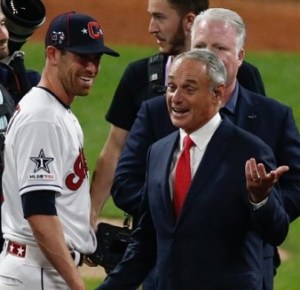
Commissioner Rob Manfred congratulating 2019 All-Star Game MVP Shane Bieber. Did he think deep or hard before moving this year’s All-Star Game out of Atlanta?

Most of us, generations be damned, grew up hearing the two most certain of life’s certainties are death and taxes. Everyone has candidates for the third certainty, including that which reminds us of one thing that crosses partisan lines even if the partisans forget the other side does it, too.

Translated to baseball terminology, that thing seems to be demanding a replay review when ball four is called in election races on what they think they threw for strike three. When such a review turns into something such as a new state election law, as in Georgia, there comes a fourth guarantee: somebody isn’t going to like it.

A lot of somebodies don’t like the law. Such somebodies as former Georgia state lawmaker Stacey Abrams and President Joseph Biden. A lot of not-so-much-somebodies don’t like the law, either, and their agitation as much as any other factors have prompted among other things major league baseball’s government moving this year’s All-Star Game and college draft out of Atlanta’s Truist Park.

Abrams had skin in the game going in. She lost Georgia’s 2018 gubernatorial race to Brian Kemp, who signed the omnibus bill into law earlier this month, by 50,000 votes, claiming then-Georgia secretary of state Kemp erased thousands from state voter rolls.

Kemp had skin in the current game going in, too. For the heinous offense of certifying that now-former president Donald Trump didn’t push the winning run across the state plate in the bottom of the twelfth, regardless that Kemp wasn’t exactly known to favour anyone other than Trump, Kemp faced Trump’s none-too-silent wish to see him thrown out of the league.

The most understandable result of Trump’s post-campaign campaign to overthrow his loss to Biden might have been Georgia and other states reviewing and tightening up their election laws. The only place where fury and back-and-forth charges of foul get more furious might be a baseball game decided (in truth or in allegation) by a close call for or against one or the other side at the final out.

Election shenanigans have been as common in American politics as yard signs, and they didn’t begin or end with such ancient players as New York’s Tammany Hall, Chicago’s Daley Machine, Kansas City’s Prendergast Machine, or Nassau County’s (Long Island) Margiotta/D’Amato Machine. Wherever you landed observing Trump vs. Biden, your least shocking revelation would have been one or another state addressing their election laws in the aftermath.

When Kemp signed the new Georgia election law, Abrams charged that it “suppresses voters, criminalizes compassion & seizes election authority from local + state officials.” That statement wasn’t half as incendiary as Biden’s prompt denunciation of the law as both un-American and as “Jim Crow on steroids.”

Georgia’s real history with Jim Crow is grotesque enough, from state poll taxes (1877) and literacy tests from which descendants from Confederate and Union soldiers were exempt (1907) to the “white primary” rule (1908) that prohibited non-white voting explicitly. Jim Crow in any southern states was (and remains) a portion of American history for which the nation can never be proud.

Now, about the new Georgia election law. Examine deeper than what you see excerpted in the press and aboard social media. Comparing it to Jim Crow is nebulous. It only begins with the fact that mandating seventeen days pre-election (two Saturdays included) for early voting—with mandatory eight-hour-minimum open times and allowance for twelve-hour (7 a.m.-7 p.m.) times—doesn’t exactly “suppress” voters.

A good number of states lack that allowance, including Biden’s home state Delaware which isn’t going to put it in place before the next Congressional election year 2022. Biden himself—with different priorities and a far less grotesque personality, he’s like Trump in showing you wisdom by standing athwart it—also said the Georgia law imposes limits on absentee voting that “effectively” (his word) deny voting to “countless” people. That’s not exactly what the law says or does.

For one thing, no-excuse absentee voting stays in place with just a couple of adjustments. I’d be hard pressed to think a voter is being “suppressed” because the absentee ballot application window is a “mere” 67 days, or because such applications you can now do online, because the state secretary of state is now required by law to offer them online. Or, because the absentee ballot must be received by election officials at least eleven days before Election Day.

Some of the new law’s critics harp about the voter identification portion, which has now shifted it from matching signatures to identification numbers from a voter’s driver’s license or free voter identification card. Lacking either, a Georgia voter can present a photocopy of a utility bill, a bank statement, a paycheck, a government check, or an official document that includes his or her name and address. All they have to do is include the last four digits of their Social Security numbers if they don’t have driver’s licenses or previous voter ID numbers.

If that’s “voter suppression,” I’m Willie Mays. And if that’s something designed to keep non-white voters from voting, I’m hard pressed to comprehend the 2016 Gallup survey that found 77 percent of non-white voters supporting photographic voter identification. You’d think (properly) that non-white voters have just as much stake in preventing real (not alleged) voter fraud as white voters have. And you’d be right.

The new Georgia election law also puts the famous drop boxes into law. They showed up in Georgia for the first time last year thanks to the pan-damn-ic, and now they’re legally mandatory with or without the coronavirus. The new law requires one drop box for every one hundred thousand registered voters or one for every advance vote location in any Georgia county, whichever number is smaller.

Abrams was right about one thing: the new law does “criminalise compassion,” sort of. Giving, offering, or helping give food and/or drinks to people within 150 feet of polling places or within 25 feet of voters in line to vote becomes a legal misdemeanor. Even, seemingly, when the benefactor isn’t discussing the election or particular favoured candidates.

The law also bars ordinary Georgians from photographing or recording their own votes. Guess who gets an exemption from that: the state secretary of state, whom the law requires to create “a pilot program for the posting of digital images of the scanned paper ballots created by the voting system,” with the images becoming “public records subject to disclosure.”

I’ve read about enough early proposals for inclusion in the law that were foolish at minimum, dangerous at most, and thrown out of the bill before it became a final product. But how the hell did that one slip in? How close do you think that one gets to the kind of thing you thought was reserved for the Third Reich, the Soviet Empire, and other authoritarian/totalitarian states who’ve used ballots when allowed at all against their citizens?

Kemp and any Georgia governor has a line-item veto power—but it affects only statewide and state executive budget items. Even he can’t be comfortable with the idea that his or any Georgia secretary of state can come that close to crossing the line from scanning paper ballots to making Georgians’ votes public.

You can bank it. Baseball commissioner Rob Manfred and his minions probably didn’t read the new Georgia law in almost any way, shape, or form. You can understand why, since the law’s volume is 68 percent (92 pages if you’re scoring at home) the length of Philip Roth’s legendary novella Goodbye, Columbus. But the mis- or mal-excerpting of the law did them no favours and puts baseball into a precarious position.

For one thing, the Atlanta Braves themselves aren’t thrilled with baseball pulling the All-Star Game out of their home playpen. Indeed, even Abrams herself has said Georgia companies shouldn’t jump all the way into boycotts but first “use the chance to publicly condemn the law, invest in voting rights expansion and support wide-ranging federal election legislation before they’re targeted with a boycott movement,” as the Atlanta Journal-Constitution puts it.

For another thing, former UN ambassador and Atlanta mayor Andrew Young demurs from any such boycott, especially involving Atlanta, whatever he thinks of the new law, telling The Athletic, “Everything doesn’t depend on sports. But if you hurt the sports, you hurt the hotels, you hurt the airport, you hurt every business in town . . . [Atlanta’s] the 44th largest economy in the world — and, you can quote me, I don’t know why anybody wants to [fornicate] with that.”

Manfred and his look more like knee-jerkers than thoughtful protesters who considered the whole thing reasonably. (They look, in other words, much the way Trump looked when thundering against Maximum Security’s 2019 Kentucky Derby qualification or on behalf of Pete Rose’s Hall of Fame entry without troubling himself with the deets on both rejections.) Lacking an immediate suggestion for an alternate All-Star Game site this year is the least of Commissioner Nero’s largely self-imposed problems.

On Wednesday night, some Republican lawmakers in Georgia’s state House of Representatives voted to cancel a tax break for Georgia-based Delta Air Lines, on the grounds that Delta objected to the new election law. “You don’t feed a dog that bites your hand,” said Georgia’s House speaker David Ralston. “You got to keep that in mind sometimes.”

Imagine the furies if Democratic officials behaved likewise. Oops . . . Lois Lerner, for openers, call your office.

Wherever you sit about the law itself, the thought of governing officials deciding a private entity needs to be punished for taking any position regarding any legislation or policy should scare the hell out of you. If they can do it to an airline, they can do it to anything, including the business of a game.

It’ll take more than winning . . .

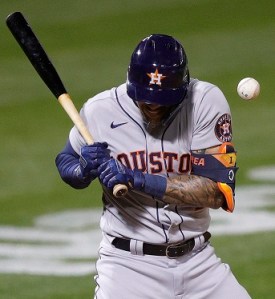
What Carlos Correa took on the shouhlder from Chris Bassitt on Opening Night isn’t likely to be the last such drill—not until the absolute last Astrogater isn’t an Astro anymore.

“Got to hear some boos, finally,” said Astros righthander Zack Greinke after Opening Night in Oakland. “That wasn’t fun to listen to, I didn’t think, but we played good so it didn’t matter. Hopefully we’ll keep playing good and it won’t be as big of an issue.”

Greinke wasn’t a member of the Astros in 2017. The season-opening roster now has only five remaining from that World Series-winning team: second baseman Jose Altuve, third baseman Alex Bregman, shortstop Carlos Correa, first baseman Yuli Gurriel, and pitcher Lance McCullers, Jr.

But there’s a reasonable enough suspicion that the Astros won’t stop hearing boos and catcalls until every last member of the 2017-18 team is gone, either to other teams or from the game itself. The pan-damn-ically truncated, fan-less, irregular 2020 season kept the Astros shielded from anything beyond fans outside the parks serenading their team bus.

Lucky them. Until now. With fans returning even in limited numbers this season, the Astros won’t be immune to road fans letting them have it. If Greinke thinks wins will neutralise them—wins such as their 8-1 Opening Night win over the Athletics—he may be guilty of wishful thinking.

That’d be a far less grave offense to be guilty of than the one over which the Astros remain convicted by the evidence and in the eyes of the rest of the game and its fans. The stain won’t leave for a long enough time. The pan-damn-ic didn’t really amputate the long arm of Astrogate after all.

Fair? Probably not to the 89 percent of the Astro roster who weren’t there and had nothing to do with Astrogate. More than fair to the eleven percent remaining.

Limited though it was by safety protocols, the Oakland crowd wasted no time. During pre-game introductions they booed the Astros loudly, accompanied by a few who carried assorted trash cans to bang just as loudly. The Astros should consider themselves lucky if lusty booing and can banging on the road are all they get.

“That’s fine,” said outfielder/designated hitter Michael Brantley of the Oakland crowd. “This is a veteran team. We’ve been in the World Series, we’ve been in the playoffs. The guys know how to compete day in and day out. They can boo, they can yell, they can do whatever they want. But at the end of the day we have each other’s backs, and that’s all that matters.”

Having each other’s backs is one thing. Genuine contrition for the worst cheating scandal major league baseball saw since the at-long-last-affirmed exposure of the 1915 New York Giants as pennant race comeback telescopic cheaters seems not to be Astro policy. That non-apologetically apology at last year’s spring-opening presser, pre-COVID shutdown, was no act, apparently.

They still don’t seem to get it so far. They still don’t seem to get just how terrible a look it was when commissioner Rob Manfred handed all 2017 players blanket immunity from discipline in return for spilling the deets about the Astro Intelligence Agency—the ones who either took an existing center field camera off its mandatory eight-second delay, or installed a new and illegal real-time camera, to steal signs from a clubhouse monitor and signal the stolen intelligence to their hitters with bangs on a large vinyl trash can nearby.

They still don’t seem to get, so far, that the AIA went a lot farther than went any team (the 2018 Boston Rogue Sox for certain, others quite possibly) who merely used existing video rooms at home and on the road to steal signs and relay them to baserunners to send the batters.

They still don’t get what then-Dodger pitcher Alex Wood meant when he said he’d rather face a batter using actual or alleged performance-enhancing substances than an AIA-like sign stealer, because the former still doesn’t know what’s coming and lacks the 50 percent or better chance of hitting it before he even sees the pitch.

They still don’t get why Astrogate team member Correa inspired lusty cheering when A’s starter Chris Bassitt drilled him in the fourth inning despite a runner being aboard. Or why Correa, Altuve, Bregman, and Gurriel are liable to be ongoing targets for brushbacks and knockdowns so long as they’re Astros.

Former Astrogater George Springer, now a Blue Jay, opened the season on the injured list. Will he face the catcalls from Blue Jay opponents unable to forget he was one of the Astrogate team? Time will tell, though other former Astrogaters haven’t really felt it in the hips or on opposing fans’ lips. Yet.

Remember: When Astrogate exploded from mere revelation in November 2019 to Manfred’s final report and limited discipline—the team fined and stripped of draft picks, general manager Jeff Luhnow and manager A.J. Hinch suspended for the season, then Luhnow and Hinch fired by owner Jim Crane who seemed himself barely able to grok the outrage—it wasn’t just fans outraged by the AIA.

Long ago, the father-in-law of convicted killer Jeffrey MacDonald, fearing his son-in-law might yet remain free on appeal in the deaths of his pregnant wife and two young daughters, proclaimed publicly, “If the courts of this country won’t administer justice, I most certainly will.” More players than you may remember said much the same thing about administering to the Astros the justice Manfred truly denied, though they didn’t quite have murder in their hearts for the unjudged.

Dodger relief pitcher Joe Kelly showed such players weren’t kidding, late last July, when he got his chance and sailed ball four past Bregman’s shoulder and subsequently threw one behind Correa’s head. For every one soul a little put-off by Kelly’s dusters, there were probably three who thought he didn’t go far enough administering Astrogate justice.

Too many fans would love nothing better than to see every last being in Astro fatigues pay such prices as Bregman and Correa. I observed one social media poster writing, and probably speaking for too many “Bean balls, mound charging, spiking, spitting, fighting, punches, headlocks, punches to the face hard and often. Umpires should call every pitch against them a strike.”

And then we should get really mad?

Actually, we should have Wednesday night—at home plate umpire Brian Gorman. He called strike on a wide outside pitch to Brantley early in the game, called balls on two more strikes so obvious Helen Keller could have seen them, and then Brantley slashed a single more or less into center field on one of the upper strikes that Gorman might have called a ball if taken. Brantley should have been out on strikes in that plate appearance.

Gorman was an equal opportunity offender. He called strike three on the A’s Matt Olson on a pitch that was far enough off the outside corner to slide a bat through without it touching either side. All night long Gorman’s strike zone was more improvisational than music legends John Coltrane, Cream, and Miles Davis. Robby the Umpbot may be closer to arriving at last than people think or might like.

You can search the archives of this journal and see precisely where I stood (and continue to stand) on Astrogate. So you know I’m not just looking to take the culprits off the hook when I say there’s a limit to how much Astrogate justice their opponents can administer and road fans can demand.

I get the urge and itch to send messages to Altuve, Bregman, Correa, and Gurriel. (McCullers being a pitcher won’t be batting unless he’s in the game and the Astros are playing a National League team on the road, thanks to Commissioner Nero forcing the absence of the universal designated hitter for this season at least.) They were members of the Astrogate team and they got away with murder.

But Brantley didn’t join the Astros until 2019. The rest of the roster had nothing to do with Astrogate. Joe and Jane Fan don’t always draw the proper distinctions, but the players can, do, and should. Save the return messages for the real culprits. Right?

Sort of. Nobody held a gun to the Astros’ heads to compel them to extend Gurriel another year with an option for next year. Nobody held guns to their heads to compel them to try for an extension for Correa, who now says he’s looking forward to the free agency market he’ll hit after this season.

Altuve and Bregman are locked in as Astros until 2024. Nobody will hold guns to the Astros’ heads and force the team to extend or re-sign them further. If any team reads the appropriate tea leaves and decides to make a trade play for either one, nobody will hold the Astros hostage until they agree to retain the pair.

It’s not fair to blame the entire 2021 Astro roster for the crimes of the eleven percent remaining Astrogaters. But it’s entirely understandable. The Astros will have to live with the continuing ramifications of their cheating and the continuing outrage of opponents and fans until the absolute last Astrogater no longer wears their fatigues.

Opening Day: Snow fooling

There was nothing wrong with your television set. Do not attempt to adjust the picture. The snow took control of the transmission when Miguel Cabrera hit this Opening Day home run . . .

Just because the expected Opening Day marquee battle between Jacob deGrom (Mets) and Max Scherzer (Nationals) had to be postponed (COVID-positive Nats players and a team staffer to quarantine), that didn’t mean Wednesday was going to lack for the good, the bad, and the bizarre. This is baseball. Where anything can happen—and usually does.

Especially if Opening Day is also April Fool’s Day. The part that wasn’t a gag—fans in the stands again, at long enough last. The sound was glorious, even if reduced from most normal capacities thanks to the continuing if only slightly receding pan-damn-ic.

Comerica Park should have been playing “Winter Wonderland” Wednesday. The Tigers’ aging star Miguel Cabrera shouldn’t be blamed if he was singing “Let it Snow, Let It Snow, Let It Snow.” Especially when he more than a little hard on the Bieber, turning on the Indian ace’s rising snowball, hitting a two-run homer, and . . . sliding into second base, unable to tell through the snow that the ball flew out.

I don’t know if the Coors Field public address people had it cued up, but they could and should have sounded “Don’t Pass Me By” after Dodger first baseman Cody Bellinger hit an RBI single . . . off Rockies left fielder Raimel Tapia’s glove and over the left field fence. The problem: Justin (Who Was That Unmasked Man) Turner not seeing the ball reach the seats and retreating to first, compelling Bellinger to pass him on the basepath.

Oops. On a day the Rockies thumped Clayton Kershaw and managed to squeeze a win out after doing what Rockies usually do in the off-season—in this case, unloading their franchise player and all but reveling in front office dissembly and mission abandonment—Turner was the gift that . . . added insult to injury for the defending World Series winners.

The sleeper star in waiting in Blue Jays silks might have thought about singing an ancient  T. Rex number called “The Slider.” Gerrit Cole’s was just too juicy for Teoscar Hernandez to resist in the sixth. He sent it into earth orbit or 437 feet and into the left field bleachers at Yankee Stadium—whichever came first. Who needed Bo Bichette and Vladimir Guerrero, Jr.?

Just one thing was wrong. Hernandez needs to work on his bat flips. He didn’t have one. A blast like that was just begging for him to go Willson Contreras. Hernandez just ambled up the base line carrying his bat, then kind of nudged it away to the grass. He’s young, with plenty of time to learn, though. And his blast tied the game the Jays went on to win, 3-2.

Which is the score by which the Phillies beat the Braves in ten innings—after Bryce Harper began the inning as the free cookie on second base, took third on J.T. (Nothing Is) Realmuto’s ground out, waited patiently as Didi Gregorius was handed first on the house, then came home with the winner when Jean Segura sliced a single to left.

The game got to the tenth in the first place because Phillies manager Joe Girardi decided he wasn’t quite ready to trust the National League’s leading arsonists with taking over from certified innings-eater Aaron Nola with a 2-0 lead in the seventh. The Braves were far more ready to trust Pablo Sandoval—erstwhile Giant, one-time World Series hero, all-time poster child for Slim Slow—to pinch hit for Max Fried’s relief Tyler Matzek with a man on.

. . . and slid into second unable to tell at first whether the ball or the snow cleared the fence.

Kung Fu Panda turned out to be more than ready to hit Nola’s 0-2, slightly down and slightly in fastball into the right field seats. Girardi is many things but a crystal ball operator isn’t one of them. If he had been, he could have lifted Nola safe and sound because the Phillies’ bullpen apparently forgot to refill the gasoline cans for a change. Not even a bases-loaded jam in the eighth could keep Archie Bradley, Jose Alvarado, Hector Neris and Conner Brogdon from keeping the Braves scoreless over the final three and a third.

Does Philadelphia believe in miracles? Don’t ask too quickly, folks. Remember: this is the baseball town in which a typical wedding concludes with the minister pronouncing the newly-married couple husband and wife—then addressing the gathering with, “You may now boo the bride.” As much as I hate to drop a cliche so worn you see more holes there than in an oil field, the Phillies have 161 games left to play. Ruh-roh.

That was last year’s pan-damn-ically irregular season: Twins center fielder Byron Buxton, who sometimes evokes Willie Mays when he’s not on the injured list, walked twice all year long. This was Opening Day: Buxton should have had “Cadillac Walk” as his entrance music—he walked twice. He also blasted a two-run homer to the rear end of American Family Field in the seventh and had his arm calibrated so well that the Brewers didn’t dare to even think about running wild on him.

Buxton’s blast made it 5-3, Twins. Proving that no good deed goes unpunished, the Twins undid their own sweet selves with a badly timed error, making room for a ninth-inning, three-run, game-tying comeback that turned into a 6-5 Brewers win on—wait for it!—a chopped ground out that left just enough room for Lorenzo Cain to score the winner from third. (A transplanted Minnesotan of my acquaintance thinks, only, “That’s so Twins!”)

The Twins were saved from Opening April Fool’s Day ignominy by the Reds, alas. The Cardinals spotted Jack Flaherty a six-run lead in the first—abusing Reds starter Luis Castillo with an RBI infield hit, a bad error by Reds third baseman Eugenio Suarez playing shortstop, and Dylan Carlson ringing a three-run homer off the foul pole—before he had to throw a single competitive pitch in the game.

Flaherty didn’t quite have his A game. A C+ might be more like it. Lucky for him and the bullpen that the Cardinals felt in the mood to abuse the Reds the rest of the way: An RBI single and a run home on a wild pitch plus a two-run homer in the fifth, and it didn’t matter if the Cardinal arms let the Reds have all six of those first-inning runs back. Let the Cardinals’ song for the day be “The Eleven,” as in the 11-6 final.

The bad news for the Angels opening at home against the White Sox: the lineup struck out ten times. The good news: only four of them came in the final six innings. Meanwhile, they beat the White Sox 4-3 like pests instead of power drivers: walking here, working counts there, game-tying single here (Justin Upton), solo homer (Max Stassi) there, RBI single (Mike Trout) and RBI ground out (Albert Pujols) yonder, the bullpen keeping the White Sox quiet the final three.

Not to mention the Still Best Player in the Game ending his Opening Day with a .750 on-base percentage: that RBI single plus a pair of well-worked walks in four plate appearances. Trout could also point proudly to something not usually associated with the Angels the last couple of years: they didn’t let the game get away early, and they nailed it late with a two-run eighth and a shutdown ninth by reliever Raisel Iglesias.

Unfortunately, time will tell if a triumph like that proves an April Fool’s joke that wasn’t half as funny as Miguel Cabrera’s home run slide.

But here’s no joke: There were 222 hits on Opening Day and a mere 35 percent of them went for extra bases, including a measly thirteen percent being home runs, while fifteen percent of the day’s hits were infield hits. The games produced a .311 batting average on balls in play. There were even nineteen tries at grand theft base and 79 percent of them succeeded.

Maybe the rumours of the all-around game’s death are more than slightly exaggerated for now. When there’s a slightly higher percentage of infield hits than home runs on a day, the small ballers should take their victories where they can find them. But you wonder if Cabrera will inspire more than a few players to think it’s time to work on their home run slides.

Lindor gets his lucre

341 million more seasons to smile than Lindor already had making himself a Met.

The night before Opening Day, Francisco Lindor went from prospective off-season free agent to a Met for life. The morning after Lindor became a $341 million Met, the anticipated enough Opening Day duel between Jacob deGrom and the Nationals’ Max Scherzer got postponed thanks to five Nats players and one team staffer testing positive for COVID-19.

Lindor was already the catch of the offseason when the Mets reeled him in from the Indians with pitcher Carlos Carrasco in exchange for Amed Rosario, Andres Gimenez, and two prospects. That one showed things stood a fine chance of being far different under the Steve Cohen regime than they were under the former Wilpon government.

But would the gigarich Cohen be willing to open the vaults deep to keep Lindor beyond his walk season? Turns out that he would, after a little tussling and a few hiccups. Especially after Lindor turned spring training into his personal coming-out party as a Met.

All Lindor wanted, it turns out, was for someone—preferably his new bosses—to acknowledge that, sure, Fernando Tatis, Jr.’s hot stuff and liable to stay that way, and sure, the Padres weren’t stupid to lock him down and make him a Padre for life, but there was someone else playing shortstop on the baseball street who’d shown and proven a little bit more (well, a lot more) than Tatis had just yet.

When the Mets first offered Lindor $325 million, Lindor—whose smiling style can provide alternative power in the event of a major blackout—said nice, but not so fast. He’d have had to be willfully blind not to notice the Padres invested $340 million in a shortstop who’s played just shy of a full season’s worth of games in two years. He wanted just a little bit more—$1 million more as things turned out.

A little nudge here, a little tug there, a little bump yonder, and Lindor got what he wanted. Just $1 million more worth of evidence that he’d done already what the Padres hope Tatis continues doing. Even if the tradeoff for getting just that much more acknowledgement meant Lindor also looks at $50 million deferred money.

“When it came to negotiating his contract, Lindor was comparable to Tatis only in the sense they play the same position,” writes Ken Rosenthal of The Athletic. “Lindor, 27, was one year away from free agency. Tatis, 22, was four years away. And in terms of career accomplishment, Lindor had produced five seasons of at least 4.0 Wins Above Replacement, according to FanGraphs, and Tatis had yet to produce one.”

The thing they have in common otherwise is how much plain fun both Lindor and Tatis are to watch. They’re studies in controlled incendiaries at the plate; they’re studies in acrobatics at shortstop. So far. Barring catastrophic injury or other unforeseen unforced troubles, they’re likely to be that for a long enough time to come.

Lindor’s played six Show seasons; Tatis has played 143 Show games so far. This is how they compare in terms of my Real Batting Average metric: total bases (TB) x walks (BB) x intentional walks (IBB) x sacrifice flies (SF) x hit by pitches (HBP), divided by total plate appearances (PA):

Player PA TB BB IBB SF HBP RBA
Francisco Lindor (6 yrs, per 162) 732 319 59 27 8 5 .571
Fernando Tatis, Jr. (143 games) 629 325 57 2 4 10 .633

Tatis is equivalent to the hot first-season wonder. Lindor’s a six-year veteran. If Tatis after six years shows an RBA of .571 or better, he belongs at Lindor’s level. But Tatis isn’t just going to have to keep it up at the plate. He’s going to have to step it up major bigtime in the field. For that equivalence of one season, Tatis has saved 18 runs below his league average. For six seasons, Lindor has saved 56 runs above his league average.

Tatis is the prodigy, the work in progress. Lindor’s the established positional model. If he’s aware that he’s proven himself a top-of-the-line all-around shortstop, you can’t blame him for believing the Mets—or his next employer, should he have chosen to play 2021 out and hit what might be a crowded offseason market throttled by dependence on the next CBA negotiations and outcome—should pay him just so.

Without Lindor’s presence the coming shortstop division of the next free agent class is going to be formidable enough. Unless one of these players lands himself an extension to his liking before the 2021 season finishes playing out, here they are, according to RBA so far:

Player PA TB BB IBB SF HBP RBA
Javier Baez 2708 1201 128 30 12 22 .504
Carlos Correa 2583 1089 272 17 27 15 .550
Corey Seager 2301 1034 207 15 12 16 .558
Trevor Story 2541 1228 213 10 9 21 .583
Francisco Lindor 3510 1531 284 27 36 25 .542

Story, of course, benefits from the Coors factor; neutralised and his RBA might be somewhere more between Lindor and Correa. Now, put them all in the field, see who’s saving runs how far above his league average, and it’s no contest:

Player TZR
Javier Baez +11
Carlos Correa +30
Corey Seager +23
Trevor Story +41
Francisco Lindor +56

With Lindor off the market, Story is the best all-around shortstop in the coming free agents’ class by the raw numbers, but that Coors factor may or may not factor likewise into whether his payday might come that close to Lindor and Tatis.

Tatis landing his Padres lifetime meant that Lindor’s market would take a big leap flying high. Now Lindor’s jumped the coming shortstop market up, of course. But—assuming the CBA negotiations don’t put any kind of crimps into the real market values of players—Baez, Correa, Seager, and Story may see better dollars than they thought they’d see without getting close to Lindor’s bank account to come.

Assume a fair market and intelligence to match coming for argument’s sake. Story and Correa should see larger lucre than Seager and Baez. But that’s only on assumption. We don’t know yet what the coming CBA will deliver.

The bad news is that I’m pretty sure of one thing the coming CBA won’t deliver. The Major League Baseball Players Association isn’t likely to even think about revisiting the player pension plan and giving a reasonable shake to the class that was frozen out of the plan’s 1980 re-alignment capriciously and unfairly: short-career major league players from 1949-80.

Those players include a small handful of one-time Mets. Players such as Bill Denehy, the pitcher traded to the Washington Senators after a single injury-disrupted season as a Met, so the Mets could bring Gil Hodges from Washington to manage them.

Players such as Bill Wakefield, whose lone major league season was as a Met reliever in 1964 when he set a team record for appearances. Players such as outfielder Rod Gaspar and infielder Bobby Pfeil of the 1969 Miracle Mets. Players such as 1970s outfielders George (The Stork) Theodore and Leon Brown. And more.

The 1980 re-alignment changed pension vesting to 43 days major league service and health care vesting to a single day’s major league time. But it excluded players with short careers who played between 1949 and 1980. Some who follow the issue believe one reason was that they were seen as little more than September call-ups, though most of the players frozen out made teams right out of spring training.

The sole redress those players have received since comes from a 2011 deal between then-commissioner Bud Selig and then-players union director Michael Weiner: they have the pre-1980 short-career players $625 per quarter for every 43 days major league service, up to four years worth. The bad news: it doesn’t allow the players to pass those dollars to their families upon their deaths. The worse news: Weiner’s own death, taking further chances for better redress off the table so far.

Cohen has shown he wasn’t kidding when he said he was willing to spend and invest reasonably in reviving the Mets and securing them as a competitive Show team. Perhaps if the players union continues refusing to do better by the short-career players frozen out of the full pension realignment, Cohen—like me, a Met fan since the day they were born—might think about doing something better just for his own former Mets.

I’ve said it before, but I’ll say it again: It’s worth considering, and doing. Think about the props Cohen would earn if he, an owner, starts with his own team what the union still won’t think about with all 614 remaining un-pensioned short-career major leaguers. Maybe he’d inspire other owners with comparable dollars and love of the game to do likewise for theirs.

Denehy, Wakefield, Gaspar, Pfeil, Theodore, Brown, and other such short-term former Mets were among the players who supported the union during their major league lives, walking pickets, surrendering small incomes otherwise, the better to see the days when a Francisco Lindor could count before taxes on $341 million going into the bank thanks to a far more fair and open market than that in which they played.

Someone needs to make a serious move. If the union can’t or won’t, why not an owner? Especially one who’s been as unapologetic in his love for his team and the game as Cohen has been?